

If you're an adult in the UK with ADHD, perhaps alongside Autism, figuring out the right support can feel like a huge mountain to climb. The simple truth is that medication is one of the most effective tools we have for managing ADHD symptoms. It creates a solid foundation, making other strategies like therapy and coaching far more effective.
Why Are So Many Adults Being Diagnosed With ADHD and Autism Now?

In the last few years, public awareness of Attention Deficit Hyperactivity Disorder (ADHD) in adults has absolutely exploded. Suddenly, people who have struggled their whole lives with focus, organisation, and keeping their emotions in check are finally getting answers. For many, that diagnosis is a profound moment of validation for a lifetime of feeling 'different'.
This journey can be even more complicated for autistic individuals. The traits of ADHD and Autism can overlap and sometimes mask each other, which is why a careful, expert assessment that considers both conditions is so important. Really getting to grips with this neurodivergent experience is the first, crucial step towards finding support that actually works for your unique brain.
Where Medication Fits into the Bigger Picture
It’s really important to understand that when it comes to ADHD medication for adults in the UK, we're not talking about a "cure." It’s a vital piece of a much larger puzzle, especially when managing co-occurring ADHD and Autism.
Think of it like this: medication helps to fine-tune the settings in your brain. It doesn't change your personality or who you are; it just helps manage the core neurological symptoms that make daily life so challenging.
This chemical support can be the very thing that makes all other strategies click into place.
For so many people, medication provides the mental space and stability needed to finally build new habits, get the most out of therapy, or stick with organisational systems that felt impossible before.
With that foundation sorted, you can start making real progress on skills like:
- Executive functioning: Getting better at planning, managing time, and just starting tasks.
- Emotional regulation: Feeling less impulsive and having more control over mood swings, which can be a significant challenge for AuDHD individuals.
- Social interaction: Finding it easier to navigate relationships, which is a huge benefit for those with co-occurring Autism.
The Numbers Tell a Story
The rising demand for support is impossible to ignore. In England alone, the number of adults being prescribed medication for ADHD has shot up dramatically. The latest data from the NHS Business Services Authority reveals that 190,000 adults received prescriptions, which is a 24.3% increase in just one year.
But here’s the kicker: despite that huge jump, studies estimate that only around 15% of adults with ADHD in England are actually receiving medication-based treatment. To see the full breakdown, you can read the detailed analysis on The Pharmaceutical Journal.
This guide is here to give you a clear, practical roadmap for navigating what comes next.
Understanding Your ADHD Medication Options
When you first start looking into ADHD medication in the UK, the different options can feel a bit overwhelming. But it helps to know they all fall into two main camps, and each works in a completely different way to help you manage your symptoms. Think of it like a toolkit: you have different tools for different jobs, and the right one for you comes down to your unique brain chemistry, daily life, and overall health.
The two main groups are stimulants and non-stimulants. The vast majority of adults—around 70-80%—find that stimulants work incredibly well. But for some, especially those who also have conditions like significant anxiety or are autistic, a non-stimulant approach can be a much better fit.
Stimulant Medications: The Volume Knob for Focus
Stimulants are by far the most common treatment prescribed for adult ADHD. They work by boosting the levels of two key brain chemicals (neurotransmitters) that are crucial for focus and executive function: dopamine and noradrenaline.
A good way to picture it is to imagine your brain's attention system is like a radio tuned to a fuzzy station, with lots of static and background noise making it hard to hear the broadcast. Stimulant medication acts like a precision dial, turning up the volume of the signal you want to hear while filtering out the interference. The result? Clearer thinking, sharper focus, and much better impulse control.
The two main types of stimulants used in the UK are:
- Methylphenidate: This is usually the first medication people try. You'll probably recognise brand names like Concerta XL, Equasym XL, or Ritalin. It works mainly by stopping the brain from reabsorbing dopamine and noradrenaline too quickly, which keeps more of these chemicals available and active.
- Lisdexamfetamine: Widely known as Elvanse, this is another highly effective option. It takes a slightly different approach by prompting your nerve cells to release more dopamine and noradrenaline into the system.
It's not about one being "better" than the other. It’s about finding the one that clicks with your individual neurobiology, and your psychiatrist will guide you on the best place to start. For some autistic individuals, stimulants can feel too intense, which is an important factor to discuss with your specialist.
Fast-Acting vs. Long-Release Formulas
Just as important as the type of stimulant is how it's released into your system throughout the day. Your work schedule, lifestyle, and even how your body processes medication will play a big part in figuring out the right formulation for you.
- Immediate-Release (IR): These tablets get to work fast, usually within 30-45 minutes, but the effects wear off after just 3-4 hours. This means you have to take multiple doses a day, which, let's be honest, can be a real challenge for someone with ADHD.
- Modified-Release (MR) or Extended-Release (XL): This is what most adults use. You take one capsule in the morning, and it's designed to release the medication slowly and consistently over the next 8-12 hours. This provides smooth, reliable symptom control without the rollercoaster of ups and downs, keeping you focused and on track all day.
For most working adults, a modified-release formula is a complete game-changer. It gets rid of the faff of remembering midday doses and delivers a stable, predictable level of focus that fits perfectly with a standard workday.
Non-Stimulant Medications: The Background Support System
While stimulants are the go-to for many, they're not the right choice for everyone. That's where non-stimulant medications come in, offering a different—but just as valid—path to managing ADHD.
Think of non-stimulants as working more subtly in the background. Instead of feeling a noticeable "switch" flick on for your focus, they build up in your system over several weeks. The goal is to create a more stable and even baseline for your emotional and cognitive regulation, 24/7. This can be especially beneficial for those with both ADHD and Autism (AuDHD).
The main non-stimulant options in the UK are:
- Atomoxetine (Strattera): This is the most common non-stimulant prescribed. It works almost exclusively on noradrenaline, that other key neurotransmitter involved in attention. Because it doesn't directly act on the dopamine system in the same way, it has a very low potential for misuse and is often a great choice for people with co-occurring anxiety or a past history of substance use.
- Guanfacine (Intuniv): This one works differently again. It targets specific receptors in the prefrontal cortex—the brain's command centre—to strengthen emotional regulation, calm hyperactivity, and reduce impulsivity. It can be especially helpful for people who struggle with big emotional swings alongside their ADHD.
Your consultant might suggest a non-stimulant if you can't tolerate the side effects of stimulants, if you have a pre-existing health condition (like a heart problem), or if anxiety is a really significant part of your profile. For many autistic adults with ADHD, the calmer, more gradual effect of a non-stimulant often feels much more comfortable than the more direct punch of a stimulant.
To help you see the key differences at a glance, here’s a quick comparison of the two medication types.
Comparing Stimulant and Non-Stimulant ADHD Medications
| Medication Class | Examples (Brand Names) | How It Works | Best For | Speed of Effect |
|---|---|---|---|---|
| Stimulant | Methylphenidate (Concerta, Ritalin), Lisdexamfetamine (Elvanse) | Increases dopamine and noradrenaline levels directly | Rapid and robust symptom control for focus, hyperactivity, and impulsivity | Fast (works within 1-2 hours) |
| Non-Stimulant | Atomoxetine (Strattera), Guanfacine (Intuniv) | Gradually adjusts neurotransmitter levels (mainly noradrenaline) | Individuals who cannot tolerate stimulants; those with significant anxiety, tic disorders, or co-occurring Autism | Slow (takes 4-8 weeks to reach full effect) |
Ultimately, both classes of medication are effective tools. The goal of the titration process is simply to find out which tool works best for you and your brain.
The Titration Journey: Finding Your Optimal Dose
Starting ADHD medication isn’t a one-and-done deal. You won't simply be handed a prescription that works perfectly from day one. Instead, you'll begin a careful and collaborative process called titration. It sounds clinical, but it's really just the journey of finding the precise medication and dosage that gives you the best results with the fewest side effects.
Think of it like tuning an old radio. At first, all you get is static. So, you slowly and carefully turn the dial, listening for the signal to become clearer and stronger. Titration is exactly that, but for your brain's focus and attention signals, with your psychiatrist helping you adjust the dial.
This infographic shows the two main paths your titration journey might take, depending on whether you start with a stimulant or a non-stimulant.
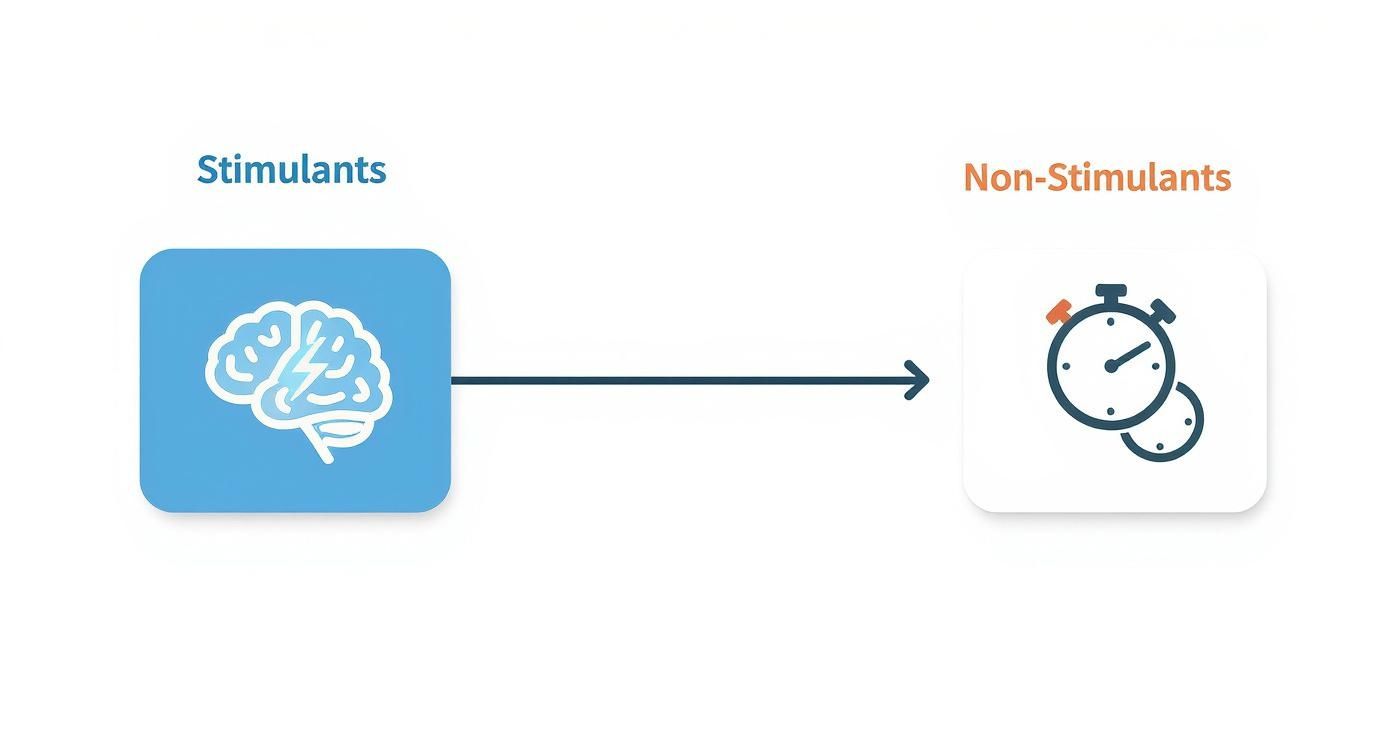
As you can see, stimulants tend to have a rapid effect, while non-stimulants build up their effectiveness over a longer period. This highlights the different pacing you can expect from each titration process.
What to Expect When You Begin
The process always kicks off with a very low dose of your prescribed medication. This "start low, go slow" approach is the bedrock of safe and effective treatment. It lets your body get used to the medication gradually, which massively reduces the chances of being hit with overwhelming side effects right at the start.
Over the next few weeks, your prescribing clinician will guide you as you slowly increase the dose in small steps. This isn't a race; the pace is set entirely by how you respond. This step-by-step method is crucial for finding what we call your optimal dose—that sweet spot where you get the maximum benefit for your ADHD symptoms.
Titration is a process of discovery. It’s not just about finding a dose that 'works,' but about finding the dose that works best for you, enhancing your quality of life without introducing disruptive side effects.
Your Role in the Titration Process
This journey is a partnership between you and your clinical team, and your feedback is the most important piece of the puzzle. During titration, you’ll need to become an observer of your own experience, monitoring how you feel day-to-day. Autistic individuals can sometimes have different interoceptive awareness (the sense of the internal state of the body), so finding a tracking method that works for you is key.
You'll usually be asked to track a few key things, often in a simple diary or log:
- Symptom Changes: Have you noticed any improvements in focus, impulsivity, or organisation? When did you feel the medication kick in? How long did the positive effects last?
- Side Effects: Keep a note of any unwanted effects, like sensory sensitivity changes, reduced appetite, or trouble sleeping. Jot down when they happen and how intense they feel.
- Overall Well-being: Pay attention to your mood, energy levels, and your general sense of wellness.
This detailed feedback is gold dust. It gives your psychiatrist the precise information they need to make smart decisions about your treatment plan, whether that means tweaking the dose, trying a different release formula, or even switching to another type of ADHD medication for adults in the UK.
How Long Does Titration Take?
The honest answer is: it varies. For some people, finding the right dose of a stimulant medication can be sorted in as little as four to six weeks. For others, especially if you're trying a non-stimulant or need to test a different medication, the process might take a few months.
Patience is key during this phase. Rushing things or making big jumps in dosage can lead to unnecessary side effects and make it much harder to pinpoint your true optimal dose. Once you and your clinician agree that you've found that 'just right' level, you'll move onto a stable, long-term prescription. This stable dose is what allows for a Shared Care Agreement to be set up with your GP for ongoing NHS prescriptions, making your treatment sustainable for the long haul.
Choosing Your Path: NHS vs Private Assessment
If you're an adult in the UK seeking an ADHD and/or Autism diagnosis and medication, you'll quickly find yourself at a crossroads. There are essentially two main routes you can take: the NHS or the private sector. It’s not just a simple choice; it’s a decision that involves a very real trade-off between time, cost, and how quickly you can get help. Understanding the nuts and bolts of each pathway is the first step to making the right choice for you.
For most people, the journey starts with a chat with their GP. This is a crucial first step, no matter which path you end up taking. Your GP can listen to your concerns, discuss your symptoms, and if appropriate, refer you to a specialist service for a proper assessment.
The NHS Pathway Explained
Going down the NHS route means all your care is funded by the public health system. Once your GP makes a referral, you’re put on a waiting list for a specialist adult neurodevelopmental service. And this, right here, is where the biggest challenge lies.
The waiting times for an NHS assessment can be staggering. We're not talking weeks; we're talking many months, and often, several years. This delay is a massive hurdle and can be incredibly disheartening when you’re struggling with unmanaged symptoms every single day.
It's a frustrating reality. Experts estimate that 2.5% to 5% of UK adults have ADHD, yet there's a huge gap in support. A shocking 15% or so of adults with the condition are actually getting medication, a far cry from the 70–90% who could really benefit from it. The problem is made worse by a postcode lottery and assessment queues that can drag on for two years or more. You can dive into the full findings in this in-depth NHS ADHD Taskforce report.
If you can navigate the wait, your assessment, diagnosis, and medication titration are all covered. But that initial wait is the mountain you have to climb first.
The Private Pathway Alternative
For many, waiting years for help just isn't an option. This is where private healthcare comes in, offering a much faster route. By choosing a private provider, you can often get an assessment within weeks, not years. This lets you sidestep the long NHS queues and get the support you need much sooner, which is particularly vital when dealing with the complexities of co-occurring conditions like ADHD and Autism.
Of course, the trade-off for this speed is cost. You’ll have to pay for the initial assessment, the titration process (finding the right medication and dose), and the private prescriptions during this time. The costs can add up, but for many, it’s an investment worth making to get their life back on track.
Bridging the Gap: The Shared Care Agreement
So, how do you balance the speed of private care with the long-term affordability of the NHS? This is where a vital tool called a Shared Care Agreement (SCA) comes into play.
An SCA is a formal arrangement between your private specialist and your NHS GP. Once you’ve been through the private titration process and are settled on a stable, effective dose of medication, your specialist can propose an SCA to your GP.
If your GP agrees, they can take over writing your repeat prescriptions. This is a game-changer, as it means you’ll only pay the standard NHS prescription charge going forward. This hybrid model gives you the best of both worlds: you get timely help from the private sector, then transition to more affordable ongoing care through the NHS. At Insight Diagnostics Global, our consultants are experienced in guiding you through this process, including providing options for private prescriptions online while we work with you towards a stable medication plan.
NHS vs Private: A Direct Comparison
To lay it all out clearly, it helps to see the two pathways side-by-side.
NHS vs Private ADHD Assessment and Medication Pathways
| Feature | NHS Pathway | Private Pathway |
|---|---|---|
| Assessment Speed | Very slow. Waiting lists often last for years. | Very fast. Assessments are typically available within weeks. |
| Initial Cost | Free at the point of use. | Self-funded. You pay for the assessment and titration. |
| Medication Cost | Covered by NHS prescription charges from day one. | Initially self-funded until a Shared Care Agreement is approved. |
| Choice of Clinician | Limited choice; you are assigned to your local service. | You can choose your provider and specialist based on their expertise, including those skilled in diagnosing AuDHD. |
| Long-Term Plan | All ongoing care and prescriptions are managed within the NHS. | The goal is a Shared Care Agreement to move prescription costs to the NHS. |
Ultimately, there’s no single "right" answer. The choice between the NHS and a private pathway is deeply personal. It comes down to weighing up your immediate needs, your financial situation, and how long you feel you can wait for support.
Managing Side Effects and Ensuring Safety

Let’s be honest: the idea of side effects can be a bit daunting when starting a new medication. When it comes to ADHD medication for adults in the UK, it's crucial to have a realistic understanding of what you might experience and, more importantly, how your clinical team works to keep you safe every step of the way.
The goal is never to just ignore side effects or expect you to "put up with" them. It’s all about active, collaborative management, especially during the titration phase while your body gets used to the treatment. This is a partnership.
Think of it like breaking in a new pair of walking boots. They might feel a bit stiff or rub at first, but with a few adjustments and a little time, they mould to your feet and become incredibly supportive. Finding the right medication balance is a very similar process of making small, guided tweaks until it feels right.
Common Side Effects and How We Handle Them
Most side effects that pop up with ADHD medications are mild and often fade as your body adjusts. They're also completely expected, which means your psychiatrist already has a plan in place to monitor and manage them right from the start. It is important to note that autistic individuals may be more sensitive to medications, making careful monitoring even more crucial.
Here are some of the most common things people notice initially:
- Reduced Appetite: It's quite common to not feel as hungry, particularly around lunchtime. A good tip is to have a protein-rich breakfast before taking your dose and plan for a more substantial evening meal.
- Trouble Sleeping: Stimulants can be activating, so if they're taken too late, they can mess with your sleep. The simplest and most effective fix is nearly always to take your medication first thing in the morning.
- Dry Mouth: A frequent and easily managed side effect. Simply keeping a water bottle handy and staying hydrated throughout the day usually does the trick.
- Increased Heart Rate or Blood Pressure: You might notice a slight, temporary increase in these vitals as your body first reacts to the medication.
This is precisely why we don't just hand you a prescription and send you on your way. Close, continuous monitoring is an essential, non-negotiable part of your treatment. Your clinical team will be in regular contact to check in, see how you're feeling, and make any adjustments needed.
The key thing to remember is that you are not on your own with this. Side effects are a normal part of the initial process, and your clinical team has tried-and-tested strategies to manage them, ensuring your treatment is as safe as it is effective.
The Importance of Ongoing Safety Checks
Because stimulant medications can have an effect on the cardiovascular system, your physical health is always the top priority. This isn't just a one-time check at the beginning; it's an ongoing part of your care plan.
Before you even begin treatment, your psychiatrist will carry out a full health assessment. This monitoring continues throughout titration and for as long as you're on the medication.
Routine safety checks will typically involve:
- Blood Pressure Monitoring: Regular checks to make sure your blood pressure stays within a healthy range.
- Pulse Rate Checks: We'll monitor your heart rate to ensure it isn’t staying elevated.
- Weight Monitoring: Keeping an eye on your weight helps us make sure any appetite changes aren't leading to unhealthy weight loss.
These straightforward checks give your psychiatrist the information they need to be confident that the medication is working safely for you. Your input is vital here, too. If you ever notice anything that feels off or have a concern, letting your clinician know straight away means they can step in and help. It's this teamwork that makes the journey to better focus a safe and successful one.
How to Start Your Journey to Diagnosis and Treatment
Deciding you're ready to explore a diagnosis is a massive step. It can feel a bit daunting, so let's break down exactly what to do next, making the whole process feel clearer and more manageable.
Your journey, whether you go through the NHS or choose a private route, almost always starts with a chat with your GP. This is your crucial first port of call. To get the most out of that appointment, it really helps to do a bit of prep work beforehand.
Preparing for Your Appointment
Walking into your GP's office with a few notes can make all the difference. Try to think of concrete, real-life examples where you feel neurodivergent traits are getting in your way – at work, at home, or in your relationships.
Here are a few things to jot down:
- Life-long patterns: Can you recall examples from your school days or childhood that sound a lot like ADHD or Autism? Think school reports mentioning being "a daydreamer," "fidgety," or "in their own world."
- Current impact: Be specific about how things are now. Are you struggling to meet deadlines at work? Is managing household finances a constant battle? Do you experience sensory overload or social exhaustion?
- Co-occurring challenges: It’s not uncommon for ADHD to exist alongside Autism. If you suspect this might be you, it’s really important to bring it up. Our specialists are experienced in the complexities of co-occurring conditions. You can find out more about our Autism assessment in the UK here.
Seeking support is not a sign of weakness. It’s a proactive and powerful move towards taking control of your well-being. Your experiences are valid, and being able to explain them clearly is the first real step to getting the help you need.
Choosing Your Expert-Led Pathway
At Insight Diagnostics Global, our assessments are led by experienced consultants who provide a supportive, expert-driven path for adults. We really get the nuances of ADHD and Autism, which means we can offer a thorough evaluation that results in a clear, personalised treatment plan.
It's also worth knowing about things that are out of our control but can impact treatment, like medication availability. You might have heard that the UK has faced shortages of key ADHD medications recently. This is down to a mix of global demand and supply chain problems, which has understandably created a lot of stress for patients. This situation just underscores why having expert clinical guidance is so important for managing your care and finding alternatives if needed. Our team keeps a close eye on the situation to help you navigate it all.
Frequently Asked Questions
When you're starting out with ADHD medication, it's completely normal to have a lot of practical questions. Let's walk through some of the most common ones we hear from adults in the UK.
Can I Drink Alcohol While Taking ADHD Medication?
This is something you absolutely must discuss with your psychiatrist. Alcohol is a depressant, and it can really mess with how your medication works, sometimes making side effects worse.
With stimulants, for example, the alcohol can blunt the medication's effects, which might lead you to drink more than you realise. It's all about your personal health, the specific medication you're on, and your dose, so get personalised advice from your clinician before you even consider it.
Do I Have to Tell the DVLA I Am Taking ADHD Medication?
Here's the rule of thumb: you're legally required to tell the DVLA if your ADHD itself affects your ability to drive safely.
If your medication gets your symptoms under control and doesn't cause any new issues that impair your driving (like serious drowsiness), you may not need to declare the medication itself. The key is declaring the condition if it impacts your driving. The best advice is always to check the official DVLA guidelines and have a frank conversation with your doctor.
What Happens If I Want to Get Pregnant?
Planning a family is a huge life step, and it requires a careful, in-depth conversation with your ADHD specialist. Some medications just aren't recommended during pregnancy or while breastfeeding because of the potential risks to your baby.
Your team will help you weigh everything up – the benefits of staying on your medication versus the risks of stopping – so you can make a properly informed decision that's right for you. For a deeper dive, you can explore our full ADHD FAQs for adults.
Can My GP Prescribe My ADHD Medication?
Not at first. The initial prescription and the whole titration process have to be handled by a specialist, usually a consultant psychiatrist. This is because getting the dose right requires expert monitoring.
But once you're on a stable and effective dose, there’s a great system in place. Your specialist can set up a 'Shared Care Agreement' with your GP. If your GP agrees to it, they can then take over writing your repeat prescriptions on the NHS, which makes managing your long-term treatment much simpler.
Ready to take the next step towards clarity and support? The consultant-led team at Insight Diagnostics Global provides comprehensive online assessments for ADHD and Autism, along with expert medication titration services. We are here to guide you with clinical expertise and compassionate care. Visit us at https://insightdiagnostics.co.uk to learn more and book your initial consultation.