
Navigating the world of private ADHD and Autism assessments can feel a bit like wading through fog, especially when it comes to costs. The figures you see can vary wildly, so let's clear things up. In the UK, you should generally budget for a private ADHD and Autism assessment to be somewhere between £800 and £2,500. The final price tag depends on a few things, like the clinic you choose, the seniority of the clinician, and just how in-depth the evaluation needs to be, especially if multiple conditions are being considered.
It's important to remember this isn't just for a one-off chat; it's an investment in a thorough diagnostic journey for neurodevelopmental conditions.
Your Guide to Private Neurodevelopmental Assessment Costs
Getting your head around the financial side of a private assessment is often the first real step towards getting help. This isn't your standard GP visit. A better way to think about it is like commissioning an architect for a detailed structural survey of a house. You're not just paying for a quick look around; you're paying for an expert's dedicated time, their specialised tools, and a comprehensive report that acts as a blueprint for what comes next.
The whole process is designed to be meticulous. It has to be, to make sure the diagnosis for conditions like ADHD and Autism is accurate and takes every part of your life into account. For many people, the painfully long NHS waiting lists make the private route the only practical way to get a timely diagnosis and start treatment. The cost simply reflects the significant amount of clinical time and resources needed to do the job properly.
Understanding the Average UK Costs
So, what should you actually expect to pay? Recent data gives us a pretty solid benchmark for ADHD assessments, which are often a starting point for exploring neurodiversity. The chart below shows the typical cost for both adult and child assessments in the UK, which should help you set a realistic budget.
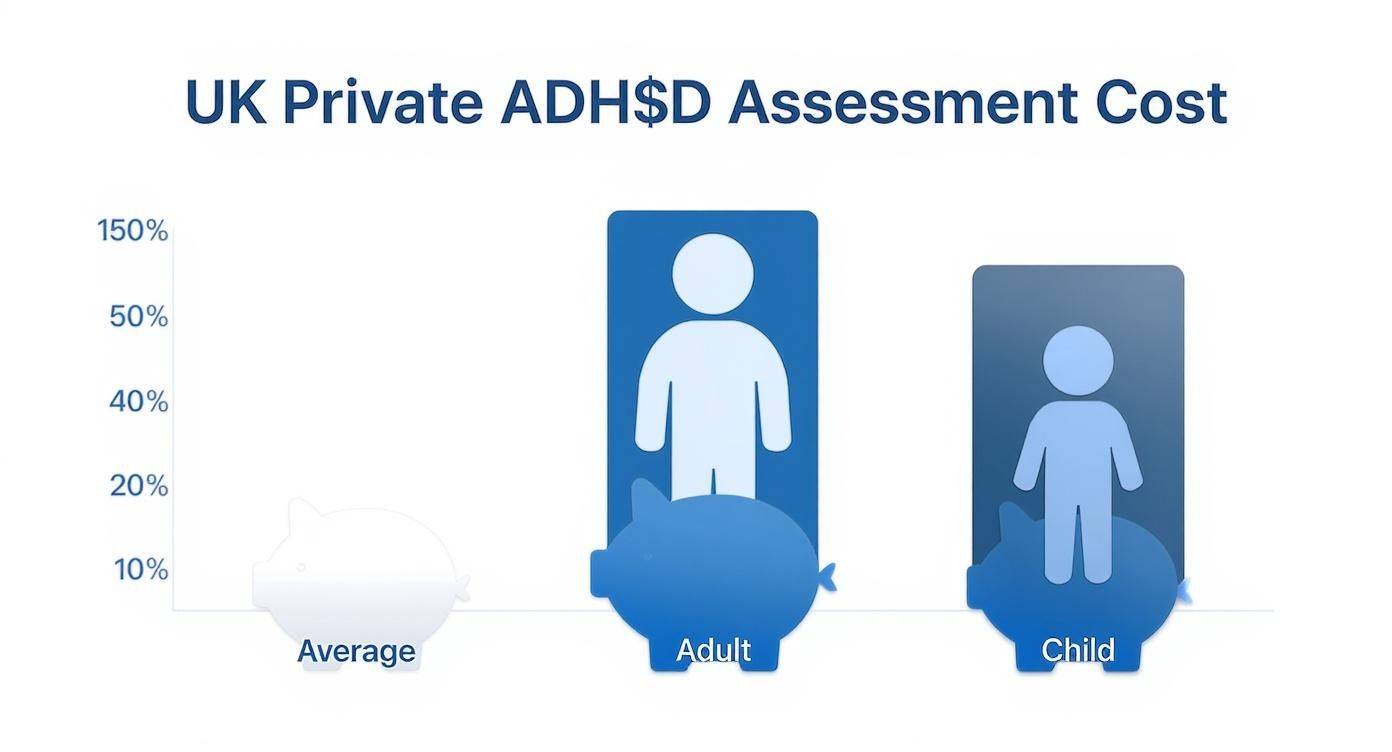
As you can see, assessments for children often come in a little higher. This is usually because they involve more complexity, like gathering detailed information from schools and parents, which takes extra time, particularly when assessing for both ADHD and Autism.
A wide-ranging survey of 401 UK clinics found that the average cost of a private ADHD assessment was £1,267. Breaking that down, adult assessments came in at an average of £1,200, while assessments for children averaged £1,361. This gives you a reliable baseline for budgeting. If you're interested in the details, you can explore the full findings of the private ADHD assessment cost survey on myTribe Insurance.
To help you see exactly where that money goes, here’s a typical breakdown of the services included in that initial assessment fee.
Typical Private ADHD Assessment Cost Breakdown
The table below shows an estimated cost breakdown for the different stages of a private ADHD assessment process in the UK. These are typical ranges and can vary between providers. Combined ADHD and Autism assessments will cost more.
| Service Component | Average Cost Range (Adult) | Average Cost Range (Child) |
|---|---|---|
| Initial Assessment & Diagnosis | £800 – £1,500 | £900 – £1,800 |
| Medication Titration Period | £150 – £300 per month | £150 – £300 per month |
| Follow-Up Consultations | £100 – £250 per session | £120 – £280 per session |
| Private Prescriptions | £80 – £150 per month | £80 – £150 per month |
This breakdown helps illustrate that the initial assessment is just the first step. The ongoing costs for medication management (for ADHD) and follow-ups are also crucial to factor into your long-term budget.
So, what exactly are you paying for in that initial, larger fee? It usually covers several key stages:
- Initial Screening: A preliminary step to see if a full, in-depth assessment for ADHD, Autism, or both is the right path for you.
- Full Diagnostic Assessment: This is the core of the process, involving deep-dive interviews and clinical evaluations with a specialist.
- Collateral Information Gathering: The clinician will often need to speak with a family member or, for a child, review school reports to get a 360-degree view.
- A Comprehensive Report: You'll receive a detailed document that lays out all the findings, the final diagnosis, and clear recommendations.
- Feedback Session: A follow-up appointment is crucial for talking through the report, answering your questions, and planning the next steps together.
Hopefully, this initial overview makes it much clearer where your investment is going and helps you appreciate the real value behind the price of a private ADHD and Autism assessment.
Understanding What Your Assessment Fee Includes
When you first see the price tag for a private ADHD or Autism assessment, it's easy to think of it as a one-off charge for a single meeting. But that’s not really the whole story. You’re not just paying for an hour of a clinician’s time; you're investing in a thorough, multi-part process designed to build a complete and accurate picture of who you are.
Think of it like getting a full structural survey on a house you want to buy. The surveyor doesn't just poke a few walls and call it a day. They check the foundations, the wiring, the history—everything—to give you a report you can trust. A proper neurodevelopmental assessment is exactly like that: a deep dive into your life experiences, challenges, and cognitive patterns.
The Initial Clinical Stages
The journey usually starts well before you even sit down with a psychiatrist. It kicks off with a series of detailed screening questionnaires. These forms are absolutely vital for gathering the initial data on your symptoms, how severe they are, and the impact they have on everything from your career to your relationships.
Once the screening is done, you move on to the heart of the assessment: the diagnostic interview. This is a comprehensive, structured conversation with a specialist who will explore your entire history—developmental, medical, and family. To make sure the evaluation is robust and meets clinical standards, they'll use gold-standard diagnostic tools for both ADHD and Autism.
A crucial part of any solid assessment is gathering 'collateral information'. This just means getting insights from people who know you well, like a partner or parent. For younger adults, it could even mean looking at old school reports to see if a pattern of symptoms was present early on.
This 360-degree approach gives the clinician the full picture, which is essential for an accurate diagnosis. It's particularly important because conditions like Autism and ADHD can have overlapping traits that need careful untangling.
The Diagnostic Report and Feedback
The clinician's work doesn't stop after the interview. They then have to carefully analyse all the information they've gathered to arrive at a diagnosis before writing up a comprehensive report. This isn't just a quick letter; it's a detailed document that outlines the entire process, explains the clinical findings, and gives a clear diagnostic conclusion.
The final piece of the puzzle is the feedback session. This is a dedicated appointment where your clinician talks you through the report, explains what it all means, and discusses what comes next. This could involve recommendations for therapy, lifestyle changes, or medication for ADHD. The report itself is an incredibly useful document you can use to arrange workplace support or share with other healthcare professionals.
It's also worth remembering that while the assessment fee covers the diagnosis, it's a good idea to understand the potential cost of ADHD medications, as this will be a separate, ongoing expense.
What Factors Influence the Final Price?
When you start looking into the cost of a private ADHD assessment, you'll quickly see that the prices can vary quite a bit from one clinic to the next. This isn't just random pricing; a few key things directly shape the final bill. Getting your head around these variables helps you understand exactly where your money is going.
Think of it a bit like getting a custom-built piece of furniture. A simple pine stool isn't going to cost the same as a hand-carved oak dining table. The materials, the skill of the person making it, and how complicated the design is all come into play. The same logic applies to a diagnostic assessment.
Clinician Seniority and Expertise
One of the biggest factors affecting the price is who is actually doing the assessment. A diagnosis from a Consultant Psychiatrist—a medical doctor who has specialised in mental health—will almost always cost more than one from a Specialist Nurse or a Clinical Psychologist.
That price difference is down to their years of training and diagnostic authority. Consultant Psychiatrists, for example, are qualified to handle more complex cases involving multiple conditions like ADHD and Autism, and can prescribe medication right from the start, which brings an extra level of expertise to the whole process.
Case Complexity and Co-occurring Conditions
Not every assessment is a simple, open-and-shut case. Things can get a lot more complicated if you have other conditions happening at the same time, like Autism Spectrum Disorder (ASD), anxiety, or depression. For instance, telling the difference between overlapping symptoms of ADHD and autism takes a lot more clinical time and very specific diagnostic tools.
An assessment for someone with suspected ADHD and autism will almost always be more expensive than one for ADHD alone. That's because the clinician has to carefully untangle the symptoms to make sure the diagnosis for both conditions is spot on, which requires a much deeper dive.
Each extra layer of complexity adds time to the clinical interviews, the analysis, and the report writing, all of which gets factored into the final cost.
Scope of the Assessment Package
Finally, what's actually included in the assessment package will have a big impact on the price tag. Some clinics will quote a single fee just for the diagnosis, while others offer a more comprehensive package that bundles in follow-up services.
It’s so important to get clear on what's covered. The total cost is often broken down into different stages. You might see an initial screening starting at £300, with the full, in-depth assessment costing £1,450 or more. On top of that, there are often extra fees for support after the diagnosis, like medication titration, therapy, and follow-up appointments. This higher price reflects just how detailed the whole process is, often involving multiple sessions and standardised tools like the ACE assessment for ADHD or the ADOS-2 for Autism. To get a better handle on these costs, you can find more details about private clinic fees at ADHD and Autism Clinic.
Always make sure to ask any potential provider for a clear, itemised breakdown of their fees. It’s the best way to avoid any nasty surprises down the line.
Private Assessment vs NHS: A Cost and Time Comparison
Deciding how to get an ADHD or Autism assessment can feel like you're stuck at a crossroads. Down one path is the NHS route—free at the point of care, but often with a very long journey ahead. The other path is the private sector, which promises a much quicker, more direct route, but comes with a financial cost. The choice isn't just about money; it's a very real trade-off between what you can afford to pay and what you can afford to wait.
The NHS provides an absolutely essential service, and for many, its free assessments are the only feasible option. But this "free" route has a different kind of price tag: time. With demand soaring, waiting lists for an NHS neurodevelopmental assessment can stretch on for months, and in some parts of the country, it's not uncommon to wait for years.
This isn't just an inconvenience. That long wait can have a massive impact on your life, affecting everything from your mental health and relationships to your performance at work or university. The very issues that made you seek help in the first place don't just pause while you're on a list; they often get worse.
The Hidden Costs of Waiting
The non-financial price of a long wait can be huge. For a student, it might mean struggling through vital exams and academic years without the right support in place. For an adult, it could mean passed-over promotions, mounting stress at work, or even job instability. The emotional weight of living in limbo, feeling misunderstood, and battling daily challenges can be exhausting.
This is where going private really makes a difference. The number one reason people choose a private assessment is speed. Instead of waiting years, you can often be seen in a matter of weeks, get a diagnosis, and start getting the support you need almost immediately. That rapid access is often what's needed to stop the long-term negative impacts of waiting from taking hold. If you're curious about what this involves, our guide on the UK ADHD assessment process breaks down every step.
The core decision between NHS and private care often boils down to a single question: Can you afford to pay, or can you afford to wait? Both options have a "cost," but one is measured in pounds, while the other is measured in time, stress, and missed opportunities.
A Side-by-Side Look
To really see the differences, let's put the two pathways next to each other. The table below lays out the key distinctions, helping you weigh up the pros and cons based on what matters most to you right now.
Private vs NHS ADHD & Autism Assessment Pathways
| Feature | Private Pathway | NHS Pathway |
|---|---|---|
| Referral Process | Self-referral is standard; no GP visit needed. | Requires a GP referral to a specialist service. |
| Waiting Times | Typically very short, often a matter of weeks. | Can be extremely long, from many months to several years. |
| Financial Cost | Requires an out-of-pocket payment for the assessment. | Free at the point of service, funded by the taxpayer. |
| Choice of Clinician | You can often choose your specialist or clinic. | You are usually assigned to the next available specialist. |
| Flexibility | Appointments are often more flexible, with evening or weekend slots. | Less flexibility; appointments are set by the service. |
Ultimately, looking at this comparison should give you a clearer picture of which route aligns best with your personal circumstances, your budget, and, crucially, your immediate needs.
How to Choose the Right Private Clinic
When you decide to invest in a private assessment for ADHD or Autism, you're putting a huge amount of trust in your chosen clinic. It's a big step, and you need to be sure you're in safe hands. After all, a good diagnosis should open doors to support, not create new obstacles.
The absolute first thing you should do is check the clinician's credentials. It sounds basic, but it’s the most important check you’ll make. Any psychiatrist involved in a diagnosis must be on the General Medical Council (GMC) Specialist Register. If you're seeing a psychologist, they need to be registered with the Health and Care Professions Council (HCPC). A quick search on their websites takes only a minute and gives you immediate peace of mind.
Vetting a Clinic’s Process and Reputation
Next up, dig into their assessment process. A good clinic will be completely open about how they work and should be following the National Institute for Health and Care Excellence (NICE) guidelines. This isn't just a box-ticking exercise; it's what ensures your diagnosis is robust and will be recognised by your GP, especially if you need a shared care agreement down the line.
Patient reviews can give you a feel for a place, but you need to learn how to read them properly. Look past the five-star ratings and hunt for detailed comments about the whole journey—from the first phone call to the final report and any follow-up support. A string of thoughtful, balanced reviews tells you a lot more than a few generic "great service!" comments. Many people also need a combined diagnosis, and you can get a clearer picture by reading our guide to the private autism assessment cost and what’s involved.
A high-quality diagnostic report is the cornerstone of your assessment. It should be comprehensive, clear, and based on established clinical standards. This document is what you will use to access support from employers, educational institutions, and the NHS.
Questions to Ask Before You Commit
Don't be afraid to ask direct questions before you part with any money. A reputable provider will expect you to do your homework and will be happy to answer.
Get your list ready and ask them things like:
- Who exactly will be conducting my assessment? Get their name and check their qualifications.
- What, specifically, is included in the fee? You want a clear breakdown of the assessment, the report, the feedback session, and any follow-up appointments.
- What is your approach to assessing co-occurring conditions like autism?
- Will the report you provide be suitable for an NHS shared care agreement?
Asking these questions puts you in control. It helps you make a truly informed choice, ensuring the private adhd assessment cost delivers a credible diagnosis that genuinely helps you move forward.
Frequently Asked Questions About Private Assessments
As you get closer to booking an assessment, a few practical questions almost always crop up. Getting these sorted will help you feel much more confident and clear about what to expect.
Can My GP Refuse a Shared Care Agreement?
Yes, they can. Your GP isn't obligated to accept prescribing recommendations from a private clinic for ADHD medication. Often, this refusal comes down to concerns about their own workload or perhaps not being familiar enough with the specific ADHD medications.
However, you can make it much more likely they'll say yes. The key is to provide them with a high-quality, NICE-compliant diagnostic report from a reputable, CQC-regulated clinic. A thorough and professional report gives your GP the clinical confidence they need to agree to the arrangement.
Is a Private Diagnosis Recognised Officially?
Absolutely. A formal diagnosis of ADHD or Autism from a qualified private specialist is 100% valid. Think of the diagnostic report as a legal document—because it is. You can use it to request reasonable adjustments at work or university.
It’s also the key that unlocks other support systems. For example, it allows you to apply for the government's Access to Work scheme, which can offer grants for workplace coaching or equipment to help you thrive in your role.
There's a common myth that a private diagnosis is somehow 'less than' an NHS one. This simply isn't true. As long as a registered specialist conducts the assessment and follows national guidelines, the diagnosis is equally valid and recognised everywhere.
Are There Cheaper Alternatives?
If the private adhd assessment cost is a real barrier, you do have a couple of other options to look into.
In England, the 'Right to Choose' pathway is a great middle ground. It lets you choose an approved private provider to carry out your ADHD or Autism assessment, but it’s funded by the NHS. You still have to join a waiting list, but it's often much shorter than the standard NHS one.
Another route is to check with local university psychology departments. Some run clinics that may offer assessments at a lower cost because they are part of their training programmes for doctoral students (under full supervision, of course).
At Insight Diagnostics Global, our focus is on providing clear, comprehensive, and CQC-regulated assessments for adults. We make sure your report meets the highest clinical standards, giving you the clarity and official documentation you need. Explore our ADHD and Autism assessment services to take the next step.