

Yes, you absolutely can manage ADHD and Autism without medication. The key is to build a personalised toolkit of behavioural strategies and lifestyle adjustments that work for your brain, not against it. This is especially true for those navigating the unique intersection of ADHD and Autism Spectrum Disorder (ASD), often called AuDHD. It's an approach that focuses on creating systems and routines to take the friction out of daily life and make executive function less of a struggle.
Your Toolkit for Managing AuDHD Without Medication
This guide goes beyond generic advice. We're going to get into the practical, real-world strategies that can make a genuine difference for adults managing both ADHD and autism. We’ll explore evidence-based therapies, powerful lifestyle changes, and organisational systems designed specifically for the neurodivergent mind.
It's crucial that we acknowledge the significant overlap between ADHD and Autism, as the best strategies will always honour the distinct needs of both conditions. For many, medication isn't the right path, or they prefer to combine it with other powerful methods. Learning how to manage ADHD without medication when you're also autistic is about empowering yourself with skills that will serve you for a lifetime. The journey starts with a fundamental shift in perspective: realising your brain isn't broken; it just processes the world differently.
Understanding the AuDHD Experience
When you have both Autism and ADHD (often called AuDHD), you're dealing with a unique set of challenges. It can feel like a constant internal tug-of-war. The ADHD brain craves novelty and stimulation, while the autistic brain thrives on predictability and routine. One moment you're desperate for a new hobby, and the next, you're retreating to the comfort of the familiar.
The goal isn't to 'fix' these competing drives but to find a balance. This means creating flexible routines that allow for spontaneous interests while maintaining a core structure that prevents overwhelm and burnout.
The Core Pillars of Non-Medication Management
Successfully managing AuDHD is a multi-faceted game. There’s no single magic bullet. Instead, it’s about building a supportive structure across different areas of your life.
Before we dive deep into specific methods, it's worth noting that getting a formal diagnosis is often a crucial first step. It provides clarity, validation, and a real foundation to build from. If you're exploring this option, getting information about the process of a private ADHD assessment in the UK can be incredibly helpful.
The strategies we'll cover in this guide all fall into several key pillars:
- Behavioural Therapies: Learning to work with your thought patterns and build practical, real-world skills.
- Lifestyle Foundations: Using sleep, nutrition, and exercise as natural regulators for your brain's chemistry and sensory needs.
- Environmental Design: Structuring your physical and digital spaces to support your executive functions and reduce sensory overwhelm.
- Interpersonal Skills: Navigating relationships and the workplace with greater understanding and self-advocacy.
Think of this as your roadmap—not a rigid set of rules, but a collection of powerful tools you can adapt to fit your life. The table below gives a snapshot of how these pillars connect to form a robust support system.
Core Strategies for Managing ADHD Without Medication
This table provides a quick overview of the key non-pharmacological approaches we'll be discussing. Think of it as a menu of options you can combine to create your personalised management plan, keeping both your autistic and ADHD traits in mind.
| Strategy Pillar | Primary Focus | Examples for AuDHD |
|---|---|---|
| Therapy & Coaching | Skill-building & reframing negative thoughts | Cognitive Behavioural Therapy (CBT), Neurodiversity-Affirming Coaching |
| Lifestyle Adjustments | Regulating energy, mood, and focus | Protein-rich diet, consistent sleep schedule, sensory-friendly exercise |
| Environmental Systems | Reducing cognitive load & externalising memory | Visual calendars, time-blocking, designated 'doom boxes', sensory-safe spaces |
| Relational Strategies | Improving communication & self-advocacy | Setting clear boundaries, scripting conversations, requesting accommodations at work |
Each of these pillars works in concert with the others. By strengthening one area, you'll often find it becomes easier to make progress in another, creating a positive cycle of change.
Building Skills with Therapy and ADHD Coaching
Trying to manage ADHD without medication isn't about brute-forcing your brain to be something it’s not. It’s about building a new set of skills to work with its unique wiring. This is where professional support, like therapy and coaching, can make a huge difference.
These approaches offer a structured, logical way to understand your own mind and develop practical strategies for everyday life. For many autistic adults with ADHD (AuDHD), that structured nature is especially effective. It provides the predictability and clarity needed to navigate a world that often feels overwhelmingly chaotic.
How Cognitive Behavioural Therapy (CBT) Can Help
Cognitive Behavioural Therapy, or CBT, is a goal-oriented therapy that zeroes in on the powerful connection between your thoughts, feelings, and actions. It’s not about endlessly digging into your past; it’s about giving you practical tools to change unhelpful patterns right now.
For adults with ADHD, CBT is fantastic for tackling the negative thought spirals that fuel procrastination and emotional overwhelm. For autistic individuals, it can help manage anxiety and reframe rigid or black-and-white thinking. Maybe you have an internal script that says, "I always mess this up, so why even bother starting?" CBT teaches you to catch that thought, challenge it, and reframe it into something more realistic and less paralysing, like, "This task feels big, but I can break it down into smaller steps."
Research from right here in the UK backs this up. A significant 2022 study by the University of Oxford found that after 16 weeks of CBT, 58% of adults with ADHD saw a clinically significant reduction in core symptoms like inattention and disorganisation. Even more telling, 70% of participants also reported real improvements in their day-to-day lives, from better time management to feeling less anxious.
Real-World CBT Exercises for ADHD
Forget abstract theory—CBT for ADHD is hands-on and practical. A therapist might guide you through specific exercises designed to interrupt the cycle of task avoidance.
One of my favourite techniques is "behavioural activation." If you're avoiding a huge project, your therapist won't just talk about why. They'll help you schedule a tiny, non-threatening first step—like just opening the document and writing a single sentence—and commit to only doing that.
That small action breaks the inertia and gives you a tiny dopamine hit, which makes the next step feel much more doable. For someone dealing with rejection sensitivity, CBT can also help build resilience by examining the evidence behind perceived social slights, helping you sort genuine criticism from misinterpretation.
What Is ADHD Coaching?
While therapy often addresses the emotional and cognitive sides of ADHD and autism, ADHD coaching is laser-focused on practical, real-world skills. Think of an ADHD coach as a personal trainer for your executive functions. They won't usually delve into deep-seated emotional issues, but they will work with you to create tangible systems for your life.
A coach can help you:
- Design a personalised planning system: Whether it's a digital app or a giant whiteboard, they help you find what actually sticks for your brain.
- Master time management: They can introduce you to techniques like time blocking or the Pomodoro method and help you adapt them so they work for you.
- Organise your environment: A coach can help you declutter your space and create logical "homes" for everything to reduce that constant daily friction.
For an AuDHD individual, a coach who understands both profiles can be a game-changer. They can help create routines that provide autistic stability while allowing for ADHD flexibility—a balance that's key to reducing burnout. Understanding the nuances between conditions is vital, and you can explore more about differential diagnoses to see why tailored support is so important.
A great coach doesn't give you a one-size-fits-all solution. They help you experiment and build a unique operational manual for your own brain, empowering you with skills that last a lifetime.
Finding the Right UK Professional
When you’re ready to seek support, it’s crucial to find someone who genuinely understands adult ADHD and, if it applies to you, the AuDHD intersection. Not all therapists or coaches are created equal.
When searching, look for practitioners in the UK who explicitly state they specialise in adult neurodiversity. Check their credentials with organisations like the British Association for Counselling and Psychotherapy (BACP) or the UK ADHD Partnership (UKAP). During an initial chat, don't be afraid to ask about their specific experience with autistic clients who also have ADHD. Finding the right fit is the first step toward building a powerful toolkit for managing your life.
Creating a Lifestyle That Works With Your Brain, Not Against It

While coaching and therapy are fantastic for building skills, the real groundwork for managing ADHD without medication is laid in your daily life. The small choices you make every day—what you eat, how you move, and how well you sleep—have a huge impact on your brain’s chemistry, your energy levels, and your ability to focus.
The aim isn't perfection. It’s about building a supportive foundation that energises you instead of draining your already limited resources.
If you're managing both ADHD and autism (AuDHD), this foundation becomes even more critical. The right routines can give you the predictability your autistic side craves, while also satisfying your ADHD brain's constant need for stimulation. It’s a bit of a balancing act, but when you get it right, the reduction in daily overwhelm is profound.
Harnessing Movement for a Dopamine Boost
If your brain feels like it’s constantly searching for the next interesting thing, movement is one of the best ways to satisfy that need constructively. Exercise is so much more than a physical health tick-box; it’s one of nature’s most effective ways to increase dopamine and norepinephrine—the very same neurotransmitters targeted by many ADHD medications. A good dose of movement can sharpen your focus, lift your mood, and help you get a handle on impulsivity.
The secret, though, is to find something you actually like doing. Forcing yourself into a rigid, boring gym routine is a surefire way to burn out. The ADHD brain hates monotony, so think variety and novelty. For the autistic brain, consider sensory-friendly activities. This could mean swimming, solo hiking, or dancing in your living room with headphones—whatever feels good for both your mind and body.
This isn’t just a nice idea; the research backs it up. In the UK, exercise is increasingly recognised as a powerful non-medication strategy. A great study from the University of Exeter found that regular physical activity led to a 30% reduction in ADHD symptoms in children over a 12-week period. That’s a significant improvement in attention and impulse control, just from structured activity. Learn more about these important findings on ADHD and exercise.
Fuelling Your Brain The Right Way
What you eat has a direct and often immediate effect on your energy and concentration. For the ADHD brain, which is always on the hunt for a quick dopamine hit, sugary snacks and simple carbs are incredibly tempting. The problem is, they put you on a blood sugar rollercoaster: a sharp spike of energy followed by a massive crash that kills your focus and leaves you feeling irritable. This must also be balanced with autistic sensory needs, as many autistic people have specific food preferences or aversions related to texture and taste.
The goal is to aim for stable, sustained energy with foods you find palatable. Protein and complex carbs become your new best friends. They’re digested slowly, which prevents those dramatic energy spikes and troughs, giving your brain a steady supply of fuel to work with.
Here are a few simple swaps to get you started:
- For breakfast: Instead of sugary cereal, try eggs, Greek yoghurt with berries, or a protein smoothie. A solid start to the day makes a huge difference.
- For lunch: Swap a sandwich on white bread for one on whole grain, or go for a big salad with chicken or chickpeas.
- For snacks: Keep protein-rich snacks handy so you don't automatically reach for biscuits or crisps. Think nuts, cheese sticks, edamame, or beef jerky.
The key is to focus on adding the good stuff in, rather than just banning the "bad." Find 'safe foods' that are also nutritionally balanced. Try to get a source of protein into every meal and you’ll be amazed at the difference it makes to your focus and mood.
Solving the ADHD and Autism Sleep Puzzle
Sleep. For many with ADHD and autism, it’s a constant battle. Just as your head hits the pillow, your ADHD brain decides it’s the perfect time to review every decision you’ve ever made. At the same time, autistic sensory sensitivities can turn a peaceful bedroom into a minefield of tiny, irritating distractions.
It's a vicious cycle, because poor sleep makes every single ADHD and autistic trait worse—from focus and executive function to emotional regulation and sensory overload.
To tackle this without medication, you need to create a wind-down routine that actually works for your brain. This goes beyond just turning off your phone. It's about creating a predictable, sensory-friendly transition from 'on' to 'off'.
Consider these AuDHD-friendly sleep tips:
- Do a sensory audit: Is your bedding a bit scratchy? Is there a faint buzzing from a plug socket? Are your pyjamas too tight? Hunt down and eliminate these small sensory annoyances. A weighted blanket can also be a game-changer, offering a deep, calming pressure that soothes both the ADHD and autistic nervous systems.
- Perform a "brain dump": Keep a notepad by your bed. Before you try to sleep, spend ten minutes just scribbling down every thought, worry, or to-do list item bouncing around in your head. Getting it out onto paper gives your brain permission to let it go for the night.
- Create consistent bedtime cues: Build a short, simple, and repeatable routine that signals to your body that sleep is on its way. For the autistic brain, this predictability is deeply calming. This could be anything from brewing a specific herbal tea to listening to the same calm playlist. Consistency is far more important than complexity.
By being intentional about how you move, eat, and sleep, you're building a powerful biological foundation. This doesn't 'cure' ADHD or autism, but it makes every other strategy you use infinitely more effective.
Designing Your Environment for Success
Trying to manage ADHD without medication often feels like an uphill battle. But what if, instead of trying to force your brain to change, you changed the world around it? This is about shifting your focus from fighting executive dysfunction to creating an environment that supports your brain’s natural way of working. Think of it as building external systems that do the heavy lifting for your memory, focus, and organisation.
This approach can be a game-changer, especially for those with both Autism and ADHD (AuDHD). By setting up a predictable, low-demand, and logically organised space, you can dramatically cut down on the sensory overload and cognitive strain that makes daily life so exhausting. The real goal here is to build a supportive ecosystem that lets you save your mental energy for the things that actually matter to you.
It all comes down to making deliberate choices about where things live, how you see your tasks, and how you manage your time. You're essentially externalising the mental load so your brain doesn't have to carry it all.
Make Everything Visible
For the ADHD brain, the phrase "out of sight, out of mind" is a daily reality. If something isn't directly in your line of sight, it might as well not exist. This is exactly why hiding things away in drawers or complicated filing systems is a recipe for disaster. The solution? Make your most important information and tasks impossible to ignore, but in a way that doesn't create sensory chaos for your autistic side.
Think of it as creating an external hard drive for your brain. By using visual aids, you're outsourcing the job of remembering, which frees up your precious cognitive resources for thinking and problem-solving.
Here are a few practical ways to get started:
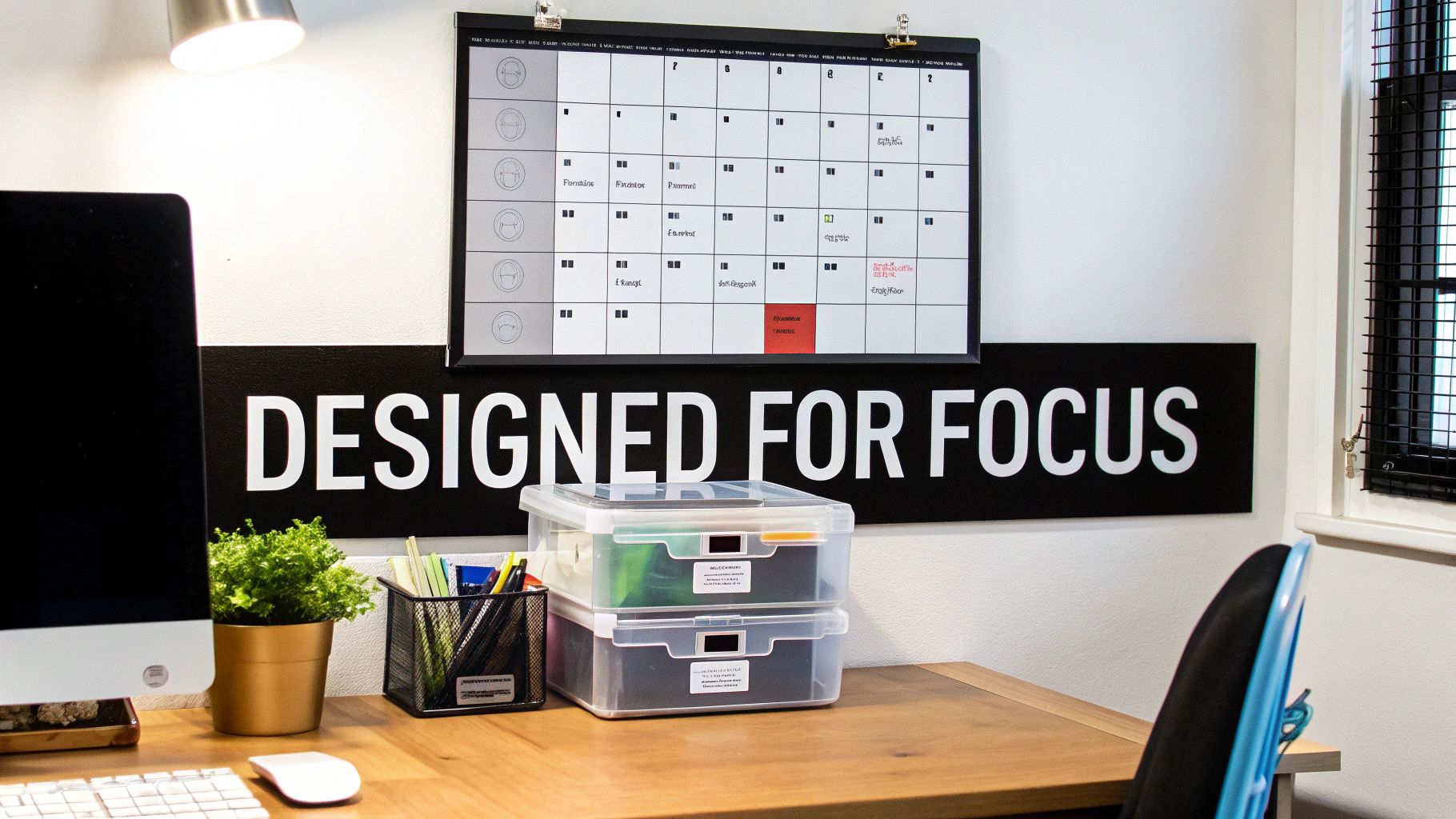
- Get a massive wall calendar or whiteboard. This becomes your mission control. Use it for appointments, deadlines, and reminders. Its sheer size makes it pretty hard to miss.
- Switch to transparent storage containers. Instead of opaque boxes where things go to be forgotten, use clear bins for everything from office supplies to snacks. You can see what you have at a glance without having to rely on your memory.
- Use sticky notes strategically. For urgent, single-step tasks, a sticky note on the bathroom mirror or the front door is a simple but incredibly effective prompt.
This isn't about creating more clutter; it's about curating visibility. By placing cues and reminders directly in your physical path, you build a system that nudges you into action, no longer relying on a memory that can sometimes let you down.
The Power of a Designated Home
Clutter is more than just a mess. For an autistic brain, it's sensory overload. For an ADHD brain, it's a physical pile of postponed decisions. That visual noise is incredibly draining. The "everything has a home" philosophy is one of the most powerful ways to fight back.
The rule is beautifully simple: every single item you own must have a specific, logical place where it belongs. Your keys don’t just get tossed "on the counter"; they go in a dedicated bowl by the door. Your phone charger doesn't live "somewhere in the living room"; it lives in a designated charging station.
This simple habit dramatically reduces the number of decisions you have to make each day. You no longer have to decide where to put something down or waste mental energy searching for it later. The decision has already been made, creating a routine that just flows.
Of course, life gets messy. This is where the "doom box" (or basket, or drawer) can be a true lifesaver. This is a single, designated container for all the random bits and pieces you don't have the energy to put away properly right now. It contains the chaos to one spot, helping you maintain a sense of order elsewhere until you have the capacity to sort through it.
Structuring Your Time for Focus
Just as you can structure your physical space, you can do the same with your time. A traditional, long to-do list can feel completely overwhelming—a daunting wall of text with no clear starting point. Time-based strategies, on the other hand, provide the structure and urgency needed to get things moving.
Two popular and genuinely effective methods are:
- Time Blocking: This is where you schedule your day in advance, assigning specific "blocks" of time to particular tasks. So, instead of a vague goal like "work on report," your calendar would have a block from 10 am to 11 am labelled "Draft introduction for Q3 report." It removes the guesswork and makes it far easier to just start.
- The Pomodoro Technique: This method uses a timer to break down work into short, focused sprints—traditionally 25 minutes—separated by short breaks. It’s brilliant for the ADHD brain because it provides a clear, finite endpoint for a burst of focus, followed by a little reward. This cycle helps you build momentum without burning out.
For AuDHD individuals, these structured time management techniques offer a comforting sense of predictability. Knowing exactly what you’re supposed to be doing at any given time can lower anxiety and make the day feel much more manageable. It’s about creating a supportive routine that works with your neurotype, not against it.
Thriving at Work and in Relationships
Let's be honest, managing ADHD and autism without medication isn't just about finishing your to-do list. It’s about feeling capable and connected in the two areas that define so much of our lives: our work and our relationships.
When you're dealing with executive dysfunction, emotional rollercoasters, and a communication style that’s different from the norm, both your career and your personal life can feel like walking through a minefield. This is especially true for those of us who are also autistic (AuDHD). The key isn't to force yourself into a neurotypical box—that's just a fast track to burnout. The real goal is to build environments where you can succeed as your authentic self.
Navigating the Workplace with ADHD and Autism
The modern workplace, with its unspoken social rules, sensory challenges, and constant demands on our focus and memory, can be incredibly tough. But it's important to remember you have rights. Here in the UK, the Equality Act 2010 legally classifies both ADHD and Autism as disabilities. This isn't about getting special treatment; it means your employer is required to make "reasonable adjustments" to help you do your job.
Knowing this is your first and most powerful step. It gives you the foundation to advocate for what you actually need to perform at your best.
Asking for What You Need (Reasonable Adjustments)
Bringing this up with a manager can feel intimidating, I know. But going in prepared can make a world of difference. You don't need to lay out your entire diagnostic history. The most effective approach is to focus on the practical challenges you face and suggest specific, simple solutions.
Here are a few common adjustments that can have a huge impact:
- Flexible Hours: Could you start earlier or later to work with your body's natural focus clock, not against it? This can be a game-changer for productivity.
- Noise-Cancelling Headphones: In a busy open-plan office, good headphones are less of a perk and more of an essential tool for managing auditory sensory input. They create a much-needed bubble of quiet so you can actually think.
- Getting it in Writing: Simply asking for important instructions or feedback via email gives you something concrete to refer back to. This supports both ADHD working memory and the autistic need for clear, unambiguous communication.
- A Quiet Corner: If your office has them, could you ask to be seated away from high-traffic areas or the coffee machine? A low-distraction, low-sensory spot can make all the difference.
When you have this chat, try framing it as a win-win. Something like, "I've noticed I do my best deep work when I have a solid block of quiet time. To get this financial report done right, would it be okay if I book a small meeting room for a couple of hours each morning?" This shows you're focused on the quality of your work, not just your own comfort.
Building Stronger Personal Relationships
ADHD traits can be so easily misunderstood by the people we love most. Your impulsivity might come across as carelessness. Your distractibility can feel like you're not interested in them. An emotional outburst can be deeply hurtful, even if you don't mean it to be. The bridge back to connection is almost always built with open, honest communication.
One of the toughest things to explain is Rejection Sensitive Dysphoria (RSD). It's that gut-wrenching, intense emotional pain that flares up from even the slightest hint of criticism or rejection. It’s not just "being overly sensitive"—it's a very real and overwhelming neurological response common in ADHD.
Explaining Your Experience to a Partner
Helping your partner understand RSD requires stepping away from blame. An analogy can be a really powerful way to make an abstract feeling more concrete. At the same time, explaining your autistic need for clear communication and downtime to recharge can prevent misunderstandings.
You could try saying something like this: "Imagine you accidentally touch a scorching hot pan. Your hand flies back automatically, right? It's a pure reflex. For me, a word that feels like criticism can trigger that same kind of instant, overwhelming emotional pain. It's not about what you did, but a painful reflex in how my brain is wired. It's also why I sometimes need very direct communication, or time alone to decompress from social and sensory input."
This shifts the conversation. Instead of "You hurt me," it becomes, "This is what happens inside my head." It invites curiosity and empathy instead of defensiveness, paving the way for finding better ways to talk and listen to each other.
Knowing When and How to Get More Support
Managing ADHD and Autism without medication is a constant process of learning, adapting, and fine-tuning what works for you. It's completely normal to hit a wall—to have days, or even weeks, where your go-to strategies just don't seem to cut it anymore.
This isn't a failure. Far from it. It's simply a signal that your needs might be shifting, and it could be time to explore another layer of support. Be kind to yourself; you're navigating a complex neurotype in a world that wasn’t exactly designed for the AuDHD brain. When that feeling of being perpetually overwhelmed won't budge, or your mental health starts to take a hit despite your best efforts, that’s your cue to reach out.
Recognising the Signs You Need More Help
Sometimes, it’s hard to see the wood for the trees. The slow, creeping nature of burnout can trick you into thinking you just need to "try harder," but that's a path that rarely leads anywhere good. Spotting the signs early means you can take action before you reach a crisis point.
Look out for these key indicators that your current toolkit might not be enough:
- Persistent Overwhelm: You constantly feel like you’re drowning in tasks and responsibilities. Your tried-and-tested organisational systems just aren't making a dent anymore.
- Worsening Mental Health: You've noticed a real spike in anxiety, a dip into depressive feelings, or your emotional reactions feel far more intense than usual and are affecting your daily life.
- Significant Life Impairment: ADHD and autistic traits are now causing serious friction at work, damaging your most important relationships, or impacting your physical health.
- Constant Exhaustion: You feel utterly drained, no matter how much you rest. This deep-seated fatigue is a classic sign of neurodivergent burnout.
This decision tree can help you map out what to do next, whether the challenges are cropping up at work or in your personal life.
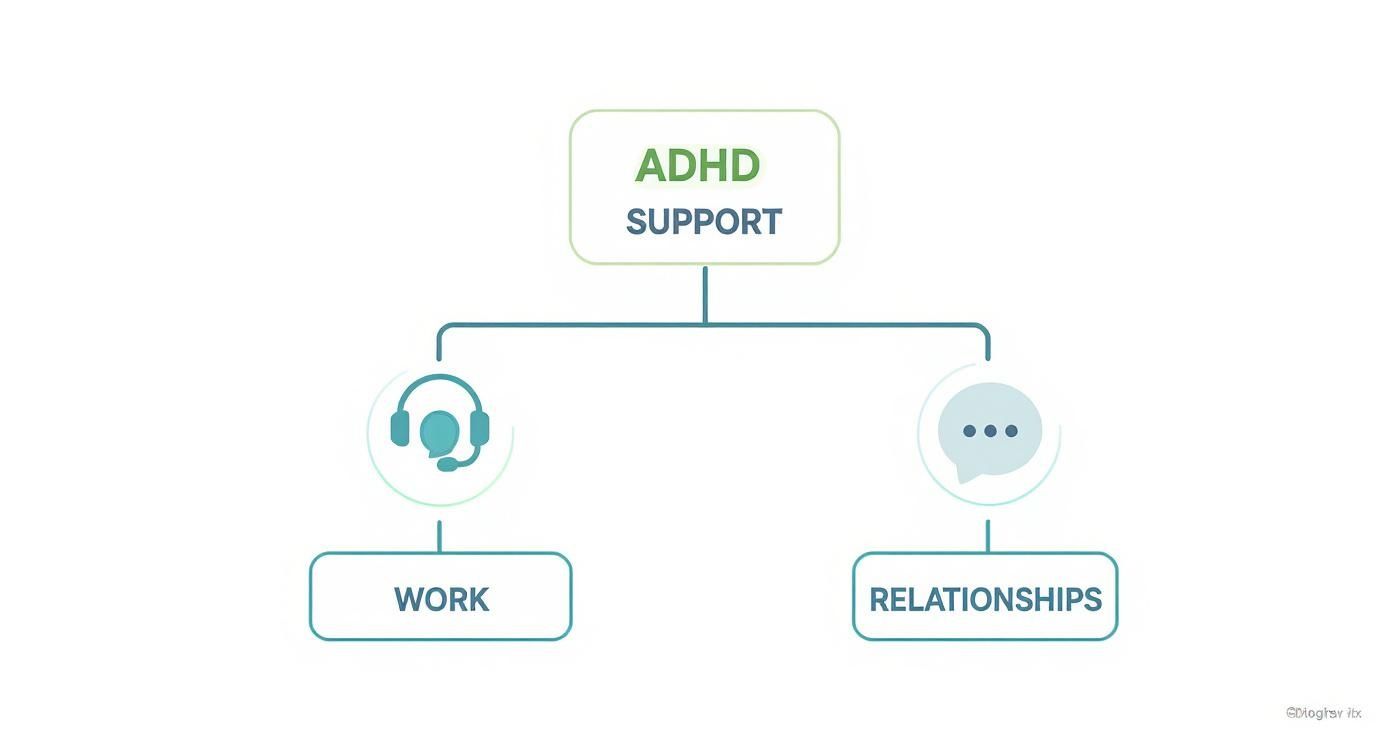
The real takeaway here is that you're not stuck. For every challenge, there's a practical support option waiting.
Navigating the UK Diagnostic and Support Pathways
If you haven't had a formal diagnosis yet, getting one can be the single most empowering step you take. It offers validation and, crucially, unlocks access to specialist support tailored to you. In the UK, you have two main routes to go down.
First, there's the NHS pathway. This journey typically starts with your GP, who can refer you to a local mental health team. It’s well-known that waiting lists can be long. However, thanks to 'Right to Choose' legislation in England, you can ask your GP to refer you to a qualified private provider that also holds an NHS contract. This can often slash the waiting time.
The alternative is a private assessment. This is a much faster route to getting a diagnosis and starting a support plan. While it comes with an upfront cost, the speed can be a lifeline for those who are really struggling in the here and now.
A formal diagnosis isn't the finish line; it’s the starting block. It marks the beginning of a new chapter where you can truly understand yourself and figure out which supports—whether that’s therapy, coaching, or even medication—are right for you. Even if you're committed to non-pharmacological strategies, knowing if medication is a viable tool for your toolbox is powerful. You can learn more in our guide to ADHD medication for adults in the UK.
Build Your Community
Perhaps most importantly, you don't have to figure this all out on your own. There is incredible power in connecting with other neurodivergent people. Peer support groups, whether online or local, provide a unique space to share experiences and trade tips with people who just get it.
UK-based charities like ADHD UK and the National Autistic Society are brilliant sources of information, from articles and webinars to directories of local support groups. Building this network isn't just a nice-to-have; it's a fundamental part of long-term well-being, reminding you that you’re part of a strong, vibrant, and resourceful community.
At Insight Diagnostics Global, we provide consultant-led, CQC-regulated online assessments for adults seeking clarity on ADHD and Autism. If you're ready to take the next step towards understanding your unique brain, find out how our expert team can support you at https://insightdiagnostics.co.uk.