

A private mental health assessment in the UK offers a direct and often much faster route to getting a diagnosis for neurodevelopmental conditions like ADHD and Autism, completely bypassing the long NHS waiting lists. For many adults, this means getting vital clarity and support in weeks rather than years – a crucial first step towards understanding themselves and getting the right help.
Why Choose a Private ADHD or Autism Assessment?
Have you ever felt like you’re just wired differently from everyone else around you? It’s a common feeling, and for a growing number of adults in the UK, it’s the starting point for exploring whether they might have a neurodivergent condition like Attention Deficit Hyperactivity Disorder (ADHD) or Autism Spectrum Disorder (ASD).
The journey to an official diagnosis, however, can be frustratingly long via the NHS. This is the single biggest reason why people turn to the private route. It’s less about 'skipping the queue' and more about gaining timely access to what can be life-changing answers. Waiting years for an ADHD or Autism diagnosis can take a real toll on your job, your relationships, and your mental health.
Navigating The Two Pathways
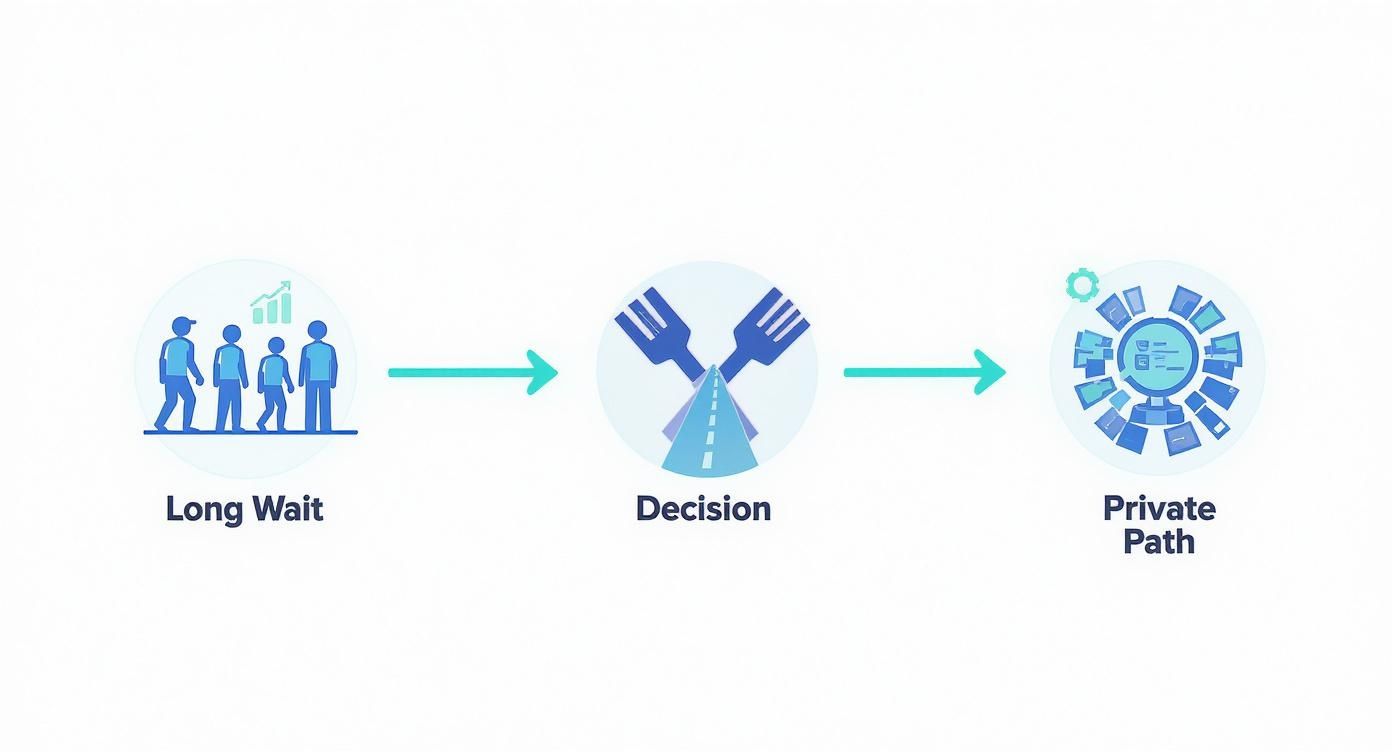
You can think of the NHS and private routes as two different ways to get to the same destination: a formal diagnosis for ADHD or Autism.
The NHS pathway is like the local bus service. It’s free and will get you there eventually, but it runs on a fixed timetable with lots of stops along the way. The journey can be very, very long. The private pathway, on the other hand, is like calling a taxi. It costs money, but it takes you directly where you need to go, and a lot faster.
This speed is especially important for adults who have spent their whole lives coping without a diagnosis, often building complex masks to hide their struggles. We dive deeper into this experience in our guide on getting an autism diagnosis in adults UK. A private assessment can validate these lifelong feelings much sooner, finally providing the 'why' behind years of challenges.
A private assessment is an investment in understanding yourself. It’s a structured, expert-led process designed to give you clear, actionable answers about ADHD or Autism without the prolonged uncertainty that often comes with the public health system.
Ultimately, the choice comes down to a balance of urgency, cost, and how much control you want over the process. The NHS provides an incredible service, but for those who need answers now, the private option is a focused and much quicker alternative for ADHD and Autism assessment.
NHS vs Private Assessment Pathways for ADHD and Autism
To really understand the differences, it helps to see the two pathways side-by-side. This table breaks down what you can expect from each route when seeking an ADHD or Autism diagnosis.
| Feature | NHS Pathway | Private Pathway |
|---|---|---|
| Waiting Times | Can be incredibly long, from many months to several years, depending on your local area. | Much shorter, often just a few weeks from your first enquiry to the assessment itself. |
| Referral Process | A GP referral is almost always mandatory to get on the specialist waiting list. | You can usually refer yourself directly, giving you immediate access to the clinic. |
| Cost | Free at the point of use, as it’s funded by the taxpayer. | You have to pay for it yourself, with costs varying by the provider and type of assessment. |
| Choice of Clinician | You are usually assigned to the next available specialist within the local trust. | You often have the freedom to research and choose the specific clinician you want to see. |
As you can see, the trade-off is clear: the NHS route is free but slow, while the private route is fast but comes at a cost. Neither is inherently better—it all depends on your personal circumstances and how urgently you need answers about potential ADHD or Autism.
Your Private Assessment Journey Step by Step
Taking the first step towards a private mental health assessment in the UK can feel a bit like planning a big trip. You know you want to get to a place of clarity and understanding, but the route can look complicated from the outside. Let's break down the whole process for an ADHD or Autism assessment into simple, manageable stages, so you know exactly what to expect.
Stage 1: The Initial Screening
Your journey doesn't start with a formal clinical test, but with a simple conversation. After you get in touch with a clinic, the first real step is what's called a pre-assessment screening. Think of this as the initial planning phase of your trip, where you figure out the best destination and what you'll need to pack.
You'll usually be asked to fill out some detailed questionnaires covering your symptoms, personal experiences, and your history from childhood. This gives the clinical team a solid starting point to see if a full assessment is the right next step for you, and whether the focus should be on ADHD, Autism, or possibly both.
This stage is all about gathering the groundwork. For example, they might ask you to dig out old school reports or have a chat with a parent or someone who knew you well as a child. For conditions like ADHD and Autism, which start in childhood, this historical context is incredibly important for the clinicians.
Stage 2: The Core Clinical Assessment
Once the screening stage confirms that a full assessment is needed, you move on to the main event: the core clinical interviews. This is where you'll sit down with your specialist—usually a psychiatrist or a highly qualified psychologist. The assessment itself isn't a single test, but more of a series of structured conversations designed to build a complete picture of you.
These interviews are incredibly thorough and might happen over one or two sessions. The clinicians use well-established, evidence-based assessment tools to make sure everything is robust and up to the standards set by national guidelines.
-
For an ADHD Assessment: A key tool you'll likely encounter is the DIVA-5 (Diagnostic Interview for ADHD in Adults). It's essentially a guided, in-depth conversation that works through the specific criteria for ADHD, exploring how things like inattention and hyperactivity have affected different parts of your life, both now and growing up.
-
For an Autism Assessment: Here, clinicians often use tools like the ADOS-2 (Autism Diagnostic Observation Schedule, Second Edition). This is a bit different; it involves some gentle activities and conversations that let the clinician see your social communication and interaction styles in a natural way. This is almost always paired with a deep dive into your developmental history.
It’s really important to know that these aren't tests you can pass or fail. They are a collaborative process to help understand your unique way of thinking and being.
Stage 3: The Report and Feedback
After the interviews and observations are done, the clinician's work isn't over. They take all the information they've gathered—from your questionnaires, the interviews, and any other sources—and carefully analyse it to reach a diagnostic conclusion. It’s like a detective piecing together all the clues to solve a case.
Your diagnostic report is more than just a label; it's a personalised user manual. It explains the 'why' behind your lifelong experiences and provides a detailed roadmap for moving forward with the right support and strategies for your ADHD or Autism.
The final step is your feedback session. This is a dedicated meeting where the clinician sits down with you to explain the outcome of the assessment. They'll go through the report in detail, answer any questions you have, and discuss what comes next. This could involve recommendations for therapy, coaching, medication options (for ADHD), or practical advice on things like workplace adjustments. You’ll leave not just with an answer, but with a clear plan in hand.
Understanding the Costs of a Private Assessment
Let's talk about one of the biggest questions on everyone's mind: the cost. When you decide to go down the private route for an ADHD or Autism assessment in the UK, it’s a financial investment. Unlike using the NHS, you'll be paying for the service directly, so getting a clear picture of the costs is a vital first step in planning your journey towards a diagnosis.
The demand for private assessments has shot up recently. Growing limitations within the NHS have pushed many people to look for alternatives. To put it in perspective, recent NHS data revealed that over 16,500 people were waiting more than 18 months for mental health treatment. Compare that to the 2,000 waiting that long for physical health care, and you can see the scale of the problem. As a result, private clinics have seen a 30–40% surge in enquiries, a clear sign of how urgently people need support. You can read more about these trends and what they mean for England's mental health services.
What Determines the Price of an Assessment
You've probably noticed that prices for private ADHD and Autism assessments can vary quite a lot between clinics. This isn't random; a few key factors directly influence the final figure. It’s a bit like commissioning a bespoke piece of furniture – the price depends on the complexity of the design and the skill of the person making it.
Several things contribute to the overall fee:
- Clinician Expertise: An assessment with a Consultant Psychiatrist, who can also prescribe medication, will typically cost more than one with a specialist psychologist. Their level of training and seniority is reflected in the price.
- Assessment Complexity: A relatively straightforward ADHD assessment will likely have a different price tag than a more involved Autism evaluation, which might use specific observational tools like the ADOS-2. If you need to be assessed for both conditions at the same time, that will also affect the cost.
- Report Detail: The fee nearly always covers the cost of writing up a detailed diagnostic report. A comprehensive, multi-page document that you can use for support at work or in education is a significant piece of clinical work, and that's factored into the price.
What Is Typically Included in the Fee
When you get a quote for a private assessment, it’s really important to ask what that number actually includes. A good, transparent provider will be upfront about what's in their package, which should cover all the essential parts of the diagnostic process.
The initial assessment fee is your investment in clarity. It typically covers the end-to-end diagnostic process, from the first clinical interview to the final, detailed report that explains your diagnosis and recommends next steps.
For both ADHD and Autism assessments, a standard fee usually gets you:
- Pre-assessment screening questionnaires and a review of your background information.
- All clinical interview sessions with the specialist.
- The creation of a comprehensive diagnostic report.
- A feedback session to go over the findings and give you a chance to ask questions.
It's worth noting, though, that some services can involve extra costs, especially for ADHD. For a closer look at the financial side of things, take a look at our detailed guide on the cost of a private ADHD assessment.
One of the most common additional costs is medication titration. This is the separate, ongoing process of working with a clinician to find the right type and dosage of ADHD medication for you. It isn't part of the diagnostic assessment itself and is billed as a separate service. The best advice? Always ask a potential provider for a complete breakdown of their fees so there are no surprises later on.
How to Choose a Reputable Assessment Provider

Trying to find the right place for a private ADHD or Autism assessment in the UK can feel like a daunting task. With the market growing so quickly, you've got more options than ever before. But that also means you need to be extra vigilant. The goal isn't just to find the fastest service, but to find a provider who is thorough, ethical, and properly qualified.
Think of it like getting a structural survey done on a house. You wouldn't hire just anyone; you'd want a certified surveyor with a great reputation who uses the right methods. Applying that same level of care to your mental health is absolutely crucial.
The private sector has seen a huge expansion. By 2024, the number of clinics offering these assessments had jumped by 25% compared to 2019, with over 1,200 registered providers now in operation. This has certainly helped bring down waiting times to an average of just 2–4 weeks. However, it’s also raised concerns about quality, as it's estimated that only around 60% of these clinics consistently follow national clinical guidelines. You can read more about the pressures and trends in UK mental health services to understand the full picture. This makes it more important than ever to know exactly what to look for.
Your Quality Checklist for Vetting Providers
To help you cut through the noise, it's best to use a straightforward checklist. These are the non-negotiables that separate a truly professional clinic from the rest, ensuring your assessment is robust and that your diagnosis will be taken seriously by other bodies, like your local NHS trust.
Here’s what you need to verify before making any commitments:
- CQC Registration: The Care Quality Commission (CQC) is the independent regulator for health and social care in England. CQC registration means a provider is regularly inspected for safety, effectiveness, and quality of care. It's the most basic hallmark of a legitimate service.
- Clinician Credentials: The experts conducting your assessment must be registered with their relevant UK professional body. For psychiatrists, that’s the General Medical Council (GMC); for practitioner psychologists, it’s the Health and Care Professions Council (HCPC). You can—and should—look them up online to check their status.
- Adherence to NICE Guidelines: The National Institute for Health and Care Excellence (NICE) sets the gold standard for diagnosing conditions like ADHD and Autism. Any reputable provider will be upfront about following these evidence-based guidelines in their assessment process.
The Importance of a Multidisciplinary Approach
For complex conditions like Autism, the very best assessments are often carried out by a multidisciplinary team (MDT). This simply means that more than one type of professional works together to form a conclusion.
For instance, an MDT might bring together a psychiatrist, a clinical psychologist, and maybe even a speech and language therapist. This collaborative approach provides a 360-degree view, making the final diagnosis far more reliable and comprehensive. It acts as a vital safeguard against any single clinician's potential bias and gives the final report far more weight.
A diagnosis is only as valuable as the report it's written on. A high-quality report is your key to unlocking support, whether that's from your GP, your employer, or your university. It needs to be detailed, clear, and evidence-based.
What Makes a Diagnostic Report Truly Useful
Once the assessment is complete, you’ll be given a detailed diagnostic report. This document is the culmination of the entire process, so its quality is everything. A vague or poorly structured report might be rejected by your GP for a Shared Care Agreement or dismissed by your workplace when you request reasonable adjustments.
So, what does a good report look like?
- A Clear Diagnostic Statement: It has to state clearly whether you meet the criteria for a condition, referencing the official diagnostic manual used (like the DSM-5).
- Detailed Evidence: The report must walk the reader through the evidence gathered—from interviews, questionnaires, and clinical observations—to show how the conclusion was reached.
- Personalised Recommendations: It should offer practical, tailored next steps. For an ADHD diagnosis, this could cover medication options and coaching. For Autism, it might suggest specific therapies or strategies for managing sensory issues.
- Clinician's Details: The report must be signed by the professional who assessed you, including their full name, qualifications, and their GMC or HCPC registration number.
By using this checklist and knowing what a high-quality outcome looks like, you can navigate your options with confidence and choose a provider who will deliver a truly valuable private mental health assessment in the UK.
So, You Have a Diagnosis. What Happens Next?

Getting a diagnosis for ADHD or Autism isn't the finish line. In many ways, it's the starting block for a new, much clearer chapter in your life. This new understanding of yourself is a powerful tool, but the next crucial step is figuring out how to use it. Now, the focus shifts from finding answers to taking real, practical steps that can make a genuine difference day-to-day.
It can feel like a lot to take in at first, but you can break it down into smaller, more manageable pieces. Your main priorities will likely be getting your diagnosis officially recognised, accessing any medical support you need, and learning how to get the right support at work or university. It’s all about building a framework that works for you.
Getting Your Diagnosis Recognised by the NHS
One of the first questions people ask after a private mental health assessment in the UK is, "Will the NHS accept this?" The short answer is that in most cases, yes, a diagnosis from a reputable private provider who has followed NICE guidelines will be recognised by your GP. It all comes down to the quality and thoroughness of your diagnostic report.
However, recognition doesn't always mean the NHS can take over your care straight away. This is especially true for ADHD medication, which involves something called a Shared Care Agreement (SCA).
A Shared Care Agreement is basically a formal arrangement between your private specialist and your NHS GP. It’s what allows your GP to start issuing your prescriptions on the NHS once the private clinic has found the right medication and a stable dose for you.
For your GP to agree to an SCA, they need to have full confidence in your private diagnosis. They'll want to review your report and see that the assessment was robust and comprehensive. This is precisely why choosing a CQC-regulated provider with GMC-registered specialists from the very beginning is so critical.
Understanding Your Rights at Work and University
A formal diagnosis isn't just a label; it’s a key that unlocks legal protections and practical support. Under the Equality Act 2010, conditions like ADHD and Autism are typically considered disabilities. This means you are legally entitled to what’s known as reasonable adjustments.
These aren't about getting special treatment. They are simply necessary changes to the environment or working practices that ensure you have the same opportunity to succeed as anyone else. While it’s your choice whether to tell your employer or university, doing so is what enables you to access this support.
Common examples of reasonable adjustments include:
- For ADHD: Things like flexible working hours, being moved to a quieter desk to reduce distractions, or being allowed to use noise-cancelling headphones. It could also mean getting important instructions in writing instead of just verbally.
- For Autism: This might involve managers using clearer, more direct communication, giving you plenty of advance notice before a change in routine, or making adjustments to sensory triggers like harsh office lighting.
Your diagnostic report is the official evidence you can use when you have these conversations with your HR department or university student support team.
Building Your Post-Diagnosis Support System
While medical and workplace support are essential pillars, don't overlook the importance of personal and emotional support. A diagnosis opens up a whole new world of resources designed specifically for neurodivergent adults.
Your journey from here might involve exploring:
- Specialist Coaching: ADHD and Autism coaches are brilliant at helping you develop practical, real-world strategies for managing things like executive function, timekeeping, and organisation.
- Therapy: Therapies such as Cognitive Behavioural Therapy (CBT) can be adapted to help with common co-occurring conditions like anxiety or depression, which often go hand-in-hand with ADHD and Autism.
- Peer Support Groups: There is immense power in connecting with other people who just get it. Online forums and local meet-up groups provide a safe space to share experiences and trade tips with people who have walked a similar path.
For those with an ADHD diagnosis who are starting medication, getting to grips with prescriptions is a key part of the process. You can learn more about managing private prescriptions online to keep your treatment running smoothly. By embracing these resources, you can move from just having a diagnosis to truly thriving with it.
Common Questions About Private Assessments
It’s completely normal to have a few questions still buzzing around, even after getting a good overview. Deciding to get a private mental health assessment for ADHD or Autism is a big step, and you want to feel sure about it before you move forward. Let's tackle some of those common "what ifs" and "how does this work" questions head-on.
Think of this as our final Q&A session. I've pulled together the most frequent queries people have at this stage, with the aim of giving you clear, straightforward answers. The goal is to iron out any last wrinkles of uncertainty, so you can make your next move with confidence.
Will My GP and the NHS Actually Accept a Private Diagnosis?
This is probably the biggest question on everyone's mind, and rightly so. The short answer is: yes, usually. But there's an important "if" attached. A private ADHD or Autism diagnosis from a reputable clinic will almost always be accepted by your GP, if the assessment was done properly.
For the diagnosis to hold water, it needs to have been carried out by a fully qualified clinician – think a psychiatrist on the GMC Specialist Register or a psychologist registered with the HCPC. It also has to follow the national rulebook, the official guidelines from the National Institute for Health and Care Excellence (NICE). This is exactly why that detailed diagnostic report is so crucial; it's the proof that everything was done to a high standard.
That said, it's not a 100% guarantee. Some NHS trusts have their own local policies, and a GP might want to give the report a thorough read-through before agreeing to a Shared Care Agreement for medication. The smartest thing you can do is talk to your GP before you book anything. A quick chat to check their stance can save a lot of hassle down the line.
Can I Use My Private Medical Insurance to Cover the Cost?
Whether your insurance will foot the bill really comes down to the fine print of your policy. To be blunt, many standard insurance plans specifically exclude assessments for neurodevelopmental conditions like ADHD and Autism. It's a common frustration.
However, some of the more comprehensive corporate or high-level personal plans might provide full or partial cover. The only way to know for certain is to pick up the phone and speak to your insurer before you commit to an assessment.
Make sure you get written confirmation from your insurance provider detailing exactly what’s covered. You need to know if it includes the initial assessment, any follow-ups, and—this is a big one for ADHD—the costs of medication titration. Getting it in writing prevents any nasty financial surprises.
What’s the Difference Between an ADHD and an Autism Assessment?
While both are looking into neurodevelopmental conditions, they are hunting for different things and use different tools. They might feel similar in some ways, but the focus of each is quite distinct.
-
An Adult ADHD Assessment: This process zeros in on the core traits of inattention, hyperactivity, and impulsivity. Clinicians use structured interviews like the DIVA-5 and various rating scales to map out how these symptoms show up in your day-to-day life. A huge piece of the puzzle is looking back at your childhood to see if the signs were there then, too.
-
An Adult Autism Assessment: This evaluation is all about exploring social communication and interaction, as well as looking for restricted or repetitive patterns of behaviour and interests. It often involves observational tools like the ADOS-2, where you'll work through different scenarios designed to see your social style in action. This is paired with deep-dive interviews about your life experiences, sensory sensitivities, and how you see and navigate the world.
For both assessments, getting input from someone who knew you well as a child—like a parent or an older sibling—is seen as best practice. It just adds another layer of valuable insight.
Do I Need a GP Referral for a Private Mental Health Assessment?
For most private clinics, you don't need a GP referral for an ADHD or Autism assessment. This is one of the key benefits of going private – you can self-refer and get the ball rolling whenever you’re ready, without waiting.
But, just because you don't need one doesn't mean you shouldn't get one. I highly recommend it. A referral letter from your GP gives the private specialist a concise summary of your medical history, which is incredibly useful context for a thorough assessment.
Even more importantly, it keeps your GP in the loop from day one. This builds a good foundation for your ongoing care, especially if you later hope to get medication under a Shared Care Agreement. When everyone on your team is on the same page from the start, transitioning your care back to the NHS becomes a much smoother process.
At Insight Diagnostics Global, our consultant-led team provides CQC-regulated, NICE-adherent online assessments for adults seeking clarity on ADHD and Autism. If you're ready to take the next step with a trusted and experienced provider, learn more about our services at https://insightdiagnostics.co.uk.