

Ever wondered if the challenges you face might be signs of ADHD or Autism, but the idea of a long, formal, in-clinic process feels overwhelming? A mental health assessment online could be your answer. It’s a complete clinical evaluation for neurodevelopmental conditions like ADHD and Autism Spectrum Disorder (ASD), conducted remotely by qualified specialists using secure video calls.
Think of it as the official route to a professional diagnosis, but from the comfort and safety of your own home. For many adults, this is the crucial first step toward understanding their neurotype and getting the right support.
Understanding Your Diagnostic Options Online
Imagine getting clear, professional insights into how your brain works without ever leaving your house. That's exactly what a mental health assessment online for Autism or ADHD delivers. This isn't a quick internet quiz; it's a series of in-depth clinical conversations and evaluations, expertly managed by regulated professionals who specialise in adult neurodiversity.
This modern approach uses technology like video calls and clinically-validated digital forms to gather the same detailed information a clinician would in a traditional face-to-face setting. For conditions like Autism and ADHD, this means diving deep into your developmental history, current struggles, and personal strengths, but in a familiar environment where you feel most at ease.
Why Online Assessments for Autism and ADHD Are Gaining Momentum
The demand for accessible diagnostic services for neurodevelopmental conditions has surged. In the UK, referrals to mental health services recently hit a staggering 5.2 million—a 37.9% jump since 2019, with a significant portion of this being for ADHD and Autism assessments. Online services are helping to meet this huge demand by offering a practical and effective way for people to get a timely diagnosis and the support they need. You can explore more data on UK mental health service pressures.
Switching to remote evaluations has some very real benefits for anyone seeking clarity about ADHD or Autism:
- Accessibility: It breaks down geographical barriers. You can connect with a top specialist in adult neurodiversity no matter where you live.
- Comfort: Being assessed in your own space can lower anxiety, which is particularly helpful for autistic individuals or those with ADHD, leading to a more genuine and accurate assessment.
- Efficiency: Waiting lists for in-person appointments for ADHD and Autism can be incredibly long. Online services often provide a much faster route to a diagnosis.
An online assessment for Autism or ADHD is designed to mirror the traditional clinical process—it's just delivered through a different medium. The goal is exactly the same: to provide a robust, evidence-based diagnosis that gives you self-understanding and a clear path forward.
Ultimately, these services offer a modern and effective way to understand your unique neurotype. They break down old barriers, providing vital early insights and making it easier than ever to begin your journey towards an official diagnosis for Autism or ADHD, and the right support. The whole process is built to be thorough, making sure every part of your experience is carefully considered to build a complete and accurate diagnostic picture.
Your Online Diagnostic Journey: What to Expect
Wondering what really happens during an online mental health assessment for Autism or ADHD? It’s natural to feel a bit unsure. This isn’t about ticking boxes on a generic quiz; it's a carefully structured clinical process designed to get you a clear and accurate diagnosis.
Think of it as a specialist helping you build a detailed personal profile of your neurotype. Each stage adds another layer of understanding, creating a complete picture of your life, your challenges, and your unique strengths. The goal is to be just as thorough as an in-person evaluation, but with the convenience of doing it from a place where you feel comfortable.
The Initial Screening Phase
Your journey will almost always kick off with an initial screening. This first step usually involves filling out a series of online questionnaires. These aren't just random questions; they are clinically validated tools like the ASRS for ADHD or the AQ for Autism, designed to gather preliminary information about the symptoms and traits you've been experiencing.
For an ADHD assessment, you might be asked about things like focus, impulsivity, and organisation. For Autism, the questions will likely touch on social communication, sensory sensitivities, and patterns of behaviour. This stage acts as a triage system, helping the clinical team determine if a full diagnostic assessment for ADHD or Autism is the right path for you.
This infographic gives you a good idea of how the online process simplifies the traditional, clinic-based journey.
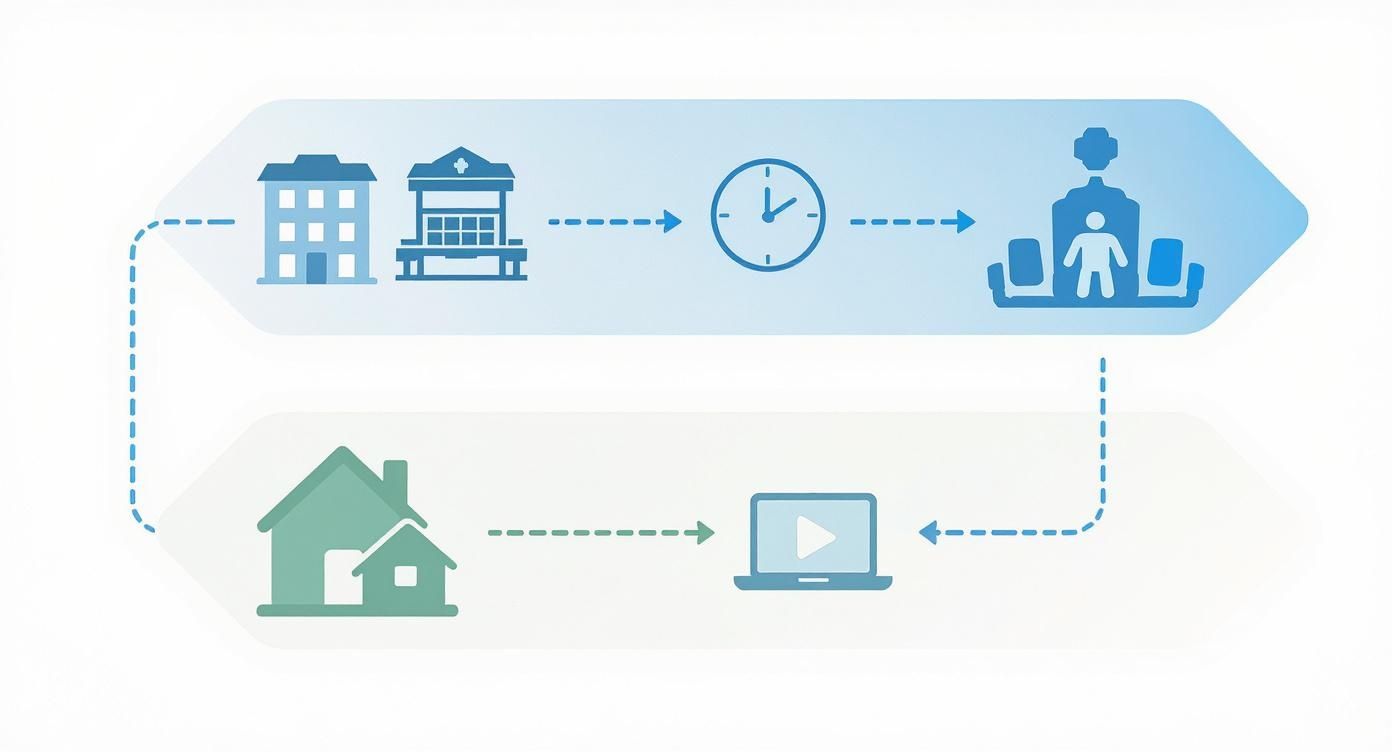
As you can see, the online model cuts out the travel and the waiting rooms, giving you direct and secure access to clinicians right from your own home.
The Core Diagnostic Interviews
If the screening suggests an assessment is needed, you'll move on to the heart of the process: the core diagnostic interviews. These are in-depth, structured conversations with a qualified clinician, held over a secure video link. When assessing adults for Autism or ADHD, this usually means taking a deep dive into your entire life story.
Your clinician will expertly guide you through:
- Your Developmental History: They’ll explore your childhood, focusing on social development, friendships, and school experiences, which are key for an Autism or ADHD diagnosis.
- Your Current Challenges: You'll discuss specific difficulties related to ADHD or autistic traits you're facing at work, in relationships, or in daily life.
- Your Personal Strengths: A good assessment also identifies your neurodivergent strengths. It’s about building a balanced, complete picture.
These interviews are vital for gathering the rich, qualitative evidence needed for an accurate diagnosis. The clinician is trained to pick up on the nuances in how you communicate and to understand the context behind your answers, just as they would if you were in the same room. If you'd like to learn more about this, have a look at our guide on what's involved in an autism diagnosis near you.
Standardised Testing and Collateral Information
It’s not all talk. A comprehensive mental health assessment online for ADHD and Autism also involves psychometric testing. You'll be asked to complete standardised, evidence-based tests (like the ADOS-2 for Autism or the DIVA-5 for ADHD) that measure specific cognitive and behavioural patterns. These are the very same 'gold-standard' tools used in NHS and private clinics across the country.
This multi-faceted approach, combining self-report, interviews, and standardised testing, is what ensures the clinical robustness of the diagnosis. It’s about triangulating evidence from different sources to form a reliable conclusion.
On top of this, your clinician might ask for your permission to speak with someone who knows you well—a parent, a partner, or a close friend. This is called gathering collateral information. Hearing from someone else can offer valuable insights into your developmental history and how your traits appear to others, which is particularly important for diagnosing adult ADHD and Autism and helps strengthen the overall diagnostic picture. This is always done with your explicit consent.
Your Report and Feedback Session
The final piece of the puzzle is receiving your outcome. Your clinician will synthesise all the gathered information into a comprehensive diagnostic report. This document will detail the assessment process, lay out the clinical findings, and provide a clear conclusion. If you are given a diagnosis, the report will explain exactly how your experiences match the formal criteria for ADHD or Autism Spectrum Disorder.
But it doesn't just end with an email and a PDF. Any reputable service will finish with a dedicated feedback session. This is a final video call where your clinician talks you through the report, explains the findings in plain English, and ensures you have time to ask questions. Most importantly, this session is about looking forward—discussing what comes next, from potential support for your specific neurotype to other resources that can help you move ahead with clarity and confidence.
Why More People Are Choosing Online Assessments for Autism & ADHD
Deciding to explore a diagnosis for ADHD or Autism is a massive step, and the path you take matters. More and more, people are opting for a mental health assessment online, and it’s not just about convenience. This route offers powerful advantages that tackle the real-world hurdles of traditional clinical services head-on.
The most obvious benefit? Geography is no longer a barrier. In the past, your access to a specialist in adult ADHD or Autism was dictated by your postcode. Online assessments blow that limitation wide open, letting you connect with a leading clinician from anywhere in the UK. It doesn't matter if you're in a busy city centre or a quiet village.
This immediately opens up a much wider pool of expertise. You’re not stuck with local services that might have eye-watering waiting lists or lack specialists in adult neurodiversity. Instead, you can pick a provider based on their experience and the approach that feels right for you, ensuring you get the best care possible.
A More Comfortable, Supportive Environment
Let’s be honest: a traditional clinic can be a stressful place. For many autistic or ADHD individuals, the unfamiliar rooms, harsh lighting, and sensory overload can be overwhelming. That kind of anxiety makes it incredibly hard to open up and unmask, which can muddy the waters of the assessment.
An online assessment flips this on its head.
Being assessed in your own home—a familiar, controlled space where you feel safe—is a complete game-changer. This comfort helps you relax and be fully present, which means you can give a much more accurate picture of who you are. You’re in charge of your environment. You can dim the lights, sit in your favourite chair, or have a fidget toy to hand.
The whole point of a good assessment is to get to know the real you. By stripping away the stress of a clinical setting, online assessments make it easier to share your experiences openly, giving the clinician a far richer and more accurate insight into your world.
This isn’t a trivial detail. For conditions like Autism and ADHD, where your environment can hugely influence how you present, feeling comfortable is fundamental to getting an accurate diagnosis.
Slashing Those Agonising Waiting Times
Perhaps the single biggest reason people go online is the drastic reduction in waiting times for Autism and ADHD assessments. The traditional routes, whether through the NHS or even private in-person clinics, are often swamped. It’s not uncommon to face waits of many months, and sometimes even years. That delay isn't just frustrating; it can be actively harmful.
The evidence is clear: long waits for healthcare take a toll. Reports from the NHS and mental health charities show that over a third of people find their mental health gets worse while stuck on a waiting list. You can read more about the impact of waiting times on mental health.
Getting a timely mental health assessment online is more than a convenience—it's a critical intervention.
Shorter waits mean you get the answers and validation for your ADHD or Autism much faster. This allows you to start accessing the right support and begin building a life that truly works for you, rather than one you’re just struggling to get through. Online providers have fine-tuned their processes to cut out the administrative bottlenecks, moving you from your first enquiry to a full diagnostic report with genuine efficiency.
Understanding the Limitations and Considerations
While getting a mental health assessment online is a fantastic option for many people seeking an ADHD or Autism diagnosis, it’s not a one-size-fits-all solution. To figure out if it's the right move for you, it’s important to have a clear view of the potential downsides and what you’ll need to make it work.
Online assessments for conditions like ADHD and Autism are generally very effective, but some situations really do benefit from the old-fashioned, face-to-face approach.
When an In-Person Assessment Might Be Better
Sometimes, a person's situation is just too complex for a screen. An in-person assessment is often a better fit for anyone dealing with significant co-occurring conditions like severe depression, complex trauma, or signs of psychosis alongside their suspected neurodivergence. These situations need the careful, in-person observation a clinician can provide.
Likewise, if someone has profound communication difficulties that a video call might worsen, or if a physical or neurological exam is needed to rule out other conditions, a clinic is the more sensible choice. There’s a certain nuance clinicians can pick up on from body language and subtle non-verbal cues in person that can sometimes get lost through a screen.
Practical Needs for a Successful Online Assessment
For an online assessment to go smoothly and be clinically sound, a few things are non-negotiable. Think of these as the basic building blocks for a successful evaluation.
- A Stable Internet Connection: A flaky connection that keeps dropping out can completely derail the conversation, causing real frustration for both you and the clinician.
- A Private, Quiet Space: You absolutely need a confidential spot where you won’t be interrupted. This is crucial for feeling safe enough to speak openly and honestly about your life experiences.
- Suitable Technology: You'll need a device you're comfortable with, like a laptop or tablet, that has a reliable camera and microphone for a long video call.
A successful online assessment hinges on creating a remote environment that mirrors the privacy and focus of a clinical room. Without these practical elements, the quality and accuracy of the evaluation can be compromised.
The Importance of Choosing a Reputable Provider
Perhaps the biggest thing to watch for is that the quality of online ADHD and Autism assessment providers can be all over the map. The industry isn’t consistently regulated, so it’s vital to learn the difference between a clinically robust service and one that cuts corners.
A trustworthy provider will be upfront about their clinicians' qualifications (e.g., Clinical Psychologists, Consultant Psychiatrists), their regulatory status (like being CQC registered in the UK), and exactly what their assessment process involves.
Choosing a service that isn't properly regulated can lead to a diagnosis that your GP or other healthcare providers won't accept, which can be a huge problem if you need a shared care agreement for medication. Doing your homework on a provider is an essential first step. The financial side of things matters too; getting a clear picture of the full private ADHD assessment cost ensures there are no nasty surprises.
How to Find a Reputable Assessment Provider
Deciding to get a mental health assessment online for ADHD or Autism is a big step, and it all hinges on trust. Not all providers are created equal when it comes to clinical quality. Choosing the right one is probably the most critical decision you'll make. It’s what ensures your diagnosis is accurate, respected, and actually helps you move forward.
Think of it this way: if you needed a specialist surgeon, you wouldn't just pick the first name you saw online. You'd check their qualifications and track record. It’s exactly the same here. Vetting an online assessment provider is about protecting your health, your money, and your future by making sure you get a diagnosis that’s clinically sound.
Verify Clinician Credentials and Qualifications
First things first: you need to know exactly who will be assessing you. A legitimate provider will be completely upfront about their team's credentials. Be wary of vague titles like "mental health expert"—that’s not specific enough for an Autism or ADHD diagnosis.
For a diagnosis to hold any weight in the UK, the team must include professionals registered with official regulatory bodies. Here’s what you should be looking for:
- Psychiatrists: They must be on the General Medical Council (GMC) Specialist Register. This confirms they are qualified medical doctors who have completed years of extra training to specialise in diagnosing and treating conditions like ADHD.
- Psychologists: They should be registered with the Health and Care Professions Council (HCPC). This is a legal requirement for Clinical and Counselling Psychologists in the UK and proves they meet strict national standards.
Don’t just take their word for it. A good provider will often link directly to their clinicians’ registration profiles, but it’s always wise to spend two minutes checking the registers yourself. It gives you absolute peace of mind.
Check for Official Regulation
Beyond the individuals, the service itself should be regulated. In England, the main regulator for all health and social care services is the Care Quality Commission (CQC). If a provider is CQC registered, it means they are independently monitored and inspected to ensure they are safe, effective, and properly managed.
A provider’s CQC rating is a powerful indicator of their quality and commitment to patient safety. It’s the difference between a service that operates to a proven standard and one that simply claims to.
This registration isn't just a logo for their website; it's your guarantee that the service is held to account and meets fundamental standards of care. A provider without CQC oversight might not be operating to the same high standards, putting the validity of your diagnosis at risk.
Ask About the Assessment Process and Report
Any trustworthy provider will have no problem explaining their methods from start to finish. Before you commit, you should have clear answers to some key questions about their Autism and ADHD assessments:
- What does the full assessment involve? It needs to be a multi-stage process, including initial screening, comprehensive diagnostic interviews (like ADI-R for autism), and standardised psychometric tests. A quick online form and a 20-minute chat simply won’t cut it.
- Is the process compliant with NICE guidelines? The National Institute for Health and Care Excellence (NICE) sets the gold standard for clinical practice in the UK for diagnosing ADHD and Autism. A diagnosis that doesn't follow these guidelines might not be recognised.
- What is included in the final diagnostic report? The report should be a detailed, comprehensive document, often over 20 pages long. It needs to lay out all the evidence gathered, the clinician's reasoning, and a clear diagnostic conclusion.
- Is the report suitable for a shared care agreement? This is crucial if you're seeking an ADHD diagnosis and might want to explore medication. Ask if their reports are regularly accepted by NHS GPs for these kinds of arrangements.
Asking these direct questions helps you quickly sort the thorough, evidence-based services from those offering something far less substantial.
Life After Your Diagnosis
Getting a diagnosis for ADHD or Autism from an online mental health assessment isn't the end of the road; it's the beginning of a new one. This newfound clarity gives you a solid foundation to build a life that truly works for you. The conversation in your head can finally shift from "what's wrong with me?" to "how does my brain work, and how can I best support it?"
Think of your diagnosis less as a label and more as a user manual for your brain. It helps make sense of past struggles and, more importantly, points you toward evidence-based support for the future. Understanding your neurotype is the very first step toward learning to advocate for yourself.
Turning Your Report into Practical Support
That diagnostic report you receive is a powerful tool. It’s the formal evidence you need to advocate for yourself, turning your personal understanding into tangible, practical help.
With your report in hand, you can start accessing vital resources:
- Workplace Accommodations: Under the Equality Act 2010, your ADHD or Autism diagnosis can be used to request reasonable adjustments at work. This might mean flexible hours, noise-cancelling headphones, or getting instructions in writing.
- University Support: Students can use their report to apply for the Disabled Students' Allowance (DSA). This allowance can fund specialist equipment, one-to-one mentoring, and other support systems to help you succeed academically.
Your diagnostic report isn't just a clinical document; it's a key that unlocks a more supportive and accommodating world. It validates your experiences and gives you the confidence to ask for what you need to thrive.
Exploring Treatment and Community
A diagnosis also paves the way for specialised treatments and connection with a community that genuinely understands. For many with ADHD, this means looking into medication options to help manage symptoms. This process, called titration, is carefully overseen by a psychiatrist to find the exact right medication and dosage for you. As you start this journey, it can be really helpful to learn how to get private prescriptions online.
For both autistic people and those with ADHD, connecting with the wider neurodivergent community can be incredibly validating. Finding peer support groups lets you share experiences and coping strategies with people who just get it. This sense of belonging is often one of the most powerful parts of getting a diagnosis, serving as a constant reminder that you are not alone.
Frequently Asked Questions
Thinking about an online assessment for ADHD or Autism naturally brings up a lot of questions. We’ve put together some straightforward answers to the queries we hear most often.
Are Online ADHD or Autism Diagnoses Actually Valid?
Absolutely. When a mental health assessment online for ADHD or Autism is carried out by qualified, regulated clinicians who stick to NICE guidelines, the diagnosis is just as valid as one you’d get in person. Good providers use the exact same diagnostic rulebooks (e.g., DSM-5 or ICD-11) and the same proven assessment tools.
A properly detailed report is the key. It should give you everything you need to arrange workplace adjustments under the Equality Act or to start a conversation with your GP about a potential shared care agreement for ADHD medication.
What’s the Cost of a Private Online Assessment in the UK?
The price for a private online assessment for Autism or ADHD in the UK can differ quite a bit, usually falling somewhere between £700 and over £2,000. The final figure often comes down to the provider's experience, how in-depth the assessment is, and the specialists you’ll be working with.
It's really important to check that the price you're quoted covers everything for the ADHD or Autism assessment, including:
- The initial screening and triage process.
- All the necessary interviews with clinicians.
- Your complete diagnostic report.
- The final feedback meeting to go through the results.
What Tech Do I Need for an Online Assessment?
The technology side of things is pretty simple. All you really need is a reliable internet connection and a device with a camera and microphone – a laptop, tablet, or even a modern smartphone will do the job. The sessions themselves happen on secure video platforms to ensure your conversation is kept private.
The most important thing isn't the tech, but your surroundings. You need to be in a quiet, private space where you won't be interrupted. This is crucial for keeping the assessment focused and effective.
Can I Get Medication After an Online Diagnosis?
If you receive an ADHD diagnosis, many private online clinics have a clear path for starting medication if it’s the right step for you. This usually begins with a separate appointment with a specialist psychiatrist or a non-medical prescriber to talk through your treatment options.
From there, the process of figuring out the right medication and dose, which is known as titration, can also be handled remotely by the same team. This gives you seamless care, from the first assessment all the way through to managing your treatment, right from your own home.
If you're ready to get some answers and move forward, Insight Diagnostics Global offers CQC-regulated, consultant-led online assessments for adults. Our GMC-registered specialists provide thorough, NICE-compliant evaluations for ADHD and Autism. You can learn more and start your journey on our website at https://insightdiagnostics.co.uk.