

A private ADHD assessment is an in-depth evaluation with a qualified specialist—usually a psychiatrist—that takes place outside of the NHS. It’s designed to give adults who are struggling with symptoms of Attention Deficit Hyperactivity Disorder a much faster route to getting a diagnosis and the right support for their overall mental health.
Why Consider a Private ADHD Assessment

Let's be honest, staring down a massive NHS waiting list for a mental health assessment is daunting. For countless adults, the day-to-day chaos that comes with suspected ADHD—whether it’s disorganisation at work or strained personal relationships—feels too urgent to put on hold for months, or even years. This long wait in limbo is a huge reason why so many people are now exploring private ADHD assessments.
Going private offers a direct, timely alternative. It connects you with an expert who can finally provide clarity not just on ADHD, but on your broader mental health landscape. Getting a formal diagnosis isn’t about getting a label; it’s about getting a crucial tool that helps you understand yourself on a deeper level. It can completely reframe past struggles and give you strategies that actually work with your brain, not against it.
The Impact of Timely Diagnosis on Wellbeing
It's very common for undiagnosed ADHD to walk hand-in-hand with other mental health conditions like anxiety and depression. Its traits can also look a lot like those of Autism Spectrum Disorder (ASD), a phenomenon often referred to as 'AuDHD' when both are present. A proper private assessment will explore these potential overlaps, giving you a full, accurate picture of your neurotype and mental health.
Getting a prompt diagnosis can feel like a genuine turning point. It provides an explanation for lifelong patterns and validates experiences you might have always felt alone in. It empowers you to:
- Access Support Sooner: You can start treatment, coaching, or therapy for ADHD and any related mental health conditions without long delays.
- Improve Your Professional Life: You can finally put strategies in place or ask for workplace adjustments that help with executive function challenges.
- Strengthen Relationships: Gaining insight into how your symptoms affect your interactions with loved ones can lead to much better communication and understanding.
- Enhance Your Mental Health: A diagnosis can help lift the secondary anxiety or low mood that often comes from struggling with unmanaged ADHD and co-occurring conditions.
A diagnosis provides the 'why' behind the challenges, shifting the narrative from personal failing to neurological difference. This understanding is the first step towards effective management and improved self-esteem.
A Growing Trend Towards Private Care
This need for faster answers has created a real shift in how people are accessing healthcare. The number of people opting for private ADHD assessments in the UK has shot up, largely because of the lengthy NHS waiting times for mental health services.
Right now, just over one in five patients in England get their ADHD medication through a private prescription. This statistic really shows the vital role private clinics are playing, especially when you consider that only an estimated one in nine people with ADHD in the UK has ever received a formal diagnosis.
Choosing to go private is really about taking back control of your mental health journey. For more on why people are making this choice, this article on understanding the rationale behind private health services offers some great insights.
If you think you might be dealing with symptoms, a good starting point is to look through an adult ADHD symptoms checklist.
Navigating the path to an ADHD assessment can feel like standing at a crossroads. One sign points to the NHS, a well-trodden but often slow-moving route. The other points to a private assessment, a faster, more direct journey, but one that comes with a cost. Both can get you to the same destination—a diagnosis and support—but the experience of getting there is worlds apart.
Let's break down the real-world differences between these two options. We'll look at the things that matter most: waiting times, costs, and the level of control you have over the process. The goal is to give you a clear, honest picture so you can choose the path that feels right for you.
The Elephant in the Room: Waiting Times
Let's be blunt: the single biggest difference is time. The NHS is under incredible pressure, and as a result, waiting lists for adult ADHD assessments have become extremely long. It's not an exaggeration to say that in many parts of the country, people wait for months, sometimes even years, just for that first appointment.
This is where going private changes the game completely. Private clinics can bypass those long queues. In fact, the average UK waiting time for a private assessment is just 43 days. That's a massive difference. For many people, the ability to get answers and start treatment sooner is the main reason they choose to go private. You can see more on this comparison over at audhdpsychiatry.co.uk.
Getting Started: Referrals and Flexibility
The journey itself starts very differently. With the NHS, your first port of call is always your GP. You'll need to discuss your symptoms with them, and if they feel an assessment is justified, they’ll refer you to a local mental health service. You generally don't get a choice about where you go or which specialist you see.
The private route puts you firmly in the driver's seat.
- You can self-refer. Most private providers, ourselves included, don't require a GP referral. You can simply pick up the phone or fill out a form online to get the ball rolling.
- You choose the expert. You have the freedom to research and select a psychiatrist or clinic with specific expertise in adult ADHD, Autism, or any other co-occurring mental health conditions you might be concerned about.
- You control the schedule. Private clinics are often much more flexible, offering appointments in the evenings or on weekends to fit around your life.
Being able to self-refer and choose your own specialist is a huge plus for the private pathway. It gives you control right from the very beginning.
When you're trying to weigh up the pros and cons, seeing a direct comparison can make things much clearer.
Private vs NHS ADHD Assessment At a Glance
| Factor | Private Assessment | NHS Assessment |
|---|---|---|
| Waiting Time | Weeks (average 43 days) | Months, often years |
| Referral | Self-referral is usually possible | GP referral is required |
| Cost | Upfront fee for assessment & follow-ups | Free at the point of use |
| Choice of Clinician | You can research and choose your specialist | Assigned by the local service |
| Flexibility | More flexible scheduling (evenings/weekends) | Limited to standard clinic hours |
| Long-term Care | Often leads to a 'Shared Care Agreement' with GP | Fully managed within the NHS |
This table lays out the core trade-offs, helping you decide whether the speed and control of a private assessment outweigh the cost-free nature of the NHS route.
The Financial Side: Costs and Long-Term Planning
Of course, the financial commitment is a huge part of the decision. An NHS assessment is completely free. From the initial evaluation right through to diagnosis and any medication, it's all covered. For many, this makes it the only feasible option.
A private ADHD assessment in the UK is an investment. You'll pay an initial fee for the comprehensive evaluation, with further costs for any follow-up appointments and for the 'titration' period, where your doctor works with you to find the right medication and dosage.
However, it's important to think about the long term. Many people who go private don't pay for their medication forever. Once you're on a stable dose, it's often possible to set up a 'Shared Care Agreement' with your GP. This means your private psychiatrist hands over the prescribing to your NHS doctor, so you can get your ongoing prescriptions through the NHS. It's a great way to combine the speed of the private sector with the long-term affordability of the NHS.
Your Step-by-Step Private Assessment Journey
Deciding to get a private ADHD assessment can feel like a huge step, but knowing what’s involved makes the whole thing a lot less daunting. It’s not just a single chat; it's a carefully designed process where clinicians piece together a detailed and accurate picture of you. They gather information from different angles to make sure the evaluation is spot on.
The whole experience is meant to be clear and supportive. So, let’s walk through what you can actually expect, from the first time you get in touch to when you have the final, detailed report in your hands.
This flowchart gives you a quick visual of the private pathway. It really shows how it’s designed to be a more direct route to getting answers, without the long waits you might find elsewhere.
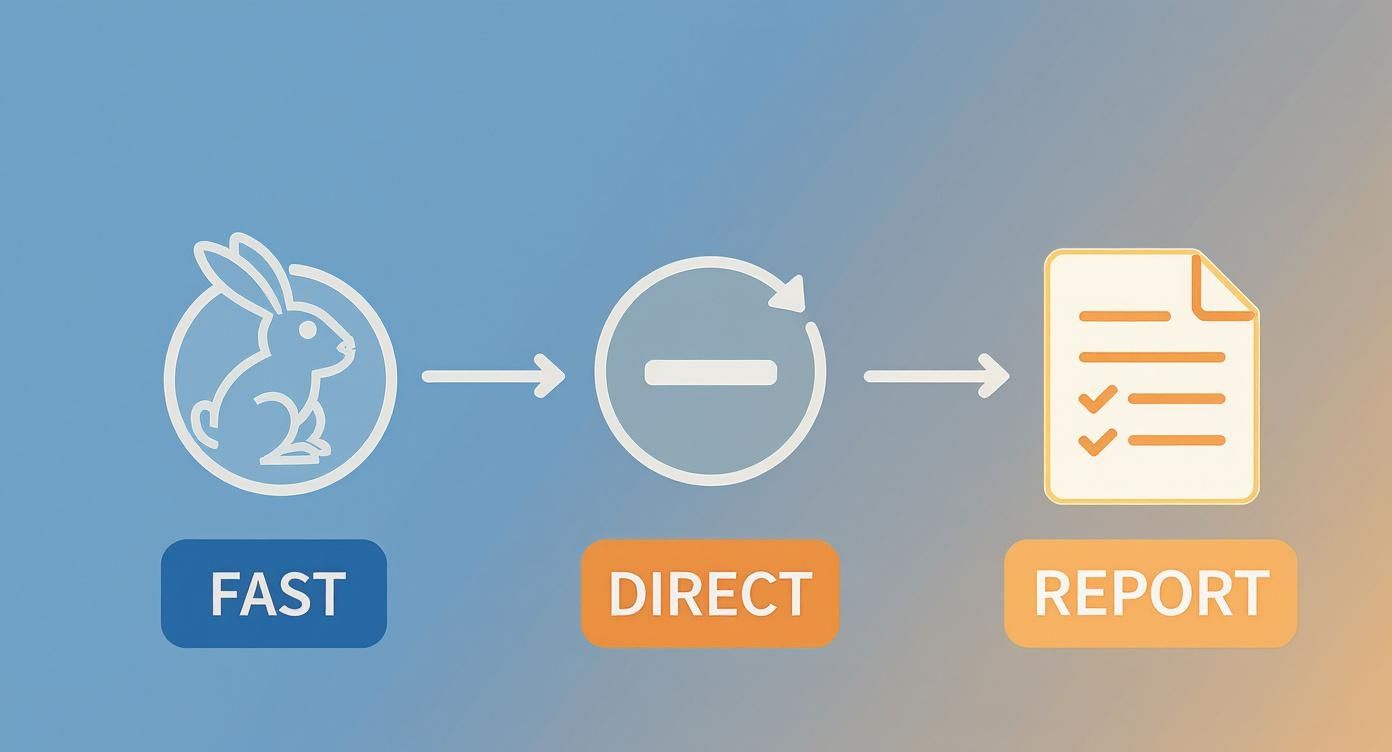
As you can see, the focus is on getting you from evaluation to understanding efficiently.
Stage 1: The Initial Enquiry and Triage
Your journey starts the moment you decide to reach out. One of the biggest differences from the NHS is that most private clinics allow self-referral. That means you can contact them directly—no need for a GP appointment first. Usually, this just involves filling out an online form or having a quick chat on the phone.
At this point, a member of the clinical team will look over your information. This isn't the assessment itself, but more of a triage step. They're just checking that a full ADHD assessment is the right path for you and that the clinic has the right specialists to help with your specific situation, especially if other mental health concerns like anxiety, depression, or potential Autism are in the mix.
Stage 2: Gathering Information with Questionnaires
Before you sit down with the psychiatrist, you'll be asked to fill out some in-depth questionnaires. These aren't just admin; they are standardised tools that give the clinician a solid baseline understanding of your symptoms and how they're impacting your daily life. Think of it as laying the groundwork so the main clinical interview can be as productive as possible.
You'll likely come across some of these:
- Adult ADHD Self-Report Scale (ASRS): A well-known screening tool from the World Health Organisation that asks how often you experience various ADHD symptoms.
- DIVA-5 (Diagnostic Interview for ADHD in Adults): This is a more structured guide that helps explore symptoms in both childhood and your adult life, which is absolutely vital for a diagnosis.
- Conners' Adult ADHD Rating Scales (CAARS): This one often gives a deeper look into specific behaviours and emotional patterns.
These forms provide hard data that backs up the more personal story you'll share during your main assessment.
Stage 3: The Comprehensive Clinical Interview
This is the heart of your private ADHD assessment. You’ll have a one-to-one session with a consultant psychiatrist, usually lasting somewhere between 60 to 90 minutes. The conversation is a real deep-dive, covering everything from your early school days right up to your current work and home life.
The psychiatrist is looking for patterns of behaviour that line up with the official criteria for ADHD (in the DSM-5 manual). They won’t just be asking what you struggle with, but how it actually affects you day-to-day.
What makes a good private ADHD assessment stand out is its holistic approach. The clinician isn't just ticking an ADHD box. They're looking at your overall mental health, actively checking for things like anxiety, depression, or personality disorders that can look like, or exist alongside, ADHD.
It's also crucial that the assessment considers other neurodevelopmental conditions. ADHD and Autism Spectrum Disorder (ASD), for instance, have a lot of overlapping traits, like executive function and social communication challenges. A good clinician will carefully navigate these nuances to make sure the final diagnosis is right for your unique neurotype. Exploring a broader mental health assessment online can offer more context on this.
Stage 4: Input From Someone Who Knows You
To get the full picture, clinicians often need to hear from someone who knows you really well—a partner, a parent, or even a long-term friend. This is sometimes called an "observer report," and it’s an incredibly valuable piece of the puzzle. It gives them an outside perspective on your behaviours.
After all, it can be hard to report your own ADHD symptoms accurately, especially if you’ve spent your life building coping mechanisms or "masking" your traits. An observer can give real-world examples of how you are in daily life, which helps confirm the patterns the psychiatrist is looking for to make a solid diagnosis. This extra information makes the whole case much stronger and more reliable.
Stage 5: Diagnosis and Your Detailed Report
After the interview and a thorough review of all the questionnaires, the psychiatrist will pull all their findings together. If the evidence points to an ADHD diagnosis, they'll confirm it with you and explain which presentation you have (inattentive, hyperactive-impulsive, or combined).
Soon after, you’ll receive a comprehensive diagnostic report. This document is so much more than a simple label. It’s a detailed breakdown that typically includes:
- A full summary of your personal and developmental history.
- The clinical evidence that led to the diagnosis.
- A discussion of any other co-occurring conditions they noted, like autism traits, anxiety, or mood disorders.
- Personalised recommendations for what to do next, which might cover medication, therapy, or ADHD coaching.
This report is a powerful tool. You can use it to get adjustments at work, support at university, or to set up a Shared Care Agreement with your GP if you decide to go down the medication route. It’s the final, tangible outcome of your assessment journey, giving you the clarity you were looking for.
Understanding the Costs of a Private ADHD Diagnosis
Let’s talk about one of the biggest considerations when going private for an ADHD assessment: the cost. Unlike the NHS route, which is free to use, the private path requires a financial investment. Getting a clear picture of the full cost structure from the outset is crucial so you can budget properly and avoid any nasty surprises down the line.
It’s important to realise you’re not just paying for a single chat with a doctor. The fee covers a whole diagnostic journey. This includes the clinician’s expert time for the in-depth interview, the analysis of all the questionnaires, and the creation of a detailed, multi-page report. This report isn't just a piece of paper; it’s the key to getting workplace support or setting up a Shared Care Agreement with your GP later on.
Breaking Down the Potential Costs
The total bill for a private ADHD assessment is more than just the initial consultation fee. It helps to think about the costs in stages, as not every stage will apply to everyone. Knowing this upfront makes financial planning much easier.
Here are the main expenses you'll likely come across:
- The Initial Diagnostic Assessment: This is the headline fee. It covers the main clinical assessment, all the pre-screening questionnaires, and the final diagnostic report.
- Follow-Up Consultations: Once you have your diagnosis, you’ll probably need at least one follow-up appointment to go through the findings, talk about treatment options, and get your questions answered.
- Medication Titration: If you and your psychiatrist agree that medication is the best next step, there's a separate cost for the titration process. This covers the series of appointments needed to find the right medication and the most effective dose for you, which can take several weeks or even a few months.
A good rule of thumb is to always ask for a clear, itemised fee schedule from any clinic you’re considering. A trustworthy provider will be completely transparent about all potential costs, making sure you know exactly what you’re signing up for before you commit.
This kind of transparency helps you plan for the entire journey, not just the first appointment. For a more detailed look at what goes into these costs, our guide on the cost of a private ADHD assessment breaks it down even further.
Why Do Prices Vary So Much Between Clinics?
You've probably noticed that prices can swing quite a bit from one clinic to another. This isn't random; it reflects some important differences in the quality and depth of the service you receive. Understanding what’s behind the price tag helps you make a much smarter choice.
For instance, the experience and qualifications of the clinician make a huge difference. An assessment with a Consultant Psychiatrist who is on the GMC Specialist Register will naturally cost more than one with a practitioner who has less specialised training. The level of detail in the final report and whether the assessment includes screening for co-occurring conditions like autism or anxiety also play a part in the total cost.
The average cost for a private adult ADHD assessment in the UK hovers around £1,200. The assessment itself usually lasts between 60 and 90 minutes, and you can generally expect your full report within a couple of weeks. While face-to-face appointments might be slightly pricier than online ones, both are widely available.
What Sort of Timescales Can You Expect?
Beyond the money, it's also about the time involved. While going private is significantly quicker than the NHS, it still follows a proper, structured timeline to ensure the diagnosis is thorough and accurate. Trying to rush it would only compromise the quality of the outcome.
Here’s a rough idea of the timeline:
- Initial Enquiry to Assessment: From the moment you first get in touch, you can usually expect to be offered an assessment appointment within one to two weeks.
- Receiving Your Report: After the assessment is complete, the detailed diagnostic report is typically written up and sent to you within five to ten working days.
- Starting Titration: If medication is the chosen path, the titration process can often start very soon after your follow-up appointment.
This efficiency is one of the main reasons people opt for the private route. It means getting the clarity and support you need in a matter of weeks, not years.
How to Choose a Reputable UK Provider

Diving into the world of private ADHD assessments can feel like a minefield. With a growing number of clinics popping up, how can you tell the good from the bad? Making the choice to go private is a big investment in your health, so finding a provider you can trust is absolutely the most important first step.
A proper assessment isn't just about getting a quick answer. It's about getting an accurate, in-depth diagnosis that your own GP and other healthcare professionals will take seriously. A trustworthy clinic provides a robust, carefully considered evaluation, which is the bedrock of your future mental health journey. Let's walk through a practical checklist to help you sort the wheat from the chaff.
Verify Essential Credentials
Before you go any further with a clinic, it's time to do a little homework. Think of it as a background check for your healthcare. The best providers are completely open about their credentials and regulation because they see them as badges of quality.
Your verification checklist should have two absolute non-negotiables:
- CQC Regulation: The Care Quality Commission (CQC) is the independent regulator for all health and social care services in England. If a clinic is CQC regulated, it means they meet essential standards of safety and quality. You can easily look up any provider on the CQC website.
- GMC Specialist Register: The psychiatrist who assesses you must be on the General Medical Council's (GMC) Specialist Register. This is your proof that they are a fully qualified consultant psychiatrist with the deep expertise needed to diagnose complex conditions like ADHD, especially when it might overlap with things like autism.
These credentials are a powerful sign that a clinic operates to a high professional standard. They ensure your diagnosis is credible and won't be dismissed later on.
A diagnosis from a CQC-regulated clinic and a GMC-registered specialist holds significant weight. It’s far more likely to be recognised by your GP, which is crucial for any future treatment plans.
Spotting the Red Flags
Just as there are green flags to look for, there are also some serious red flags that should give you pause. Some providers might be more focused on profit than patient care, and it’s vital to recognise the warning signs.
Be wary of any clinic that:
- Guarantees a diagnosis. An ADHD assessment is a careful, meticulous process. A diagnosis should never be promised upfront. Ethical clinicians provide an impartial evaluation based on the evidence, not a guaranteed outcome.
- Rushes the process. A thorough assessment simply takes time. If a clinic is offering a suspiciously short or over-simplified process, it’s probably not comprehensive enough to be accurate.
- Lacks transparency on costs. All fees should be laid out clearly from the start, covering everything from the initial assessment to medication titration and follow-ups. Hidden costs are a major red flag.
- Doesn't screen for co-occurring conditions. ADHD often walks hand-in-hand with other conditions like anxiety, depression, and autism. A good assessment looks at the whole mental health picture, not just ticking a single box.
Ultimately, trust your gut. If an offer seems too good to be true, it probably is. It's worth taking your time to find a more professional and thorough service.
Confirm Their Shared Care Agreement Policy
This is a critical, and often forgotten, step when choosing a provider for your private ADHD assessment. A Shared Care Agreement (SCA) is a formal arrangement where, once you’re stable on your medication, your private psychiatrist hands the prescribing responsibility over to your NHS GP.
This is a game-changer because it allows you to get your ongoing prescriptions at the standard NHS rate, saving you a fortune compared to long-term private prescriptions. The catch? Not all GPs will agree to it, and some private reports aren't detailed enough to give them the confidence to take over.
Before you book, ask the clinic directly about their policy and success rate with SCAs. A high-quality provider designs their reports specifically to give your GP all the information and reassurance they need to agree to shared care. This one question could save you a huge amount of money and stress down the line.
Life After Diagnosis: What Happens Next?
Getting an ADHD diagnosis isn't an endpoint. For most people, it’s the complete opposite—it’s the beginning of a clearer, more informed path forward. It's often a moment of pure relief, a lifetime of "whys" finally answered, giving you a framework to understand yourself better.
This newfound understanding is the real power of your private ADHD assessment. Your diagnostic report is more than just a piece of paper; it’s a toolkit. It opens the door to medical treatments, practical support, and life adjustments designed to help you work with your brain, not constantly fight against it.
Exploring Your Treatment Options
Your journey after diagnosis is yours alone, and it's important to remember that medication is just one piece of the puzzle. A good clinician won't just hand you a prescription; they'll talk you through a whole range of strategies for your overall mental health, often combining a few to get the best results for you.
Here are the most common routes people take:
- Medication: For many, stimulant or non-stimulant medications are incredibly effective at dialling down the core symptoms of ADHD, like a racing mind or impulsivity.
- ADHD Coaching: A specialist coach can work with you to build real-world skills. Think of it as a personal trainer for your executive functions—helping you nail down organisation, time management, and planning.
- Therapy: Cognitive Behavioural Therapy (CBT) is particularly useful. It can be adapted specifically for the ADHD and autistic brain, helping you untangle the negative thought patterns and unhelpful habits you may have built up over years of trying to cope.
Most people find that a blend of these supports gives them the strongest foundation for moving forward.
Demystifying Medication Titration
If you and your psychiatrist agree that medication is the right step, you'll begin a process called titration. It’s best to think of this as a careful calibration period. You don't just get a standard prescription; it's a methodical process of finding the exact medication and the precise dose that works best for your unique brain chemistry.
This involves regular catch-ups with your psychiatrist over a few weeks or months. You’ll start on a very low dose, and they’ll guide you in gradually increasing it, keeping a close eye on how you're feeling and any side effects. Your feedback here is absolutely crucial—it's a team effort to find that sweet spot.
The whole point of titration is to find the lowest effective dose that helps you function better without causing unwanted side effects. It’s a highly personal and collaborative journey.
Securing Long-Term, Affordable Care
Once you and your psychiatrist have found a stable, effective medication dose, the next conversation is about managing it for the long term. This is where a Shared Care Agreement (SCA) becomes so important.
An SCA is a formal arrangement made between your private psychiatrist and your NHS GP. It allows your GP to take over issuing your repeat prescriptions. The biggest benefit? You'll pay the standard NHS prescription price instead of the much higher cost of ongoing private prescriptions. Reputable clinics know this and will create a diagnostic report with all the detail your GP needs to confidently agree to shared care.
Accessing Non-Medical Support
Your diagnosis can also unlock vital support in other parts of your life, especially at work. A formal diagnosis provides you with legal protections and opens the door to practical help that can make a huge difference.
The Access to Work scheme is a fantastic government-funded programme that offers grants to pay for "reasonable adjustments." This could mean funding for things like:
- Noise-cancelling headphones to help you focus in a busy office.
- Specialist software for mind-mapping or managing your to-do list.
- Sessions with an ADHD coach to build effective workplace strategies.
This kind of support can be the key to not just coping at work, but truly thriving.
Your Questions Answered
When you're considering a private ADHD assessment, it’s completely normal to have a lot of questions buzzing around. Let's tackle some of the most common ones to give you a clearer picture of what to expect.
Will My GP Accept a Private Diagnosis?
This is a big one, and the answer is usually yes. GPs in the UK are generally happy to accept a diagnosis from a reputable private service. The key is that the assessment must be carried out by a psychiatrist who is on the GMC Specialist Register, and the report they provide needs to be detailed and comprehensive.
However, it's really important to know that your GP is not obliged to prescribe medication under a Shared Care Agreement. The best approach? Have a chat with your GP before you book an assessment. A quick conversation can tell you where they stand and help you plan your next steps.
Can I Be Assessed for Autism at the Same Time?
Yes, absolutely. Many people find their experiences don't fit neatly into one box, and specialist clinics understand this. There's a well-known overlap between ADHD and Autism Spectrum Disorder (ASD), so many providers now offer combined neurodevelopmental assessments.
While any good clinician will screen for co-occurring conditions as part of a standard assessment, if you have a strong feeling that both might apply to you, asking for a combined assessment right from the start is often the most efficient way to get a full understanding of your unique neurotype.
What if I Don’t Want to Take Medication?
That’s perfectly fine. A diagnosis is about so much more than just medication. Think of the diagnostic report as a personal user manual for your brain; it’s a powerful tool in its own right.
Your diagnosis is a key. It can unlock workplace support, specialised therapies, and coaching, giving you strategies that finally work with your brain, not against it.
Receiving a diagnosis can validate a lifetime of experiences. It also opens the door to legally protected reasonable adjustments at work or university, support through schemes like Access to Work, and practical help from ADHD coaches or therapists using approaches like Cognitive Behavioural Therapy (CBT).
At Insight Diagnostics Global, our consultant-led team provides clear, CQC-regulated assessments for adults, helping you gain the understanding you need to move forward. If you're ready to take the next step, learn more about our services at https://insightdiagnostics.co.uk.