

A private ADHD assessment is a direct, confidential, and much quicker way for adults who are struggling with symptoms to get a diagnosis. Unlike the long-winded NHS process, this route gives you faster access to specialist psychiatrists, often providing clarity and support for your mental health in weeks, not years.
Why Choose a Private ADHD Assessment?
If you feel like you're constantly fighting a battle against distraction, disorganisation, and emotional ups and downs, it's completely draining. For many adults, these struggles are classic signs of Attention Deficit Hyperactivity Disorder (ADHD), but getting answers through the NHS can feel like joining a queue with no end in sight. This is exactly why a private ADHD assessment has become such a vital option for so many people across the UK seeking clarity on their mental health.
You can think of the journey to a diagnosis like trying to get to an important meeting. The NHS route is like taking the public bus – it’s free and it will get you there eventually, but you can expect long waits, lots of stops, and a very unpredictable timetable. The private route is more like a taxi. You know the cost upfront, but it takes you straight to your destination, on your schedule, making for a faster and more personal experience.
The Overlap Between ADHD, Autism and Mental Health
It’s really important to understand that ADHD rarely shows up on its own. Many people with ADHD also have co-occurring conditions like autism, anxiety, or depression. A major benefit of a thorough private assessment is that an experienced psychiatrist will look at your entire mental health picture. They don't just tick boxes for ADHD; they dig into the complex ways different symptoms and traits interact, recognising the significant overlap between ADHD and autism.
This kind of detailed approach is crucial. What might look like anxiety on the surface could actually be driven by the daily stress of living with undiagnosed ADHD or autism. A nuanced evaluation ensures you get a diagnosis that truly fits your neurotype, not just a single, isolated label. Our detailed guide on the ADHD assessment process in the UK breaks down what a complete evaluation should cover.
Speed and Certainty When You Need It Most
Let's be honest, the biggest reason people go private is the massive difference in waiting times. Long delays can take a serious toll on your mental health, put a strain on relationships, and derail your career. Private ADHD assessments in the UK have become a popular solution for this very reason. In 2025, the average wait for a private assessment is around 43 days. That's a world away from NHS waiting lists, which can stretch on for many months, and in some areas, even years.
A private diagnosis is more than just a faster answer. It’s about taking back control of your mental health and finally getting the support you need to start thriving instead of just surviving. It gives you a clear, actionable plan when everything feels uncertain.
To help you see the differences clearly, let's put the two options side-by-side.
Private vs NHS ADHD Assessment At a Glance
This table breaks down the key differences between going private and using the NHS for an ADHD assessment.
| Feature | Private Assessment | NHS Assessment |
|---|---|---|
| Wait Time | Weeks to a few months | Months to several years |
| Referral | Self-referral is usually an option | GP referral is mandatory |
| Cost | Self-funded (costs vary) | Free at the point of service |
| Choice of Clinician | You can choose your specialist | Assigned by the service |
| Flexibility | More flexible appointment scheduling | Less flexibility in scheduling |
Ultimately, the choice comes down to what you can afford and how urgently you need answers. While the NHS provides an essential service, the private route offers a level of speed and control that can be life-changing for those who can access it.
Your Private Assessment Journey Step by Step
Taking the first step towards a private ADHD assessment can feel like a big deal, and it's natural to have questions or feel a bit of anxiety. But knowing what to expect can turn that uncertainty into a clear, straightforward plan. Think of it less as a test and more as a structured conversation designed to give you clarity, not confusion. The whole point is to get an accurate picture of your mental health, guided by experts who really understand the nuances of neurodevelopmental conditions like ADHD and autism in adults.
It all starts the moment you get in touch.
The First Steps: Triage and Questionnaires
Your journey begins with a confidential enquiry. This is your chance to ask those initial questions and just get a feel for the clinic. From there, you'll move to what's known as the screening or triage stage.
This usually involves filling out some self-report questionnaires, like the Adult ADHD Self-Report Scale (ASRS). These forms are designed to give the clinical team an initial snapshot of your symptoms and, crucially, how they affect your day-to-day life. It’s an essential filter that helps confirm whether a full, in-depth assessment is the right path for you.
This simple diagram shows the difference between the typical NHS journey and the more direct route offered by a private provider.
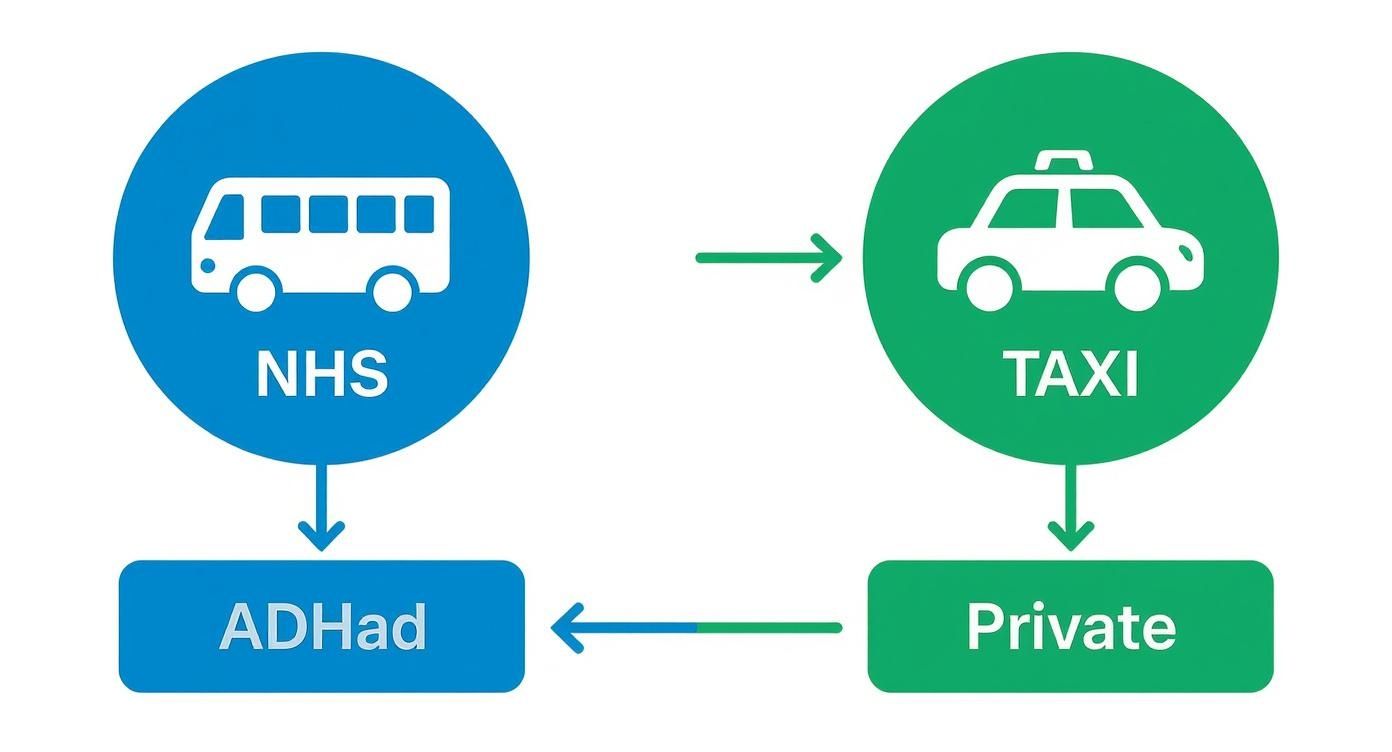
As you can see, the private path is often a much faster way to get the answers you're looking for.
Getting Ready for Your Clinical Assessment
Once you’re booked in, a bit of preparation can make all the difference. Your provider will probably ask you to pull together some supporting information that helps paint a picture of your life and challenges over the years. Don't worry, this isn't about finding a perfect paper trail—it's about building a story.
Some things that can be really helpful include:
- Old School Reports: You'd be surprised how insightful those old teacher comments can be. Remarks about you being 'chatty', 'a daydreamer', or 'disruptive' can be telling, even if no one mentioned ADHD or autism back then.
- Work Performance Reviews: Feedback on your time management, organisational skills, or ability to hit deadlines can show how symptoms might be playing out in your career.
- Input from Someone Who Knows You Well: A partner, parent, or trusted friend can often offer observations you might not have noticed yourself. This is sometimes called an 'observer report' and adds another valuable layer to the assessment.
Gathering these details helps your clinician see the long-standing patterns of behaviour that are a key part of an ADHD or autism diagnosis. It adds real depth and context to your conversation.
What Happens During the Main Assessment?
The core of the process is a deep, structured conversation with a specialist psychiatrist. This is where they connect the dots between your past experiences and your present challenges.
They won’t just be having a casual chat; they'll be using a formal diagnostic tool like the DIVA-5 (Diagnostic Interview for ADHD in Adults) to guide the discussion. This makes sure all the official diagnostic criteria from the DSM-5 are covered methodically.
You can expect detailed questions about:
- Your Childhood: They’ll want to know about your behaviour and any difficulties you had before the age of 12.
- Your Current Symptoms: How do things like inattention, hyperactivity, or impulsivity show up in your work, relationships, and home life right now?
- The Impact on Your Life: They’ll explore how much these challenges are genuinely getting in the way across different areas of your life.
This is far more than a simple Q&A. The psychiatrist is using their expertise to distinguish ADHD symptoms from other mental health conditions that can sometimes look similar.
Looking at the Bigger Picture: Autism and Co-occurring Conditions
One of the markers of a truly high-quality private assessment is its breadth. Conditions like ADHD, autism, anxiety, and depression are often tangled together. A good psychiatrist won't look at ADHD in a vacuum; they’ll carry out a comprehensive mental health evaluation.
They understand that what looks like social anxiety might be related to autistic traits, or that emotional dysregulation can be a part of both ADHD and a mood disorder. This holistic view is crucial for getting a diagnosis that truly fits you, setting you up for effective, personalised support.
This is why a full assessment is so valuable. For anyone interested in this wider approach, our guide on undertaking a mental health assessment online explains more about what a complete evaluation involves. A thorough check for co-occurring conditions isn’t just a nice-to-have; it’s a hallmark of a reliable service and is vital for your long-term wellbeing.
Your Diagnosis and What the Report Means
After your clinical interview, the psychiatrist will bring everything together—your questionnaires, the supporting documents, and the diagnostic interview itself—to make a formal diagnosis.
You’ll then receive a comprehensive diagnostic report. This is an incredibly important document. It clearly lays out the findings, confirms the diagnosis (if one is made), and gives you personalised recommendations. It's your roadmap forward, suggesting next steps for treatment, practical support strategies, and any adjustments you might need at work or in education. It’s the final, clarifying piece of the puzzle.
Understanding the Costs and Timelines

Let’s get down to brass tacks. When you’re considering a private ADHD assessment, two questions immediately jump to mind: "How much is this going to set me back?" and "How long will I have to wait?". Getting straight answers to these is essential for planning and helps take the financial stress out of the equation.
It's helpful to think of the cost as more than just a single payment for the assessment itself. The reality is a journey with a few stages, including follow-up care and potentially medication. Understanding the full financial picture right from the start means you can budget properly and avoid any nasty surprises down the line.
Breaking Down the Full Cost of an Assessment
The headline price for a private ADHD assessment can vary quite a bit from one UK clinic to another. This often comes down to their setup, the specialists' experience, and how thorough the evaluation is. It’s so important to look beyond that initial number to see what you're actually getting for your money.
For many, the cost is a deciding factor. The average adult assessment lands somewhere around £1,200. Some clinics might advertise a lower price to get you in the door, but this can climb, especially if you want a face-to-face appointment, which often costs about 9% more than an online one. For a more detailed look at how to navigate pricing, have a read of our guide to the private ADHD assessment cost.
To get a true sense of the total investment, you need to ask providers for a complete breakdown:
- The Initial Assessment Fee: This is the core cost. It should cover the clinical interviews, a review of your personal history, and the drafting of your comprehensive diagnostic report.
- Follow-up Appointments: After a diagnosis, you'll need at least one follow-up to go through the report and discuss what happens next. Find out if this is included or billed separately.
- Medication Titration: If you and your specialist decide medication is the right move, you'll enter a 'titration' period to find the right medication and dosage for you. This is almost always a separate cost, often sold as a package or billed per appointment.
- Private Prescriptions: Before your GP can potentially take over your care through a Shared Care Agreement, you'll have to cover the cost of the medication yourself through private prescriptions. These come with a dispensing fee on top of the drug's price.
Knowing about these different components from the outset is crucial for budgeting for the entire process, not just the first step.
Mapping Out the Typical Timelines
Just as vital as the cost is how long everything takes. Let's be honest, a huge reason people go private is to skip the notoriously long NHS waiting lists. The private route offers a far more predictable and quicker timeline.
While every clinic is a little different, the private pathway is built for speed. The entire system is geared towards getting you from your initial enquiry to a clear diagnosis in a matter of weeks, not years, so you can get the answers you need and start moving forward.
Here’s a rough guide to what you can expect:
- Enquiry to First Appointment: From the day you reach out, you can often get your main assessment booked in within one to four weeks.
- Receiving Your Diagnostic Report: Once your assessment is done, a good clinic will get your detailed report back to you within five to ten working days.
- Beginning Medication Titration: If medication is part of your plan, the titration process can start soon after your follow-up. This phase can last anywhere from four to twelve weeks, as it’s a careful, methodical process to find what works best for you.
This streamlined timeline means that in just a few months, you could have a diagnosis, a clear treatment plan, and be settled on the right medication—a stark contrast to the timeline you'd face on the standard NHS route.
How to Find a Credible and Trustworthy Provider
The market for private mental health services is booming, which is both a blessing and a curse. Choosing the right clinic for your private ADHD assessment isn’t just about getting an appointment—it's a massive decision for your long-term health.
A good provider gives you more than a diagnosis; they offer a safe, regulated, and supportive path forward. A bad one, on the other hand, can lead to an incorrect diagnosis, unsafe prescribing, and a complete waste of your time and money.
Knowing what to look for shifts you from being a hopeful patient to an informed advocate for your own care. The trick is to approach this like you’re doing a background check, focusing on official credentials, genuine expertise, and transparent practices. This is how you ensure your journey is built on trust.
Non-Negotiable Regulatory Checks
Before you even think about services or prices, the very first thing to do is check a provider's regulatory status. Honestly, this is the single most important step in figuring out if they are legitimate and safe.
In the UK, there are two key bodies you need to know about:
- The Care Quality Commission (CQC): This is the independent regulator for all health and social care services in England. If a clinic is CQC-registered, it means they’ve been inspected and met essential standards for quality and safety. They should have this information proudly displayed on their website.
- The General Medical Council (GMC): The psychiatrist who will assess you must be registered with the GMC. But don't stop there. You need to confirm they are on the GMC Specialist Register for psychiatry. This is proof they have completed years of advanced training and are properly qualified to diagnose and treat complex conditions like ADHD.
Think of these checks as your safety net. They are the official stamps of approval that separate a professional medical service from an unregulated outfit that could put your health at risk.
Expertise in Adult ADHD, Autism, and Co-occurring Conditions
It's vital to find a psychiatrist with deep experience in adult ADHD, but their expertise shouldn't stop there. As we’ve mentioned, ADHD rarely travels alone. It often comes hand-in-hand with other neurodevelopmental conditions like autism, not to mention common mental health challenges like anxiety and depression.
A provider who only looks for ADHD is only seeing part of the picture. True expertise lies in understanding the complex interplay between different conditions like ADHD and autism, ensuring your diagnosis is accurate and not a misinterpretation of overlapping symptoms.
When you first get in touch with a clinic, ask them directly about their clinicians' experience with co-occurring conditions. A confident, skilled provider will have no problem talking about their approach to differential diagnosis—the clinical process of telling one condition apart from others that look similar.
Red Flags and What to Watch Out For
As you research potential clinics, you'll learn to spot the warning signs that should make you walk away. Protecting yourself means being aware of practices that just aren't up to professional standards.
Be very wary of providers who:
- Promise a Guaranteed Diagnosis: An assessment is an investigation, not a purchase. No ethical clinician can guarantee an outcome before they’ve done a thorough evaluation.
- Lack Transparency About Costs: All fees should be laid out clearly from the start, including what you'll pay for follow-up appointments and medication titration. No surprises.
- Have a Rushed or Superficial Process: A proper assessment takes time. Be suspicious of any service offering a diagnosis after a quick chat.
You should also check their commitment to your privacy. A trustworthy clinic will be open about how they use top healthcare data security solutions to keep your sensitive information safe.
For those looking specifically in the capital, our guide on getting a private ADHD diagnosis in London offers more local advice. Taking that extra bit of time to vet a provider properly is the best investment you can possibly make in your mental health.
Life After Diagnosis: Navigating Your Next Steps

Getting an ADHD diagnosis isn't the finish line. Far from it. It's the start of a new chapter where you finally have the right map to navigate your own mind. For so many people, it’s a moment of profound clarity that opens the door to effective, targeted support for both ADHD and your wider mental health.
This new path is all about building a personalised toolkit of strategies, treatments, and support systems that actually work for you. For many, the first step is exploring medication, which naturally leads to an important conversation about something called a Shared Care Agreement.
Understanding Shared Care Agreements
A Shared Care Agreement (SCA) is a formal arrangement between your private specialist and your NHS GP. In simple terms, it’s what allows your GP to take over prescribing your ADHD medication, making your long-term treatment much more affordable and convenient.
Think of it this way: your private psychiatrist is like a specialist architect who draws up the blueprint for your treatment, carefully choosing the right medication and tweaking the dose during titration. Once that plan is stable and working well, the SCA hands that blueprint to your GP, who acts as the reliable builder, continuing the project exactly to the specialist's specifications.
An SCA is designed to bridge the gap between private and NHS care. It creates a sustainable, long-term plan for managing your medication and is a critical step for ensuring that effective treatment doesn't come with an impossible price tag.
Before an SCA can be set up, you'll need to have completed the titration process with your private provider. This period is all about finding a stable, optimised dose of medication. Once that's done, your GP is much more likely to feel confident taking over the prescribing duties.
Beyond Medication: Holistic Support for Your Mental Health
While medication can be a genuine game-changer for managing the core symptoms of ADHD, it’s only one piece of the puzzle. To really thrive with ADHD, especially when it co-exists with conditions like autism or anxiety, you need a much broader approach to your wellbeing.
Building a life that works with your brain, not against it, means developing new skills, getting to grips with your emotional landscape, and finding your people. This is where other forms of support become so valuable.
Here are some of the most effective strategies to consider:
- Specialised ADHD Coaching: This is a brilliant, goal-focused process where a coach helps you develop practical strategies to tackle daily challenges like time management, organisation, and procrastination. It's about practical, real-world solutions.
- Adapted Cognitive Behavioural Therapy (CBT): Standard CBT doesn't always click for neurodivergent minds. ADHD-adapted CBT, however, is specifically designed to work with the ADHD brain, helping you reframe unhelpful thought patterns and manage emotional dysregulation.
- Community Support Groups: Connecting with other adults who have ADHD or who are also AuDHD (autistic and ADHD) can be incredibly validating. It helps to fight the isolation so many of us feel and provides a safe space to share experiences and coping tips without any fear of judgment.
Building Your Personalised Support Network
Your journey after a private ADHD assessment is about more than just managing difficulties; it’s about discovering your strengths and building a life that celebrates how you're wired. The best part is that you get to decide what your support network looks like.
This could mean combining medication managed by an SCA with weekly coaching sessions to finally nail your work-from-home routine. Or it might involve finding an online community of fellow AuDHD adults who just get it, giving you a sense of belonging that bolsters your overall mental health. The power is in the combination.
Ultimately, your diagnosis is the key that unlocks all these possibilities. It empowers you to move forward with self-awareness and the right tools, so you can build a future that isn't just managed, but is genuinely fulfilling.
Your Questions Answered: Navigating a Private ADHD Assessment
Deciding to get a private ADHD assessment is a huge step, and it's only natural to have a lot of questions. When it comes to your health, you need clear, straightforward answers to feel confident you're making the right choice.
Let's clear up some of the most common queries we get, so you can plan your next steps with confidence.
Can My GP Refuse a Private Diagnosis or Shared Care Agreement?
This is a big one, and a completely valid concern. The short answer is, yes, a GP can decline to enter into a Shared Care Agreement (SCA). While most GPs are incredibly supportive, they aren’t obligated to accept a private diagnosis or take over prescribing your medication.
So, why might this happen? A few reasons:
- Local NHS rules: Some local commissioning groups (ICBs) have specific policies that can make it tricky to work with private clinics.
- The GP’s own expertise: Your GP might not feel confident enough in their specialist knowledge of ADHD medications to manage the prescription safely.
- Doubts about the provider: If the GP has concerns about how thorough or reputable your private assessment was, they might be hesitant to get on board.
My best advice? Have a chat with your GP before booking anything. Just ask if they’re generally open to shared care arrangements with a reputable, CQC-regulated provider. A quick conversation upfront can save you a world of stress down the line.
Do I Need a GP Referral for a Private Assessment?
No, and this is one of the biggest benefits of going private. You don't generally need a referral from your GP, which is a mandatory first step on the NHS pathway.
Being able to self-refer means you can sidestep long waits and potential gatekeeping just to get seen. You can pick up the phone, contact a clinic directly, and get the ball rolling on your own terms. This direct access is a huge part of why the private route is so much faster.
Psychiatrist vs Psychologist: What’s the Difference?
Knowing who does what is really important, especially when it comes to ADHD treatment. The main difference boils down to medical training and the ability to prescribe medication.
A psychiatrist is a medical doctor who has specialised in mental health. Critically, they are the only ones who can prescribe and manage ADHD medication.
A clinical psychologist is also a highly trained expert who can diagnose conditions through detailed assessments and testing. However, they aren't medical doctors, so they can't prescribe. Their focus is on therapy and psychological support, like adapted CBT. If you're looking for a full private ADHD assessment with the option of starting medication, you need to see a specialist psychiatrist.
Can I Switch From Private Care Back to the NHS?
Yes, you absolutely can. After getting a private diagnosis and finding a treatment that works for you, it's very common to move your care back into the NHS. The smoothest way to do this is through a Shared Care Agreement, where your GP takes over your prescriptions.
But even if an SCA isn't an option, you still have your rights as an NHS patient. You can ask your GP for a referral to the local NHS adult ADHD service. The good news is you won't be starting from square one. Your private diagnostic report is powerful evidence and can often speed things up once you get to the top of the NHS waiting list. Your investment in a private assessment continues to pay off for your long-term care.
At Insight Diagnostics Global, we provide clear, comprehensive, and CQC-regulated online assessments for adults, delivered by GMC-registered specialist consultants. If you're ready to gain clarity on your mental health, explore our services and take the first step today. Learn more at https://insightdiagnostics.co.uk.