

Trying to figure out if you need an ADHD assessment in London can feel like a maze, especially when you suspect it might be intertwined with other mental health conditions like autism. You know you need answers, but where do you even start? It really boils down to two main options: going through the NHS or choosing a private clinic. Each route has its own trade-offs between cost, speed, and access, and getting your head around these is the first real step to finding some clarity for your overall mental health.
Your Guide to ADHD and Autism Assessments in London
If you've spent years feeling like you're running on a different operating system to everyone else, you're not alone. For many adults, nagging questions about focus, social interactions, organisation, and emotional control that have been there since childhood eventually lead them to wonder about Attention-Deficit Hyperactivity Disorder (ADHD) and often Autism Spectrum Disorder (ASD) as well.
Getting a formal diagnosis can be a huge turning point for your mental health. It's about finally understanding how your brain is wired and getting the right kind of support. This guide is here to walk you through the process of getting an ADHD assessment in London, with a focus on its connection to autism and your wider mental wellbeing, giving you the confidence to take that next step.
The Connection Between ADHD and Autism
It’s becoming more and more clear that ADHD rarely exists in a vacuum. It often overlaps with other neurodevelopmental conditions, especially Autism Spectrum Disorder (ASD). In fact, research suggests a huge crossover, with some studies estimating that between 30% and 80% of autistic people also have ADHD. This combination is sometimes called AuDHD, and it comes with its own unique set of strengths, challenges, and mental health considerations.
A thorough assessment is absolutely key because the traits can easily get tangled up and mask each other. For example:
- Are social difficulties coming from autistic communication styles or from ADHD-related impulsivity and inattention?
- Is that intense concentration an autistic special interest or an ADHD hyperfocus?
- Emotional dysregulation is a hallmark of both conditions and can be mistaken for anxiety or depression, but it can show up in very different ways.
Getting this right is so important for your mental health. A diagnosis that only spots one condition can leave you with a bunch of unanswered questions and ongoing challenges. That's why many specialist clinics in London now offer combined assessments to give you the full picture.
Seeking a diagnosis isn't about getting a label. It's about finally getting the user manual for your own brain. It gives you the words to explain your experiences and points you toward mental health strategies that actually work.
Two Main Pathways to a Diagnosis
When it comes to getting an ADHD assessment in London, you have two main routes to consider. The first is through the National Health Service (NHS). This is the publicly funded path, which starts with a chat with your GP to get a referral. The major plus is that it's free, but the big drawback is often the very long waiting lists, which can take a toll on your mental health.
Your second choice is the private route. Here, you can refer yourself directly to a specialist clinic. This is a much faster way to get assessed and start treatment, but you will have to cover the costs yourself. We’ll dive into the details of both options, comparing how they work, how long they take, and what support you can expect, so you can figure out what’s right for you.
The UK's ADHD Diagnosis Bottleneck: Why Getting Answers is So Hard
To really understand the challenge of getting an ADHD assessment in London, you have to zoom out and look at the situation across the whole country. If you’ve been struggling with focus, feeling out of sync, and are finally looking for answers about your neurotype and mental health, you’re not alone. Far from it. We're in the middle of a massive national awakening around ADHD and neurodiversity.
This wave of awareness is, of course, a good thing. People are finally connecting the dots and realising that their lifelong struggles might have a name. But this has put an incredible strain on a healthcare system that was never built to handle this volume of adult assessments. The result? A huge bottleneck, with thousands of people stuck in limbo, waiting for a diagnosis that could change their life and improve their mental wellbeing.
The Great Diagnosis Gap
The heart of the problem lies in the massive gap between the number of people who likely have ADHD and the number who have actually been diagnosed. This isn't just a feeling people have; the statistics paint a very clear picture of a national mental health logjam.
For decades, ADHD was seen almost exclusively as a condition affecting hyperactive little boys. This outdated, narrow view meant that countless girls, women, and adults with the less disruptive, inattentive form of ADHD were completely missed. Their symptoms were often dismissed or misdiagnosed as anxiety, depression, or even just personal character flaws, leaving the underlying neurodivergence unaddressed.
This historical blind spot has created an enormous backlog of adults. People who have spent their entire lives trying to cope are now stepping forward, seeking the validation and treatment that a formal diagnosis can unlock.
The ADHD diagnosis crisis in the UK isn't just a headline; it's one of the biggest mental healthcare challenges we face right now. It validates the immense frustration so many people feel and screams for more accessible ways to get a proper diagnosis.
A Look at the Numbers
Just how wide is this gap? Recent data gives us a clue. An analysis of 9 million GP records in January 2024 revealed that only 0.32% included an ADHD diagnosis. That figure is shockingly low, especially when you compare it to what the experts believe the real number is.
The National Institute for Health and Care Excellence (NICE) estimates that around 2.5 million people in England have ADHD, including all the undiagnosed cases. Do the maths, and you’ll see that roughly only 1 in 9 people who likely have ADHD has ever received a formal diagnosis. You can dig deeper into the ADHD diagnosis crisis to see the full scale of the issue.
This staggering difference is exactly why both NHS and private mental health services are completely swamped. It’s not just a few people seeking help; it's a whole generation of adults finally recognising their own neurodivergence and reaching out for support they should have had years ago.
The Overlap with Autism and Mental Health
Making things even more complicated is the significant overlap between ADHD and other conditions, especially Autism Spectrum Disorder (ASD). It’s thought that somewhere between 30% and 80% of autistic people also have ADHD. This combination, which some call AuDHD, creates a very distinct set of strengths, challenges, and impacts on a person's overall mental health.
When these conditions exist together, they can mask or even amplify each other, which makes getting an accurate diagnosis absolutely crucial. For instance:
- Executive Function: Both conditions can cause issues with planning and organisation, but the reasons behind the struggle can be very different.
- Social Interaction: Difficulties here could be down to ADHD-related impulsivity or rooted in autistic differences in social communication.
- Emotional Regulation: Feeling emotions intensely is a hallmark of both, and is often misdiagnosed as a standalone mood disorder, but the support strategies needed can vary significantly.
If a clinician fails to spot co-occurring conditions, it can lead to treatment plans that just don't work and leave the person still struggling with their mental health. A thorough, comprehensive assessment that looks at the whole person is non-negotiable for effective, long-term support. This is vital context when you're looking for an ADHD assessment in London—you need a provider who truly gets this complexity.
Comparing Your Options: NHS vs Private Assessments
When you start looking into getting an ADHD assessment in London, you quickly realise there are two main roads you can take: going through the National Health Service (NHS) or opting for a private clinic. It’s a big decision, and each path has its own distinct landscape of pros and cons, especially concerning your mental health needs.
There’s no single right answer here. The best choice for you will come down to your personal circumstances—how urgently you need answers, what your budget looks like, and what you need from the process. It’s a classic trade-off. Think of the NHS as the reliable, free-to-use bus service. It’s a fantastic public resource that will get you to your destination, but you’re on its schedule, and that often means long waits. The private route is more like hailing a taxi: it costs a fair bit more, but it takes you directly where you need to go, right when you need to go.
The NHS Pathway Explained
Starting your journey with the NHS always begins at the same place: your GP’s surgery. You'll need to book an appointment to talk through your symptoms and struggles, including any impact on your mental health. If they agree that an ADHD assessment is appropriate, they'll refer you to a specialist adult ADHD service. This GP referral is an essential first step you can't skip.
The biggest hurdle with the NHS route, without a doubt, is what comes next: the waiting list. The delays for ADHD assessments have become a real crisis. As of mid-2024, it was estimated that over 500,000 people in England were stuck waiting, with a shocking number of them having been on that list for two years or more. You can read more in the NHS England response to the ADHD Taskforce report.
But here’s the crucial upside: if you can navigate the wait, the entire process—assessment, diagnosis, and any follow-up treatment—is completely free. For many people, this alone makes the NHS the only realistic option.
The Private Pathway Unpacked
The private pathway is all about getting you seen quickly and efficiently. The most significant difference is that you don’t need a GP referral. You can simply research clinics that specialise in adult ADHD and autism, pick one you trust, and book an appointment yourself. This puts you firmly in the driver's seat of your mental health journey.
Speed is the main reason people choose a private ADHD assessment in London. While NHS waits can stretch into years, a private clinic can often get you an appointment in just a few weeks, sometimes even sooner. For someone whose mental health is suffering due to their symptoms, that speed can be absolutely transformative.
Private clinics also tend to offer more flexibility with appointments and a wider choice of specialists, including those experienced in co-occurring conditions. The catch, of course, is the cost. It's a significant financial investment that you'll need to cover yourself. Our guide on the cost of a private ADHD assessment breaks down what you can expect to pay.
Key Differences at a Glance
To really understand the trade-offs, it helps to see the two routes side-by-side. Here’s a straightforward look at how the NHS and private pathways compare.
NHS vs Private ADHD Assessment in London: A Comparison
| Feature | NHS Pathway | Private Pathway |
|---|---|---|
| Referral | GP referral is mandatory | Self-referral is standard |
| Wait Times | Extremely long (months to several years) | Very short (days to a few weeks) |
| Cost | Free at the point of use | Self-funded (typically £700 – £2,000+) |
| Choice of Specialist | Limited; assigned by the service | High; you can choose your clinician/clinic |
| Post-Diagnosis Support | Included, but may have further waits | Immediate, but costs for titration are extra |
| Shared Care | Standard process within the NHS system | Possible via a Shared Care Agreement with GP |
You'll notice the term "Shared Care Agreement" in the private pathway. This is a key concept to understand.
A Shared Care Agreement is a formal arrangement where a private specialist and your NHS GP agree to share responsibility for your care, primarily for prescribing medication. This can make long-term treatment more affordable, but it's not guaranteed and depends on your GP's willingness to participate.
Ultimately, the choice comes down to which resource you can spare more of: your time or your money. If you’re at a breaking point with your mental health and have the funds, the private route offers a fast track to clarity. If cost is your primary concern, the NHS provides a comprehensive, gold-standard service—you just have to be prepared for the long wait.
What to Expect from a Private ADHD Assessment
Deciding to get a private ADHD assessment in London is often the first real step towards getting answers. Yes, it’s a financial commitment, but it’s also a way to sidestep long NHS queues and get on a clear, structured path to understanding your mental health. The whole process is designed to be thorough but not intimidating.
It doesn’t start with a brain scan or a complex test. Your journey actually begins with some straightforward paperwork. Before you meet anyone, you’ll be sent a few pre-assessment questionnaires. Think of these not as a test, but as a way to give the clinical team a head-start in understanding your world.
These forms will dig into your current challenges, your background, and the real-world impact your symptoms have day-to-day. It’s also pretty standard for clinics to ask for a bit of input from someone who knows you well – a parent, a partner, or a close friend – to get an outside perspective.
The Core Diagnostic Interview
After the paperwork is sorted, you’ll get to the heart of the assessment: the core diagnostic interview. This is essentially an in-depth chat with a specialist, usually a psychiatrist, in a completely confidential and non-judgemental setting. Their aim is to build a complete picture of you, right from childhood up to today.
The conversation will likely cover a few key areas:
- Childhood and School Days: They’ll want to know what you were like as a kid, how you got on at school, and if any of those old teacher’s comments on school reports ring any bells now.
- Work and Career: You’ll talk about your job history, any recurring struggles with things like deadlines or organisation, and how you manage relationships at work.
- Daily Life: This part is about how symptoms affect the everyday stuff – from managing money and keeping the house in order to staying in touch with friends.
- Mental Health History: The interview will also touch on how you manage your emotions, your general mood, and whether you might also be dealing with anxiety or depression, as they often go hand-in-hand with ADHD and autism.
A good clinician knows ADHD rarely travels alone. The interview is carefully structured to pick up on the nuances, including potential overlaps with other conditions like Autism Spectrum Disorder (ASD), to make sure the final picture of your mental health is as accurate as it can be.
Standardised Tools and Clinical Judgement
Alongside this deep-dive conversation, your clinician will use standardised rating scales and psychometric tools. These are well-established, evidence-based questionnaires that help put a number on your symptoms and see how they line up with the official diagnostic criteria, like those in the DSM-5. It’s this blend of personal conversation and scientific rigour that makes for a really solid assessment.
The specialist then puts all the pieces together – your own words, the interview, feedback from others, and the test results. It's a bit like a detective solving a puzzle of your mental health profile. This careful approach is vital for telling ADHD apart from other conditions, or for understanding how it might co-exist with them, which is particularly important for adults who suspect they may have both ADHD and autism. If you're curious about the specifics, you can learn more about the steps in a private ADHD assessment.
Getting Your Diagnostic Report and Feedback
Once the assessment is complete, the clinician collates everything into a detailed diagnostic report. This isn't just a tick-box exercise; it's a comprehensive document that clearly explains the diagnosis, lays out your personal strengths and challenges, and offers tailored recommendations for what to do next to support your mental health.
A quality report should give you:
- A clear statement confirming the diagnosis.
- A summary of the evidence used to reach that conclusion.
- Suggestions for treatment, which might include medication, therapy like CBT, or specialist ADHD coaching.
- Practical advice for adjustments at work or in education.
The final step is the feedback session. This is where the clinician sits down with you to go through the report, breaking down the findings into plain English and answering all of your questions. It’s your chance to really absorb the information and work together on a plan, so you can walk away feeling empowered and ready for what’s next.
How to Choose the Right London Clinic for Your ADHD Assessment
Deciding to go private for an ADHD assessment is a big step, and it often feels like the fastest way to get answers. But a quick search for a clinic in London can be overwhelming. The sheer number of options is dizzying, and frankly, they aren't all up to scratch.
The goal isn't just to get a quick diagnosis. You need an assessment that is thorough, professional, and holds weight with your GP, your university, or your workplace. It’s about making a smart investment in your mental health, which means doing a bit of homework upfront to find a clinic you can trust, especially one that understands the complexities of ADHD and autism.
Start with Regulatory Approval
First things first: check for official regulation. Any credible health service in England, including a private ADHD clinic, must be registered with the Care Quality Commission (CQC). Think of the CQC as the independent watchdog for all health and social care. Their stamp of approval is a non-negotiable sign of quality and safety.
A CQC registration proves the clinic is held to strict standards. You should be able to find this information proudly displayed on their website. If it’s not immediately obvious, don't be shy—ask them for their registration details directly.
The process at a well-run private clinic should be clear and structured from the get-go, typically following a path like the one below.
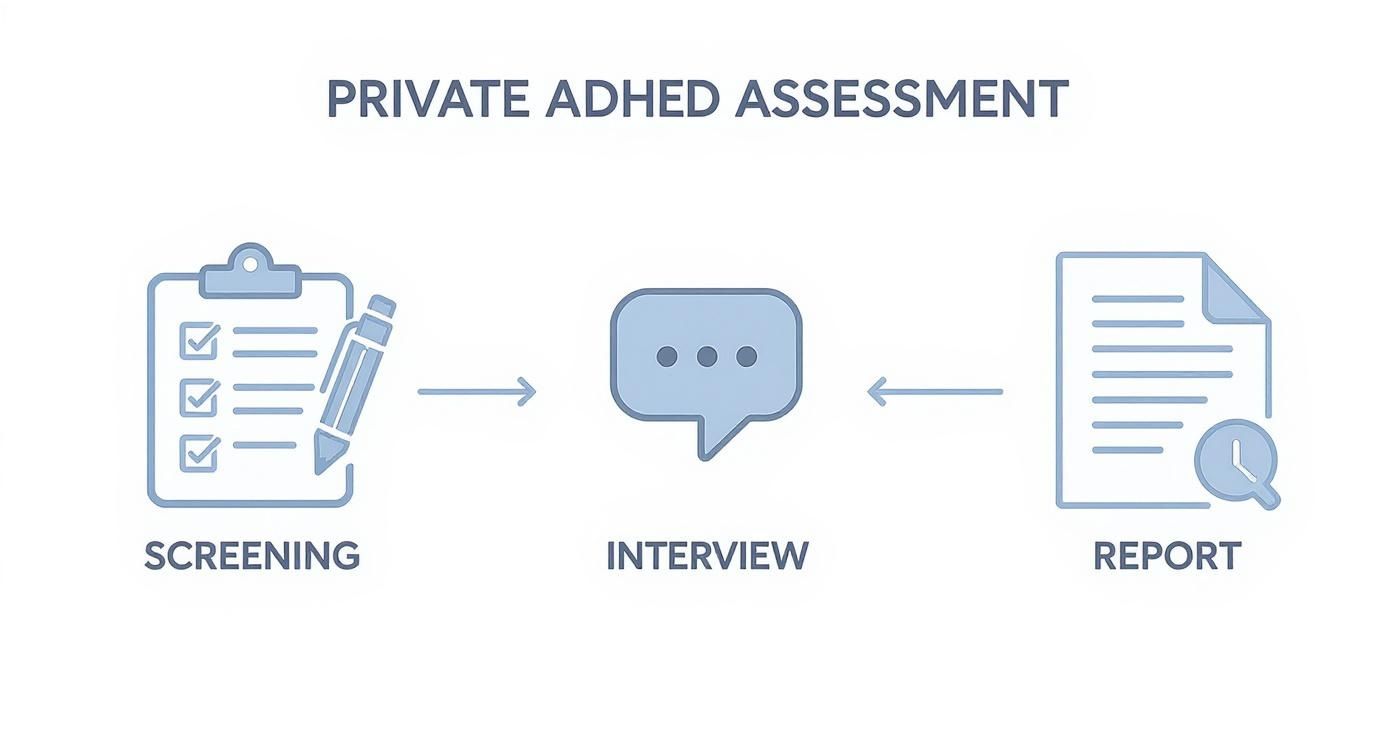
This structured approach ensures everything is done by the book, from your initial screening right through to receiving your final report.
Check Out the Clinicians and Their Methods
Once you've confirmed the clinic is regulated, it's time to look closer at the people who will actually be assessing you.
- GMC Registration: Any psychiatrist involved must be on the General Medical Council (GMC) Specialist Register. This is a hard-and-fast rule that confirms they are a qualified specialist who is fit to practise medicine in the UK.
- NICE Guidelines: The clinic should be open about following the official guidelines from the National Institute for Health and Care Excellence (NICE). These are the evidence-based standards for how ADHD and associated mental health conditions should be diagnosed and managed.
- Transparent Pricing: A reputable provider will be upfront about their costs. Be wary of vague pricing structures or hidden charges for things like writing the report or follow-up consultations.
This commitment to transparency should also cover how your personal information is handled. A good clinic takes its duty of care seriously, which includes ensuring patient data security throughout the process.
Why the Final Report Is So Important
The assessment report is more than just a piece of paper; it’s the key that unlocks future support. A detailed, professionally written report is what you’ll need to arrange a Shared Care Agreement with your GP, which is essential if you want your medication prescribed on the NHS. It's also the document required to get support at university or adjustments in the workplace.
A diagnosis is only as good as the report it comes in. A flimsy, one-page summary is a major red flag. A proper report should be a multi-page document detailing your history, the clinical findings, and clear, actionable recommendations for your mental health.
This is especially crucial because ADHD services can be a postcode lottery. There’s no single, official list of ADHD services across the country, and waiting times can vary wildly from one area to another. This is why having a robust report from a credible provider is so vital.
By taking the time to carefully vet your choice for a private ADHD diagnosis in London, you're making sure your investment leads to genuine, recognised, and truly helpful support.
Life After Diagnosis: Medication and Holistic Support
Getting an ADHD diagnosis isn't the end of the road; it's the beginning of a new chapter for your mental health. For so many people, it’s that lightbulb moment when the seemingly random struggles they’ve faced for years finally click into place and make sense. This new clarity is the key that unlocks effective, targeted support, shifting the focus from confusion to building a life where you can genuinely thrive. This journey usually involves a combination of medication and broader mental health strategies.
The first step is often medication, but it’s a very careful, collaborative process. This initial phase is called titration, where your specialist works closely with you to find the right type of medication and the most effective dose. Think of it like tuning a guitar – it takes a bit of patience and small, precise adjustments to hit the perfect note for your unique brain chemistry. The goal is to get all the benefits while keeping any side effects to an absolute minimum.
The Medication Titration Journey
Medication can be a game-changer, but it’s certainly not a one-size-fits-all fix. The titration phase is a critical period of close monitoring and fine-tuning, all managed by your psychiatrist.
- Starting Slow: You’ll almost always start on a very low dose, which is then gradually increased over a few weeks.
- Regular Check-ins: During this time, you'll have frequent catch-ups to talk about how you’re feeling, keeping a close eye on improvements as well as any side effects.
- Finding the Balance: The aim is to land on a "stabilised" dose—the sweet spot where your symptoms are managed effectively with the fewest possible side effects.
This careful, supervised process is what makes the treatment both safe and effective. If you want to dive deeper into the different options, you can read our comprehensive guide on ADHD medication for adults in the UK.
Beyond the Prescription: A Holistic Approach
While medication is incredibly helpful for managing the core symptoms of ADHD, real, long-term success comes from looking at the bigger picture of your mental health. ADHD rarely travels alone; it often goes hand-in-hand with anxiety, depression, and can co-occur with autism. That’s why tackling your mental wellbeing from all angles is so crucial.
A diagnosis tells you what is going on, but a holistic support plan gives you the how. It's about building a toolkit to navigate not just your ADHD, but your entire emotional world, creating real resilience for the future.
Some of the most effective support strategies include:
- ADHD-Focused Therapy: Cognitive Behavioural Therapy (CBT) can be brilliant when it's adapted for ADHD and autistic thinking styles, helping you build practical skills to tackle executive function challenges.
- Specialist Coaching: An ADHD coach acts as a strategist, helping you build life skills, set goals you can actually reach, and create systems and routines that work with your brain instead of against it.
- Lifestyle Adjustments: You’d be surprised what a difference simple changes to your diet, exercise routine, and sleep habits can make in managing symptoms and boosting your overall mental wellbeing.
Securing a Shared Care Agreement
Once your medication dose is stable and working well, the next practical step is often to arrange a Shared Care Agreement with your NHS GP. This is a formal plan where your private psychiatrist hands the responsibility for writing your ongoing prescriptions over to your GP.
This agreement is a huge help, making your long-term treatment much more affordable and easier to manage. For your GP to accept it, they’ll need a detailed diagnostic report and clear communication from your specialist. This partnership between private and NHS care is essential for ensuring you get seamless, consistent support long after your initial ADHD assessment in London.
Your ADHD Assessment Questions, Answered
If you’re thinking about getting an ADHD assessment in London, you’ve probably got a few practical questions spinning around in your head. Let's clear up some of the most common ones so you know exactly what to expect.
How Much Does a Private ADHD Assessment Cost in London?
You can expect to pay anywhere from £700 to £2,000 for a private ADHD assessment in London. That price should cover everything from the initial screening forms to the in-depth interview with the specialist and the final, detailed diagnostic report.
But here's a crucial tip: always ask for a full breakdown of the costs upfront. Things like follow-up appointments or the medication titration process often come with their own price tags, so make sure you have the complete financial picture before you commit.
Will My NHS GP Accept a Private ADHD Diagnosis?
For the most part, yes. As long as the diagnosis comes from a credible private clinic, your GP will usually accept it. This is the key to getting a 'Shared Care Agreement' set up, which allows your GP to take over your repeat prescriptions.
So, what makes a clinic credible? Look for one that’s CQC-regulated, uses GMC-registered specialists, and writes up a thorough report that meets the official NICE guidelines. It’s always a good idea to have a quick chat with your GP about your plan to go private before you book anything, just to keep them in the loop.
It's also worth remembering that ADHD often overlaps with other conditions, like Autism. A good assessment from a reputable clinic will explore these possibilities, giving your GP a robust and reliable diagnosis they can feel confident working with.
Can I Get Assessed for ADHD and Autism at the Same Time?
Absolutely. In fact, many specialist London clinics now offer combined assessments for both ADHD and Autism Spectrum Disorder (ASD). This has become a more common approach as we've come to understand just how frequently the two conditions show up together.
Going for a combined assessment can be far more efficient. It gives you a much clearer, more holistic view of your neurodivergent profile and overall mental health, which helps in creating a support plan that truly fits your unique needs. If you have a feeling that both might be a factor for you, it’s definitely worth asking clinics about this option.
If you are looking for a clear path to understanding your mental health, Insight Diagnostics Global provides CQC-regulated online assessments for adults. Our GMC-registered specialists offer timely, expert evaluations for ADHD, Autism, and a range of mental health conditions. Start your journey towards clarity with a professional assessment.