

If you’ve been searching for ‘CBT Birmingham UK’ trying to find the right support for ADHD, Autism, or other mental health challenges, you’ve landed in the right place. This guide is designed to be your map, helping you navigate the world of Cognitive Behavioural Therapy and see how it can be genuinely effective, especially for neurodivergent minds. We’ll walk through all the options for getting help in Birmingham—from the NHS to private specialists—cutting through the jargon to help you find support that is both effective and compassionate.
Your Roadmap to Finding CBT in Birmingham
Cognitive Behavioural Therapy, more commonly known as CBT, is a very practical, goal-focused type of talking therapy. It’s less about deep-diving into your past and more about dealing with the here and now. Think of it as a practical toolkit for understanding how your thoughts, feelings, and actions are all linked, and learning how to change patterns that aren't working for you.

This approach can be a game-changer for people with Autism or ADHD. Neurodivergence often brings a unique set of hurdles, like issues with executive function, social anxiety, or managing intense emotions. A one-size-fits-all therapy just doesn't cut it.
Why Standard CBT Isn't Always Enough for Autism and ADHD
This is where the real skill comes in. One of CBT's greatest strengths is how adaptable it is. A good therapist working with a neurodivergent client won’t just roll out standard techniques. Instead, they will carefully modify their approach to fit your unique way of processing the world. That personal touch is what makes all the difference.
Some of these crucial adaptations for ADHD and Autism include:
- Making things concrete: Abstract ideas can be tricky for autistic individuals. A great therapist will use visual aids, real-life examples, and structured worksheets to make concepts easier to grasp.
- A focus on practical skills: The therapy often targets real-world challenges common in ADHD and Autism, like procrastination, time management, or navigating social situations.
- Respecting sensory needs: They’ll ensure the therapy room and the session itself are comfortable and not overwhelming for your senses, a key consideration for many autistic people.
The aim of CBT for a neurodivergent person isn't to "fix" who you are. It’s about giving you the tools to manage co-occurring mental health conditions like anxiety or depression. The goal is empowerment—helping you build confidence and reduce stress as you navigate a world not always designed for your brain.
As you explore your options, you'll find that many clinics are embracing technology to improve their services, sometimes using modern patient care tools to manage appointments and communications. Our goal with this guide is to give you a clear understanding of what's involved in finding the right CBT in Birmingham UK. From making sense of NHS pathways to knowing what to look for in a private therapist, we’ve got you covered.
How CBT Works for ADHD and Autism
Cognitive Behavioural Therapy isn't a rigid, one-size-fits-all formula. Think of it more like a highly adaptable toolkit. When working with neurodivergent individuals, a good therapist knows they can't just hand over the standard tools. They need to modify and recalibrate them to fit the unique wiring of an ADHD or autistic brain, turning CBT into a powerful strategy for managing specific mental health challenges.
Let’s imagine your mind is a garden. CBT helps you spot the ‘weeds’—those sticky, unhelpful thought patterns that pop up again and again, causing real distress. More importantly, it gives you the practical skills to replace them with healthier, more constructive ways of thinking. This process is particularly effective when it’s tailored to the very different mental health needs that come with ADHD and Autism.
Adapting CBT for the ADHD Brain
For adults with Attention-Deficit/Hyperactivity Disorder (ADHD), many of the daily struggles boil down to challenges with executive functions. These are the crucial mental skills that help you plan, focus your attention, remember instructions, and juggle different tasks. When these functions aren't running smoothly, it can create frustrating cycles of procrastination, disorganisation, and emotional turmoil.
A therapist experienced in ADHD will adapt CBT to tackle these core issues head-on:
- Breaking Down the 'Overwhelm': That feeling of being paralysed by a huge project is a classic ADHD hurdle that leads to avoidance and anxiety. CBT introduces concrete techniques to slice big, scary tasks into small, manageable steps. This makes it far easier to just get started and build some momentum.
- Making Time Tangible: Therapists work with you to build practical systems for managing time and staying organised. This isn't about generic advice; it might involve finding specific planners, digital apps, or visual timers that turn the abstract concept of 'time' into something you can see and work with.
- Creating a 'Pause' Button: CBT helps you wedge a little space between an impulse and an action. By learning to spot your triggers and practise different responses, you can gain more control over impulsive decisions, whether that's in a conversation or a spending habit.
A major focus is on emotional regulation. The intense frustration or flashes of anger that can bubble up with ADHD—often called emotional dysregulation—can feel impossible to control. CBT provides strategies to recognise your emotional triggers and develop healthier ways to cope. If this sounds familiar, learning more about an emotional dysregulation test can offer valuable clarity on this aspect of your mental health.
CBT for ADHD isn't about trying to "cure" the condition. It’s about building practical skills and confidence. The goal is to equip you with strategies to work with your brain, not against it, reducing the daily friction that so often leads to anxiety and a chipped-away sense of self-worth.
A Focused Approach for Autistic Individuals
For autistic people, CBT is carefully modified to address the anxiety that so often comes from trying to navigate a world built for neurotypicals. The therapy zeroes in on providing concrete, logical strategies to handle situations that cause distress. This is vital, as standard, more abstract therapeutic chat can sometimes miss the mark or even feel counterproductive.
An experienced CBT therapist in Birmingham will tailor their methods in specific ways:
- Making Social 'Rules' Explicit: Social interactions can feel like trying to play a game where everyone else knows the rules but you. Adapted CBT helps to decode this unwritten rulebook, teaching specific communication skills and structured ways to interpret social cues.
- Tackling Rigid Thinking: A preference for routine and predictability is a common autistic trait. While it can be a source of comfort, rigid thinking can also cause immense distress when plans inevitably change. CBT helps build mental flexibility, allowing for different outcomes without triggering overwhelming anxiety.
- Managing Sensory Overload: Therapists work with you to identify your unique sensory triggers and develop proactive strategies to manage them. This could mean planning ahead for noisy environments, using sensory tools, or learning grounding techniques to stay calm when your senses feel on fire.
The therapy is highly personalised and often draws on special interests as a bridge to understanding. A therapist might, for instance, use a client's love of coding to explain how thought patterns can be 'debugged' and rewritten. This neurodivergent-affirming approach ensures the therapy feels relevant and respectful. It provides a solid framework for understanding and navigating the world with greater confidence and much less anxiety.
Navigating Your CBT Options in Birmingham
Trying to find the right CBT service in Birmingham can feel a bit like staring at a Tube map for the first time – lots of lines, all going to different places. To make it simpler, you’ve essentially got three main routes: going through the NHS, working with a private clinic, or using an online therapy service.
Each path has its own pros and cons, and this is especially true if you’re neurodivergent and need support that understands the specific mental health challenges of ADHD or Autism. Let’s break down what each option looks like so you can figure out which one is the best fit for you.
The NHS IAPT Pathway
For most people, the first port of call is the National Health Service. The main programme for this is called IAPT, which stands for Improving Access to Psychological Therapies. Here in Birmingham, you'll probably know it as Birmingham Healthy Minds. This is the standard route for anyone looking for NHS-funded CBT in Birmingham UK.
Getting started is usually straightforward. You can refer yourself directly online or have a chat with your GP, who can do it for you. After that, you’ll have a brief initial assessment, typically over the phone, where you'll discuss what’s going on. Based on that conversation, they’ll suggest the next steps, which could be anything from guided self-help resources to group workshops or one-to-one therapy.
CBT is a cornerstone of the IAPT service because it's been shown to work for so many common mental health challenges. To give you an idea of its scale, between 2013 and 2014, the IAPT programme delivered over 1.1 million face-to-face CBT appointments across the country. That number alone shows just how central it's become to the UK's mental health strategy.
The major downside? Waiting times. While the service is free, demand is incredibly high. You could be waiting several months for one-to-one CBT, which is a massive hurdle when you need help right now, especially when dealing with the mental health impacts of ADHD or Autism.
Private CBT Clinics in Birmingham
If you need support sooner or want more say in who you work with, going private is a really solid option. The biggest advantage here is speed – you can often be talking to a therapist within a week or two, completely skipping the long NHS queues.
Going private also puts you in the driver's seat. You can hand-pick a therapist who has real, hands-on experience working with autistic adults or people with ADHD, ensuring your sessions are neurodivergent-affirming from day one. Of course, this route comes with a cost, but many people find the investment is well worth it for tailored, immediate support.
You can expect to pay anywhere from £70 to £150 per hour for private CBT sessions in Birmingham. The price often depends on the therapist’s experience and where their clinic is located. It’s also worth remembering that therapy is just one piece of the puzzle; you might also want to look into options for managing ADHD without drugs alongside your sessions.
The Flexibility of Online Therapy
The third route, which has become incredibly popular, is online therapy. Services like ours at Insight Diagnostics Global offer a consultant-led model that brings together top clinical expertise with the convenience of remote sessions. For many neurodivergent people with ADHD or Autism, this is a game-changer.
- Comfort and Control: There's no need to travel to an unfamiliar clinic. Having therapy from your own space can massively reduce the anxiety and sensory overload that often comes with new environments.
- Access to Specialists: Living in Birmingham doesn't mean you're limited to therapists in Birmingham. You can connect with a leading specialist in Autism or ADHD, no matter where they are in the country.
- Scheduling Flexibility: Juggling work, studies, or family life is hard enough, especially with ADHD. Online sessions are much easier to fit into a busy schedule, removing a huge barrier to getting consistent support.
This decision tree gives you a clearer picture of how CBT can be adapted for ADHD and Autism, focusing on either executive function skills or social interaction challenges.
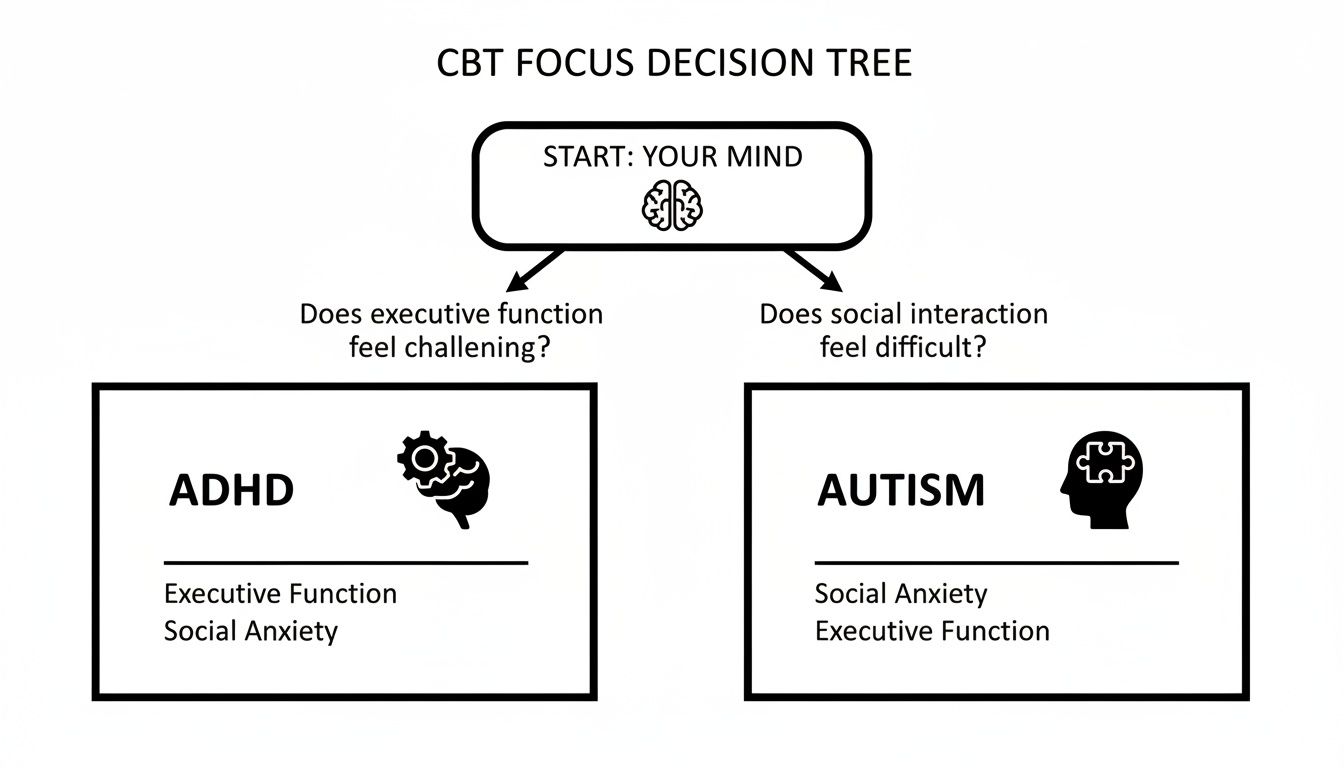
As you can see, the starting point is always what's going on in your mind, but the therapeutic journey branches out depending on the specific hurdles you're facing.
Comparing CBT Access Routes in Birmingham
To help you see everything side-by-side, this table breaks down the key differences between the three main pathways for accessing CBT in Birmingham.
| Feature | NHS (IAPT) | Private Clinics | Online Services |
|---|---|---|---|
| Cost | Free | £70 – £150+ per session | Varies; often competitive with private clinics |
| Waiting Times | Can be several months | Typically 1-2 weeks | Usually very short; often within a week |
| Choice of Therapist | Limited; assigned by the service | High; you choose your own specialist | High; access to specialists nationwide |
| Flexibility | Lower; fixed appointments | Good; sessions can be arranged directly | Excellent; sessions from your own home |
Ultimately, the best path for you comes down to your personal situation. Think about your budget, how urgently you need to speak to someone, and whether finding a therapist with specific expertise in ADHD and Autism is a top priority for your mental health.
How to Choose the Right Neurodivergent-Affirming Therapist
Finding the right therapist can feel a bit like dating. It’s all about finding the right connection, and a bad match can leave you feeling completely deflated. This is especially true when you're neurodivergent. You don't just need a qualified professional; you need someone who truly gets how your brain is wired and is ready to adapt their approach for you.
That connection is what we call the therapeutic alliance, and honestly, it's the most reliable sign of whether therapy will actually work. It’s that feeling of trust, teamwork, and mutual respect you build with your therapist. Without it, even the best, most proven techniques can fall flat.
When you start looking for CBT in Birmingham UK, the first thing to check is professional accreditation. You’ll want to look for therapists registered with the British Association for Behavioural and Cognitive Psychotherapies (BABCP). Think of this as the gold standard in the UK—it guarantees they’ve met some pretty strict training and ethical guidelines. But that’s just the starting point, not the finish line.
Questions to Ask a Potential Therapist
A good therapist won't just tolerate your questions; they'll welcome them. Most are happy to have a quick introductory chat before you commit. This is your chance to interview them, to see if their style clicks with what you need. Don't hold back or feel shy about being direct—you're looking out for yourself here.
Here are a few essential questions you could ask:
- Experience with Neurodiversity: "Could you tell me a bit about your experience working with autistic adults or adults with ADHD?"
- Adaptation of Techniques: "How do you typically adjust standard CBT techniques for someone with Autism or ADHD?"
- Specific Challenges: "How do you approach helping clients with executive function challenges like procrastination, or social anxiety linked to Autism?"
- Therapeutic Style: "How would you describe your approach? Are you more structured and directive, or do you tend to be more flexible?"
This isn't an interrogation; it's a conversation. Pay close attention to how they answer. Do they use language that feels respectful and affirming? Do they sound patient, or are they rushing? Trust your gut. If something feels off, it probably is.
A truly neurodivergent-affirming therapist isn't trying to 'fix' you or change who you are. Their goal is to help you build a life that actually works for your unique brain, giving you tools to handle co-occurring mental health issues like anxiety or depression while celebrating your autistic or ADHD identity.
The Importance of the Therapeutic Relationship
The strength of this relationship really can't be overstated. Research from the University of Birmingham, specifically the CBTBAR trial, showed that the sense of alliance, engagement, and commitment were crucial factors in therapy creating real change. This work reinforces that for therapy to be effective, you have to feel connected and truly involved in the process. You can dig into the research on therapeutic relationships and engagement if you want to learn more.
At the end of the day, picking a therapist is a deeply personal choice. Qualifications are a must, of course, but that feeling of being genuinely seen and understood is what will make all the difference. Remember, the aim isn't just to find a therapist; it's to find your therapist. Getting this right is a vital part of undertaking a private mental health assessment in the UK, as it sets the foundation for all the work that follows.
What to Expect in Your First CBT Sessions
Stepping into a therapist's office for the first time can feel a bit daunting. What actually happens? Let's demystify the process and give you a clear picture of what your initial Cognitive Behavioural Therapy sessions will involve, especially when focusing on ADHD and Autism. From the very beginning, CBT is built on collaboration—it’s a structured, supportive partnership.
Your very first meeting is what we call an initial assessment. Don't let the word "assessment" worry you; it's really just a conversation. You'll chat about what brought you to therapy, the specific difficulties you're up against—be it anxiety linked to Autism, or overwhelm from ADHD—and what you're hoping to change.
A good therapist uses this time to truly get to grips with your world. For an autistic person, that might mean exploring sensory sensitivities or the nuances of social anxiety. For someone with ADHD, the conversation might centre on the daily battles with executive functions, like procrastination or staying on top of emotions.
This first step is all about building a strong connection—the therapeutic alliance—so you feel genuinely heard and understood. It’s from this foundation that you’ll start mapping out your journey together.
Setting Clear and Achievable Goals
CBT isn't about aimless chats; it’s a practical, goal-focused therapy. You'll work together with your therapist to define exactly what you want to achieve. These goals won't be vague wishes but clear, measurable, and realistic targets tailored to ADHD or Autism.
For instance, a goal could look like this:
- "I want to cut down procrastinating on my work tasks from five days a week to just two within the next eight weeks." (ADHD-focused)
- "My goal is to have three solid coping strategies I can use when I feel sensory overload in the supermarket." (Autism-focused)
- "I’d like to be able to start one social conversation each week without feeling completely overwhelmed by anxiety." (Autism-focused)
Setting goals like these gives your therapy a clear direction. They also serve as important milestones, so you can track your progress and celebrate the wins as they happen.
This collaborative goal-setting is incredibly empowering. It shifts the dynamic entirely. Therapy becomes a partnership where you are the active driver of your own change, not just a passenger.
The Structure of a Typical Session
After the initial assessment, your sessions will usually fall into a predictable rhythm. This structure can be particularly reassuring for many autistic and ADHD individuals who find comfort in routine. A typical CBT session in Birmingham usually follows a simple pattern:
- Check-in and Agenda Setting: You’ll kick off by touching base on how your week has been. Then, you'll both agree on what to focus on for that session, making sure you get the most out of your time.
- Reviewing 'Homework': This isn't like school homework, so don't worry! It’s about discussing the practical exercises you tried between sessions. You'll explore what worked, what you found tricky, and what you discovered in the process.
- Learning New Skills: The core of the session is dedicated to exploring a new cognitive or behavioural technique relevant to ADHD or Autism. This might mean learning how to challenge a negative thought pattern, breaking down a tough problem, or planning a small 'behavioural experiment' to test out a new approach in the real world.
- Planning for the Week Ahead: To wrap up, you'll summarise the main takeaways from the session and agree on a new practical task to put into practice before you next meet.
The overall length of therapy can vary. For many specific issues linked to Autism or ADHD, a course of CBT might last between 12 to 20 sessions. And you won't just be left to figure things out alone afterwards. Towards the end, you’ll work with your therapist to create a maintenance plan, giving you the tools to keep using your new skills and navigate future challenges with confidence.
When Therapy Connects with the Real World: Medico-Legal Reports and Referrals
Your therapy journey doesn't happen in isolation. It's deeply woven into your work, your studies, and your home life. Sometimes, you'll need formal documentation to get the right support in those areas, and that’s where a medico-legal report comes in.
Think of these reports as official, expert-backed documents. They explain how a condition, like ADHD or Autism, affects your ability to function day-to-day. This kind of evidence is exactly what you need to support applications for educational help, like the Disabled Students' Allowance (DSA), or to request reasonable adjustments at work. In more serious situations, like an employment tribunal, a solid report is absolutely vital.
A consultant-led service is perfectly placed to provide the specialised psychiatric insight required for these documents. You can learn more about how a professional medico-legal consultancy can help make your case clearly and effectively.
Knowing When to Call in Other Experts
CBT is a fantastic tool, but it's not a silver bullet for everything. A truly professional and ethical CBT therapist knows the boundaries of their own expertise. Their priority is your overall wellbeing, which sometimes means bringing other specialists into the picture to ensure you get complete, well-rounded care for your mental health.
So, when might your therapist suggest seeing someone else? Here are a few common scenarios for those with ADHD or Autism:
- Seeing a Psychiatrist: If you're considering medication for ADHD or a co-existing condition like depression, your therapist will refer you to a psychiatrist. They are the medical doctors who can properly assess and prescribe.
- Working with an Occupational Therapist: These experts offer brilliant, practical strategies and tools. They can help you manage daily tasks, cope with sensory sensitivities common in Autism, or make your workspace more ADHD-friendly.
- Consulting a Dietitian: For anyone whose mental health is tangled up with their eating habits or nutritional issues, a dietitian provides specialist guidance that a therapist can't.
Why the Right Therapeutic Fit is Non-Negotiable
This referral system really brings home a critical point: not every therapy works for every person or every condition. It's absolutely essential that your treatment is carefully matched to your specific diagnosis and mental health profile.
Take CBT, for instance. While it's incredibly versatile, it's not always the right fit. A UK study looking at patients with ME/CFS (a condition sometimes managed through similar pathways) found that CBT could actually make symptoms worse. After treatment, the number of participants who rated their condition as severe jumped from 10.9% to 19.1%.
This starkly illustrates why an expert-led assessment is so important before starting any therapy. You can read more about the crucial need for matching therapy to the condition on the ME Association website. It’s precisely why a skilled CBT Birmingham UK therapist will always start with a thorough assessment and won’t hesitate to refer you to a different specialist if that’s what’s best for your mental health.
Got Questions About CBT in Birmingham? We've Got Answers.
Stepping into the world of therapy can feel a bit overwhelming, and it’s natural to have questions. Here, we'll tackle some of the most common queries people have about finding and starting CBT in Birmingham UK, particularly for adults exploring support for ADHD and Autism. The goal is to give you clear, practical information so you can move forward with confidence.
How Long Is the NHS Waiting List for CBT in Birmingham?
This is the million-dollar question, and the honest answer is: it varies. For NHS services like Birmingham Healthy Minds, waiting times really depend on how many people are seeking help at any given time. If you're referred for lower-intensity support, like guided self-help, you might hear back in just a few weeks.
However, for the more intensive, one-to-one CBT sessions, the wait can often stretch into several months. This long wait for mental health support is what leads many people with ADHD or Autism to look into private or online routes for quicker access to a therapist.
Does CBT Actually Work for Anxiety Linked to Autism?
Yes, it absolutely can, but with a big caveat: it has to be adapted. A good therapist won't just roll out a standard CBT programme. They'll know to adjust their approach, making it more concrete, using visual aids, and being mindful of sensory processing differences.
The real focus becomes about explicitly teaching skills—like how to better read social situations or developing go-to coping mechanisms for anxiety-inducing environments. When done right, it’s a powerful way to build self-regulation and grow in confidence.
Can a CBT Therapist Diagnose Me with ADHD or Autism?
That’s a definite no. A CBT therapist isn’t qualified to give you a formal diagnosis of a neurodevelopmental condition like ADHD or Autism. That job is reserved for specialists, usually a consultant psychiatrist or a highly trained clinical psychologist who can conduct a full, in-depth mental health assessment.
That said, your therapist can still play a massive role. They're there to help you manage the day-to-day symptoms and can be an invaluable source of support while you go through the separate process of getting a diagnosis. They help make the whole journey feel much less daunting.
What if I Just Don't Click with My Therapist?
The relationship you build with your therapist—what we call the 'therapeutic alliance'—is one of the biggest predictors of success. If it doesn't feel right, it probably isn't. It's completely normal, and actually quite common, not to gel with the first person you meet. You should never, ever feel stuck with a therapist you don't feel comfortable and safe with.
If you're paying for a private therapist, you simply have the freedom to find someone new. If you're with an NHS service, you can raise your concerns with the service manager and ask about the possibility of being matched with a different therapist. Any true professional will understand and support your need to find the right person for you.
At Insight Diagnostics Global, we offer a clear, straightforward path to understanding your mental health. Our expert, consultant-led online assessments cover ADHD, Autism, and a range of other conditions. As a CQC-regulated service, we help you bypass long waiting lists, connecting you directly with specialist psychiatrists who provide thorough diagnostic reports and personalised treatment plans, all from your own home. Ready to find clarity and support? Explore our services at https://insightdiagnostics.co.uk.