

Navigating the workplace when you have ADHD, Autism, or a mental health condition can often feel like trying to fit a square peg into a round hole. But you don't have to go it alone. The UK Government's Access to Work grant is a fantastic, practical support system that offers funding for the exact adjustments, coaching, and equipment you need to not just survive, but truly thrive in your job.
Think of it less as a benefit and more as a strategic investment in your professional success, bridging the gap between your unique talents and standard workplace structures.
Thriving at Work with ADHD and Autism

Let's be real—the clash between a neurodivergent mind and a rigid office environment is a genuine, often draining, daily challenge. Whether it's the executive function hurdles of planning and organisation common in ADHD, or the sensory overload and social communication difficulties associated with Autism, the daily grind can easily lead to burnout and affect your mental health. These aren't personal failings; they're simply mismatches between a person and their environment.
And this struggle is incredibly common. A staggering 55% of adults evaluated for ADHD in the UK reported major problems finding or keeping a job because of their condition. This single statistic shows just how essential schemes like Access to Work really are.
A Practical Solution for Neurodivergent Professionals
The whole point of the Access to Work grant is to level the playing field. It funds personalised support that tackles the specific barriers you're up against, creating an environment where you can finally perform at your best.
It's a government-funded toolkit for your career. The support is tailored specifically to you and your role, but some of the most common adjustments include:
- Specialist Equipment: Things like noise-cancelling headphones to block out distractions or software that helps with focus and organising tasks.
- ADHD or Autism Coaching: A professional coach who gets neurodiversity can be a game-changer, helping you build solid strategies for time management, project planning, and handling workplace politics.
- Support Workers: Imagine having a virtual assistant to handle the admin tasks you find draining. This frees up your cognitive energy for the work you're actually good at.
To give you a clearer picture, here’s a quick summary of the kinds of support you can expect.
Access to Work Support for Neurodiversity at a Glance
| Support Category | Examples for ADHD & Autism |
|---|---|
| Specialist Equipment & Software | Noise-cancelling headphones, dual monitors, mind-mapping software, text-to-speech tools, project management apps. |
| Coaching & Mentoring | One-to-one ADHD/Autism workplace strategy coaching to develop coping mechanisms and organisational skills. |
| Human Support | Funding for a support worker, job aide, or virtual assistant to help with administrative or organisational tasks. |
| Awareness Training | Training for your colleagues and managers to help them understand neurodiversity and create a more inclusive environment. |
| Travel Assistance | Help with the cost of taxis if sensory issues or anxiety make public transport a significant barrier to getting to work. |
This table just scratches the surface, but it shows the breadth of practical help available.
The goal of Access to Work is to provide practical, funded solutions that go beyond an employer's standard obligations. It empowers you to request the specific tools you need to not just cope, but to truly excel in your career.
Beyond the Grant: Effective Workplace Strategies
While the grant is a phenomenal resource, building a sustainable career also means developing your own strategies. For instance, improving communication skills is invaluable for navigating professional relationships and clearly explaining what you need to your manager.
It's also crucial to understand what counts as fair support from your employer. Our guide on https://insightdiagnostics.co.uk/reasonable-adjustments-for-adhd/ delves into your rights and the kinds of changes you can request, even without an Access to Work grant. By combining funded support with confident self-advocacy, you can create a professional life that truly works for you.
Do You Qualify for Access to Work? Let's Find Out
Before you dive into an application, it’s worth taking a moment to see if you tick the right boxes. The good news is that the eligibility for Access to Work is often more flexible than people think, especially for neurodiversity and mental health.
The basics are simple enough. You need to be 16 or over and live in England, Scotland, or Wales. The main thing they look at is your work situation.
It’s All About Your Employment
To get an Access to Work grant for your ADHD, Autism or mental health condition, you need to be in paid work, or just about to start. 'Paid work' is a really broad term here, covering much more than your standard 9-to-5.
This includes:
- Full-time or part-time jobs (the most common route).
- Self-employment – yes, freelancers, contractors, and business owners are definitely included.
- Apprenticeships.
- Paid internships and work trials.
Basically, if you’re getting paid for your work, the scheme is there to help you thrive in that role. It’s less about finding you a job and more about giving you the tools to succeed in the one you have.
The Biggest Myth: You Don't Need a Formal Diagnosis
Let's clear this up right away, because it’s the one thing that stops so many people from even trying. You do not need an official, medical diagnosis of ADHD, Autism or another mental health condition to apply for and receive support.
Waiting lists for assessments can be painfully long, but the challenges you face at work won't wait. While a diagnostic report is great evidence to have, it is not a deal-breaker.
What really matters is showing the impact your condition has on your work. The focus is on the barriers you face day-to-day, not the specific label.
Access to Work cares more about how your condition affects your job than what it’s called. A strong application clearly explains the specific difficulties your neurodivergent traits or mental health create in your work tasks.
For instance, instead of getting hung up on a specific label, you can simply describe the real-world effects.
- "The constant background noise in our open-plan office makes it almost impossible for me to concentrate on detailed reports."
- "I really struggle with organising my time and prioritising tasks, which leads to missed deadlines and feeling constantly overwhelmed."
- "Commuting on busy public transport causes me a great deal of sensory overload and anxiety, making it a major hurdle just to get to the office."
See the difference? This shifts the conversation from a medical term to the practical, work-related problems you need help solving. It empowers you to get support based on your actual experience.
If you are thinking about getting a formal diagnosis anyway, our guide on how to get tested for ADHD in the UK walks you through that separate process.
Is Your Condition Considered ‘Long-Term’?
The final piece of the puzzle is that your disability or health condition needs to be something that has lasted, or is likely to last, for 12 months or more.
For neurodevelopmental conditions like ADHD or Autism, this is a given since they are lifelong. For mental health conditions like anxiety or depression, it just means the issue is ongoing, not just a temporary rough patch.
If you’re in paid work and a long-term condition is making your job harder than it should be, then you’re almost certainly the kind of person Access to Work was created for.
How to Build a Compelling Application
Getting the green light for Access to Work is one thing, but actually building an application that gets you the right support is another challenge entirely. This isn't just about listing your struggles; it's about translating your real-world experience into a language the assessors can understand and act on.
Think of it as connecting the dots for them. A vague statement like, "I struggle with deadlines," won't cut it. You need to paint a clear picture of the specific barrier in your workplace and how it impacts your performance. This reframing is probably the single most important part of a successful ADHD Access to Work application.
Frame Your Challenges in Workplace Terms
Assessors can't read your mind. They rely on you to provide concrete, work-related examples of how your ADHD, autism, or mental health condition gets in the way of you doing your job.
Let’s take a classic ADHD issue. Saying "I get distracted easily" is true, but it doesn't give them much to work with. A much more effective approach is to be specific:
"My ADHD makes it difficult to filter out background noise in our open-plan office. This means detail-oriented tasks, like proofreading reports or inputting data, take me much longer and I'm more likely to make mistakes."
See the difference? This version clearly states:
- The condition (ADHD).
- The specific workplace barrier (auditory distractions).
- The direct, negative impact on your job (slower work, more errors).
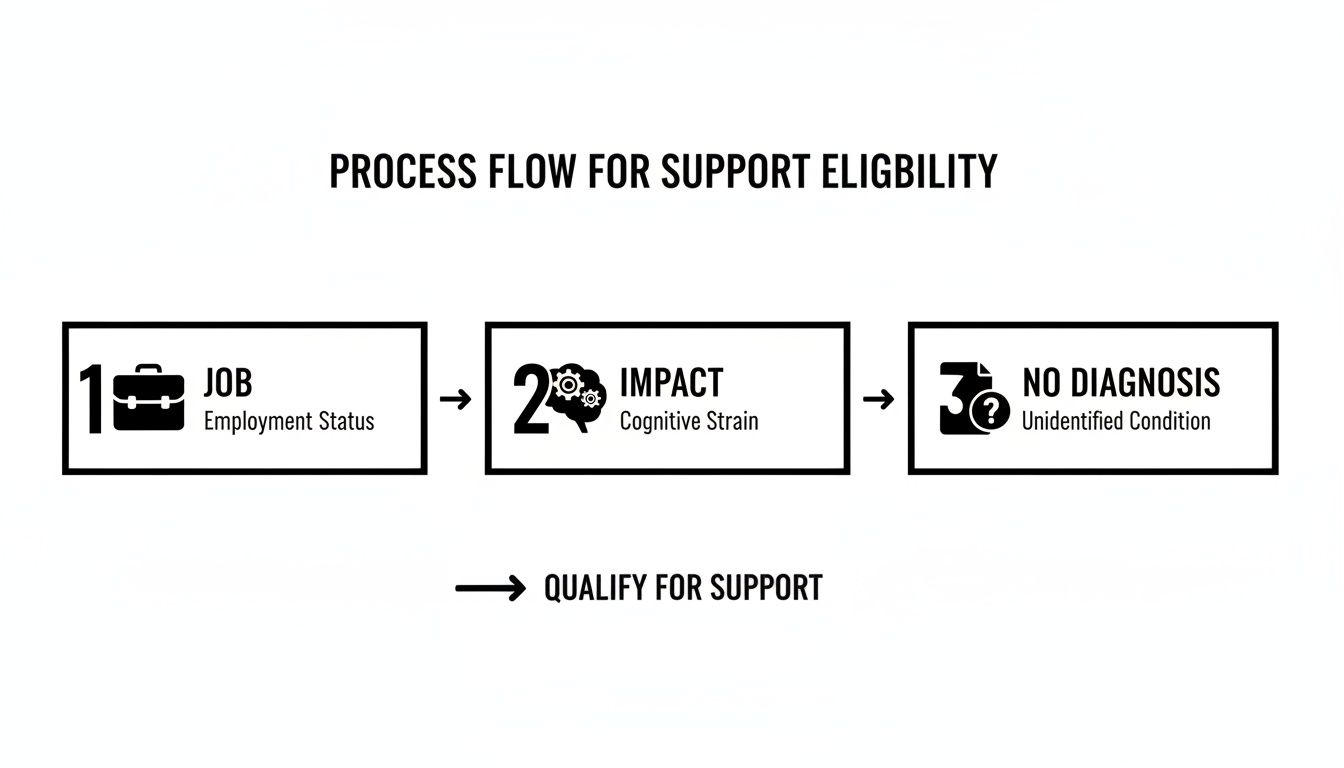
This is exactly what the assessor is looking for. They need to see that there's a job, a demonstrable impact, and a need for support – even if you don't have a formal diagnosis yet.
This flowchart breaks it down visually, showing that the core requirement is how your condition affects you at work. That's the key that unlocks support.
Get Your Information Ready
Before you even think about starting the application, do yourself a favour and get all your information together. Pulling these details beforehand makes the whole process smoother, whether you apply online or over the phone. It also shows the assessor you’ve put serious thought into your needs.
Here’s a quick checklist of what to have on hand:
- Employer Details: The company name, address, and a key contact (usually your manager or someone in HR).
- Job Information: Be ready to clearly describe your role, your main duties, and how long you’ve worked there.
- Impact Examples: Jot down a few specific examples of how your condition affects your work, using the framing technique we just talked about.
- Current Support: Make a note of any adjustments your employer has already put in place or any strategies you already use. This demonstrates you're being proactive.
This prep work isn't just about filling out a form; it's about building your case so you can explain it clearly and confidently.
Specificity is Your Superpower
When you're describing your challenges, always think about the knock-on effect. For instance, emotional dysregulation is a huge part of ADHD that many people don't understand. Just saying you have mood swings is too general.
Instead, you could explain how it affects your professional life. If you want to get a better handle on this, you can learn more about managing these feelings with an emotional dysregulation test.
Here’s how you could frame this for your application:
"Because of rejection sensitive dysphoria linked to my ADHD, I find it really hard to process constructive feedback without feeling intense emotional distress. This makes performance reviews and team collaboration incredibly stressful and has sometimes knocked my confidence in taking on new projects."
This level of detail gives the assessor a concrete problem they can help solve with things like coaching or specialist mentoring. While this guide is focused on the Access to Work grant, it's also worth knowing how to create an ATS-friendly resume template to get your foot in the door in the first place.
Online vs. Phone Application
You have two options for applying: online or by phone. Honestly, neither one is better than the other, so just pick the one that feels right for you.
- Online Application: This is a great choice if you like to take your time and craft your answers carefully. You can save your progress and come back later, which is perfect for getting your thoughts in order.
- Phone Application: If you find writing a chore or just prefer talking things through, applying by phone is a solid option. An adviser will guide you through the questions and fill out the form based on your conversation.
Whichever route you choose, the goal is identical: to present a clear and compelling case that gives a true picture of your life at work. By preparing your information and framing your challenges effectively, you give yourself the best possible shot at a successful outcome.
Getting Your Evidence Together and Nailing the Assessment
Once your application is in, the real work begins. Now you need to show Access to Work how your condition affects you in your job. This isn't about proving you have ADHD or Autism; it's about connecting the dots between your specific challenges and the tasks you do every day. The stronger and clearer this link, the better your chances of getting the right support.
While you don't technically need a formal diagnosis to apply, a diagnostic report is the gold standard of evidence. It's an official, expert opinion that gives weight to everything you've described. For many people, getting that diagnosis is the first concrete step towards getting the help they need.
Why a Diagnostic Report is Your Best Tool
A proper diagnostic report is much more than a piece of paper with "ADHD" or "Autism Spectrum Condition" on it. It should break down your unique profile of strengths and weaknesses, which is precisely what the Access to Work assessor needs to see.
Think of it as the foundation of your case. It’s credible, independent proof that can help the assessor quickly grasp your situation. If you're looking to get this sorted, a comprehensive ADHD assessment for adults can give you both the clarity and the official documentation you need to make a powerful request for support.
A great diagnostic report explains the how and why. It doesn't just say you have executive dysfunction; it explains how that executive dysfunction makes it incredibly difficult to plan multi-stage projects or manage your inbox, directly impacting your performance.
Don't worry if you don't have a full report, though. Other documents can still build a strong case. A detailed letter from your GP, psychiatrist, or therapist can be incredibly useful, especially if they can speak directly to how your condition impacts your ability to function at work.
Preparing for the Workplace Needs Assessment
After the initial paperwork, you'll almost certainly be invited to a workplace needs assessment. It’s easy to get nervous about this, but please don't. This is not a test or an interrogation. It's a constructive conversation with an expert whose only job is to figure out what will help you thrive at work.
Usually, this happens over the phone or a video call with an independent assessor. They're there to listen, understand your role, and recommend practical, fundable solutions.
A little bit of prep beforehand can make all the difference.
What to Expect From the Call
- A deep dive into your job: The assessor will want to know about your main duties and, crucially, which specific tasks cause you the most difficulty.
- A brainstorming session: They'll suggest different types of support, from noise-cancelling headphones and software to specialist coaching or even a support worker.
- An honest chat: This is your moment to be completely open. Don't play down your struggles. The more real you are, the more targeted and effective the final recommendations will be.
See the assessor as a problem-solving ally. They're clued up on all the adjustments that work well for neurodivergent people and may suggest things you've never even heard of, like a virtual assistant to help with admin or mind-mapping software to organise complex projects.
How to Talk About Your Needs
When you're on that call, being clear and specific is everything. You want to paint a vivid picture of what your day-to-day reality looks like. Instead of just saying you have a problem, give them a concrete example of that problem in action.
Here’s a look at how to frame your challenges effectively:
| Instead of this… | Try saying this… |
|---|---|
| "I'm bad with time management." | "I have difficulty with time perception, so I consistently underestimate how long reports will take. This means I often end up working late to hit deadlines, which causes a lot of stress." |
| "I find meetings really hard." | "In back-to-back meetings, I struggle to process all the verbal information and my focus drifts. I often leave without being clear on my action points." |
| "I get overwhelmed in the office." | "The constant background noise and movement in our open-plan office leads to sensory overload by about 2 pm. After that, my ability to do any deep, focused work is pretty much gone." |
This level of detail is gold dust for an assessor. It shifts the conversation from a vague issue to a tangible, real-world problem that has a practical solution. If you prepare your examples and are ready to be open, you give the assessor everything they need to recommend a support package that could genuinely change your working life for the better.
Putting Your Workplace Adjustments into Action

Getting your Access to Work grant approved is a huge relief, but it’s really just the starting line. The next, and arguably most important, step is to turn that list of recommendations into tangible support that actually makes your working day better. This is where you, your manager, and HR will need to work together to put everything into practice.
It's crucial to remember what these adjustments are for. They aren't perks or unfair advantages; they are practical tools designed to level the playing field, removing the specific barriers that ADHD or Autism puts in your way so you can bring your A-game to work.
Common Adjustments for Neurodiversity
While your Access to Work report will be tailored specifically to you and your role, there are some common threads in the types of support that help neurodivergent people thrive. Seeing what's worked for others can give you and your employer a solid idea of what's possible.
Tangible Tools and Technology
- Noise-cancelling headphones: An absolute game-changer if you’re sensitive to noise or find it impossible to tune out the office buzz. Seriously, don't underestimate how much mental energy this can save.
- Specialised software: This could be anything from mind-mapping tools that help you visually organise sprawling projects, to text-to-speech software for when your eyes are tired, or project management apps that break down overwhelming tasks.
- Ergonomic equipment: Things like standing desks or even wobble chairs might sound minor, but for anyone with the ADHD restlessness, having a way to move while you work can be incredibly helpful for focus.
Human-Centred Support
- ADHD or Autism coaching: This is where a specialist coach works with you one-on-one. They help you build practical strategies for managing things like time blindness, planning, and emotional regulation, all within the specific context of your job.
- Virtual assistant (VA): Let's be honest, for many of us, it’s the admin that drains the life out of us. Access to Work can fund a VA to handle the tasks you struggle with—think scheduling, managing that overflowing inbox, or data entry—so you can focus on the parts of your job you’re brilliant at.
The real magic happens when the adjustments directly target the specific friction points in your role. The grant gives you a highly personalised toolkit, letting you combine technology and human support to create an environment where you can truly excel.
Starting the Conversation with Your Employer
Broaching this with your manager can feel a bit awkward, but it really doesn't need to be a confrontation. The key is to frame it as a positive step—a collaborative plan to boost your productivity and make things better for everyone.
It’s worth remembering that your employer has a legal duty under the Equality Act 2010 to make reasonable adjustments. The Access to Work grant is specifically designed to help them do this, often covering 100% of the cost.
Often, the simplest way to kick things off is with a clear, direct email. It gives your manager a moment to digest the information before you chat in person.
Here’s a simple template you can adapt:
Subject: Good news about my Access to Work grant
Hi [Manager's Name],
Just wanted to let you know that my application for the Access to Work grant has been approved, which is great news. The assessment has recommended a few adjustments that will really help me manage my [ADHD/Autism] and perform at my best in my role.
The main things they've suggested are [mention 1-2 key adjustments, e.g., some specialist software and a block of ADHD coaching sessions]. The fantastic thing is that the grant will cover the costs.
I've attached the full report for you to have a look at. Would you be free for a quick chat next week to discuss how we can get these things in place?
All the best,
[Your Name]
This approach is professional, proactive, and focuses entirely on the solution. It positions the adjustments as a win-win, helping both you and the business. By taking the lead like this, you’re not just asking for help—you’re taking ownership of your success at work.
Common Adjustments for ADHD vs Autism Spectrum Condition
While there’s a lot of overlap in the types of support that benefit people with ADHD and Autism, there are also some key differences based on the distinct challenges each condition can present. The table below gives a general idea, but remember, everyone's needs are unique.
| Adjustment Type | Beneficial for ADHD | Beneficial for Autism Spectrum Condition |
|---|---|---|
| Noise-Cancelling Headphones | ✅ Helps minimise distractions and improve focus. | ✅ Crucial for managing sensory overload from noise. |
| Structured Routines & Checklists | ✅ Provides external structure to combat executive dysfunction. | ✅ Offers predictability and reduces anxiety. |
| Flexible/Remote Working | ✅ Allows for movement and control over the work environment. | ✅ Reduces sensory and social demands of a busy office. |
| ADHD Coaching | ✅ Specifically targets executive function skills like planning. | ➖ Less common; support is usually focused on social communication. |
| Clear, Written Instructions | ✅ Helps with working memory and reduces misunderstandings. | ✅ Essential for avoiding ambiguity and ensuring clarity. |
| Mentoring/Buddy System | ✅ Can provide accountability and guidance on tasks. | ✅ Helps navigate workplace social rules and unwritten expectations. |
| Assistive Technology | ✅ Tools for time management, reminders, and focus. | ✅ Text-to-speech or communication aids can be very helpful. |
Ultimately, the best workplace adjustments are the ones that address your personal experience. This is why the one-to-one Access to Work assessment is so valuable—it moves beyond general labels and gets to the heart of what you need to succeed.
Building a Career That Works for You
Think of Access to Work as more than just a government grant. It’s your toolkit for genuinely shaping a professional life that plays to your strengths, rather than one that constantly has you fighting against the current.
This whole process is about moving from simply coping with ADHD, Autism or a mental health condition at work to actively creating an environment where you can truly excel. It’s an exercise in taking back control.
From the first moment you check if you’re eligible, right through to the day your new tech or coaching starts, every step you take is a powerful act of self-advocacy. You’re not just asking for help; you’re making a strategic decision to invest in your own long-term success.
Let’s be clear: using the ADHD Access to Work scheme isn't just about making your own job easier. It's a ripple effect. Your success proves the incredible value neurodivergent people bring to the workplace when they have the right support in place.
Ultimately, this is about designing a career that fits you, instead of trying to contort yourself to fit a role that was never designed with your brain in mind. You’re simply removing the barriers so you can focus your energy on what you're brilliant at.
Frequently Asked Questions
When you're trying to get your head around the Access to Work scheme, especially for neurodiversity and mental health, a lot of questions pop up. It's completely normal. Here, I'll walk you through some of the most common queries I hear about getting support for ADHD or Autism.
I'm self-employed – can I still apply?
Yes, absolutely. The Access to Work grant isn't just for people in traditional nine-to-five jobs. It’s fully available to freelancers, contractors, and business owners.
When you apply, you’ll just need to show that you're actively trading. This could be through a recent tax return, your business plan, or even your Unique Taxpayer Reference (UTR) number. The whole point of the scheme is to help you thrive at work, whatever that looks like.
Will my employer have to pay for anything?
This is a big worry for many people, but the answer is usually no. For the kind of support that’s most beneficial for ADHD and Autism – things like specialised coaching or a support worker – Access to Work typically covers 100% of the cost.
Where your employer might have to chip in is for specialist equipment, but this contribution is tiered based on the company's size. Smaller businesses often pay nothing at all.
It's a common myth that asking for support will hit your company’s budget hard. In reality, the scheme is set up to remove cost as a barrier, making it much easier for your employer to say "yes".
How long does the whole process take?
Patience is key here. Right now, the wait time from submitting your application to hearing from an assessor can be several months. It's a frustratingly long time, I know.
But don't let that stop you from getting help. Your employer has a legal duty to provide reasonable adjustments regardless of an Access to Work grant. Start that conversation with them straight away while your application is in the queue.
What happens if I change jobs?
Your Access to Work grant is tailored to you and your specific role, so it doesn't automatically follow you to a new company.
If you move jobs or your duties change significantly, you'll need to let Access to Work know. This means starting a new application to make sure the support you get is right for your new responsibilities and work environment.
At Insight Diagnostics Global, we provide the clear, expert assessments that are the bedrock of a strong Access to Work application. If you're looking for a comprehensive evaluation for ADHD or Autism, our consultant-led team delivers the robust diagnostic report you need to advocate for yourself effectively. Find out more about our CQC-regulated online services by visiting our website.