

Imagine an emotional sunburn. The slightest touch of what you think might be criticism or rejection doesn't just sting—it causes intense, overwhelming mental pain. That’s the closest way to describe Rejection Sensitive Dysphoria (RSD).
RSD is an extreme emotional experience that’s very common in people with ADHD and Autism. While it isn't a standalone diagnosis you'd find in a medical manual, effective rejection sensitive dysphoria treatment gets to the root of the issue. It focuses on managing the underlying neurodivergent condition and building emotional resilience, often through a combination of therapy and sometimes medication tailored to your specific mental health needs.
What Is Rejection Sensitive Dysphoria
Rejection Sensitive Dysphoria (RSD) is a term for the severe emotional pain that some people feel when they perceive rejection, criticism, or failure. For someone with ADHD or Autism, this isn't just a case of feeling a bit down or disappointed. It’s more like a sudden, tidal wave of shame, anger, or despair that feels completely unmanageable and can severely impact their mental health.
The word "dysphoria" comes from Greek and means "unbearable," which perfectly captures the intensity of the feeling.
It's crucial to understand that this isn't a choice or some kind of character flaw. It's a very real neurological response, tied to how the brains of individuals with ADHD and Autism process emotions and social signals. This experience can be so powerful that it starts to dictate behaviour. Some people become relentless people-pleasers, desperate to avoid disapproval, while others might withdraw from social situations entirely, just to avoid the risk of that painful trigger.
The Core Experience of RSD
While RSD shows up differently from person to person, its impact is almost always disruptive to their mental well-being. Many describe the feeling as a physical blow or a sudden, sharp drop into a dark, depressive state. This isn't the kind of disappointment everyone feels from time to time; it’s a massively disproportionate emotional reaction that can take over completely.
At its heart, RSD is an extreme emotional response to perceived social rejection. It can turn a minor stumble into a mental catastrophe, making it incredibly difficult to tell the difference between what you're feeling and what's actually happening. This isn't an overreaction—it's the output of a nervous system that's wired for high sensitivity, a common trait in both ADHD and Autism.
Recognising this is the first step toward getting the right support. The intense emotional pain of RSD is a serious mental health challenge, and it often requires professional help to navigate. The key is to see that these feelings are valid and rooted in a neurological difference, not a personal failing. You can learn more about the link between neurodivergence and emotional control in our guide on ADHD and emotions.
RSD Experiences vs Common Misinterpretations
The intense, internal experience of RSD often looks very different on the outside. This disconnect can lead to significant misunderstandings with friends, family, and colleagues, further impacting the mental health of the individual with ADHD or Autism. The table below highlights how RSD behaviours can be misinterpreted, helping to bridge that gap in understanding.
| RSD Symptom or Behavior | Common Misinterpretation |
|---|---|
| Sudden emotional outbursts (anger, tears) after minor criticism. | "They're being overly dramatic or just can't handle feedback." |
| Constantly seeking reassurance and approval. | "They seem needy and insecure." |
| Avoiding new situations or taking risks for fear of failure. | "They're lazy, unmotivated, or apathetic." |
| Becoming a people-pleaser, always saying 'yes'. | "They're a pushover or don't have their own opinions." |
| Suddenly withdrawing or shutting down in conversations. | "They're being rude, moody, or giving the silent treatment." |
Understanding these different perspectives is vital. For the person with RSD, their reaction feels entirely justified by the emotional pain they're in. For an onlooker, the behaviour can seem confusing and out of proportion. Recognising this gap is the first step toward better communication and support for their mental health.
RSD in the UK Context
The connection between RSD and neurodivergence is impossible to ignore. In the UK, ADHD is thought to affect somewhere between 2.5% and 4% of adults, with Autism diagnoses also on the rise. Within these communities, Rejection Sensitive Dysphoria is an incredibly common challenge that can have a huge impact on daily life and overall mental health.
In fact, some UK research has estimated that up to 99% of individuals with ADHD experience symptoms of RSD. This staggering figure underscores just how vital it is to get specialised support quickly. You can read more about these findings on the prevalence of RSD in the UK.
This high prevalence is precisely why addressing RSD must be a core part of any comprehensive mental health or neurodivergent care plan. By understanding what it is and how it links to conditions like ADHD and Autism, people can start finding the right strategies and support to manage its challenges and improve their quality of life.
The Neurological Roots of RSD in ADHD and Autism
To really get to grips with the intense emotional pain of Rejection Sensitive Dysphoria, we need to look past the surface-level behaviours and into the brain’s unique wiring. RSD isn't a sign of weakness or someone just being "too sensitive"; it’s a genuine neurological response, born from the distinct brain structures and functions we see in both ADHD and Autism. Understanding this is the first crucial step toward validating the experience and finding the right rejection sensitive dysphoria treatment.
For many, learning this is a lightbulb moment. It means those overwhelming feelings of shame or despair aren't a character flaw—they’re a direct result of a nervous system that’s built to process social feedback differently, a core aspect of their ADHD or Autism.
The ADHD Brain and Emotional Amplification
In a brain with ADHD, the systems governing attention and motivation work a bit differently. You might have heard it called an "interest-driven nervous system," and it runs on the neurotransmitter dopamine. In a neurotypical brain, dopamine levels tend to be pretty stable, but in the ADHD brain, they can be less available, creating a constant hunt for something stimulating.
When someone with ADHD gets a bit of social approval, it’s like a much-needed shot of dopamine, and it feels intensely rewarding. But the flip side is brutal. Perceived rejection or even mild criticism can feel like the bottom has dropped out of their world, triggering a sudden, catastrophic dopamine crash. The brain’s emotional regulation centres—specifically the amygdala (the 'fear centre') and the prefrontal cortex (the 'reasoning centre')—don’t communicate as smoothly as they should.
This disconnect means the initial emotional fire alarm pulled by the amygdala isn't calmed down by the logical prefrontal cortex. The end result? A small comment gets misinterpreted as a major personal attack, unleashing an emotional tidal wave that feels completely overwhelming and out of proportion. Since RSD and ADHD often go hand-in-hand, understanding how to approach treating adult ADHD is a huge piece of the mental health management puzzle.
The Autistic Experience with Rejection
For autistic people, the neurological drivers of RSD come from a slightly different place but are just as powerful. A key factor is the difference in social interpretation. Many autistic individuals process social cues analytically—like solving a puzzle—rather than intuitively. This makes socialising incredibly demanding work and can lead to frequent misunderstandings or a persistent feeling of being out of sync with everyone else.
This history of social challenges can create a state of hypervigilance. The brain becomes wired to anticipate rejection, scanning every interaction for potential threats. When a potential slight occurs, it confirms a deeply ingrained fear, triggering an intense emotional response that significantly affects mental health.
What's more, sensory hypersensitivity, a core feature of Autism, plays a significant role. Think of it this way: just as an unexpectedly loud noise can be physically painful, the emotional sting from perceived criticism can be amplified to an unbearable degree. The brain processes this emotional pain with the same intensity as physical pain, which helps explain why it feels so completely debilitating.
This infographic does a great job of showing the vicious cycle of RSD, where the initial perception of rejection spirals into a cascade of painful outcomes.
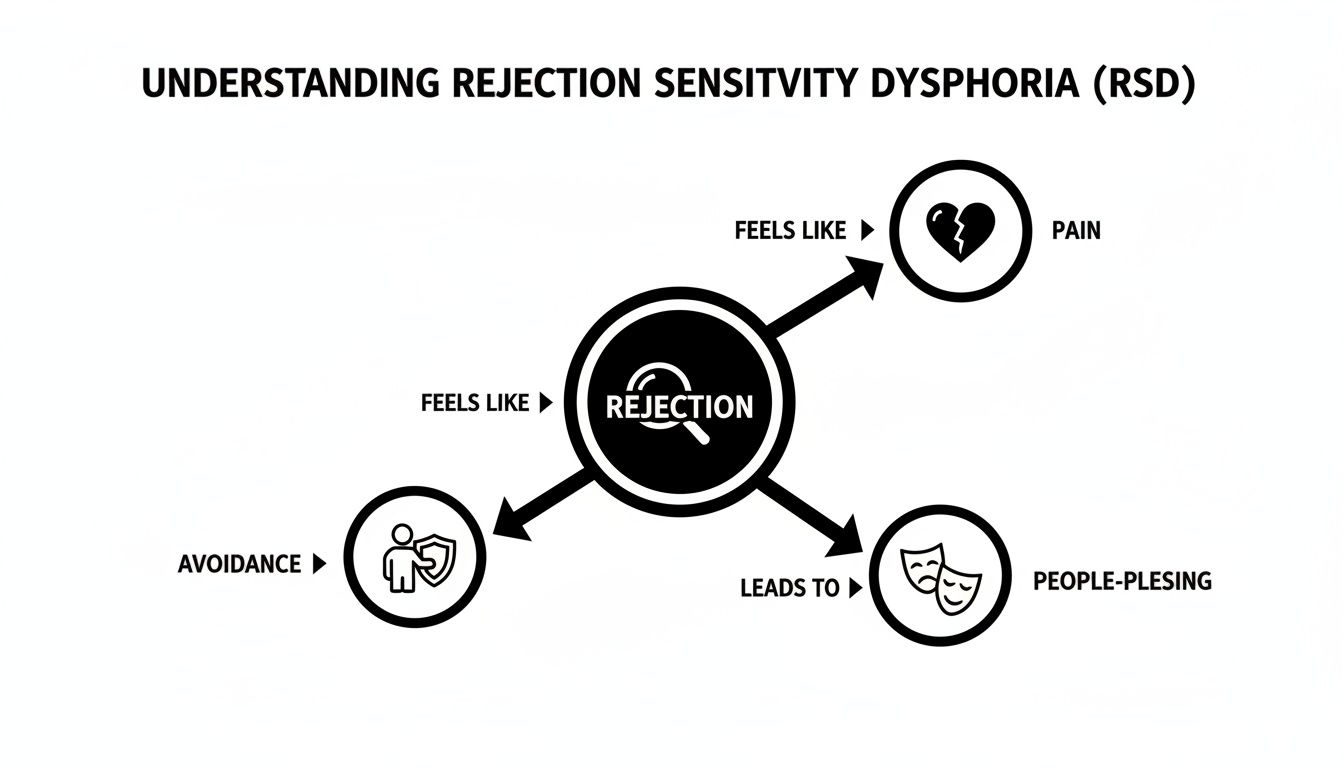
As the diagram shows, a moment of rejection doesn’t just cause a fleeting bit of hurt. It triggers a deep, visceral pain that fuels protective behaviours like avoiding social situations or becoming an extreme people-pleaser. Grasping this neurobiological foundation is everything—it validates the entire experience and makes it clear why any effective treatment has to get to the root of these brain-based differences in Autism and ADHD.
Therapeutic Approaches for Managing RSD
Knowing the neurological side of Rejection Sensitive Dysphoria is one thing, but finding practical ways to deal with it is the crucial next step. For many people with ADHD and Autism, the emotional storms that RSD whips up can feel completely overwhelming. The good news is that evidence-based psychotherapies provide a powerful toolkit for getting back in control. These are structured approaches designed to help you manage the intense pain of perceived rejection and improve your overall mental health.
The aim isn't to numb yourself or stop feeling things entirely. It’s about learning to ride the emotional waves instead of letting them pull you under. Think of it as building a stronger emotional foundation, one brick at a time. This is where the right kind of therapy becomes a cornerstone of any effective rejection sensitive dysphoria treatment plan for neurodivergent individuals.

Cognitive Behavioural Therapy for Neurodivergence
Cognitive Behavioural Therapy (CBT) has been a go-to for years because it’s so effective at helping people spot and change unhelpful thought patterns and behaviours. When it's specifically adapted for neurodivergent minds—recognising the unique thought processes in ADHD and Autism—it becomes an incredibly useful tool for tackling RSD. At its heart, CBT is about intercepting those automatic, catastrophic thoughts that rejection can unleash.
For someone with ADHD or Autism, something as small as a friend cancelling plans can easily trigger a downward spiral: "They can't stand me. I must have done something wrong. I ruin every friendship I have." CBT gives you a practical framework for stopping that spiral in its tracks.
A therapist might help you walk through a process like this:
- The Trigger: A friend cancels coffee.
- The Automatic Thought: "They're avoiding me because they don't like me anymore."
- The Challenge: "Hang on, what's the actual evidence here? They said they had a work deadline. We just made plans for next week. Is my first thought 100% true?"
- The Reframe: "They're probably just swamped with work. I'm disappointed, but it doesn't mean our friendship is on the rocks."
Practising this over and over helps forge new neural pathways. It gets easier to hit the pause button and question that initial gut-punch of emotion before it takes over completely. It's always worth looking at a range of options, and you might find it useful to read our guide on how to treat ADHD without drugs, which delves into other non-medication strategies for mental health.
Dialectical Behaviour Therapy for Emotional Regulation
Where CBT hones in on your thoughts, Dialectical Behaviour Therapy (DBT) is all about giving you practical, in-the-moment skills to handle intense emotions. It was originally created to help people with borderline personality disorder, but its skill-based structure is a fantastic match for the emotional dysregulation that comes with RSD in both ADHD and Autism.
DBT is built on four key skill areas, each one directly targeting the core challenges of RSD.
- Mindfulness: This is about learning to observe your feelings without judging them. Instead of getting completely swept away by the pain of rejection, you learn to sit with it, acknowledge it as a temporary state, and trust that it will pass.
- Distress Tolerance: This part of DBT is like an emotional first-aid kit. When RSD hits hard, you have go-to strategies—like plunging your face into cold water, doing some intense exercise, or using paced breathing—to survive the peak of the storm without acting impulsively.
- Emotional Regulation: Here, you learn the nuts and bolts of your emotions. You'll work on understanding what makes you vulnerable to big feelings (like poor sleep or stress) and how to change unwanted emotional responses over the long term by building more positive experiences into your life.
- Interpersonal Effectiveness: This is all about communication. You learn how to ask for what you need and set boundaries in a clear, respectful way. This alone can significantly cut down on the kinds of misunderstandings that often trigger RSD in the first place.
DBT gives you a toolkit. When the emotional storm of RSD arrives, you don't have to just endure it. You have specific, practical actions you can take to ground yourself, tolerate the distress, and communicate more effectively, improving your mental health outcomes.
On top of formal therapies, bringing practices like mindfulness into your daily routine can make a huge difference. Taking some time to explore different mindfulness exercises for stress relief can give you more tools for self-regulation and calm. By weaving these structured therapies together with your own personal coping strategies, you can build incredible resilience against the pain of RSD.
How Medication Can Help Regulate RSD
While therapy and coaching build vital emotional skills, sometimes the sheer force of Rejection Sensitive Dysphoria is too much to handle with strategies alone. For many people with ADHD and Autism, this is where medication can become an essential part of the puzzle. It doesn't numb you or erase your feelings; instead, it works on a deeper level, helping to regulate the brain's hair-trigger response that makes emotions so overwhelming.
Think of it as turning down the volume on a speaker that's blasting static. Medication can lower that baseline emotional noise, giving you the mental space to hear your own thoughts, engage properly with therapy, and actually use the coping skills you're learning. It creates a stable foundation, allowing the other mental health work to finally stick.
Addressing RSD Through ADHD Medication
Because RSD is so tangled up with the emotional dysregulation common in ADHD, it’s not surprising that medications designed for ADHD often bring significant relief. These treatments target the brain’s neurotransmitter systems, which not only improves focus and impulse control but, crucially, can also steady the emotional ship and improve mental health.
Stimulant Medications: Drugs like methylphenidate and lisdexamfetamine increase the availability of key brain chemicals, dopamine and norepinephrine. By doing so, they can strengthen the lines of communication between the brain’s emotional hub (the amygdala) and its rational command centre (the prefrontal cortex). This helps put the brakes on that instant, gut-wrenching reaction to perceived rejection, giving you a precious moment to think before you feel.
Non-Stimulant Medications: Options like atomoxetine work a bit differently, building up levels of norepinephrine over time. The change is more gradual, but for some, it provides a more consistent, 24/7 improvement in emotional stability. To get a better sense of all the options, you might find our guide on the best ADHD medication for adults helpful.
Alpha-2 Agonists: A More Direct Approach
While ADHD medications often help as a positive side effect, another class of medication seems to tackle the hyperarousal of RSD head-on. The most promising of these are the alpha-2 agonists, like guanfacine and clonidine. Originally used to treat high blood pressure, they are now commonly prescribed off-label in the UK for the emotional rollercoaster that comes with ADHD.
These medications work on a different pathway. They are thought to calm the brain’s overactive "fight or flight" response that RSD loves to trigger, essentially strengthening the prefrontal cortex’s ability to manage overwhelming emotional signals.
The effect can be remarkably fast and profound. It's not uncommon for patients to report an 80-90% reduction in the intensity of their RSD symptoms within just hours of finding the right dose.
This powerful impact really drives home the biological reality of RSD. A 2021 UK study highlighted just how common it is, finding that up to 99% of people with ADHD report experiencing it. This staggering figure explains why a treatment plan that addresses the underlying neurobiology is often so necessary for improving mental health.
Why Professional Guidance is Non-Negotiable
It's absolutely critical to understand that medication for RSD isn't a quick fix or something to experiment with. Finding the right treatment is a careful, personalised process that must be led by a qualified specialist in neurodivergent mental health.
A proper approach always involves:
- A comprehensive psychiatric assessment to confirm the diagnosis of ADHD or another underlying condition like Autism.
- Careful medication choice, factoring in your unique symptoms, medical history, and overall mental health.
- A meticulous titration period, where your dose is adjusted slowly and carefully to find that sweet spot between maximum benefit and minimal side effects.
- Ongoing monitoring with your specialist to ensure the medication remains safe and effective for you in the long run.
In the right hands, medication can be a genuinely life-changing tool. It can provide the stability needed to break free from the painful cycle of RSD and start building a more confident, emotionally resilient life.
Practical Strategies for Daily Life with RSD
While therapy and medication are the cornerstones of a good rejection sensitive dysphoria treatment plan, it’s what you do day-to-day that really cements your progress. Living with the emotional intensity of RSD, especially when it’s tied to ADHD or Autism, means you need a toolkit of practical strategies you can pull out in the heat of the moment. These techniques are all about empowering yourself between your appointments and supporting your own mental health.
Think of these strategies as your own personal emotional first-aid kit. They won’t magically stop every trigger from happening, but they can dramatically lessen the emotional fallout and help you get back on your feet much faster.

Developing Self-Awareness and a Pause Plan
The first step is learning to be a detective of your own emotions. Start by getting really curious about your personal RSD triggers. Is it a vaguely worded email from your boss? A friend taking too long to text back? The feeling of being on the outside of a conversation? Nailing down exactly what sets you off is the most crucial piece of the puzzle for anyone with ADHD or Autism.
Once you know what your triggers are, you can create a ‘pause plan’. This isn’t complicated; it’s just a pre-planned action you commit to taking the second you feel that familiar spike of emotion. It creates a vital buffer between the trigger and your reaction.
Your pause plan could be as simple as:
- Physical Movement: Get up and leave the room. Walk around the block. Do a few quick stretches.
- Sensory Input: Splash cold water on your face, hold an ice cube in your hand, or put on a specific song that you find calming. This can be particularly effective for autistic individuals.
- Breathing Exercise: Take just three slow, deep breaths, focusing on nothing but the feeling of the air moving in and out of your lungs.
The goal here isn't to squash the feeling. It’s to give the logical part of your brain—the prefrontal cortex—a fighting chance to catch up with the initial emotional gut punch from your amygdala.
Grounding Techniques and Mindfulness
When RSD sends your thoughts into a spiral, grounding exercises are brilliant for pulling you back into the here and now. They work by anchoring you to your physical reality, which helps to turn down the volume on the internal chaos that damages mental health.
A beautifully simple and effective method is the 5-4-3-2-1 technique. Just stop and notice: five things you can see, four things you can feel, three things you can hear, two things you can smell, and one thing you can taste. This little trick forces your brain to focus on real-world sensory information instead of the emotional pain.
Mindfulness is the related practice of just observing your thoughts and feelings without getting tangled up in them. Instead of being swept away by the "I'm a complete failure" narrative, you learn to see it for what it is: just a thought. It's a temporary blip in your brain that doesn't have to be your reality.
Lifestyle Factors and Communication Scripts
Building a more resilient nervous system is a huge part of managing RSD for the long haul. That means getting serious about sleep, nutrition, and regular exercise. These basics give your brain the fuel it needs to regulate emotions more effectively. A well-rested and well-fed brain is simply less likely to be hijacked by its emotions, which is critical for the mental health of those with ADHD or Autism.
For UK adults with ADHD, RSD is an almost universal part of the experience, with its prevalence hitting as high as 99%. For a third of those people, it’s the single most disabling symptom they face. Effective management often involves a mix of strategies, including ADHD medications that can help regulate dopamine and dial down that emotional sensitivity. You can find more on this in this excellent article about RSD and its treatment in ADHD on hsmh.co.uk.
Finally, trying to explain RSD to people can be tough. Having a few simple scripts ready can make a world of difference. You could try saying something like, "Sometimes my brain processes feedback really intensely due to my ADHD/Autism, and I might need a minute. It's not personal to you; it’s just the way I’m wired." A little bit of clear communication can go a long way in creating the supportive environment you need to thrive.
Finding Professional and Medico-Legal Support
It takes courage to admit you need help, but knowing when to take that step is key. If the emotional pain from perceived rejection is starting to poison your relationships, stall your career, or has plunged you into a low mood you just can't shake, it’s time to talk to a mental health professional. These aren't signs of weakness; they're signals that the coping strategies that once worked are now being overwhelmed.
This is particularly true if you have ADHD or Autism, where RSD can feel less like a passing shower and more like a constant, raging storm. When self-help runs out of road, professional support provides the structured expertise needed to build real, lasting resilience. A good clinician can help you move from a painful cycle of emotional reactivity to a place of genuine understanding and control over your mental health.
The Comprehensive Psychiatric Assessment
The first, and most essential, step toward getting the right rejection sensitive dysphoria treatment is a comprehensive psychiatric assessment. This isn’t just a quick chat. It's a deep diagnostic dive designed to map out your unique brain wiring, pinpointing your specific challenges and strengths. The main goal is to confirm or rule out underlying conditions like ADHD or Autism, which often fuel RSD's intensity.
This process gives a specialist a full, 360-degree view of your mental health, allowing them to create a personalised, evidence-based plan just for you.
A thorough assessment is the absolute bedrock of successful treatment. It ensures that any therapy or medication is targeted precisely to your specific neurotype, whether that's ADHD, Autism, or both. This avoids guesswork and focuses on what will genuinely move the needle for you. That kind of clarity isn't just helpful—it's essential for safe and effective care.
To get a better sense of how this works in practice, you might find our article on Rejection Sensitive Dysphoria and the NHS useful.
Navigating Medico-Legal Challenges
Sometimes, the fallout from RSD isn't just personal; it can spill over into your professional life with serious consequences. In difficult situations like workplace disputes, harassment claims, or employment tribunals, the medico-legal side of things suddenly becomes critical. An intense emotional reaction, driven by RSD related to ADHD or Autism, can easily be misinterpreted by others as insubordination or unprofessional conduct, putting your job on the line.
This is where a court-compliant psychiatric report can be a game-changer. These impartial, expert-written documents do two crucial things:
- Provide a Clinical Explanation: They clearly and formally explain how RSD, as a feature of a condition like ADHD or Autism, affects your emotional regulation and behaviour. This gives crucial context to actions that might otherwise be completely misunderstood.
- Serve as Legal Evidence: The report stands up as robust evidence in legal proceedings. It can help demonstrate that your experiences are tied to a recognised medical condition, which is often vital in cases of disability discrimination or unfair dismissal.
By drawing a clear line between the emotional impact of RSD and a formal diagnosis of a neurodevelopmental condition, these reports bridge the gap between your private mental health struggles and the objective demands of the legal system. They become a powerful tool for your protection and advocacy.
Frequently Asked Questions About RSD Treatment
If you're exploring treatment for Rejection Sensitive Dysphoria, it's natural to have a lot of questions. It can be a confusing topic, especially when it comes to getting a diagnosis and figuring out what actually works. Here are some straightforward answers to the questions we hear most often from people with ADHD and Autism who are looking for help with their mental health.
Is Rejection Sensitive Dysphoria an Official Diagnosis in the UK?
This is a really common point of confusion. The short answer is no; RSD is not a standalone diagnosis in the official manuals used by UK clinicians, like the DSM-5 or ICD-11.
Instead, think of it as a well-recognised and significant part of the emotional dysregulation that often comes with conditions like ADHD and Autism Spectrum Disorder. A good psychiatric assessment won’t just look for RSD in isolation. It will dig deeper to see how these symptoms fit into your complete neurodivergent profile, which is absolutely essential for creating a mental health treatment plan that actually works.
Can I Get Treatment for RSD Without an ADHD or Autism Diagnosis?
Because the extreme emotional pain of RSD is so deeply connected to the brain wiring of conditions like ADHD and Autism, effective treatment has to get to the root of the problem. Simply put, you can't properly treat RSD without addressing the underlying neurodevelopmental condition that's fuelling it.
This is why a formal assessment is always the first, most crucial step. It confirms whether a neurodivergent condition is present, ensuring that any treatment plan is correctly targeted and safe. Trying to manage RSD symptoms without understanding their origin is like trying to fix a leak without finding the source of the water—it just won’t be effective for your long-term mental health.
How Quickly Can I Expect to See Results from Treatment?
The timeline for feeling better really does depend on the person and the approach. For some, certain medications can bring surprisingly fast relief. Alpha-2 agonists like guanfacine, for example, have been reported to dial down the intensity of emotional reactions within a few hours or days once the right dose is found.
On the other hand, therapies like Cognitive Behavioural Therapy (CBT) or Dialectical Behaviour Therapy (DBT) are more of a slow burn. They require commitment and practice. You'll likely start noticing real shifts in your thought patterns and emotional resilience after several months of dedicated work with your therapist.
The most successful approach for individuals with ADHD or Autism is almost always a combination of strategies. A specialist psychiatrist can help you map out a realistic timeline and fine-tune the plan as you go.
Are There Natural Ways to Manage RSD Symptoms?
Absolutely. While they aren't a substitute for professional, evidence-based treatment, lifestyle changes can make a massive difference in building a more resilient nervous system and supporting your mental health. Think of them as the foundation upon which targeted treatments for your ADHD or Autism can be built.
Here are a few key strategies that can offer powerful support:
- Regular physical exercise is a brilliant way to regulate mood and burn off stress.
- A balanced, nutrient-rich diet helps keep your brain chemistry stable.
- Consistent, high-quality sleep is non-negotiable for emotional regulation.
- Mindfulness practices like meditation or simple grounding exercises can help calm an overactive nervous system in the moment.
Nailing these basics creates a much stronger baseline for your mental health, making it easier for you to get the most out of therapy and medication.
At Insight Diagnostics Global, our consultant-led team provides comprehensive psychiatric assessments to get to the bottom of conditions like ADHD and Autism, which opens the door to effectively managing RSD. If you're ready to make sense of your emotional world and find mental health support that works, you can explore our services and get in touch.