

Thinking you might have ADHD is one thing, but getting an official diagnosis in the UK involves a specific process. It's not something your GP can do directly. Think of your GP as the starting point – they’re the gatekeeper who listens to your concerns and, if appropriate, refers you to a specialist.
The actual diagnosis has to come from a healthcare professional who has deep, specialised training in neurodevelopmental conditions like ADHD and autism. Most of the time, this will be a consultant psychiatrist.
Who Are the ADHD Diagnostic Professionals?

Figuring out who can give you that formal diagnosis is a critical first step. It can feel a bit overwhelming, especially when symptoms of ADHD often get tangled up with other mental health conditions like autism or anxiety. That’s why you need an expert who can carefully unpick these threads through a really thorough assessment.
These specialists have spent years training to see the subtle ways ADHD shows up in adults. This is so important because adult ADHD rarely looks like the stereotypical image of a hyperactive child. A proper expert assessment also serves to rule out other mental health conditions that might be causing similar symptoms, or even co-existing alongside ADHD.
Key Professionals in Your ADHD Diagnostic Journey
To make sense of it all, it helps to know who's who. Different professionals have distinct roles in the process, and each brings a unique skillset to the table for your diagnosis and treatment, especially when considering overlapping mental health needs.
Here’s a look at the different specialists you might meet on your journey to getting an adult ADHD assessment in the UK.
| Professional | Role in Diagnosis | Can Prescribe Medication? | Typical Setting |
|---|---|---|---|
| Consultant Psychiatrist | Leads the diagnostic assessment, evaluates co-occurring conditions like autism and anxiety, and develops a full treatment plan. | Yes, they are medical doctors who can prescribe and manage medication. | NHS specialist services, private online clinics, and hospitals. |
| Clinical Psychologist | Conducts psychological testing, behavioural analysis, and provides therapy. Contributes to the assessment but often works alongside a psychiatrist. | No, they are not medical doctors and cannot prescribe. | NHS mental health teams, private practices, and academic institutions. |
| Specialist ADHD Nurse | Often assists with the assessment, provides ongoing patient support, and manages medication titration under a psychiatrist's supervision. | Yes, if they are a qualified nurse prescriber, working within a specialist team. | NHS community mental health teams and specialist ADHD clinics. |
This table shows that while a few different professionals are involved, they each play a specific part. It’s not just about ticking boxes; it’s about getting a complete picture of your mental health.
A correct diagnosis is so much more than a label. It's the key that unlocks the right support. It gives you the official validation you need to access workplace adjustments, medication, and therapies that can genuinely change your day-to-day life for the better.
When it comes down to it, the most straightforward route to a complete diagnosis and a clear treatment plan is through a consultant psychiatrist. They have the unique qualifications to manage the entire journey, from that first detailed evaluation right through to prescribing and fine-tuning medication, making sure your care is both comprehensive and expert-led.
Understanding the Specialists Behind Your Diagnosis
Getting an ADHD diagnosis is a big step, and knowing who you can trust is crucial. It’s not just about getting a label; it’s about getting an accurate, detailed picture of what’s going on, drawn by an expert with the right training to see all the nuances of adult neurodevelopmental conditions.
This is especially important because ADHD rarely shows up alone. It often comes with friends like anxiety, depression, and even autism. A proper specialist knows how to untangle these threads. They can see the whole person, not just a checklist of symptoms, making sure that what looks like ADHD isn't something else, or that a co-existing condition gets the attention it needs.
The Role of the Consultant Psychiatrist
When it comes to a reliable adult ADHD diagnosis in the UK, the Consultant Psychiatrist is the central figure. These are fully qualified medical doctors who have spent years specialising in mental health and are registered on the General Medical Council (GMC) Specialist Register. Think of them as the lead detective in your diagnostic journey.
Their medical training is what makes all the difference, for two main reasons:
- Holistic Assessment: They’re trained to perform a complete psychiatric evaluation. This means they can rule out other medical or mental health issues that can sometimes look a lot like ADHD, and they can diagnose co-occurring conditions like autism.
- Prescribing Authority: As doctors, they are the key professionals who can prescribe ADHD medication, oversee the titration process (which is all about finding the exact right dose for you), and monitor how you're getting on.
This combination of skills means they can do more than just diagnose. They can build and manage a complete mental health treatment plan right from the start. If you want to dive deeper into their specific role, you can learn more about finding the right psychiatrist for an ADHD assessment.
Clinical Psychologists and Specialist Nurses
While a psychiatrist usually leads the way, other experts have important roles to play, too. A Clinical Psychologist, for instance, has incredible expertise in psychological testing and understanding behaviour. They can add a lot of valuable insight to an assessment, but because they aren't medical doctors, they can't prescribe medication.
You might also work with a Specialist ADHD Nurse. These are highly trained nurses who often work as part of a team, under the supervision of a consultant psychiatrist. They’re brilliant at handling the practical side of treatment, like helping you manage medication titration, offering ongoing support, and giving you real-world strategies to navigate daily life with ADHD.
A robust diagnosis is built on a foundation of specialist medical expertise. It considers not just the "what" (your symptoms) but the "why" (the underlying neurobiology) and the "what next" (a safe and effective treatment plan).
Ultimately, a consultant psychiatrist is in the unique position to oversee the entire journey, from diagnosis to treatment. Their ability to handle complex cases, tell the difference between overlapping conditions like autism and ADHD, and safely manage medication makes them the gold standard for anyone in the UK seeking a clear and genuinely helpful adult ADHD diagnosis.
The Hidden Crisis of Undiagnosed ADHD in the UK
If you’re struggling to get an ADHD assessment, you’re definitely not alone. Figuring out who can actually diagnose ADHD is one challenge, but the bigger one is often navigating a system that’s creaking under the pressure of a massive, unspoken crisis. This isn't just about your personal journey; it's a nationwide mental health problem affecting countless adults.
There's a huge disconnect between the number of people thought to have ADHD and those who actually get a diagnosis. This has created a serious ‘diagnostic bottleneck’, especially within the NHS. So many adults spend years thinking they might have ADHD, only to hit a brick wall of frustration when they finally seek help.
The Scale of the Diagnostic Gap
The numbers really lay it bare. Public awareness of adult ADHD has shot up, but the services needed to diagnose it just haven't caught up. The hard truth is that only a tiny percentage of adults living with ADHD are ever officially identified.
A deep dive into 9 million GP records across the UK found that a mere 0.32% of people had an ADHD diagnosis on file. That works out to roughly 1 in 300 people. But here's the kicker: population studies suggest the real prevalence is closer to 2.8%. This means for every single person who gets a diagnosis, there could be nine others out there managing on their own. You can read more about these startling UK ADHD diagnosis rate findings.
This isn't just a statistic; it’s a public health problem that leaves thousands of people without the support and understanding that could genuinely turn their lives around.
Navigating the NHS Bottleneck
The most immediate effect of this diagnostic gap is the immense strain on NHS services. For most, the journey begins with a hopeful chat with their GP. But all too often, it leads to a referral with a waiting list that stretches not for months, but for years.
These waiting lists aren't just an inconvenience; they are a monumental barrier to getting help. When you're dealing with the daily chaos of untreated ADHD, being told to wait several years can feel like an impossible task, often making your mental health worse and damaging your work, relationships, and quality of life.
The situation isn't the same everywhere, either. Your access to specialist care can be wildly different depending on where you live, creating a 'postcode lottery' that leaves many feeling completely let down. It’s this systemic pressure that makes getting a timely, specialist-led assessment so critical. Closing this gap is about more than just individual wellbeing—it’s about tackling the huge societal costs of untreated ADHD.
Navigating the NHS and Private Assessment Pathways
When you decide it’s time to get a formal diagnosis for adult ADHD, you essentially have two main roads you can take in the UK: the NHS or the private route. Both paths will ultimately lead to an assessment by a qualified specialist, but how you get there—and how long it takes—couldn't be more different.
Let's break down what each journey looks like so you can figure out which one is right for you.
The NHS Route: Free, But A Long Wait
The journey through the NHS almost always starts at your local GP surgery. You’ll have a chat about your symptoms, and if your doctor agrees that an ADHD assessment is the next logical step, they will refer you to a local specialist mental health service.
The good news? This is all free at the point of care. The bad news? The NHS is under incredible strain, and waiting lists for adult ADHD assessments are notoriously long. We’re not talking weeks or months; in many areas, people are waiting 1 to 5 years, sometimes even longer, just to be seen.
For many adults, putting life on hold for that long just isn't an option. When untreated ADHD is affecting your job, your relationships, and your overall mental health, a faster solution becomes a necessity. This is where the private pathway comes in.
The Private Route: Faster Access to Specialists
Going private means you pay for the assessment yourself, but what you get in return is speed and control. Reputable private clinics, especially those offering online consultations, can often get you a full assessment with a consultant psychiatrist in a matter of weeks. That’s a game-changer.
If you go down this road, there’s one non-negotiable: make sure your chosen provider is regulated by the Care Quality Commission (CQC). The CQC is the independent watchdog for health and social care in England, and their stamp of approval is your assurance of quality and safety. A diagnosis from a CQC-regulated clinic with GMC-registered psychiatrists is a diagnosis you can trust. If you're looking for a firsthand account of this process, this piece on Navigating ADHD Assessments is incredibly helpful.
So what happens after a private diagnosis, especially with medication? Most people aim for a shared care agreement. This is a formal arrangement between your private specialist and your NHS GP. The specialist will work with you to find the right medication and dose, and once you're stable, they'll hand over the day-to-day prescribing to your GP. It’s a collaborative approach that bridges the gap between private and NHS care.
Comparing NHS and Private ADHD Assessment Pathways
To make things clearer, let's put the two pathways side-by-side. Seeing the key differences at a glance can help you weigh up your priorities, from your budget to how urgently you need answers.
| Feature | NHS Pathway | Private Pathway (e.g., Insight Diagnostics) |
|---|---|---|
| Starting Point | GP appointment and referral. | Self-referral directly to the clinic. |
| Typical Timeline | 1-5+ years waiting list for assessment. | Assessment often available within 1-2 weeks. |
| Cost | Free at the point of service. | Privately funded (costs vary by clinic). |
| Specialist Access | Assigned a specialist by the local NHS trust. | Choice of clinics and consultant psychiatrists. |
| Flexibility | Limited appointment flexibility, often in-person. | High flexibility with online video consultations. |
| Shared Care | N/A (care is managed within the NHS). | Can be established with your GP post-diagnosis. |
At the end of the day, it doesn’t matter whether you choose the NHS or a private clinic. The goal is the same: getting a clear, accurate diagnosis from an expert who understands adult ADHD and its common co-occurring conditions.
For a deeper dive into what the assessment process itself involves, you might find our guide on getting an ADHD diagnosis in the UK really useful.
What Really Happens During an ADHD Assessment
The idea of an ADHD assessment can feel a bit intimidating, but knowing what to expect really helps take the mystery out of it. It’s not just about ticking boxes on a form. A proper evaluation is a deep, structured conversation designed to build a complete picture of your mental health and life experiences. The whole point is to give you a clear and reassuring path towards an accurate diagnosis, not to leave you in the dark.
At the heart of the assessment is a structured clinical interview. This is where a specialist sits down with you to dive into your personal history. They won’t just ask about the challenges you’re facing today; they'll want to understand how things have played out in your childhood, school days, career, and relationships. Think of it as a collaborative effort – you tell your story, and the clinician listens to piece together the unique patterns and difficulties you've faced.
Core Components of the Evaluation
To get to a solid, evidence-based conclusion, specialists rely on a mix of diagnostic tools and what’s called 'collateral information'. This multi-angled approach is crucial for distinguishing ADHD from other conditions like anxiety or autism, which can sometimes look quite similar on the surface.
Here’s what you can typically expect:
- Standardised Rating Scales: Clinicians often use tools like the DIVA-5 (Diagnostic Interview for ADHD in Adults). This gives them a consistent framework to make sure they systematically check against all the official diagnostic criteria.
- Collateral Information: This is just a fancy way of saying they might ask to speak with someone who knows you well, like a partner, parent, or close friend. It’s incredibly useful. They can offer an objective view of your behaviours and often remember details from your childhood that you might have long forgotten.
- Screening for Co-occurring Conditions: A thorough assessment will always check for other mental health conditions. Your specialist will carefully screen for things like anxiety, depression, and autism to make sure the final diagnosis is as accurate as possible.
The infographic below shows the two main routes you can take to get to this specialist assessment.
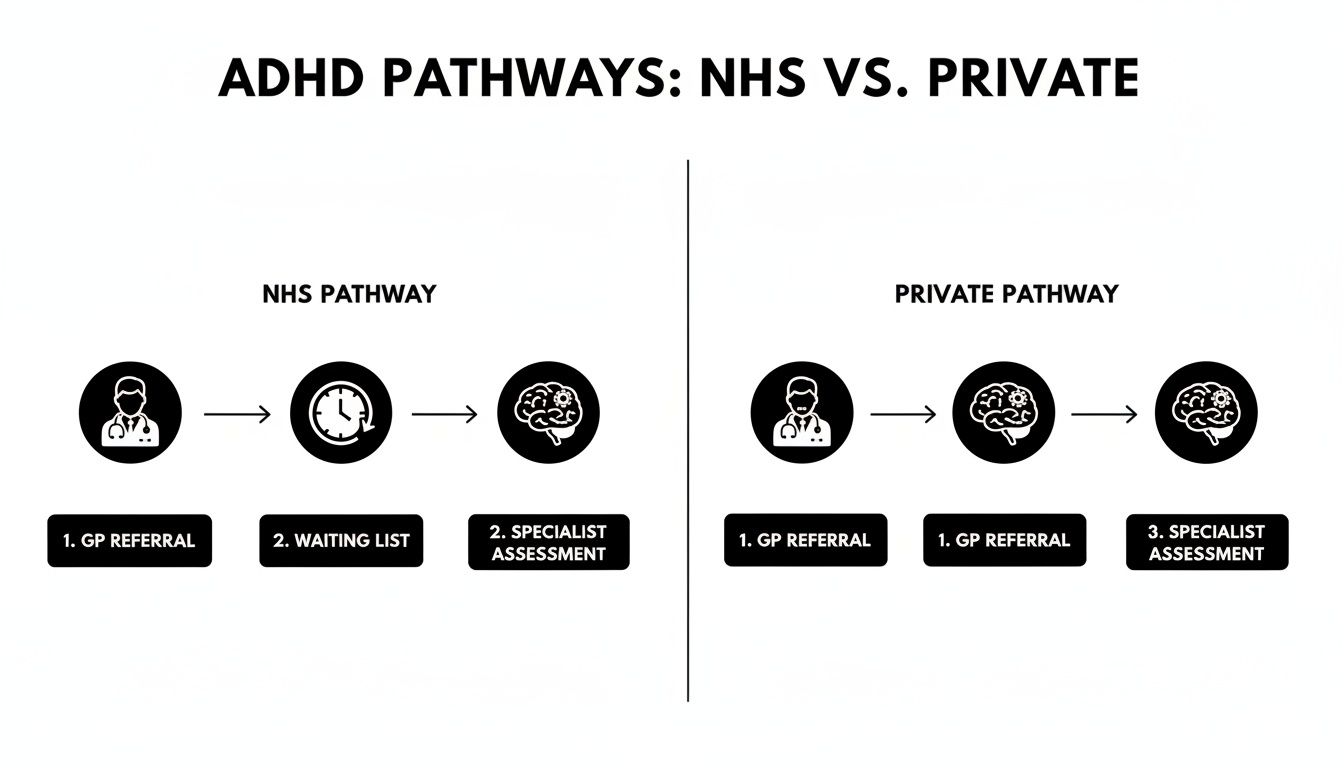
As you can see, the biggest difference is often the waiting time. The NHS pathway can involve a significant wait, whereas going private typically offers much faster access. If you want to dig deeper into the specifics, we have a detailed guide on how ADHD is tested.
There's no doubt that demand for these assessments is growing. In England, ADHD prescription rates have been jumping by 18% year-on-year since the pandemic began, and that’s likely just the tip of the iceberg. Once the comprehensive evaluation is complete, knowing how to write a medical report is a vital skill for specialists to clearly communicate the diagnosis and the recommended plan forward.
What Happens After an ADHD Diagnosis?
Getting an ADHD diagnosis isn't the end of the road; it's the beginning. For many, it's the first time they have a proper map to make sense of lifelong experiences and understand how ADHD might overlap with other conditions like anxiety or autism. Now, you can start building a life that truly works for you.
One of the first conversations you'll likely have is about medication. This isn’t as simple as just getting a prescription. It involves a careful, collaborative process called medication titration, where a specialist (usually the psychiatrist who diagnosed you) works with you to find the right medication and the optimal dose. It's a highly personal journey designed to manage your symptoms effectively while keeping side effects to a minimum.
Putting Your Diagnosis into Action
Medication can be a game-changer, but it’s just one piece of the puzzle. A good treatment plan is holistic and addresses your overall mental health.
This is where a whole world of non-medical support opens up:
- ADHD Coaching: A coach helps you design practical, real-world systems for things like organisation, managing your time, and hitting those big personal or professional goals you've been aiming for.
- Therapy: Therapies like Cognitive Behavioural Therapy (CBT) can be adapted specifically for the ADHD brain, helping you challenge unhelpful thought patterns and better manage emotional dysregulation. This is especially helpful if you also have anxiety or depression.
An official diagnosis is your key to unlocking this support. The under-diagnosis of ADHD in the UK has been a long-standing issue. Health records from 2000-2018 show just 0.74% of men and 0.20% of women had a recorded diagnosis, a tiny fraction of the true estimated prevalence. You can read more in the report of the independent ADHD taskforce. This is why a formal assessment from a specialist using NICE-approved tools is so critical.
Your final psychiatric report is more than just a piece of paper; it's a powerful tool. It’s the official evidence you need to request reasonable adjustments for ADHD at work under the Equality Act 2010. It can also be used to access support at university or serve as crucial evidence in medico-legal cases, highlighting just how valuable a comprehensive, expert-led assessment truly is.
Common Questions About ADHD Diagnosis
Working out how to get an ADHD assessment often throws up a lot of questions, especially when other conditions like anxiety or autism are in the mix. Let's tackle some of the most frequent queries head-on to give you the clear, straightforward answers you need.
Can My GP Diagnose Me with ADHD?
In short, no. In the UK, your GP can't give you a formal ADHD diagnosis. Think of them as the crucial first step: they'll listen to your concerns, do an initial screening, and if it looks like ADHD could be a possibility, they'll refer you to a specialist service.
The official diagnosis has to come from a qualified expert who really knows their stuff when it comes to neurodevelopmental conditions and mental health, like a specialist psychiatrist.
How Long Does a Private ADHD Assessment Take?
The assessment appointment itself usually takes somewhere between two and three hours. The great thing about many private online services is the speed – you can often get an appointment booked within a week.
After your session, you won't be left waiting long. You should receive your comprehensive diagnostic report in about five working days.
Will My GP Recognise an Online ADHD Diagnosis?
Absolutely, as long as it's done properly. For your GP to accept the diagnosis and work with you on prescriptions, it needs to come from a reputable clinic that's regulated by the CQC and uses GMC-registered consultant psychiatrists.
The process usually involves setting up a 'shared care agreement'. This is simply a plan that allows your GP and your private specialist to work together to manage your treatment, making everything much smoother.
A huge part of a specialist assessment is teasing apart the symptoms of ADHD from other conditions that often go alongside it, like autism or anxiety. A good clinician will carefully look at how these might overlap or influence each other. This is vital for making sure your final diagnosis is accurate and your treatment plan is built just for you.
At Insight Diagnostics Global, our consultant-led team provides expert, CQC-regulated online assessments for adults, helping you get the clarity you need. Find out more about our adult ADHD assessment services.