

For adults who suspect they might have ADHD or autism, a private assessment offers a direct route to clarity, sidestepping the notoriously long NHS waiting times. Making this choice is about more than just getting a diagnosis; it’s about finally understanding your mental health, transforming your career, relationships, and overall wellbeing, and freeing yourself from that frustrating feeling of being stuck in 'diagnostic limbo'.
Why Adults Are Seeking Clarity and Support

If you've spent years feeling misunderstood or like you're just not on the same wavelength as everyone else, you're not alone. Many adults with undiagnosed ADHD or autism grapple with challenges that can significantly impact their mental health. This can lead to a lifetime of confusion, self-doubt, anxiety, and depression.
The decision to seek a private ADHD and autism assessment usually comes after hitting a wall. It’s a conscious step towards figuring out the 'why' behind lifelong struggles with things like focus, social situations, or emotional regulation, all of which are deeply connected to your mental wellbeing.
The Impact of Endless Waiting
Let's be honest: one of the biggest reasons people go private is the state of the public healthcare system. In the UK, NHS services are completely overwhelmed. The numbers are staggering—over 549,000 people are waiting for an ADHD assessment, and another 227,813 are in the queue for autism evaluations in England alone.
Worse still, 90.1% of them have been waiting longer than the 18-week target. This isn't just an administrative backlog; it’s a crisis that leaves people feeling forgotten. You can read more about the reality of psychiatry waiting times in the UK in our guide.
This long wait is more than just an inconvenience. For someone struggling with the emotional toll of undiagnosed neurodivergence, it can exacerbate mental health conditions like anxiety and depression. For many, a private assessment feels like the only realistic way to get timely answers and start accessing the right mental health support.
A formal diagnosis isn't about getting a label. It's about gaining a framework for understanding yourself and finally accessing the strategies and mental health support you need to thrive, not just get by.
A Path to Personal and Professional Growth
Opting for a private assessment is really an investment in yourself and your future. A clear, professional diagnosis can be the key that unlocks your true potential, both personally and professionally.
Here’s why so many adults decide to take this step:
- Improving Relationships: Finally understanding how your brain works can do wonders for your relationships. It helps you and your loved ones navigate communication hurdles that might have caused friction for years.
- Enhancing Career Performance: A formal diagnosis can open the door to reasonable adjustments at work under the Equality Act. Think flexible hours, a quieter desk, or clearer instructions—small changes that let you perform at your best.
- Validating Your Experiences: People often describe their diagnosis as a huge moment of relief. It validates a lifetime of feeling 'different' and helps replace that harsh inner critic with a sense of self-compassion, which is vital for mental health.
Ultimately, seeking a private assessment is an act of taking control. It’s about owning your story and getting the clarity you need to build a life that truly works for you.
Navigating Your Options: Private Versus NHS Pathways

When you start exploring an assessment for ADHD or autism, you’ll quickly find yourself at a fork in the road. One path leads through the NHS; the other, through the private sector. It can be a confusing choice, and each route offers a completely different experience. Getting to grips with these differences is the first step toward making a decision that feels right for you.
Think of it like this: the NHS is the public highway. It’s free to use and will get you to your destination, but it’s often heavily congested with long queues and unavoidable delays. The private route is more like a direct toll road—you pay for priority access to bypass the traffic and get expert guidance much sooner.
The sheer scale of the NHS backlog is what pushes many to consider private care. The number of people waiting for an autism assessment has ballooned, with 13 times more people on the list now than just a few years ago. Projections show that by September 2025, England could have 227,813 individuals waiting, and over 90% of them will have already been waiting longer than the official target. This isn't just a statistic; it represents thousands of adults left in a state of limbo, a situation which can take a heavy toll on their mental health.
Let's break down the key differences to help you see the full picture.
Private vs NHS Assessment Pathways at a Glance
This table offers a clear, side-by-side comparison of what you can typically expect from each pathway, from the initial consultation right through to post-diagnostic support.
| Feature | Private Assessment (e.g., Consultant-Led Clinic) | NHS Assessment |
|---|---|---|
| Waiting Times | Typically weeks for an initial appointment; assessment completed within a few months. | Can range from many months to several years, depending on the local trust. |
| Cost | Self-funded. Costs vary but include the full diagnostic process and report. | Free at the point of service. |
| Choice of Clinician | You can research and choose a specific consultant, clinic, or specialist. | You are assigned to the next available clinician or team within your local NHS trust. |
| Assessment Process | Often a streamlined, client-focused process with direct communication. | Follows a set, structured pathway which can sometimes feel impersonal. |
| Report Recognition | High, if from a CQC-regulated, consultant-led service. Meets NICE guidelines. | Universally accepted within the NHS, by employers, and educational institutions. |
| Follow-Up & Support | Immediate access to post-diagnostic support, such as medication titration and therapy. | Follow-up support is available but often subject to further waiting lists. |
While the NHS route is a cornerstone of our healthcare system, the private pathway provides a vital alternative for those who need answers and support without an agonising wait.
Speed and Accessibility
The most glaring difference is time. An NHS wait for an ADHD or autism assessment can stretch from months into years—a delay that feels impossible when you're struggling to understand yourself and cope with daily life. This long period of uncertainty can seriously strain your mental health, relationships, and career.
A private ADHD and autism assessment cuts through that waiting time. Reputable clinics can often book you in for an initial chat within weeks, wrapping up the whole process in a much shorter, more manageable timeframe. This isn't about cutting corners; it's about providing efficient, focused access to specialists exactly when you need it. For anyone needing clarity to protect their mental health, that speed is invaluable. If you're wondering about the first steps, our guide on how to get a mental health assessment can be a helpful starting point.
Cost and Investment
Of course, the financial side is a major factor. NHS assessments are free of charge, which is a massive plus. The hidden 'cost', however, is paid in time and the emotional strain of waiting for answers.
A private assessment is a financial investment in your mental health. You are paying for the dedicated time and deep expertise of consultant-level clinicians. While it means an upfront cost, many people see it as a worthwhile trade-off for a swift, thorough diagnosis and a concrete plan to move forward with their lives.
Choosing a private pathway is often framed as a proactive investment in your wellbeing. It’s about deciding that the cost of waiting—in terms of mental strain, career stagnation, and personal distress—is greater than the financial outlay for a timely diagnosis.
Clinician Choice and Report Credibility
On the NHS, you're generally allocated to the next specialist available in your local trust, with little say in the matter. The private sector, however, gives you control. You can do your homework, read reviews, and select a consultant or clinic whose experience and approach resonate with you—for instance, someone who specialises in adult neurodiversity and co-occurring mental health conditions.
Here’s a crucial point: the credibility of your final report is everything. A diagnosis from a CQC-regulated, consultant-led private service staffed by GMC-registered psychiatrists carries real authority. These reports are carefully written to meet NICE guidelines, which means they are far more likely to be accepted by your GP for a Shared Care Agreement, or by employers and universities for vital support and adjustments under the Equality Act. Choosing a properly regulated provider is the key to ensuring your diagnosis opens doors, rather than creating new problems.
Your Private Assessment Journey Step by Step
Thinking about a private ADHD and autism assessment can feel a bit daunting, like you’re stepping into a whole new world. But in reality, good clinics have a well-trodden path designed to make the process as straightforward and supportive as possible. Knowing what to expect can take a lot of the anxiety out of it.
Think of it like building a detailed picture of you. Each step adds a new layer, a new piece of the puzzle, until the consultant psychiatrist has a clear and complete view of your neurotype and mental health. The whole point is to work together to understand your history, your strengths, and the things you find challenging.
The Initial Inquiry and Triage
It all starts with that first contact, usually a quick phone call or an online form. This isn't the assessment itself, but a vital first screening step called triage. A trained coordinator will ask a few initial questions about why you’re seeking an assessment and what you’re struggling with. This is simply to make sure a full diagnostic assessment is the right path for you.
If it is, you'll be sent a secure link to a set of pre-assessment questionnaires. They're pretty detailed, and for good reason—they give your consultant a huge head start by providing essential background information before you've even spoken.
These forms usually ask about:
- Your early life: Questions about childhood, developmental milestones, and what school was like for you.
- Current symptoms: You'll fill out standardised rating scales (like the ASRS for ADHD or AQ for autism) that help measure your current traits.
- Medical and mental health history: This covers any previous diagnoses (like anxiety or depression), treatments, or medications.
Getting this groundwork done upfront means the assessment itself can be much more focused and productive, making the most of everyone's time.
The Comprehensive Clinical Interview
The heart of the private ADHD and autism assessment is the in-depth interview with a consultant psychiatrist. This is a guided conversation, not a scary interrogation. It usually takes between 90 minutes and three hours and is often done online for convenience and comfort. As this is often a remote process, it can be helpful to understand how UK online doctor consultation services work, as this will give you an idea of what to expect from virtual appointments and follow-up care.
During this session, the consultant will gently explore your life story, looking for the connections between your childhood experiences, current challenges, and your overall mental health. They’re listening for patterns of behaviour and experience that align with the diagnostic criteria for ADHD and/or Autism Spectrum Disorder (ASD), and how these traits interact with conditions like anxiety. It’s your chance to share your story with an expert who genuinely gets it. You can learn more about what to expect by reading our guide to an online mental health assessment.
The clinical interview is a safe space to share your narrative. The consultant’s role is to listen with an expert ear, applying clinical knowledge to your lived experience to form an accurate and holistic diagnostic picture of your neurotype and mental health.
Gathering Collateral Information
For a diagnosis to be truly reliable, the clinician needs to see the bigger picture—how your traits show up in different parts of your life. This is where collateral information comes in, and it's incredibly valuable. With your permission, the clinic will ask to speak to someone who knows you well.
This person might be:
- A parent or older family member who remembers what you were like as a child.
- A partner or spouse who can talk about your day-to-day life now.
- A close friend or, in some cases, a supportive manager at work.
This external perspective helps round out your own account and gives the consultant a 360-degree view, which is a key part of meeting national assessment guidelines. It’s this thorough, multi-angled approach that ensures your final report is as accurate and useful as possible, giving you the clarity you need.
3. What Happens After Your Assessment? Understanding the Report and Next Steps
Getting a diagnosis isn't the finish line; it’s the starting line for a new, more informed chapter of your life. A high-quality diagnostic report from a private assessment is so much more than a clinical label. Think of it as a personalised roadmap—one that helps you understand your mental health better and secure the right support.
This document is where the clinical findings get translated into a practical guide for your life. It connects the dots between your lifelong experiences and a clear diagnostic explanation, telling you not just what the diagnosis is, but why it fits. The real power of a good report is its ability to unlock real, positive change.
The journey to getting that report is often more straightforward than people think. The process is designed to be efficient and focused on gathering the right information to build a clear picture.
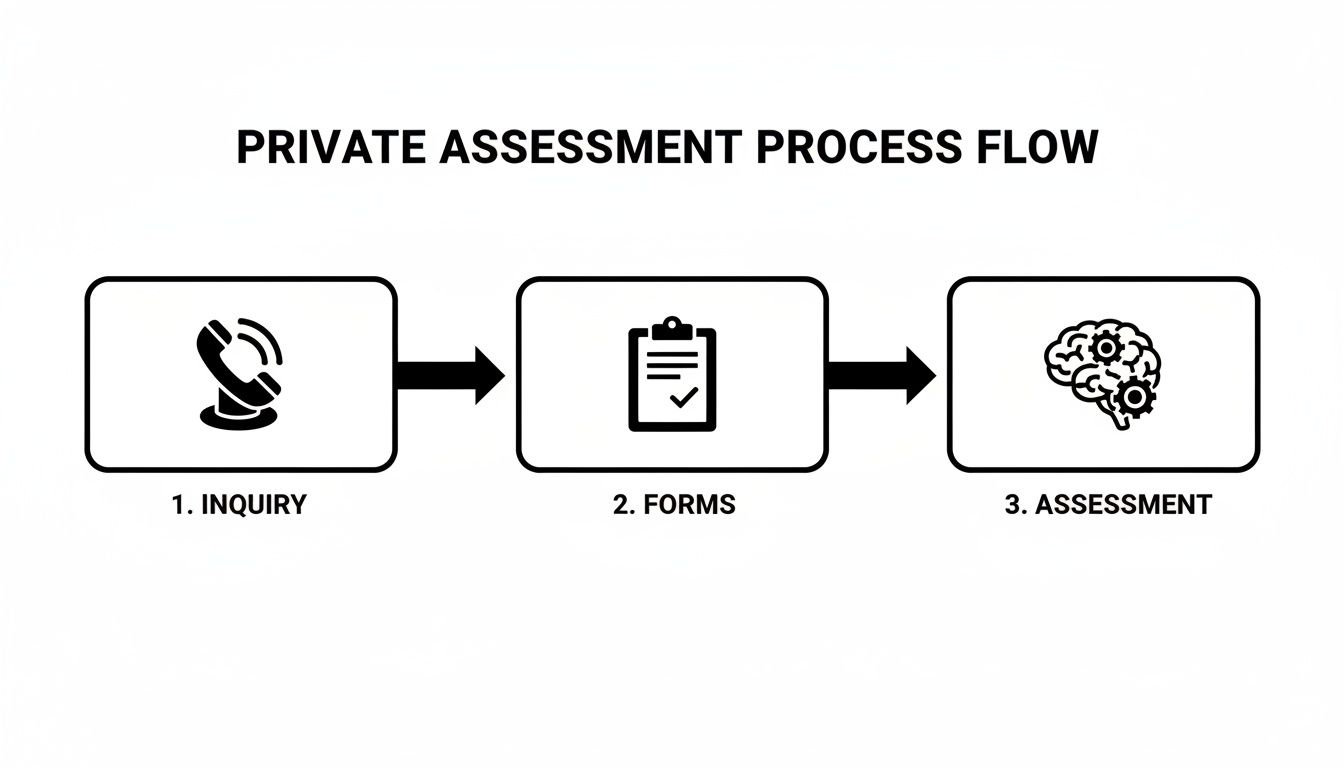
As you can see, the process flows logically from your first enquiry to the assessment itself, all leading to that comprehensive report which will guide what you do next.
What a High-Quality Report Looks Like
A credible diagnostic report is detailed, evidence-based, and, most importantly, actionable. It should be written in clear, jargon-free language that you, your GP, and even your employer can understand and use.
Here’s what you should always expect to find inside:
- A Clear Diagnostic Statement: This will state plainly whether you meet the clinical criteria for ADHD, Autism Spectrum Disorder (ASD), or both. It will also reference the official diagnostic manuals used, such as the DSM-5 or ICD-11.
- The Diagnostic Formulation: This is the story behind the diagnosis. It’s where the consultant explains how your personal history, developmental background, and the challenges you've described fit together to meet the clinical criteria.
- A Summary of Assessment Findings: This section breaks down the evidence gathered during the process. It will cover the clinical interviews, the results from any standardised questionnaires, and feedback from anyone else involved, like a family member.
- Personalised Recommendations: This is perhaps the most critical part. It should offer specific, practical advice tailored to you and your life, covering everything from mental health and relationships to work and education.
A great report doesn't just diagnose; it empowers. It should feel like a user manual for your own brain, offering insights and strategies that finally make sense of your world and give you a clear path forward for your mental health.
Planning Your Next Steps Post-Diagnosis
With your report in hand, it’s time to start making proactive changes. This is where the real work begins—integrating your new understanding into your daily life, guided by the expert recommendations from your consultant psychiatrist.
Your journey forward will likely involve a few different paths, and they often work best when used together.
Medication and Therapeutic Support
For many adults with ADHD, medication can be a game-changer for managing core symptoms like inattention and impulsivity. If this seems like a good option for you, the next step is medication titration. This is a careful, consultant-led process where you work together to find the right medication and dosage that gives you the most benefit with the fewest side effects.
But it’s not just about medication. Therapy and coaching are vital for building long-term skills. Your report will probably recommend specific approaches, such as:
- Cognitive Behavioural Therapy (CBT): This can be adapted specifically for ADHD and autism challenges, helping you manage anxiety, tackle Rejection Sensitive Dysphoria (RSD), and develop healthier thinking patterns.
- ADHD or Autism Coaching: A specialist coach provides practical, hands-on support to help you with executive functioning skills like organisation, time management, and planning.
- Psychotherapy: A significant number of neurodivergent adults also live with co-occurring conditions like depression or anxiety. Ongoing therapy provides crucial support for your overall mental well-being.
Securing Workplace Adjustments
Your diagnostic report is also the key to unlocking support at work. Under the Equality Act 2010, conditions like ADHD and autism can be considered disabilities, which gives you the right to ask your employer for 'reasonable adjustments'.
The report provides the formal evidence you need to have that conversation. Common adjustments that can make a world of difference include:
- Flexible start and finish times or hybrid working.
- Permission to use noise-cancelling headphones to help with focus.
- Getting instructions and feedback in writing instead of just verbally.
- Access to assistive software for things like task management or text-to-speech.
Ultimately, a well-written report from a credible private ADHD and autism assessment gives you the foundation for all these positive changes. It validates your experiences and equips you with the official documentation needed to build a life that truly works for you.
How to Choose a Credible and Reputable Clinic

As more and more adults are seeking answers about their neurotype, the number of clinics offering a private adhd and autism assessment has shot up. While it’s great to have options, it also means you have to be more careful than ever. Honestly, choosing the right provider is the single most important decision you'll make in this entire process. It’s what separates a life-changing diagnosis from a frustrating waste of time and money.
Think of it as doing your homework on a major investment—an investment in your mental health. You’re not just buying a report; you’re trusting a clinic with your personal story and your future. A credible diagnosis can unlock support, self-understanding, and real change, but a shoddy one can lead to dead ends and immense frustration.
The Non-Negotiables of a Trustworthy Clinic
When you start digging into different providers, there are a few things that aren't just 'nice-to-haves'—they are absolute essentials. Getting this part wrong can mean your final report isn't worth the paper it's printed on.
Your checklist should start with these three core elements:
- CQC Regulation: The Care Quality Commission (CQC) is the independent watchdog for health and social care in England. If a clinic is CQC-regulated, it’s being inspected and held to high standards for safety and quality. This is your number one assurance that they are a legitimate operation.
- Consultant-Led Service: Your assessment should be overseen by a Consultant Psychiatrist. This isn’t just any doctor; they are a senior specialist who has gone through years of extensive training and is on the General Medical Council's (GMC) Specialist Register. Their expertise is what ensures a deep and accurate diagnostic process.
- GMC Specialist Registration: Every single psychiatrist involved must be registered with the GMC. This confirms they are licensed to practise medicine in the UK and are bound by strict professional ethics.
Without these fundamentals in place, you’re taking a huge risk. You could end up with a diagnosis that your GP, university, or employer simply won’t recognise. When you find a psychiatrist, you'll see why sticking to professionals who meet these standards is so crucial.
Key Questions to Ask Potential Providers
Once you've ticked off the basics, it's time to ask some more direct questions. A good, transparent clinic will have no problem answering these and should welcome your thoroughness. Don't feel awkward about digging for details before you commit. While focused on a different area, this article on how to choose the best online medical certification provider offers some great transferable tips on vetting professional services.
Here are the critical questions to put to any clinic you're considering:
Who exactly will be conducting my assessment?
You need to know the name and qualifications of the clinician you'll actually be speaking to. Ask for their GMC number so you can look them up on the Specialist Register yourself.What specific diagnostic tools and interviews do you use?
A robust assessment isn't just a chat. It relies on internationally recognised, evidence-based tools. For ADHD, you should hear them mention the DIVA-5 (Diagnostic Interview for ADHD in Adults). For autism, the gold standard includes tools like the ADOS-2 (Autism Diagnostic Observation Schedule) and ADI-R (Autism Diagnostic Interview-Revised).What does the final report actually include?
Will it provide a detailed diagnostic breakdown, genuinely personalised recommendations, and clear guidance for setting up a shared care agreement with your GP? A great report is a practical roadmap for your future, not just a diagnostic label.Can your report be used for workplace or university support?
Make sure their reports are comprehensive enough to be used for things like occupational health referrals or applying for reasonable adjustments under the Equality Act 2010.
A reputable clinic’s process should feel like a supportive investigation, not a quick transaction. The focus will be on giving you clarity and a solid, evidence-based understanding of how your brain works, no matter what the final diagnosis is.
Choosing the right clinic is the first and most critical step. By insisting on proper regulation, consultant-led expertise, and clinical rigour, you protect your investment and set yourself up for a diagnosis that truly empowers you to move forward.
Answering Your Key Questions
Even with a clear map of the journey, I know you probably still have some practical questions buzzing around. Deciding to go for a private ADHD and autism assessment is a big step, so it’s completely normal to wonder about the cost, the process, and what it all actually means for you. Let’s tackle some of the most common queries I hear.
How Much Should I Expect to Pay for a Private ADHD and Autism Assessment in the UK?
This is usually the first question people ask, and the answer is that it varies. For a combined assessment covering both ADHD and autism, you’re typically looking at a range of £1,500 to over £3,000. The final figure often depends on the clinic's reputation, the seniority of the clinicians involved, and just how in-depth the whole process is.
What’s crucial is getting a fully transparent, itemised quote before you commit to anything. Make sure it clearly spells out what’s included. Does that single fee cover everything from the first screening questionnaires and the main interview with the consultant, to gathering information from a loved one, the final detailed report, and the follow-up session to discuss it all?
A word of caution: be wary of prices that seem too good to be true. While everyone wants good value, a rock-bottom price can sometimes be a red flag. It might signal a rushed process, a lack of direct input from a consultant psychiatrist, or a report that’s too thin to be useful, potentially undermining the very diagnosis you’re paying for.
Will My GP Actually Accept a Private Diagnosis?
This is a big one, and rightly so. The short answer is that GPs aren’t legally required to accept a private diagnosis or take over prescribing medication based on it. However, in my experience, they are far more likely to work with you when the report comes from a credible, high-quality service.
You stand a much better chance of getting your GP on board if your assessment comes from:
- A CQC-regulated clinic, which proves it meets national safety and quality standards.
- A service overseen by a GMC-registered Consultant Psychiatrist.
- A provider that explicitly follows the official NICE (National Institute for Health and Care Excellence) guidelines.
When your GP receives a thorough, well-reasoned report from a service that ticks all these boxes, they have the confidence to enter into a 'Shared Care Agreement'. This is simply the formal arrangement where your GP agrees to take over issuing your NHS prescriptions once the private clinic has safely managed the initial medication titration and found a stable, effective dose for you. Having a chat with your GP before you book an assessment can really help smooth this process.
What’s a Medico-Legal Report? Do I Need One?
It’s easy to get these terms mixed up, but the difference is really important. A standard diagnostic report is for clinical use. Its whole purpose is to give you a clear diagnosis (or rule one out), help you understand your own mind better, and map out a plan for treatment and support, whether that’s medication, therapy, or getting adjustments at work.
A medico-legal report, on the other hand, is a completely different beast. It's a highly specialised document written specifically for use in legal proceedings, like:
- Employment tribunals
- Personal injury claims
- Family court cases
- Criminal proceedings
These are written by psychiatrists with special training in court reporting and have to meet strict legal rules. For the vast majority of people who are simply seeking personal clarity and help for their mental health, a standard clinical diagnostic report is precisely what you need.
An assessment's primary goal is to provide clarity, not just a label. A high-quality evaluation delivers powerful insights and a path forward, whether or not you meet the specific criteria for ADHD or autism.
What Happens If They Say I Don’t Have ADHD or Autism?
It's a common fear: what if I go through all this and they tell me it's not ADHD or autism? It's important to know that a good assessment doesn't automatically lead to a diagnosis. An ethical clinician will only give you a diagnosis if your experiences and history genuinely fit the established criteria. But if they don’t, the process is still incredibly valuable.
A high-quality assessment that rules out ADHD or autism won't just leave you with a "no." The report you receive will be just as important, because it will:
- Explain the reasoning clearly: It will carefully detail why you don't meet the criteria, giving you a definitive answer and allowing you to rule those conditions out.
- Offer an alternative clinical view: The consultant will use their expertise to suggest what might be behind the challenges you're facing, perhaps identifying things like anxiety, depression, or the impact of past trauma.
- Provide personalised recommendations: Most importantly, the report will still give you tailored advice based on your unique profile, pointing you towards the right kind of mental health support for you.
Ultimately, the goal of any good assessment is to give you answers and a clear direction. That clarity is the real prize, whatever the outcome.
At Insight Diagnostics Global, our consultant-led team is committed to providing CQC-regulated, NICE-adherent assessments that deliver the clarity and support you deserve. If you are ready to take the next step on your journey to self-understanding, we are here to help.
Find out more about our private ADHD and autism assessment services by visiting https://insightdiagnostics.co.uk.