If you’re considering an ADHD assessment in London, it can feel like a huge, overwhelming first step. But it’s also the first step towards getting real answers about your mental health. The journey boils down to two main routes: you can go through the NHS, which is thorough but often slow, or you can opt for a private assessment, which is much quicker.
Getting a formal diagnosis isn’t just about getting a label. It’s the key that unlocks proper support, effective treatment, and a much clearer understanding of how your own mind works, especially if you suspect other conditions like autism might be part of your experience.
Your First Step to an ADHD Assessment in London
Trying to arrange an ADHD assessment can feel like you've been dropped into a maze without a map. That's what this guide is for. For many adults, seeking a diagnosis is the first time they can finally put a name to lifelong struggles with focus, organisation, or impulsivity. It’s about trading years of confusion and mental health strain for a new sense of confidence and finding strategies that actually work for your career, relationships, and life in general.
The whole process usually starts with a big decision: go with the NHS or find a private provider? Each pathway has its own set of steps, waiting times, and things to consider. Knowing the difference right from the start helps you choose the path that makes the most sense for you.
Understanding the Overlap: ADHD, Autism, and Mental Health
One of the most critical aspects of a modern assessment is understanding that ADHD rarely travels alone. Many people discover that their experiences overlap with traits of both ADHD and Autism Spectrum Condition (ASC). This combination is so common it's sometimes called AuDHD. In fact, research suggests that as many as 80% of autistic people may also have ADHD.
This is why a really detailed, holistic mental health assessment is so important. Some key traits can look the same on the surface but have completely different roots. For instance:
- Social Difficulties: Is it because ADHD makes it hard to pay attention in conversations, or is it related to autistic differences in reading social cues? This can also be compounded by social anxiety, a common co-occurring condition.
- Intense Focus: Are you experiencing ADHD hyperfocus, driven by a sudden burst of interest? Or is it an autistic special interest that provides a deep sense of comfort and is a core part of your identity?
- Sensory Overload: Is it a case of ADHD-related sensory-seeking, or is it autistic sensory sensitivity causing you to feel overwhelmed and anxious?
A good clinician knows how to dig into these details. They don't just tick boxes; they work to understand the ‘why’ behind your experiences, which is absolutely vital for getting the right support for your entire mental health profile.
The Importance of a Full Picture
Because of this frequent overlap, an assessment that looks for co-occurring conditions can give you a much more accurate and helpful diagnosis. Acknowledging the interplay between ADHD, potential autistic traits, and related mental health challenges like anxiety or depression means you get support strategies that are genuinely tailored to your specific neurodivergent profile.
This holistic approach ensures nothing gets missed, clearing the way for real progress. For anyone starting this journey, exploring a complete online mental health assessment can be an excellent way to get that full picture.
Why Getting an ADHD Diagnosis Can Feel So Hard
If you're looking into an ADHD assessment in London and finding it all a bit overwhelming, you’re definitely not alone. Many adults say the whole process feels like a frustrating, uphill battle. It’s easy to feel discouraged when you’re already dealing with the daily challenges of ADHD and its impact on your mental health, but what you're experiencing isn't just a feeling—it's a very real problem within the UK's healthcare system.
There’s a massive gap between the number of people who likely have ADHD and the number who actually have a formal diagnosis. Think of it as a 'diagnostic gap'. It means millions of adults are trying to get by without the support, validation, or treatment that could genuinely change their lives. This isn't just a minor issue; it's a major public mental health challenge.
The Scale of the Problem
The numbers really bring the issue to life. A huge study of GP records found that only 0.32% of patients had ADHD on their file. That means for every nine people with the condition, only one has been officially diagnosed. This suggests there could be around 2.5 million people in England living with undiagnosed ADHD. You can read more about these ADHD statistics to see the full picture.
Of course, these aren't just numbers. Every single one represents a person who might be struggling unnecessarily at work, in their relationships, or with their overall mental wellbeing.
The Hidden Costs of Undiagnosed ADHD
When ADHD isn't recognised, the knock-on effects can be huge, both for individuals and for society. It's so much more than just being a bit forgetful or disorganised. The impact is profound and often gets tangled up with other mental health issues, including autism.
- Mental Health Strain: Undiagnosed ADHD often walks hand-in-hand with anxiety, depression, and other mood disorders. If you don't know ADHD is the root cause, treatments for these other conditions might not work as well as they should. Similarly, the social challenges of autism can lead to significant anxiety if not understood correctly.
- Career Hurdles: Struggling with things like planning, managing your time, and staying focused can lead to job instability, not reaching your potential, and a lot of frustration at work.
- Relationship Friction: ADHD traits like impulsivity or inattention can easily be misunderstood by friends, partners, and family, causing all sorts of tension and hurt.
- Exhaustion and Burnout: For years, many adults—especially women and those with co-occurring autism—work incredibly hard to 'mask' their symptoms just to fit in. This constant effort is mentally and emotionally draining and often ends in total burnout.
It's so important to understand this context. The ridiculously long NHS waiting lists and the high demand for private assessments are a direct result of this massive diagnostic gap. Your struggle to get an appointment isn't a personal failure; it's a sign of a system that just can't keep up with the demand for comprehensive mental health and neurodevelopmental services.
Knowing this hopefully validates your experience and shows why taking that step to get a diagnosis is so powerful. It’s your first move from a place of constant struggle to one of real understanding and getting the right support for the way your brain works.
Choosing Your Path: NHS vs Private Assessment
When you're looking for an ADHD assessment in London, you’ll quickly find yourself at a crossroads: do you go through the NHS or opt for a private clinic? This isn't just a simple choice between cost and speed; it's about figuring out which route truly fits your personal circumstances, your urgency, and your long-term mental health needs.
Think of it like getting across town. The NHS is a bit like the public bus service – it’s a reliable and essential system that's free to use, and it will get you where you need to go. But you’ll have to wait at the stops, and the journey can be a long one. The private route is more like hailing a taxi – it costs a fair bit more, but it arrives quickly and takes you straight to your destination.

The NHS Pathway: A Test of Patience
For most people, the NHS is the natural first step. It’s a comprehensive service, and the fact that it’s publicly funded is a massive plus. The journey starts with a chat with your GP, where you'll lay out your symptoms and concerns. If they agree that an assessment seems necessary, they’ll refer you to the local adult ADHD service.
And this is where the real waiting game begins. With demand far outstripping capacity, the waiting lists for an NHS assessment in London can be incredibly long. We’re often talking months, and in many cases, years. This isn't a minor inconvenience; for someone grappling with the daily fallout of untreated ADHD, a delay this long can take a serious toll on their career, relationships, and overall mental health.
There is one potential shortcut within the system: the ‘Right to Choose’ policy in England. This gives you the option to be referred to a CQC-registered private provider that also holds an NHS contract. It can sometimes shorten the queue compared to your local trust, but make no mistake, you are still in the NHS system, and significant waits are still very common.
The Private Pathway: Speed and Choice
The private route offers a much faster, more direct alternative. One of its biggest advantages is the ability to self-refer. You don't need to go through your GP first; you can just contact a clinic directly. This simple step cuts through a huge amount of red tape, with many private clinics able to offer an assessment within a few weeks, not years.
That speed can be a lifeline for people whose symptoms are causing real disruption to their lives. But it's not just about getting a diagnosis faster. Private services often give you more flexibility in choosing a specialist, which is particularly helpful if you think you might have co-occurring conditions like autism. For a closer look at what this involves, our guide to the UK ADHD diagnosis process has plenty of useful information.
The obvious trade-off, of course, is the cost. A private assessment is a significant financial commitment, and you need to factor in the fees for the initial diagnosis, medication titration, and any follow-up appointments.
At its heart, the difference boils down to resources. The NHS is a brilliant service under immense strain, which inevitably creates long delays. Private clinics work on a different model, enabling them to provide immediate access for those who can afford it.
NHS vs Private: A Direct Comparison
| Feature | NHS Pathway | Private Pathway |
|---|---|---|
| Referral | GP referral is mandatory. | Self-referral is usually possible. |
| Wait Time | Extremely long, often 1-5 years. | Very short, typically 2-8 weeks. |
| Cost | Free at the point of use. | Significant financial investment required. |
| Choice of Clinician | Limited; assigned by the local service. | Greater choice of specialists. |
The Shared Care Agreement: Bridging the Gap
One of the most important things to think about is the shared care agreement. This is an arrangement where, after you've received a private diagnosis and your medication is stabilised, your GP agrees to take over prescribing it on an NHS prescription. This can make a huge difference, shifting the ongoing cost of medication from your pocket to the NHS and making long-term treatment much more affordable.
But here’s the crucial part: GPs are not obligated to accept a shared care agreement. It’s a really good idea to have a conversation with your GP about this before you commit to a private assessment to avoid any difficult conversations down the line. A good working relationship between your private clinician and your GP is the key to making this run smoothly.
What to Expect During Your Clinical Assessment
The thought of an ADHD assessment in London can be a bit intimidating, but knowing what’s involved helps to strip away the mystery. It’s less like a test you can pass or fail and much more like a series of structured conversations. The whole point is to piece together a clear picture of your life, from childhood right up to today, to see if your experiences match the patterns of ADHD and understand your broader mental health.
Before you even sit down with a specialist, the process usually kicks off with some screening questionnaires. These forms are a really important first step. They get you thinking about your own behaviours and feelings, giving the clinical team a solid foundation before they even meet you. This means your time with them can be much more focused and productive.
The In-depth Clinical Interview
The heart of the assessment is the deep-dive interview with a specialist psychiatrist or another highly qualified clinician. Think of it as a collaborative chat. Your clinician will guide you through your life story, searching for those persistent traits that often signal ADHD.
They’ll want to know about:
- Your Childhood: What were you like at school? Did your old school reports mention anything about your focus or energy levels?
- Your Adult Life: How do those same challenges pop up today? Maybe at work, in your relationships, or even just trying to manage bills and keep the house tidy.
- Your Mental Health: They’ll also check in on your general mental wellbeing, since it’s very common for conditions like anxiety, depression, or traits of autism to go hand-in-hand with ADHD.
Looking back at your history is absolutely crucial. For an ADHD diagnosis to be made, there needs to be clear evidence that symptoms were causing issues before you were 12 years old and that they’ve continued to affect different parts of your life ever since.
To get the full picture, your clinician might also ask to speak with someone who knows you really well—a parent, a partner, or a close friend. This isn't about "fact-checking" your story. It’s about getting another perspective, which adds valuable context to what you’ve shared.
Diagnostic Tools and Ruling Other Things Out
To keep the assessment structured and thorough, clinicians rely on standardised diagnostic tools. One of the go-to interviews is the DIVA-5 (Diagnostic Interview for ADHD in Adults). It’s essentially a guided conversation that walks you through the official diagnostic criteria, using real-world examples to help you pinpoint how symptoms have shown up in your own life.
A huge part of a skilled assessment is what we call differential diagnosis. This is the careful work of ruling out other conditions that can sometimes look a lot like ADHD.
A good clinician is like a detective. They have to carefully sift through the evidence to tell the difference between ADHD and something else. For instance, is your trouble concentrating a classic sign of inattentive ADHD, or could it be driven by an underlying anxiety disorder? Or is it a combination of ADHD and autistic traits? Getting this right is the key to getting the right support.
This meticulous approach ensures your diagnosis is accurate and that any treatment plan is built on a solid foundation. Conditions such as Autism Spectrum Condition (ASC), anxiety, and mood disorders can have overlapping symptoms, which is why an expert evaluation is so vital. Any robust private ADHD assessment will always include this careful sifting of possibilities.
The image below from the American Psychiatric Association gives a good overview of the core symptoms clinicians are looking for.
This visual really clarifies the key areas of inattention and hyperactivity/impulsivity that form the basis of a diagnosis. It shows that these aren't just quirks; they have to be persistent, disruptive, and get in the way of daily life.
Ultimately, the whole assessment is designed to build a detailed, evidence-based understanding of you. By combining your own account, insights from others, and structured clinical tools, it leads to a clear conclusion. You don’t just walk away with a label; you get a comprehensive report that explains everything and maps out the next steps for support, leaving you feeling empowered and understood.
Life After Diagnosis: Treatment and Support
Getting an ADHD diagnosis isn't the finish line; it’s the beginning of a new chapter where you finally have the right map. Understanding that your brain is wired differently is a huge first step, but what comes next is all about building the right support system to help you truly flourish. For most people, this involves a blend of medication and practical, therapeutic strategies.
The journey with medication usually starts with a process called titration. It’s a bit like tuning a guitar – you and your clinician work together to carefully adjust the type of medication and the dose until everything is in harmony. This careful, gradual process is designed to hit that sweet spot where you get the most benefit with the fewest side effects.
Navigating Medication and Therapeutic Support
While titration itself is a standard clinical process, getting access to medication isn't always straightforward. Prescription rates for ADHD treatment in England have actually doubled between 2017-18 and 2023-24, but there's a real postcode lottery at play.
Some analysis has shown a massive threefold difference in prescribing rates across the country. For example, some regions like NHS Frimley prescribe to 19.6% of their estimated ADHD population, whereas others like NHS Humber and North Yorkshire only manage to reach 6.1%. You can dig deeper into these regional ADHD prescription disparities to see how varied the national picture is.
This is exactly why having a clear, reliable post-diagnosis plan is so critical for anyone seeking an ADHD assessment in London. But truly effective management isn't just about a prescription. The best approach combines medication with practical skills and therapeutic support to help you navigate daily life, especially if you're managing co-occurring autism or other mental health conditions.
A diagnosis provides the 'why,' but treatment and support provide the 'how.' Combining medication with new coping strategies is what translates understanding into meaningful, day-to-day improvement in your quality of life.
The pathway from that first inkling of concern to a formal diagnosis follows a clear, structured path.
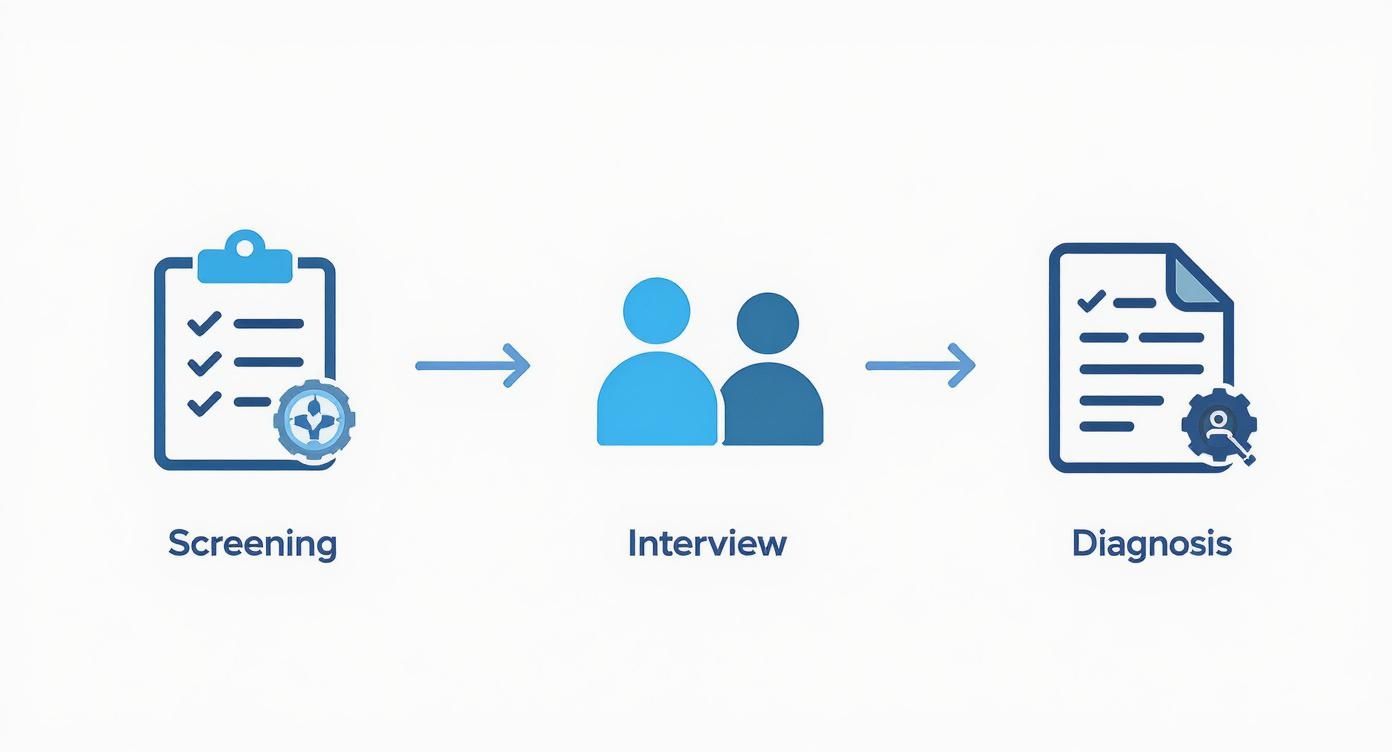
As you can see, the process involves distinct stages of screening, interviewing, and final diagnosis, which is the hallmark of any credible assessment.
Building Your ADHD Management Toolkit
Beyond medication, there's a whole toolbox of powerful strategies that can help you manage your symptoms and boost executive functions like planning, organising, and keeping your emotions in check. Many people find these non-medical approaches are just as vital as their prescription.
- ADHD Coaching: A coach is like a personal trainer for your brain. They work with you one-on-one to build practical, real-world strategies for things like managing your time better, creating routines that stick, and breaking down huge, overwhelming projects into small, doable steps. This can be especially helpful for those also navigating autistic inertia.
- Cognitive Behavioural Therapy (CBT): CBT is a type of therapy that’s fantastic for helping you spot and challenge the negative thought patterns that can come with ADHD. It's especially useful for tackling procrastination, crippling rejection sensitivity, and that nagging feeling of low self-esteem.
- Practical Strategies: Sometimes, the simplest changes make the biggest difference. This could be anything from using visual planners and calendars, setting alarms on your phone for everything, or creating a dedicated, clutter-free space where you can focus on work.
Pulling all these different elements together creates a strong, personalised support system that’s built just for you. For anyone wanting to explore this further, there's some great information on how to manage ADHD without medication, which can be a fantastic addition to any treatment plan.
Ultimately, life after your diagnosis is about equipping yourself with the right tools—both medical and practical—to navigate the world with more confidence and a real sense of control.
How to Find a Credible London ADHD Clinic

With more private options for an ADHD assessment in London popping up, it’s more important than ever to know how to choose the right one. The goal isn’t just to get an answer quickly; it’s to find a thorough, ethical, and officially recognised clinic whose diagnosis will be taken seriously by everyone, including your GP.
Think of it like doing your due diligence. You’re looking for specific markers of quality that give you peace of mind, ensuring the service is legitimate and staffed by genuine experts. Getting this right protects you from rushed, inaccurate assessments and makes sure your investment leads to real, meaningful support.
Your Non-Negotiable Checklist
When you're vetting a clinic, a few credentials are non-negotiable. These are the absolute bedrock of any trustworthy mental health service here in the UK.
Before you go any further with a provider, make sure you can tick these boxes:
- CQC Registration: The clinic must be registered with the Care Quality Commission (CQC). This is the independent regulator for all health and social care in England. No CQC registration is a major red flag.
- GMC Specialist Register: The psychiatrist who will assess you needs to be on the General Medical Council (GMC) Specialist Register. This is your proof that they’ve completed the higher-level training required to be a consultant psychiatrist in the UK.
- Transparent Pricing and Timelines: A good clinic will be completely upfront about its costs. Look for a clear, itemised breakdown of all fees—for the assessment, for medication titration, and for any follow-ups. There should be no nasty surprises or hidden charges.
Looking for Deeper Expertise
Beyond the essential paperwork, the best clinics show a much deeper, more nuanced understanding of neurodiversity and mental health. One of the clearest signs of this is their ability to assess for conditions that often go hand-in-hand with ADHD, especially autism.
Many adults with ADHD also have traits of Autism Spectrum Condition (ASC). A clinic that offers combined or specialist assessments for both shows a sophisticated, real-world understanding of how neurodevelopmental conditions and mental health overlap and interact.
This level of expertise is crucial. The symptoms of ADHD and autism can look very similar from the outside and are easily misinterpreted without specialist knowledge. Choosing a clinic that gets this nuance means your diagnostic report is far more likely to paint an accurate picture of your experiences, paving the way for support that’s properly tailored to you.
Your ADHD Assessment Questions Answered
Starting the process of getting an ADHD assessment in London can feel a bit daunting, and it's completely normal to have a lot of questions. Whether you're thinking about this for yourself or for someone you care about, getting clear answers is the first step toward feeling in control. Let's tackle some of the most common queries we hear from adults at the beginning of their journey.
Do I Need a GP Referral for a Private ADHD Assessment in London?
Technically, you don't always need a GP referral, but I strongly recommend getting one. Think of it this way: a referral gives your new specialist a head start by providing a summary of your medical history, which helps them build a much fuller picture of you and your mental health.
More practically, it's often essential for setting up a 'Shared Care Agreement' down the line. This is a crucial arrangement where your GP agrees to take over prescribing your medication on the NHS, which makes your long-term treatment much more affordable. Most good London clinics will encourage, and many will insist on, a GP referral because it’s the right way to ensure your care is joined-up and consistent.
Can My Assessment Also Check for Autism?
Yes, absolutely, and it's highly recommended. Many specialist clinics in London now offer combined neurodevelopmental assessments that look for signs of both ADHD and Autism Spectrum Condition (ASC). This is incredibly helpful because the two conditions often appear together—a combination people are starting to call AuDHD.
The traits of ADHD and autism can look very similar on the surface. Things like social difficulties or being able to hyperfocus on a passion project can be a feature of both. A combined assessment with a clinician who understands both conditions is the only way to get a truly accurate diagnosis. It means you get support that actually fits your specific neurodivergent brain, not just a generic plan.
What Should I Prepare for My Assessment?
A little bit of prep work can make a huge difference. If you can, try to dig out any old school reports; they can be a goldmine of impartial evidence showing what you were like as a child.
It’s also a really good idea to jot down a list of the specific difficulties you're having right now – at work, in your relationships, or just managing day-to-day life. Be honest and detailed when you fill out any forms the clinic sends you, including information about your general mental health. And if you can, ask a partner, close friend, or family member who has known you for a long time if they'd be willing to share their observations with the clinician. Their perspective can be invaluable.
How Much Does a Private ADHD Assessment Cost in London?
In London, you can expect the cost of a private adult ADHD assessment to be somewhere in the range of £700 to £2,000. This usually covers the main clinical interviews, the diagnostic report itself, and a discussion about your initial treatment plan.
Be sure to ask exactly what's included. The costs for medication titration (the process of finding the right dose) and any follow-up appointments are almost always separate. Always ask for a complete, itemised breakdown of all potential costs before you commit, so there are no nasty surprises later.
At Insight Diagnostics Global, we provide clear, comprehensive, and CQC-regulated online assessments for adults, delivered by GMC-registered specialists. We understand the complex interplay between ADHD, autism, and overall mental health. If you're ready to get the answers you deserve, you can explore our ADHD assessment services.