If you’re thinking about getting an ADHD assessment in London, you’ll quickly find yourself at a crossroads: do you go through the NHS or choose a private clinic? It’s a big decision, often made more complex by the fact that ADHD rarely travels alone. It frequently co-occurs with other conditions like Autism or affects your broader mental health, leading to anxiety or depression. The NHS route is free, but waiting lists can be incredibly long. Private options get you seen much faster, but there's a cost involved.
Getting your head around what each path looks like is the first real step toward getting the clarity you need for your overall mental wellbeing.
Your Guide to ADHD and Autism Assessment in London
Starting the journey to understand your mental health can feel a bit like trying to navigate the London Underground during rush hour—overwhelming and confusing. This is especially true when you're looking for an ADHD assessment in London, because it often bumps up against other conditions, like Autism Spectrum Condition (ASC), and can be tangled up with anxiety or depression.
As mentioned, the first choice is usually between the NHS and a private evaluation. The NHS offers a thorough, high-quality service without any direct cost. The catch? The demand for mental health services is massive, which often means you could be waiting for months, or even years, for an appointment. For anyone struggling day-to-day with their mental health, that delay can feel like an eternity.
This is where private clinics come in. They offer a much quicker, more direct route to getting a diagnosis. Of course, this speed comes with a price tag, but for many people, the ability to get answers and start managing their mental health sooner makes the investment completely worth it.
To give you a clearer picture, here’s a quick breakdown of how the two pathways compare.
NHS vs Private ADHD Assessment in London: A Quick Comparison
| Factor | NHS Pathway | Private Pathway |
|---|---|---|
| Cost | Free at the point of service. | Varies by clinic, typically from £700 to over £2,000. |
| Wait Times | Can be very long, often 6 months to 2+ years. | Much shorter, usually a few weeks to a couple of months. |
| Referral Process | Requires a GP referral to join the waiting list. | Self-referral is often possible, directly contacting the clinic. |
| Choice of Clinician | You are usually assigned a clinician. | You may have more choice over who you see. |
| Post-Diagnosis Support | Can be comprehensive but subject to long waits. | Often faster access to medication titration and therapy. |
Ultimately, choosing between the NHS and a private assessment comes down to your personal circumstances—your budget, how urgently you need support for your mental health, and what feels right for you.
Understanding the Overlap Between ADHD and Autism
It’s becoming much more widely understood that ADHD and Autism often show up together. When they do, some people use the term AuDHD to describe the experience. Although they are distinct conditions, their traits can overlap, which can sometimes make diagnosis a bit tricky and have a significant impact on a person's overall mental health.
- ADHD tends to affect your executive functions—things like your ability to focus, control impulses, and stay organised.
- Autism primarily influences social communication, how you process sensory information, and a preference for routine and predictability.
When someone has both, it creates a unique set of challenges. For example, the impulsivity that comes with ADHD might constantly clash with the autistic need for a predictable, structured environment. This internal conflict can be a major source of anxiety and stress, making a specialist assessment essential to carefully unpick these layers.
Why a Clear Diagnosis Matters for Mental Health
Getting a formal diagnosis for ADHD or Autism isn't just about sticking a label on things. It’s about finally getting access to the right kind of support for your mental health. A diagnostic report is your key to unlocking accommodations at work or university, getting the right educational help, and finding therapies that actually work for you.
More than anything, it provides a real framework for understanding your own brain. It helps make sense of your experiences, reduces self-blame, and allows you to develop strategies to navigate the world in a way that supports your mental wellbeing, not works against it.
So, whether you decide on the steady, publicly funded NHS path or the faster private alternative, the end goal is exactly the same: getting a clear understanding of your neurotype. This guide is here to light up both paths, helping you make a confident, informed decision that fits your life here in London.
The Growing Need for ADHD and Autism Services
If you've started looking for an ADHD assessment in London, you’ve probably noticed the queues seem to stretch for miles. It’s not your imagination. The reality is that our healthcare system is under enormous pressure, and the demand for both ADHD and Autism services is skyrocketing far faster than resources can keep up.
This isn't just a London problem, but the pressure here is particularly intense. With a dense population and growing awareness around neurodivergence and mental health, more people than ever are seeking answers. Unfortunately, this surge has laid bare a massive gap between the number of people needing an assessment and the system's capacity to provide one.
The Scale of Under-Diagnosis
It's hard to grasp just how many people are living with undiagnosed ADHD and Autism. A good analogy is an iceberg: the diagnosed population is the tip you see above the water, but a much larger community exists just beneath the surface, often struggling with their mental health without support or even a name for their challenges.
The numbers really bring this into focus. A recent look at 9 million GP records in the UK showed that only about 0.32% had a recorded ADHD diagnosis. That figure is a tiny fraction of the estimated prevalence. It suggests that for every person who has a diagnosis, there are likely another eight who don't. That could mean over two million people in the UK are living with unrecognised ADHD, as highlighted in recent research on ADHD under-diagnosis statistics.
This huge treatment gap isn't just a statistic; it represents real, long-term difficulties impacting education, work, and personal wellbeing for countless adults and children.
Systemic Pressures and Long Waits
When you combine this massive demand with chronic underfunding, you get a perfect storm. The result? The notoriously long waiting lists so many people face. The NHS is staffed by dedicated professionals, but the system simply can't process referrals for mental health assessments fast enough. Every request for an ADHD assessment in London joins an ever-growing queue, with waits often stretching into months, and sometimes, even years.
This delay isn't just an inconvenience. It's a critical period where people are left to manage complex, often debilitating, symptoms on their own. The prolonged wait can easily worsen related mental health conditions like anxiety and depression, making the path to feeling better that much harder down the line.
This situation is exactly why so many are now looking at private options. For a growing number of people, going private isn't a luxury—it's the only way to get timely access to the support they desperately need. Beyond the initial diagnosis, families also need ongoing support, often looking for helpful resources for neurodivergent children to help with emotional understanding.
Getting a clear picture of this landscape—the sheer scale of the need versus the limited public resources—helps explain why getting a diagnosis in London can feel so daunting, and why exploring every possible pathway is so important.
Your Step-by-Step Guide to the Assessment Process
Thinking about getting an ADHD assessment in London can feel a bit daunting, like you’re stepping into the unknown. But once you understand how it all works, that uncertainty melts away. The whole thing is a carefully structured process designed to build a clear, accurate picture of you, your experiences, and your overall mental health.
It's less like a one-off exam and more like putting together a detailed puzzle. Each piece—from questionnaires to conversations—provides vital clues that lead to the final diagnosis. This methodical approach is crucial. Whether you're looking into ADHD, Autism, or both, the process follows strict clinical guidelines to make sure the outcome is reliable and truly reflects your life. It also means the final report will be recognised and respected by GPs, employers, and universities.
The Initial Screening and Triage
Your journey kicks off with an initial screening, often called triage. This is a preliminary step to see if a full, in-depth assessment is actually the right move for you. Think of it as a gatekeeper, making sure everyone's time and energy are spent in the right place.
At this stage, you’ll usually be asked to fill out some self-report questionnaires. These forms will ask about your symptoms, how much they affect you, and how they show up in different parts of your life, from work and relationships to your general mental health. This initial data gives the clinical team a solid foundation for understanding the challenges you’re facing.
This first step is so important. It helps clinicians tell the difference between symptoms that might just look like ADHD or Autism and those that strongly point towards a neurodevelopmental condition. It ensures the next, more intensive part of the assessment is genuinely needed.
This process has also been shaped by the massive demand for mental health services. The diagram below shows the incredible strain on ADHD and Autism services, illustrating how high demand creates a service gap and, ultimately, the long waits so many people run into.
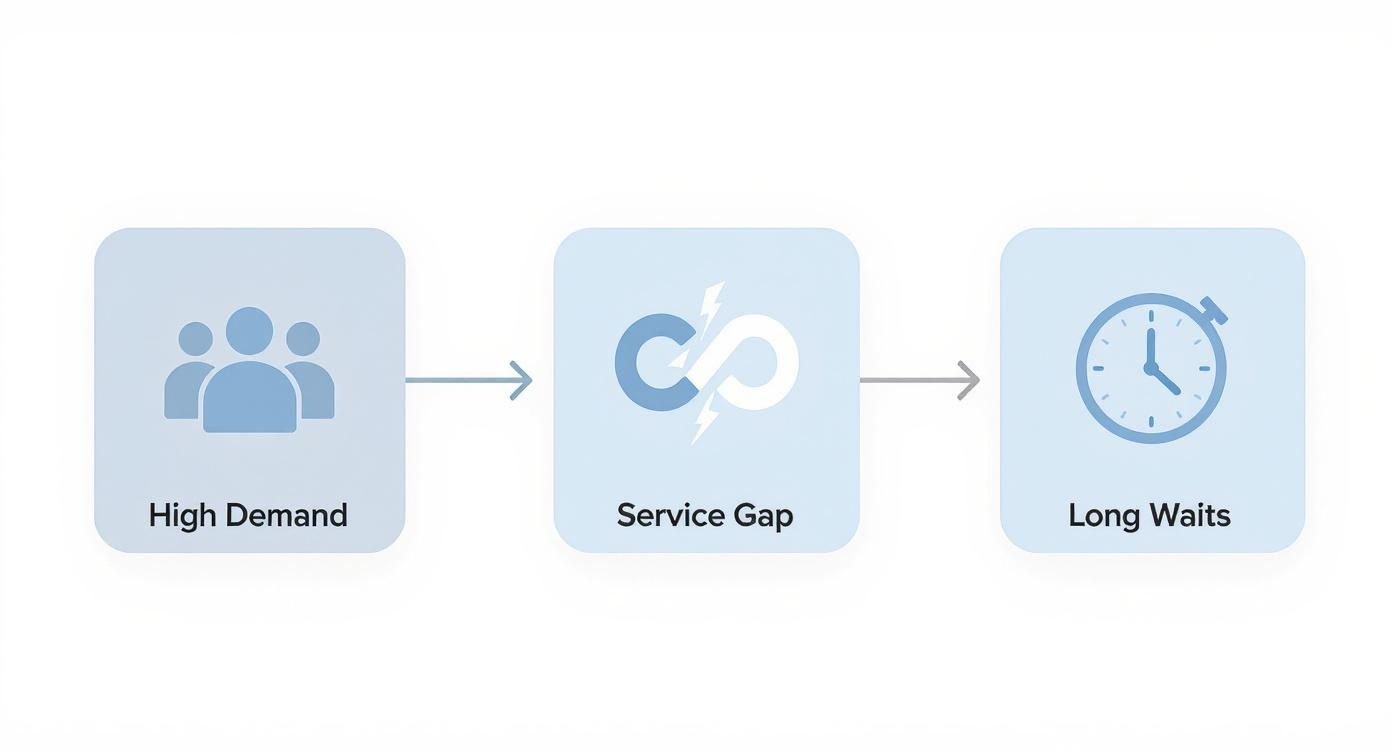
This really highlights why an efficient triage system is so critical for managing limited clinical resources, especially in a high-demand city like London.
The Core Diagnostic Interviews
Once you’re through the screening, you get to the heart of the assessment: the clinical interviews. These are detailed, structured conversations with a specialist—usually a psychiatrist or a clinical psychologist who’s an expert in adult ADHD and any co-occurring conditions like Autism.
The clinician will want to get a good sense of your personal history, covering a few key areas:
- Developmental History: They’ll ask about your childhood, what school was like, and any early signs of inattention, hyperactivity, or differences in social communication you might remember.
- Medical and Family History: This helps to rule out any other medical reasons for your symptoms and check for any genetic links.
- Current Functioning: You'll talk about how things are affecting your life right now—your career, home life, and general mental wellbeing.
These interviews aren't just about ticking off a list of symptoms. They’re a real chance for the clinician to understand the bigger picture, including your overall mental health and how your challenges have changed over time. The goal is to see the whole person, not just a few isolated behaviours. For a closer look at what a full evaluation involves, you can explore the complete ADHD assessment UK process.
Psychometric Testing and Observer Reports
Alongside the interviews, your assessment will almost certainly include standardised psychometric tests. These are validated tools that add objective data to the clinical picture, backing up the diagnosis with evidence. Common examples you might come across are the DIVA-5 (Diagnostic Interview for ADHD in Adults) or the Conners' Adult ADHD Rating Scales (CAARS).
These tests measure specific ADHD-related behaviours and compare your answers to established norms, which is a critical part of making sure the diagnosis is based on solid evidence, not just a subjective chat.
Clinicians also often ask for observer reports. This means getting information from someone who knows you really well, like a partner, parent, or close friend. Their perspective can be incredibly valuable, offering insights into how your symptoms appear in different situations. It gives a more rounded view that you might not be able to see yourself and is especially useful for spotting the lifelong patterns of behaviour needed for a robust diagnosis of ADHD or Autism.
Choosing Your Path: NHS vs. Private ADHD Assessments
https://www.youtube.com/embed/jk3y-7HwwYc
If you’ve decided to get an ADHD assessment in London, you’re standing at a crossroads with three main paths to consider: the NHS, a private in-person clinic, or a private online service. This decision isn’t just about weighing up cost against speed. It’s about figuring out which route best fits your personal circumstances, your level of urgency, and how you feel most comfortable approaching your mental health.
Each option has its own distinct landscape. The NHS offers a solid, publicly funded pathway, but it’s often a long and winding road. Private clinics, on the other hand, provide a much more direct and faster route, though you'll need to fund it yourself. Getting to grips with the reality of each path is the first, most crucial step in making a choice you feel good about.
The NHS Route: A Path of Patience
For most people in the UK, the GP is the natural first port of call for any health concern, and that includes getting an ADHD or Autism assessment. You'll start by talking to your doctor about your symptoms and how they're affecting your life. If your GP agrees that an assessment is the right next step, they’ll refer you to a specialist NHS mental health team.
The biggest plus here is obvious: it’s free. The major downside, however, is the wait. ADHD services across England, especially in London, are under enormous pressure, leading to some truly staggering delays. Recent reports show that over 549,000 children and adults in England are currently waiting for an ADHD assessment. Worryingly, in some areas, people are left waiting for more than two years because of the sheer demand. You can read more about the official response in the ADHD taskforce final report.
This kind of prolonged wait can be incredibly tough on your mental health, especially when you’re already juggling daily challenges and potentially other conditions like anxiety or depression, which often go hand-in-hand with ADHD and Autism.
The Private Pathway: A Faster, More Direct Approach
For anyone who simply can’t face the NHS waiting lists, going private is a much faster alternative. This path splits into two main options: the traditional in-person clinic or a more modern online service.
The number one advantage of the private route is speed. You can often book an initial appointment within weeks, completely sidestepping the long NHS queues. Getting a diagnosis and starting treatment or support that much sooner can be genuinely life-changing for your mental health.
Choosing a private assessment is an investment in your immediate wellbeing. It lets you move from a place of uncertainty and struggle to one of clarity and proactive management in a fraction of the time.
Private services also tend to offer more flexibility. You often get more say in which clinician you see and can book appointments at times that actually work for you—a huge benefit for busy London professionals or parents trying to fit everything in.
In-Person vs. Online Private Assessments
Once you've decided on the private route, you have another choice to make: face-to-face or online.
-
In-Person Clinics: These offer a traditional, clinical experience. Some people just prefer meeting face-to-face, feeling it helps them build a better rapport with their psychiatrist. If you go this route, it's vital to check that the clinic is regulated by the Care Quality Commission (CQC) to ensure you're getting high-quality care.
-
Online Providers: With the rise of telehealth, online assessments have become a really popular and credible option. They offer fantastic convenience, letting you do the whole thing from the comfort of your own home. This can be a game-changer for people who find travelling stressful, perhaps due to anxiety or if they are also autistic.
Whether you choose in-person or online, the quality of a private assessment should be just as rigorous as an NHS one, following NICE guidelines and carried out by GMC-registered specialists. Always check a provider’s credentials—this ensures your diagnosis will be recognised and respected by other healthcare professionals down the line.
When it comes to the financial side, it’s worth knowing exactly what’s included. Our guide on the private ADHD assessment cost breaks down the typical expenses to help you budget. In the end, whether you opt for the steady NHS path or a faster private one, the goal is always the same: getting the clarity and support you need.
Getting Ready for Your Assessment
Walking into an ADHD assessment can feel like a big deal, and honestly, it is. But a little bit of prep work beforehand can make all the difference. The goal isn't to 'pass' a test, but to give the clinician a clear, honest window into your world. The more organised you are, the easier it is for them to get a full and accurate picture of your experiences with ADHD, Autism, and your overall mental health.
When you come to your appointment with your thoughts and documents in order, the whole process feels less daunting and more like a collaboration. It empowers you to clearly explain the challenges you've been facing, ensuring nothing important gets missed.
Piece Together Your Personal History
Because ADHD and Autism are neurodevelopmental conditions, their roots stretch back to childhood. Your clinician will need to understand how these patterns have shown up throughout your life, not just right now. So, it's time to do a bit of detective work on your own history.
Think of it like building a case file for yourself. You're gathering evidence from different chapters of your life. A few things are particularly golden:
- Old School Reports: These are often the most revealing documents you can find. Were there comments from teachers about you being "a daydreamer," "disruptive," "disorganised," or "not living up to your potential"? These can be massive clues for ADHD, while notes on social difficulties or rigid routines might point towards Autism.
- Past Performance Reviews: Feedback from jobs can also highlight classic ADHD struggles. Look for comments about missing deadlines, issues with organisation, or even difficulties with colleagues that might stem from impulsivity or social communication differences.
- Personal Journals or Notes: If you've ever jotted down your frustrations with focus, mood swings, or just keeping your life on track, those personal reflections can provide powerful, real-life context for your mental health journey.
Pulling these bits and pieces together helps create a timeline, showing the clinician that the difficulties you're experiencing today aren't new—they have a history.
Nail Down Your Symptoms and Experiences
It’s completely normal to get into a clinical interview and suddenly have your mind go blank. To sidestep that frustration, take some time before your appointment to jot down the key things you struggle with. You don't need to write a novel; a simple list of bullet points is perfect.
It can help to break down your thoughts by area of life:
- Work or Study: How does this affect your performance? Do you battle with deadlines? How are your interactions with colleagues or classmates?
- Home and Daily Life: Think about the practical stuff. The mountain of laundry, the forgotten appointments, the late bills, or even the inability to just relax and have "down time."
- Relationships & Mental Health: Be honest with yourself about how things like impulsivity, inattention, or emotional flashes might affect your relationships. Also, note any feelings of anxiety or depression that accompany these challenges.
Sometimes, a structured list can help you organise your thoughts. It might be useful to look over an adult ADHD symptoms checklist to jog your memory and find specific examples from your own life that really hit home.
A quick tip: Consider bringing someone you trust with you—a partner, parent, or a close friend who knows you well. They often see the things you don't and can offer examples of your behaviours from an outside perspective. This can give the clinician a much more rounded view.
Life After a Diagnosis
Getting a diagnosis isn't the end of the road; it's the beginning of a new one. It gives you a framework for understanding yourself and unlocks the door to support and treatment that’s actually designed for how your brain works. The diagnostic report is your roadmap, detailing your clinical profile and recommending the next steps for your mental health.
Your journey after diagnosis will likely involve a few key elements:
- Medication Titration: If medication is part of your plan, you'll start a process called titration. This is where you and your psychiatrist work closely together to find the right type of medication and the right dose for you. It's a careful, methodical process to maximise the benefits and minimise any side effects. Patience is key.
- Therapeutic Support: Many people find therapy incredibly helpful. Cognitive Behavioural Therapy (CBT), when adapted specifically for ADHD or Autism, isn't just about talking; it's about learning practical, real-world strategies for managing your time, getting organised, and handling your emotions.
- Workplace and Educational Adjustments: Your formal diagnosis is the official document you need to ask for "reasonable adjustments" at work or university, as protected by the Equality Act 2010. This could mean things like getting extra time on exams, having access to a quiet workspace, or arranging more flexible working hours.
Finding a Credible and Qualified London Clinic

With so many private mental health services popping up across London, figuring out where to go for an assessment can feel overwhelming. The last thing you need when you're already trying to get some clarity around ADHD or Autism is even more confusion.
Thankfully, there are some straightforward, official checks you can do to make sure a clinic is legitimate and that you'll be in good hands.
Choosing wisely isn't just about protecting your financial investment. It's about ensuring your diagnosis is accurate and will be taken seriously by other healthcare professionals, including your GP. You need a provider who not only gets the nuances of ADHD and co-occurring conditions like Autism but also follows strict professional rules. This is where regulatory bodies become your best friend.
Key Regulatory Bodies to Check
Before you book any ADHD assessment in London, get familiar with two crucial organisations. Think of them as the official watchdogs for healthcare in the UK. Checking a clinic against their records is an absolute must.
-
The Care Quality Commission (CQC): This is the independent regulator for all health and social care in England. If a clinic is CQC-registered, it means they are inspected regularly and meet essential standards for quality and safety. You can easily search the CQC's public register online to see if a provider is listed and what their latest report says.
-
The General Medical Council (GMC): The GMC keeps the official list of every doctor legally allowed to practise medicine in the UK. Any psychiatrist assessing you must be on the GMC's Specialist Register. This is your proof that they’ve completed years of advanced, specialised training in psychiatry.
A reputable clinic will be completely open about its credentials. If you can't easily find a CQC registration number or verify that their doctors are on the GMC Specialist Register, that’s a major red flag.
What to Look For in a Clinician
Beyond the clinic's registration, the expertise of the person actually doing the assessment is what really counts. Diagnosing ADHD and Autism is a specialist medical process, not a simple box-ticking exercise. It requires a real expert in neurodevelopmental conditions and their impact on mental health.
You should always look for a Consultant Psychiatrist to handle your assessment. This title is protected and represents the highest level of psychiatric training in the UK. Their depth of experience is vital for telling the difference between ADHD, Autism, and other mental health conditions like anxiety or depression, which can often have similar-looking symptoms.
A reliable diagnosis hinges entirely on this level of clinical skill. To understand what this process involves with qualified specialists, you can learn more about getting a private ADHD diagnosis in London.
Answering Your Questions About ADHD Assessments in London
Thinking about getting an ADHD assessment can feel overwhelming, and it's natural to have a lot of questions running through your mind. To help clear things up, here are some straightforward answers to the questions we hear most often from people looking for an ADHD assessment in London.
How Much Does a Private ADHD Assessment Cost in London?
You can expect to pay anywhere from £700 to over £2,000 for a private ADHD assessment in London. It’s a wide range, I know. The final figure really depends on who you see – a clinic's reputation and the experience of the psychiatrist play a big part – as well as how in-depth the assessment is, for instance, if it also screens for Autism.
Typically, that price covers the initial chat, the main diagnostic sessions, and the detailed report you get at the end. What you must check, though, is what happens after the diagnosis. Ask if follow-up appointments and medication management are part of the package or if they’re extra costs. Getting a clear, itemised breakdown upfront is the best way to avoid any nasty surprises later on.
Can My GP Refuse an NHS Referral for an ADHD Assessment?
In short, no – a GP can’t just refuse a referral if you’re presenting with clear symptoms of ADHD that are genuinely messing with your life. What they might do, however, is suggest looking into other things first if the picture isn't crystal clear. For example, they might want to rule out or treat anxiety and depression, as the symptoms can sometimes overlap with ADHD and Autism.
The best thing you can do is go in prepared. Don't just say you think you have ADHD; give them concrete examples. Jot down a list of your symptoms and exactly how they cause problems at work, in your relationships, or just day-to-day. If you walk away feeling like you haven't been heard, remember you are well within your rights to ask for a second opinion from another doctor at the practice.
It's worth remembering that conditions like ADHD and Autism often go hand-in-hand. A good, thorough assessment won't just look for one thing in isolation; it will explore this potential overlap to make sure any diagnosis gives a true picture of what's going on with your mental health.
Will a Private ADHD Diagnosis Be Accepted by the NHS?
This is a big one. Generally, yes, but it’s not a simple guarantee. Acceptance often comes down to the policy of your local NHS trust and, crucially, the quality of the private assessment you received. To stand the best chance, your diagnosis absolutely must come from a GMC-registered Consultant Psychiatrist, and the report needs to show that the whole process followed the official NICE guidelines.
Most NHS trusts will respect a well-documented report from a reputable private clinician. That said, they might still want to do their own quick review before they agree to take over your care, especially for prescribing medication under what’s called a ‘shared care agreement’. It’s always a smart move to have a chat with your GP about this before you commit to a private assessment.
Do I Need an Official Diagnosis for Support at Work or University?
Yes, for any official support, a formal diagnostic report is pretty much non-negotiable. This report is the key piece of evidence that universities and employers require to provide what the law calls "reasonable adjustments" under the Equality Act 2010.
These aren't special privileges; they are practical changes designed to give you a level playing field. Think things like getting extra time in exams, being given a quiet space to work, or having more flexible deadlines. Without that official paper trail, it's incredibly difficult to formally request and secure the support you're entitled to for ADHD or Autism.
At Insight Diagnostics Global, we offer CQC-regulated, consultant-led online assessments for adults, providing a clear, credible, and supportive route to understanding your mental health. If you feel ready to explore this further, you can find out more about what we do and book a consultation at https://insightdiagnostics.co.uk.