Navigating the world of neurodevelopmental assessments in the UK can feel like a maze, but it all boils down to one essential first step: getting a proper, professional evaluation. Forget the online quizzes; a formal diagnosis for conditions like ADHD and Autism is what gives you real clarity and opens the door to the right kind of support for you or your child.
Starting Your Assessment Journey in the UK
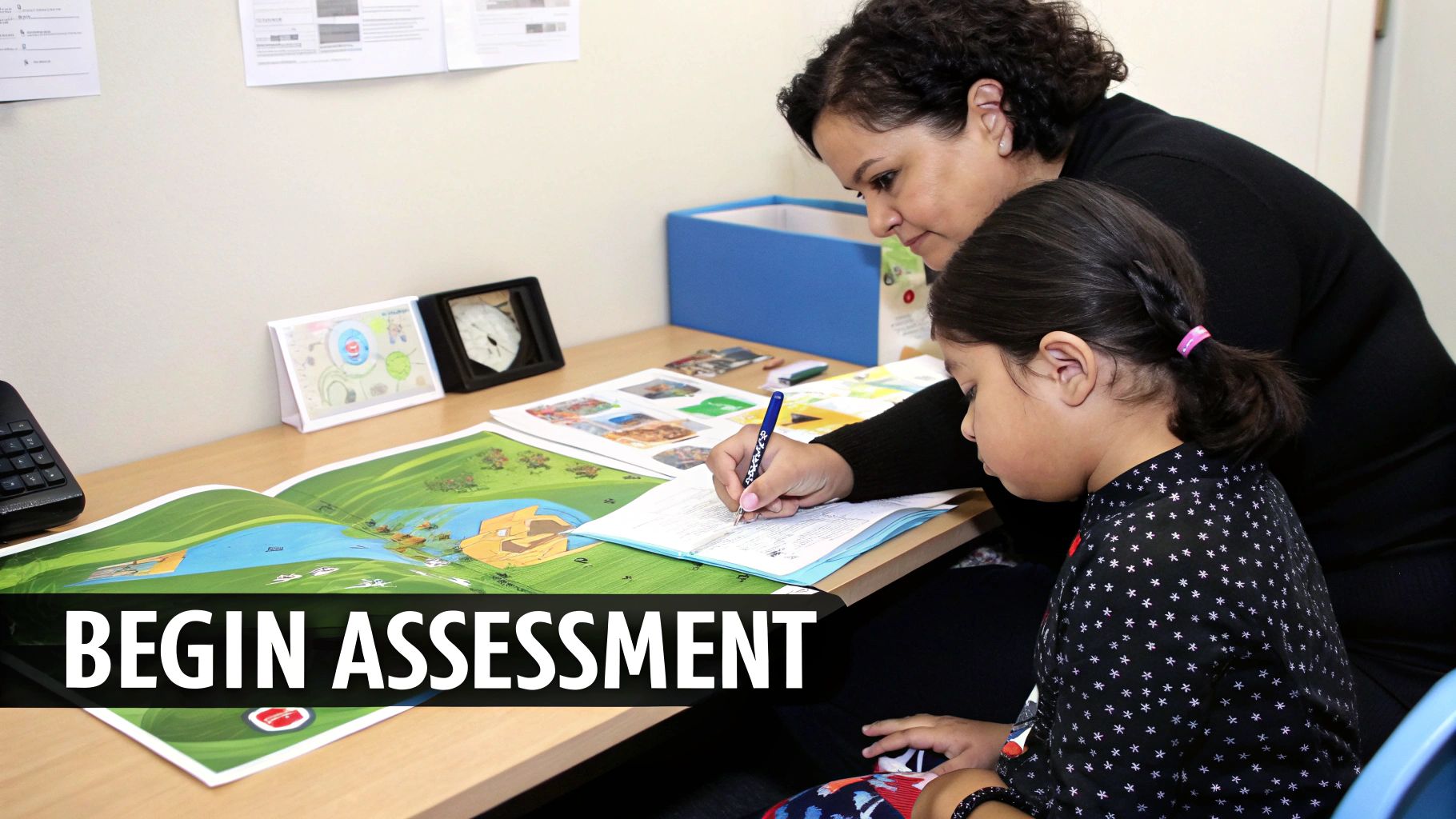
With a growing public conversation around neurodivergence, many people are realising that conditions like ADHD and Autism can, and often do, show up together. This is changing the way assessments are done, with a greater focus on understanding the complete picture. If you’ve found yourself wondering if you or someone you care about might have ADHD, Autism, or both, you're definitely not the only one looking for answers.
Why a Formal Diagnosis Matters
A formal assessment is your gateway to finally understanding and managing symptoms in a way that works. It’s a huge relief for many, confirming that the struggles you’ve faced aren't a personal failing but symptoms of a recognised neurodevelopmental condition.
This kind of diagnostic clarity is crucial for a few key reasons:
- Access to Treatment: It's the only way to access medical treatments, like medication for ADHD, that can make a world of difference to focus and emotional regulation.
- Therapeutic Support: A diagnosis unlocks the door to specialised therapies, including Cognitive Behavioural Therapy (CBT) and coaching tailored for ADHD or Autism.
- Legal Protections: It gives you the standing you need to ask for reasonable adjustments at work or university, as protected by the Equality Act 2010.
The Overlap Between ADHD and Autism
It’s not unusual for people looking into an ADHD assessment UK to also wonder about Autism. The two conditions can look similar on the surface—both can involve challenges with social communication, executive function, and sensory issues. A good clinician will be able to tell the difference, or even recognise when both are present, to make sure your support plan is tailored to your specific neurotype.
A comprehensive neurodevelopmental assessment doesn't just tick a box for one condition. It’s about seeing the whole person, exploring co-occurring conditions like Autism to ensure the final diagnosis and support plan are genuinely right for you.
Understanding the Scale of Undiagnosed ADHD
The need for clear, accessible diagnostic pathways has never been more obvious. Recent research paints a stark picture, revealing a huge gap between how many people are thought to have ADHD and how many actually have a diagnosis. An analysis of 9 million GP records found an ADHD diagnosis rate of just 0.32%—that's only about 1 in 9 of the people likely to have the condition.
This means over two million people in the UK could be navigating life with undiagnosed ADHD, which really highlights why reliable assessment services are so important. You can dig deeper into these ADHD statistics and what they mean for the UK population.
Choosing Your Path: NHS vs. Private Assessments
Deciding to get a neurodevelopmental assessment is a huge first step. The next, and equally important, question is how to get there. In the UK, you essentially have two main roads to a diagnosis: the National Health Service (NHS) or the private healthcare sector.
Each path offers a very different journey. They have their own unique signposts when it comes to referrals, waiting times, and costs, so the right choice for you will really come down to your own personal circumstances.
The NHS Assessment Pathway
For most people, the journey to an NHS ADHD assessment UK kicks off at their local GP surgery. This is the traditional starting line. You’ll need to book an appointment, chat with your doctor about your symptoms, and explain your concerns about ADHD and/or Autism. If your GP agrees an assessment is the next logical step, they’ll refer you to the local specialist NHS mental health service.
While the care itself is free, the biggest hurdle on the NHS path is, without a doubt, time. Waiting lists for neurodevelopmental assessments have grown enormously, creating a massive backlog. Recent figures show that over 500,000 people in England are currently waiting for an assessment, and more than a quarter of them have already been on the list for two years or longer. This strain, fuelled by growing awareness and stretched services, is a critical issue that even NHS England's own taskforce has recognised. For more on this, you can read about the future of ADHD services in the UK.
There is, however, a lesser-known but powerful option available in England: the ‘Right to Choose’ policy. This legislation gives you the right to ask your GP for a referral to a qualified private provider that also holds an NHS contract, even if they aren't in your local area. The assessment is still funded by the NHS, so it won’t cost you anything, but it can often dramatically shorten your wait time.
The Private Assessment Route
Going for a private assessment is a much more direct, and usually faster, route. One of the biggest draws is the ability to self-refer. You don’t need to go through your GP first; you can simply research clinics, find one you like, and book an appointment yourself.
This approach puts you firmly in the driver's seat. You get to choose your specialist, perhaps finding someone with particular expertise in co-occurring conditions like Autism. The whole process is generally much quicker, with initial appointments often available within a few weeks, rather than the months or years you might face otherwise.
Of course, this speed and control come with a price tag. A private assessment can cost anywhere from several hundred to over a thousand pounds. It's also important to remember that this initial fee often doesn't cover follow-up appointments or the ongoing cost of medication.
For many, the decision to go private is a pragmatic one. It's an investment made to bypass long waits and get access to answers and support sooner, which can be invaluable for mental wellbeing and daily functioning.
A Side-by-Side Comparison
To help you weigh everything up, it’s useful to see the key differences between the NHS and private pathways laid out clearly.
Comparing NHS and Private ADHD Assessments
Here’s a simple breakdown of what to expect from each option.
| Feature | NHS Pathway | Private Pathway |
|---|---|---|
| Referral | GP referral is required. | Self-referral is standard. |
| Waiting Time | Often long (months to years). | Typically short (weeks). |
| Cost | Free at the point of service. | Paid for by the individual. |
| Choice of Clinician | Limited; assigned by the service. | High; you can choose your provider. |
| Post-Diagnosis Care | Integrated into NHS services. | May require a shared care agreement with your GP. |
This table highlights the fundamental trade-offs: cost versus speed and choice.
After a private diagnosis, any medication prescribed is also handled privately. This means you’ll cover the cost of the prescription itself and the titration period, which is where a specialist works with you to find the right medication and dosage. To get your medication on the NHS long-term, you’ll need a 'shared care agreement' with your GP, where they agree to take over prescribing duties. If you're new to this, our guide on how private prescriptions work online can help clarify this part of the process.
Ultimately, there’s no single "best" path. The NHS offers a comprehensive, free service if you have the time to wait. The private sector provides a faster, more controlled alternative if you have the budget. Think about your urgency, finances, and personal preferences to decide which road is the right one for your neurodevelopmental journey.
What Happens During Your ADHD Assessment
The idea of a neurodevelopmental assessment can feel a bit daunting, but pulling back the curtain on the process really helps. It’s not a single, high-pressure test. Think of it more as a comprehensive conversation—a deep dive into your life experiences, both the challenges and the things you excel at. The goal is to build a complete, nuanced picture of you.
The whole thing is led by a specialist clinician, usually a psychiatrist or a highly trained psychologist. They know what to look for and are skilled at spotting the patterns of ADHD and Autism that you might have been living with your whole life without ever putting a name to.
To give you a clearer picture, this infographic breaks down the typical journey through both the NHS and private routes.
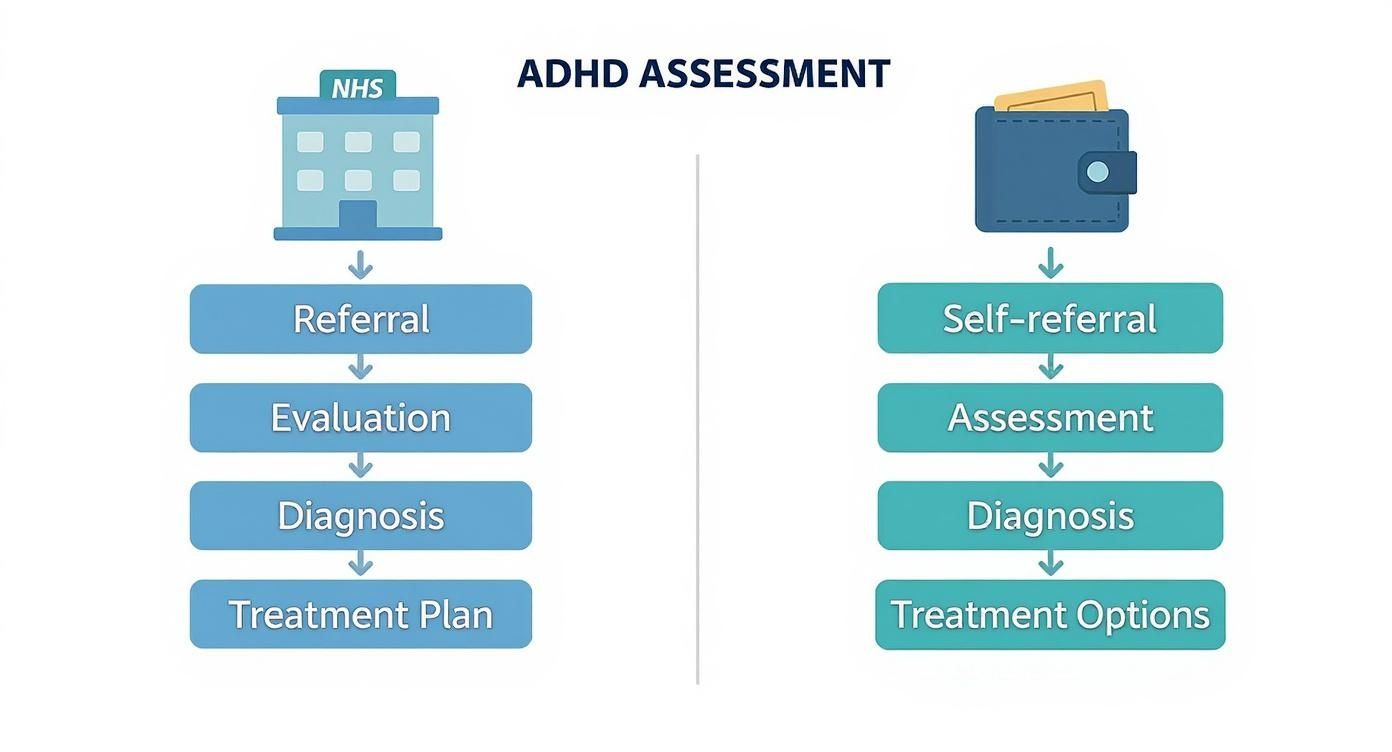
As you can see, the core diagnostic steps are pretty much the same. The real difference is often the waiting time and the process of actually getting to that first appointment.
The Clinical Interview
At the heart of any good ADHD assessment UK is the clinical interview. This is a detailed, structured chat that covers your life story, from your earliest school days right up to what’s happening at work and home today. The clinician will ask very specific questions about the classic signs of ADHD—things like inattention, hyperactivity, and impulsivity—as well as traits associated with Autism, such as social communication differences and sensory sensitivities.
They’re trying to build a timeline, looking for evidence that these struggles have been a consistent part of your life, not just a recent problem. It’s all about understanding the real-world impact these traits have had across different areas of your life.
Standardised Rating Scales and Questionnaires
You won't just be talking. You'll also fill out a few standardised questionnaires. These aren't tests you can pass or fail; they're clever tools that help the clinician measure your experiences against the formal diagnostic criteria, like those in the DSM-5.
Think of them as a way to add some objective data to the story you’ve shared. The questions will be about how often you find yourself losing keys, feeling like you're driven by a motor, or finding social situations confusing.
The Importance of Collateral Information
One of the key requirements for an adult neurodevelopmental diagnosis is showing that symptoms were present before you were 12 years old. Let's be honest, remembering the specifics of what you were like in Year 4 can be tricky. That’s where collateral information comes in.
This simply means getting input from someone else who knew you back then, or who knows you well now. This could be:
- A parent or an older sibling: They can offer priceless memories about your behaviour, school performance, and developmental milestones as a child.
- Your partner or a close friend: Their perspective is crucial for understanding how your symptoms show up in your adult life and relationships.
- Old school reports: These can be an absolute goldmine. Comments from teachers about being "day-dreamy," "disorganised," or "fidgety" can provide powerful, objective evidence.
Collateral information is like a historical cross-reference. It helps the clinician connect the dots between your childhood and your present-day struggles, adding a vital layer of proof to the diagnostic picture.
Differentiating ADHD from Co-Occurring Conditions
A thorough assessment isn't just about ticking ADHD boxes. A good clinician will also be looking out for other conditions that can look a lot like ADHD or even exist alongside it. Autism is a very common example.
Both ADHD and Autism can create challenges with social interaction and executive function, but the reasons behind them are very different. For instance, someone with ADHD might struggle socially because they interrupt people impulsively. In contrast, someone with Autism might find it difficult to interpret body language or sarcasm.
Carefully teasing apart these differences is essential for getting an accurate diagnosis. It ensures that the support plan you receive is genuinely tailored to your unique brain wiring. It’s this kind of detailed, holistic view that we prioritise in our comprehensive mental health assessment services.
How to Prepare for Your Assessment
Heading into your assessment with a bit of prep work can genuinely make all the difference. Think of it less like studying for a test and more like gathering the evidence for a documentary about your life. You’re aiming to give the clinician the clearest possible window into your world, both past and present.
When you take the time to organise your thoughts and documents, you ensure those crucial little details don’t get lost in the moment. It helps the expert connect the dots between your childhood and your current struggles, which is a cornerstone of any good ADHD assessment in the UK.
Gathering Your Historical Documents
Right, time to put on your detective hat and do a bit of digging into your own past. The goal here is to unearth evidence of neurodivergent traits from your childhood – anything from before you were 12 is particularly golden. These old documents offer an objective glimpse into how others saw you back then.
Here’s what you should be looking for:
- Old School Reports: These are often the most telling pieces of the puzzle. Hunt for recurring comments from teachers – things like "chatty," "disorganised," "daydreamer," "easily distracted," or comments about social difficulties or intense interests.
- Past Performance Reviews: If you’re comfortable sharing them, work appraisals can reveal long-standing patterns of missing deadlines, struggling with organisation, or communication differences in a professional setting.
- Childhood Diaries or Journals: Sometimes, the most honest insights come from your own hand. These can offer a raw, unfiltered look at your thoughts and frustrations as a young person.
- Any Previous Medical or Educational Psychology Reports: If you were ever assessed for something like dyslexia or other learning difficulties, these reports are absolutely vital.
Think of it as building a case file. Each document adds another layer to the story you’ll be sharing with your clinician.
Compiling Your Symptom and Example List
Your own experiences are, without a doubt, the most critical part of the assessment. The trouble is, when you’re put on the spot, it’s surprisingly easy for your mind to go completely blank. To avoid this, it’s a brilliant idea to jot down a list of symptoms and real-life examples beforehand.
A great way to structure this is to group your examples by the different areas of your life they affect. This gives your clinician a panoramic view of how these traits actually play out day-to-day.
Creating a detailed list of examples isn't about proving you have ADHD or Autism. It's about providing rich, specific context that helps your clinician understand the unique way your brain works and the true impact it has on your life.
Try to come up with a few concrete examples for each trait:
Work/Study
- Inattention: "I constantly miss crucial details in emails, which has caused embarrassing mistakes. In team meetings, my mind just drifts, and I’ll realise I have no idea what was just decided."
- Social Communication: "I find small talk exhausting and often say things that come across as too blunt. I struggle to know when it's my turn to speak in meetings."
Relationships
- Emotional Dysregulation: "My partner says I go from 0 to 100 in seconds over tiny things, and then it’s over just as quickly. It leaves them feeling like they’re walking on eggshells."
- Sensory Issues: "I can't stand noisy environments like pubs. It feels like a physical assault, and I have to leave. This makes socialising difficult."
Daily Life
- Hyperactivity/Restlessness: "I simply cannot sit through a whole film without fidgeting or scrolling on my phone. I just feel this constant, buzzing need to be doing something."
- Disorganisation: "My flat is what you might call 'organised chaos', but mostly it's just chaos. Keeping on top of bills and life admin feels like a monumental task."
Choosing and Briefing Your Informant
Finally, have a think about who could provide what’s known as ‘collateral information’. This is just a formal way of saying ‘someone who knows you really well’. It’s often a parent, an older sibling, or a long-term partner who can give their perspective on your behaviour, both now and way back when.
The key is to choose someone you trust to be both honest and supportive.
Once you’ve got someone in mind, it’s a good idea to have a quiet chat with them before the assessment. Explain what it's for and what kind of information would be helpful. You could prompt them to think about things like your energy levels as a kid, how you coped with schoolwork, or your social life. A little heads-up means they can come prepared with thoughtful, genuinely useful insights rather than being put on the spot.
Understanding Your Diagnosis and What Comes Next
Getting the results of your ADHD assessment UK is a huge moment. For many, it’s the end of a long, often confusing road of questioning why certain things have always felt so difficult. It can bring a massive sense of relief, but it’s also the start of a brand-new chapter.
Whether the outcome confirms ADHD, Autism, both, or points to another condition, you finally have some clarity. This isn't just about getting a label; it's about getting a roadmap. For those with a new diagnosis, the next step is to build a support system that actually works for you, helping you learn to work with your brain, not against it.
Interpreting Your Assessment Outcome
Once your assessment is complete, the clinician will walk you through their findings. They won't just hand you a report; they'll explain what it all means in a way that makes sense to you.
There are generally a few potential outcomes:
- A Confirmed Diagnosis: This means your experiences line up with the clinical criteria for ADHD, Autism Spectrum Condition (ASC), or both. You'll get a formal report detailing this.
- Diagnosis of Another Condition: It’s quite common for the symptoms that made you seek an assessment to be better explained by something else, like an anxiety disorder or depression. A good assessment will pick this up and point you in the right direction.
- No Formal Diagnosis: Sometimes, your symptoms might not fully meet the criteria for any specific condition. If this is the case, the clinician will explain why and might offer other ideas or recommendations based on what they've learned about you.
No matter the result, you walk away with a professional, evidence-based perspective. This is incredibly empowering. It gives you a solid foundation to either start exploring neurodivergent-affirming treatment or look into other types of support.
Mapping Out Your Post-Diagnosis Support Plan
If you are diagnosed with ADHD and/or Autism, the report is just the beginning. The real work starts now: creating a personalised plan to tackle your specific challenges and help you reach your goals. This is rarely a one-size-fits-all solution; it’s usually a blend of medical treatment and practical, skills-based support.
Think of it like finally getting the right user manual for your brain. The diagnosis is the front cover, but the treatment and support plan holds all the instructions you need to get things running smoothly.
A diagnosis is not a label; it is a guide. It unlocks access to a range of tools and supports designed to help you manage challenges and harness your strengths, giving you greater control over your life.
Your plan will be tailored to you, likely combining some of the options below.
Medical Treatment: Medication Titration and Monitoring
For a lot of adults with ADHD, medication can be a game-changer. It can significantly help with core symptoms like poor focus and impulsivity. But it’s not as simple as picking up a prescription. The journey starts with a careful process called titration.
During titration, you’ll work very closely with your psychiatrist to find the right medication and the right dose for you. This involves starting low and slowly adjusting the dose, with regular check-ins to see how you're feeling. It’s a collaborative effort designed to get the maximum benefit with the fewest side effects.
Once you’ve found a stable dose that works well, the focus shifts to ongoing management. This is where a Shared Care Agreement comes in. It's an arrangement between your private specialist and your NHS GP that allows your GP to take over issuing your repeat prescriptions. This makes getting your medication much more convenient and affordable.
Non-Medical Support and Therapies
Medication is often just one piece of the puzzle. A truly effective plan also includes therapy and practical strategies to help you build lasting skills and better coping mechanisms for both ADHD and Autism.
Here’s a quick look at the main treatment and support options available in the UK after a diagnosis.
Common ADHD & Autism Support Options in the UK
| Treatment Type | Description | Common Examples |
|---|---|---|
| Psychological Therapy | Talking therapies designed to help you understand your thought patterns and behaviours, giving you practical strategies to manage daily challenges. | Cognitive Behavioural Therapy (CBT) that’s been adapted for neurodivergence. It can help with procrastination, time management, emotional regulation, and managing social anxiety. |
| Specialist Coaching | A goal-focused partnership where a coach helps you build practical life skills for organisation, planning, and achieving your personal or professional goals. | Working with a coach to break down a huge project, create a routine that sticks, or improve communication in your relationships. |
| Workplace Accommodations | These are 'reasonable adjustments' your employer is legally required to consider under the Equality Act 2010 to help you do your job well. | This could be noise-cancelling headphones, flexible working hours, getting instructions in writing, or having a quiet space to work. |
By combining medical and non-medical support, you can create a balanced and powerful toolkit for managing your neurotype long-term. Exploring these different avenues empowers you to not just cope, but to truly thrive.
Finding a Reputable Assessment Provider
The world of ADHD and Autism assessments has grown massively, and choosing the right provider is more than just a box-ticking exercise. It's a critical decision that affects your safety and whether your diagnosis will be taken seriously. The quality of your assessment is the foundation for everything that comes next—from your treatment plan to getting the right support at work.
Taking the time to make an informed choice helps you sidestep the predatory services that have popped up and ensures you get a credible, thorough evaluation that other healthcare professionals will respect. It's all about looking past the slick marketing and zeroing in on the credentials and processes that actually matter.
First Things First: Check Their Credentials
This is the most important step. Before you go any further, you need to verify the qualifications of the clinician who will be assessing you. Any legitimate ADHD assessment UK provider will be completely open about their team's credentials.
You're looking for clinicians registered with one of two key professional bodies:
- General Medical Council (GMC): Any psychiatrist involved must be on the GMC Specialist Register. This is an absolute must-have. It proves they've gone through the years of intense training needed to diagnose and treat complex conditions like ADHD and Autism.
- Health and Care Professions Council (HCPC): This is the equivalent for clinical and practitioner psychologists. HCPC registration shows they meet the UK's national standards for training, professional skills, and ethical conduct.
Think of these registrations as your guarantee. They confirm the person you're seeing is qualified, accountable, and held to strict professional standards. You can (and should) check their status yourself on the official GMC and HCPC websites.
Are They Following the Rulebook? (NICE Guidelines)
In the UK, the gold standard for healthcare is set by the National Institute for Health and Care Excellence (NICE). Their guidelines are built on solid evidence, and any provider worth their salt—whether NHS or private—must follow them for diagnosing conditions like ADHD and Autism.
Sticking to NICE guidelines means the assessment won't be a quick chat. It has to be comprehensive. It will involve a deep-dive clinical interview, using standardised rating scales, and gathering information from someone who knows you well (often called 'collateral information'). This multi-angled approach is crucial for getting the diagnosis right, especially if other conditions like Autism might be in the picture.
When a clinic says they are 'NICE-compliant', they're promising that their process is methodical, evidence-based, and up to the highest standard of UK healthcare. This is a big deal, especially if you hope to get your GP on board with a shared care agreement later on.
Red Flags to Watch Out For
Knowing what to look for is only half the battle; you also need to know what to run away from. Some services are more interested in your money than your well-being, and spotting the warning signs can save you a lot of time, cash, and heartache.
Be very cautious of any provider that:
- Guarantees a Diagnosis: This is a massive red flag. No ethical clinician can ever promise a specific outcome before they've even met you. It suggests they're selling a product, not providing healthcare.
- Offers a Super-Quick Process: A proper neurodevelopmental assessment takes several hours and involves multiple stages. If a clinic is offering a diagnosis after a single one-hour chat, it’s simply not thorough enough to be reliable.
- Is Vague About Costs: Good clinics are upfront about their fees. You should know exactly what you’re paying for the assessment, the report, any follow-ups, and the medication titration process. Hidden costs are a sign of a shady operation.
- Tries to Cut Your GP Out: A responsible provider will want to work with your GP, not against them. Collaboration is key, especially when it comes to long-term medication and care.
Choosing your assessment provider is a big decision. By checking credentials, insisting on NICE compliance, and keeping an eye out for these red flags, you put yourself in the driver's seat. You can find a service that isn't just convenient, but is fundamentally safe, credible, and professional.
Got Questions? We’ve Got Answers
It’s completely normal to have questions swirling around your head when you're thinking about a neurodevelopmental assessment. Let's tackle some of the most common ones we hear to give you a bit more clarity.
Can I Be Assessed for Both ADHD and Autism at the Same Time?
Yes, you certainly can. It’s actually quite common for ADHD and Autism Spectrum Condition (ASC) to appear together, and specialist clinics are often set up to assess for both. This is usually handled through what’s called a combined neurodevelopmental assessment.
The key is to mention that you suspect both conditions right from your very first conversation with a provider. That way, they can ensure you see a clinician with the right expertise to untangle the symptoms, see if both are present, or figure out which one fits best. It’s the surest path to an accurate diagnosis.
What’s the Cost of a Private ADHD Assessment?
The price for a private ADHD assessment UK varies significantly depending on the clinic, but as a ballpark figure, expect to see costs ranging from £600 to over £2,000. A combined assessment for ADHD and Autism will likely be at the higher end of this range, or potentially more.
Typically, this price covers the main diagnostic sessions and the final written report. What you really need to check, though, is what isn't included. Ask specifically about follow-up appointments and the medication titration process, as these can easily add several hundred pounds to the overall cost if they're billed separately.
It's worth knowing that while most GPs are happy to accept a private diagnosis (especially from a clinic following NICE guidelines), they aren't required to. Most of the time, this acceptance comes in the form of a 'shared care agreement' for medication. This is where your specialist gets you stabilised on the right dose, and then your GP takes over the repeat prescriptions.
For a deeper dive into other common questions, feel free to check out our ADHD FAQs page.
At Insight Diagnostics Global, our consultant-led team offers clear, CQC-regulated assessments for adults. If you’re ready to get some answers about your mental health, you can find out more about what we do at https://insightdiagnostics.co.uk.