
For many people with ADHD in the workplace UK, the daily grind can feel like trying to run a high-performance engine on the wrong kind of fuel. It just creates friction, inefficiency, and a whole lot of frustration. When you're navigating professional life with ADHD, often alongside co-occurring conditions like autism, you face a unique set of challenges and mental health pressures that colleagues and managers simply don't see or understand.
Understanding How ADHD and Autism Shape the Workday
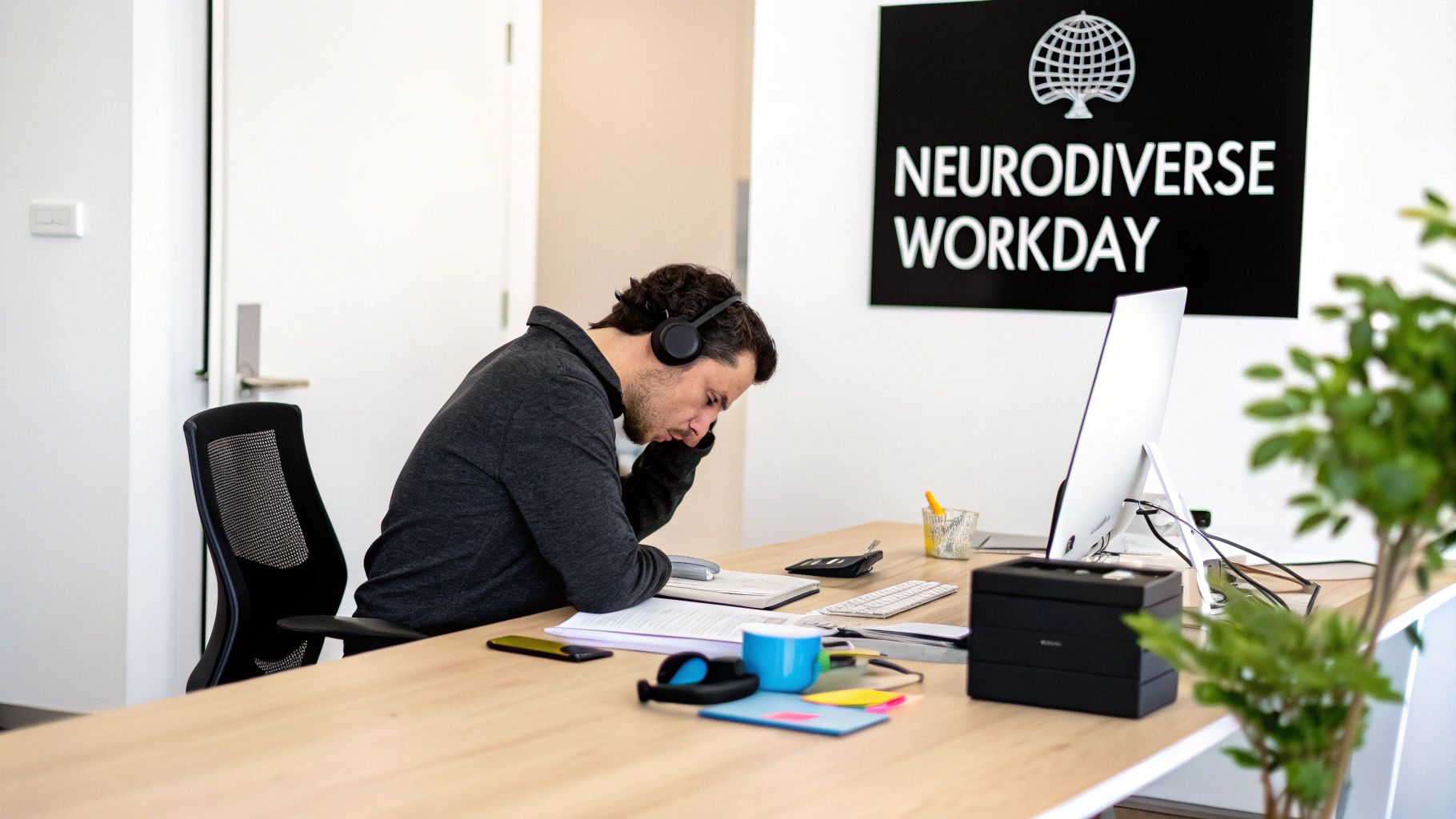
To really get what it’s like working with ADHD and autism, we have to go beyond the textbook definitions. It’s about seeing how these clinical traits actually play out, day in and day out, in a professional setting. This isn't about a lack of effort or willpower; it's about a fundamental difference in brain wiring that directly impacts our executive functions—the crucial mental toolkit we rely on to manage time, organise tasks, and control our focus.
Think about it this way: what an employer might see as carelessness with deadlines could actually be "time blindness." This is a common ADHD trait where accurately guessing how long a task will take is almost impossible. In the same way, an employee who looks disengaged in a team meeting might be grappling with sensory overload—a common challenge for autistic individuals, where background noise and bright lights become completely overwhelming, leading to significant mental fatigue.
From Clinical Traits to Workplace Realities
Getting to the 'why' behind these behaviours is the first real step toward building a genuinely supportive environment. Let's break down how these neurodivergent traits often show up at work:
- Inattention and Distractibility: In a bustling open-plan office, an employee with ADHD can find it almost impossible to filter out nearby conversations. Completing work that requires deep focus becomes a constant battle against a brain that’s hardwired to notice every single stimulus.
- Impulsivity and Hyperactivity: This isn't just about fidgeting. At work, it might look like interrupting colleagues in meetings—often driven by a genuine fear of forgetting a great idea—or impulsively switching between tasks without finishing anything.
- Sensory Sensitivity: For someone who is autistic, the scratchy texture of a uniform, the constant hum of a computer, or the flicker of fluorescent lights can be incredibly distracting or even distressing. It saps the mental energy they need for their actual job.
- Working Memory Challenges: Having difficulty with working memory makes it tough to follow multi-step verbal instructions or recall key details from a chat you had just a few minutes ago. This is why having things in writing is so essential for many with ADHD and autism. To explore this further, you can read our detailed guide on ADHD symptoms in adults.
The Hidden Impact on Mental Health and Wellbeing
These daily struggles really take their toll. The constant effort to "mask" or fit into a neurotypical environment can lead to burnout, anxiety, and depression. While around 1 in 20 people in the UK have an official ADHD diagnosis, it’s thought that as many as 2 million are undiagnosed and struggling with their mental health in silence.
This hidden reality creates a huge problem. It’s no surprise that neurodivergent employees report alarmingly low wellbeing, scoring themselves just 2.2 out of 5 on average in workplace wellness surveys. The mental health impact is profound.
But once we start to reframe these challenges, we can also see the incredible strengths that come with neurodiversity. The intense ability to hyperfocus on a passion project, a knack for generating truly innovative solutions, or a talent for noticing critical details others overlook are all powerful assets.
Ultimately, understanding ADHD and autism at work isn’t about listing deficits. It's about recognising a different kind of operating system—one that, with the right support and adjustments, can perform brilliantly.
Your Legal Rights Under The Equality Act 2010
If you're trying to manage your career while living with ADHD or autism, it's easy to feel like you're on your own. But it’s vital to know that you have significant legal protections in place. In the UK, your main safeguard is the Equality Act 2010.
This isn't just a dusty piece of government guidance; it's a powerful law designed to ensure fair treatment and prevent discrimination in almost every part of daily life, especially at work. Understanding this Act is the first step towards advocating for yourself effectively and protecting your mental health. It shifts the conversation from asking for a favour to discussing your legal rights.
Is ADHD or Autism a Disability Under the Act?
A common question I hear is whether conditions like ADHD and autism are legally considered disabilities. The Equality Act 2010 has a very specific definition. To be covered, you need to have a physical or mental impairment that has a ‘substantial’ and ‘long-term’ negative effect on your ability to do normal, day-to-day things.
Let’s unpack what those legal terms actually mean for you:
- Substantial: This just means the impact is more than minor or trivial. For instance, if your ADHD makes concentrating in a noisy, open-plan office so difficult that you’re constantly missing deadlines, that’s almost certainly a 'substantial' effect. Similarly, if social anxiety linked to autism makes client-facing meetings incredibly stressful, that also qualifies.
- Long-term: This means the effect has lasted (or is likely to last) for at least 12 months, or for the rest of your life. Since ADHD and autism are lifelong neurodevelopmental conditions, they automatically meet this part of the test.
So, if your ADHD or autism significantly gets in the way of your work—whether that’s organising your tasks, managing your time, or communicating with colleagues—it's highly probable that you are protected by the Act.
The Duty to Make Reasonable Adjustments
This brings us to the most practical and powerful part of the law for neurodivergent employees: the duty to make reasonable adjustments. This is the absolute cornerstone of the Equality Act 2010 when it comes to ADHD in the workplace UK.
Put simply, your employer has a legal obligation to make changes to your job or your work environment. The goal is to remove, or at least reduce, any disadvantages you face because of your condition.
Crucially, reasonable adjustments are not optional perks or a manager doing you a good turn. They are a legal requirement. An employer who fails to make them could be found guilty of discrimination.
This duty isn't a one-off, either. It’s an ongoing responsibility that applies from the moment you apply for a job, right through your employment, including any training or promotion opportunities. The whole point is to level the playing field, giving you the same chance to thrive as your neurotypical peers.
A great way to see how this works in practice is by looking into the government's Access to Work scheme for ADHD, which can even provide funding to help cover the cost of these adjustments.
Now, what’s considered 'reasonable'? Well, it depends on the context. Factors like how effective the change will be, the cost, and the size of the company all come into play. But you might be surprised to learn that many of the most effective adjustments for ADHD and autism—like getting instructions in writing, being allowed to wear noise-cancelling headphones, or having a bit of flexibility with your start time—cost very little, or even nothing at all. We'll dive into a whole range of these practical solutions in the next section.
Putting Reasonable Adjustments Into Practice

This is where the rubber meets the road—moving beyond the legal framework and into real, practical solutions. It’s a common misconception that reasonable adjustments mean lowering the bar. They don't. The goal is simply to remove the unnecessary hurdles that prevent neurodivergent employees from bringing their best selves to work.
You’d be surprised how many of the most effective adjustments for ADHD in the workplace UK cost very little, or even nothing at all. Real support is built on a culture of understanding and flexibility, not a bottomless budget. By linking specific challenges to practical adjustments, we can build a powerful toolkit for success and alleviate workplace stress.
Despite this, the reality on the ground is stark. A recent study found that a staggering 69% of neurodivergent workers get no reasonable adjustments whatsoever. This often stems from a fear of disclosing their condition and the potential impact on their mental health, with 65% admitting they worry about facing discrimination from their manager.
Modifying the Work Environment
For someone with ADHD or the sensory sensitivities often seen in autism, the average open-plan office can feel like a battlefield of distractions. The good news is that small tweaks to the physical environment can lead to huge gains in focus, productivity, and mental wellbeing.
Think of it like trying to tune an old radio. A neurotypical person might easily filter out the background office chatter as mere static. But for someone with ADHD or autism, every phone call, footstep, and keyboard click is a competing station, making it almost impossible to lock onto the right frequency.
Thankfully, there are simple ways to help clear the signal. You can explore strategies for office cubicle privacy or consider these straightforward adjustments:
- Noise-Cancelling Headphones: The classic for a reason. They provide a simple way to create a personal bubble of quiet and block out a world of auditory distractions.
- Desk Relocation: Moving a desk to a quieter corner of the office—away from the main thoroughfare, the kitchen, or the chatty sales team—can slash interruptions.
- Lighting Adjustments: Harsh fluorescent lighting can be a major source of sensory overload for autistic individuals. Swapping to softer, natural, or adjustable desk lamps can prevent headaches and improve comfort.
Leveraging Technology and Tools
In a world filled with digital solutions, technology can be a fantastic ally for managing executive function challenges. The right app or piece of software can act as an external 'scaffolding' for a brain that struggles with organisation, planning, and memory.
For an employee who struggles with working memory, a verbal instruction can evaporate into thin air just moments after it’s given. Technology creates a permanent, accessible record they can refer back to, reducing anxiety.
The goal isn't to find one magic tool, but to build a personalised 'tech stack' that offloads the mental strain of remembering, planning, and prioritising. This frees up precious cognitive energy for the actual work.
Here are a few tech-based adjustments to consider:
- Task Management Apps: Tools like Trello or Asana (or even a shared digital to-do list) help break down daunting projects into smaller, visible steps, which builds momentum and clarity.
- Calendar and Reminder Systems: Using shared calendars with automated pop-up reminders for deadlines and meetings is a powerful antidote to 'time blindness', keeping projects on track.
- Speech-to-Text Software: For those who think faster than they can type, this software is a game-changer. It’s perfect for quickly drafting emails, reports, or just getting initial ideas down.
Adjusting Communication and Management Styles
Often, the most profound adjustments have nothing to do with equipment and everything to do with how we communicate and manage people. This is where empathetic leadership and clear processes make a real difference, costing nothing more than a little thought and effort.
Clear, direct, and—crucially—written communication is your best friend. It supports working memory, cuts down on the anxiety that ambiguity can create for those with ADHD or autism, and ensures everyone is on the same page from the start.
For instance, providing a meeting agenda in advance allows an employee with ADHD or autism to process the topics beforehand and prepare their thoughts. This small step can transform a potentially overwhelming meeting into a productive, collaborative session. A quick follow-up email summarising key decisions and action points is another simple but incredibly effective habit.
The table below offers a practical look at how specific challenges can be met with simple, effective adjustments for both ADHD and Autism.
Effective Reasonable Adjustments for Neurodiversity
| Challenge Area | Example ADHD/Autism Trait | Reasonable Adjustment Idea | Why It Helps |
|---|---|---|---|
| Focus & Distraction | Difficulty filtering out background noise/visual stimuli; easily pulled off-task. | Provide noise-cancelling headphones; move desk to a quieter area. | Creates a 'sensory bubble', reducing the mental energy needed to block out distractions and allowing for deeper focus. |
| Organisation & Planning | Struggles with breaking down large tasks; difficulty prioritising. | Use a digital task manager (e.g., Trello); provide clear, written, step-by-step instructions. | Externalises the planning process, making projects feel less overwhelming and providing a clear visual path forward. |
| Working Memory | Forgets verbal instructions or details from meetings. | Follow up verbal conversations with a summary email; record meetings (with consent). | Provides a permanent record to refer back to, reducing the pressure to remember everything in the moment. |
| Time Management | "Time blindness"—loses track of time or misjudges how long tasks will take. | Use calendar reminders and visual timers (like a Time Timer); encourage breaking work into focused blocks (e.g., Pomodoro technique). | Makes time tangible and visible, helping to build an internal sense of pace and manage deadlines more effectively. |
| Sensory Sensitivity | Overwhelmed by bright lights, strong smells, or certain textures. | Allow adjustments to lighting (e.g., a desk lamp instead of overhead fluorescents); agree on a fragrance-free policy. | Reduces sensory overload, which can cause stress, fatigue, and headaches, leading to a more comfortable and productive environment. |
| Communication | Finds ambiguity stressful; prefers direct, literal communication. | Be clear and specific in feedback and instructions; provide agendas before meetings. | Removes guesswork and anxiety, allowing the employee to focus on the content of the communication rather than interpreting subtext. |
As you can see, these adjustments aren't about reinventing the wheel. They are small, logical changes that empower employees to perform at their best.
Supporting Time Management and Flexibility
Finally, it's worth rethinking the rigid 9-to-5 structure that so many workplaces still cling to. ADHD and autism don't operate on a fixed schedule; energy levels and the ability to focus can ebb and flow throughout the day, often impacting mental health.
Flexible working is an acknowledgement of this reality. Allowing an employee to start later can accommodate different sleep cycles, while hybrid or remote work options can provide the controlled, low-distraction environment they need to thrive. Ultimately, these adjustments are about empowering people to work when and how they are most productive, which is a win for everyone.
How to Talk to Your Employer About Your Needs
The thought of telling your employer you have ADHD or are autistic can be daunting. It’s a very personal decision, and worries about being judged or misunderstood are completely normal and valid. But opening up this conversation can also be the key to getting the support and legal protections you need to truly thrive at work and safeguard your mental wellbeing.
Think of it less as a confession of weakness and more as a practical discussion about what helps you do your job well. You’re not listing problems; you’re proactively suggesting solutions. The aim is to create a situation where a few simple adjustments allow you to perform at your best, which is a win for everyone involved.
Preparing for the Conversation
Walking into this chat prepared will make a world of difference. It helps keep the tone professional and focused on outcomes, rather than getting sidetracked by emotion. This is about showing, not just telling.
First, gather some concrete examples of how your work is affected. Instead of a vague statement like "I find deadlines hard," be more specific: "I've noticed that when I'm in the busy open-plan office, it takes me almost twice as long to write up detailed reports, which has a knock-on effect on our project timelines." This links a challenge directly to a business outcome.
Then, have a think about what might help. You don't need to have all the answers, but bringing a few ideas to the table shows you're invested in finding a fix.
- Note the sticking points: For a week or so, keep a private log of specific moments you felt distracted, overwhelmed, or struggled with a particular task. Note the impact on your stress levels.
- Remember your strengths: Don’t forget what you’re brilliant at. Can you hyperfocus and solve a problem nobody else can? Are you the go-to person for creative ideas? Hold onto these – they’re a key part of the value you bring.
- Research potential fixes: Look back at the reasonable adjustments we covered earlier. Which ones feel like a direct solution to the issues you’ve noted down? It might be as simple as noise-cancelling headphones or a quick weekly check-in with your manager.
Your strongest asset here is a formal diagnostic report. It provides clear medical evidence and often comes with expert-recommended workplace adjustments, which adds serious weight to your request.
Who to Talk to and What to Say
Who should you speak to first? Your line manager or someone in HR? This really comes down to your company culture and the relationship you have with your boss. If they're supportive, they are a great place to start. If you’re not sure how they'll take it, or if they’re part of the problem, then HR is your safest bet for an impartial discussion.
When you have the conversation, keep it focused on performance and practical solutions. You don't have to lay out your entire mental health history. Just share enough for them to understand the barriers you're facing at work and how they can help you overcome them.
A great way to start the conversation is: "I'd like to chat about how we can set up my work environment to help me be as productive as possible. I've found that [describe the challenge] can affect my work on [mention the task]. I think [suggest an adjustment] could be a really straightforward solution."
This phrasing keeps the dialogue professional and forward-thinking. It shows you’re a dedicated employee looking for practical ways to do your best work, turning what could be an awkward disclosure into a constructive plan for success.
The Path to Getting a Formal Diagnosis in the UK
Getting a formal diagnosis for ADHD or autism is often the first real step towards getting the right support at work. It’s the key that unlocks legal protections, effective treatment, and a better understanding of how your mind works. For many adults, even considering an assessment is a huge milestone, but the system in the UK can feel like a maze. Let's break down the main pathways available so you can move forward with confidence.
The sheer number of adults grappling with this without a diagnosis is staggering. In England alone, an estimated 2.5 million people are thought to have ADHD, but most have never been formally assessed. While one in twenty adults (5.8%) suspect they have the condition, only 1.8% actually hold a diagnosis. This leaves millions trying to navigate their careers and mental health without the support they need. You can see more of the startling figures in these ADHD statistics published by Priory Group.
Once you have a diagnosis, the next step is often deciding whether to tell your employer. This three-step process shows how to approach it.
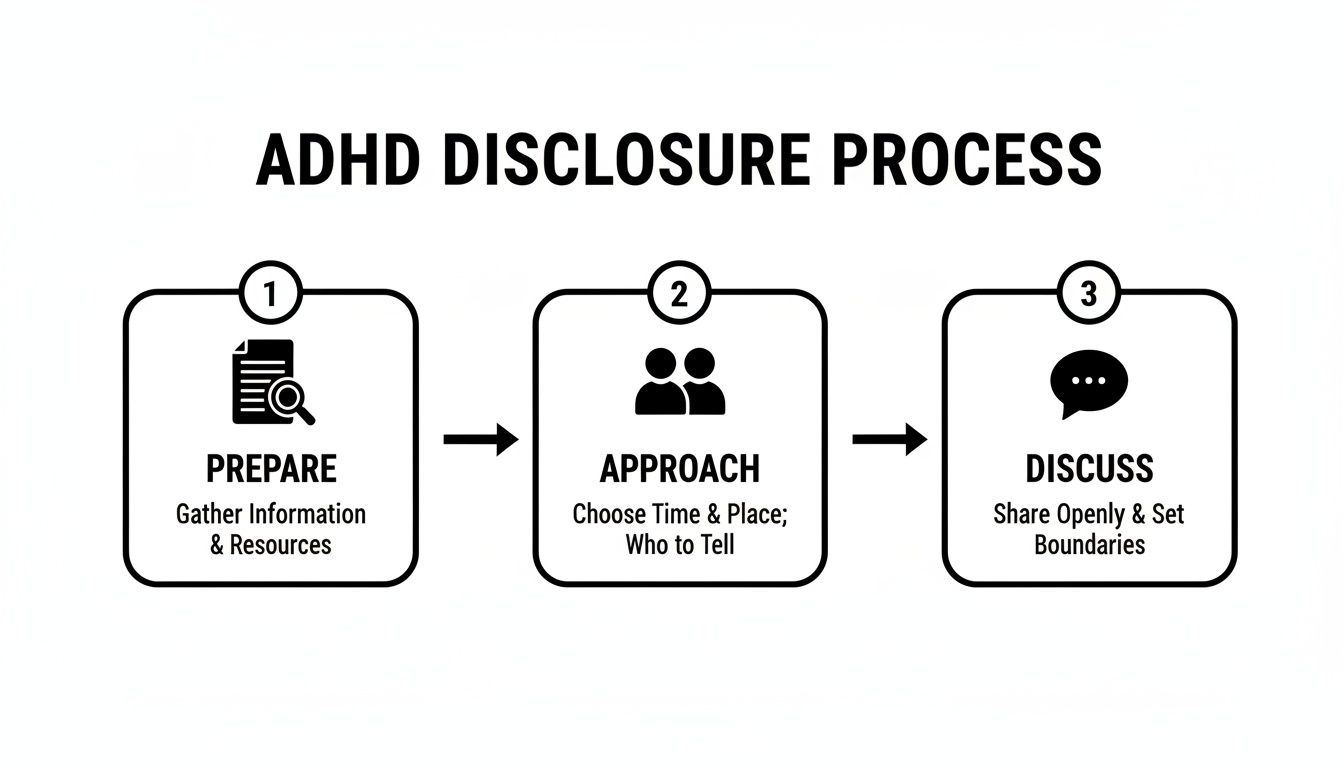
As you can see, a successful conversation is all about careful preparation, a well-thought-out approach, and keeping the discussion focused on positive, practical solutions.
Navigating the NHS Pathway
For many, the first port of call is their GP. A GP can refer you to a specialist NHS mental health service for an assessment, which is free at the point of use and follows strict clinical guidelines.
The major hurdle with the NHS route, however, is the waiting time. The demand for adult ADHD and autism assessments is incredibly high, and it’s not uncommon to wait many months—or in some areas, several years—for an appointment. These long delays can be immensely frustrating and can mean your struggles with work and mental health continue for far longer than necessary.
Exploring the Private Route
If you’re looking for a faster option, going private is a common choice. This route puts speed and convenience on your side, often getting you an appointment with a specialist in weeks rather than years. It’s a direct way to get the clarity and documentation needed to secure workplace adjustments quickly.
When you go private, doing your homework is absolutely crucial. You need to ensure the service is led by GMC-registered consultant psychiatrists who specialise in adult neurodevelopmental conditions like ADHD and autism. Just as importantly, check that the clinic is regulated by the Care Quality Commission (CQC), the independent body that oversees all health and social care services in England.
A reputable private service doesn't cut corners. It should offer a comprehensive, multi-stage assessment that's every bit as rigorous as an NHS evaluation. This ensures your diagnosis is robust, credible, and widely accepted by employers and other professionals.
What Does a Comprehensive Assessment Actually Involve?
Whether you go down the NHS or private route, a proper assessment is much more than a quick chat. It’s a detailed investigation designed to build a complete picture of your life, from childhood right through to the present day.
A thorough assessment for ADHD or autism typically includes several key stages:
- Initial Screening: This usually starts with you filling out detailed questionnaires and rating scales. This gives the clinical team some preliminary information about your symptoms and how they affect your life.
- Clinical Interview: This is a deep-dive conversation with a psychiatrist or specialist nurse. They’ll ask about your childhood experiences, school life, career path, and current challenges to look for the lifelong patterns that are characteristic of these conditions.
- Gathering Information: The clinician may ask for permission to speak with someone who knows you well, like a parent, partner, or a close friend. This gives them an outside perspective on your behaviours and challenges over the years.
- The Diagnostic Report: After the assessment, you’ll receive a detailed report. This is the official document that confirms the diagnosis, explains how your symptoms meet the clinical criteria, and provides personalised recommendations for treatment, mental health support, and reasonable adjustments at work.
This final report is an incredibly powerful tool. It’s the evidence you need to have a constructive conversation with HR, secure the adjustments you’re entitled to, and start any recommended treatment, such as medication. For a closer look at the steps involved, our guide explains how to get an ADHD diagnosis in the UK.
How Employers Can Build a Neuro-Inclusive Workplace

Creating a workplace that genuinely supports employees with ADHD or autism isn't just about ticking a box on a diversity policy. It's about a fundamental cultural shift, moving from simply tolerating differences to actively and intentionally including them. Think of it as a powerful investment in your people—one that pays back in spades through increased innovation, creativity, and loyalty, while also promoting better mental health across the board.
This journey starts when leaders truly grasp the strategic advantage of nurturing neurodivergent talent. The unique perspectives, creative problem-solving, and intense focus that often come with conditions like ADHD and autism are massive assets. Supporting ADHD in the workplace UK isn't just the right thing to do; it’s smart business.
The cost of getting this wrong is staggering. Failing to support ADHD in the workplace costs the UK economy an estimated £17 billion annually in healthcare costs and lost productivity. By fostering a neuro-inclusive culture, you can help reverse this trend and unlock the full, untapped potential of your entire team.
Train Managers to Lead with Empathy
Your managers are on the front line. Their attitude and understanding can single-handedly shape a neurodivergent employee's entire experience at work, for better or for worse. That’s why training on ADHD, autism, and mental health isn’t just a nice-to-have; it's absolutely essential.
This training needs to go beyond dry definitions. It should focus on practical empathy, helping managers understand the 'why' behind certain behaviours. For instance, they need to see that a missed deadline might be due to 'time blindness' rather than a lack of care. When a manager’s first instinct is curiosity and support instead of criticism, it changes everything.
A well-trained manager learns to offer support proactively. They start asking questions like, "What’s the best way for me to give you feedback?" or "Would you prefer the instructions for this task in writing?" These simple adjustments build psychological safety and trust, which are the bedrock of high performance and good mental health.
Adapt Your Recruitment and Onboarding Processes
A truly inclusive culture begins long before an employee’s first day. Many traditional recruitment processes, often without realising it, put up barriers for neurodivergent candidates. Making your hiring process more accessible doesn't just widen your talent pool—it sends a clear signal that you’re committed to inclusion from the get-go.
Here are a few simple but high-impact changes to consider:
- Share Interview Questions in Advance: Giving candidates with ADHD or autism the questions beforehand allows them the time to process and structure their thoughts. This reduces anxiety and helps them showcase their true abilities, not just their knack for thinking on the spot.
- Offer Flexible Interview Formats: Some people shine in a practical, task-based assessment but find a classic conversational interview incredibly stressful. Providing different options lets candidates demonstrate their skills in a way that plays to their strengths.
- Rethink Vague Job Descriptions: Cut the ambiguous corporate jargon. Be crystal clear and direct about the core responsibilities and expectations of the role.
Embed Neurodiversity into Your Company Culture
Finally, for inclusion to stick, it has to be woven into the very fabric of your organisation. It needs to be more than a one-off initiative; it should be a core part of your company's identity, values, and mental health strategy.
One of the best ways to do this is by formalising your commitment. By consulting a UK employment handbook template guide, you can establish clear policies and supportive frameworks for everyone. This ensures that support is consistent and doesn't just depend on the goodwill of individual managers.
Celebrate neurodiversity openly. Encourage the formation of employee resource groups and make sure your Diversity & Inclusion (D&I) efforts visibly include neurodivergent voices. When people see their experiences are not just accepted but valued, they feel safe, respected, and empowered to bring their A-game to work every day.
Frequently Asked Questions
When you're trying to manage work with ADHD or autism, a lot of questions can come up. Let's tackle some of the most common ones for both employees and employers here in the UK with some clear, practical answers.
Can I Get Fired for Having ADHD in the UK?
The short answer is no, you can’t lawfully be fired just because you have ADHD or are autistic. These conditions are protected under the Equality Act 2010, provided they have a ‘substantial and long-term’ impact on your day-to-day life.
This means that if your employer were to dismiss you without first offering proper support and reasonable adjustments, it could be seen as discrimination. Having a formal diagnosis is your best line of defence here, as it gives your employer clear medical evidence they can't ignore.
That said, the reality is that unsupported neurodivergence can make holding down a job and managing mental health much harder. Research shows that adults with ADHD are nearly 60% more likely to be fired and three times more likely to quit a job on impulse. This really brings home why it's so important to understand and use your legal right to adjustments. You can find more details in these workplace ADHD statistics.
Do I Have to Pay for Reasonable Adjustments Myself?
Absolutely not. Your employer is legally required to cover the cost of any reasonable adjustments you need. The good news is that many of the most effective supports don't cost a penny – things like flexible working hours or getting instructions in writing.
If you do need specific software or equipment, it's on your employer to pay for it. There's also a government scheme called Access to Work which offers grants to help companies with these costs, so there really shouldn’t be any financial barrier to you getting the support you're entitled to.
What Should I Do If My Manager Isn’t Supportive?
It can be really disheartening and bad for your mental health when your direct manager doesn't seem to get it. If you find yourself in this situation, your next port of call should be the HR department or a more senior manager.
Go into that conversation prepared. Bring along your formal diagnostic report and any other professional evidence you have.
HR teams are generally well-versed in employment law and can act as a neutral party to make sure you get the support you're legally entitled to. They can enforce official company policy, effectively bypassing any personal reluctance from your line manager. Just remember to frame the conversation around finding solutions that will help you do your job well.
At Insight Diagnostics Global, our consultant-led team provides CQC-regulated assessments for ADHD and Autism. We deliver the clear, comprehensive diagnostic reports you need to secure support at work. Take the first step towards getting the clarity and adjustments you deserve.