If you’re an adult in the UK and have ever wondered if you might be neurodivergent, getting a formal autism assessment UK, often combined with an ADHD assessment, is the definitive way to get some clarity. For many, it's the first real step towards making sense of lifelong experiences and finding the right kind of support for conditions like Autism Spectrum Disorder (ASD) and Attention-Deficit/Hyperactivity Disorder (ADHD).
Your Path to an Adult Autism and ADHD Assessment
If you've found yourself asking "Am I autistic?" or "Could I have ADHD?", you're certainly not alone. With a growing understanding of neurodiversity, many adults are now looking back on their lives through a new lens. Think of this guide as your practical roadmap, designed to demystify the entire assessment process for both autism and ADHD, from beginning to end.
So often, the journey starts with a deep-seated feeling of being 'different' without ever having the words to explain why. A formal diagnosis can be the key to finally understanding the persistent challenges you may have faced for years.
Common Reasons for Seeking a Diagnosis
It can be reassuring to know that your reasons for seeking an assessment are shared by many others. People often decide to take this step because of:
- Social and Communication Difficulties: Maybe you consistently feel you're missing social cues, find it hard to keep friendships going, or feel completely drained after social events. This is a common trait associated with autism.
- Executive Function Challenges: This could look like a constant battle with organisation, time management, and planning. Perhaps you struggle to start tasks or see them through to completion—often signs linked to both ADHD and autism.
- Sensory Sensitivities: Feeling intensely overwhelmed by sounds, lights, smells, or textures that other people barely seem to register is a very common experience for autistic individuals.
- Attention and Focus Issues: You might find it hard to concentrate on one thing, be easily distracted, or experience a racing mind, which are classic signs of ADHD.
- Emotional Regulation: You might find yourself dealing with powerful emotions that feel overwhelming and difficult to get a handle on, a challenge common in both autism and ADHD.
An autism or ADHD diagnosis doesn't change who you are at your core. What it does is provide a new framework for understanding your unique brain. It highlights your strengths and explains your challenges, paving the way for profound relief, self-acceptance, and the right kind of support.
This guide will walk you through everything you need to know about getting an autism assessment UK, with a strong focus on the common overlap with ADHD. We’ll compare the NHS and private options, break down what actually happens during the evaluation, and look at what comes next after you receive your report.
You can also get a broader overview of the support available by exploring our comprehensive mental health assessment services. Our aim is simple: to give you clear, supportive information so you can move forward with confidence.
What an Assessment Actually Involves
It’s easy to think of an adult autism or ADHD assessment as a test you can pass or fail, but that’s not really what it is. It’s much more like putting together a detailed biography of your life and how your mind works. The whole point isn’t to judge you; it’s to build a clear and honest picture of your experiences, right from childhood up to today.
To get this right, clinicians piece together information from lots of different sources. Think of it like assembling a personal puzzle. Every piece—from your earliest school memories to your current struggles with organising your day or navigating social events—helps to form a complete and validating image of who you are.
Building Your Personal Profile
A proper diagnostic assessment in the UK is a deep dive. It's a collaborative process where you and the clinical team work together to see how your lifelong patterns of social interaction, behaviour, and sensory experiences align with the established diagnostic criteria for both autism and ADHD.
Assessors don't just use simple checklists. Instead, they rely on a mix of structured tools and in-depth conversations to explore your history and current life in real detail.
The main parts of an assessment usually include:
- Clinical Interviews: These are simply structured conversations with a specialist who will ask you about your life, relationships, work, and any challenges you face. The goal is to see the world from your perspective.
- Standardised Questionnaires: You’ll likely be asked to fill out some forms with specific questions about your traits and behaviours. These help to gather consistent information and see how your experiences compare to known patterns for both conditions.
- Developmental History: This part is all about your past. The clinician will want to talk about your childhood and teenage years, often with help from a parent or someone who knew you well back then. This is crucial for understanding that the traits have been there throughout your life.
Distinguishing Between Autism and ADHD
Many adults looking for an autism assessment UK also wonder if they might have ADHD. This makes perfect sense, as the two conditions often go hand-in-hand and many of their traits can look similar on the surface. In fact, it's estimated that between 30-80% of autistic people also meet the diagnostic criteria for ADHD. A good clinician knows how to spot the overlaps and, more importantly, the key differences.
Imagine a Venn diagram. In the overlapping section, you might find things like difficulties with executive function (planning and staying organised) or managing emotions. But an experienced assessor digs deeper to understand the reasons for these difficulties. They’re interested in the 'why' behind your experiences, not just the 'what'.
For example, they'll explore whether social challenges come from difficulty reading non-verbal cues (often associated with autism) or from being inattentive and impulsive in conversation (more typical of ADHD). To do this, they use specific, evidence-based tools designed for the job.
- For Autism: One of the gold standards is the Autism Diagnostic Observation Schedule, Second Edition (ADOS-2). This is a series of activities and conversations that allows the clinician to observe your social communication and interaction skills in a structured way.
- For ADHD: A widely used tool is the Diagnostic Interview for ADHD in Adults (DIVA-5). It’s a structured interview that goes through the list of ADHD symptoms to see how they’ve affected you throughout your life.
This careful, multi-layered approach ensures the final diagnostic report is as accurate as possible. Gaining this kind of clarity is so important, especially when you consider that the prevalence of autism in the UK is thought to be more than 1 in 100 people. That’s over 700,000 autistic adults and children, many of whom are on the same journey as you, looking for answers and understanding. The National Autistic Society provides more detail on its research into autism prevalence rates.
In the end, the whole process is designed to be thorough, supportive, and validating. The aim is to give you a comprehensive profile that finally makes sense of your experiences and gives you a solid foundation for finding the right support.
Choosing Your Path: NHS vs Private Assessment
Deciding where to go for an autism or ADHD assessment is a huge step. In the UK, you have two main options: going through the National Health Service (NHS) or choosing a private provider. Each route has its own pros and cons, and the best choice for you really boils down to your personal situation, how urgently you need answers, and your budget.
For many, the NHS is the natural starting point. The process kicks off with a chat with your GP, who, if they agree it's appropriate, will refer you to a local specialist team for an autism assessment UK or an ADHD assessment. The biggest plus here is that it's completely free, making it accessible to everyone.
The catch, however, is the waiting time. Demand for neurodevelopmental assessments has rocketed, and waiting lists can be incredibly long – we’re talking months, and often, years. This isn't just an anecdotal issue; the numbers back it up. In Northern Ireland, for example, the referral rate for autism assessments shot up from 8.3 per 1,000 children in 2018 to around 12.5 per 1,000 in early 2025. You can dig into the official figures on these quarterly autism statistics and waiting times.
This infographic breaks down the core elements you can expect on either pathway, from the initial chats right through to gathering developmental history and filling out questionnaires.
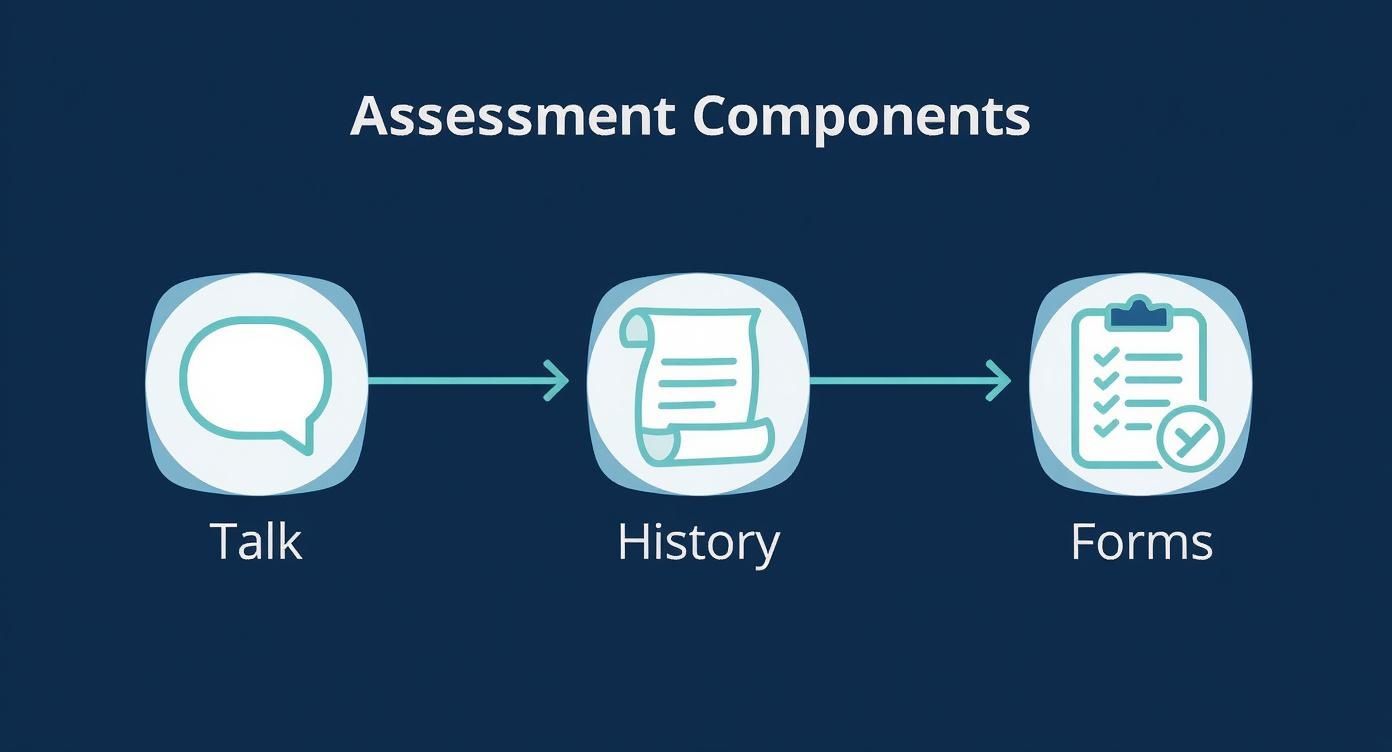
Whichever path you take, the assessment itself is a deep dive, designed to build a complete and nuanced picture of who you are.
The Private Assessment Alternative
If the thought of waiting years feels unbearable, the private route offers a much faster way forward. Private clinics can often get you in for an initial consultation within a few weeks, with the whole process, including the final report, wrapped up in a much shorter timeframe. That speed can be a game-changer if you need a diagnosis to access support at work or simply for your own peace of mind.
Going private also gives you more control. You get to research and choose a clinician or a clinic that you feel comfortable with—perhaps one that specialises in adult neurodiversity or offers combined autism and ADHD assessments. Having that choice can be incredibly reassuring.
Of course, the main thing to consider with a private assessment is the cost. It’s a significant financial commitment. The price can vary quite a bit depending on the clinic and whether you’re looking for a single diagnosis or a combined one. To get a clearer idea of the investment involved, you can learn more about our private autism assessment cost.
A Direct Comparison: NHS vs Private
To help you weigh everything up, it’s useful to see the two pathways side-by-side.
NHS vs Private Autism and ADHD Assessment in the UK
Here’s a straightforward comparison to help you understand the key differences at a glance.
| Factor | NHS Pathway | Private Pathway |
|---|---|---|
| Cost | Free at the point of use. | A significant financial cost, typically ranging from £1,500 to £4,000+. |
| Wait Times | Often very long, potentially lasting several years in many areas. | Much shorter, with assessments often available within weeks or months. |
| Referral Process | You'll need a GP referral to a local NHS mental health service. | You can usually refer yourself, giving you direct access. |
| Choice of Clinician | You have little to no choice; you will be seen by the assigned local NHS team. | You have full choice to research and select a specialist or clinic that fits your needs. |
| Report Recognition | Universally accepted by all public services, including education and the DWP. | Generally well-recognised, but some NHS services may want to conduct their own reassessment. |
Ultimately, the decision comes down to a trade-off between time and money. If you need clarity sooner rather than later to support your well-being or career, the investment in a private assessment might be well worth it. If cost is the main barrier, the NHS route is still a solid and reliable option, you just need to be prepared for the wait.
How to Prepare for Your Assessment Session
It’s completely normal to feel a bit overwhelmed heading into an autism or ADHD assessment. Many people worry they’ll forget crucial details or struggle to put a lifetime of experiences into words on the day. But a little bit of preparation can make all the difference, helping you feel more in control and confident that you’re giving the clinician the full picture.
Think of it less like studying for a test and more like becoming the lead detective in your own life story. You’re gathering the evidence and pulling together the key moments that will help the assessor understand exactly who you are. This is all about making sure your autism assessment UK is as accurate and, ultimately, as validating as possible.
Digging into Your Personal History
A good assessment is built on identifying lifelong patterns, which means that details from your childhood are pure gold. This is your chance to piece together your own past and find objective evidence that backs up your memories.
Start by hunting down any documents that offer a glimpse into your younger self.
Consider looking for:
- Old School Reports: These are often incredibly revealing. Look for recurring comments from teachers. Were you described as a ‘daydreamer,’ ‘easily distracted,’ ‘a perfectionist,’ or ‘socially quiet’? Did they note any 'intense' or 'unusual' interests? These can point to both ADHD and autistic traits.
- Childhood Medical Records: Notes from your GP or a health visitor about developmental milestones, anxieties, or any behavioural quirks can be very helpful.
- Diaries or Journals: If you kept a diary as a child or teenager, it can provide an unfiltered look into your social world and emotional state back then.
This kind of historical context is invaluable because it shows the assessor that the traits you're describing today aren't a recent development, but have been a consistent thread running through your entire life.
How to Organise Your Own Experiences
While old documents are useful, your own reflections are the heart of the assessment. It's so easy to go blank when you feel "put on the spot," forgetting important examples you wanted to share. The best way to avoid this is to jot down your thoughts and experiences beforehand.
Try to organise your notes into the key areas the assessment will cover for both autism and ADHD. For each point, think of specific examples from both your childhood and your adult life.
This isn't about trying to fit yourself into a diagnostic box. It's about giving the clinician clear, concrete examples of your lived experience. Saying, "I have sensory issues," is one thing. Saying, "I had to leave a party after 20 minutes because the bass from the music felt physically painful," gives them so much more to work with.
Here’s a simple way you could structure your notes:
- Social Communication & Interaction: Make a note of any struggles with small talk, understanding sarcasm or body language, or feeling like you have to 'mask' your true self to fit in.
- Executive Functioning & Attention: This covers challenges with planning, procrastination, organisation, managing your time, remembering appointments, or maintaining focus.
- Intense Interests & Hyperfocus: Describe your special interests or hyperfixations. How do they feel? How much of your time do they absorb?
- Sensory Needs: List any sensitivities you have to light, sound, textures, or smells. On the flip side, do you actively seek out certain sensations, like using fidget toys or a weighted blanket?
- Routine and Repetitive Behaviours: Think about your relationship with routine. How do you react to unexpected changes? Do you have any repetitive movements (stimming) or fidgets that help you regulate?
The Importance of Another Perspective
Finally, any high-quality assessment will involve gathering ‘collateral information’ from someone who knows you well and has seen you in different contexts. This simply means getting another person's perspective to help build a richer, more complete picture.
It’s a good idea to ask a trusted partner, parent, or close friend if they’d be willing to share their observations. They might remember childhood stories you’ve completely forgotten or have noticed patterns in your behaviour that you aren't even aware of. Their input adds a vital layer of detail, making the final assessment even more robust and accurate.
Understanding Your Diagnostic Report and Next Steps
Getting your diagnostic report is a huge moment. After what might have been weeks, months, or even years of questioning and uncertainty, you finally have a professional document explaining how you're wired. It’s so much more than a simple ‘yes’ or ‘no’ – it's a personalised manual for your own mind.
Think of it less as a label and more as a detailed map of your unique neurological landscape. A good report won't just confirm a diagnosis for autism and/or ADHD; it will give you a rich profile of your personal strengths, your specific challenges, and the clinical reasoning behind the lifelong patterns you’ve always experienced.
Learning to understand this document is your first step towards using it as a powerful tool for self-advocacy and getting the right support. Let's break down what you'll find inside and what to do with this new knowledge.
How to Read and Understand Your Report
At first glance, a diagnostic report can look a bit dense and clinical, but it’s usually structured very logically. It tells a story – your story – backed by the evidence and observations gathered during your assessment.
Most reports will have a few key sections:
- Developmental History Summary: This part pulls together what the clinician learned about your childhood, drawing from your own memories and anything family members might have shared.
- Clinical Observations: Here, the assessor writes down their professional observations from your sessions. They'll note things about your social communication, interaction style, and any repetitive behaviours or sensory needs they noticed.
- Standardised Test Results: If formal tools like the ADOS-2 for autism or the DIVA-5 for ADHD were used, this section will include the scores and what they mean.
- Diagnostic Conclusion: This is the final summary where the clinician pulls all the evidence together to explain why you either meet, or don't meet, the diagnostic criteria for Autism Spectrum Disorder and/or ADHD.
A diagnosis doesn't change who you are. It offers a new lens to view your life through, validating past struggles and lighting a clearer path forward. It gives you the language to understand yourself with more compassion.
The growing recognition of neurodiversity is reflected in the latest statistics. For example, recent data from Northern Ireland shows the prevalence of autism among schoolchildren reached 5.9% for the 2024/25 academic year. That's a huge jump from the 1-2% estimates of the early 2000s, showing just how much awareness and diagnostic practices have improved. You can read more about these findings on autism prevalence in schools.
Turning Your Diagnosis into Action
With your report in hand, you can start taking practical steps. A formal diagnosis can unlock support pathways that weren’t available before, empowering you to advocate for what you need in all areas of your life.
Here are some key actions to consider:
- Inform Your GP: Sharing a copy of your report with your GP is a crucial first step. It gets the diagnosis onto your official medical record, which is essential for accessing NHS services and ensuring continuity of care.
- Explore Medication (for ADHD): If you received an ADHD diagnosis, your report is the key to discussing treatment. You could explore medication through the 'Right to Choose' pathway or look into getting private prescriptions online to manage the titration process.
- Apply for Access to Work: This government scheme provides grants for reasonable adjustments at work. Your diagnostic report is the vital evidence you need to apply for things like noise-cancelling headphones, specialised software, or a job coach.
- Connect with Support Networks: The post-diagnostic period can feel overwhelming, so it's a great time to find your community. Connecting with local or online neurodivergent groups provides incredible validation and practical advice from people who just get it.
If the assessment concludes that you don't meet the criteria, it can feel confusing or disheartening. A good clinician will provide a clear explanation for their decision and suggest other avenues for support, because your challenges are still real and valid. This might mean exploring other mental health conditions or finding specific therapies to help with your difficulties.
Life Beyond Diagnosis: Your Journey Forward
Getting an autism or ADHD diagnosis isn't a final destination. Far from it. Think of it as finally being handed the right map for a journey you've been on your whole life. It's a fresh start, one where you can finally make sense of past experiences and begin to build a life that truly fits you.
This new understanding is a powerful thing. For most people, the biggest, most immediate feeling is one of relief – a profound sense of validation. That nagging feeling of being different, the social situations that never quite made sense, or the constant battle to stay organised… suddenly, it all has a name. It lets you look back at your life not as a string of personal failings, but as the story of a neurodivergent person making their way in a world that wasn't always designed for them.
Embracing Your Neurodivergent Identity
One of the most powerful next steps can be connecting with the wider neurodivergent community. There’s a huge sense of belonging that comes from finding other people who just get it. Hearing their stories and sharing your own is incredibly affirming, and you’ll pick up practical advice from people who have been there.
An autism or ADHD diagnosis doesn't change who you are; it shines a light on the person you've always been. It gives you a new lens for self-acceptance, helping you to celebrate your unique strengths and ask for what you need with confidence.
Whether your autism assessment UK journey ended with a formal diagnosis or not, the process itself is invaluable. You've gained a much richer understanding of yourself, and that’s the most important tool you have for building a better future.
This knowledge gives you the permission to create new strategies that work with your brain, not against it. It's your green light to advocate for your needs, celebrate your unique way of seeing the world, and consciously create a more authentic, fulfilling life. Your journey forward is yours to shape.
Your Questions Answered
When you're looking into an autism assessment UK, it's completely normal to have a lot of questions. This is especially true if you suspect you might also have ADHD. Let's walk through some of the most common queries we hear.
Can I Be Assessed for Autism and ADHD at the Same Time?
Absolutely. In fact, it’s often the best way to go. Many specialist private clinics, and some NHS teams, offer combined assessments for both autism and ADHD.
Think of it this way: there’s a lot of overlap between the two. Things like challenges with executive functioning or managing emotions can be a feature of either autism, ADHD, or both. A dual assessment gives the clinician a complete, 360-degree view, allowing them to carefully untangle the traits and see how they fit together. This leads to a much more accurate and helpful diagnosis. If this sounds like you, make sure you specifically ask for a 'combined' or 'dual' assessment when you first get in touch.
How Much Does a Private Autism Assessment Cost in the UK?
This is a big question, and the answer varies quite a bit depending on the clinic. For a standalone adult autism assessment UK, you can generally expect to see prices in the range of £1,500 to £3,000.
If you're looking for a combined autism and ADHD assessment, the cost is naturally a bit higher, typically falling somewhere between £2,000 and £4,000. My best advice is to always get a detailed quote upfront. Make sure it breaks down exactly what's included – from the initial chats and the assessment itself to the final report and any follow-up sessions.
Will the NHS Accept My Private Diagnosis?
For the most part, yes. As long as your diagnosis comes from a reputable clinic and a qualified clinician who follows the official NICE (National Institute for Health and Care Excellence) guidelines, the NHS is very likely to accept it. That said, acceptance can sometimes depend on your individual GP practice.
This is crucial if you get a private ADHD diagnosis and want to explore medication through the NHS. Your GP will need to agree to a 'shared care agreement' to handle your prescriptions. It’s always a good idea to have a chat with your GP before you book a private assessment to confirm they’re happy to work with your chosen provider.
What Is ‘Right to Choose’ for Assessments?
‘Right to Choose’ is an NHS policy in England that puts you in the driver’s seat. It gives you the option to pick where you receive your care from a list of approved NHS providers, even if they aren't in your local area.
This route is very well-established for adult ADHD assessments, and it can be a game-changer. It allows you to select a qualified private service that also holds an NHS contract, meaning you can get assessed much faster, and it won't cost you a penny. While it’s less commonly used for autism assessments, it's a vital pathway to know about if you're pursuing an ADHD diagnosis.
At Insight Diagnostics Global, we offer clear, comprehensive, and CQC-regulated online assessments for adults who want to understand if they are autistic or have ADHD. Our consultant-led team provides a supportive and straightforward path to getting the clarity you need. Ready to take the next step? Explore our services at https://insightdiagnostics.co.uk.