If you’re an adult in the UK wondering if you might be autistic or have ADHD, you are definitely not on your own. For many, this journey begins with a quiet, lifelong feeling of being just a little out of step with everyone else, and it builds towards a need for answers and self-understanding. It’s about finally putting a name to a lifetime of experiences you could never quite articulate.
Why Are More Adults Seeking an Autism and ADHD Diagnosis?
There’s been a huge shift in recent years, with a noticeable rise in adults across the UK seeking assessments for both autism and ADHD. This isn't because these conditions are new, but because we’re finally realising they aren’t just for children. Countless adults have navigated their entire lives feeling disconnected from the world, never knowing the reason why.
This is often what’s meant by a 'late diagnosis'. It represents decades of trying to get by in social, professional, and personal situations without the right user manual. It's a path often paved with exhaustion from 'masking' or 'camouflaging' to get by.
What is Masking and Why is it so Draining?
Masking is the process of consciously (or unconsciously) hiding your natural autistic or ADHD traits to fit in with neurotypical social norms. Imagine you have to manually run a complex social translation app in your brain for every single conversation. You're constantly decoding body language, tone of voice, and unwritten rules that seem to come naturally to others.
This relentless performance is draining. It can lead to burnout, anxiety, and a deep-seated feeling that you can never truly be yourself – which is often the very reason people finally decide to seek a formal diagnosis.
So, why the recent surge in adults seeking answers? It's down to a combination of factors that reflect a real change in our society.
- Growing Awareness: Better representation in the media and powerful online advocacy have helped more adults see autistic or ADHD traits in themselves.
- The "Lightbulb Moment": Many parents begin to recognise their own lifelong patterns while supporting their child through the diagnostic process.
- Less Stigma: Thankfully, conversations about neurodiversity are becoming more open, making it feel safer for adults to explore who they are.
The Important Connection with ADHD
A massive piece of this puzzle is the significant overlap between Autism Spectrum Disorder (ASD) and Attention-Deficit/Hyperactivity Disorder (ADHD). It's incredibly common for someone to have traits of both, a combination often called AuDHD. Because the characteristics can get tangled up – affecting things like executive function, managing emotions, and social energy – a combined assessment can offer the clearest picture.
This guide is all about the path to an adult autism diagnosis in the UK, but we'll pay close attention to its link with ADHD. For many, understanding that connection is the final piece of the puzzle.
It's a critical issue. A major review by King's College London revealed that a shocking 89% to 97% of autistic adults over 40 are still undiagnosed, which often leads to major health struggles. You can read more about these findings on undiagnosed autistic adults here. Taking that first step to seek clarity is not just valid; it's a powerful act of self-advocacy.
Recognising Autistic and ADHD Traits in Adulthood
The first real step towards understanding autism and ADHD in adults is to throw out the childhood stereotypes. For many of us, the penny doesn't drop because of some obvious, external behaviour. It’s the slow, dawning realisation that a lifetime of quiet, internal struggles might finally have an explanation. This moment of recognition is the starting point for seeking an autism diagnosis in adults UK.
Many adults have spent decades perfecting the art of masking – a term for consciously or unconsciously hiding your natural autistic or ADHD traits just to fit in. This isn't about being fake; it’s an exhausting, full-time job you never get to clock out from.
Think of it like running a complex social translation app in your head, 24/7. In every single conversation, you’re manually processing subtext, decoding body language, and figuring out the "right" thing to say, all while actively suppressing what comes naturally. It’s no wonder this leads to burnout and a profound sense of exhaustion.
What Autistic Traits Actually Feel Like on the Inside
When you look beyond the outdated caricatures, the lived experience of adult autism often involves a unique set of internal challenges and, importantly, strengths. Seeing these in yourself can be incredibly validating.
- Sensory Sensitivities: This is so much more than just "not liking loud noises." It’s the way fluorescent lights in the supermarket can feel like a physical assault, the scratchy texture of a jumper can be unbearable, or a colleague's perfume can be so overwhelming it derails your focus for hours. Everyday environments can become genuinely painful.
- Deep and Intense Interests: Often called 'special interests', these aren't just hobbies. They're deep dives into subjects that bring immense joy, structure, and a sense of expertise. These passions often form a core part of an autistic person's identity and well-being.
- Social Burnout and Needing Solitude: After a day of holding it all together, many autistic adults need to retreat and be alone. This isn't being anti-social. It’s a vital recovery period, like plugging in your phone after the battery has been completely drained by the cognitive effort of navigating the world.
This pattern of masking and internalised struggle is a huge reason why so many adults fly under the radar. The National Autistic Society estimates there are at least 700,000 autistic people in the UK, but many have no formal diagnosis because their traits have been camouflaged or misunderstood for their entire lives. You can find out more about autism prevalence from their resources.
The Crucial Overlap with ADHD
It's almost impossible to have a meaningful conversation about adult autism without bringing ADHD into the picture. The two neurotypes often show up together, a combination many now refer to as AuDHD. Their traits can overlap so much that it's tricky to tease them apart without a specialist assessment.
This is exactly why a combined or dual assessment is often the most helpful way forward. A clinician with experience in both can help pinpoint the source of your challenges, giving you a much clearer picture of how your brain is wired.
Here’s a look at where the traits often blur together:
| Shared Trait | How It Might Show Up in Your Life |
|---|---|
| Executive Dysfunction | Struggling to plan your day, prioritise tasks, manage your time, or simply get started on something (and then finish it). |
| Emotional Dysregulation | Feeling emotions with incredible intensity, which can feel overwhelming and lead to rapid, confusing mood swings. |
| Rejection Sensitive Dysphoria (RSD) | Experiencing extreme emotional pain and sensitivity from the perception of being rejected, criticised, or letting someone down. |
| Social Energy Fluctuations | Going from being "on" and highly sociable to suddenly hitting a wall and needing to completely withdraw to recover. |
Connecting these patterns to your own life is the bridge between your personal history and the formal diagnostic criteria. It turns the idea of a diagnosis from a sterile clinical label into a powerful validation of your lifelong experiences, giving you the confidence to take the next step.
Choosing Your Path: NHS vs Private Diagnosis for Autism and ADHD
So, you’ve decided to seek an assessment. This is a huge step, and it brings you to a major crossroads: do you go through the NHS, or do you find a private provider? This isn't just a logistical choice. It’s a personal one, forcing you to weigh up your finances, your circumstances, and just how urgently you need clarity.
Each path has its own set of pros and cons, and getting to grips with them is the first step toward making a decision that feels right for you.
The NHS route is the one available to every UK resident. It all starts with a chat with your GP, who essentially holds the key to the next stage. You'll need to explain why you think you might be autistic, have ADHD, or both. From there, they can refer you to a specialist adult neurodevelopmental service in your area. The biggest plus? It’s completely free.
On the flip side, going private puts you in the driver's seat. You get to research and choose your own clinician or diagnostic service, often without needing to go through your GP first. This means you can find someone who really specialises in how autism and ADHD present in adults. The major trade-off, of course, is the price tag.
This decision tree gives you a visual map of the first few questions you'll likely ask yourself when you start thinking about an assessment.
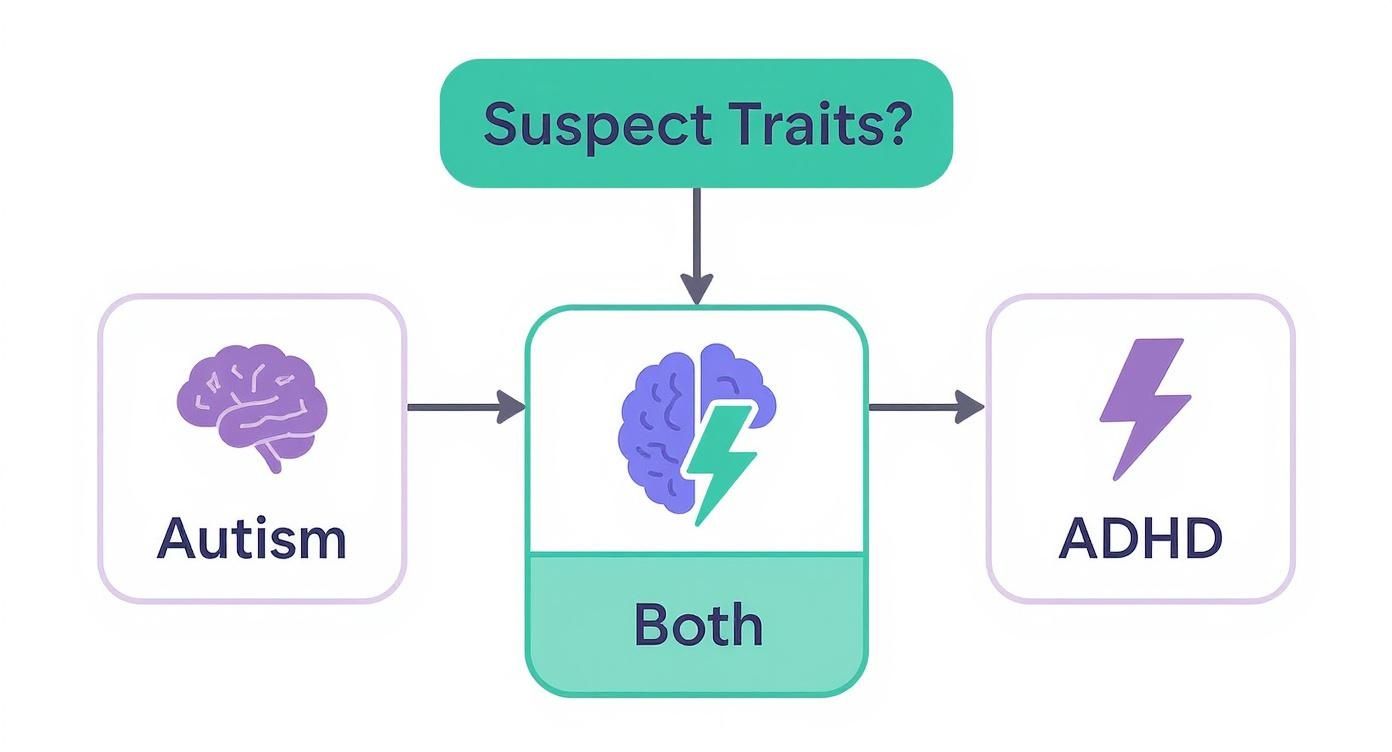
As the infographic shows, the journey often begins with that flicker of self-recognition—spotting traits in yourself that feel like they could be autism, ADHD, or both. For many adults, this is exactly where it all starts.
Comparing the NHS Pathway
The number one reason people stick with the NHS is simple: it’s free. A diagnosis received through the NHS is also universally accepted everywhere, from other healthcare services to employers, giving you a solid footing when you need to ask for accommodations.
But here’s the reality check: the waiting times are staggering. It’s not an exaggeration to say that some adults wait several years between that first GP appointment and actually getting an assessment for autism or ADHD. That long limbo can be incredibly draining, especially if you’re struggling and desperately need answers. On top of that, the quality and availability of services can feel like a "postcode lottery," varying massively depending on where you live.
Exploring the Private Route
Speed is the main draw of the private route. You can often get an assessment booked within a few weeks or months, which feels worlds away from the NHS timeline. It allows you to get answers quickly and start figuring out what support you need sooner. You also have total control over who you see, meaning you can find a specialist who really gets adult presentations and has expertise in co-occurring conditions like AuDHD.
The biggest hurdle, without a doubt, is the cost. A comprehensive diagnostic assessment can set you back anywhere from £1,500 to over £3,000. If you go this route, it's absolutely crucial to do your homework and pick a reputable provider who follows NICE guidelines. This ensures the diagnosis will be recognised by the NHS, universities, and employers. It's also smart to understand the full financial picture; for example, you can learn more about the private ADHD assessment cost to avoid any surprises.
Choosing a private pathway is often a decision driven by an urgent need for answers. For many adults who have struggled for decades, the cost is a worthwhile investment for the validation, self-understanding, and access to support that a timely diagnosis provides.
To help you weigh everything up, here's a side-by-side comparison of the two options.
NHS vs Private Adult Autism & ADHD Diagnosis Pathways in the UK
| Factor | NHS Pathway | Private Pathway |
|---|---|---|
| Cost | Free at the point of service. | Typically costs £1,500 – £3,000+. |
| Waiting Times | Extremely long; often 1-4 years or more. | Significantly shorter; usually weeks to months. |
| Referral Process | Requires a GP referral to a local NHS trust. | Self-referral is usually possible; direct contact. |
| Choice of Clinician | Limited; assigned by the local service. | Full choice of clinician or diagnostic service. |
| Recognition | Universally recognised by all UK institutions. | Widely recognised if NICE guidelines are followed. |
Ultimately, there isn't a single "right" answer here. The best path forward depends entirely on your own needs, your finances, and how long you feel you can wait for answers. Both routes lead to the same destination: the clarity and self-knowledge that a formal autism diagnosis in adults UK can bring.
How to Prepare for Your Autism and ADHD Assessment
Walking into a diagnostic assessment can feel pretty nerve-wracking, but it doesn't have to be. Let’s break down what you can do beforehand to feel more in control and ready to share your story. Good preparation can make a world of difference, helping the clinician get a full, accurate picture of who you are.
Think of it less like an exam and more like an interview where you're the leading expert on your own life. You’re not being tested. You’re simply sharing the information a professional needs to understand your unique way of thinking and experiencing the world. The goal is to get your thoughts and memories in order so you can pull them out when you need them.
Gathering Your Evidence
Before your appointment, it’s a brilliant idea to pull together any documents or notes that tell the story of your life, from childhood right up to today. Clinicians are looking for lifelong patterns, so anything from your early years is especially valuable. This isn't about finding a single 'smoking gun' but about building a consistent narrative over time.
See if you can track down any of the following:
- Old School Reports: These are often absolute goldmines. Look for recurring teacher comments like "a daydreamer," "quiet in class," "bright but disorganised," "struggles with group work," or "meticulous about their special interests."
- Personal Journals or Diaries: Your own words from the past can offer powerful, unfiltered insights into your social struggles, anxieties, or intense passions over the years.
- Feedback from Trusted People: Ask a parent, an older sibling, or a long-term friend if they'd be willing to write down a few memories of you. Sometimes, the people who have known us the longest can spot patterns we’re too close to see ourselves.
The point of gathering this information isn't to diagnose yourself. It's to give the clinician concrete examples that go beyond what you can remember off the top of your head. It helps ground your current feelings in a lifelong context, which is vital for an accurate diagnosis.
Understanding the Assessment Tools
Knowing what to expect on the day can massively reduce any anxiety. While every assessment is a bit different, most will include a mix of in-depth conversation and some specific diagnostic tools. You'll almost certainly fill out questionnaires designed to measure the frequency and intensity of various traits.
For an autism assessment, a common tool is the Autism Diagnostic Observation Schedule, Second Edition (ADOS-2). This is a semi-structured assessment where you’ll do a few activities and have a chat, allowing the clinician to observe your social communication and interaction style. It's designed to feel much more like a natural conversation than a formal test.
For ADHD, clinicians often use tools like the DIVA-5 (Diagnostic Interview for ADHD in Adults). This is a structured interview that goes through the official criteria, asking for specific examples from both your childhood and your adult life. Don't worry about trying to find the 'right' answers—the only right answer is your honest experience.
As you prepare, it's worth understanding how different clinics work. You can learn more about finding an autism diagnosis near you to see what local options involve.
Creating a Life Timeline
One of the most effective things you can do is create a 'life timeline'. This is essentially a document where you list key examples from your life that you feel relate to the diagnostic criteria for both autism and ADHD. It’s helpful to organise it by different areas, like 'Social Communication', 'Repetitive Behaviours', 'Sensory Sensitivities', or 'Executive Function'.
Under each heading, just jot down short, specific examples:
- Social Communication: "Always felt a step behind in conversations; rehearsed scripts in my head before making a phone call."
- Sensory Issues: "Had to cut the labels out of all my clothes as a kid; I avoid busy supermarkets because the fluorescent lights and noise feel overwhelming."
- Executive Functioning: "Constantly missed deadlines at university even when I knew the subject inside out; my flat is organised into 'doom piles' that only make sense to me."
This timeline acts as your personal cheat sheet during the assessment. If your mind goes blank under pressure (which is completely normal!), you’ll have a list of real-world examples right there to help you communicate your experiences clearly.
What Your Diagnostic Report Really Means

Finally holding your diagnostic report is a massive moment. For many, it's the first time their life story feels like it makes sense, providing a new lens through which to see themselves. But after the initial wave of feelings—relief, validation, maybe a bit of uncertainty—the big question hits: what now?
Think of this report as more than just a confirmation; it’s your personal user manual. It translates a lifetime of experiences into a clinical framework, giving you the language and evidence to advocate for yourself and get the right support.
Decoding Your Diagnosis
Your report will be a pretty detailed document, likely referencing clinical manuals like the DSM-5 (Diagnostic and Statistical Manual of Mental Disorders) or the ICD-11 (International Classification of Diseases). You'll find clinical terms describing your social communication, sensory profile, and the specific patterns or deep interests that came up during the assessment.
It can all seem a bit technical at first glance. The most important part, though, is the conclusion stating whether you meet the criteria for Autism Spectrum Disorder, ADHD, or both. A well-written report won't just slap a label on you; it will offer a personalised profile of your unique strengths and challenges.
This report is the key to unlocking support. It is official evidence that validates your experiences and gives you a legitimate foundation for requesting the accommodations you need to thrive.
The journey to getting this piece of paper can be long and frustrating. Systemic issues often cause huge delays, and data collection challenges in some parts of the UK, such as Northern Ireland, show just how much administrative hurdles can affect adult diagnosis rates. These wider barriers are a big reason why getting a timely autism diagnosis in adults UK can feel like such a struggle. You can read more about these autism statistics and see how they impact adult services.
Your First Practical Steps
With your report in hand, a few simple steps can help you put it to good use. Remember, you are in complete control of who you share this with. There's no rush.
-
Share it with Your GP: Your GP practice should be your first stop. Ask them to add the diagnosis (or diagnoses) to your medical records. This is crucial for ensuring any future healthcare you receive is sensitive to your needs as a neurodivergent person.
-
Find Your Community: This is often the most powerful part of the post-diagnosis journey. Connecting with other autistic and/or ADHD adults, whether in online groups or local meetups, creates a space where you feel instantly understood without having to constantly explain yourself.
-
Process and Self-Reflect: Give yourself time to let it all sink in. The diagnosis doesn't change who you are, but it can profoundly change how you see yourself. Be kind to yourself as you navigate this new understanding.
Translating Your Diagnosis into Real-World Support
Perhaps the most empowering part of a formal diagnosis is its legal weight. In the UK, being autistic or having ADHD means you are protected under the Equality Act 2010. This law requires employers and places of education to make 'reasonable adjustments' to ensure you aren't at a disadvantage.
These aren't special favours; they are necessary changes to an environment that wasn't built for you, allowing you to work or learn effectively.
Here are a few real-world examples:
- Workplace Adjustments: You could ask for a desk in a quieter part of the office, noise-cancelling headphones, or for instructions to be given in writing instead of verbally. Flexible working hours can also be a game-changer for managing energy levels.
- Educational Support: If you're at university, you can access support through Disability Services. This might mean extra time in exams, a note-taker for lectures, or access to a mentor.
To get these things, you'll need to disclose your diagnosis to your employer's HR department or your university's disability support team, usually by sharing a copy of your report. It’s a confidential process designed to help you succeed, not to single you out. Armed with this report, you have the power to start reshaping your world into one that finally works for you.
Your Questions Answered: Navigating an Adult Autism and ADHD Diagnosis
Getting an autism and/or ADHD diagnosis as an adult often feels like stepping into a whole new world, and it’s natural to have a lot of questions. Let's tackle some of the most common practical concerns that come up, so you can move forward with confidence.
Can I Get Assessed for Autism and ADHD at the Same Time?
Yes, you can – and it's often the best way to do it. Many private clinicians and some specialist NHS teams now offer combined neurodevelopmental assessments that look for both conditions in one go.
This makes a lot of sense when you think about it. There's a huge overlap between autistic and ADHD traits, especially around things like executive function struggles and managing emotions. A dual assessment gives you a far richer, more accurate picture of your unique brain wiring. It's also much more efficient than going through two separate, lengthy processes, and it helps the clinical team figure out which traits belong to which condition.
When you're looking for a provider, keep an eye out for services offering 'combined' or 'dual' assessments.
Will an Autism or ADHD Diagnosis Affect My Job or Driving Licence?
This is a big worry for many, but the law in the UK is on your side.
An autism or ADHD diagnosis is a protected characteristic under the Equality Act 2010. Put simply, an employer cannot legally discriminate against you for being neurodivergent. You don't have to tell your employer, but if you want to request 'reasonable adjustments' to help you at work, you will need to disclose your diagnosis.
As for your driving licence, you only need to tell the DVLA if your autism or ADHD affects your ability to drive safely. For most adults, this isn't an issue. The diagnosis itself is not a reason to contact them. If you have specific worries about how your traits might affect you behind the wheel, that's a great conversation to have with your assessor.
What if the Assessment Shows I’m Not Autistic or Don't Have ADHD?
It can be really tough to hear that you don't meet the diagnostic criteria, especially after a long and emotional journey of self-discovery. But a good assessment is never a waste of time.
A thorough report won’t just say "no." It should give you a clear, detailed explanation for the clinician's conclusion. More importantly, it might point towards other reasons for your experiences, like another form of neurodivergence, complex anxiety, or the impact of past trauma. This is still a positive step, guiding you towards the right kind of support.
And remember, if you strongly feel the assessment missed the mark, you always have the right to seek a second opinion from a different provider.
Is a Private Diagnosis Recognised by the NHS?
This is a crucial question. The short answer is yes, but there's a big 'if' attached. For the NHS to accept a private diagnosis, the assessment must have been carried out by a qualified, multi-disciplinary team following the official NICE (National Institute for Health and Care Excellence) guidelines.
This usually means the assessment was led by a professional like a clinical psychologist or a psychiatrist who is on the GMC Specialist Register and has real expertise in adult neurodevelopmental conditions. A report that meets these standards is generally accepted by the NHS, opening doors to post-diagnostic support.
Before you commit to any private service, ask them outright if their assessments are NICE-compliant. A reputable clinic will be completely transparent about their qualifications and process. This ensures the diagnosis you receive is robust, respected, and genuinely useful, whether you're talking to your GP or your employer.
If your diagnosis includes ADHD, you might want to look into treatment options. To get a clear picture of what's involved, it helps to understand the potential expenses. You can learn more in our detailed guide on the cost of ADHD medications in the UK.
At Insight Diagnostics Global, we provide consultant-led, NICE-compliant online assessments for adults seeking clarity on autism and ADHD. Our experienced team of psychiatrists is here to support you through every step of the diagnostic journey, from initial enquiry to a comprehensive report and post-diagnostic guidance. If you are ready to find answers, we are here to help.
Find out more about our services at https://insightdiagnostics.co.uk.