
If you’re finding it a real struggle to manage daily life with ADHD, you're absolutely not alone. That constant internal chatter, the deadlines that seem to sneak up on you, and the sudden emotional storms aren't character flaws. They’re simply the hallmarks of a brain that’s wired to see and process the world differently, especially when co-occurring conditions like autism and anxiety are part of your experience.
To get a real handle on coping with ADHD, we need to go beyond the textbook definitions and acknowledge just how tough these challenges can be, and how they interact with your overall mental health.
Understanding Why It Feels So Hard to Cope With ADHD
The core of the struggle often comes down to three interconnected areas that have a huge impact on your focus, how you organise your life, and your relationships. It’s not just about being a bit forgetful or easily distracted; it’s a constant battle against your own brain, often intensified by co-occurring neurodivergent traits and mental health conditions.
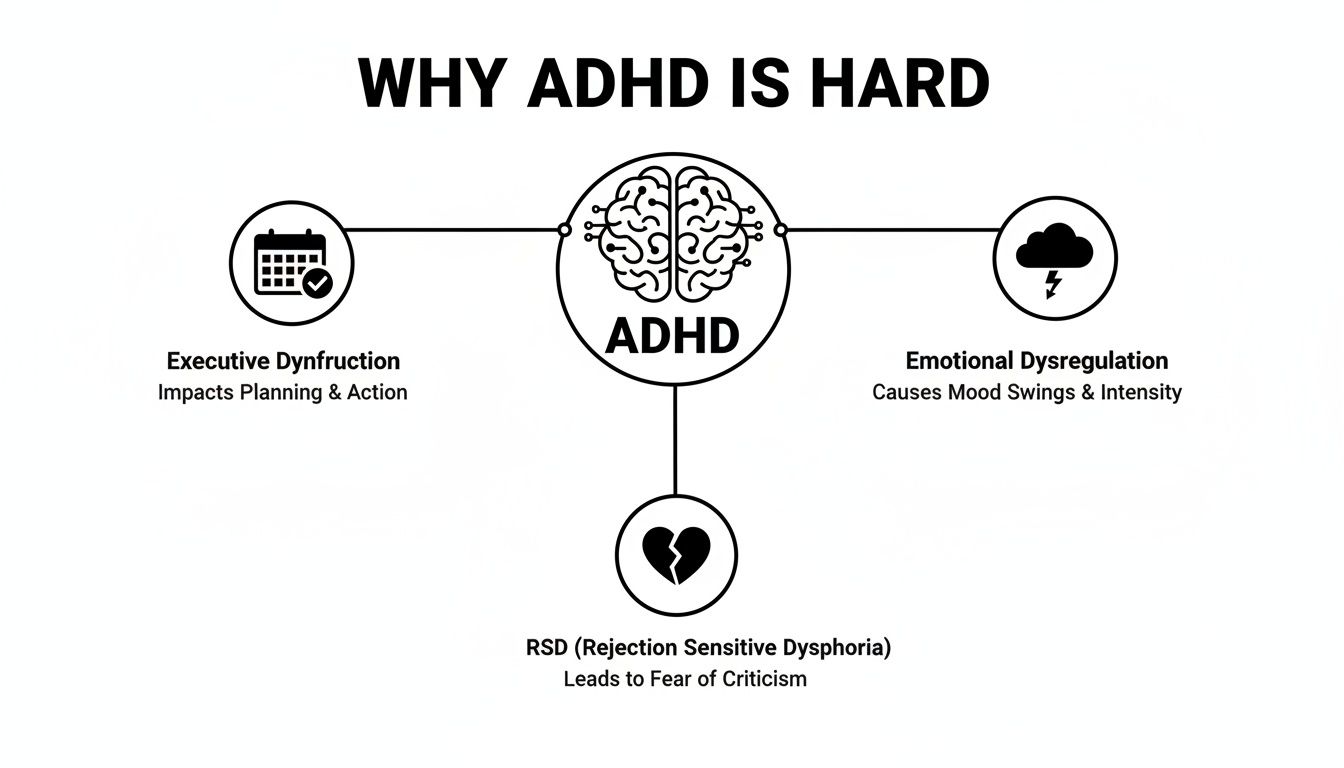
This map shows how the real challenges of ADHD go way beyond simple inattention, affecting everything from planning your day to managing your feelings and navigating social situations, especially when autism and other mental health concerns are also present.
The Impact of Executive Dysfunction
Think of executive functions as the CEO of your brain—they handle planning, prioritising, and actually getting things done. In an ADHD brain, the CEO is often brilliant but unreliable. It’s the reason you can know exactly what you need to do but feel physically unable to start. This isn't just an ADHD issue; executive dysfunction is also a core trait of autism, though it can manifest differently.
This isn’t laziness. It’s a genuine neurological hurdle. In real life, this might look like:
- Task Paralysis: Staring at a simple email for an hour, totally unable to figure out how to reply.
- Time Blindness: Genuinely believing a task will take 20 minutes when it actually takes two hours, leading to chronic lateness.
- Difficulty Prioritising: Treating every task with the same level of urgency, whether it’s paying a critical bill or sorting the sock drawer.
Navigating Emotional Dysregulation
Another major piece of the puzzle is emotional dysregulation. ADHD can make it incredibly difficult to manage the intensity and duration of your feelings. A small frustration can snowball into overwhelming anger or despair, leaving you and the people around you feeling completely bewildered. This emotional volatility is a key contributor to the anxiety and depression that so often accompany ADHD.
This isn't a choice; it's a neurological reality. It’s why a bit of feedback can feel like a devastating personal attack and why bouncing back from disappointment feels so much harder.
This experience is often compounded when autism is also a factor. While ADHD may fuel impulsive emotional reactions, autism can add a layer of difficulty in identifying and articulating those feelings (alexithymia), creating intense internal confusion and leading to meltdowns. We take a deeper look at this in our guide on ADHD and emotional challenges.
The Hidden Pain of Rejection Sensitive Dysphoria
Rejection Sensitive Dysphoria (RSD) is a term that resonates deeply with many people who have ADHD. It describes an extreme emotional sensitivity and pain triggered by the perception of being rejected, criticised, or failing. While it’s not an official diagnosis, its impact on mental health is very real.
It’s that gut-wrenching sting you feel when a friend cancels plans or your boss offers some constructive feedback. Over time, this fear can lead to intense people-pleasing or avoiding any situation where you might face judgement. It’s a silent battle that can really erode your self-worth and fuel social anxiety.
Overlap with Autism
For many adults, the picture is further complicated by the fact that ADHD and autism often occur together. This overlap can make it challenging to pinpoint the source of a particular struggle, as some traits manifest in similar, yet distinct, ways. Understanding this interplay is key to finding the right support for your mental health.
Common ADHD & Autism Trait Overlaps in Adults
| Challenge Area | How It Manifests in ADHD | How It Manifests in Autism | The Combined Impact |
|---|---|---|---|
| Social Interaction | May interrupt others, talk excessively, or miss social cues due to inattention. | Difficulty understanding non-verbal cues, social reciprocity, or sarcasm. Prefers structured interaction. | Feeling socially out of sync, leading to anxiety. May overcompensate by masking or withdraw completely. |
| Executive Function | Struggles with starting tasks, planning, and time management due to "time blindness" and procrastination. | Difficulty with flexible thinking and adapting to changes in routine. Prefers predictability and structure. | An intense feeling of being "stuck." The need for routine clashes with the inability to initiate and stick to one. |
| Sensory Processing | Seeks sensory input (fidgeting, pacing) to maintain focus, or is under-sensitive to stimuli. | Experiences sensory overload or hypersensitivity to light, sound, or touch, leading to distress. | A constant push-pull between needing stimulation to focus (ADHD) and being overwhelmed by it (Autism), causing exhaustion. |
| Emotional Regulation | Experiences intense, short-lived emotional outbursts (dysregulation) often triggered by frustration or RSD. | Difficulty identifying and expressing emotions (alexithymia) or experiences meltdowns from overwhelm. | Emotional responses can be confusing and intense. Frustration from ADHD can trigger an autistic meltdown, creating a volatile cycle. |
Recognising how these traits combine helps create a more complete picture, moving beyond a single diagnosis to understand the whole person. This clarity is the first step toward building a personalised toolkit that honours your unique neurotype, rather than trying to force yourself into a neurotypical box.
Unfortunately, far too many people navigate these challenges without any support. In the UK, it’s estimated that 2.5 million people in England alone live with ADHD. Yet with just 0.32% of UK GP records showing a diagnosis, a huge number are missing out. The fact that over 549,000 people are waiting for an assessment highlights the critical role of timely private services in providing the diagnosis needed to finally start coping effectively.
Building Your Personal ADHD Management Toolkit
Figuring out how to live with ADHD isn't about forcing your brain to operate like everyone else's. Far from it. The real progress happens when you discover strategies designed for a neurodivergent mind—when you start working with your brain’s unique wiring, not against it. This means ditching the one-size-fits-all advice and building a personal toolkit filled with techniques that genuinely help you with focus, organisation, and just feeling good.
The whole point is to experiment. What’s a game-changer for one person might do nothing for you, and that’s completely fine. Think of this as creating a unique collection of tools that you can adapt and change as your life and needs evolve, especially for managing both ADHD and autistic traits.

Hacking Your Focus and Motivation
One of the biggest hurdles for an ADHD brain is just getting started on something that feels dull or massive. It's a phenomenon many call "task paralysis." Instead of trying to power through with sheer willpower (which rarely works), you can use a few clever tricks to get your brain on board.
A surprisingly powerful strategy is the body double. This is as simple as having someone else in the room—physically or even on a video call—while you tackle a task. They don't have to do anything. Just their quiet presence adds a little external accountability that can be enough to keep you focused.
You can also adapt well-known productivity methods to fit your brain. The Pomodoro Technique, with its focused 25-minute work sprints, is a great starting point. But don't be afraid to customise it. Some days, a 15-minute burst is all you can manage, and honestly, that’s still a win.
Making Time and Tasks Tangible
Lots of us with ADHD struggle with "time blindness," making it nearly impossible to accurately guess how long a task will take. This is where making time visible can be a lifesaver. A visual timer, like a Time Timer that shows time disappearing as a red disc shrinks, makes the abstract concept of time feel much more real and manageable.
Digital tools can also bring some much-needed structure to the chaos. A few apps designed with neurodivergent minds in mind can help break down overwhelming projects.
- Tiimo: A visual daily planner that helps you map out your day with checklists and customisable routines.
- Goblin.Tools: This uses AI to slice big, vague tasks into small, specific steps. Just type in "clean the kitchen," and it will generate a detailed to-do list for you.
Of course, the foundation of any good ADHD toolkit is a solid framework. Taking the time to build your personal productivity systems can make a world of difference in how you handle daily demands.
Creating a Brain-Friendly Environment
The space around you has a massive impact on your ability to function. For an ADHD brain, physical clutter quickly becomes mental clutter, draining your energy and focus. The goal isn't to become a minimalist overnight, but to create systems that align with your natural tendencies.
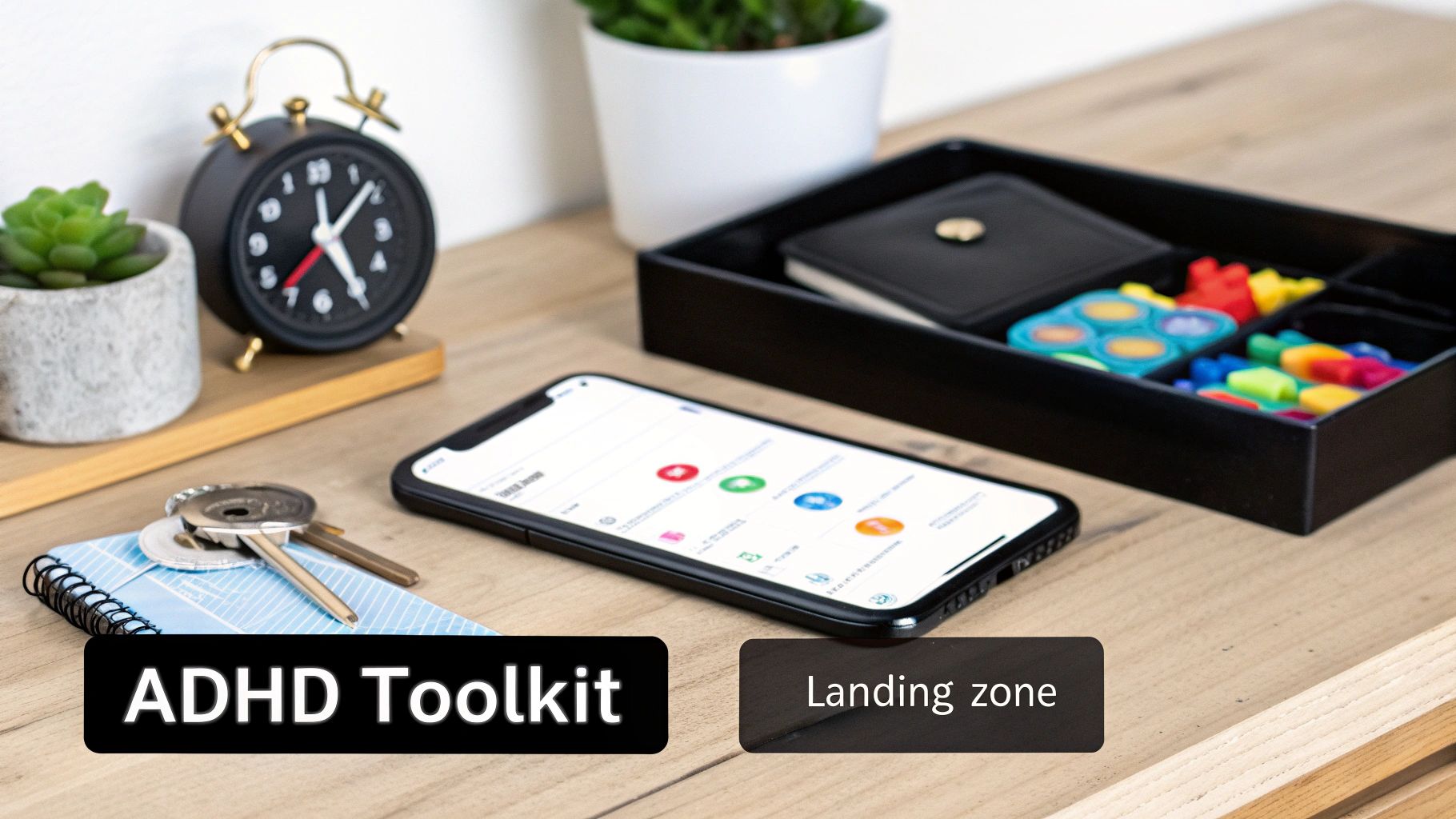
One incredibly simple but effective idea is the "landing zone." It's just a designated spot by your front door—a bowl, a tray, some hooks—where you always put your essentials like keys, wallet, and phone the second you walk in. This one habit can save you from countless frantic searches.
Remember, this is about progress, not perfection. Setting up your space to reduce friction and support your executive functions is a genuine act of self-care. It’s about making your environment finally work for you.
When you set up simple systems like this, you cut down on the number of small decisions you have to make all day. That frees up precious mental energy for the things that really matter. You can find more ideas in our other articles covering strategies for coping with ADHD.
Managing Sensory Overload
There's a significant overlap between ADHD and autism, and that often includes challenges with sensory processing. Your environment can feel intensely overstimulating, leading straight to anxiety, irritability, and burnout. That’s why having sensory regulation tools in your kit is absolutely essential for protecting your well-being.
This doesn't need to be complicated. It's really about spotting your triggers and having something ready to help you cope.
- Noise-cancelling headphones: A true lifesaver in an open-plan office, on public transport, or just in a loud house. They create a bubble of calm that lets your brain focus without being constantly interrupted.
- Fidget tools: Having a discreet fidget toy can provide that little bit of sensory input your ADHD brain craves, which can ironically help you concentrate better during meetings or while working on something complex.
- Weighted blankets: For those moments of intense restlessness or overwhelm, the deep pressure from a weighted blanket can have a surprisingly calming effect on the nervous system.
By proactively managing your sensory input, you can stop overwhelm before it even starts. This helps you conserve your energy and be more present in your own life, making it a critical skill for anyone learning to navigate the world with ADHD and autism.
How to Manage Work and Relationships When You're Neurodivergent
Knowing which tools can help you manage ADHD is one thing, but actually using them when other people are involved is a whole different ball game. It can feel incredibly vulnerable to talk about your needs, whether it's in a team meeting or with your partner, especially when you're worried about being judged or misunderstood.
But here’s the thing: learning to advocate for yourself is one of the most powerful skills you can develop. It’s what builds stronger, more supportive connections at work and at home. You don't have to announce your diagnosis to the world. The real key is to get good at translating what's going on in your head into a practical, actionable request that people can actually help with.
Advocating for Yourself in the Workplace
Let's be honest, the modern workplace can be a minefield for the neurodivergent brain. Open-plan offices are a sensory nightmare, back-to-back meetings drain your focus, and vague instructions can send you into a spiral of overwhelm.
The good news is that in the UK, the Equality Act 2010 requires employers to provide reasonable adjustments for employees with disabilities, which often includes conditions like ADHD and autism.
Interestingly, you often don't even need a formal diagnosis to ask for support. It's about focusing on the specific challenge and offering a clear solution.
Instead of saying, "My ADHD makes it hard to focus," try framing it as a solution. For example: "I do my best, most focused work when I can really get into a deep-work zone. Would it be okay if I used the quiet room for a couple of hours each morning to power through my main tasks?"
Here are a few common scenarios and some scripts you can adapt:
- You're given verbal instructions: "Thanks for explaining that. Just to make sure I get this spot on, could you pop the key points and deadlines in a quick email to me? Having it in writing is a massive help for me to stay on track."
- The office is full of distractions: "I find it a bit tough to concentrate on detailed work with the background noise in the main office. Would it be alright if I used my noise-cancelling headphones?"
- You're struggling to prioritise deadlines: "I really want to make sure I'm managing my workload effectively. Could we have a quick 10-minute check-in on Monday mornings just to confirm the top priorities for the week? It would really help me align my focus with the team's goals."
These requests sound professional, are completely reasonable, and are all about improving your performance. That makes it much easier for a manager to say yes.
Strengthening Your Personal Relationships
Relationships are wonderful, but they can also be a source of major friction when neurodivergent traits get lost in translation. Your partner might see you forgetting a birthday as carelessness, or your interrupting as rudeness. In reality, these are often direct symptoms of ADHD, not a reflection of how much you care.
This is where open, honest communication becomes non-negotiable. It takes a bit of vulnerability, but it’s far better to explain how your brain is wired than to spend your life apologising for it. The goal is to team up and find solutions that work for both of you.
"When I interrupt you, I promise it’s not because I don’t care what you're saying. It’s my brain desperately trying to grab a thought before it vanishes forever. What if we tried a system where I quickly jot it down instead of blurting it out?"
A script like this reframes the behaviour from a personal flaw to a neurological quirk, turning a potential argument into a problem-solving session.
Scripts for Common Relationship Hurdles
Navigating these conversations isn’t always easy. Having a few phrases in your back pocket can help you express what you need clearly and lovingly, building connection instead of conflict.
Tackling Perceived Inattentiveness
- The Issue: Your partner feels you aren’t listening because you're fidgeting or looking around the room while they're talking.
- The Script: "I know it might not look like I'm listening, but when I'm fiddling with something, it actually helps my brain tune in to every word you're saying. I am listening, and what you're saying is really important to me. This just helps me process it all."
Addressing Emotional Intensity
- The Issue: A tiny disagreement spirals into a huge emotional reaction from you, which leaves your partner feeling completely overwhelmed.
- The Script: "I feel my emotions really intensely, and sometimes they just hit me like a train. If I seem to be getting overwhelmed, could we agree to take a 10-minute break to cool off before we carry on? I really want to sort this out with you calmly."
Managing Time Blindness
- The Issue: You're often late, and your partner takes it personally, feeling you don't respect their time.
- The Script: "I'm honestly so bad at judging how long things will take, and I'm really sorry for how that affects you. I'm trying out a new system with visual timers and setting extra alarms. Could you maybe help by giving me a shout 20 minutes before we need to leave?"
Using communication strategies like these is empowering. You stop playing defence and start proactively collaborating, building a world around you that works with, not against, your unique brain.
When to Seek a Formal Assessment and Medical Support
Self-management strategies are brilliant, but they aren't always enough to navigate the complexities of ADHD, especially when it co-occurs with autism or other mental health conditions. If you feel like you're constantly fighting an uphill battle, if your daily life is being severely affected, or if you're also wrestling with anxiety and depression, it might be time to think about professional support.
Getting a formal assessment isn't about admitting defeat. Far from it. It's about gaining access to incredibly effective tools—like a clear diagnosis and potentially medication—that can amplify all your other coping strategies. It gives you clarity and opens up a new, more supported way of living.

Recognising When Self-Management Isn't Enough
So, how do you know when you’ve hit the limit of what self-help can achieve? There isn't a single definitive answer, but there are some strong signals that suggest it’s time to explore a formal diagnosis. These signs often point to the underlying neurobiology of ADHD, which can't always be outsmarted by willpower or clever life hacks alone.
Consider looking into an assessment if you're consistently experiencing any of these:
- Serious Functional Impairment: Your symptoms are causing real problems at work, perhaps leading to performance warnings or even job losses. At home, your relationships might be strained to breaking point due to impulsivity, forgetfulness, or emotional dysregulation.
- A Constant Feeling of Failure: You’ve bought every planner, downloaded all the apps, and tried countless productivity systems, but nothing seems to stick for long. This can create a horrible cycle of shame and low self-worth, where you end up blaming yourself for challenges that are neurologically driven.
- Co-occurring Mental Health Struggles: It’s incredibly common for ADHD to travel with companions. In fact, up to 70% of adults with ADHD also deal with sleep problems, and many live with anxiety or depression. Often, these issues are a direct result of the strain of living with untreated ADHD, and a diagnosis helps get to the root of the problem.
If any of this sounds painfully familiar, a professional evaluation could give you the validation and answers you've been searching for.
What a Comprehensive Assessment Involves
The thought of an assessment can feel intimidating, but knowing what’s involved can really help take the fear out of it. A high-quality, consultant-led assessment from a CQC-regulated service is a thorough, evidence-based process. It’s designed to get a complete picture of who you are—not just a quick questionnaire, but a deep dive into your unique neurotype.
A proper assessment will usually include:
- A Structured Diagnostic Interview: A specialist psychiatrist will talk you through your life, from childhood memories to your current struggles. They use standardised, proven tools to explore symptoms related to inattention, hyperactivity, and impulsivity.
- A Look at Your Developmental History: They’ll likely ask about old school reports, your family history, and how your symptoms might have shown up differently when you were a child. This helps build a lifelong picture of your traits.
- Screening for Co-occurring Conditions: The assessment will also check for signs of other conditions that often go hand-in-hand with ADHD, like autism, anxiety, or depression. This ensures the final report is as accurate and helpful as possible.
The goal of a proper assessment is clarity. It's about understanding the 'why' behind your struggles and creating a clear path forward, whether that includes therapy, medication, or specific workplace adjustments.
At the end of the process, you receive a detailed diagnostic report. This document not only confirms a diagnosis but also provides personalised recommendations for your next steps. To see what this journey looks like, you can learn more about how to get assessed for ADHD and what each stage involves.
Understanding ADHD Medication as a Tool
For many people, medication is a genuine game-changer. It doesn’t "cure" ADHD, but it can dramatically improve focus, dial down impulsivity, and help keep emotions on a more even keel. A good way to think of it is like turning down the static in your brain, which finally allows your own skills and strategies to work properly.
The process of finding the right medication is called titration. This is a careful, closely supervised period where a psychiatrist works with you to find the right type and dose. It’s a slow and steady process, starting with a low dose and making small adjustments over several weeks to get the maximum benefit with the fewest side effects.
There are two main categories of ADHD medication:
- Stimulants: These are the most commonly prescribed and, for many, the most effective. They work by increasing the levels of certain neurotransmitters, which improves communication between brain cells and boosts executive function.
- Non-Stimulants: These are a great alternative for people who can't take stimulants or don't respond well to them. They work differently but can still bring significant improvements in focus and impulse control.
For those thinking about medication, knowing where to turn for reliable supply is important, and resources that help you find Adderall or other prescribed treatments can be a practical help. Ultimately, the decision to take medication is a personal one, but for many, it’s the key that unlocks their potential to truly thrive.
How Medico-Legal Services Can Be Your Strongest Ally
Learning to manage daily life with ADHD is one thing, but there's another layer of support that often goes overlooked. It’s the kind of formal, expert backing you need when your mental health crosses paths with legal or professional hurdles. In these moments, a robust diagnostic report from a CQC-regulated service isn't just a piece of paper—it's one of the most powerful tools you can have.
Think about it. You might find yourself in a situation where you need to officially explain how your neurodivergence affects you. This could be anything from fighting a discrimination case at an employment tribunal to navigating the complexities of family court. When the stakes are that high, your own words might not be enough. You need impartial, expert evidence to back you up.
This is exactly where medico-legal services come in, offering a unique kind of support.
So, What Is a Court-Compliant Psychiatric Report?
A court-compliant psychiatric report is a world away from a simple GP's note. It's a comprehensive, impartial document drafted by a specialist psychiatrist, specifically written to be understood and respected by the legal system. It lays out an expert opinion on your mental health, explains how your condition impacts your day-to-day life, and gives a professional prognosis.
These reports follow strict legal standards, making sure they’re clear, objective, and built on solid evidence. They essentially translate your personal experience of ADHD—and any co-occurring conditions like anxiety or autism—into a formal language that solicitors, judges, and employers can understand and act on.
When Might You Need This Kind of Support?
The need for a formal psychiatric report can pop up in all sorts of situations where your mental health is a key factor. Having this documentation in your corner can genuinely change the outcome, ensuring you’re treated fairly and that your circumstances are properly understood.
Here are a few common scenarios:
- Employment Tribunals: If you believe you've faced disability discrimination, a report is critical. It provides the evidence that your ADHD is a protected characteristic under the Equality Act 2010 and can detail exactly how certain workplace practices put you at a serious disadvantage.
- Personal Injury Claims: After an accident, a report can assess the psychological fallout. It documents any impact on your cognitive function, memory, or emotional regulation, which is vital for calculating fair compensation.
- Family Court Cases: During divorce proceedings or disputes over child arrangements, a report can clarify how your ADHD might affect your parenting and, just as importantly, what support systems would be helpful.
A medico-legal report is like having an expert witness in your corner. It provides an objective voice that validates your experience and champions your needs within systems that can feel incredibly overwhelming.
Knowing this support exists is a crucial part of managing ADHD effectively across all areas of your life. If you're looking for an expert assessment, it’s well worth exploring a provider's medico-legal consultancy services to see how a formal report could help in your specific case. It ensures that when you need to stand up for your rights or secure the right accommodations, you’ve got credible, professional evidence on your side.
Your Top Questions About Adult ADHD Answered
When you’re first exploring the possibility of ADHD, or even after a diagnosis, it’s completely normal to have a ton of questions. Let’s face it, the internet is full of conflicting information. Getting straight answers from a reliable source is the first step toward understanding yourself better and finding what works for you.
Here are some of the most common questions I hear.
How Do I Know If It's ADHD, Autism, or Both?
This is a big one, and for good reason. There’s a lot of overlap between ADHD and Autism, especially when it comes to things like executive function struggles or navigating social situations. The key difference often lies in the why. For instance, someone with ADHD might interrupt conversations due to impulsivity, whereas an autistic person might struggle more with reading social cues.
Teasing these apart isn't something you can do with an online quiz. The only way to get a clear picture is through a comprehensive diagnostic assessment with a specialist psychiatrist. They have the expertise to dig into your developmental history and use specific diagnostic tools to understand your unique neurotype. This process is all about getting you the right kind of clarity, whether it turns out to be ADHD, Autism, both, or something else entirely.
Can I Get Support at Work in the UK Without a Formal Diagnosis?
Technically, yes. Under the Equality Act 2010, you don't necessarily need a piece of paper to ask for reasonable adjustments. If your symptoms are having a ‘substantial’ and ‘long-term’ negative effect on your day-to-day life and work, you are likely protected by the act.
However, in my experience, a formal diagnostic report from a CQC-regulated service makes the whole process smoother. It removes the guesswork for your employer and gives them a clear, professional breakdown of what you need. This can seriously speed up getting practical support like flexible hours, noise-cancelling headphones, or a quieter desk space.
What Exactly Is ADHD Medication Titration?
Think of titration as a highly personalised fine-tuning process for your medication. There’s no magic pill or one-size-fits-all dose for ADHD, so this is about finding exactly what your brain and body need to thrive.
A specialist psychiatrist will start you on a very low dose of a medication. Then, over a period of several weeks, you'll have regular check-ins to see how you're feeling. They'll monitor the benefits—like better focus or less impulsivity—and keep an eye out for any side effects. Based on your feedback, they'll carefully adjust the dose up or down until you hit that sweet spot.
Titration is a genuine partnership between you and your doctor. It’s a careful, methodical journey to ensure you get the maximum benefit from your medication with the fewest possible side effects.
Are Online ADHD Assessments as Good as In-Person Ones?
Absolutely, as long as you choose a reputable, properly regulated provider. The quality of an assessment comes down to the clinician's expertise and the thoroughness of their process, not whether you're in the same room.
Look for services led by GMC-registered consultant psychiatrists and regulated by the CQC. These organisations adhere to the highest clinical standards in the UK. They use the exact same gold-standard diagnostic interviews (like the DIVA-5) and follow the same evidence-based criteria you'd find in a face-to-face clinic. It just means you can get a robust, reliable diagnosis from the comfort of your own home, which makes getting help so much more accessible.
Figuring out your neurotype is the starting point for creating a life that actually works for you. At Insight Diagnostics Global, our CQC-regulated, consultant-led team offers clear, comprehensive online assessments for ADHD, Autism, and other mental health conditions, giving you the answers you need to move forward. Find out more on the Insight Diagnostics Global website.