A fitness to work assessment isn't about passing or failing a test. Think of it as a practical, collaborative tool that helps everyone understand an employee's health in the context of their specific job, making sure they can work safely and effectively. It’s a supportive process, designed to bridge the gap between an employee's health needs—especially around mental health, Autism, or ADHD—and the genuine demands of their role.
What Is a Fitness to Work Assessment

Picture a bridge connecting an employee's personal health with their professional responsibilities. A fitness to work assessment is that bridge. Its purpose isn't to find fault; it's about finding solutions and creating a sustainable, productive work environment that works for everyone involved.
This process is especially crucial when dealing with conditions like Autism, ADHD, or mental health challenges, which can often be misunderstood at work. An assessment cuts through assumptions, offering an objective, expert opinion on how a condition might affect an employee's duties and, crucially, what support they need to thrive.
The Goal of a Workplace Health Assessment
At its core, the assessment aims to answer one fundamental question: Is this employee medically fit to carry out their specific duties without posing a risk to themselves or others? This involves a careful, considered evaluation of their health status against the actual requirements of their job.
The term fitness to work assessment is broad and often overlaps with a Functional Capacity Evaluation (FCE), which focuses on measuring an individual’s physical capabilities. However, when mental health or neurodiversity is the central concern, the focus naturally shifts from physical strength to cognitive and emotional wellbeing.
A fitness to work assessment is fundamentally about alignment. It aligns the needs of the employee with the responsibilities of the role, guided by expert medical insight to ensure safety, fairness, and productivity.
With the growing awareness of mental health at work, these assessments have become more important than ever. In the UK, mental health issues are a leading cause of absence. The Health and Safety Executive reports that stress, depression, or anxiety accounted for a staggering 22.1 million lost working days. These figures don't just represent lost productivity; they highlight a critical need for proper, structured support systems.
Two Primary Assessment Pathways
To meet different needs, there are two main routes for these assessments. Each pathway serves a distinct purpose and is suited to specific circumstances. Understanding the difference is the first step to getting the right support for your employee, as the choice depends entirely on the complexity of the situation and the questions you need answered.
Exploring various comprehensive mental health assessment services can help clarify the best approach for your organisation's unique needs.
To help you distinguish between the two, here’s a quick comparison of what each assessment involves.
Comparing Occupational Health and Psychiatric Medico-Legal Assessments
| Aspect | Occupational Health Assessment | Psychiatric Medico-Legal Assessment |
|---|---|---|
| Primary Purpose | General workplace health management, short-term absence, and return-to-work planning. | Complex cases involving mental health, neurodiversity, legal disputes, or potential disability discrimination. |
| Who Conducts It | Occupational Health nurse, advisor, or physician. | A Consultant Psychiatrist with specific medico-legal training and expertise in areas like Autism and ADHD. |
| Typical Application | Routine health screenings, managing common illnesses, or initial return-to-work interviews. | Long-term sickness absence, performance issues linked to ADHD/Autism, employment tribunals, or harassment claims. |
As you can see, a standard Occupational Health check is perfect for day-to-day issues, but when the situation is more complex—especially involving mental health or legal implications—a specialist psychiatric assessment becomes essential.
Knowing When an Assessment Is Necessary
Deciding to request a fitness to work assessment can feel like a big step. As an employer, you're trying to strike a difficult balance between your duty of care and an employee's right to privacy about their health. The trick is to reframe it in your mind: it's not a punishment, but a positive, practical tool to help a struggling team member get the support they need.
This is especially true when you suspect mental health or neurodiversity might be part of the picture. Conditions like Autism and ADHD can show up at work in ways that are easily mistaken for poor performance or a bad attitude. In reality, these behaviours are often symptoms of a condition that, with the right support, can be managed effectively.
Common Triggers for an Assessment
So, when is it time to make that call? There are usually a few clear signs that a fitness to work assessment is the right next move. These aren't about prying; they're about observable issues tied directly to an employee's ability to do their job safely and well. Spotting them early means you can step in with support before a situation gets worse.
Here are some of the most common scenarios:
- Prolonged or Frequent Absences: A recurring pattern of short-term sick days or one long period of absence, often linked to mental health, is a clear red flag that a sustainable return-to-work plan is needed.
- Noticeable Changes in Performance: Has a reliable employee's work quality suddenly dropped? Are they struggling with deadlines or organisation? This kind of shift is a strong signal that an underlying condition like ADHD or anxiety could be getting in the way.
- Safety Concerns: This one is non-negotiable. If an employee's mental health or behaviour poses a potential risk to themselves, their colleagues, or the public, an assessment is essential to keep everyone safe.
- Post-Incident Evaluation: After a workplace accident or a serious near-miss, an assessment can help figure out if a mental health condition or neurodivergent trait played a part and what needs to change.
The state of the UK's workforce health makes this more relevant than ever. Recent figures show that roughly 8.7 million people of working age are living with a health condition that limits their ability to work. And according to the Keep Britain Working Review, 2.8 million people are now economically inactive due to long-term sickness—that's a staggering 40% increase since 2019. It really drives home the need for employers to have effective support systems in place. You can explore more data on the health of the UK workforce and its economic impact.
Autism and ADHD in the Workplace
Understanding the nuances of neurodiversity is crucial. It’s all too easy to misread behaviours associated with Autism or ADHD if you don't have the right context. For instance, an autistic employee who finds direct eye contact difficult might be perceived as untrustworthy or disengaged. An employee with ADHD who struggles to manage their time might just look unreliable.
An assessment cuts through these assumptions. It brings in an expert who can interpret the situation correctly, shifting the conversation from guesswork about behaviour to an evidence-based understanding of what an individual actually needs.
Instead of guessing, a specialist psychiatric assessment provides clarity. It can determine, for example, whether an employee's trouble with deadlines is genuinely linked to the executive function challenges of ADHD, or if it's something else entirely. That clarity is the starting point for providing support that actually works.
The Focus on Proactive Support
Ultimately, the decision to seek an assessment should always come from a place of support. Think of it as a formal, structured way of saying, "We value you, and we want to figure out how we can help you do your job safely and well." It demonstrates a genuine commitment to your duty of care.
By getting an assessment, you're creating a clear path forward for everyone. It gives you an objective, expert opinion to guide your decisions, protects your organisation from a legal standpoint, and—most importantly—gives your employee the best possible chance to thrive in their role.
What Happens During a Fitness to Work Assessment? A Step-by-Step Guide
The thought of a fitness to work assessment can be daunting for anyone, but knowing what to expect can make a world of difference. Far from being an interrogation, it’s a structured, supportive conversation. The goal is to build a bridge between an employee's health and their ability to thrive at work, especially when navigating conditions like Autism or ADHD.
Let's walk through the process from the employee's perspective to see how it all works.
Step 1: The Referral and Your Consent
It all starts when an employer, usually through their HR team, refers an employee to a specialist provider. This isn't a decision taken lightly. It’s typically prompted by genuine concerns, such as recurring health-related absences, noticeable changes in performance, or potential safety issues.
The most important thing to know is that nothing happens without the employee's express permission. Under GDPR, you have a right to know exactly what information is being shared and why. The referral will typically include your job description, some context around the performance or absence concerns, and specific questions the employer needs an expert opinion on.
This is often the point where patterns have started to emerge in the workplace.
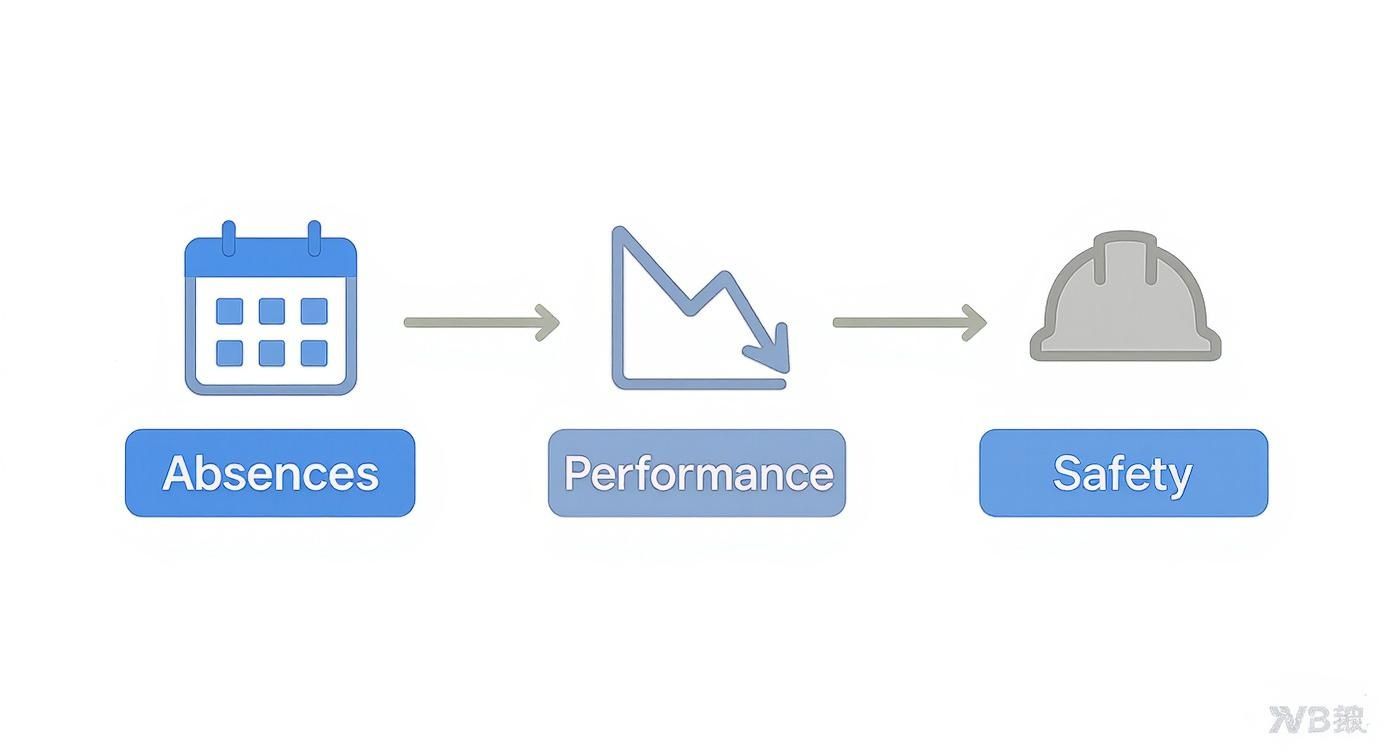
As you can see, these factors are often linked. An assessment is usually a proactive step to understand and address a series of challenges, not just a one-off incident.
Step 2: The Assessment Itself
Once you’ve given your consent, the assessment will be scheduled. Today, many evaluations—particularly those focused on mental health or neurodiversity—are carried out remotely by a consultant psychiatrist. This approach provides a private, comfortable setting, taking away the added stress of travelling to an unfamiliar office.
The assessment is simply a guided conversation. The psychiatrist is there to listen and understand, not to pass judgement.
The core purpose is to connect the dots between your health—be it anxiety, ADHD, or Autism—and the real-world demands of your job. It's always about finding solutions, not finding fault.
The consultant will ask about your role, what your main duties involve, and any specific difficulties you're experiencing. Every question is framed within your work context. For example, rather than simply listing off ADHD symptoms, they might ask:
- "How do you find your concentration holds up during long team meetings or when you're working on a detailed report?"
- "Could you tell me a bit about how you manage your deadlines and organise your daily tasks?"
- "Do you find the office environment, like background noise or bright lighting, distracting or perhaps a little overwhelming?"
This keeps the conversation focused and relevant to your job. It’s your opportunity to explain what you're going through in a safe space with an expert who truly gets the nuances of mental health and neurodiversity. If you wanted to get some clarity for yourself before a work-led process, you could always explore a private mental health assessment in the UK first.
Step 3: The Report and Recommendations
After your conversation, the consultant psychiatrist compiles a detailed report. This document does three key things: it summarises the discussion, provides a professional opinion on your fitness for your role, and offers clear, practical recommendations for reasonable adjustments.
Crucially, you get to review the report to check for factual accuracy before it goes to your employer. This ensures the whole process is transparent and fair. This final step is what turns the assessment from a simple evaluation into a concrete plan for making the workplace safer, more supportive, and more productive for everyone.
Understanding Your Legal Duties as an Employer
As a UK employer, getting your head around all the legal obligations can feel daunting, but the fundamentals are actually quite straightforward. Everything boils down to fairness, safety, and support—especially when an employee's mental health, Autism, or ADHD is part of the picture.
It all starts with your basic ‘duty of care’, a responsibility cemented in the Health and Safety at Work Act 1974. In plain English, this means you must do everything you reasonably can to protect the health, safety, and wellbeing of your people. A fitness to work assessment is a practical way to fulfil this duty, giving you expert medical insight to ensure the workplace is safe for everyone involved.
This core responsibility is tightly linked to another landmark piece of legislation.
The Equality Act 2010 and Disability
The Equality Act 2010 is a critical piece of the puzzle when you're considering a fitness to work assessment, particularly for an employee with a mental health condition, Autism, or ADHD. Under this Act, a person is legally considered to have a disability if they have a physical or mental impairment that has a ‘substantial’ and ‘long-term’ negative effect on their ability to carry out normal daily activities.
It’s important to realise that many mental health conditions and neurodevelopmental differences fit this description. This gives the employee legal protection from discrimination, and places a clear legal duty on you, the employer, to make ‘reasonable adjustments’ to support them at work.
An employer’s legal duty isn’t just about ticking boxes to avoid a tribunal. It's about proactively building a work environment where employees with conditions like ADHD or Autism can genuinely succeed in their roles—a win for the individual and the business.
What Are Reasonable Adjustments?
So, what exactly are ‘reasonable adjustments’? They are simply changes made to a job or the workplace to remove or reduce the disadvantages an employee with a disability might face. This is where a specialist psychiatric fitness to work assessment becomes invaluable, as the final report will offer specific, evidence-based recommendations for adjustments that are tailored to both the employee’s condition and their role.
These adjustments don’t have to be costly or complicated. In fact, small, simple changes often have the biggest impact.
- For an employee with Autism: Providing a pair of noise-cancelling headphones can make a world of difference in a noisy, open-plan office.
- For an employee with ADHD: Using project management software that provides clear, written instructions can be a game-changer for focus and organisation.
- For an employee with anxiety: Offering flexible start and finish times to avoid the stress of a rush-hour commute can be a lifeline.
Failing to make reasonable adjustments isn't just a missed opportunity; it can lead to serious legal trouble, including discrimination claims. But looking beyond the risk, embracing this duty helps create a far more inclusive, supportive, and productive culture. Data from the UK’s Work and Health Programme highlights this: while 21% of participants with disabilities found work within a year, that figure climbed to 32% within two years, showing just how effective sustained support can be.
For HR professionals keeping up with compliance, it's also worth noting how modern tools intersect with these duties, especially when navigating AI ethics, EPPA compliance, and risk management in Human Resources. At the end of the day, your legal responsibilities and the fitness to work process work together to create a clear, fair, and supportive path for both you and your employee.
Putting Recommendations into Practice: Making Reasonable Adjustments Work
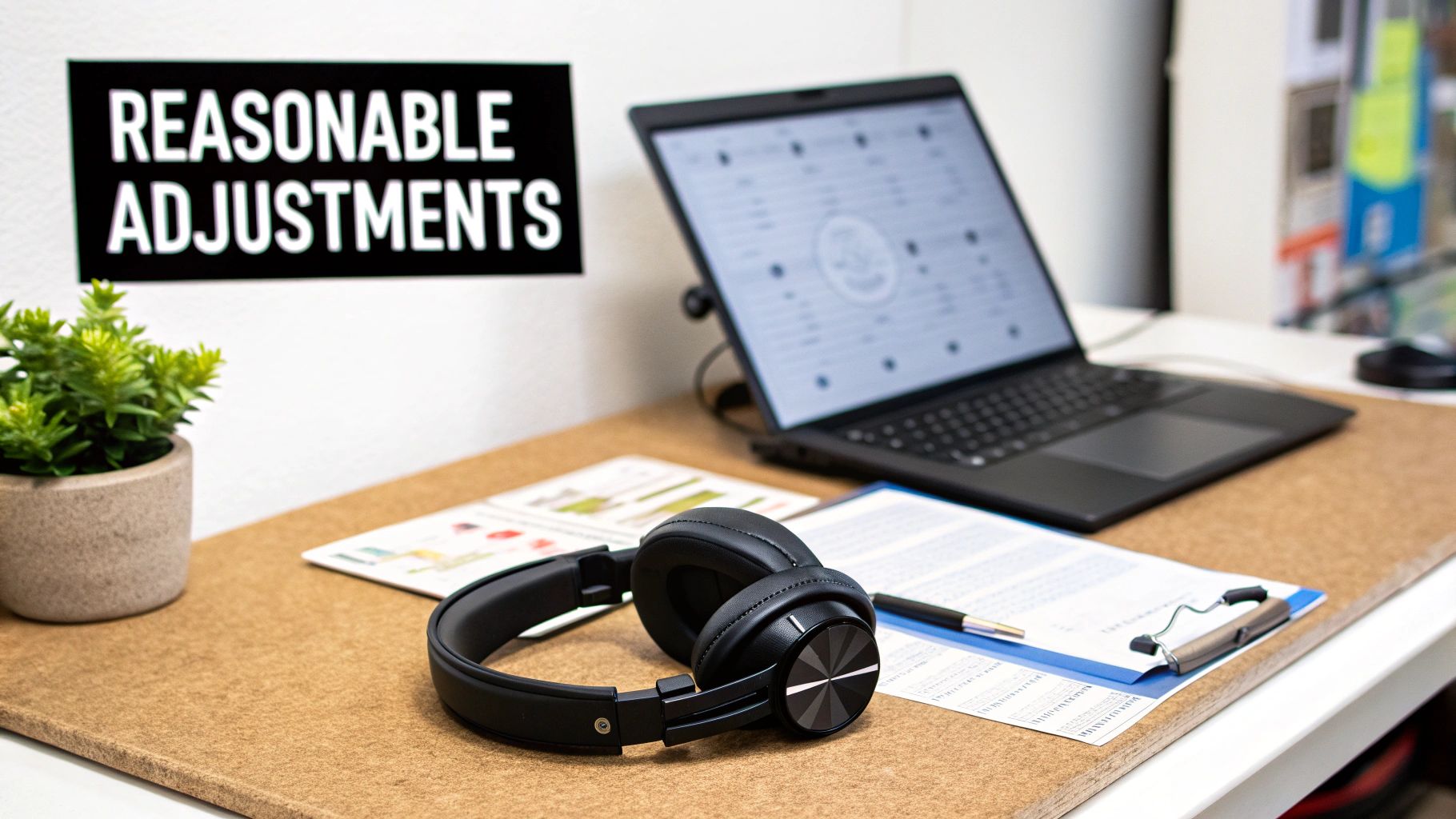
A specialist report from a fitness to work assessment shouldn't just be filed away. Think of it as a practical roadmap for creating a more supportive and productive workplace. The real value is unlocked when you translate its expert recommendations into tangible, meaningful actions for your employee. This is where theory meets reality.
For team members managing conditions like Autism, ADHD, or mental health challenges, these changes—known as reasonable adjustments—are often the key to them thriving, not just surviving, at work. It's not about lowering standards. It’s about levelling the playing field so every person has what they need to succeed.
From Recommendations to Reality
Turning a written recommendation into a genuine workplace adjustment is a collaborative process. It starts with a thorough review of the assessment report, followed by an open and constructive conversation with the employee. The focus should always be on finding solutions that are practical, effective, and sustainable for both the individual and the business.
You'd be surprised how often the most impactful adjustments are simple and low-cost. The aim is to dismantle the specific barriers an employee’s condition might create in their day-to-day work. Taking this proactive step doesn't just help one person; it sends a powerful message about the inclusive and supportive culture you're building.
The success of a fitness to work assessment isn't measured by the quality of the report alone, but by the positive changes it inspires. It's about building a bridge of support that allows an employee to bring their best self to work, every day.
By focusing on these tailored solutions, you can address the root causes of workplace stress and difficulty. To learn more about this, our guide offers some effective workplace stress management strategies that work hand-in-hand with these adjustments.
Practical Adjustments for Neurodiversity and Mental Health
A one-size-fits-all approach is doomed to fail because everyone's experience is unique. Effective support has to be personal. Here are some real-world examples of reasonable adjustments that genuinely help.
For an Employee with Autism Spectrum Disorder (ASD):
- Sensory Modifications: Provide noise-cancelling headphones to reduce distractions in a busy, open-plan office. Adjusting the lighting or offering a desk in a quieter spot can also make a huge difference in preventing sensory overload.
- Clear Communication: Use written instructions, simple checklists, and clear agendas for meetings. This adds structure and removes the anxiety that often comes from trying to interpret ambiguous verbal requests.
- Structured Routines: Establish predictable daily patterns and always give plenty of notice before changing schedules or routines.
For an Employee with ADHD:
- Task Management Support: Introduce project management tools like Trello or Asana to help break down large, overwhelming projects into smaller, more manageable steps. This is a game-changer for organisation and focus.
- Flexible Work Arrangements: Allow for flexible start and finish times or encourage short, frequent breaks. This helps with managing energy levels and maintaining concentration throughout the day.
- Minimising Distractions: Offer a quiet workspace or tools like screen-dimming software to reduce external stimuli and sharpen focus on the task at hand.
For an Employee with Anxiety or Depression:
- Modified Workload: During particularly difficult periods, temporarily adjust performance targets or reallocate a few high-pressure tasks.
- Enhanced Support: Schedule regular, informal check-ins with a line manager to discuss workload and wellbeing in a supportive, non-judgmental environment.
- Phased Return to Work: After a period of sick leave, agree on a plan to gradually increase hours and responsibilities. This makes the transition back to work far less daunting.
A Practical Example
Let's talk about Sarah, a talented graphic designer who was struggling to hit deadlines and seemed constantly overwhelmed in team meetings. Her performance had dipped, prompting a referral for a fitness to work assessment, which identified previously undiagnosed ADHD.
The consultant psychiatrist’s report suggested a few simple adjustments. Her employer provided her with a good pair of noise-cancelling headphones and a premium subscription to a task management app. Her manager also started providing all project briefs in writing, with clear, step-by-step deadlines.
The change was almost immediate. With the structure from the app and the ability to block out distractions, Sarah’s focus improved dramatically. Within three months, she was not only meeting her deadlines but was producing some of her most creative work yet. A small investment in personalised support completely transformed her performance and wellbeing, delivering huge benefits for both Sarah and her team.
How We Can Help at Insight Diagnostics Global
When you’re facing a complex situation at work, especially one involving mental health, Autism, or ADHD, a standard approach just won’t cut it. You need a specialist partner who truly gets the subtleties of these conditions and the legal landscape that comes with them. This is exactly where we come in, offering expert, CQC-regulated support for your most challenging cases.
We focus specifically on consultant-led psychiatric assessments. This isn't a general check-up; it's a deep, evidence-based evaluation designed to give you a robust medico-legal report that is clear, court-compliant, and genuinely useful.
What a Truly Robust Report Gives You
A report from us is more than a piece of paper—it’s a clear, practical roadmap. We know that vague advice is the last thing you need when making crucial decisions about an employee's career. That's why our reports are built on meticulous clinical assessments, giving you a professional opinion you can rely on.
This means you get:
- A Clear Medical Opinion: A direct and unambiguous view on an employee’s fitness for work, answering the specific questions you asked in your referral.
- An Evidence-Based Prognosis: A realistic outlook on the employee's condition and their genuine prospects for a sustainable return to their job.
- Actionable Recommendations: Concrete, practical suggestions for reasonable adjustments that are genuinely tailored to the individual, whether they have ADHD, Autism, or a mental health condition.
A truly robust fitness to work assessment report removes the guesswork. It gives you the expert clarity needed to support your employee properly, meet your legal duties, and make fair, informed decisions for your organisation.
Our Expertise in Mental Health and Neurodiversity
Our strength is our specialisation. We don't try to be a one-size-fits-all service. Our consultant psychiatrists are all on the GMC Specialist Register and have years of hands-on experience in diagnosing and managing adult ADHD, Autism, and a wide range of mental health conditions in a work context.
This level of expertise ensures our fitness to work assessments are not only sensitive and accurate but also full of genuine insight. We understand how neurodivergent traits or mental health symptoms can show up in the workplace, which allows us to provide recommendations that actually work.
We believe in being upfront from the very beginning, with clear costs and timelines. Assessments are usually scheduled within seven working days, and reports are finalised shortly after. To see everything we offer, you can explore the full range of our specialist medico-legal services. When you work with us, you get a reliable, compliant, and high-quality solution for handling complex workplace health issues with both confidence and care.
Common Questions About Fitness to Work
To round things out, let's tackle some of the most frequently asked questions we hear from both employers and employees. These are the practical, day-to-day concerns that often come up when a fitness to work assessment is on the table.
Will an Assessment Go on a Permanent Record?
This is a very common worry, but the short answer is no. A fitness to work report is a confidential medical document, not something that goes into a general HR file or a so-called ‘permanent record’.
It's stored securely with restricted access. Typically, only key people like HR and direct line managers will see it, and only for the specific purpose of managing your health and your role within the company.
Can an Employee Refuse an Assessment?
Yes, an employee absolutely has the right to refuse an assessment, as their consent is required. However, it's important to understand that this refusal isn't without potential consequences.
If the employer has good reason to be concerned about an employee's health or safety in their role, they are still obligated to make a decision. Without the expert input from an assessment, they have to rely on the limited information they have. This could unfortunately lead to disciplinary action or even dismissal.
What Adjustments Can Be Requested for ADHD or Autism?
There's no one-size-fits-all answer here, as adjustments for neurodiversity must be tailored to the individual and their specific job. The focus is usually on managing sensory input, improving communication, and providing organisational support.
Here are a few common examples we see:
- For ADHD: Things like flexible working hours, access to task-management software, or simply providing instructions in writing can make a huge difference to focus and productivity.
- For Autism: We often recommend noise-cancelling headphones, moving a desk to a quieter part of the office, or ensuring communication is clear and literal to avoid ambiguity and sensory overload.
A key goal of a specialist fitness to work assessment is to provide specific, evidence-based recommendations for these exact types of adjustments, tailored to the employee’s unique needs and job duties.
How Much Does a Private Psychiatric Assessment Cost?
The cost for a private psychiatric fitness to work assessment can vary quite a bit, mainly depending on how complex the situation is and who you go to.
As a general guide, you should expect the cost to be somewhere in the range of £1,500 to £3,000. This fee covers the extensive work of a consultant psychiatrist and the creation of a detailed, medico-legal report that stands up to scrutiny.
When you're dealing with complex situations involving mental health or neurodiversity in the workplace, getting expert guidance isn't just helpful—it's essential. Insight Diagnostics Global provides CQC-regulated, court-compliant psychiatric fitness to work assessments to give you the clarity and confidence you need to move forward. Explore our specialist medico-legal services to see how we can help.