
When you're looking to get an ADHD diagnosis in the UK, you essentially have two main paths: an NHS referral via your GP, or a direct private assessment. The NHS route is obviously free, which is a major plus, but the waiting lists can be incredibly long. Going private costs money, but it's a much faster way to get answers and clarity, which can be crucial for your mental health.
Recognising You Might Need an ADHD Assessment
For many adults, it all starts with a nagging feeling—a quiet, persistent thought that the way your brain is wired just seems… different. It might bubble up after you’ve missed yet another important deadline at work, even though you tried your absolute best. Or maybe it’s during a tense chat with your partner, who’s frustrated by your forgetfulness again. The journey to even thinking about an ADHD diagnosis rarely starts with one big moment; it's usually the culmination of a lifetime of puzzling challenges that have taken a toll on your mental health.
You might notice a pattern of chronic disorganisation that makes simple things, like keeping on top of bills or remembering appointments, feel like a constant battle. For others, it’s about emotional impulsivity—reacting with an intensity that doesn't seem to match the situation or struggling to keep your feelings in check, causing friction at home and at work. Simply getting through the day can be utterly exhausting.
The Mental Load of Masking Symptoms
Many adults, particularly women, become masters at hiding their ADHD traits. This "masking" involves building elaborate, often unconscious, coping mechanisms to fit in and appear 'normal'. You might over-prepare for every meeting to compensate for a wandering focus, or sidestep social events where you're worried your impulsivity might break through. This constant performance is an enormous drain on your mental energy and a significant contributor to anxiety and burnout.
This constant performance is an enormous drain on your mental energy. It often leads to burnout and a profound sense of being misunderstood. It’s no wonder so many people eventually start to question if there’s a real reason for these struggles, shifting away from self-blame and towards seeking genuine understanding.
Understanding the Overlap with Autism and Mental Health
Figuring things out on your own gets even trickier when you consider the significant overlap between ADHD and Autism Spectrum Disorder (ASD), as well as common mental health conditions. Both ADHD and autism are neurodevelopmental conditions, and they can share traits that are almost impossible to tell apart without a professional eye. These shared characteristics often include:
- Executive function challenges: Problems with planning, organising, and managing time are classic signs of both.
- Social interaction difficulties: Both autistic people and those with ADHD might find social cues confusing or struggle with conversations, though the underlying reasons can be different. This social strain is a common source of anxiety.
- Sensory sensitivities: Feeling overwhelmed by bright lights, loud noises, or the texture of certain clothes is very common in both ADHD and autism.
- Emotional dysregulation: Big, intense emotional responses can be a part of both profiles, and are often mistaken for mood disorders.
The daily struggle of living with undiagnosed ADHD or autism can also directly lead to secondary mental health issues like chronic anxiety and depression. A professional evaluation is the only way to really untangle these complexities, get a clear picture of your unique neurotype, and ensure you get the right support for your mental health.
If you're starting to wonder if your experiences point towards ADHD, looking at a formal list of signs can be a really helpful first move. Take a look at this adult ADHD symptoms checklist to see how your own life lines up with the common diagnostic criteria. It could give you the confidence you need to take that next step and turn years of questioning into a clear path forward.
Choosing Your Path: NHS vs Private Diagnosis
So, you’ve decided an assessment is the right next step. This is a big moment, and it brings you to a major fork in the road here in the UK: do you go through the National Health Service (NHS) or opt for a private assessment?
This isn't as simple as choosing between 'free' and 'fast'. It’s about understanding two completely different systems and figuring out which one genuinely fits your life, your budget, and how urgently you need answers for the sake of your mental health.
Most people’s journey to this point looks something like this: first, the struggle, then the dawning realisation that something isn’t quite right, and finally, the decision to seek a proper, professional opinion.
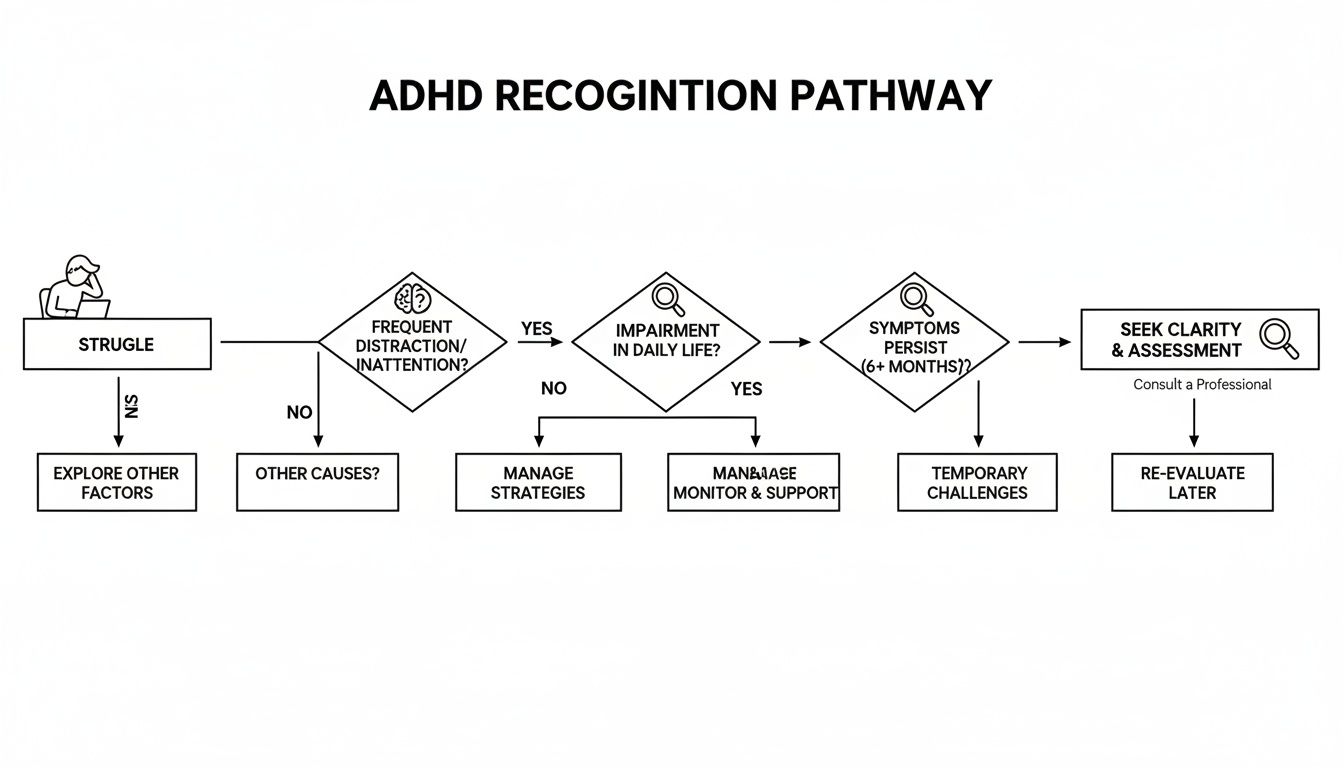
This flowchart really captures that mental pathway, moving from feeling stuck to making that crucial choice about getting assessed.
Navigating the NHS Pathway
For most of us, the GP is the first port of call, and that’s exactly where the NHS process starts. You’ll need to book an appointment, explain your symptoms, and talk through why you think you might have ADHD. If your GP agrees that an assessment is needed, they will refer you to your local adult ADHD service.
Unfortunately, this is often where things grind to a halt. It's no secret that NHS waiting lists for adult ADHD assessments are incredibly long. We’re not talking months; we’re often talking years. The system is just completely overwhelmed, and the demand for help massively outstrips the resources available. It leaves thousands of people in limbo, waiting for the validation and support that a diagnosis can bring, which can worsen their mental health.
There is one potential lifeline in England called 'Right to Choose'. This piece of legislation gives you the right to ask for your referral to be sent to a qualified provider with an NHS contract, even if they aren't in your local area. While it can sometimes speed things up, you're still within the NHS system, and you can still face long waits for follow-up care like medication titration.
The Realities of NHS Waiting Times
The struggle to get an ADHD diagnosis on the NHS isn't just a few bad experiences; it's a systemic problem plagued by a postcode lottery. Millions of adults are thought to have ADHD, but the vast majority remain undiagnosed.
Just look at the numbers. An analysis of NHS data shows that prescription rates—a good proxy for diagnosis rates—can vary by more than three times across different regions. Some areas manage to support almost 20% of their estimated ADHD population, while others only reach 6.1%. A review of 9 million GP records in England found that only 0.32% had a recorded ADHD diagnosis, suggesting as few as one in nine adults who have it have been formally identified.
Considering the Private Assessment Route
This is where the private pathway comes in as a much faster, more direct alternative. Instead of waiting for a GP referral, you can contact a private clinic yourself and book an assessment directly.
This route completely bypasses the NHS queues. Many people find they can get an appointment, be assessed, and receive a diagnosis within a matter of weeks, not years.
The obvious catch is the cost. A private assessment is a significant financial commitment, and it’s vital to understand what you’re paying for. The initial assessment is just the first step. If medication is part of your treatment plan, you’ll also need to cover the costs of the titration process (the period of finding the right medication and dosage) and the private prescriptions. For a full breakdown, have a look at our guide on the cost of an ADHD assessment.
Choosing the private route is often a decision driven by necessity. For many, the mental health impact of waiting years for an NHS appointment is too great, making the speed and certainty of a private diagnosis a worthwhile investment in their wellbeing.
Ultimately, whether you choose the NHS or a private service is a deeply personal decision. You have to weigh the financial cost of going private against the emotional and practical cost of waiting. If your symptoms are seriously affecting your job, your relationships, or your mental health, the speed of the private option might be the most supportive path you can take.
Comparing NHS and Private ADHD Diagnosis Routes in the UK
To help you see the differences at a glance, we've put together a simple comparison of the two main pathways.
| Feature | NHS Pathway | Private Pathway |
|---|---|---|
| Starting Point | GP appointment and referral | Direct contact with a private clinic |
| Waiting Times | Extremely long, often 2-5+ years | Very short, typically a few weeks |
| Initial Cost | Free at the point of use | Significant upfront cost (£700-£2000+) |
| Medication Costs | NHS prescription charges apply | Full cost of private prescriptions and titration fees |
| Choice of Provider | Limited to local service or 'Right to Choose' options | Full choice of any registered private provider |
| Continuity of Care | Can be fragmented due to long waits between stages | Generally seamless, with integrated assessment and treatment |
Deciding which route is best depends entirely on your individual circumstances. If you can afford it and waiting isn't an option, the private route offers a clear and swift path to answers. If not, the NHS pathway is there, but it requires a huge amount of patience.
How to Prepare for Your Adult ADHD Assessment
Getting an ADHD diagnosis in the UK really hinges on good preparation. An assessment isn’t just a casual chat; it's a structured clinical evaluation. The psychiatrist needs to see clear, consistent evidence of your traits, both as they are now and how they were in your past. Walking in prepared does more than just calm your nerves—it helps you paint an accurate picture of your life, which is essential for a reliable outcome.
Think of it like building a case file on yourself. The aim is to gather real, concrete examples that demonstrate how your suspected ADHD traits impact you every single day. Just saying "I'm disorganised" doesn't carry much weight.

Gathering Evidence of Your Current Struggles
Before your appointment, spend some time documenting your current challenges. Don't just try to recall everything on the day. Our brains have a funny way of going blank under pressure, especially when it comes to specific details.
A great tip is to start a note on your phone or keep a small notebook handy. When something happens that feels like an ADHD moment, jot it down. This gives you a real-time log of your experiences.
Here are the kinds of specific examples that are incredibly helpful for a clinician:
- Workplace difficulties: "Last Tuesday, I missed a project deadline because I got completely sidetracked by a minor email and just forgot to finish the main report. My manager had to chase me for it, which was mortifying."
- Relationship strains: "My partner was really upset last night because I'd completely forgotten we’d agreed to book holiday tickets. It's the third time this month I've forgotten something important we talked about."
- Financial impulsivity: "I bought a £200 gadget online last week on a total whim, even though I knew that money was for my car tax. Now I'm scrambling to figure out how to cover that bill."
- Household management: "I have three separate piles of clean laundry on my bedroom floor because I can never, ever seem to get through the final step of folding it and putting it away."
This level of detail gives the clinician a clear window into your world. It transforms your struggles from abstract ideas into tangible, real-life events.
Uncovering Evidence from Your Childhood
A critical part of any ADHD diagnosis is showing that the symptoms have been around since you were a child. This is non-negotiable. ADHD is a neurodevelopmental condition, which means it starts in childhood, even if nobody recognised it at the time.
This can be the most challenging part of your preparation, but it’s absolutely essential. You’ll need to do a bit of digging.
Start by looking for old school reports. Teacher’s comments like "bright but daydreams a lot," "can be disruptive in class," or "rushes work and makes careless mistakes" are gold dust. These objective observations from years ago are invaluable pieces of evidence.
If you can't find any reports, talking to family members can help fill in the gaps. Try asking parents or older siblings open-ended questions:
- "What was I actually like as a kid? Was I always full of energy?"
- "Do you remember me ever getting into trouble at school for not paying attention?"
- "Compared to other kids, was I particularly messy or disorganised?"
Their memories might help you piece together a history you don’t fully recall yourself.
Completing Pre-Assessment Questionnaires Thoughtfully
Most clinics, whether NHS or private, will send you self-report questionnaires to fill out beforehand. A common one is the Adult ADHD Self-Report Scale (ASRS). It's tempting to rush through these, but it's so important to take your time.
Don't just tick the boxes. As you read each question, try to think of a specific time in your life that illustrates that behaviour. When it asks if you "often have difficulty organising tasks and activities," think back to the last time you tried to plan a simple trip or manage a project at work. This reflective approach makes sure your answers are properly grounded in your reality. The whole evaluation is designed to build this complete picture, and to get a better sense of this, it's useful to learn about what a psychiatric assessment involves.
The Value of Collateral Information
While your own perspective is key, getting input from someone who knows you well adds a powerful layer of evidence. This is often called collateral information, and it can come from a partner, a close friend, or a family member.
They see your behaviours from the outside and might notice patterns you're completely oblivious to. For instance, you might not realise just how often you interrupt people in conversation, but your partner definitely will. Ask them to fill out a questionnaire if the clinic provides one, or just sit down and have a chat with them about what they see. Their insights can really strengthen your case and give the clinician a much more rounded view. Putting in this effort beforehand will make you feel far more confident and ready for a productive conversation.
What Happens During the Diagnostic Assessment
The thought of any psychiatric assessment can feel pretty intimidating. I get it. But knowing what’s actually involved can strip away a lot of that anxiety.
Forget any idea of a scary, high-pressure test. This is a structured, collaborative conversation. The specialist’s only goal is to build a complete, three-dimensional picture of you and your life experiences, both past and present.
This is your opportunity to finally tell your story—all of it. The frustrations at work, the challenges in relationships, the little daily struggles that made you start searching for an answer. The clinician is there to listen and connect the dots, not to pass judgement.
The Structured Clinical Interview
The heart of the assessment is a detailed clinical interview. This isn't just a casual chat; it's a careful exploration of your life, designed to map your experiences against the established diagnostic criteria for ADHD. Your psychiatrist will lead the way, but it’s your honest answers that make everything click into place.
You’ll find yourself talking about a whole range of things, such as:
- School and Work Life: How did you get on in school? What did your teachers say about you on reports? We’ll look at how ADHD traits might have shown up in your academic life and how they affect your job performance or career path now.
- Relationships: This covers everything from friendships and family life to romantic partnerships. We might touch on how things like impulsivity or emotional overwhelm play out in your interactions with the people you care about.
- Day-to-Day Life: This is about the practical stuff. The psychiatrist will likely ask how you manage everyday tasks like staying on top of bills, keeping your house in order, or just remembering appointments.
- Your Emotional World: This is a really important part of the puzzle. We’ll explore how you cope with frustration, what your moods are like, and how you manage your overall mental wellbeing.
Using Diagnostic Tools and Rating Scales
To add structure and objectivity, your psychiatrist will use specialised diagnostic tools alongside the interview. These aren’t tests you can pass or fail. Think of them as a framework that ensures every important area is covered properly.
One of the most common tools used for adults in the UK is the DIVA-5 (Diagnostic Interview for ADHD in Adults). It’s a highly structured interview that guides the clinician through each specific ADHD symptom, prompting you for real-world examples from both your childhood and your adult life.
That look back into your childhood is non-negotiable. For a formal diagnosis, there must be clear evidence that symptoms were present before you were 12 years old. This is precisely why digging out old school reports or chatting with your parents beforehand is so valuable—it provides the historical evidence we need to establish a lifelong pattern.
Looking for Co-occurring Conditions
It’s incredibly common for ADHD to show up with company. A good clinician knows this and will actively screen for other conditions during the assessment. This isn’t about collecting labels; it’s about getting the most accurate picture possible so you get the right support for your overall mental health.
A thorough assessment looks at the whole person. It’s vital to explore whether symptoms are purely from ADHD or if they might be influenced by co-occurring conditions like anxiety, depression, or autism. Understanding this interplay is key to effective treatment.
For instance, things like social difficulties or sensory issues can overlap between ADHD and Autism Spectrum Disorder (ASD). An experienced psychiatrist knows how to gently pull these threads apart, asking questions to understand the why behind a behaviour. Do you get overwhelmed in groups because your mind is racing and you can’t follow the conversation (ADHD), or is it because you find unwritten social rules confusing (autism)?
Likewise, the sheer exhaustion of living with undiagnosed ADHD often leads to secondary anxiety or depression. The assessment will explore these feelings to see if they are separate issues or a direct result of the daily ADHD struggle. This holistic approach ensures the final diagnosis truly reflects your needs.
This careful, step-by-step process ensures the final report is a true and accurate reflection of you. It demystifies the whole thing, turning a potentially scary evaluation into a guided journey of self-discovery that can finally bring you the clarity you’ve been looking for.
Making Sense of Your Diagnosis and What Comes Next
Getting your diagnostic report is a big moment. For many, it’s a huge wave of relief and validation, quickly followed by the question, "Okay, what now?" This document isn't just about putting a name to your struggles; it’s a roadmap for understanding yourself better and the first real step towards clarity and better mental health.

A proper diagnostic report goes far beyond a simple yes or no. It should break down the clinical findings, explaining exactly how your history and experiences match up with the diagnostic criteria for ADHD. It’s also common for it to highlight any co-occurring conditions that came up during the assessment, like anxiety or autistic traits. Crucially, it will lay out personalised recommendations, giving you a clear plan for moving forward.
Medical and Non-Medical Support Pathways
After getting your report, your options generally split into two camps: medical treatment and non-medical support. These aren’t an either/or choice—in fact, the most effective plans usually blend both.
Medical support often means medication. If you and your psychiatrist decide this is the right path, you’ll start a process called medication titration.
- What is titration? It’s a careful, methodical process of finding the right medication and the right dose for you. There's no magic pill, so it requires patience and honest feedback with your clinician.
- How long does it take? You can expect it to take several weeks, sometimes a few months, as you carefully track the benefits and any side effects.
- What's the goal? The aim is simple: to find a dose that makes a real difference to your core ADHD symptoms (like focus and impulsivity) while causing the fewest possible side effects.
On the non-medical front, therapy can be a game-changer. Cognitive Behavioural Therapy (CBT) that has been specifically adapted for ADHD is brilliant for building practical strategies to tackle things like procrastination and disorganisation.
Once your diagnosis is confirmed, diving into practical strategies like these Top ADHD Time Management Tips to Boost Productivity can make a massive difference in your day-to-day life.
What If You Don't Get an ADHD Diagnosis?
It’s also entirely possible the assessment concludes you don't meet the full criteria for an ADHD diagnosis. Hearing this can be tough, especially if you felt certain you had it.
A good clinician won't just leave you hanging, though. The assessment process will have still shed light on your specific challenges, and the report should offer alternative explanations or suggest other avenues to explore. Your difficulties are very real; this outcome just means they might be rooted in something else, like a primary anxiety disorder, autism, or another condition that needs a different approach.
A diagnosis is often the key that unlocks better mental health. It brings self-understanding and acceptance, and it opens the door to new, effective ways of managing your life. That clarity is what empowers you to find the right support for your actual needs.
This is all the more important when you look at the bigger picture in the UK. ADHD is still wildly underdiagnosed. A huge study looking at almost 9.6 million GP records found that only 0.32% of people had a recorded ADHD diagnosis—that's just one in 300. Compare that to estimates that ADHD affects around 2.8% of the UK population, and you realise that only about one in nine people with ADHD are likely to have a formal diagnosis. The gap is staggering.
Common Questions About ADHD Diagnosis in the UK
Thinking about getting an ADHD diagnosis often throws up a lot of practical questions. Even when you've decided on a path, it’s normal to feel a bit uncertain about the details. Let's tackle some of the most common queries I hear, so you can feel more confident about taking the next step.
A major worry for many is whether their NHS GP will actually accept a private diagnosis. The straightforward answer is, they don’t have to. While most GPs are cooperative, they aren't obligated to honour a diagnosis from a private clinic, especially if they have doubts about how thorough the assessment was.
This is precisely why choosing the right clinic is so critical. A diagnosis from a reputable, CQC-regulated service with GMC-registered psychiatrists carries significant weight and is far more likely to be accepted and integrated into your NHS care record without any issues.
What Is a Shared Care Agreement?
If you start treatment privately, you'll almost certainly come across the term ‘shared care agreement’. In simple terms, this is a formal arrangement between your private psychiatrist and your NHS GP. The idea is that once your medication type and dose are stable (a process called titration), your GP can agree to take over issuing your repeat prescriptions.
This setup lets you benefit from standard NHS prescription fees, while your specialist continues to handle your annual medication reviews. The catch is that your GP has to agree to it. Some will, but others might refuse, which would mean you'd need to keep paying for private prescriptions.
A shared care agreement is essentially a bridge between private and NHS care, designed to make your ongoing treatment more affordable and manageable. The key to making it work is ensuring good communication between your GP and your private clinician right from the start.
Another common question is about work. Do you have to tell your employer? No, you are under no legal obligation to tell your boss you have ADHD. However, choosing to disclose it can be a game-changer, as it gives you access to ‘reasonable adjustments’ under the Equality Act 2010—support that can make a real difference to how you perform and feel at work.
How Much Does a Private Assessment Cost?
The cost of a private ADHD diagnosis in the UK can vary quite a bit, so it's wise to budget for a significant investment. It's crucial to understand that the initial assessment is just the first part of the bill.
To get a true picture of the total cost, you need to account for:
- The Diagnostic Assessment: This covers the initial in-depth evaluation with the psychiatrist.
- Medication Titration: This is a separate, often lengthy, process to find the right medication and dosage, involving several follow-up appointments.
- Private Prescriptions: You’ll also need to cover the cost of the medication itself during the titration period.
Before you commit to any clinic, always ask for a complete, transparent breakdown of all potential costs. A good provider will be upfront about the entire financial journey, from that first consultation to getting you settled on a stable treatment plan. Remember, a diagnosis is far more than a label; it’s the key to finally understanding yourself and getting the right support.
At Insight Diagnostics Global, we provide clear, consultant-led online assessments for adults, ensuring you receive a thorough evaluation from experienced psychiatrists. If you're ready to find clarity and explore your options for getting an ADHD diagnosis in the UK, we're here to help. Find out more about our CQC-regulated services.