
If you’re wondering how long it takes to get an ADHD diagnosis in the UK, the honest answer is: it varies enormously. The timeline can stretch from just a few weeks to, in some cases, several years. It all depends on the route you take.
Navigating this process, especially when you might be dealing with co-occurring conditions like autism, can feel overwhelming. That uncertainty alone can weigh heavily on your mental health, which is why getting a clear picture of what to expect is so important.
Navigating UK ADHD Diagnosis Timelines
Embarking on the journey to get an adult ADHD diagnosis can feel like a huge step, but understanding the timeline can give you back a sense of control. The single biggest factor that will shape your experience is whether you go through the National Health Service (NHS) or choose a private provider.
While the NHS is an incredible resource, it's no secret that it’s under immense pressure, and waiting lists for specialist services like ADHD and autism assessments have grown incredibly long.
This visual timeline gives you a stark, at-a-glance comparison of the waiting times you can expect after getting a referral from your GP.
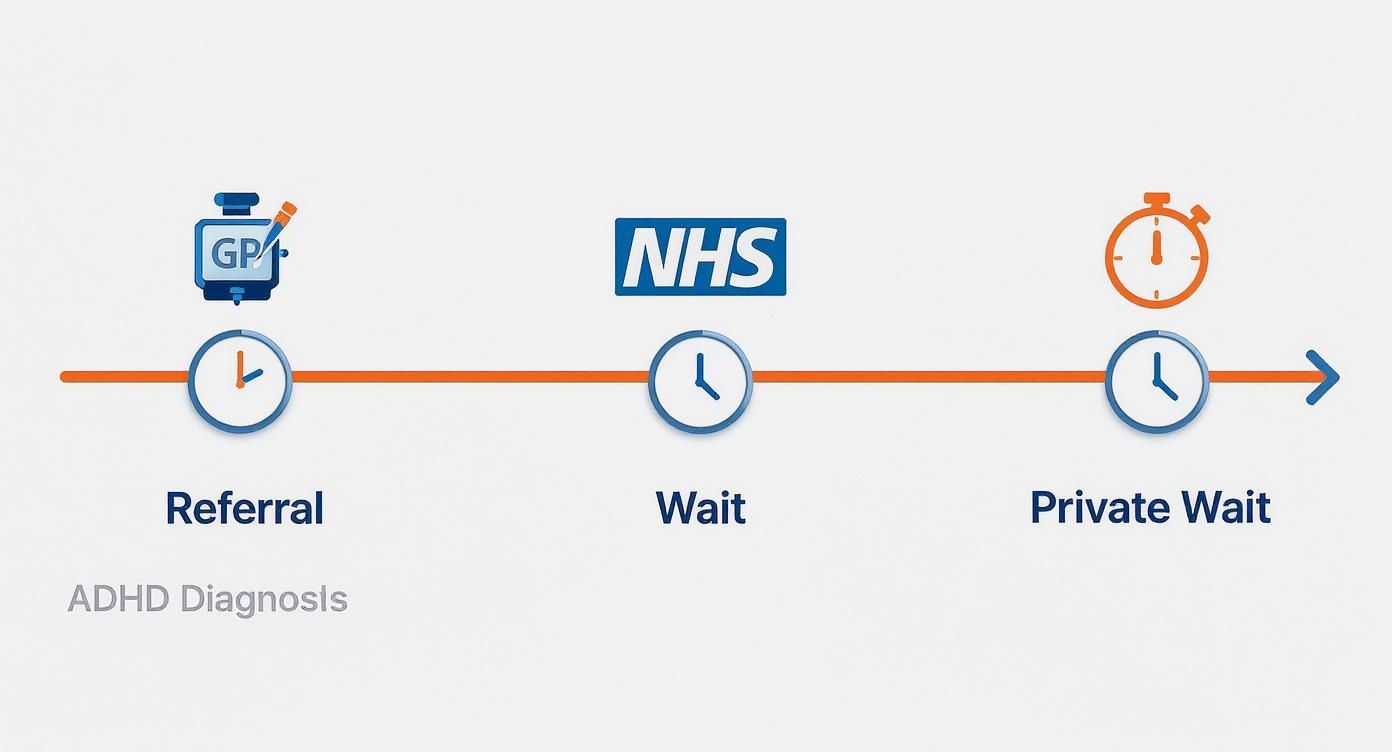
As you can see, both pathways begin with that crucial GP visit. But it's in the next step—the wait for an actual assessment—where the timelines diverge dramatically.
The Reality of Current Waiting Lists
Let's be blunt: the situation for ADHD diagnosis in the UK right now is tough. Guidelines from the National Institute for Health and Care Excellence (NICE) state that the maximum wait from referral to assessment should be 13 weeks.
The reality is a world away from that. As of September 2023, a mere 6.4% of patients were actually seen within that recommended window. Worse still, 24% of people are left waiting for one to two years, and another 10% are waiting as long as three years. It's a systemic issue that leaves many people in limbo.
Why Timelines Matter for Mental Health
This isn't just about ticking a box. A prolonged wait is far more than an inconvenience; it can have a genuinely damaging effect on your mental wellbeing. Living with the symptoms of suspected ADHD, often alongside other conditions like autism or anxiety, without a diagnosis fuels a cycle of frustration, self-doubt, and poor mental health. You can read more about what's involved and how long ADHD testing takes to understand all the factors at play.
Gaining clarity through a formal diagnosis is often the first step toward self-understanding and accessing the right support. It validates personal experiences and opens the door to effective strategies for managing symptoms, which is why a timely assessment is so important for overall mental health.
Taking the time to explore your options for an ADHD diagnosis in the UK is the best way to decide which path is right for you, your timeline, and your personal circumstances.
ADHD Diagnosis Timelines at a Glance
To make things clearer, here’s a simple breakdown of what to expect from the different routes available for an ADHD assessment in the UK.
| Pathway | Typical Wait Time for Assessment | Key Consideration |
|---|---|---|
| NHS | 1–5 years | Free at the point of use, but waiting lists are extremely long. |
| Private Clinic | 2–6 months | Faster access but involves out-of-pocket costs. |
| Online Provider | 4–12 weeks | Often the quickest route, offering convenience and speed. |
This table highlights the significant trade-off between cost and speed. While the NHS provides an essential service without charge, the private and online routes offer a much faster path to getting the answers and support you need for your mental health.
The Step-by-Step ADHD Assessment Process

Getting an ADHD diagnosis isn’t just about waiting times; it’s about understanding the journey ahead. The process is much more than a single appointment. It’s a structured evaluation designed to build a complete and honest picture of your life, both now and in the past. This thorough approach is crucial for an accurate diagnosis, especially as other conditions like autism can sometimes present with similar traits.
Knowing what’s coming at each stage can really help ease the anxiety of it all. So, let’s break down what actually happens, from that first referral to getting your final report.
Stage 1: The Initial Referral and Triage
For most people, the first port of call is their GP. This is where you’ll have an initial chat about your symptoms and the real-world impact they're having on your life. If your GP suspects ADHD, they'll refer you to a specialist mental health service, either within the NHS or a private provider of your choice. It's important to mention if you also suspect other conditions, such as autism, at this stage.
Once your referral lands, it goes into a process called triage. This is where a clinical team reviews your information to make sure you’re on the right path and to prioritise your case based on urgency. Think of it as a gatekeeping step to ensure you get to the right specialist from the get-go.
Stage 2: The Comprehensive Clinical Assessment
This is the heart of the diagnostic process. Forget a quick chat; this is a detailed clinical interview that can last anywhere from one to three hours. A psychiatrist or another qualified specialist will lead a conversation that covers a lot of ground.
To keep a precise record of these detailed discussions, many clinics now use professional medical healthcare transcription to accurately document the interview. This ensures nothing important gets missed.
You should be prepared to talk about:
- Your childhood: This includes your developmental history, what you were like at school, and any early signs of hyperactivity, inattention, or social communication differences.
- Your adult life: How are your symptoms affecting you now at work, in your relationships, and with day-to-day tasks?
- Your mental health history: A frank discussion about any other challenges, like anxiety, depression, or traits of autism, which often go hand-in-hand with ADHD.
- Your symptom patterns: The clinician will want to know when your symptoms are at their worst and what strategies you’ve developed to cope.
Stage 3: Gathering Collateral Information
One of the key criteria for an ADHD diagnosis is having evidence of symptoms before the age of 12. To piece this together, clinicians need what’s called collateral information—basically, evidence from other people or records that can offer a more objective viewpoint.
Collateral information is like a historical record. It helps the clinician spot patterns from another perspective, backing up your own memories and creating a much stronger foundation for a reliable diagnosis of ADHD and any related conditions.
This supporting evidence is incredibly important. It could be old school reports with teachers’ comments about your concentration, or it might be questionnaires filled out by a parent, your partner, or a close friend who knows you well. This step adds a vital layer of depth and credibility to the final outcome.
Why NHS Wait Times Are So Challenging
If you're stuck in the queue for an NHS ADHD assessment, you know how frustrating and demoralising it can feel. You’re not alone. The system is currently caught in a perfect storm of issues that have pushed waiting lists to a breaking point, leaving thousands of adults feeling invisible and unsupported.
Knowing why the delays are so long doesn't magically shorten the wait, but it does help put things into perspective. It can shift the feeling from a personal struggle to an understanding of the immense pressures on the NHS. This context is vital, especially if you're also dealing with other potential conditions like autism, where getting answers sooner rather than later can make a huge difference to your mental health.
The Soaring Demand for Assessments
Over the last few years, public awareness of adult ADHD and autism has exploded. People are finally talking about neurodiversity, and more and more adults are recognising the signs in themselves and seeking help. While this is a fantastic step forward, it has created a tidal wave of referrals that the NHS simply wasn't built to handle.
The number of people asking for an assessment has skyrocketed, completely overwhelming the available services. Think of it like a quiet country lane suddenly being turned into a motorway during rush hour – the infrastructure just can't cope. Every new referral joins a queue that, in many parts of the country, is already years long.
The bottom line is that services for adult ADHD and other neurodevelopmental conditions are struggling to keep up. More awareness is essential, but without a matching increase in funding and staff, these long, painful waits are the inevitable result.
This means that even a straightforward ADHD assessment in the UK through the NHS can turn into a marathon of waiting, holding you back from the support and treatment you need for your mental health.
Underfunding and Staffing Shortages
At the heart of the problem are two stubborn issues that go hand-in-hand: a history of underfunding mental health services and a severe shortage of qualified specialists. For decades, mental health hasn't been given the same priority as physical health, and neurodevelopmental conditions like ADHD and autism have often been pushed even further down the list.
This lack of investment means fewer clinics, outdated resources, and—most critically—not enough psychiatrists and clinical psychologists to carry out the assessments. The specialists who are in the system are often juggling impossible caseloads, which makes hitting the three-month waiting time recommended by NICE a near-impossible task.
The Postcode Lottery Phenomenon
Perhaps the most unfair part of the NHS wait is the "postcode lottery." How long you wait for an ADHD diagnosis can change dramatically simply based on where you live. The differences are staggering, ranging from a few months in some areas to several years—or even over a decade—in others.
For example, the wait for an adult assessment can be just 12 weeks in one NHS Trust, while in another, it’s a mind-boggling 550 weeks (that's over ten years). With an estimated 131,000 people currently on the waiting list for an ADHD assessment across the UK, this geographic lottery feels deeply unfair. You can discover more about these regional ADHD wait time differences and see how it affects people. It adds another layer of stress to an already difficult mental health journey.
What About Going Private for an ADHD Diagnosis?

For a lot of adults, the thought of waiting years on an NHS list is a non-starter. That kind of prolonged uncertainty can take a real toll on your mental health and leaves you without the support you need right now. This is precisely why many people look towards private and online consultant-led services as a much faster, more direct alternative.
Choosing to go private can slash the time it takes to get an ADHD diagnosis from several years down to just a few weeks or months. It puts you in the driver's seat. You can self-refer, which means you get to skip the initial GP appointment and the NHS triage process altogether.
Instead of being just another name on a massive waiting list, you can book an assessment directly with a qualified specialist at a time that actually suits your schedule. From that first enquiry to holding a full diagnostic report in your hands, the whole journey is just significantly quicker.
Your Journey with a Private Provider
The private process is built for clarity and efficiency. It’s a straightforward path designed to get you answers without the bureaucratic hurdles.
A typical private assessment usually looks something like this:
- Initial Forms & Triage: You'll start by filling out pre-assessment forms and questionnaires online. A clinical team then checks these over to make sure they have all the info they need to proceed.
- The Clinical Interview: Next, you'll have a detailed virtual assessment with a consultant psychiatrist. This usually lasts between one and two hours.
- Your Diagnostic Report: After your assessment, the clinician writes up a comprehensive report. This document will detail their findings, confirm the diagnosis, and provide personalised recommendations for what to do next.
At Insight Diagnostics Global, for instance, we can typically schedule your assessment within seven working days of you completing the initial forms. Your final report is then usually ready within another five working days. This kind of speed is a massive draw for people who need clarity for their mental health sooner rather than later.
Choosing a private provider is an investment in your own peace of mind. It gives you back control over your health journey, allowing you to get answers quickly, which can make a world of difference to your wellbeing.
Comparing NHS vs Private ADHD Diagnosis
To make sense of the different routes, it helps to see them side-by-side. Both pathways have their place, but they offer very different experiences when it comes to time, cost, and the overall process.
| Feature | NHS Pathway | Private Pathway |
|---|---|---|
| Referral Process | Requires a GP referral, which can sometimes be difficult to secure. | Self-referral is standard; you contact the provider directly. |
| Waiting Times | Extremely long, often ranging from 2 to 7 years for an assessment. | Very short, typically a few weeks to a couple of months from enquiry to diagnosis. |
| Cost | Free at the point of service. | Involves a significant upfront cost for the assessment, report, and initial medication titration. |
| Choice of Clinician | You are assigned to the next available specialist within your local trust. | You can research and choose your preferred clinic or consultant. |
| Flexibility | Appointments are often rigid and during standard working hours. | Appointments are more flexible, often including evenings or weekends. |
| Post-Diagnosis Care | Medication and follow-ups are covered by the NHS once you reach the top of the treatment list. | Medication is paid for privately until a 'shared care agreement' with your GP is established. |
This table highlights the fundamental trade-off: the NHS route is free but incredibly slow, while the private route offers speed and control at a financial cost, which for many is a necessary investment in their mental health.
Key Questions to Ask Any Private Provider
If you decide the private route is for you, it's absolutely vital to do your homework. Speed should never come at the expense of quality. Before you commit your time and money, there are a few non-negotiable details you need to confirm.
First and foremost, ask if the clinician who will be diagnosing you is on the GMC Specialist Register. This is your guarantee that they hold the right qualifications to give a diagnosis that will be recognised and respected by other healthcare professionals. It’s also a good idea to check if the provider is regulated by an official body, like the Care Quality Commission (CQC) in England.
Finally, and this one is crucial for your long-term planning, talk to your own GP about a potential ‘shared care agreement’. This is an arrangement where your GP agrees to take over prescribing your ADHD medication on the NHS after you've been diagnosed and your treatment has been stabilised by the private specialist. Not all GPs agree to this, so having that conversation early can save you a lot of money and hassle down the line.
If you’re still weighing your options, taking our online ADHD test can be a great first step to gather more personal insight before you decide.
Factors That Influence Your Diagnosis Timeline
While the path you choose—NHS or private—is the biggest factor affecting your wait for an ADHD diagnosis, it’s far from the only one. A few other things can either put a spring in your step or add frustrating delays to the journey. Knowing what they are can help you feel a bit more in control and better prepared for what's ahead.
Honestly, being proactive is one of the most powerful things you can do here. The more organised you are from the get-go, the smoother the whole process will be. Think of it like packing for a holiday; having everything ready before you leave saves a frantic last-minute scramble. This means gathering any documents that can help paint a clearer picture for your clinician.
Preparing for Your Assessment
Your ability to pull together good background information can really speed things up. Clinicians need to see evidence that your symptoms have been around since childhood, and having this ready can prevent a lot of time-wasting back and forth.
Here are a few key things worth digging out:
- Old school reports: You're looking for those classic teacher comments – "daydreamy," "disruptive," or "not reaching their potential." These are gold dust.
- Detailed symptom logs: Start keeping a journal of your current struggles. Note specific examples of how they affect your work, relationships, and day-to-day life.
- Personal history: Try to jot down a rough timeline of your life, highlighting key moments or challenges where you now suspect ADHD was playing a part.
Having this information ready doesn’t just save time; it builds a much stronger case. It gives the clinician a rich, detailed history to work from, which makes the whole diagnostic process more accurate and efficient.
Navigating Potential Delays
Unfortunately, some delays are simply out of your hands, but knowing they might happen can at least help manage your expectations. A common tripwire is an incomplete or vague GP referral form. If it’s not detailed enough, it can get rejected at the triage stage, sending you right back to the beginning.
The presence of co-occurring conditions is another major factor. Things like autism, anxiety, or depression often have symptoms that overlap with ADHD, which complicates the diagnostic picture. A clinician will need to take extra time and care to unpick which symptom belongs to which condition. This isn't a setback, though—it’s a crucial step to make sure you get a diagnosis that truly reflects and addresses all of your mental health needs.
The Real Cost of a Delayed Diagnosis
Waiting for an ADHD diagnosis isn’t just about ticking off days on a calendar. It's a deeply personal and often painful period of uncertainty, and it takes a genuine toll on your mental health.
When you’re living with undiagnosed ADHD, possibly alongside autism, you can spend years wrestling with confusion and self-blame. It’s common for adults to see their struggles with focus, organisation, and emotional control as character flaws, not as symptoms of a neurodevelopmental condition. You start to believe you’re lazy, or just not trying hard enough.
This constant internal battle can quietly chip away at your self-worth, put a huge strain on your relationships, and bring your career to a grinding halt. When you don’t have the right words to explain what’s going on, it’s easy to feel like you’re constantly failing everyone, including yourself. The sheer frustration of this experience can easily spiral into anxiety, depression, and total burnout.
Just How Many People Are Waiting?
The problem is bigger than most people realise. The official rate of ADHD diagnosis in the UK is shockingly low. One major study that looked at over 9 million GP records found that only 0.32% of the population had a formal ADHD diagnosis.
What does that actually mean? It means only about 1 in 9 people who likely have the condition have been identified. That leaves more than two million adults in the UK trying to navigate life without any support – a silent public health crisis hiding in plain sight. If you want to dig deeper into the numbers, you can read more about these ADHD diagnosis statistics.
This is why getting a diagnosis in a reasonable timeframe is so critical. It’s about so much more than just getting a label or a prescription.
A diagnosis is a moment of profound validation. It finally gives a name to a lifetime of invisible struggles, allowing you to replace self-criticism with self-understanding and see a clear path forward for your mental health.
This shift in perspective is the first real step towards building better coping strategies. It lets you reframe your past experiences through a new lens and start building a future with more compassion for yourself. That’s why the long wait isn't just an inconvenience; it's a real barrier to a person's wellbeing.
Common Questions About the ADHD Diagnosis Process

It’s completely normal to have a lot of questions when you’re thinking about an ADHD assessment. Getting clear, straightforward answers can make a huge difference, helping you feel more in control as you move forward.
This final section tackles some of the most frequent queries we hear, zeroing in on the practical side of the assessment and what you should really expect for your mental health.
What If I Suspect Both Autism and ADHD?
This is a really common scenario. If you feel that you might have traits of both Autism and ADHD (sometimes called AuDHD), it's crucial to find a clinician who has specific experience in assessing co-occurring conditions. A specialist will know how to carefully untangle the overlapping symptoms to get a clear picture, which is essential for an accurate diagnosis and a holistic mental health plan.
When you first talk to your GP or a private provider, be sure to mention both possibilities right from the start. This helps ensure you're pointed toward an expert who can handle the complexity of a combined assessment.
Is an Online Diagnosis as Valid as In-Person?
Absolutely. An online diagnosis is just as valid as a face-to-face one, with one big condition: it must be conducted by a qualified, GMC-registered psychiatrist or specialist who follows the official NICE guidelines.
The most important thing is the provider's credibility. A properly regulated service means the diagnosis will be recognised by your GP, which is vital if you need a shared care agreement for medication down the line. We’ve covered more of these kinds of questions in our full list of ADHD FAQs.
At Insight Diagnostics Global, we provide clear, consultant-led online assessments that meet the highest clinical standards. We're here to help you get the answers you need without the long waits. Find out more about our CQC-regulated services at https://insightdiagnostics.co.uk.