
If you're an adult in the UK wondering if you have ADHD, the first step is usually either speaking to your GP for an NHS referral or contacting a CQC-regulated private clinic directly. Whichever route you choose, the core of the process is a detailed clinical interview with a specialist, like a psychiatrist, who will explore your symptoms and history using established diagnostic criteria. Pulling together things like old school reports or keeping a symptom diary can be a massive help.
Suspecting ADHD as an Adult: What to Look For
If you're reading this, chances are you've wondered if your lifelong struggles might be explained by ADHD. It's a valid thought, and you're certainly not alone. The stereotypical image of a hyperactive little boy just doesn't fit the reality for millions of adults, particularly women, whose symptoms have often been misunderstood or missed entirely.
For many adults, the signs are less about bouncing off the walls and more about an internal sense of chaos. It could be that constant feeling of being overwhelmed by everyday tasks, a mind that never seems to switch off, or a real battle to juggle priorities at work and home. Another common experience is intense emotional dysregulation, sometimes called "rejection sensitivity," where even mild criticism can feel crushing, taking a toll on your relationships and self-worth.
Beyond the Stereotypes
Adult ADHD often presents very differently from the way it does in children. Instead of obvious disruptive behaviour, you might be dealing with things like:
- Chronic Disorganisation: Despite trying countless planners and productivity hacks, your life feels like a constant struggle against clutter, missed deadlines, and poor time management.
- Emotional Intensity: You might have a short fuse, experience rapid mood swings, or just feel easily frustrated and emotionally drained by small setbacks.
- Difficulty with Focus: Maybe you find yourself zoning out in meetings, losing the thread of conversations, or having to re-read the same paragraph over and over again.
If you consistently grapple with planning, organising your thoughts, or managing your time, these could be signs of underlying challenges with executive function, which is a cornerstone of the ADHD experience. For a more structured look, our https://insightdiagnostics.co.uk/adult-adhd-symptoms-checklist/ can help you pinpoint specific symptoms.
The Scale of Underdiagnosis in the UK
These feelings are incredibly widespread, yet there's a huge gap between the number of people who suspect they have ADHD and those who actually get a formal diagnosis. It's estimated that 2.5 million people in England alone are living with ADHD.
Worryingly, while one in twenty adults believe they have the condition, only a small fraction have ever been professionally diagnosed. This highlights a massive, unmet need for accessible assessment services across the country.
Getting an assessment isn't just about getting a label. It's about finally getting answers and understanding yourself. It’s the first real step towards finding the right support, making sense of past struggles, and ultimately improving your quality of life and overall mental health.
Choosing Your Path: NHS vs Private ADHD Assessments
So, you've decided to explore an ADHD assessment. This is a big step, and now you're facing one of the first major decisions in the UK: which path should you take? The two main routes are through the National Health Service (NHS) or by going to a private clinic.
Both pathways can get you a formal diagnosis and the support you need, but they're worlds apart when it comes to speed, cost, and the overall process. Getting your head around these differences is key to making a choice that feels right for you, your finances, and your mental health needs.
This visual guide breaks down the initial steps you'll face when deciding between an NHS or private assessment.
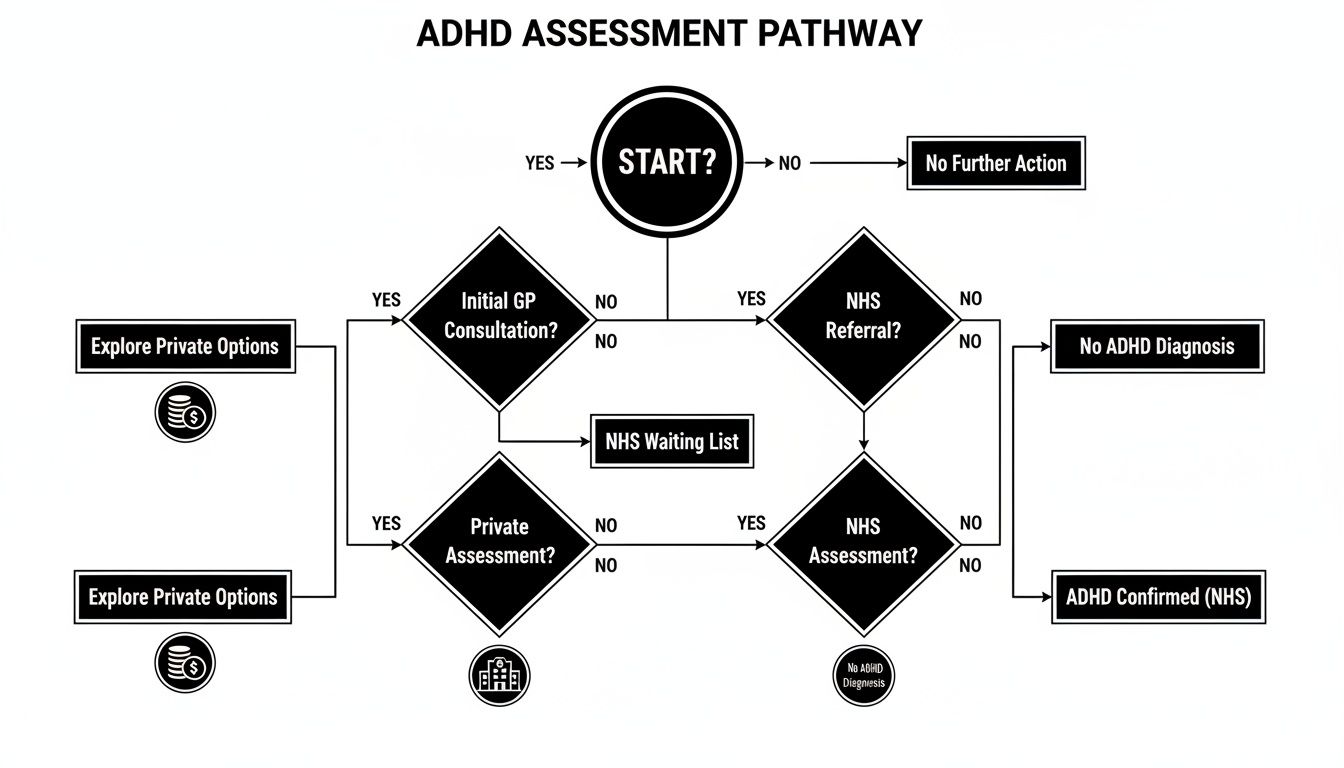
As you can see, the NHS journey always starts with your GP, whereas the private option lets you go straight to a specialist clinic. This is one of the biggest factors affecting how long you'll be waiting.
To make this decision easier, let's compare the two pathways side-by-side.
Comparing NHS and Private ADHD Assessment Pathways
| Feature | NHS Pathway | Private Pathway |
|---|---|---|
| Cost | Free at the point of use | Self-funded, typically £700-£2000+ |
| Waiting Time | Extremely long, often 1-5+ years | Very short, usually 2-12 weeks |
| Referral Process | GP referral is mandatory | Self-referral is the norm |
| Choice of Specialist | Limited; assigned by the local trust | You choose the clinic and consultant |
| Flexibility | Less flexible; follows set local protocols | More flexible; online options are common |
| Medication Costs | Standard NHS prescription charges | Private prescription costs, which are higher |
Ultimately, the right path depends on your personal circumstances. If cost is the primary concern and you can manage a long wait, the NHS is a solid option. However, if getting answers quickly is your priority and you have the financial means, the private route offers a much faster and more direct solution.
The NHS Pathway: A Test of Patience
The traditional route to an ADHD assessment kicks off with a visit to your GP. You'll need to book an appointment to chat through your symptoms and explain why you think you might have ADHD. Your doctor will probably ask you to fill out a screening questionnaire before referring you to a specialist mental health service.
While this pathway won't cost you anything, its biggest hurdle is the waiting time. The demand for adult ADHD assessments on the NHS has skyrocketed, creating unbelievably long waiting lists that can stretch from months to, in some areas, several years. That long wait can be incredibly tough when you're struggling and need help now.
The sheer scale of the problem is massive. A recent NHS England update revealed that over 549,000 people were waiting for an evaluation for conditions like ADHD or Autism. With an estimated 3 million people in the UK potentially having ADHD, it’s clear the system is under immense pressure.
The Private Pathway: Speed and Specialist Choice
For those who are in a position to pay, a private assessment is a much, much faster alternative. You can simply contact a private clinic directly and book yourself in, completely bypassing the need for a GP appointment to get started. This route puts you firmly in control of who you see and when.
Here are the main benefits of going private:
- Shorter Waiting Times: You can often be seen within a few weeks, not years.
- Choice of Specialist: You can research and pick a psychiatrist or clinic that specialises in adult ADHD, or even co-occurring conditions like autism.
- Convenience: Many private clinics now offer assessments online, which makes the whole process much more accessible, no matter where you live.
Of course, the main drawback is the cost, which is a significant investment. For many people, though, the value of getting a swift diagnosis and starting treatment without an agonisingly long wait makes it a price worth paying for their mental health.
Right to Choose: A Hybrid Option
For adults in England, there's a third way known as Right to Choose. This NHS scheme allows you to pick a qualified private provider for your assessment, but the NHS foots the bill. It can be a fantastic middle ground, giving you the speed of the private sector without the personal expense.
To use Right to Choose, you still need a referral from your GP. The trick is to find a private provider that accepts NHS funding under this scheme and then ask your GP to refer you to them specifically.
This option can slash waiting times compared to the standard NHS route. However, not all private providers are part of the scheme, and you might have to navigate a bit of admin to get it sorted.
To get a better understanding of how this works, you might find our detailed breakdown on getting an ADHD diagnosis in the UK really helpful. It’s crucial to pick a provider regulated by the CQC to ensure you receive high-quality care and get a diagnosis your GP will be happy to accept for any future shared care agreements.
How to Prepare for Your ADHD Assessment
A good ADHD assessment isn't about passing a test. It's about giving the psychiatrist a clear, honest window into your world so they can make an accurate diagnosis. The key is to communicate your life experiences effectively. Feeling prepared can transform anxiety into confidence, helping you advocate for yourself.

This groundwork has never been more important. Here in the UK, demand for ADHD assessments has skyrocketed, with prescriptions for ADHD medication jumping by 18% every year since COVID. Despite this, adult diagnosis rates are lagging; only an estimated 15.6% of adults with ADHD are diagnosed, compared to 26.6% of children. You can read more about these ADHD incidence rates, but the takeaway is clear: presenting solid evidence helps close that diagnostic gap.
Gathering Your Life's Evidence
Think of this part as becoming a historian of your own life. You’re hunting for evidence that shows a consistent pattern of traits, stretching all the way back to childhood. A clinician needs to see that your struggles aren't a recent development but have been a persistent feature for years.
Start digging out any documents you can get your hands on. This is about finding tangible proof to back up your own account.
- School Reports: These are absolute gold. Look for those recurring teacher comments: "doesn't live up to potential," "is easily distracted," "very chatty," or "disorganised."
- Employment Records: Performance reviews, notes from disciplinary meetings, or even old emails about missed deadlines can paint a powerful picture of your challenges in the workplace.
- Medical History: Collect any notes from past GP or therapy appointments where you brought up issues like anxiety, depression, or feeling constantly overwhelmed. These conditions often go hand-in-hand with ADHD and Autism.
Remember, the clinician is looking for patterns. One bad school report isn't enough, but a collection showing the same themes from primary school through to your last job tells a compelling story. This evidence helps them see your struggles are persistent and pervasive.
Documenting Your Symptoms and Their Impact
Historical documents are one piece of the puzzle, but your present-day experiences are just as crucial. It’s not enough to simply say, "I'm disorganised." You need to give concrete, real-world examples of how this disorganisation actually affects your life.
Keeping a "symptom diary" for a few weeks before your assessment can be a game-changer. Jot down specific instances where you feel your suspected ADHD is causing real problems.
A quick example of a log entry:
- Date: 25th October
- Symptom: Time Blindness / Poor Planning
- Situation: I was supposed to leave for a 10 am work meeting. I totally misjudged how long getting ready and finding my keys would take.
- Impact: I showed up 20 minutes late, missed the intro, and felt completely embarrassed and unprofessional in front of my manager. This sort of thing happens at least twice a week.
This kind of detail helps a clinician see the functional impairment your symptoms cause, which is a core part of the diagnostic criteria for both ADHD and Autism. It connects the dots between a trait and its real-world consequences.
Completing Pre-Assessment Questionnaires
Most clinics will send you screening questionnaires to fill out before you even have your appointment. The most common one for adults is the Adult ADHD Self-Report Scale (ASRS). Take your time with these.
Don't just rush through them ticking boxes. Use your symptom diary and the evidence you've gathered to inform your answers. It can also be incredibly helpful to ask a partner, a close friend, or a parent to look over your responses. They might remember examples or patterns that you’ve completely forgotten.
Many assessments also need an "informant" questionnaire filled out by someone who knows you well. Choose this person wisely. The best informant is often someone who has known you for a very long time, like a parent or an older sibling, who can give insight into both your childhood behaviours and your current struggles.
By organising your evidence, tracking your daily challenges, and thoughtfully completing these forms, you walk into your consultation armed with the information needed for a truly productive conversation. It’s the best way to ensure you can tell your story clearly and finally get the answers you deserve.
What Happens During the ADHD Assessment
Knowing what to expect during your ADHD assessment can make a world of difference. It helps turn what can feel like a daunting process into a straightforward, collaborative conversation. Think of it less like an exam you can pass or fail, and more like a structured discussion designed to build a complete picture of you. It's a chance for a specialist to truly understand your unique brain wiring and how it has shaped your life.
The whole evaluation is designed to be thorough. While it might feel a bit intense to recount your life story, this depth is precisely what leads to an accurate diagnosis and, most importantly, helpful support for your overall mental health.

These days, many assessments are done online, which is often far more convenient and comfortable. A typical comprehensive assessment usually lasts somewhere between 90 minutes and two hours, though this can vary. Being in your own familiar space can really help you relax and speak openly.
The Core of the Assessment: The Clinical Interview
The heart of your assessment is a deep-dive interview with a consultant psychiatrist. They will guide you through your life story, piecing together the connections between your past experiences and your current struggles. This isn’t just a casual chat; it’s a clinical process based on established diagnostic criteria, like those in the DSM-5.
Your psychiatrist will want to explore a few key areas of your life:
- Developmental and Childhood History: You’ll be asked about your early years. Think back to your school days, friendships, and any comments teachers made on your reports. Evidence of symptoms before the age of 12 is a crucial part of the diagnostic criteria.
- Academic and Employment History: You’ll talk through your career path, job performance, and any patterns you’ve noticed—like frequently changing jobs, constantly battling deadlines, or having friction in workplace relationships.
- Current Symptoms and Functional Impairment: This is where you get into the nitty-gritty of your day-to-day challenges. How do symptoms like inattention, hyperactivity, or impulsivity actually impact your work, home life, and relationships right now?
- Mental Health and Family History: The psychiatrist will also screen for other conditions. ADHD often travels with friends like anxiety, depression, or mood disorders, so it's vital to get the full picture. They may also explore whether you have traits associated with autism, as there's a significant overlap between the two.
The goal here is to establish a clear, lifelong pattern. The psychiatrist is looking for consistent evidence that your traits aren’t a recent development but have been a part of you across different settings and stages of your life, stretching back to childhood.
The Role of Informant Information
Your perspective is essential, but it isn’t the only piece of the puzzle. To get a truly objective view, the psychiatrist will almost always need information from someone who knows you well. This is often called informant evidence.
This usually comes from a parent, an older sibling, or a long-term partner who can offer an outside perspective on your behaviours, both past and present. They’ll typically be asked to fill out a questionnaire about their observations. This helps to corroborate your own account and can even highlight traits you might not have realised were there.
For instance, a parent might remember specific teacher comments from your primary school reports that you've long forgotten. A partner could describe how your distractibility affects daily chores or makes it hard to finish a conversation. This kind of information is invaluable for building a robust and reliable diagnostic picture. For a first-hand account, reading a personal perspective on navigating ADHD assessments can be incredibly insightful.
Ultimately, the assessment is a fact-finding mission. By combining your personal story, historical evidence, and feedback from someone who knows you well, the psychiatrist can piece everything together. Understanding in detail how ADHD is tested can demystify the steps even further, making sure you feel prepared for a process that is, above all else, about gaining clarity and finding the right way forward for you.
What to Do After Your Diagnosis
Getting an ADHD diagnosis can feel like a huge moment. For many, it's a mix of overwhelming relief, a sense of validation, and maybe a little bit of "Okay… what now?" It’s important to remember this isn't the finish line. It's the starting block for a new way of understanding yourself and accessing support that actually works with your brain.
The first thing you'll get is your diagnostic report. Don't just file it away. This document is more than a label; it’s a detailed blueprint of your unique neurotype, especially if it's from a CQC-regulated clinic. A good report breaks down your symptoms, history, and how they impact your day-to-day life. Most importantly, it will lay out personalised recommendations—your roadmap for what to do next.
Think of this report as your key. It unlocks the door to medication, therapy, workplace adjustments, and a better understanding of your overall mental health.
Getting Started with Medication: The Titration Process
For a lot of adults with ADHD, medication can be a game-changer. It’s not a cure, but it can be an incredibly powerful tool for sharpening focus, dialling down impulsivity, and getting a handle on emotional dysregulation. The journey to finding the right medication starts with a process called titration.
Titration is simply a careful, collaborative process where you and your psychiatrist find the right medication and dose for you. It's definitely not a one-size-fits-all deal. Your psychiatrist will start you on a very low dose, which you'll slowly increase over several weeks.
Throughout this period, you’ll have regular check-ins to monitor a few key things:
- Is it working? Are you noticing any positive shifts in your focus or mood?
- Any side effects? How’s your sleep? Your appetite? We're looking for any unwelcome changes.
- Your overall health: You’ll keep an eye on things like your blood pressure and heart rate to make sure everything is ticking along nicely.
This slow-and-steady approach ensures you land on a dose that gives you the best results with the fewest possible side effects. It requires a bit of patience, but getting it right from the start is absolutely crucial for long-term success.
More Than Just Medication: Finding the Right Therapy
While medication handles the neurochemical side of things, it’s most effective when paired with other types of support. Therapy and coaching give you the practical skills and coping strategies for the challenges that pills alone can't fix.
Cognitive Behavioural Therapy (CBT), specifically adapted for ADHD, is one of the most effective options out there. This isn’t the standard CBT for anxiety; it’s designed to tackle the executive function struggles at the heart of ADHD. It gives you real-world strategies for:
- Getting organised and managing your time.
- Breaking down massive, scary tasks into small, doable steps.
- Handling intense emotions and the sting of rejection sensitivity.
- Building self-esteem by challenging those old negative thought patterns.
ADHD coaching is another fantastic tool. A coach is more like a supportive partner in crime. They help you set achievable goals, build routines that stick, and figure out how to get around the daily obstacles that trip you up. It’s less about digging into the past and more about building momentum for the future.
The best treatment plans are rarely just one thing. Combining medication for the biology with therapy or coaching for the behaviour gives you a comprehensive toolkit to create real, lasting change.
Navigating ADHD and Other Traits
It's really common for ADHD to show up with friends, especially Autism Spectrum Disorder (ASD). Research shows a huge overlap, and many people have traits of both. Acknowledging this is absolutely vital if you want a support plan that truly fits you.
If you're navigating both ADHD and autistic traits, you might find that some of the classic ADHD advice just doesn't land. For instance, the ADHD brain's craving for novelty can clash directly with the autistic brain's need for a predictable routine. A skilled clinician will help you see how these traits interact and find a balance that honours your entire neurotype, rather than trying to fix one part in a way that makes another part worse.
This support extends to other areas of your life, too. Your diagnosis is often the key to getting reasonable adjustments at work. Understanding your rights can completely change your professional life for the better. To get a head start, you can learn more about reasonable adjustments for ADHD in our guide. It’s a practical step you can take right now that can make a massive difference.
Answering Your Questions About Adult ADHD Assessments
It's completely normal to have a lot of practical questions when you're thinking about getting an ADHD assessment. Now that we've walked through the whole process, let's tackle some of the most common queries that come up. Here are some straightforward answers to help you move forward with confidence.
How Much Does a Private ADHD Assessment Cost in the UK?
You’ll find that private ADHD assessment costs in the UK typically fall somewhere between £700 and £2,000. The final figure really depends on the clinic and exactly what their package includes.
What you're looking for is total transparency in pricing. A good, comprehensive package should cover everything from the initial screening and the full psychiatric assessment to a detailed diagnostic report and the first set of treatment recommendations.
My advice? Always ask upfront if there are extra fees for things like follow-up appointments or the medication titration process. It’s the best way to avoid any surprise bills down the line and understand the full financial picture before you commit.
Can My GP Refuse a Private Diagnosis?
It's not common, but yes, a GP can decline to enter into a shared care agreement after a private diagnosis. Usually, this is because they have concerns about the quality of the report or the credentials of the person who assessed you.
To give yourself the best chance of a smooth process, choose a provider that is regulated by the CQC and ensure your assessment is carried out by a GMC-registered consultant psychiatrist. Reports that are written to meet clear NHS standards are much more likely to be accepted, making the transition to a shared care agreement for your prescriptions far more straightforward.
What if the Assessment Shows I Don't Have ADHD?
A good assessment isn’t just about ticking boxes for one condition; it's about finding the right explanation for the difficulties you're facing. If it turns out you don't meet the criteria for ADHD, a quality diagnostic report is still incredibly valuable.
It should dig into other possibilities that could explain your symptoms, like anxiety, depression, or even traits of Autism Spectrum Disorder (ASD).
The report should give you clear, actionable recommendations for other types of support or suggest further investigations. The goal is to leave you with a clear path forward and a much better understanding of your own mental health, whatever the outcome.
Can I Get Assessed for Both ADHD and Autism at Once?
Absolutely. Many specialist clinics now offer combined assessments for ADHD and Autism, and for good reason. The two conditions often show up together, and their symptoms can overlap in confusing ways.
An integrated assessment allows the psychiatrist to carefully untangle the nuances of your neurotype. It leads to a much more holistic understanding and a support plan that truly fits you. Plus, it can be more efficient and even more cost-effective than chasing two separate diagnoses. If you're wondering how to get assessed for ADHD and autism together, this is often the best route to a complete picture.
If you feel ready to get clear answers and take control of your mental health, Insight Diagnostics Global offers CQC-regulated, consultant-led online assessments for adults. Our GMC-registered psychiatrists provide comprehensive evaluations for ADHD, Autism, and a range of mental health conditions, with transparent pricing and timely appointments. Begin your journey to clarity by exploring our services at https://insightdiagnostics.co.uk.