Getting tested for ADHD in the UK usually starts with a chat with your GP. From there, you can ask for a referral to a specialist. The main choice you'll face is whether to go down the NHS route, which is free but often has long waits, or opt for a private assessment, which is quicker but comes at a cost. Either way, a formal diagnosis is the key to getting proper treatment and support for your mental health.
Recognising the Signs of Adult ADHD

If you're even considering an ADHD assessment, chances are you've been dealing with persistent challenges that feel like more than just a bit of disorganisation. Adult ADHD is a far cry from the classic stereotype of a hyperactive little boy. For many adults, it feels like a lifelong pattern of being overwhelmed, working twice as hard for half the result, or fighting a constant inner restlessness that never lets you switch off.
It’s not uncommon for adults to seek a diagnosis only after one of their children is diagnosed. For others, a big life change—like starting a new job or going to university—finally pushes their old coping strategies past their breaking point. The internal monologue can be relentless, like having a hundred browser tabs open in your brain all at once, impacting your overall mental health.
Unpacking Executive Dysfunction and Emotional Dysregulation
These might sound like clinical jargon, but executive dysfunction and emotional dysregulation are at the very heart of the daily ADHD struggle.
- Executive Dysfunction: This is all about your brain's "management system" going haywire. It's that infuriating feeling of knowing exactly what you need to do but being completely unable to start. It's the chronic procrastination, the struggle to plan anything, the terrible time management, and the perpetually messy house, no matter how hard you try.
- Emotional Dysregulation: This is about having emotional reactions that feel way too big for the situation. You might find yourself snapping with frustration over something minor or feeling absolutely crushed by a small piece of criticism (often called rejection sensitivity). These intense emotional swings can put a real strain on your relationships and self-worth.
The Overlap with Autism and Other Mental Health Conditions
It’s really important to know that ADHD rarely travels alone. It has a significant overlap with other conditions, which is exactly why getting a professional assessment is so vital for getting your mental health support right.
A lot of people with ADHD also have traits of Autism Spectrum Condition (ASC). Both can involve things like sensory sensitivities and social challenges, but the underlying reasons are different. For instance, someone with ADHD might interrupt people impulsively, whereas an autistic person might struggle more with the unwritten rules of conversational back-and-forth. This combination, sometimes referred to as AuDHD, creates a unique profile of strengths and challenges.
What’s more, a lifetime of struggling with undiagnosed ADHD often leads to secondary mental health issues like anxiety and depression. The constant battle to keep up in a neurotypical world is exhausting and can lead to chronic stress and a deep-seated feeling of failure. A proper diagnosis helps to untangle which symptoms are ADHD, which might belong to a co-occurring condition like autism, and which are secondary mental health conditions, making sure you get support that actually works.
You can start to make sense of your own experiences with our helpful adult ADHD symptoms checklist.
"Seeking a diagnosis is not about finding an excuse; it's about finding an explanation. It validates your struggles and provides a roadmap for understanding how your brain works, allowing you to find strategies that are right for you."
If this all sounds painfully familiar, looking into a formal assessment is a brilliant, empowering next step. It's worth remembering that getting tested for ADHD in the UK has been historically difficult, as the condition has been massively under-recognised in adults. It's estimated that around 1.6 million adults aged 25 and over in England may have ADHD, with the vast majority still undiagnosed.
Getting Your GP on Board
That first chat with your GP can feel like the biggest hurdle of all. It’s completely normal to worry you won’t be taken seriously, or that your struggles will be put down to anxiety or just a stressful patch. I've been there. The secret is to go in prepared, ready to turn those vague, overwhelming feelings into a clear, compelling story.
Remember, your GP isn't an ADHD or Autism specialist. Their job is to act as a gatekeeper, deciding who needs a specialist's input. Your job is to give them everything they need to make that referral. You need to show them this isn't just a recent thing – it's a pattern that has followed you your whole life.
Before You Even Book the Appointment
Walking into that room with a structured list of your concerns is a game-changer. It stops your mind from going completely blank the moment you sit down. Think of it as building a case file for yourself.
Here’s how you can pull your evidence together:
-
Your adult life right now: Don't just say, "I'm disorganised." Get specific. Talk about the £50 late fee you just paid on a council tax bill. Mention the friendship that's fizzling out because you can never seem to reply to messages. Bring up the feedback from your last performance review about missing deadlines or making careless mistakes. These are real-world impacts.
-
Traces from childhood: ADHD doesn't just start when you're 30. It's been there all along. Can you get your hands on old school reports? They are often a goldmine. Look for comments from teachers like, "bright but doesn't apply himself," "easily distracted in class," or the classic "fails to live up to his potential."
-
The mental health toll: Be honest about how this is affecting you. Explain that the constant struggle to keep your head above water is fuelling your anxiety, or leaving you feeling flat and demoralised. The effort of masking and compensating is absolutely exhausting and takes a huge toll on your mental health.
Use the Tools the Professionals Use
To help frame your concerns in a way your GP will immediately understand, it's a great idea to fill out a screening questionnaire beforehand. The Adult ADHD Self-Report Scale (ASRS) is a standard tool used across the NHS. You can easily find it online.
The ASRS isn't for diagnosing yourself. Think of it as a translator. It helps you turn your lived experiences into the clinical language that doctors are trained to look for, giving weight to your request for an assessment.
Bringing a completed copy with you demonstrates that you've thought about this seriously and aren't just having a bad week.
Your Opening Gambit
Knowing what you're going to say in those first 30 seconds can shift the entire dynamic of the appointment. Rehearse a simple, direct opening. You don’t need to be aggressive, just clear about your purpose.
Feel free to adapt this script:
"Hi Doctor. Thanks for seeing me. I've made this appointment because for a long time I've suspected I might have ADHD and possibly also Autism. I've always struggled with things like concentration and social situations, and it’s really starting to affect my career and my mental health. I've pulled together some examples from my childhood and now, and I'd like to talk about getting a referral for a proper assessment."
This approach immediately sets the agenda. It shows you're prepared, you know what you want, and you're ready to have a productive conversation. By calmly and logically laying out your case, you give yourself the very best chance of being heard and finally getting the ball rolling.
Choosing Your Path: NHS vs Private Diagnosis
So, your GP has agreed to refer you. This is a huge step, but it brings you to a major fork in the road: do you wait for an NHS assessment, or do you pay to go private?
There’s no one-size-fits-all answer here. The right choice really boils down to your personal situation – how urgently you need answers for your mental health, what your budget looks like, and how much the uncertainty is affecting you right now. It can feel like a massive decision when you're already juggling the suspected symptoms of ADHD. Let's break down what each path actually looks like in practice.
But first, if you're just starting out, getting that initial GP referral is the first hurdle. Here’s a quick visual guide to help you prepare for that conversation.
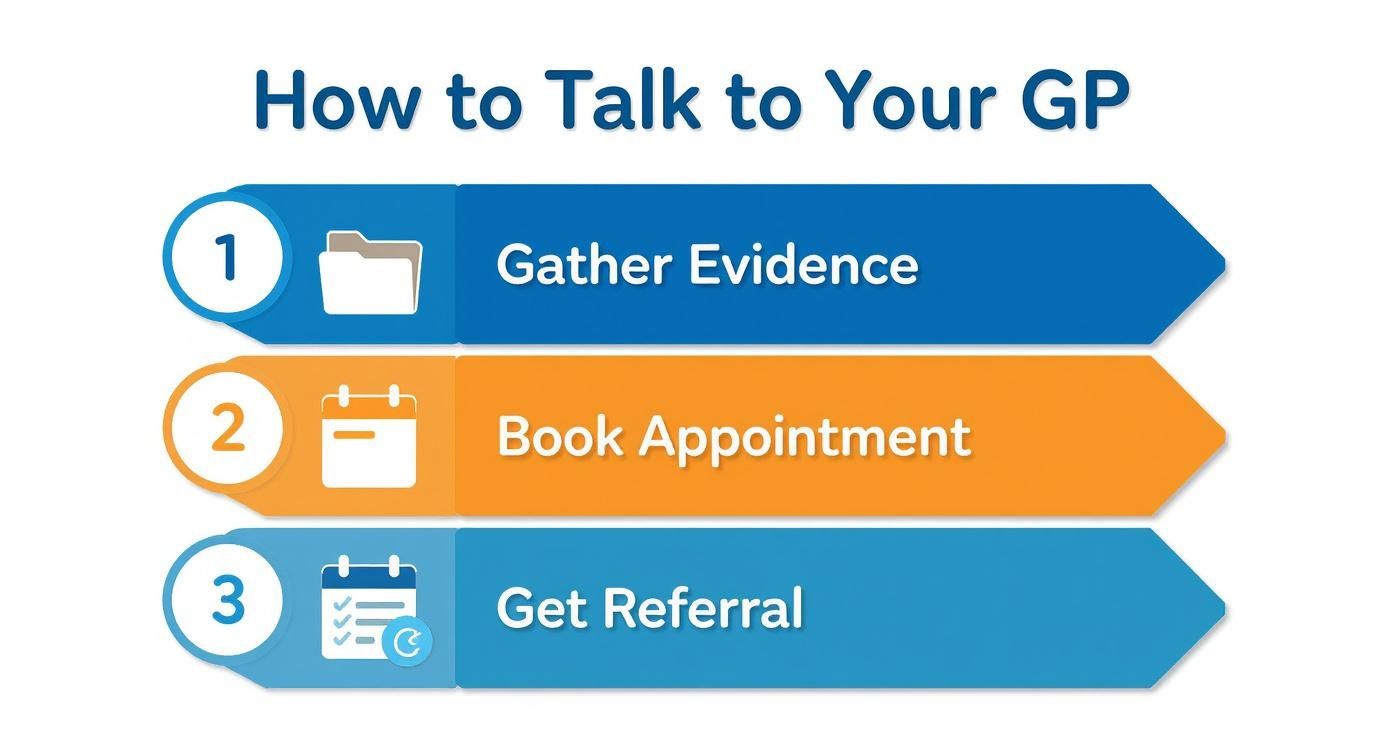
As you can see, being well-prepared is key. It helps you state your case clearly and confidently, making the referral process much smoother.
The NHS Pathway Explained
The biggest plus for the NHS route is obvious: it’s free. For many people, this alone makes it the only realistic option. You can be confident that the care you receive will meet high standards, as it’s all based on national guidelines.
The flip side, however, is the waiting time. And it’s a big one. Demand for adult ADHD assessments has skyrocketed, and NHS services are completely overwhelmed. It’s not uncommon to face a wait of two to five years, and in some regions, it can be even longer.
That kind of delay is more than just an inconvenience; it can feel unbearable when your symptoms are wreaking havoc on your job, your relationships, and your overall mental health. Despite a massive increase in people seeking help, getting a timely assessment remains a serious challenge across the country.
What Is NHS Right to Choose?
If you live in England, you have another option that sits somewhere in the middle: NHS Right to Choose (RTC). This legislation gives you the right to choose which qualified provider delivers your NHS-funded specialist assessment.
What this means in practice is you can ask your GP to refer you to a private clinic that also has a contract to provide services to the NHS. The massive benefit? These providers often have much shorter waiting lists, potentially cutting a multi-year wait down to a matter of months.
Key Takeaway: Right to Choose can be a fantastic way to get the speed of a private assessment without the cost. The key is to do your homework on suitable providers and be ready to explain your choice to your GP, as some are less familiar with the process.
Going Down the Private Route
Speed is the number one reason people opt for a private ADHD assessment. Instead of languishing on a waiting list for years, you can often have your assessment and diagnosis within weeks. When your career is hanging by a thread or your mental health is suffering, that speed can be absolutely critical.
Of course, this comes at a price. A private ADHD assessment in the a UK will typically set you back somewhere between £700 and £2,000. This fee usually covers the initial diagnostic appointments and the final report.
But it’s crucial to look beyond that initial figure. If a diagnosis is made and medication is recommended, you'll have ongoing costs to consider:
- Private Prescriptions: These aren't subsidised like NHS prescriptions.
- Titration Appointments: The titration period is where your specialist finds the right medication and dosage for you. This involves regular follow-up appointments, which you’ll have to pay for. These costs can easily add another few hundred pounds a month for the first few months.
To get a clearer picture of what the process involves, you can find more details about a private ADHD diagnosis in the UK on our service page.
Choosing a provider requires a bit of detective work. Make sure any clinician you consider is a psychiatrist on the GMC's Specialist Register and that their assessment process follows NICE guidelines. A good clinic will be upfront about their fees and happy to answer your questions.
A Quick Comparison: NHS vs Private
To help you weigh everything up, here’s a straightforward comparison of the two main pathways.
| Factor | NHS Pathway | Private Pathway |
|---|---|---|
| Cost | Free at the point of use. | £700 – £2,000 for assessment, plus ongoing medication and titration costs. |
| Waiting Time | Very long. Typically 2-5 years, sometimes longer. | Very short. Usually a matter of weeks to a few months. |
| Choice of Provider | Limited to your local NHS trust, unless using Right to Choose. | Complete freedom to choose any clinic or specialist in the UK. |
| Shared Care | N/A (all care is within the NHS). | Possible, but requires a Shared Care Agreement with your GP to move prescriptions to the NHS. |
This table lays out the core trade-offs: the NHS is free but incredibly slow, while private is fast but comes with a significant financial commitment.
The Importance of a Shared Care Agreement
One final, vital point if you go private: the Shared Care Agreement. This is an arrangement where, once you are stable on your medication, your GP agrees to take over prescribing it on the NHS. This saves you from paying for expensive private prescriptions long-term.
Before you book a private assessment, always check if the clinic supports this and, crucially, have a conversation with your GP to see if they are willing to enter into such an agreement. Sorting this out beforehand can save you a lot of money and stress down the line.
What to Expect During Your ADHD Assessment
https://www.youtube.com/embed/n5mUqmFq4no
So, you’ve done the hard work of getting a referral, and now you’re facing the final hurdle: the assessment itself. The thought of a formal psychiatric evaluation can be daunting, but knowing what’s coming can take a lot of the anxiety out of the process.
Let's pull back the curtain on what actually happens, whether you’re meeting a specialist online or in person. The main goal here is for a professional—usually a psychiatrist or a specially trained psychologist—to get a really detailed picture of your life. They want to understand your struggles, your strengths, and how your symptoms have shown up over the years.
The Diagnostic Interview
The heart of the assessment is a long, guided conversation called a diagnostic interview. Don't think of it as a quick chat; it’s more of a deep dive into your personal history, designed to see how your experiences line up with the official diagnostic criteria for ADHD (like those in the DSM-5).
You’ll be asked to talk about pretty much everything, but the clinician will steer the conversation through different stages of your life.
- Childhood and School Days: They’ll want to know what you were like as a kid. Were you the 'daydreamer' staring out the window? Did school reports mention being disruptive, losing homework, or struggling to wait your turn?
- Work and Career: You can expect questions about your job history. Do you hop between jobs a lot? Have you had feedback about making careless mistakes, missing deadlines, or just general disorganisation? They're trying to see how symptoms play out in a professional setting.
- Relationships and Social Life: The conversation will also touch on your personal life. They might ask about friendships, romantic relationships, and family dynamics to understand how things like impulsivity or emotional ups and downs might affect how you connect with others.
Screening for Autism and Other Conditions
A really thorough assessment isn't just about looking for ADHD. It’s also about ruling out, or sometimes identifying, other conditions that can look similar or exist alongside it. Clinicians know there’s a big overlap between ADHD and Autism Spectrum Condition (ASC), so they might ask questions that screen for autistic traits. This could include things like sensory sensitivities, difficulty with social cues, or a strong need for routine.
They’ll also explore symptoms of anxiety and depression. It’s incredibly common for a lifetime of struggling with undiagnosed ADHD or autism to lead to these issues, so it's vital to untangle what’s causing what. This ensures you get the right support for your complete mental health profile in the long run. If you want more detail on this, our complete guide to the adult ADHD assessment process is a good place to start.
It's a process of elimination as much as it is a process of identification. The clinician's job is to build a complete diagnostic picture, which means considering every possibility to ensure the final conclusion is accurate and robust.
Questionnaires and Input from Others
Alongside the main interview, you’ll almost certainly be given some rating scales or questionnaires to fill out. These are standardised forms that help the clinician put a number on your symptoms, giving them a more objective measure to work with.
The clinician might also ask for your permission to speak to someone who knows you well, like a parent, older sibling, or partner. This is called gathering collateral information, and it’s a crucial part of the process.
Why is this so important?
- Evidence from Childhood: ADHD isn’t something that just appears in adulthood; symptoms need to have been present before the age of 12. A parent can often provide crucial details about your early years that you simply can't remember.
- An Objective View: Sometimes, we don't have the best insight into how our own behaviours affect others. Hearing from a partner or close friend gives the clinician a much more rounded view of the real-world impact of your challenges.
This isn’t about them ‘checking up’ on you or not believing what you say. It’s all about building the most robust, accurate picture possible. A good diagnosis is pieced together from your personal story, objective data from clinical tools, and insights from the people who know you best.
Life After an ADHD Diagnosis

Getting an ADHD diagnosis isn’t the end of the road; it’s the start of a whole new one. Many people anticipate a single, overwhelming wave of relief, but the reality is usually far more complex. You might feel a profound sense of validation as years of unexplained struggles suddenly make sense. At the same time, you might also feel a sense of grief for the person you could have been or the opportunities you missed.
This emotional mix is completely normal. It’s the first step in reframing your identity – shifting from seeing yourself as lazy, disorganised, or flawed to understanding that you have a neurodevelopmental condition. This new perspective is the real foundation for building a life that works for you and improving your mental health.
Understanding Medication and Titration
For many people, medication is a crucial part of managing ADHD, but it's important to know it isn’t a magic bullet. The journey begins with a process called titration, where you work closely with your psychiatrist to find the right type of medication and the most effective dose.
This isn’t something that happens in a single appointment. Titration can take several weeks or even a few months of careful, gradual adjustments. You’ll typically start on a very low dose, with regular check-ins to see how it’s working and to monitor for any side effects. Patience is absolutely essential here. The goal is to find the sweet spot that provides the maximum benefit with the fewest drawbacks.
Your psychiatrist will lead the process, but think of it as a partnership. Keeping a simple daily log of your focus, energy levels, mood, and any physical side effects can give them invaluable feedback to fine-tune your treatment.
It’s also wise to understand exactly what medication can and can't do. While it can be a game-changer for focus and emotional regulation, it’s good to be fully informed. You can learn more about what to expect by reading our detailed article on https://insightdiagnostics.co.uk/adhd-medication-side-effects/.
Support Beyond the Prescription
Medication might clear some of the mental fog, but it doesn't instantly teach you the practical skills you may have struggled to develop over the years. This is where other forms of support become so important. A diagnosis unlocks a whole new world of strategies and tools specifically designed for neurodivergent minds, addressing both ADHD and any co-occurring conditions like Autism.
Here are a few practical supports to consider:
- ADHD Coaching: This is a collaborative process focused on building real-world skills. A good coach helps you create systems for organisation, planning, and time management that work with your ADHD brain, not against it.
- Therapy: Therapies like Cognitive Behavioural Therapy (CBT), when adapted for ADHD, can be incredibly helpful. It gives you the tools to challenge the negative self-talk that’s built up over a lifetime and develop healthier ways to cope with anxiety or rejection sensitivity.
- Support Groups: There is immense power in connecting with other people who have ADHD and Autism. It’s a space where you don’t have to constantly explain yourself, and you can share tips and experiences with people who just get it.
Once you have a diagnosis, exploring things like effective ADHD time management tips can also give you a huge boost in managing day-to-day life.
Navigating Work and Your Rights
Your diagnosis is personal information, but choosing to disclose it at work can open up access to vital support. Under the Equality Act 2010, ADHD can be considered a disability, which means you’re entitled to ‘reasonable adjustments’ in the workplace.
These adjustments aren’t about getting special treatment. They’re about levelling the playing field so you have the same opportunity to perform at your best as anyone else.
Some common examples of reasonable adjustments include:
- Noise-cancelling headphones to help you focus in a busy open-plan office.
- Flexible working hours that align with your natural energy and focus cycles.
- Getting instructions in writing rather than just verbally.
- Access to software that helps with organisation, reminders, or mind-mapping.
The path to getting an ADHD test in the UK can vary wildly depending on where you live, with a complex mix of NHS and private options. NHS England data reveals that while most ADHD medication is prescribed through the NHS, over 20% of patients are now using private prescriptions due to long waiting lists and supply chain issues. You can find more details on this in the ADHD Taskforce report. Understanding this wider context helps make sense of the journey you've been on and the next steps you can now confidently take.
Your Top Questions About Getting an ADHD Diagnosis in the UK
When you're trying to figure out if you have ADHD, a lot of very practical questions pop up. Getting straight answers is the first step toward getting the right support. Let's walk through some of the most common queries we hear from people navigating this process.
Can I Get Assessed for ADHD and Autism at the Same Time?
Yes, absolutely. In fact, getting a combined assessment can be a really smart move. ADHD and Autism Spectrum Condition (ASC) often go hand-in-hand – you might see this referred to as AuDHD. What makes it even more complex is that some of the traits can look very similar from the outside.
Think about it: struggling in social settings could be down to the impulsivity that comes with ADHD, or it could be related to the challenges in picking up on unwritten social cues that are more typical of autism. A specialist needs to untangle that.
Many private clinics and even some NHS trusts now offer integrated neurodevelopmental assessments for this very reason. If you go to your GP for a referral, it’s really important to mention you suspect traits of both conditions. This helps the clinician build a full, accurate picture of who you are and create a support plan that’s genuinely right for your unique brain wiring.
What if My GP Won’t Refer Me?
It’s incredibly frustrating and upsetting when a GP says no, but please don't let it be a dead end. The first thing to do is take a breath and calmly ask the doctor why they are refusing the referral. Crucially, ask them to make a note of their reasoning in your medical records.
Once you’ve done that, you’ve got a few solid options:
- Try a different doctor. You're well within your rights to book an appointment with another GP at your practice. You can go in prepared with your notes and evidence, explain what the last doctor said, and make your case again. A fresh perspective can make all the difference.
- Use your ‘Right to Choose’. If you live in England, this is a powerful tool. The NHS ‘Right to Choose’ scheme is your legal right to request a referral to a specific provider that accepts NHS funding. Your GP needs a very good clinical reason to refuse this.
- Lodge a complaint. If you feel the refusal is simply unreasonable and you've tried seeing another doctor, you can make a formal complaint to the practice manager.
A GP's job is to be a gatekeeper, not an ADHD specialist. If you've done your homework and have a genuine suspicion, being persistent is often the key to getting that referral over the line.
Will an ADHD Diagnosis Affect My Driving Licence?
This is a huge worry for many, but the rules are clearer than you might think. You only have to tell the DVLA about your ADHD if your symptoms – or any side effects from your medication – negatively impact your ability to drive safely.
For a lot of people, the opposite happens. Getting treatment for ADHD can dramatically improve concentration and reduce impulsivity, making them safer, more focused drivers.
The bottom line is this: does your condition affect your driving? If the answer is yes, you must disclose it. Not doing so can lead to a fine of up to £1,000 and could even invalidate your car insurance if you're involved in an accident.
Do I Have to Tell My Employer I Have ADHD?
No, you generally have no legal obligation to tell your employer. Your diagnosis is your private medical information, and it's your decision who you share it with. The only exception would be if your symptoms created a direct health and safety risk in your specific job – for example, if you operated heavy machinery.
That said, choosing to tell your employer is the key that unlocks legal protection and support. Under the Equality Act 2010, ADHD can be classified as a disability. This means you have the right to ask for 'reasonable adjustments' to help you do your job well.
What does that look like in practice? It could be getting noise-cancelling headphones to help you focus in an open-plan office, having more flexible working hours, or asking for instructions to be given in writing rather than verbally. Sharing your diagnosis with a manager or HR is the formal step to accessing this support and creating a work environment where you can truly thrive.
At Insight Diagnostics Global, we understand that getting clear, expert answers is a vital part of your mental health journey. Our CQC-regulated online clinic provides comprehensive, consultant-led assessments for ADHD and Autism for adults across the UK, with no GP referral required. If you're ready to gain clarity and access the support you deserve, find out more about our services at https://insightdiagnostics.co.uk.