
Thinking about starting medication for ADHD can feel like a big decision, especially if you're also managing autism or other mental health conditions. It's totally normal to have questions and feel a bit uncertain.
The key thing to remember is that medication is just one tool in the toolkit. It’s not a magic fix, but it can be incredibly effective at managing core ADHD symptoms like distractibility and impulsivity. Think of it as creating the mental breathing room you need for other strategies, like therapy or coaching, to really land and make a difference. This is especially true when navigating the complexities of co-occurring conditions, where mental health can feel like a constant balancing act.
Your First Questions About ADHD Medication Answered

Starting this journey often brings up a lot of "what ifs," but you're definitely not on your own. Deciding to explore medication is a positive, proactive step towards taking control of your mental health and making day-to-day life feel less of a struggle.
What Does Medication Actually Do?
A great way to think about ADHD medication is that it’s like putting on a pair of prescription glasses for your brain. It doesn’t fundamentally change who you are, but it helps bring everything into sharper focus. This can make it much easier to concentrate, organise your thoughts, and keep your impulses in check.
This newfound clarity is often a game-changer, particularly for those with a dual diagnosis of autism and ADHD, where executive function challenges can feel overwhelming. The main goal is always to reduce symptoms and boost your quality of life, with medication forming just one part of a wider, supportive mental health plan. A proper clinician-led approach ensures the whole process is safe, carefully managed, and tailored specifically to you.
The Two Main Paths of Treatment
When it comes to ADHD medication, there are two main types your specialist will discuss with you. They'll help you figure out the best starting point based on your unique situation, including any other mental health conditions like anxiety or a co-occurring diagnosis of autism.
- Stimulant Medications: These are usually the first port of call. They work by balancing the levels of key neurotransmitters (chemical messengers) in your brain and tend to act quite quickly, helping to improve focus and calm hyperactivity.
- Non-Stimulant Medications: If stimulants aren't a good fit, or if you have other conditions like significant anxiety, non-stimulants are a great alternative. They work differently, building up their effect in your system more gradually over a few weeks.
You're Part of a Growing Community
If you're an adult only now seeking help, you're not late to the party – you're part of a huge, positive shift in mental health awareness. The number of adults in the UK being prescribed ADHD medication has shot up by 24.3% in just the last year.
This isn't some fleeting trend; it reflects a much deeper, long-overdue understanding of how ADHD presents in adults. The figures are stark: over 326,000 patients are now receiving prescriptions, a massive jump from just 107,000 back in 2015/16. This shows just how many people are finally getting the validation and support they've been looking for. You can read more about the rise in adult ADHD treatment and what the data shows.
How ADHD Medications Rebalance Your Brain's Focus System

To get a real feel for how ADHD medication works, it helps to use an analogy. Think of your brain’s focus system as a powerful radio. In someone with ADHD, that radio often seems to be caught between stations, filled with static that drowns out the main broadcast. This mental ‘static’ is what we experience as distraction, impulsivity, and a constant struggle to concentrate.
This isn't a character flaw or a lack of willpower; it’s rooted in brain chemistry. The interference comes from an imbalance of crucial chemical messengers, or neurotransmitters, which are responsible for zipping signals between brain cells. For ADHD, the two most important players are dopamine and noradrenaline. The brain either doesn't have enough of them, or it isn't using them very efficiently.
Tuning In with Neurotransmitters
Let's break those down. Dopamine is often called the 'reward and motivation' chemical. It’s what helps you feel engaged, chase after goals, and lock onto things you find interesting. Noradrenaline, on the other hand, is all about alertness and focus—it’s the chemical that helps you filter out distractions and stick with a task.
When these two are out of balance, the brain finds it incredibly difficult to self-regulate. It’s like trying to follow an important conversation in a room with a dozen TVs blaring. This is where medication comes in. Its job isn't to change your personality, but simply to help clear up the signal.
Stimulants: The Fine-Tuning Dial
Stimulant medications, like Methylphenidate (e.g., Concerta, Ritalin) and Lisdexamfetamine (e.g., Elvanse), are the most common first-line treatment. Think of them as the fine-tuning dial on that radio. They work quickly to adjust neurotransmitter levels and bring the broadcast into sharp, immediate focus.
They primarily work by boosting the amount of available dopamine and noradrenaline in the spaces between your brain cells. This strengthens the signalling pathways, especially in the prefrontal cortex—the part of your brain that handles executive functions like planning, organising, and controlling impulses.
By making more of these key chemicals available, stimulants effectively turn down the background noise. This allows for clearer thinking and a much-improved ability to focus. The research is clear: these medications improve the very brain circuits responsible for attention and self-control.
For most people, the effect is noticeable very quickly after taking a dose. The mental static fades, and suddenly the task at hand or the conversation you're in becomes the main event. It can be a genuinely profound feeling, giving you a sense of control over your own mind that might have felt out of reach before.
Non-Stimulants: Upgrading the Internal Wiring
Non-stimulant medications, such as Atomoxetine or Guanfacine, take a different route. Instead of acting like a quick-turn dial, they’re more like a careful upgrade to the radio's internal wiring. The goal is to create a more stable, consistent signal over the long haul.
These medications don't cause a rapid spike in dopamine. Atomoxetine, for instance, works by selectively increasing noradrenaline levels throughout the brain, providing a smooth effect that can last for a full 24 hours.
This slow-and-steady approach has some clear advantages:
- Steady Coverage: It gives you round-the-clock symptom management, avoiding the ‘peaks and troughs’ that can sometimes occur with stimulants.
- Reduced Anxiety: For those who also experience anxiety, or find stimulants make them feel jittery, the gentler action of non-stimulants can be a much better fit. This is particularly relevant for autistic individuals who may have heightened sensitivity to stimulants.
- Gradual Improvement: The full benefit builds over several weeks, leading to a more sustained improvement in focus, impulsivity, and emotional regulation.
Deciding between stimulants and non-stimulants is a collaborative process between you and your clinician. They'll consider your specific symptoms, your lifestyle, and any other co-occurring conditions, like autism or anxiety. Ultimately, the goal is always the same: to find the right tool to help you finally tune out the static and hear your own thoughts clearly.
Comparing Stimulant and Non-Stimulant Medications
When we talk about ADHD medication, we're generally looking at two main categories: stimulants and non-stimulants. It's helpful to think of them as two different kinds of athletes, each suited for a different type of race. Understanding their unique strengths is the first step in having a productive conversation with your clinician about what might be the right fit for you.
Stimulants are the sprinters of the ADHD medication world. They get to work incredibly quickly—often within the hour—delivering a powerful and effective boost to your focus and impulse control. It's this rapid action that makes them the first-choice treatment for many people.
But just like a sprinter's burst of speed, their effects are temporary. This is why you’ll find different formulations designed to control how the medication is released, managing its impact throughout your day.
Sprinters vs. Marathon Runners in ADHD Treatment
The biggest difference between various stimulant formulas lies in how they release the active ingredient into your system. This is what determines how you manage your symptoms from morning to night.
- Immediate-Release (IR): These act fast and typically last for 3-5 hours. While they offer a good deal of flexibility, you'll likely need to take multiple doses throughout the day to maintain consistent focus.
- Extended-Release (ER): These are designed for a smoother, longer-lasting effect, usually covering 8-12 hours. The medication is released gradually, helping you stay on track through a typical work or school day with just a single morning dose.
On the other side of the track, we have the non-stimulants—the marathon runners. They don't provide that immediate kick. Instead, they work by building up their effectiveness slowly and steadily in your system over several weeks.
This gradual approach delivers smooth, 24-hour symptom coverage, avoiding the peaks and troughs that some people feel with stimulants. It makes them an excellent choice if you need round-the-clock support, or if stimulants simply aren’t right for you. They’re often a preferred option for people who also have anxiety, as their effect tends to be calmer. To learn more, have a look at our guide on finding the best ADHD medication for adults.
The choice isn't about which medication is "better" in a general sense, but which one is better for your specific neurobiology, lifestyle, and overall mental health. The goal is always to find a treatment that integrates seamlessly into your life, providing reliable support exactly where you need it.
Stimulant vs. Non-Stimulant ADHD Medications at a Glance
To really bring these differences into focus, a direct, side-by-side comparison can be incredibly helpful. Seeing their distinct profiles laid out like this can make the conversation with your specialist much clearer.
| Characteristic | Stimulant Medications (e.g., Methylphenidate, Lisdexamfetamine) | Non-Stimulant Medications (e.g., Atomoxetine, Guanfacine) |
|---|---|---|
| Speed of Action | Very fast; effects are often felt within 30-60 minutes. | Slow; can take 4-6 weeks to reach full therapeutic effect. |
| Primary Mechanism | Primarily increases the availability of dopamine and noradrenaline. | Mainly increases noradrenaline, providing a different chemical pathway. |
| Symptom Coverage | Provides coverage for a set period (4-12 hours) depending on the formula. | Offers smooth, 24-hour coverage once the effective dose is reached. |
| Common Side Effects | Decreased appetite, difficulty sleeping, increased heart rate, anxiety. | Fatigue, nausea, dizziness, and dry mouth are more common initially. |
| Suitability | Often the first-line treatment due to high effectiveness (~70-80% response rate). | A strong choice for those who don't tolerate stimulants, have co-occurring anxiety or autism, or a history of substance misuse. |
This table gives you a solid starting point for understanding your options. The "right" path is deeply personal and depends on a careful clinical assessment of your needs and health history.
It's also interesting to look at prescribing trends. In England, while methylphenidate is still the most commonly prescribed ADHD medication, prescriptions for lisdexamfetamine have shot up by an astonishing 55% each year since 2019. This suggests a real shift in clinical preferences, though it's important to remember that access to diagnosis and treatment can vary quite a bit from one region to another.
Your Treatment Journey: From Diagnosis to Finding the Right Dose
Thinking about starting ADHD medication can feel daunting, but it’s helpful to see it as a carefully managed and supportive journey. Far from being a quick fix, it’s a collaborative process you’ll navigate with a specialist, where your safety and well-being are always the top priority. Every step is designed to make sure the treatment plan is the right fit for you.
It all starts well before any prescription is considered, with a comprehensive diagnostic assessment. This isn't just a simple checklist; it's a deep dive into your life history, current struggles, and overall mental health. A good psychiatrist will want to understand the complete picture, which is vital for spotting co-occurring conditions like autism, anxiety, or depression.
This thorough evaluation means the support you get is for the whole person. By understanding how different parts of your neurotype and mental health might interact, your clinician can shape a far more effective and considerate treatment plan right from the start.
This diagram shows the two main types of ADHD medication. Think of stimulants as the fast-acting 'sprinters' and non-stimulants as the steady 'marathon runners'.
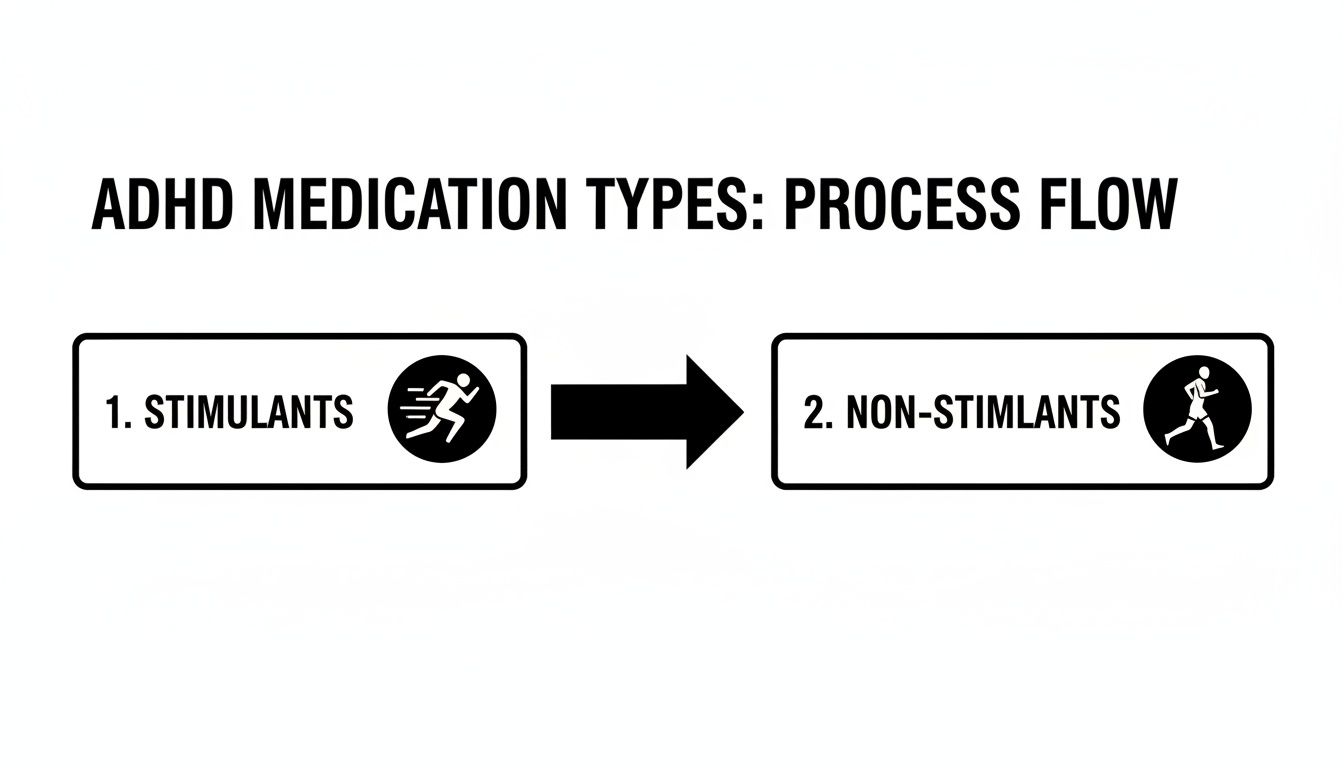
This visual helps explain the different speeds at which these medications get to work—a key factor your specialist will consider when planning your treatment.
First Things First: Pre-Medication Health Checks
Once you have a diagnosis and you’ve both agreed that medication is a sensible next step, the focus shifts entirely to safety. Before you start any treatment, you’ll have a series of essential health checks. This is standard procedure and is there to confirm that the chosen medication will be safe for your body.
These checks usually involve:
- Blood Pressure and Pulse: We need a baseline reading because some ADHD medications can cause slight increases.
- Weight and Height: Your physical health is monitored throughout your treatment, and this gives us a starting point to track from.
- An ECG (Electrocardiogram): This is a simple, painless test that checks your heart's rhythm and electrical activity. It helps rule out any underlying cardiac issues that could make certain medications unsuitable.
- Relevant Blood Tests: Depending on your personal health history, your clinician might also ask for blood tests to check your liver and kidney function are in good shape.
These checks aren’t just a one-off formality. They form the foundation of your ongoing care, ensuring we keep a close eye on your physical health as well as your mental well-being. This careful, evidence-based approach is what makes modern ADHD treatment so safe and effective.
What is the Titration Phase?
With the health checks cleared, you’ll move on to the most important part of the process: titration. It sounds a bit technical, but the idea behind it is actually very simple and reassuring. Think of it as a careful ‘calibration’ period for your brain and body.
Titration isn't about just giving you a standard dose. It’s a highly personalised, collaborative phase where you and your psychiatrist work together to find the optimal dose for you—the exact level that delivers the most symptom relief with the fewest possible side effects.
The approach is always "start low and go slow." You’ll begin on a very small dose of the medication. You and your clinician will keep in close contact to monitor how you’re feeling, what benefits you’re noticing, and whether any side effects are popping up. Based on your feedback, the dose will be slowly and carefully increased over a period of weeks.
This partnership is crucial. Your lived experience is the most important data we have, and your feedback directly guides every single adjustment. It puts you in the driver’s seat of your own care, ensuring the final dose is one that truly works for your unique body and brain. The gradual nature of titration also gives your body time to gently adapt, which massively reduces the chance of experiencing uncomfortable side effects.
For those curious about the timeline, you can find out more about how long ADHD medication takes to work in our detailed guide. From the initial assessment to the final, calibrated dose, every single step is taken with precision and care.
Effectively Managing Side Effects and Long-Term Care
Starting a new ADHD medication can feel like a big step, often bringing a mix of hope and a little bit of worry. While you’re likely focused on the positive changes ahead, it’s completely normal to wonder about side effects. The good news is that for most people, they’re usually mild, temporary, and very manageable.
Think of it like breaking in a new pair of walking boots. They might feel a bit stiff or rub at first, but with a few adjustments—and a bit of patience—they soon mould to your feet and give you the support you need for the journey. It’s often a similar process with ADHD medication.
Common Side Effects and Practical Strategies
When you start treatment, your body and brain need a little time to adjust to the new chemistry. This can sometimes lead to temporary physical or emotional blips. The key isn't to panic, but to see these as signals—useful information to share with your specialist so they can fine-tune your treatment.
Here are a few of the most common issues people run into, along with some simple, practical ways to handle them:
- Changes in Appetite: Stimulants can sometimes dampen your appetite, especially in the middle of the day. A great way to work around this is to have a solid, protein-rich breakfast before you take your morning dose. You can also keep nutrient-dense snacks on hand for the afternoon and plan a more substantial meal in the evening as the medication wears off.
- Difficulty Sleeping: An energised, more focused brain can sometimes find it hard to switch off at night. Creating a solid wind-down routine is your best defence here. Try to avoid screens for an hour before bed, make sure your bedroom is cool and dark, and definitely skip that afternoon coffee. If you're on a long-acting formula, your specialist might also suggest taking it a bit earlier in the day.
- Increased Heart Rate or Jitters: It’s not uncommon to feel a bit restless or notice your heart is beating a little faster when you first start. This sensation usually settles down within a week or two as your body gets used to the medication. Simple things like deep breathing exercises or a bit of mindfulness can really help take the edge off.
Remember, the goal is to find a treatment that fits comfortably into your life. Most of these initial hurdles smooth out as your body acclimatises. For a more detailed look, you can learn more about ADHD medication side effects and get more tips on managing them.
The Importance of Ongoing Monitoring
Finding the right medication and dose isn't a one-and-done deal; it’s the beginning of an ongoing conversation between you and your healthcare provider. This is precisely why regular monitoring is a cornerstone of safe and effective long-term ADHD treatment. It’s not about being watched—it’s about being looked after.
These follow-up appointments are your chance to be an active participant in your own care. Think of them as collaborative check-ins where you can be completely open about what’s working, what isn’t, and how you’re feeling in general.
Ongoing care is a safety net and a steering wheel combined. It ensures the treatment remains effective and safe, while allowing for adjustments that keep your mental health and well-being on the right track.
What to Expect in Your Follow-Up Appointments
Your follow-ups are structured to give a complete picture of how you're getting on. They’re designed to make sure your physical and mental health are cared for as a whole.
Typically, your clinician will:
- Discuss Your Experience: They’ll want to know how you’re feeling, both emotionally and physically. This is the perfect time to share the wins—like finally being able to focus through a meeting—as well as any side effects you’ve noticed.
- Review Medication Effectiveness: Is the medication actually helping with the symptoms you wanted to target? Is it easier to manage your time or resist impulsive decisions? Your real-world feedback is the most crucial piece of the puzzle.
- Perform Health Checks: Regular checks of your blood pressure, pulse, and weight are standard procedure. It’s a simple but vital way to ensure the medication remains a safe option for you over the long term.
- Make Necessary Adjustments: Based on everything you’ve discussed, your clinician might suggest tweaking your dose, changing the time you take it, or perhaps even trying a different type of medication.
This collaborative approach turns medication management from something that’s done to you into something that’s done with you. It’s an empowering process that ensures your treatment plan grows and adapts right alongside you, helping you to truly thrive.
ADHD Medication When You Are Also Autistic
When you're both autistic and have ADHD, navigating medication isn't always straightforward. The treatment options are the same, but your experience of them can be quite different. It’s a delicate balance, and the last thing you want is to manage one aspect of your neurotype by compromising another.
The goal here isn't to mask or suppress autistic traits. It's about easing the specific ADHD challenges that create barriers in your life. Many autistic people find their executive function struggles are massively amplified by their ADHD, and the right medication for adhd can be a game-changer for planning, starting tasks, and just getting through the day.
Navigating Heightened Sensitivities
One of the most important things to be aware of is that autistic people can have a very different sensitivity profile to medications. It’s not uncommon to be more sensitive to side effects like anxiety or sensory overload, even on what would be considered a very low dose for someone else. This isn't a universal rule, but it’s a distinct possibility we need to respect.
This is why the "start low and go slow" approach during titration isn't just good practice—it's absolutely essential. A good clinician will be extra cautious, making tiny adjustments and listening very carefully to your feedback. This careful, methodical process helps ensure that we don’t inadvertently dial up autistic traits, like sensory sensitivities, or worsen anxiety.
Finding the right balance is a collaborative effort. The aim is to calm the ADHD 'noise' to improve focus and executive function, without disrupting the routines and sensory experiences that are fundamental to an autistic person's well-being.
The Importance of a Specialist Clinician
Successfully treating co-occurring ADHD and autism really hinges on working with a clinician who understands both conditions intimately. They'll have the experience to recognise that what might look like a simple medication side effect could actually be a sign of increased autistic burnout or sensory distress. That insight is vital.
For instance, an experienced specialist knows that while stimulants can work wonders, they can sometimes ramp up anxiety for autistic individuals. If that’s a concern, we might start with a non-stimulant medication instead, which often provides a gentler, more stable effect. This careful consideration is a key part of holistic mental healthcare.
The journey is incredibly personal, but with the right clinical support, you can find a balance that honours your whole neurodivergent self. For a deeper look at the options, you can explore our overview of ADHD medication for adults in the UK. Ultimately, it’s about making medication a tool that helps you thrive, just as you are.
Your Questions About ADHD Medication Answered
It’s completely normal to have a lot of questions when you’re thinking about ADHD medication. Let’s walk through some of the most common ones that come up, especially for people who are also navigating autism or other mental health conditions.
How Long Will I Need to Be on ADHD Medication?
This is one of the most personal aspects of treatment, and it’s an ongoing conversation you'll have with your clinician. Since ADHD is typically a lifelong condition, many people find that staying on medication provides consistent, long-term support that they value. We'll keep a close eye on how you're doing with regular reviews to make sure the treatment is still right for you and your overall mental health.
Some people decide to take planned, clinically supervised breaks from their medication. Others find that after a while, they’ve built up such strong coping strategies that they feel ready to try a lower dose, or even stop altogether. The goal is always the same: find the lowest dose that works for you, and use it only for as long as it's genuinely helping.
Will ADHD Medication Change My Personality?
When the dose is right, absolutely not. Think of it less as changing you and more as clearing away the static. The medication is designed to target specific impairing symptoms—like the constant distractibility or impulsivity—which can often mask who you really are.
In fact, one of the most common things I hear from patients is that they finally feel "more like themselves." They can engage in conversations, finish projects, and just be present in their own lives. If you ever start to feel emotionally numb or just "not yourself," that's a red flag. It's a clear signal to get in touch with your clinician straight away, as your dose or medication type probably needs a tweak.
Can I Get ADHD Medication Directly from My GP?
In most cases, no, not at the beginning. The initial diagnosis and the crucial first phase of treatment—finding the right medication and dose—has to be handled by a specialist, like a psychiatrist. This is to ensure you get a comprehensive assessment and the careful supervision you need as your body adjusts, especially when co-occurring conditions like autism are present.
Once you’re on a stable dose that works for you, your specialist can set up what's called a ‘shared care agreement’ with your GP. This is a common arrangement where your GP can take over issuing your repeat prescriptions, while the specialist continues to oversee your care with annual reviews. It's a system built on clear communication and safety protocols; even the information in medication leaflets is subject to strict EMA and FDA regulations for pharmaceutical translation to ensure everything is precise and safe for patients.
If you're an adult seeking a clear diagnosis for ADHD or Autism, Insight Diagnostics Global provides consultant-led assessments and personalised treatment plans, including medication management. Start your journey towards clarity by visiting https://insightdiagnostics.co.uk.