
Facing a multi-year wait for an ADHD assessment on the NHS can feel like an insurmountable obstacle. For many, a private online ADHD assessment in the UK is a credible and timely alternative, offering a clear route to understanding their mental health and getting support without the agonising uncertainty.
This guide is designed to walk you through the process, giving you the confidence to take the next step.
Why Online ADHD Assessments Are a Lifeline in the UK

The demand for mental health services, especially for neurodevelopmental conditions like ADHD and Autism, has surged in the UK. For countless adults, the lightbulb moment—the realisation that their lifelong struggles might be ADHD—is just the start of another long and frustrating journey.
While the NHS is a cornerstone of our healthcare, it's currently stretched to its limits. This strain creates a massive gap between people needing help and actually getting it. The fallout from a delayed diagnosis can ripple through every part of your life, affecting your career, relationships, and overall mental health. It’s in this gap that private online assessments have become less of a convenience and more of a genuine lifeline.
The Staggering Scale of the UK's ADHD Diagnosis Gap
It’s hard to grasp the true scale of the problem. A shocking over 2.6 million adults in the UK—that’s more than 1 in every 25 people—are thought to be living with undiagnosed ADHD.
This silent crisis is made worse by NHS waiting lists that can stretch, on average, for a soul-crushing five years from the moment you first seek help to getting a formal diagnosis.
A properly structured online service, led by experienced consultant psychiatrists, provides a way to sidestep these excruciating delays. It offers a thorough, evidence-based assessment that meets the exact same clinical standards as an in-person appointment, giving you clarity in weeks, not years.
An online ADHD assessment isn’t a shortcut. It’s a direct and efficient pathway to the same expert-led, clinical evaluation you’d receive in a traditional setting, just delivered in a more accessible format.
The Critical Need for Timely and Specialised Care
You simply can’t overstate the urgency of getting timely help. ADHD often doesn't travel alone; it can co-exist with other mental health challenges like anxiety, depression, or even Autism Spectrum Disorder (ASD). A truly comprehensive assessment needs to be able to untangle these conditions to make sure you get the right support for your entire mental health profile.
If you’re worried about how long you might have to wait, you may find our guide on navigating https://insightdiagnostics.co.uk/psychiatry-uk-waiting-time/ helpful.
Understanding what goes on behind the scenes, such as the operational support for mental health therapy practices, highlights the robust infrastructure required to deliver credible online care. These services are bridging a vital gap, offering a concrete plan and a sense of hope for people who feel forgotten by an overburdened system.
What Really Goes into a Proper Online ADHD Assessment?
Let's get one thing straight from the start: a proper online ADHD assessment in the UK isn't a quick online quiz or a simple checklist you can tick off in five minutes. A legitimate assessment is a serious medical evaluation, every bit as rigorous as a traditional, face-to-face consultation. The entire process is designed for one thing: clinical accuracy, paving a safe and regulated path to a diagnosis.
Any service promising instant answers isn't giving you the full picture. A truly reputable assessment unfolds over several stages, meticulously building a complete understanding of your life, your history, and the challenges you're facing right now. Think of it less like a quick snapshot and more like a detailed documentary of your inner world.
Building the Foundation: Gathering the Evidence
The journey always begins with gathering a rich history. This is done through detailed questionnaires that dig much deeper than surface-level questions. You’ll be asked to think back on your experiences, from childhood right up to the present day, touching on school, work, and your personal life.
This first stage is all about building a comprehensive case history. A crucial part of this is getting an outside perspective.
- Self-Report Questionnaires: You'll fill out in-depth forms detailing your own symptoms, the hurdles you face, and how they affect your day-to-day life.
- Observer Reports: To get a 360-degree view, you’ll likely be asked to share a similar questionnaire with someone who knows you well. This could be a partner, a close friend, or a family member—their insights on how your traits appear to others are invaluable.
Weaving these two perspectives together helps the clinician see the full context of your difficulties.
The Heart of the Matter: The Clinical Interview
The centrepiece of any credible assessment is the virtual clinical interview. This is a dedicated, one-to-one session with a consultant psychiatrist who is fully registered with the General Medical Council (GMC). It’s far from a casual chat; it’s a structured diagnostic conversation that usually lasts between one and two hours.
During your meeting, the psychiatrist will delve into the information you provided in your questionnaires, ask for clarification, and carefully assess your symptoms against the formal diagnostic criteria for ADHD (usually DSM-5 or ICD-11). It's a methodical, empathetic discussion aimed at getting to the very core of your lived experience.
Seeing the Bigger Picture: Screening for Autism and Other Conditions
ADHD rarely travels alone. It often overlaps with other conditions, and if these aren't spotted, it can lead to an incomplete diagnosis and a treatment plan that just doesn't work. This is where the expertise of a specialist mental health service really comes into its own.
A thorough assessment will always screen for common co-occurring conditions, including:
- Autism Spectrum Disorder (ASD): The overlap between ADHD and Autism is huge. Many traits, like challenges with executive function or social communication, can show up in both. A skilled clinician knows how to differentiate between them or recognise when both are present.
- Anxiety and Depression: The daily struggle of living with undiagnosed ADHD can understandably lead to secondary mental health issues like generalised anxiety or a persistently low mood.
- Other Mood Disorders: The clinician will also consider other possibilities to ensure the final diagnosis is the right one.
This holistic view means you get a diagnosis that reflects your entire mental health profile, not just one piece of it. To get a better sense of this, you can learn more about what a psychiatric assessment entails in our detailed guide.
A proper online ADHD assessment is a diagnostic investigation. It meticulously pieces together evidence from your past and present, filters it through an expert clinical interview, and considers all relevant mental health factors to arrive at a clear, accurate, and defensible conclusion.
Finally, and this is crucial, any provider offering an online ADHD assessment in the UK must be regulated by the Care Quality Commission (CQC). This is a non-negotiable seal of quality. It confirms the service meets national standards for safety, effectiveness, and patient care, giving you the peace of mind that you're in the hands of a legitimate medical service that is held to account.
Your Step-by-Step Patient Journey
Taking that first step towards an online ADHD assessment in the UK often feels like the hardest part. It's completely normal to feel a bit anxious, but knowing exactly what the process involves can take away a lot of that uncertainty and put you back in control. Any good provider will walk you through a clear, structured journey, making sure you feel supported at every turn.
Think of it less as a quick check-up and more as a methodical process. It’s designed to build a detailed, accurate picture of your mental health, step by step, all delivered with genuine empathy and clinical care.
To give you a clearer idea of what to expect, the process can be broken down into three core phases.
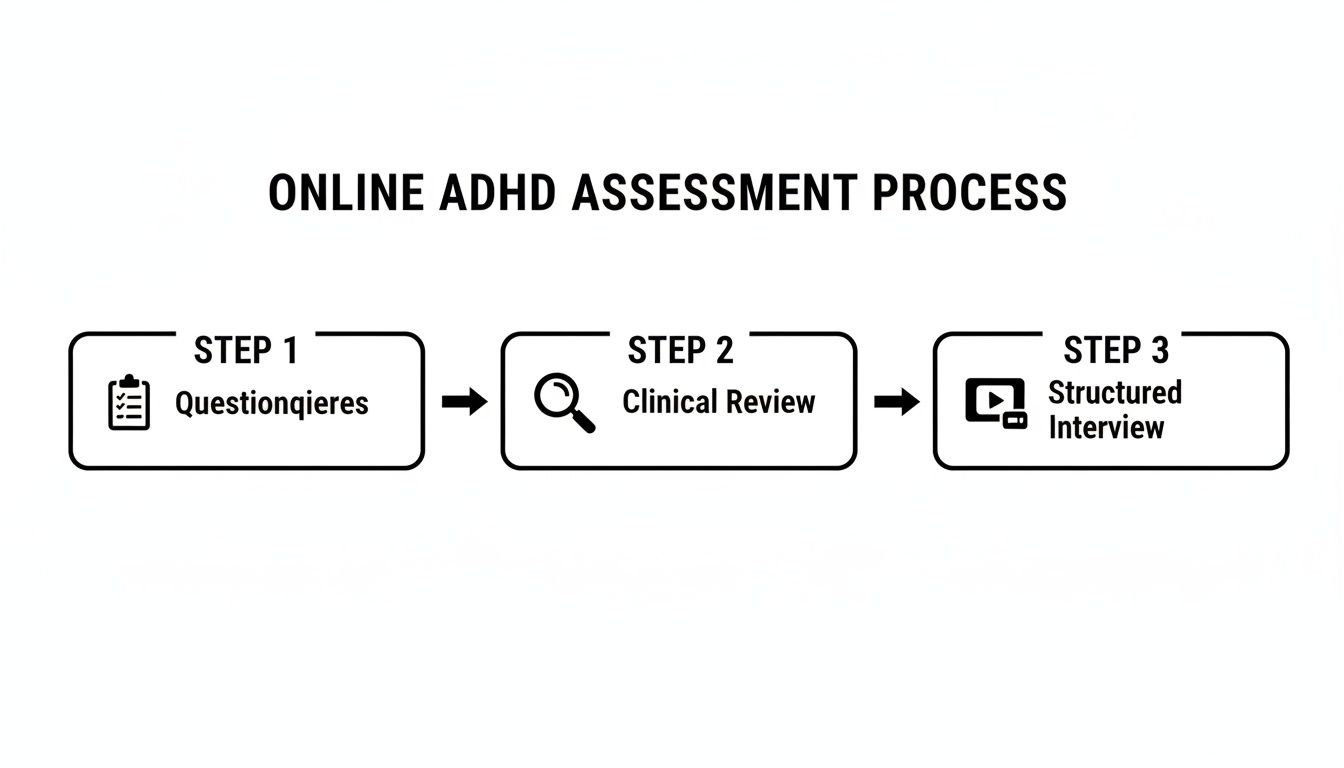
As you can see, it’s a logical flow. We start by gathering background information before moving into a deep-dive clinical interview, ensuring nothing is missed.
Stage One: Making Your Initial Enquiry
Your journey begins the moment you decide to reach out. This might be through a contact form, an email, or a phone call, but it all serves the same purpose: it’s a simple triage step. The clinical team will quickly review your enquiry to make sure their service is the right fit for you. The goal is to get you the right kind of support for your mental health needs from the very start.
This is also your chance to ask any initial questions and just get a feel for the provider. A trustworthy clinic will be completely transparent about its process, pricing, and the credentials of its clinicians.
Stage Two: Completing Pre-Assessment Questionnaires
Once you’re ready to move forward, you'll be sent a set of detailed questionnaires. This is the crucial evidence-gathering stage. These aren't just simple tick-box forms; they are carefully designed to explore your life history, your symptoms, and the real-world impact they have on you day-to-day.
You'll usually be asked to complete two main forms:
- A self-report form: This is your space to share your own experiences, from your earliest school memories right through to the challenges you face today at work or at home.
- An informant/observer form: This is sent to someone who knows you well – a partner, a parent, or a close friend. Their perspective provides invaluable context and helps the clinician see how your traits present to others.
Gathering this comprehensive data is absolutely vital. It's especially important when you consider the sheer number of undiagnosed adults. A massive study of 9 million GP records found that only 0.32% of UK adults have an official ADHD diagnosis, a tiny fraction of the estimated 2.8% who likely have it. This means millions are struggling without support, a gap that often leads to chaos in the workplace and even legal disputes. You can read the full analysis on ADHD diagnosis rates in the UK.
Stage Three: The Virtual Clinical Interview
The real heart of the assessment is the one-to-one virtual interview with a GMC-registered consultant psychiatrist. This is a structured, in-depth conversation that typically lasts between one and two hours, all conducted over a secure video link.
The psychiatrist will use the information from your questionnaires as a launchpad, asking clarifying questions and digging deeper into your experiences. They'll assess your symptoms against the formal diagnostic criteria while also screening for co-occurring conditions like Autism, anxiety, or depression. This holistic approach ensures the final diagnostic picture is both accurate and complete.
Stage Four: Receiving Your Diagnostic Report
After your interview, the psychiatrist will put together a comprehensive diagnostic report. This is so much more than a letter with a one-word answer. A high-quality report will give you:
- A summary of your developmental, personal, and medical history.
- The detailed findings from the clinical interview.
- A clear diagnostic conclusion, explaining exactly how that decision was reached.
- Personalised recommendations for treatment, which might include medication, therapy, or coaching.
- Practical suggestions, such as for workplace adjustments.
This report is your roadmap. It doesn’t just give you a diagnosis; it lays out a clear path forward, empowering you with the knowledge and tools you need to manage your condition effectively.
Stage Five: Your Follow-Up Consultation
Finally, you’ll be offered a follow-up consultation to go through the report. This is your dedicated time to ask any questions, get clarification on the findings, and talk through the recommended treatment options with your psychiatrist. It’s all about making sure you fully understand your diagnosis and feel confident about the next steps on your journey.
Navigating Medication and Post-Diagnosis Care
Getting your diagnosis from an online ADHD assessment in the UK is a huge step, but it's really the beginning of the journey, not the finish line. Figuring out what comes next is just as important, especially when it comes to treatment. The care you receive after your diagnosis is a structured process, one where you and your clinician work together to find what truly helps you.
For many, this path includes considering medication. This isn't a snap decision; it's a carefully managed step designed to help with the core symptoms of ADHD like inattention, impulsivity, and hyperactivity. The goal is to create a more stable foundation, making it easier for other strategies like therapy or coaching to have a real impact.
The Titration Journey: Finding Your Balance
If you and your psychiatrist decide medication is the right choice, you’ll start a process called titration. It sounds technical, but it’s simply a gradual, careful process of finding the right medication and the ideal dose that gives you the best results with the fewest side effects.
Think of it like tuning a guitar. You don't just crank the knobs; you make small, precise adjustments until each string hits the perfect note. It’s a partnership between you and your clinician.
You'll begin with a very low dose, and your psychiatrist will check in regularly to see how you're feeling and monitor for any side effects. Your feedback is crucial. Based on what you report, the dose is slowly adjusted over several weeks until you both agree you've hit that sweet spot. This is all managed remotely, but with the same rigour and safety you’d expect from an in-person consultation.
Typical ADHD Assessment and Titration Timeline
To give you a clearer picture, here’s a rough guide to the timings you can expect when going through the process with a private online clinic. Keep in mind that the titration phase is highly personal and can vary from person to person.
| Process Stage | Typical Timeframe |
|---|---|
| Initial Assessment | 1-2 hours for the main consultation |
| Diagnostic Report | 1-2 weeks after the assessment |
| Medication Titration | 4-12 weeks on average |
| Shared Care Agreement | 2-4 weeks to set up with your GP after titration |
This table provides a general overview, but the most important thing is that the process is tailored to your individual needs, ensuring your treatment is both safe and effective.
Integrating Your Private Diagnosis with the NHS
One of the most common questions we get is about connecting private treatment with the NHS for long-term care. This is handled through a Shared Care Agreement.
A Shared Care Agreement is a formal document that links your private psychiatrist with your NHS GP. Once you’re settled on a stable and effective medication dose, this agreement allows your GP to take over issuing your repeat prescriptions. This makes getting your medication in the long run much simpler.
This is a standard, well-established procedure that bridges the gap between specialist private care and your local GP, ensuring your care continues seamlessly. Any reputable provider will guide you through setting this up.
Beyond Medication: A Complete Support Plan
While medication can be a game-changer, it’s rarely the only piece of the puzzle. ADHD often exists alongside other conditions like Autism, anxiety, or depression, which means a multi-faceted approach to mental health is almost always best. A thorough diagnostic report should always give you recommendations for a wider support network.
This could include things like:
- Cognitive Behavioural Therapy (CBT): To learn practical strategies for managing difficult thought patterns and emotional regulation.
- ADHD Coaching: For hands-on help with executive function challenges like getting organised, managing your time, and planning ahead.
- Lifestyle Adjustments: Solid advice on how sleep, diet, and exercise can play a huge role in managing ADHD symptoms.
Effective treatment is about building a personal toolkit of strategies that support your entire well-being. If you'd like to dive deeper into the different options, our guide on ADHD medication for adults in the UK is a great resource. Ultimately, the goal is to empower you with a plan that helps you not just manage, but genuinely thrive.
How to Choose a Credible Online Provider

With so many new online mental health services popping up, trying to find the right one for an online ADHD assessment in the UK can feel a bit like navigating a maze. But making an informed choice is crucial for your health. A truly credible provider isn’t just there to give you a diagnosis; they're your partner in a safe, regulated, and supportive clinical journey from beginning to end.
This boom in online options isn’t surprising. NHS adult ADHD referrals have skyrocketed, with some services reporting a staggering 400% rise since the pandemic. The result? Multi-year waiting lists that have left many feeling stranded. This situation has even prompted groups like the ADHD Taskforce to criticise the chaos and push for better diagnostic models. As you look for a private option, you need a service that bridges this gap effectively—offering both speed and unwavering clinical rigour.
The Non-Negotiable Checklist
When you're vetting a potential provider, a few things are simply non-negotiable. Think of this as your essential checklist to make sure you’re putting your trust in the right people.
- CQC Regulation: Is the service regulated by the Care Quality Commission (CQC)? This is the single most important stamp of approval. It means they're held to the same high standards you’d expect from any NHS hospital.
- GMC-Registered Consultant Psychiatrists: Who is actually conducting the assessment? A professional service will only use consultant psychiatrists listed on the GMC Specialist Register. This is your guarantee that they have the highest level of training and experience in the field.
- Transparent Pricing: Are the costs laid out clearly from day one? A reputable clinic will have a simple, upfront pricing structure with no nasty surprises or hidden fees for your assessment, report, or follow-up appointments.
- A Comprehensive Approach: Does the provider look beyond just ADHD? A thorough mental health assessment must also screen for co-occurring conditions like Autism Spectrum Disorder (ASD), anxiety, and depression, as these often go hand-in-hand.
Red Flags to Watch Out For
Just as you need to know what to look for, you also need to know what to run from. Certain signs should immediately make you question the quality and legitimacy of a service.
Be very wary of any provider that:
- Promises an "Instant" Diagnosis: A proper clinical assessment isn't a quiz you can ace in five minutes. It involves gathering your life history, a structured clinical interview, and careful, expert analysis. Anyone offering instant answers is cutting corners.
- Skips the Live Clinical Interview: The one-to-one consultation with a psychiatrist is the absolute core of the assessment. If a service relies only on you filling out forms, they aren't performing a valid medical evaluation.
- Hides Their Clinicians: Can you easily find the names and GMC registration numbers of their psychiatrists? If this information is buried or missing, it's a huge red flag.
- Has Vague or Complicated Pricing: A lack of clarity around costs is often a deliberate tactic, meaning you'll likely face unexpected charges later on.
A provider's commitment to patient education is also telling. See how they build a comprehensive knowledge base to empower you with clear, accessible information.
A high-quality online service replicates the standards of an in-person clinic. The technology is simply the medium; the clinical expertise, regulatory oversight, and patient-first approach must remain the same.
Ultimately, choosing a provider is a major investment in your mental wellbeing. By using this checklist and keeping an eye out for red flags, you can confidently find a service that offers genuine expertise and puts your health first. To get a better feel for the process, you might find it helpful to read about what to expect from an online ADHD test.
Common Questions About Online ADHD Assessments
Taking the first step towards an online ADHD assessment in the UK is a big deal, and it's completely normal to have a few practical questions. Getting these sorted out from the start can make the whole process feel much less daunting. Here are some straightforward answers to the questions we hear most often.
A big one is whether a diagnosis from a private online service is ‘real’. People worry if their GP or employer will accept it. The short answer is yes, absolutely—as long as the assessment meets the proper clinical standards. A diagnosis from a CQC-regulated provider, carried out by a GMC-registered consultant psychiatrist, is a legitimate medical diagnosis, full stop.
This is vital for two reasons. It’s the foundation for getting medication via a Shared Care Agreement with your GP, and it's the formal evidence you need to ask for reasonable adjustments at work under the Equality Act 2010. It’s about getting you the right support, both medically and professionally.
How Much Does a Private Assessment Cost?
The price tag for a private online ADHD assessment can differ between clinics, but what you’re looking for is total transparency. A good provider will have a clear, fixed price that covers the entire diagnostic package. That should include all the initial questionnaires, the in-depth virtual consultation with the psychiatrist, the detailed report you get afterwards, and a follow-up chat to go through the findings.
You can expect the cost to be anywhere from several hundred to over a thousand pounds. It’s a significant investment, but it reflects the specialist's time and the sheer level of clinical expertise needed to get it right. Be wary of any service with vague pricing structures or surprise fees for things like writing the report or follow-up calls.
Do I Need a Referral from My GP?
No, you don't. This is one of the main reasons people choose to go private. You can book an online ADHD assessment in the UK directly with a private clinic without needing to see your GP first. It’s a self-referral process, meaning you are in control and can start whenever you feel ready.
This direct access removes a huge hurdle and dramatically cuts down the waiting time, helping you get the clarity you’re looking for much, much faster.
What if My Assessment Uncovers Autism?
It’s incredibly common for ADHD and Autism Spectrum Disorder (ASD) to show up together. Their traits can look very similar at times, which is why it's so important that your assessment is handled by a clinician who really understands both conditions. A quality assessment isn't just a tick-box exercise for ADHD; it's a comprehensive look at your whole neurodevelopmental profile.
If, during the assessment, the evidence starts pointing towards Autism—either instead of or alongside ADHD—your psychiatrist will talk this through with you.
A proper diagnostic process isn't about forcing a label. It's about finding the right explanation for your experiences. The goal is to give you a complete and accurate understanding of how your brain is wired so you can get support that actually works for you.
This way, your final report and the recommendations that follow are genuinely tailored to what you need, whether that’s support for ADHD, Autism, or a combination of both.
So, What's Next on Your Path to an ADHD Diagnosis?
Figuring out if you have ADHD can feel like a huge, tangled puzzle. We’ve walked through how getting a high-quality online ADHD assessment in the UK can help you bypass those notoriously long NHS waiting lists, offering a clear and surprisingly quick path forward. It’s a genuine opportunity to get the answers you need and start improving your daily life, all within a process that’s both supportive and clinically sound.
The single most important decision you'll make is choosing a regulated, consultant-led service. Think of it as a direct investment in your mental well-being. It puts you in front of specialist psychiatrists who genuinely understand the nuances of ADHD, Autism, and how they can overlap. You don't have to figure this out on your own, and professional help is available right now.
Taking Charge of Your Own Mental Health Story
Deciding to get assessed is a huge step. It’s you taking the reins, moving away from confusion and frustration towards understanding and empowerment. The aim isn't just to stick a label on things; it's about getting a personalised roadmap that finally makes sense of your experiences and gives you a clear plan for what to do next.
This is your chance to learn how your brain is wired. That knowledge is the key to unlocking new ways of managing the tricky stuff and leaning into what you’re brilliant at. It’s a genuinely positive and empowering move for your mental health.
A diagnosis isn't an ending; it’s a new beginning. It gives you the validation to rebuild your approach to work, relationships, and self-care, arming you with the right tools to finally thrive.
How to Make That First Call with Confidence
Getting the ball rolling with a trusted provider is usually very simple. Most regulated clinics will have an easy-to-use enquiry form on their website or a contact number you can call.
When you do get in touch, keep these things in mind:
- Just be yourself: You don't need a perfect speech. Briefly explain what you've been struggling with.
- Don't be afraid to ask questions: Ask about their CQC registration, who their psychiatrists are, and how they handle assessing for other conditions like Autism.
- Look for clear answers: A good clinic will be totally transparent about their prices, timescales, and exactly what’s included in their assessment package.
Making that first enquiry is often the biggest hurdle. It’s a decisive step towards a future where you feel seen, supported, and back in control of your life. You deserve answers, and a professional, empathetic team is ready to help you find them.
If you’re ready to get clear answers from a CQC-regulated, consultant-led service, Insight Diagnostics Global is here for you. We provide comprehensive online assessments for both ADHD and Autism.
Find out more and start your journey on the Insight Diagnostics Global website.