An online ADHD test can be anything from a quick self-report quiz to a full-blown clinical assessment, all designed to spot the signs of Attention-Deficit/Hyperactivity Disorder. Think of it like this: a simple screener might tell you it's worth getting a professional opinion, but only a comprehensive evaluation by a qualified specialist can result in a medical diagnosis that considers your whole mental health picture, including potential co-occurring conditions like Autism.
Why Online ADHD Tests Are Becoming Essential in the UK

Realising you might have ADHD as an adult can feel like a lightbulb moment. Suddenly, a lifetime of difficulties with focus, organisation, or acting on impulse clicks into place. But that feeling of clarity often slams into a brick wall here in the UK: the notoriously long NHS waiting lists for a specialist assessment, which can stretch on for years.
This huge delay leaves millions of adults stuck in limbo, wrestling with symptoms that impact their careers, relationships, and overall mental health, with no clear way forward.
The Hidden Crisis of Undiagnosed ADHD
The gap between the number of people who likely have ADHD and those with a formal diagnosis is massive. Research from the Priory Group analysing millions of GP records found a shocking statistic. Of an estimated 2.5 million people in England with ADHD, it's thought that just one in nine have actually been diagnosed.
This isn't just a number; it points to a serious public health issue where the real scale of the condition isn't showing up in official records.
It’s in this gap that a well-regarded online ADHD test becomes more than just a convenience—it's a lifeline. It provides a timely and accessible alternative to the overstretched traditional routes. For many, it's the first real step towards understanding their own mind and getting the support needed to not just cope, but thrive.
Connecting ADHD with Broader Mental Health and Autism
It’s also important to remember that ADHD rarely travels alone. Its symptoms can look a lot like, or even co-exist with, other conditions like anxiety, depression, and especially Autism Spectrum Disorder (ASD). This is where a proper, structured assessment process really shows its value—by carefully untangling what’s what.
A thorough evaluation looks at your whole mental health picture. It helps determine if your struggles are truly down to ADHD, are better explained by something else, or if you're dealing with more than one condition at once, such as both ADHD and Autism. Getting this right is the foundation for any effective, personalised support plan. A comprehensive online mental health assessment is often the best place to start gaining that crucial clarity.
Screeners vs Assessments: What to Expect Online
If you've searched for an "online ADHD test," you've probably noticed it's a bit of a minefield. You're hit with everything from quick social media quizzes to comprehensive clinical services. The single most important thing to grasp right away is the difference between these options.
Frankly, not all "tests" are created equal. Knowing what you’re actually looking at is vital for your mental health journey, as confusing a simple screener for a real assessment can lead to a lot of frustration and misinformation.
The two main players here are screeners and formal assessments.
Think of it this way: a free online screener is like a first-aid quiz you might find online. It asks about your symptoms and might conclude, "Based on these answers, it looks like you could have a sprain. You should probably see a doctor." It's a useful signpost, a helpful indicator, but it is absolutely not a medical diagnosis.
A formal diagnostic assessment, on the other hand, is the full examination with a specialist. It’s the X-ray, the physical check, and the deep-dive conversation with a doctor who can tell you exactly what’s going on and map out a plan.
So, What Is an Online ADHD Screener?
An online ADHD screener is usually a short questionnaire you can get through in just a few minutes. Many are based on clinically recognised tools, like the Adult ADHD Self-Report Scale (ASRS), which was designed to quickly flag potential signs of ADHD in adults.
Their main purpose is to spark self-reflection. They can help you connect the dots and spot patterns in your behaviour that line up with common ADHD traits. If the results feel right, that's a pretty strong signal that getting a professional opinion is a good idea.
But it's crucial to understand their limitations:
- They're completely subjective. Your results are based entirely on how you see yourself, which can easily be swayed by your mood or current stress levels.
- There’s no clinical oversight. No professional is there to interpret the nuances of your answers or ask critical follow-up questions.
- They can’t rule out other conditions. Many mental health conditions have overlapping symptoms. Anxiety, depression, and even Autism can create challenges with focus and organisation that a simple quiz can easily mistake for ADHD.
A high score on a screener doesn't mean you have ADHD. It just means your life experiences align with the questions enough to make a proper, in-depth conversation with a specialist worthwhile. They're the ones who can see the whole picture.
And What Is a Formal Online Assessment?
A formal diagnostic assessment is a different beast entirely. It's a structured, multi-stage medical process led by a qualified clinician, like a consultant psychiatrist. Even though it happens online for accessibility, it must follow the same rigorous clinical standards as an in-person evaluation.
The entire process is designed to build a detailed, evidence-based understanding of your neurotype and your life story. It goes way beyond a simple symptom checklist to get to the "why" behind your struggles, considering all aspects of your mental health.
To give you a better sense of what this involves, let's compare the two side-by-side.
Comparing Online ADHD Screeners and Formal Assessments
This table breaks down the essential differences between a quick online quiz and a proper clinical assessment.
| Feature | Free Online Screener | Formal Diagnostic Assessment |
|---|---|---|
| Purpose | Self-awareness and initial exploration. A starting point for curiosity. | To provide a definitive, medically recognised diagnosis. |
| Process | A short, automated questionnaire (e.g., ASRS), usually taking 5-10 minutes. | A multi-stage process involving detailed history, clinical interviews, and corroborating evidence, lasting several hours. |
| Conducted By | Typically automated software or a non-clinical website. | A qualified clinician, such as a Consultant Psychiatrist or specialist Clinical Psychologist. |
| Outcome | An informal score or likelihood rating. Not a diagnosis. | A comprehensive diagnostic report, a formal diagnosis (if criteria are met), and a personalised treatment plan. |
| Clinical Validity | Limited. Cannot account for other conditions like Autism or anxiety, or individual context. | High. Medically and legally recognised for treatment, workplace adjustments, and educational support. |
| Cost | Usually free. | A significant investment, reflecting the clinical expertise and time involved. |
As you can see, one is a signpost, and the other is the destination.
A proper online ADHD assessment involves several key stages:
- Detailed Intake and History: You’ll fill out extensive questionnaires covering your developmental, medical, educational, and family history. This helps the clinical team build a timeline of when your traits first appeared.
- Gathering Corroborating Evidence: You may be asked for supporting information, like old school reports or feedback from a partner or parent who knows you well.
- The Clinical Interview: This is the core of the assessment—a long, structured conversation with a psychiatrist. They use diagnostic criteria from manuals like the DSM-5 to explore your symptoms, how severe they are, and the impact they have on your life.
- Differential Diagnosis: A crucial step where the specialist considers and rules out other potential causes for your difficulties. This ensures the final diagnosis is accurate and not just a symptom match.
This level of rigour is essential for a diagnosis that your GP and other healthcare professionals will recognise and respect. To learn more about what this looks like in practice, you can explore the full process of a consultant-led ADHD assessment in the UK and see how it all comes together.
Ultimately, it’s the difference between a curious first glance and a definitive, life-changing answer.
Can You Trust an Online ADHD Diagnosis?
This is the big question, isn't it? Is an online ADHD diagnosis actually legitimate? The short answer is yes, but with a huge caveat: it has to come from a proper, consultant-led assessment that follows the same strict clinical process as an in-person evaluation. The way it's delivered might be different, but the medical standards absolutely must not be.
A reputable online service isn't trying to reinvent the wheel. It's just using technology to make that wheel more accessible to people who need it. These assessments are grounded in the same solid diagnostic criteria you’d find in official manuals like the DSM-5 (Diagnostic and Statistical Manual of Mental Disorders, 5th Edition). Any qualified consultant psychiatrist will use this framework to structure their clinical interview, making sure your experiences are measured against established medical benchmarks.
But getting a diagnosis you can rely on is about much more than just ticking off symptoms on a checklist. It's a careful process of elimination.
Ruling Out Other Conditions like Autism and Anxiety
ADHD symptoms rarely show up in isolation. Many of its classic challenges—trouble concentrating, feeling restless, and struggling to manage emotions—can also be signs of other mental health conditions. A huge part of an experienced clinician's job is to carefully pick these apart to get to the right conclusion.
This is where a quick, unvalidated online ADHD test you might find on social media really falls flat. A proper assessment has to consider and rule out other possibilities, such as:
- Anxiety and Depression: Both can wreak havoc on your executive functions, like focus and motivation, which can look an awful lot like ADHD inattention.
- Autism Spectrum Disorder (ASD): There’s a significant overlap between ADHD and Autism, particularly around executive function difficulties and social challenges. Many people have both, so it’s crucial to assess for the traits of each to form a complete understanding.
- Trauma or PTSD: Living through traumatic events can lead to hypervigilance and a shattered ability to concentrate, which can easily be mistaken for ADHD.
A thorough diagnostic process means taking a deep dive into your personal history to understand the whole story behind your struggles. This is what ensures your diagnosis is accurate and points you toward the support that will actually help.
The Validity and Reliability of Online Assessments
It’s completely normal to feel a bit sceptical about online healthcare, but the evidence is stacking up to show that for conditions like ADHD, it can be incredibly effective. The secret lies in a structured method that combines the information you provide with the objective judgement of a clinical expert. To get a better handle on what makes a diagnosis reliable, it helps to have a clear picture of the formal criteria, including understanding the ICD-10 codes for ADHD, which are used in the UK alongside the DSM-5.
Recent research has given a big boost to the credibility of well-designed online assessments. A 2023 study, for instance, found that a validated online ADHD assessment tool correctly identified over 80% of ADHD cases when compared directly to traditional, face-to-face clinical interviews. What's really interesting is that the online method was more cautious, leading to far fewer false-positive diagnoses. This suggests that a rigorous online process can be a reliable—and even conservative—way to get a diagnosis. You can explore the full research on online assessment validity if you want to dig into the data.
The goal of a quality online assessment isn't just about speed or convenience; it’s all about diagnostic accuracy. It brings together validated tools with the irreplaceable insight of a specialist consultant to give you an answer you can truly trust.
Of course, online assessments aren't without their limitations. A clinician can't pick up on subtle, non-verbal cues in the same way they could if you were in the same room. That’s why the best services make up for this with incredibly detailed questionnaires, evidence from people who know you well (like a partner or parent), and in-depth video interviews. All these pieces work together to build a rich, multi-dimensional picture of who you are, ensuring the final report is both credible and genuinely comprehensive.
Your Step-By-Step Guide to Getting Diagnosed Online
Figuring out the path to a formal ADHD diagnosis can feel like a maze, but a proper online assessment breaks it all down into clear, manageable steps. Knowing what's involved from start to finish helps take the mystery out of the whole thing. A good online service doesn't just skim the surface of your symptoms; it works to build a complete picture of you and your life experiences.
The whole process is carefully designed to be thorough, making sure the final diagnosis is accurate and medically solid. Think of it less like a quick online quiz and more like a full clinical evaluation, just done remotely.
Stage 1: Initial Screening and Intake
Your journey will almost always kick off with an initial screening. This usually means filling out a secure online intake form and a few preliminary questionnaires – similar to the self-report screeners we talked about earlier. Here, though, they’re the starting block for the clinical team, not the finish line.
These forms are there to gather the basics: what challenges you're facing, your personal and family medical history, and what you’re hoping to get from the assessment. This first step helps the service make sure a full ADHD assessment is actually the right path for you and gives them the background they need for a more detailed conversation.
Stage 2: Compiling Your Personal History
This is where the real digging begins. To diagnose ADHD properly, a clinician needs to see evidence of traits that have been with you for most of your life, not just for the last few months. To build this timeline, you'll be asked to fill out detailed forms about your experiences, stretching all the way back to childhood.
You’ll also be encouraged to gather some supporting evidence. This isn't as daunting as it sounds and might include things like:
- Old school reports: You'd be surprised how often comments from teachers about being 'day-dreamy,' 'easily distracted,' or 'not living up to their potential' can be powerful clues.
- Feedback from others: It can be incredibly helpful to get input from a parent, partner, or a close friend who knows you well. They often see patterns we don't notice in ourselves.
- Previous medical records: Any notes from past chats with doctors about mental health, even for things like anxiety or depression, can add valuable context to the puzzle.
This stage is absolutely vital for showing that there's a lifelong pattern, which is a core requirement for an ADHD diagnosis. It also helps the clinician distinguish ADHD from other conditions that might have popped up later in life.
Stage 3: The Clinical Interview and Assessment
The heart of the whole process is the clinical interview. This is a structured, in-depth conversation with a specialist, usually a consultant psychiatrist, held over a secure video call. It's not a quick chat – expect it to last for a good chunk of time, often 90 minutes or more.
During this session, the clinician will use the official DSM-5 diagnostic criteria to talk through your symptoms, how severe they are, and the real-world impact they have on your life—at work, in your relationships, and at home. They'll also do something crucial called a differential diagnosis. This is where they carefully consider and rule out other possible reasons for your struggles, like anxiety, depression, or even co-occurring Autism.
The whole diagnostic validation process can be pictured like this:
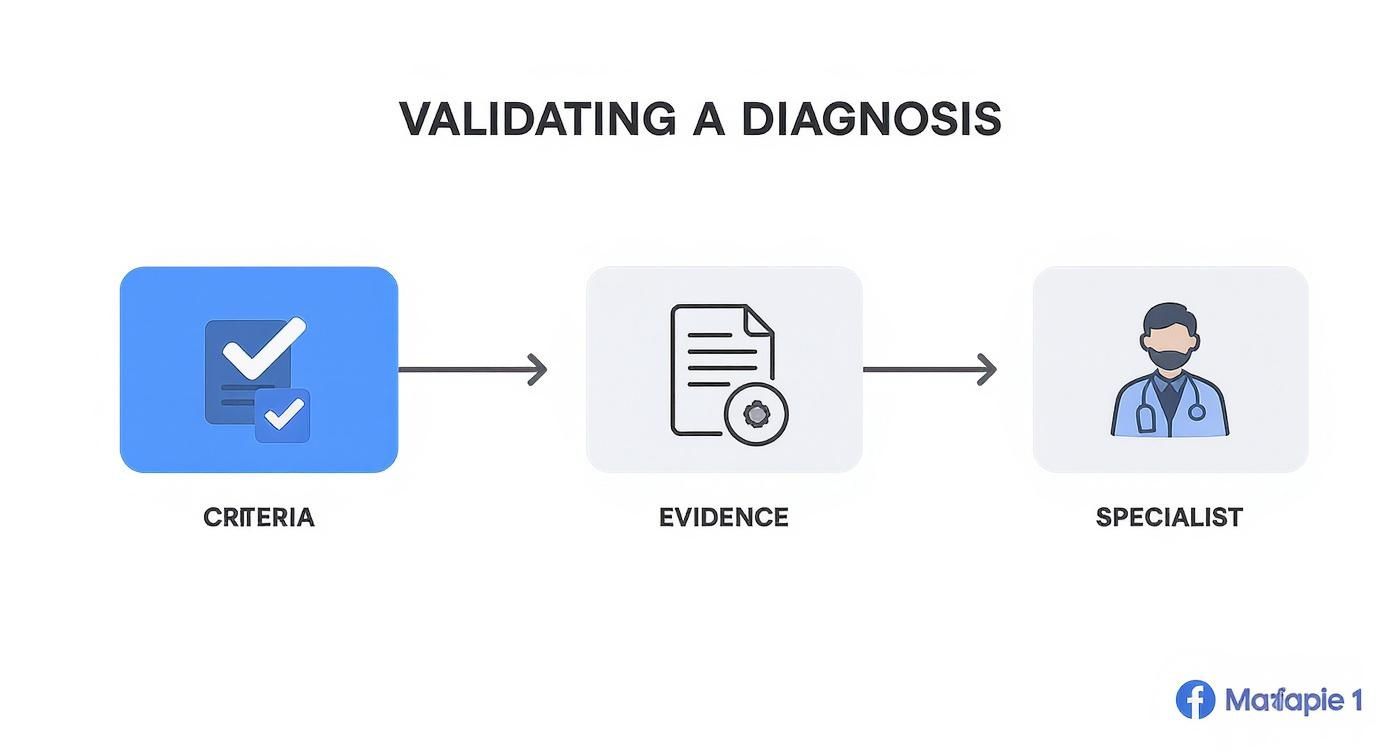
As you can see, a trustworthy diagnosis is built on three pillars: meeting the established criteria, pulling together solid evidence, and having it all interpreted by a specialist.
Stage 4: Receiving Your Comprehensive Report
Once the interview is done, the clinician brings everything together—your questionnaires, the documents you provided, and the interview itself—into a detailed diagnostic report. This document will clearly state whether or not you meet the criteria for an ADHD diagnosis and give you a full explanation of how they reached that conclusion.
A good report does more than just give you a label. It offers personalised recommendations for what to do next, which might include medication, therapy, coaching, or practical adjustments you can ask for at work. Crucially, it’s a medically recognised document that you can share with your GP.
Understanding the potential investment is key. In the UK private sector, a full diagnostic assessment typically costs between £700 and £1,200. If medication is the right path for you, the titration phase—where a specialist carefully finds the right type and dose—can add £200-£500 per month for a few months.
While going through the NHS is free, the big advantage of a private online ADHD assessment is speed. The entire process, from that first form to getting your report, can often be wrapped up in a matter of weeks. That's a world away from the years you might spend on an NHS waiting list.
How to Choose a Reputable UK Assessment Service
With the rising demand for answers, the internet is now flooded with services offering an online ADHD test. Honestly, the sheer number of options can feel overwhelming, and it's a sad fact that not all of them are legitimate medical providers. Learning to tell the difference between a high-quality clinical service and a questionable online business is absolutely critical for your safety and for getting a diagnosis that holds real weight.
Choosing the right service isn't just about getting a quick answer; it's about ensuring you receive a credible, medically sound evaluation that other healthcare professionals, including your GP, will actually respect. Think of this as your toolkit for spotting the good ones and avoiding the pitfalls.
Non-Negotiables for Any UK Provider
When you're vetting a service, there are a few key credentials that are completely non-negotiable. These are the essential safety checks that prove you're dealing with a real medical practice that operates legally and ethically within the UK.
Your checklist should include these four core items:
-
CQC Registration: The Care Quality Commission (CQC) is the independent regulator of all health and social care services in England. If a provider is CQC-registered, it means they are inspected and held to specific standards of safety and quality. Never, ever use a service that isn't.
-
GMC-Registered Consultant Psychiatrists: Your assessment absolutely must be led by a Consultant Psychiatrist who is on the General Medical Council's (GMC) Specialist Register. This is the highest level of psychiatric qualification in the UK and ensures the person diagnosing you has the required expertise.
-
Adherence to NICE Guidelines: The National Institute for Health and Care Excellence (NICE) provides the official clinical guidelines for diagnosing and treating ADHD in the UK. Any reputable service will state clearly that their assessment process follows these evidence-based standards.
-
Transparent Pricing: A trustworthy provider will have a clear, upfront breakdown of all costs. This should cover the assessment itself, the report, and any potential follow-up costs for things like medication titration. Hidden fees are a massive red flag.
Red Flags to Watch Out For
Knowing what to look for is only half the battle; knowing what to avoid is just as important. Some online services use slick marketing to look legitimate but lack the clinical substance needed for a real diagnosis. Keep a sharp eye out for these warning signs.
A diagnosis is a complex medical conclusion, not a product to be sold. Any service that frames it as a guaranteed outcome is prioritising profit over your genuine health needs and should be avoided at all costs.
Be very wary of any provider that:
- Guarantees a diagnosis: This is profoundly unethical. An assessment is an investigation, not a rubber stamp. The outcome has to be based purely on clinical evidence, whatever that may be.
- Offers prescriptions without a full assessment: Prescribing stimulant medication requires a thorough diagnostic process and careful consideration of your entire medical history. Any service offering a quick prescription is simply not safe.
- Is vague about their clinicians: If the website doesn't clearly state who conducts the assessments or what their qualifications are, that's a serious concern. You should be able to see the names and credentials of their consultant psychiatrists.
- Doesn't consider other conditions: ADHD has significant symptom overlap with other conditions like Autism, anxiety, and trauma. A good clinician will always conduct a differential diagnosis to explore and rule out other possibilities, ensuring your diagnosis is accurate.
Making the right choice ensures the report you receive is a valuable medical document. It’s the key to unlocking support, from workplace adjustments to a potential shared care agreement with your GP, which would allow you to get your prescription on the NHS. Taking the time to find a service with the right credentials provides the foundation for your entire journey post-diagnosis. For a clear example of what a robust and transparent process looks like, explore our guide to getting a private ADHD diagnosis in the UK.
Life After an ADHD Diagnosis: What Comes Next?

Getting an ADHD diagnosis isn’t the end of the road; it’s the start of a new, better-informed chapter. Suddenly, you have a framework to make sense of past struggles, and more importantly, a clear path towards getting the right kind of support. The focus shifts from wondering why things are so hard to actively building strategies that help you thrive.
This next phase is all about blending medical treatment with practical, everyday support, all shaped around your specific needs. It’s about finding the tools, therapies, and small life adjustments that work with your brain, not against it.
The Role of Medication and Titration
For many adults, medication is a game-changer for managing ADHD symptoms. But it’s definitely not a simple one-size-fits-all prescription. The journey to find the right medication and dosage is a careful process known as titration, which you’ll navigate closely with your psychiatrist.
Titration is methodical. Your specialist will start you on a very low dose, then slowly increase it over several weeks or even months. This cautious approach is crucial for finding that sweet spot—the dose that gives you the most benefit with the fewest side effects. You can get a much deeper look into how this works in our guide to ADHD medication for adults in the UK.
Building Your Support System Beyond Medication
While medication can be incredibly effective, it’s just one piece of the puzzle. A diagnosis unlocks the door to a whole range of non-medical support systems designed to help you build skills and resilience for the long term.
Here are some key supports to consider:
- ADHD Coaching: A coach can work with you one-on-one to create practical, real-world strategies for managing time, getting organised, and tackling those tricky executive function challenges.
- Cognitive Behavioural Therapy (CBT): This isn't just standard therapy; it can be specifically adapted for ADHD to help you work through negative thought patterns and manage emotional dysregulation.
- Workplace Adjustments: With a formal diagnosis in hand, you can request reasonable adjustments at work. This could mean anything from noise-cancelling headphones to flexible hours or getting instructions in writing.
A big part of post-diagnosis life is discovering what helps you manage day-to-day. For instance, looking into the top ADHD productivity tools can be a fantastic way to find practical aids for improving focus and staying on track.
Understanding Co-Occurring Conditions Like Autism
It’s very common for ADHD to exist alongside other conditions, particularly Autism Spectrum Disorder (ASD). There’s a lot of overlap in the challenges, like executive dysfunction and social difficulties. A thorough, reputable diagnostic service will have already considered this possibility during your assessment.
Understanding if you have co-occurring conditions is vital. The strategies that work well for ADHD may need to be adapted if you are also autistic, ensuring your support plan addresses your entire neurotype.
The incredibly long waiting times for adult ADHD assessments in the UK—often stretching beyond a year on the NHS—can put this entire supportive journey on hold. This delay is a huge problem, but research shows that using technology-assisted tools can significantly speed up the diagnostic process, helping more people get the timely support they need.
Ultimately, getting that accurate diagnosis is the first, most crucial step towards a future where you feel empowered with the right knowledge and tools to move forward.
Your Questions About Online ADHD Tests, Answered
You’ve likely still got some practical questions buzzing around. Let's tackle some of the most common ones to give you a clearer picture of what to expect as you move forward.
Will My GP Accept a Private Online ADHD Diagnosis?
This is a big one. While a GP isn’t obligated to accept any private diagnosis, they are far more likely to do so when it comes from a credible source. A report from a CQC-registered service, conducted by a GMC-registered specialist who sticks to the official NICE guidelines, gives them the clinical evidence they need to trust the outcome.
The best approach? Have a chat with your GP before you book a private assessment. Letting them know your plans can pave the way for a smoother transition to a shared care agreement for your medication once the titration phase is over. Working together is always the best path forward for your long-term care.
How Is an ADHD Assessment Different from an Autism Assessment?
It’s easy to see why this gets asked, as some of the outward signs of ADHD and Autism can look similar. The real difference is what the assessment is looking for. An ADHD assessment hones in on lifelong patterns of inattention, hyperactivity, and impulsivity. An Autism assessment, on the other hand, explores social communication, interaction styles, sensory sensitivities, and what are often called repetitive behaviours.
It's worth knowing that the two conditions often go hand-in-hand. That's why many of the best assessment services will screen for both. This isn't about fitting you into a box; it's about getting a truly accurate picture of your neurotype so you get support that actually works for you.
What Is the Total Cost for Online ADHD Diagnosis and Treatment?
The costs can vary quite a bit between providers, so it's smart to think about it in stages. A comprehensive diagnostic assessment will typically set you back somewhere between £700 and £1,200.
If you and your consultant decide medication is the right path, the next stage is titration. This can add another £200 to £500 per month for a few months to cover the specialist consultations and private prescription fees. The good news is that once your dose is stable, a shared care agreement with your GP can bring this cost right down to the standard NHS prescription charge. Always, always ask for a full breakdown of costs upfront so there are no nasty surprises.
Ready to get the clarity you need with an assessment you can trust? Insight Diagnostics Global offers CQC-regulated, comprehensive online evaluations for ADHD, Autism and a range of other mental health conditions, all led by experienced consultants. Take the first step towards understanding yourself better by exploring our services at https://insightdiagnostics.co.uk.