When you start looking into private autism and ADHD assessments, one of the first things you'll notice is the wide range of costs. In the UK, you can expect to see prices anywhere from £700 to £3,500. This isn't arbitrary; that significant gap reflects the different levels of detail, expertise, and support that various clinics provide.
Figuring out what's behind these numbers is the key to making a confident and informed choice for yourself or your family.
Understanding the Private Autism & ADHD Assessment Cost in the UK

Let's be honest, navigating the financial side of a private diagnosis for autism or ADHD can feel overwhelming, especially when the costs seem to vary so much from one provider to the next. The price tag isn’t just for a final piece of paper; it’s a direct reflection of the clinical time, specialist expertise, and resources needed to deliver a thorough and genuinely helpful diagnosis.
A proper, comprehensive evaluation for Autism—often alongside a co-occurring condition like ADHD—isn't a simple tick-box exercise. It's a detailed, multi-faceted process.
This investment covers the entire diagnostic journey, which typically includes:
- Initial Triage: A preliminary screening to make sure a full assessment for autism, ADHD, or both is the right step for you.
- Clinical Interviews: Deep-dive conversations to build a complete picture of your developmental history and experiences.
- Diagnostic Tools: The administration of standardised, evidence-based assessment tools like the ADOS-2 or ADI-R for autism, and the DIVA-5 for ADHD.
- Professional Expertise: The dedicated time of highly qualified clinicians—like consultant psychiatrists and clinical psychologists—for analysis and reporting.
A Quick Look at Price Tiers
To help make sense of the costs, here's a general breakdown of what you might encounter. Different price points usually correspond to different levels of assessment depth and post-diagnostic support, letting you find an option that fits your needs and budget.
Think of it like choosing a service package. A standard package will give you the essential, robust diagnosis for a single condition. A more comprehensive one might cover combined Autism and ADHD assessments, add extensive follow-up support, and include detailed recommendations for school or work.
For a clearer overview, the table below summarises the typical price tiers.
Private Autism Assessment Cost At a Glance
| Price Tier | Typical Cost Range (UK) | What's Often Included |
|---|---|---|
| Lower-End | £700 – £1,500 | A straightforward diagnostic assessment, often for a single condition and delivered remotely. It usually includes a diagnostic report but may have limited post-diagnostic support. |
| Mid-Range | £1,500 – £2,500 | A more comprehensive assessment, potentially including tools like the ADOS-2, or a combined Autism and ADHD evaluation. Includes detailed feedback sessions and a thorough report with initial recommendations. |
| Higher-End | £2,500 – £3,500+ | A full multi-disciplinary assessment for complex cases or dual diagnoses, involving several specialists. Includes extensive reports, detailed support plans, and follow-up consultations. |
This table is a guide to help set expectations. It’s also worth remembering that many clinics now offer combined assessments for Autism and ADHD. Opting for a dual assessment can often be more cost-effective than pursuing two separate diagnoses one after the other.
What Factors Influence the Final Cost?
When you start looking into private autism or ADHD assessments, the range of prices can be baffling. Why does one clinic quote £1,500 while another asks for nearly double that? It’s not arbitrary – the final figure is shaped by a few crucial factors that determine the depth and quality of the entire process.
Getting your head around these variables is key. It helps you move past just looking at a price tag and start understanding exactly what you're paying for. Think of it like buying a car; the base model will get you from A to B, but the price will naturally go up as you add a more powerful engine, advanced safety features, or specialist customisations.
The Clinician's Expertise and Seniority
A huge part of the cost comes down to who is actually carrying out the assessment. An autism or ADHD diagnosis is a significant, life-shaping piece of information, so the experience of the person making that call really matters. The seniority and specialism of the clinical team are directly reflected in the price.
- Consultant Psychiatrist: These are medical doctors with years of specialist training in mental health. They're equipped to diagnose complex cases, understand co-occurring conditions like ADHD, and can prescribe medication. Their involvement, especially in tricky situations, costs more due to their high level of expertise.
- Clinical Psychologist: A professional holding a doctorate in psychology, they are experts in administering diagnostic tests and creating detailed therapeutic recommendations.
- Multi-Disciplinary Team (MDT): The most comprehensive (and therefore expensive) assessments often involve a whole team. This might include a speech and language therapist or an occupational therapist alongside a psychiatrist or psychologist. This team-based approach gives a complete, 360-degree view but means more clinical hours are needed, pushing up the cost.
Assessment Tools and Diagnostic Rigour
Not all assessments are created equal. The specific diagnostic tools used are a major cost driver, as clinicians need specialised training to use and interpret them correctly. Using the "gold standard" tools is what makes a diagnosis robust and widely accepted by schools, local authorities, and other official bodies.
For example, assessments for autism that use the Autism Diagnostic Observation Schedule, Second Edition (ADOS-2) and the Autism Diagnostic Interview-Revised (ADI-R) will almost always cost more. For ADHD, tools like the Diagnostic Interview for ADHD in Adults (DIVA-5) are used. These aren't simple questionnaires; they are hours-long, structured interactions and deep-dive interviews that demand a huge time commitment from a highly skilled professional. A cheaper assessment might skip these, relying only on screening forms and clinical interviews, which can still lead to a valid diagnosis but might not provide the same level of certainty.
A proper assessment isn't just about getting a 'yes' or 'no'. It's about carefully building a detailed, evidence-based picture of how a person's brain works. The more detailed that picture needs to be, the more resources it takes to create it.
The Impact of a Combined Autism and ADHD Assessment
It's very common for people who think they might be autistic to see traits of ADHD in themselves too. If that sounds familiar, looking into a combined assessment for both conditions at once is often a smart move. Although a dual assessment is more complex and takes longer than an assessment for a single condition, it’s nearly always more cost-effective than arranging two separate ones down the line. It’s an efficient way to save time and money while getting a complete diagnostic picture in one go.
What Does a Private Assessment Process Involve?
So, you've got a handle on the potential costs, but what are you actually paying for? When you invest in a private autism or ADHD assessment, you're not just buying a label. You're paying for a thorough, multi-stage journey designed to build a deeply personal and accurate picture of who you are. It’s far more than a simple checklist; think of it as a team of experts carefully piecing together the story of your life.
The process often kicks off well before you even speak to a lead clinician. It starts with an initial enquiry or screening phase. Here, the clinic gathers essential background information to make sure a full diagnostic assessment for Autism, or perhaps a combined one with ADHD, is the right path for you. This initial triage is vital—it ensures you’re not heading down a road that isn’t a good fit from the very beginning.
Once you’re through that gate, the real deep-dive begins with a series of in-depth clinical interviews.
The Developmental History Interview
This is one of the most critical parts of the whole process. It's a detailed conversation, often including a parent, partner, or someone who's known you for a long time, that maps out your life from early childhood right up to today. For autism, the clinician looks for lifelong patterns of social communication, interaction, and interests. For ADHD, they explore patterns of inattention, hyperactivity, and impulsivity. It’s a collaborative exploration, not an interrogation.
Alongside this, there will be direct observation and interaction, which is where standardised diagnostic tools are used. These aren't pass-or-fail tests. Instead, they give the clinician an objective framework to hang their observations on, making sure the assessment is rigorous and meets national best practice guidelines.
The infographic below breaks down how all these different elements come together, influencing both the assessment journey and its final cost.
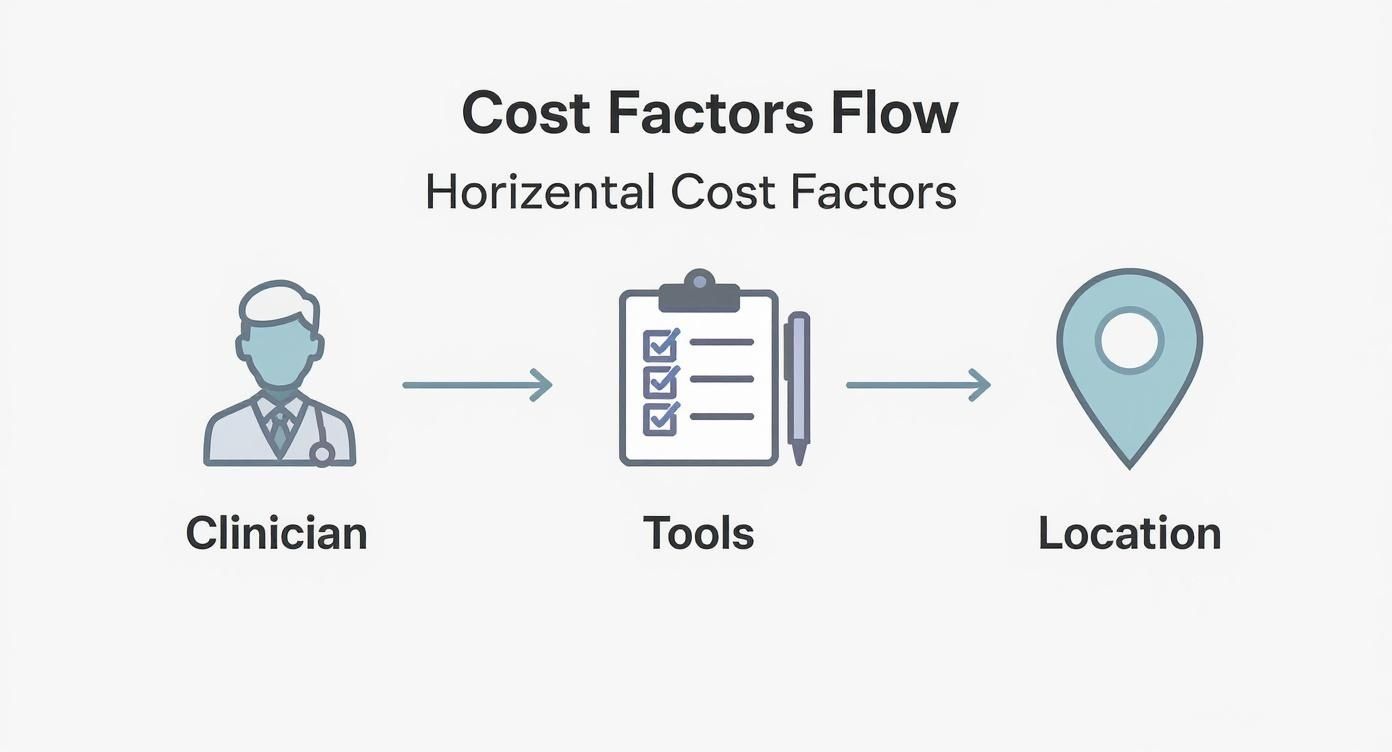
As you can see, it’s a blend of the clinician's expert judgement, the specific tools they use, and even the setting of the assessment itself. A high-quality diagnosis is built on this combination of specialist skill and methodical process.
The Role of a Multi-Disciplinary Team
For more complex situations, or simply to get a more rounded picture, a multi-disciplinary team (MDT) might be involved. This just means you get the benefit of having specialists from different fields—like a consultant psychiatrist and a clinical psychologist—weighing in. An MDT approach gives a really robust, 360-degree view, which is especially useful when co-occurring conditions like ADHD might be part of the picture.
A diagnosis isn’t an end point; it’s a signpost. A good assessment process doesn't just tell you if you are autistic or have ADHD. It explains how you are autistic or experience ADHD and provides a map for the road ahead.
Finally, every piece of information gathered—from the interviews, questionnaires, and direct observations—is brought together and analysed to produce the final diagnostic report.
The Comprehensive Diagnostic Report
This document is the culmination of the entire assessment. A truly high-quality report does much more than just state the outcome. It provides a detailed, personalised narrative that should clearly lay out:
- Your unique profile: A summary of your personal strengths alongside the challenges you face related to autism and/or ADHD.
- Diagnostic justification: A straightforward explanation of how the clinical findings line up with the criteria for Autism Spectrum Disorder (ASD) and/or Attention-Deficit/Hyperactivity Disorder (ADHD).
- Actionable recommendations: Practical, real-world suggestions for support you can use at home, in education, or at work.
This report is your key to unlocking support and accommodations. If you want to dive deeper into what a top-tier evaluation looks like, you can learn more about our comprehensive mental health assessment services. Ultimately, the entire process is there to give you clarity, validation, and a practical framework to help you move forward with confidence.
Private Diagnosis vs The NHS Pathway
Deciding whether to go through the NHS or opt for a private assessment for autism or ADHD is often the first, and biggest, hurdle you’ll face. Both routes can lead to a formal diagnosis, but the experience, timeline, and financial implications are worlds apart. Getting your head around these differences is the key to figuring out what’s right for you.
https://www.youtube.com/embed/jk3y-7HwwYc
The most glaring difference, and the one that pushes many to explore private options, is the waiting time. The NHS provides an incredible service, free for all of us, but it's no secret that it’s stretched thin. Right now, waiting lists for autism and ADHD assessments can run into years, not months. For people needing answers and support, that delay can feel like an eternity.
This is where the private sector steps in. By paying for an assessment, you are essentially paying to sidestep that long queue.
Speed and Accessibility
The biggest pull for going private is, without a doubt, speed. Where an NHS wait is often measured in years, a private assessment can usually be wrapped up in a matter of weeks or a few months. That speed can be a game-changer when you need support at work, university, or for a child at school.
Getting a diagnosis sooner means you can get the right understanding and adjustments in place much faster. For many, that clarity and immediate access to support is well worth the private autism assessment cost.
Cost and Choice
Of course, the flip side is the direct financial cost. An NHS assessment is covered by taxes, so you don't pay a penny. A private assessment is something you fund yourself, and it requires a significant investment. This cost is understandably a major factor for most people.
What you get for that investment, however, is a much greater degree of choice. You have the freedom to research different clinics and clinicians, finding someone whose experience and approach feel right for you. This is especially helpful if you think other conditions might be at play. If you're also wondering about ADHD, for example, it's worth looking into the process for an ADHD assessment in the UK to see how specialised services work.
Ultimately, it’s a trade-off. The NHS provides a high-quality, free service with a potentially very long wait. The private route offers a fast, flexible alternative that you have to pay for directly. Neither one is "better" – they just meet different needs and priorities.
To make things a bit clearer, let’s break down the key differences side-by-side.
Comparing NHS and Private Assessment Pathways
Here's a straightforward comparison to help you weigh up the two pathways.
| Factor | NHS Pathway | Private Pathway |
|---|---|---|
| Waiting Time | Often 1-3+ years, depending on your local trust's demand for autism and ADHD services. | Typically weeks to a few months from your first enquiry to getting the final report. |
| Cost | Free at the point of service. | Self-funded, usually ranging from £1,500 to £3,500+. |
| Choice of Provider | Generally limited choice; you are referred to your local NHS trust or their commissioned service. | Full choice to research and select a clinician or clinic that specialises in your specific needs, such as adult autism or combined assessments. |
| Referral Process | A GP referral is mandatory to join the NHS waiting list. | Self-referral is usually possible, meaning you can contact clinics directly without seeing your GP first. |
| Recognition | A diagnosis is universally recognised by all official bodies, including schools and local authorities. | A diagnosis from a NICE-compliant, HCPC-registered provider is widely recognised, but it's vital to check the provider's credentials. |
In the end, the right choice really comes down to your personal circumstances—your finances, your family's needs, and how urgently you need answers.
How to Choose a Reputable Assessment Provider
Searching for a private autism or ADHD assessment can feel a bit like navigating a maze. With so many providers out there, how do you know who to trust with something so important? The truth is, the quality of your assessment makes all the difference, so picking the right clinician is the single most critical step you'll take.
A reputable provider doesn’t just give you a report and send you on your way. They guide you through a clear, supportive, and clinically robust process. Your aim should be to find a service whose diagnostic report will be taken seriously by schools, employers, and local authorities. Get this choice right, and it opens the door to the support you need.
Essential Credentials and Green Flags
Before you commit to any service, you need to do a bit of homework. Think of it as doing a background check. A trustworthy provider will be completely open about their credentials and assessment process, making it easy for you to feel confident in their legitimacy.
Here are the absolute must-haves:
- HCPC Registration: Any UK-based clinician, like a Clinical Psychologist, must be registered with the Health and Care Professions Council (HCPC). If they are a psychiatrist, they need to be on the GMC Specialist Register. This is your proof that they meet strict national standards for training, ethics, and professionalism.
- Adherence to NICE Guidelines: The assessment itself has to follow the official guidelines from the National Institute for Health and Care Excellence (NICE) for autism and ADHD. This isn't just a suggestion; it's the gold standard that ensures a diagnosis is thorough, evidence-based, and reliable.
- Transparent Pricing: A clear, upfront breakdown of the private autism assessment cost is a massive green flag. You should know precisely what you're paying for—and what might cost extra—before you part with a single penny.
- Post-Diagnostic Support: A good clinician knows a diagnosis isn't the finish line; it's the starting line. Look for clinics that either offer follow-up support themselves or can point you towards trusted services that help you make sense of the report and its recommendations.
A credible assessment is built on a foundation of recognised standards and clinical rigour. If a provider cannot easily prove their credentials or seems vague about their process, consider it a serious warning sign.
Red Flags to Watch Out For
Knowing what to look for is only half the battle; knowing what to avoid is just as crucial. Some providers might tempt you with a service that seems faster or cheaper, but a poor-quality assessment is often a waste of money and can result in a diagnosis that nobody recognises.
Be very cautious of any provider who:
- Guarantees a Diagnosis: This is a huge red flag. No ethical clinician can ever promise a particular outcome before they’ve completed a full, in-depth assessment.
- Rushes the Process: A proper, thorough assessment for autism or ADHD simply takes time. Be wary of any service offering an "instant" diagnosis or a ridiculously quick evaluation that skips over detailed interviews and history-taking.
- Lacks a Multi-Disciplinary Approach: While a single expert can conduct an assessment, input from different specialists (like a psychiatrist and a psychologist working together) really strengthens a diagnosis, especially for more complex cases where Autism and ADHD might co-occur.
- Cannot Confirm Their Report is Accepted: Don't be afraid to ask them directly if their reports are typically accepted by local authorities, schools, or the NHS for things like shared care agreements. If they dodge the question or seem unsure, it's best to walk away.
Funding Your Assessment: Insurance and Payment Options
Once you have a clear quote in hand, the next big question is, "How do I pay for this?" Thinking about the financial side can feel a bit overwhelming, but breaking down your options can turn that big number into a realistic plan.
Let's be upfront: the vast majority of people in the UK will need to self-fund their assessment. While there are a few potential avenues for support, they aren't always easy to navigate. For most, this journey involves sitting down, looking at the budget, and seeing how a clinic’s payment structure can make things more manageable.
Getting this part right is so important. It helps clear away the financial stress so you can focus on what really matters—the assessment itself.
Using Private Medical Insurance
One of the first things people wonder is if their private health insurance will foot the bill. Unfortunately, the answer is usually no. Most UK insurance policies explicitly exclude the diagnosis of neurodevelopmental conditions like autism and ADHD.
It’s always worth double-checking your specific policy, though. You never know. Here’s how to get a definitive answer:
- Dig into your policy documents: Search for keywords like "neurodevelopmental conditions," "developmental disorders," or even "psychiatric assessments." The devil is in the detail.
- Call your insurer directly: Get someone on the phone and ask them straight out: "Are diagnostic assessments for Autism Spectrum Disorder or ADHD covered?" Be sure to ask about any limits or conditions.
Even if the initial assessment isn't covered, some policies might offer support for therapies or consultations after you have a diagnosis. It’s crucial to clarify exactly what’s included before you make any assumptions.
Self-Funding and Payment Plans
For most people, self-funding is the way forward. Good clinics know this is a significant financial undertaking and usually offer payment plans to soften the blow. Rather than asking for the full amount in one go, they'll often break it down into more manageable chunks.
Typically, this looks like an initial deposit to book your appointments, with the rest of the balance spread out over a few months. This makes the cost predictable and much easier to budget for. It's also wise to think ahead; when considering any potential treatment after your diagnosis, it's helpful to look into things like your options for private prescriptions online, which can be a key part of long-term financial planning.
Frequently Asked Questions
When you're thinking about a private autism or ADHD assessment, it's completely normal to have a head full of questions about how it all works and what it costs. We've put together some of the most common ones we hear to give you clear, straightforward answers and help you feel more confident about what's involved.
How Long Does the Whole Process Take?
One of the biggest differences you'll notice between private and NHS pathways is speed. From the moment you first get in touch to having the final report in your hands, most good private clinics can get everything done within four to twelve weeks.
This timeframe isn't just the assessment day itself. It covers the initial screening, the in-depth clinical interviews, the assessment, and the time your clinician needs to pull all the information together into a detailed, meaningful report. That shorter waiting time is often the key reason people choose to go private for an autism or ADHD diagnosis – it massively reduces that stressful period of not knowing.
Is a Private Diagnosis Recognised by Schools and the NHS?
This is a really important one, and the short answer is yes, but with a crucial condition: the assessment has to be done properly. For a private autism or ADHD diagnosis to hold any weight officially, it must be carried out by a fully qualified professional (like a psychologist registered with the HCPC or a psychiatrist on the GMC register). It also has to follow the national guidelines set out by NICE (the National Institute for Health and Care Excellence).
Any reputable provider knows this inside out and builds their entire process to meet these standards. Their reports are written specifically to be used by schools when creating an Education, Health and Care Plan (EHCP), by universities for support, or by employers for making workplace adjustments. It’s always worth checking this with a clinic before you sign up.
A great question to ask any potential provider is: "Are your diagnostic reports fully NICE-compliant and are they typically accepted by local authorities and NHS services?" A clinic that knows its stuff will give you a confident and clear 'yes' without any hesitation.
What Support Is Available After the Assessment?
A good assessment is more than just a document. High-quality clinics don't just hand you a report and wave goodbye. You should always have a post-diagnostic feedback session included, where the clinician sits down with you to talk through their findings, answer your questions, and explain what their recommendations actually mean for you. It’s your chance to really digest the information in a supportive space.
After that, many providers can also offer:
- Signposting: They’ll point you towards trusted charities, local support networks, and specialist therapists who can help.
- Follow-up Consultations: You can often book extra appointments later on to discuss how things are going or tackle any new challenges.
- Medication Pathways: If you receive a combined Autism and ADHD diagnosis, many clinics can help start and manage medication if that's a route you want to explore.
The whole point is to make the diagnosis a practical tool—a starting point for getting the right support in place to improve your quality of life.
At Insight Diagnostics Global, we provide clear, NICE-compliant online assessments for adults, ensuring your report is comprehensive and respected. If you need clarity and a path forward, learn more about our assessment process. Visit https://insightdiagnostics.co.uk.