When you start looking into private mental health assessments, especially for neurodevelopmental conditions like Autism and ADHD, the cost is often the first thing on your mind. In the UK, the price can vary quite a bit. For an ADHD assessment, you're generally looking at a range between £500 and £1,500. A more involved Autism assessment, on the other hand, typically starts around £1,800 and can go up to £3,500 or more.
Understanding the Initial Investment in Your Mental Health
That initial figure might seem steep, but it's important to understand what you're paying for. Going private is often about getting clarity and a clear path forward, especially when NHS waiting lists for mental health and neurodevelopmental services feel impossibly long. This isn't just a single chat; it's a comprehensive, specialist-led process designed to get to the root of your concerns about your mental wellbeing.
For many people, the need for answers about conditions like ADHD or Autism feels urgent, which is why they turn to private mental health services. Taking a look at what different providers offer can give you a much better idea of what's included in that initial cost and help you manage your expectations.
A Look at ADHD and Autism Assessment Costs
There's a noticeable price difference between ADHD and Autism assessments, and it really comes down to the complexity of the diagnostic process. An Autism diagnosis often requires a multi-disciplinary team and significantly more clinical time to ensure a thorough and accurate evaluation of this complex neurodevelopmental condition.
Here’s a quick snapshot of what you can typically expect to pay for different private assessments in the UK.
Quick Guide to Private Assessment Costs in the UK
| Assessment Type | Typical Cost Range | Key Considerations |
|---|---|---|
| ADHD Assessment | £500 – £1,500 | Generally a more straightforward diagnostic process. The price can vary based on the clinician's experience and whether follow-up appointments are included. |
| Autism (ASD) Assessment | £1,800 – £3,500+ | This often involves a multi-disciplinary team (e.g., psychiatrist, psychologist, speech therapist) and multiple sessions, making it more expensive. |
This table shows why it's so crucial to know exactly what is included in the private mental health assessment cost before you commit.
This infographic helps visualise the difference in cost between the two main neurodevelopmental assessments.
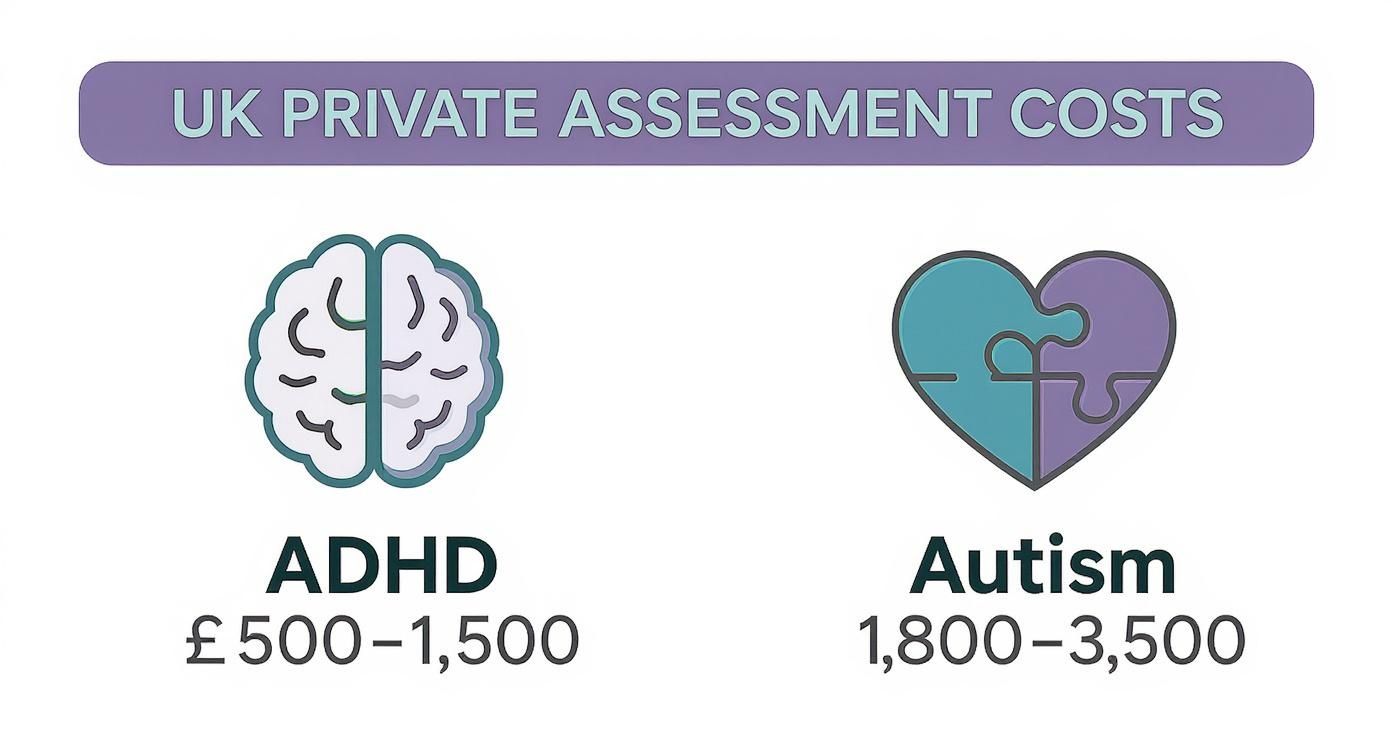
As you can see, the financial commitment for an Autism assessment is considerably higher than for ADHD.
Drilling down into the numbers, a private Autism assessment in the UK usually sits somewhere between £1,800 and £3,500. Some specialist clinics, particularly those for children, might even charge more. If you're in London, for instance, the average cost for a full assessment is about £2,344. In comparison, private ADHD assessments are more financially accessible, with the cost typically falling between £500 and £1,500. This stark difference highlights just how vital it is to understand what you're getting for your money before moving forward.
Decoding the Price Tag on ADHD and Autism Assessments

When you start exploring private mental health assessment costs, particularly for neurodevelopmental conditions like Autism and ADHD, you'll quickly spot a trend. An Autism assessment nearly always comes with a significantly higher price than one for ADHD. This isn't just a random price hike; it’s a direct reflection of the very different diagnostic journeys each condition requires.
Think of an ADHD assessment as a focused, albeit thorough, investigation into traits like inattention, hyperactivity, and impulsivity. It tends to follow a more direct path. The process usually involves structured interviews, rating scales filled out by you (and sometimes someone who knows you well), and a specialist, often a single psychiatrist, reviewing your developmental history.
An Autism assessment, on the other hand, is much more like putting together a feature-length documentary. It demands a multi-angled approach to capture a complete picture of how you communicate, socialise, and experience the world. It’s this sheer complexity that drives up the cost.
The Multi-Disciplinary Team Approach
A major reason for the higher cost of an Autism diagnosis is the need for a multi-disciplinary team. For a truly robust assessment that meets gold-standard guidelines, one clinician's viewpoint often isn't enough.
Instead, a proper assessment might bring together:
- A Consultant Psychiatrist to lead the process, pull all the evidence together, and make the final diagnosis.
- A Clinical Psychologist who might run specific cognitive or psychometric tests.
- A Speech and Language Therapist to dive into the subtleties of social communication and language.
This team effort ensures the conclusion is well-rounded and accurate, but getting multiple specialists in sync naturally adds to the time and, therefore, the expense.
An Autism assessment is not just about ticking off a list of traits; it's about understanding an individual's unique way of being in the world. This requires a deep dive with specialised tools and multiple expert perspectives, all of which influences the final cost.
Specialised Tools and In-Depth Reporting
Another key piece of the puzzle is the use of highly specialised diagnostic tools. The Autism Diagnostic Observation Schedule, Second Edition (ADOS-2) is often a central part of the assessment. This is a standardised, semi-structured session that looks closely at communication, social interaction, and imaginative play. Administering and scoring the ADOS-2 is a skill in itself, demanding specific training and a serious time commitment from the clinician.
The final report for an Autism diagnosis is also a much more substantial document. It has to weave together information from all those different sources—interviews, observations, questionnaires, and input from family or school—into a comprehensive story with personalised recommendations. This detailed analysis takes many hours of work after the assessment appointments are over, which is a big contributor to the higher price.
By comparison, an ADHD report, while still detailed, is generally less complex to pull together. For a better sense of how the two differ, you can learn more about the specifics of a private ADHD assessment cost and see a breakdown of its components.
What Factors Influence the Final Price Tag?
Trying to understand the cost of a private mental health assessment for Autism or ADHD can feel a bit like commissioning a bespoke piece of furniture rather than buying something off the shelf. The final price isn't fixed; it's shaped by several key factors. Knowing what these are will help you make sense of the quotes you receive and spot true value.
The clinician’s expertise is probably the biggest piece of the puzzle. An assessment from a Consultant Psychiatrist, a medical doctor who can formally diagnose and prescribe medication, will almost always cost more than one from a Clinical Psychologist. It’s not a reflection of quality but of their distinct, extensive medical training and legal authority to manage prescriptions.
Then there’s the depth of the assessment itself. A straightforward screening for something like ADHD or autism is a different beast entirely from a full diagnostic work-up. The latter often involves multiple sessions, in-depth cognitive tests, and a far more detailed final report. The more comprehensive the process, the more clinical hours are needed, and that’s what you’re paying for. You can get a clearer idea of the different levels available by exploring various comprehensive mental health assessment services.
Location and Follow-Up Care
Believe it or not, your postcode can have a real impact on the bill. It's a classic "postcode lottery" scenario. Private clinics in big cities, especially London, often have higher prices to cover their steeper running costs and meet high demand for mental health support.
This regional price difference is a well-known quirk of private healthcare. It really pays to shop around, comparing providers both in your local area and nationally—especially now that so many offer online consultations, which can level the playing field.
A survey of UK private psychologists highlighted just how wide this gap can be. While the national average for one consultation hovered around £130, a full course of twelve sessions could set you back £1,920 in London but only £1,284 in the North East. The MyTribe Insurance report goes into more detail on these pricing differences.
Finally, it’s crucial to look beyond the initial diagnosis. The headline price for the assessment might not include the ongoing care you'll need afterwards, which can add significant costs down the line.
Be sure to ask what’s included and what’s extra. Key post-assessment services often billed separately are:
- Medication Titration: For an ADHD diagnosis, this is the vital process of carefully adjusting your medication dosage to find the sweet spot—maximum benefit with minimal side effects. This is nearly always a separate service with its own fee structure.
- Follow-Up Consultations: You'll need these appointments to track your progress, fine-tune your treatment plan, and discuss any new issues that come up.
- Specialised Reports: If you need a specific report written for your child’s school or your employer to arrange support, this will likely be an additional charge.
Getting a clear picture of all these factors from the outset will help you compare quotes fairly and find a provider that truly fits your needs and your budget.
Comparing the Private Route to the NHS Pathway
Choosing between a private mental health assessment and going through the NHS is a big decision, and it usually comes down to weighing up speed versus cost. The real difference lies in three things: how long you’ll wait, how much you’ll pay, and how much say you get in your care. Both paths have their pros and cons, and it’s vital to know what they are.
The NHS provides mental health assessments free of charge, which is, without a doubt, its biggest plus. The trade-off, however, is time. Waiting lists for specialised assessments like those for ADHD and Autism can be painfully long, often stretching into years. For many people, that delay means living with uncertainty and going without the support they desperately need.
The Time Versus Money Equation
Going private completely flips that around. The standout benefit of a private assessment is how quickly you can be seen. Instead of being stuck on a waiting list for what feels like an eternity, you can often book an appointment within a few weeks. This means a faster diagnosis and a quicker start to any treatment.
Of course, this speed comes with a significant financial cost, as you’ll be paying for the private mental health assessment cost yourself or through an insurance provider.
To get a clearer picture of what each system offers, this Private Healthcare vs NHS a UK Comparison provides some excellent insights. The decision really boils down to a personal dilemma: can you afford to wait for the NHS, or can you afford to pay to be seen sooner?
The choice often hinges on a simple question: What is your most precious resource right now, time or money? Answering that honestly is the first real step in figuring out the best way forward for your mental health.
Let's break down the key differences in a straightforward way.
Private vs NHS Mental Health Assessments at a Glance
| Feature | Private Sector | NHS |
|---|---|---|
| Waiting Times | Typically weeks | Months, often years for specialist assessments |
| Cost | Paid directly by you or via insurance | Free at the point of service |
| Choice of Clinician | You can choose your specialist/clinic | Usually assigned a clinician based on availability |
| Flexibility | More flexible appointment times (evenings/weekends) | Less flexible, usually standard office hours |
| Referral Process | Self-referral is often possible | Requires a GP referral |
This table highlights the core trade-offs. The NHS offers incredible care without the financial barrier, but the private sector provides a fast, flexible alternative for those who can afford it or have appropriate insurance.
Understanding the Right to Choose Pathway
There is a third option that acts as a sort of middle ground, specifically for people in England seeking an ADHD or Autism assessment. The NHS Right to Choose scheme gives you the option to pick a qualified private provider for your assessment, but the NHS foots the bill. This can slash waiting times dramatically compared to the standard NHS route, without you having to pay out of pocket.
It's a fantastic option, but it's not a free-for-all. Not every private provider is part of the Right to Choose scheme, and you’ll need to meet certain criteria and get a referral from your GP. It takes a bit of research and effort, but it's well worth looking into.
Ultimately, getting a clear understanding of the process for an autism diagnosis for adults in the UK and other conditions is the key. It helps you decide which path—NHS, fully private, or Right to Choose—makes the most sense for your situation, your budget, and how urgently you need answers.
How Do You Pay for a Private Assessment?
So, you've decided a private assessment is the right path for you. That’s a massive step. The next, very practical question is: how do you actually pay for it? The private mental health assessment cost can seem intimidating, but having a clear plan removes a lot of that financial stress.
Let's break down the most common ways to cover the cost.
Will My Private Insurance Cover It?
The first place most people look is their private medical insurance. It seems logical, right? But here's where it can get a bit tricky. Historically, many insurance policies have excluded conditions like Autism and ADHD, often classifying them as developmental or educational issues rather than acute medical problems.
The landscape is changing, but you can't assume you're covered. You need to get on the phone with your insurer and ask some very direct questions.
What to Ask Your Insurance Provider
When you call, don’t be vague. You need to be crystal clear about what you're asking.
Here’s a checklist of what to confirm:
- Specific Coverage: "Does my policy explicitly cover diagnostic assessments for Adult ADHD or Autism Spectrum Disorder?"
- Exclusions: "Are there any exclusions I should know about for developmental or learning conditions?"
- Pre-authorisation: "Do I need to get pre-authorisation before I book the assessment? What’s the process for that?"
- Approved Providers: "Do I have to use a clinician from your approved list, or can I choose my own?"
Try to get their answers in writing – an email confirmation is perfect. It could save you from a nasty surprise when the bill arrives. If you find out insurance isn't an option, you'll be looking at funding it yourself.
Smart Ways to Self-Fund Your Assessment
For a lot of people, self-funding is the most straightforward route. It means you’re in complete control, but you also have to foot the bill. The good news is, there are ways to make it much more manageable.
The best providers understand this and offer payment plans. This allows you to break the total cost down into smaller, monthly chunks instead of finding a large lump sum all at once. At Insight Diagnostics Global, we make this simple by offering clear payment plans for mental health services, so you can budget without the headache.
Think of it like saving for a car or a holiday. You wouldn't expect to pay for it all in one go. Breaking the assessment cost into smaller, planned payments makes it feel far less daunting and much more achievable.
Another great strategy is to create a dedicated savings pot. Work out the total cost, decide on a realistic timeframe, and set up a standing order to move a set amount into that pot each month. This puts you in the driver's seat. Personal loans are also out there, but be sure to weigh the interest costs against the urgency of getting an assessment. It's all about making a sensible financial choice for your long-term wellbeing.
Choosing a Reputable Assessment Provider
Figuring out the private mental health assessment cost is one thing, but finding the right provider to trust with your care? That’s just as important. It’s not simply about the price; it’s an investment in getting high-quality, reliable support for yourself or someone you care about. With so many clinics out there, it really helps to have a mental checklist to work through.
First things first: check their credentials. Any psychiatrist you’re considering must be on the General Medical Council (GMC) Specialist Register. For psychologists, you’ll want to see that they’re registered with the Health and Care Professions Council (HCPC). This isn't just a box-ticking exercise—it’s the official stamp of approval that they meet the UK’s rigorous professional and ethical standards.
Key Quality Markers to Look For
Beyond the basic registrations, you want a clinic that’s completely upfront about how they work. A good provider will follow the National Institute for Health and Care Excellence (NICE) guidelines, which are the benchmark for diagnosing conditions like ADHD and Autism here in the UK. Their website should walk you through the assessment process, explaining the tools they use and exactly what you get in your final report.
Choosing a provider is like selecting a long-term partner for your health journey. Focus on transparency, clear communication, and a commitment to post-diagnostic support—not just the initial diagnosis.
The financial side of private mental health assessments is a big deal, and it's part of a much larger picture. Mental health issues are estimated to cost the UK economy around £300 billion every year when you factor in healthcare, social care, and lost productivity. With NHS waiting lists often stretching for months or even years, many people feel they have no choice but to go private, where a single psychiatrist consultation can set you back £300 to £600. This pressure makes choosing the right provider first time even more critical. You can read more about the economic impact of mental health in the UK.
Spotting Potential Red Flags
As you do your research, keep an eye out for a few warning signs. The biggest red flag of all? Any clinic that promises a "guaranteed diagnosis." A proper assessment is a neutral, clinical investigation—it’s not a product you buy with a guaranteed outcome.
Here are a few other things to be wary of:
- Vague Pricing: If the costs aren't broken down clearly, you could get stung with unexpected charges for things like writing up the report or follow-up calls.
- No Post-Diagnosis Support: Getting a diagnosis is just the start. A good provider will have clear next steps, whether that’s a plan for medication titration or onward referrals for therapy.
- Poor Communication: If they’re slow to respond to your questions or their answers are confusing, that might be a sign of the quality of care you’ll receive later on.
Making an informed decision doesn't just protect your money; it ensures you get a diagnosis that is accurate, respected, and genuinely useful for moving forward.
Common Questions About Private Assessments
When you start looking into private assessments for conditions like Autism and ADHD, it's natural to have a lot of questions. Getting your head around the process, from how long it takes to what happens after a diagnosis, is crucial for feeling confident and understanding the real value behind the private mental health assessment cost.
Let's walk through some of the most common queries people have.
How Long Does a Private Assessment Take?
This is a big one. The answer really depends on the type of assessment you need. A private ADHD assessment, for example, can often be wrapped up in a single, in-depth session lasting a few hours.
An Autism assessment, on the other hand, is usually a more involved process. It often requires several appointments spread over a few weeks. This allows the clinical team to gather information from different sources and build a complete picture of your unique neurotype.
Will a Private Diagnosis Actually Be Recognised?
This is probably the most critical question of all. Will your GP, university, or employer take a private diagnosis seriously?
The short answer is yes, as long as you choose a credible, properly regulated provider. A diagnosis from a GMC-registered specialist psychiatrist who follows the official NICE guidelines is a legitimate medical conclusion. You can absolutely use it to access support at work or university and to start conversations about treatment with your GP.
Receiving your diagnosis is a significant moment, but it's the start of a new chapter, not the end of the story. The real value comes from the clarity and direction it provides for the future.
After you receive your diagnosis, the journey continues. The typical next steps involve:
- A detailed feedback session where your clinician walks you through the report.
- Creating a personalised treatment plan, which might include therapy, medication, or both.
- Getting practical recommendations for support strategies you can use at home, work, or in your studies.
Are Online Assessments as Good as In-Person Ones?
Finally, with so many services now offered online, people often wonder if a virtual assessment is as reliable as a face-to-face one.
When carried out by qualified clinicians using established diagnostic tools and high-quality video consultations, online assessments for ADHD and Autism are considered every bit as robust and valid as in-person evaluations. They provide a much more convenient and accessible way to get the answers you’ve been looking for.
At Insight Diagnostics Global, we provide clear, CQC-regulated online assessments for adults. Our consultant-led services have transparent pricing and timelines, designed to help you move forward with confidence. You can find out more by visiting us at https://insightdiagnostics.co.uk.