If you’ve been looking into getting support for ADHD or autism, you’ve probably come face-to-face with the long NHS waiting lists. It’s this exact delay that has so many people exploring private prescriptions online as a more direct way to get a diagnosis and start treatment. This guide is here to help you navigate that world with confidence.
Why People Are Turning to Private Online Prescriptions

For adults in the UK who suspect they might have ADHD or autism, the path to a formal diagnosis can feel incredibly overwhelming. While the NHS is an invaluable service, it’s currently swamped with demand for neurodevelopmental assessments. The reality for many is a waiting list that can stretch on for months—and in some parts of the country, even years.
That long wait can be incredibly tough. You're left in a state of uncertainty, while challenges at work, in your relationships, and with your general mental health continue without any real answers or support. It’s this significant gap between needing help and actually getting it that is pushing so many people to consider private healthcare specifically for ADHD and autism.
The Appeal of Timely Support
Looking for a private assessment for ADHD or autism isn't just about getting things done faster; it’s about taking back some control over your own health. Private clinics can often offer an initial consultation within a matter of weeks, not years. This quicker timeline delivers some very real benefits:
- Faster Diagnosis: Getting a clear, professional diagnosis for ADHD or autism much sooner can bring a huge sense of relief and validation.
- Quicker Access to Treatment: If you’re diagnosed with ADHD, starting medication titration promptly can make a world of difference to your daily life.
- Reduced Uncertainty: It ends that frustrating "limbo" period, allowing you to start building a future with the right support in place.
The choice to go private often isn’t a preference, but a necessity. It’s about finding a practical way forward when the only other option is an indefinite wait for support that could dramatically improve your quality of life right now.
The growth of online healthcare has made this whole process far more accessible. Online consultations mean you can speak to a specialist from your own home, saving on travel time and fitting appointments around your life. This isn’t a niche trend, either. By late 2023, with over 7.7 million people stuck on NHS waiting lists for various treatments, it’s no surprise people are seeking quicker alternatives. Digital services offering private prescriptions are stepping in to fill this gap, with some even able to deliver medication within a few hours. You can read more about the surge in private e-prescriptions driven by NHS delays.
How to Prepare for Your Private Assessment

A successful private assessment for ADHD or autism starts well before you ever speak to a clinician. Getting properly prepared is the single best thing you can do to make the consultation effective. It ensures the specialist gets a complete and accurate picture of your life experiences.
Think of it as building a case file for yourself. The idea is to go beyond vague feelings and provide concrete, real-world examples that paint a picture of the challenges you've faced over the years. Specific instances are far more valuable to a clinician than general statements.
For instance, saying "I always struggled with focus" isn't nearly as helpful as recalling, "In my second year of university, I failed a module because I kept missing essay deadlines, even when I started weeks in advance." That specific memory provides valuable evidence for a potential ADHD diagnosis.
Documenting Your Life Experiences
First things first, start mapping out a timeline of key life events and the challenges that came with them. It doesn’t have to be a perfect, day-by-day diary, but it should highlight the recurring patterns of difficulty that have followed you from childhood into adulthood.
This is a critical step. A diagnosis for a neurodevelopmental condition like ADHD or autism often hinges on showing that these traits have been a consistent part of your life across different stages.
Your timeline could be as simple as a few bullet points for each era:
- Primary School: Dig out old report cards if you can. Did teachers often write things like "daydreams in class," "talks too much," or "is bright but doesn't apply himself"? These are classic ADHD indicators.
- Secondary School & University: Think about practical struggles. Was managing essay deadlines a nightmare? For autism, did you find group projects socially overwhelming or impossible to organise?
- Work History: Consider feedback from past jobs. Have performance reviews mentioned issues with timekeeping (ADHD) or difficulties with workplace social nuances (autism)?
- Personal Relationships: Reflect on any persistent patterns. Do you find it hard to maintain friendships? Do you consistently misunderstand social cues or feel you interrupt people too often?
Creating Your Evidence File
With your timeline roughed out, you can start gathering the actual documents to back it up. This is where you turn your personal memories into a structured collection of evidence for the clinician to review.
Collecting this information isn't about trying to 'prove' you have ADHD or autism. It’s about giving your specialist the clearest possible view of your life. The more organised you are, the more focused and productive your assessment will be.
Here’s a practical checklist of documents to hunt for. Don't worry if you can't find everything—every little bit helps.
- School Reports: These are invaluable, particularly if they show consistent comments about behaviour, focus, or social skills over several years.
- Work-Related Documents: This could be anything from formal performance reviews and emails about missed deadlines to notes from disciplinary meetings.
- Self-Assessment Questionnaires: Your chosen provider will likely send you forms to fill out beforehand, like the Adult ADHD Self-Report Scale (ASRS) or the Autism-Spectrum Quotient (AQ). Take your time and answer them honestly.
- Statements from Others: If you feel comfortable, ask a parent, long-term partner, or a close friend who has known you for years to jot down their own observations. Their outside perspective can be incredibly insightful for diagnosing ADHD and autism.
- Medical History: Make a note of any family history of neurodevelopmental conditions. Also, list any mental health support or diagnoses you've had in the past.
This groundwork is what makes a robust evaluation possible. To see how this all fits into the bigger picture, you can learn more about what a thorough evaluation looks like in our guide to comprehensive mental health assessment services. Being prepared allows you to participate fully in the process, which ultimately leads to a more accurate outcome and a clear path to getting the right support.
Finding a Safe and CQC-Regulated Online Provider
The internet is flooded with options for private healthcare, but when it's about something as important as an ADHD or autism assessment, you can't afford to get it wrong. Choosing a provider is about more than just convenience or speed; it’s about ensuring you receive safe, legitimate, and clinically sound care. Thankfully, the UK has robust regulatory bodies to help you navigate this.
The two names you absolutely must know are the Care Quality Commission (CQC) and the General Medical Council (GMC). Think of them as the official gatekeepers for quality and safety in UK healthcare. They're your best defence against unsafe practices when seeking help for ADHD or autism.
A provider’s CQC registration is your first non-negotiable checkpoint. It’s proof that the clinic meets essential standards of care. Likewise, any psychiatrist you see must be on the GMC’s Specialist Register, confirming they are fully qualified and in good standing to practise medicine in the UK.
How to Actually Verify a Provider's Credentials
Spending a few minutes checking a clinic or doctor's credentials is the smartest thing you can do for your own peace of mind. Never just take the shiny logos on a website at face value—always check the official registers yourself. It's surprisingly quick and easy.
Here’s exactly what to do:
- Check the clinic with the CQC: Head over to the CQC website and pop the clinic's name into their search bar. A legitimate service will have a public profile showing their registration status, what they’re allowed to do, and the results of their latest inspections.
- Check the doctor with the GMC: Visit the GMC’s online medical register. You can look up a doctor using their name or their GMC number. Their profile will confirm they’re a registered doctor and list their specialisms. For ADHD and autism assessments, you’re looking for a "Consultant Psychiatrist."
Taking these two simple steps is the most effective way to separate a professional medical service from a risky, unregulated operator. If you can't find a provider or their clinicians on these lists, it's a clear sign to walk away.
Here’s a simple checklist you can use to make sure you're covering all the bases.
Quick Checklist for Verifying an Online Provider
Use this checklist to quickly assess the credibility and safety of any private online healthcare service for ADHD and Autism.
| Verification Step | What to Look For | Where to Check |
|---|---|---|
| CQC Registration | The provider must be listed as 'registered'. Check for any enforcement actions or a poor inspection rating. | Search the provider's name on the CQC website. |
| GMC Registration | The consultant must be on the 'Specialist Register' (not just the 'Register of Medical Practitioners'). | Search the psychiatrist's full name or GMC number on the GMC website. |
| Clinician Transparency | The provider's website should clearly list their consultant psychiatrists with names and GMC numbers. | On the provider's 'About Us' or 'Our Team' page. |
| Physical UK Address | A legitimate UK provider must have a registered physical address, even if services are online. | Check the website's footer or 'Contact Us' page. |
Following these checks gives you a solid foundation, ensuring the provider is at least accountable to UK regulators.
Spotting the Red Flags
Beyond the official registers, there are several tell-tale signs that a provider might not be trustworthy. Services that cut corners on their processes often compromise on clinical standards, which can lead to a misdiagnosis or, worse, unsafe prescribing for conditions like ADHD.
Be very wary of any service that:
- Promises a diagnosis. No ethical clinician can ever guarantee a diagnosis before a comprehensive assessment. Phrases like "Guaranteed ADHD Diagnosis" are a huge red flag.
- Lacks a consultant-led process. The assessment should always be carried out or directly overseen by a consultant psychiatrist. Be suspicious of services relying purely on questionnaires or non-specialist staff.
- Is vague about their clinicians. A reputable clinic is proud of its team. You should be able to easily find the names and GMC numbers of their psychiatrists.
- Has no physical UK address. Online services must still have a registered UK address to be CQC-regulated. A missing address could mean they are an offshore, unregulated company.
In the end, a trustworthy provider will be completely open about their regulatory status and the qualifications of their clinical team. They always prioritise a thorough, evidence-based assessment over a quick, guaranteed result. Taking that extra time to verify these details is a crucial step in safely getting private prescriptions online.
The Assessment and Medication Titration Journey
So, you’ve picked a regulated provider and booked your appointment. The next step is the assessment itself. Knowing what to expect from the online consultation for ADHD or autism, and the medication titration that might follow for ADHD, can really take the anxiety out of the process.
What Happens in a Consultant-Led Assessment?
Let’s be clear: an assessment for ADHD or autism isn't just a quick chat. It’s a thorough, structured clinical interview, usually done over a video call with a consultant psychiatrist. I like to think of it as a guided conversation where the specialist is carefully putting together the puzzle of your life experiences, using the evidence you’ve already gathered as a framework.
They'll dig deep into your past, asking detailed questions about your childhood, how you got on at school, your work history, and your relationships. It’s all about building a complete picture.
If it’s an autism assessment, the conversation will likely centre on social communication, sensory experiences, and specific interests or repetitive behaviours. For ADHD, the focus will shift towards challenges with focus, impulsivity, organisation, and managing emotions, both now and in the past.
This infographic is a great visual reminder of the safety checks that a legitimate provider will always meet.
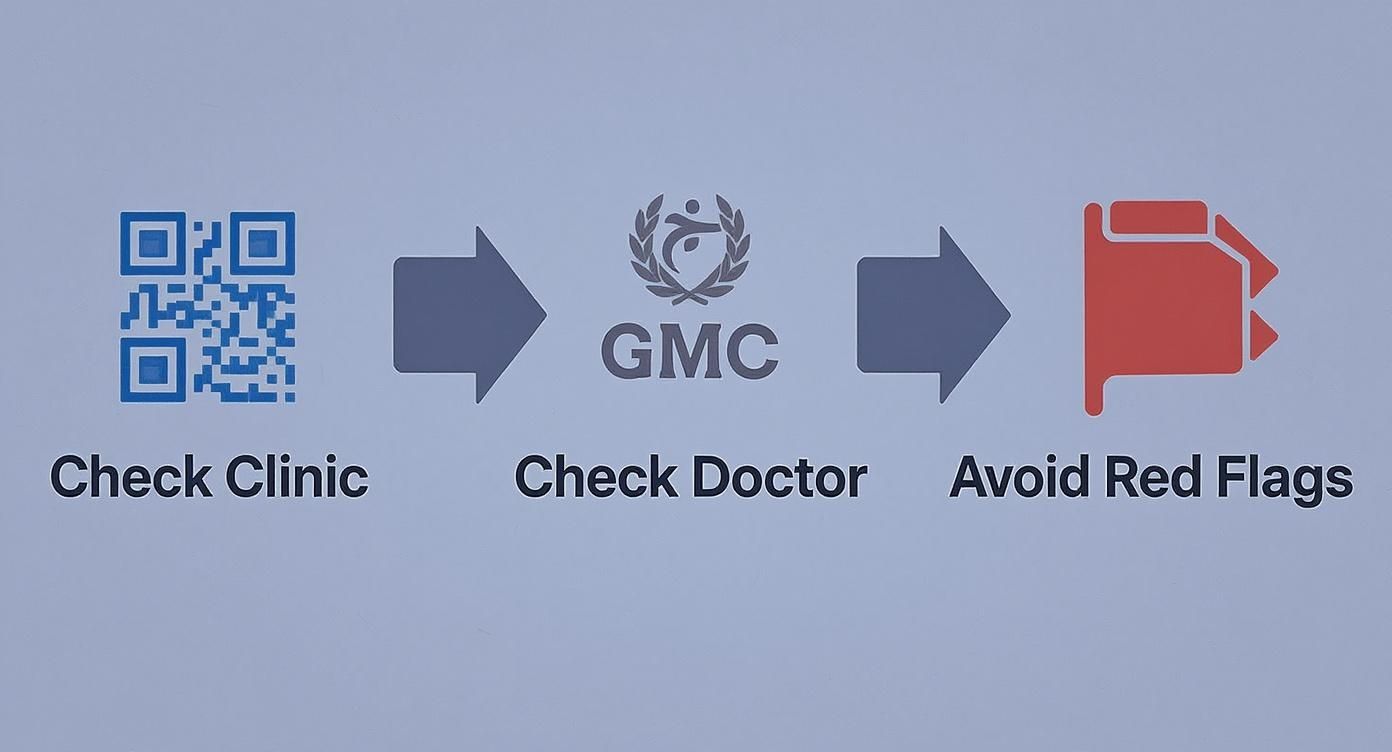
It really boils down to those core principles: checking the clinic with the CQC and the doctor with the GMC. These aren't just suggestions; they're the bedrock of a safe and professional assessment for ADHD or autism.
The Path to Diagnosis
Once the interview is over, the psychiatrist won’t make a snap judgment. They’ll take your story, combine it with the school reports, questionnaire scores, and other documents you provided, and make a holistic evaluation. A credible diagnosis for ADHD or autism is never based on one single thing but on the weight of all the evidence combined.
You’ll then receive a detailed diagnostic report. This document is incredibly important, as it explains the clinical findings, whether a diagnosis was made or not. If a diagnosis is confirmed, the report will also include personalised recommendations, which could cover therapy, workplace adjustments, or medication.
Getting to Grips with ADHD Medication Titration
If you receive an ADHD diagnosis and medication is deemed a suitable option, you’ll move on to the titration phase. This isn’t a case of just being handed a prescription and sent on your way. It’s a careful, highly collaborative process designed to find the right medication and the exact dose that works for you, maximising the benefits while minimising side effects.
Although it’s managed remotely, titration requires close and frequent communication. Here’s a typical breakdown of what to expect:
- A Low and Slow Start: You’ll always begin on a very low dose of the prescribed medication.
- Frequent Check-ins: Your clinician will schedule regular, brief follow-ups, often weekly or every two weeks, to see how you're getting on.
- Your Role is Crucial: You’ll need to monitor and report back on everything – the good and the bad. This means noting improvements in focus or mood, but also any side effects like changes in sleep or appetite.
- Step-by-Step Adjustments: Based on your feedback, the psychiatrist will guide you on whether to increase the dose slightly, hold steady, or perhaps try a different medication altogether.
Titration is a genuine partnership between you and your psychiatrist. Your honest, detailed feedback is the most critical tool they have for fine-tuning your treatment. Be prepared for this to take several weeks, or even a couple of months.
Patience really is a virtue here. It can feel slow, but this methodical approach is by far the safest and most effective way to land on a stable, long-term treatment plan. It’s a core part of ensuring that private prescriptions online are not just convenient, but also clinically sound and personalised to you.
Unpacking the Costs and Planning for Shared Care
Going private for an ADHD or autism assessment is a big step, and it's essential to have a clear picture of the costs involved from the very beginning. It’s rarely a single, one-off payment. Instead, the financial journey unfolds in stages, and knowing what to expect can help you plan and avoid any unwelcome surprises down the line.
The initial fee you see advertised usually covers the comprehensive diagnostic assessment. But if you're diagnosed with ADHD and choose to start medication, that's when you move into the next phase: titration. This period involves follow-up appointments and monthly private prescriptions, all of which have associated costs, until you land on a stable and effective treatment plan.
A Breakdown of the Financial Commitment
The total cost can feel a bit overwhelming at first, so let's break it down into the main components you’ll need to budget for.
- Initial Assessment Fee: This is the most significant upfront cost. It pays for the specialist consultant's time to conduct the in-depth clinical interview for ADHD or autism, review all the evidence, and compile your final diagnostic report.
- Titration and Follow-Up Fees: While your ADHD medication is being adjusted (the titration period), you'll have regular check-ins with your clinician. Each of these follow-up consultations comes with its own fee.
- Monthly Medication Costs: You'll be paying for your ADHD medication out-of-pocket through a private prescription until a Shared Care Agreement is arranged with your GP. The price can fluctuate quite a bit depending on the specific medication and dosage you need.
Recognising that this is a significant investment, many providers offer ways to make the costs more manageable. It’s always a good idea to ask if they provide payment plans for their services, which can help you spread the expense over several months.
The End Goal: A Shared Care Agreement
For most people going down the private ADHD treatment route, the ultimate aim is to set up a Shared Care Agreement (SCA) with their NHS GP. Think of it as a formal handover. Once your clinician has found the right medication and your condition is stable, the SCA allows your GP to take over issuing your prescriptions.
An SCA is the bridge connecting your private diagnosis and initial treatment with affordable, long-term NHS support. It lets you use the speed and specialism of the private sector to get started, before transitioning your ongoing care back to the NHS.
The moment an SCA is in place is a game-changer for your finances. Your prescriptions are then issued through the NHS, so you only pay the standard prescription charge instead of the much higher private cost. This makes the long-term management of your condition financially sustainable.
A word of caution, though: GPs are not required to accept a Shared Care Agreement. Some practices have policies against it, while other GPs might decline if they're unfamiliar with the private provider or don't feel they have the capacity to monitor the medication safely. This is why having an open and honest conversation with your GP before you even book a private assessment is an incredibly smart move.
This hybrid private-to-NHS model is becoming more common across UK healthcare. With the UK's prescription drug market expected to hit US$44.27 billion by 2025, there's a clear demand for more accessible healthcare options, as you can see from market insights. The rise of private prescriptions online is a huge part of this shift, and securing a Shared Care Agreement is what makes this modern approach work for your long-term health—and your wallet.
Your Questions Answered: Navigating Private Online Prescriptions
When you're looking into private online prescriptions for conditions like ADHD and autism, it’s completely normal to have a few practical questions. How does this all work with the NHS? What actually happens during treatment? Let’s clear up some of the most common queries we hear.
Can My NHS GP Say No to a Shared Care Agreement?
Yes, they can. It's important to know that an NHS GP can decline a Shared Care Agreement, and it's often not personal. It might be down to their practice policy, a lack of experience with the specific ADHD medication, or simply not having the resources to take on the required monitoring.
My best advice? Have a chat with your GP before you even start the private assessment process. Gauging their willingness early on helps you plan. If they’re not on board, you'll need to factor in the long-term costs of private prescriptions and follow-up care.
Are Online Prescriptions for ADHD Medication Actually Legal?
They are, but only when they come from the right place. A legitimate prescription for ADHD medication must be issued by a GMC-registered specialist following a proper diagnostic assessment, and the provider must be regulated by the Care Quality Commission (CQC).
Reputable UK online clinics aren't a Wild West – they adhere to the exact same strict standards as any private face-to-face clinic.
The key to a legitimate prescription is the provider's regulatory credentials. A genuine prescription is sent directly and securely to a registered UK pharmacy, which then dispenses your medication safely and legally.
What Happens if the First ADHD Medication I Try Doesn’t Work?
Don't worry, this is a very common part of the process. Finding the right fit isn't always immediate. This is precisely what the titration period is for – it's a dedicated time for you and your clinician to work together to find what works for you.
You’ll be asked to keep track of how you're feeling, noting the medication's effects and any side effects. Based on your feedback, your specialist will then collaborate with you to:
- Adjust the dose of your current medication.
- Switch to a different type of medication.
- Keep monitoring things until you land on the most effective treatment plan.
It’s a partnership, and your honest feedback is the most crucial part. For a deeper dive into this and other topics, you might find our extensive guide covering frequently asked questions about ADHD really helpful.
At Insight Diagnostics Global, we provide CQC-regulated, consultant-led assessments for ADHD and autism, offering a clear and supportive path from diagnosis to treatment. If you're ready to get the answers you need, learn more about our services at https://insightdiagnostics.co.uk.