When you're struggling with questions about your mental health, especially conditions like ADHD or Autism, the last thing you need is a long, uncertain wait for answers. A private psychiatrist assessment offers a direct path to an expert evaluation, bypassing the often lengthy delays within the NHS. It's a way to get clarity on your mental health and find support, on your own terms.
Why Choose a Private Psychiatrist Assessment
Sitting on an NHS waiting list for an ADHD or Autism assessment can feel like you're in limbo. You suspect what the issue might be, but without a formal diagnosis, you can’t move forward with treatment or support, and the uncertainty itself is exhausting. This is precisely why so many people are now exploring a private psychiatrist assessment—it’s a proactive step towards taking back control of their mental health journey.
Think of it as choosing an express route. Instead of waiting months or even years for an initial appointment, the private pathway connects you with a specialist consultant, often within just a few weeks. It’s a direct line to the focused, expert attention you need for your mental health.
A Direct Path to Clarity and Support
Getting a diagnosis for a condition like Autism or ADHD is a deeply personal journey. It’s not just about attaching a label; it’s about finally understanding yourself, making sense of past struggles, and finding practical strategies to improve your life. A private assessment respects the urgency of that need for clarity about your mental health.
The process is clear and structured, led from start to finish by a consultant psychiatrist. This ensures your assessment is not only fast but also comprehensive and reliable. For most people, this approach delivers:
- Timely Answers: Drastically shorter waiting times mean you get the clarity you need to make informed decisions about your mental health, work, relationships, and well-being.
- Specialist Expertise: You get direct access to a GMC-registered specialist who is an expert in adult mental health and neurodevelopmental conditions like ADHD and Autism.
- Personalised Attention: The entire process is built around you. From the first interview to the final report, the focus is squarely on your unique history, challenges, and experiences.
The Growing Need for Private Assessments
The simple truth is that demand for mental health services in the UK, particularly for ADHD and Autism, has far outstripped what the public system can provide. The recent surge in adults seeking ADHD assessments has stretched NHS waiting times to as long as eight years in some areas.
Since 2020, there has been a five-fold increase in adults looking for an ADHD diagnosis. This has led to a major shift, with private providers' share of ADHD prescriptions jumping from just 2% in 2018 to 12% in 2024. It paints a clear picture of a system where those who can afford it are increasingly turning to private services to get a timely evaluation for their mental health. You can discover more insights about mental health trends in the UK on institute.global.
A private assessment isn't just about skipping the queue. It's about taking control of your own mental health journey and investing in the self-understanding that forms the bedrock of effective, long-term support for conditions like ADHD and Autism.
By choosing a CQC-regulated, consultant-led service, you ensure your diagnosis is robust and widely recognised. It’s the crucial first step toward getting the right help, without the added stress of an indefinite wait. If you're curious, you might want to take a more detailed look at what a psychiatric assessment involves.
Your Assessment Journey From Start to Finish
Deciding to get a private psychiatric assessment is a big step, and it's completely normal to feel a little apprehensive. But knowing what to expect can make all the difference, turning uncertainty into a clear path forward. Think of it less as a test and more as a collaborative process with an expert who is there to understand your story, particularly when looking into conditions like ADHD or Autism.
The private route is often a world away from the complexities of the public health system. The flowchart below paints a clear picture of just how different the two journeys can be, especially when it comes to speed and getting started.
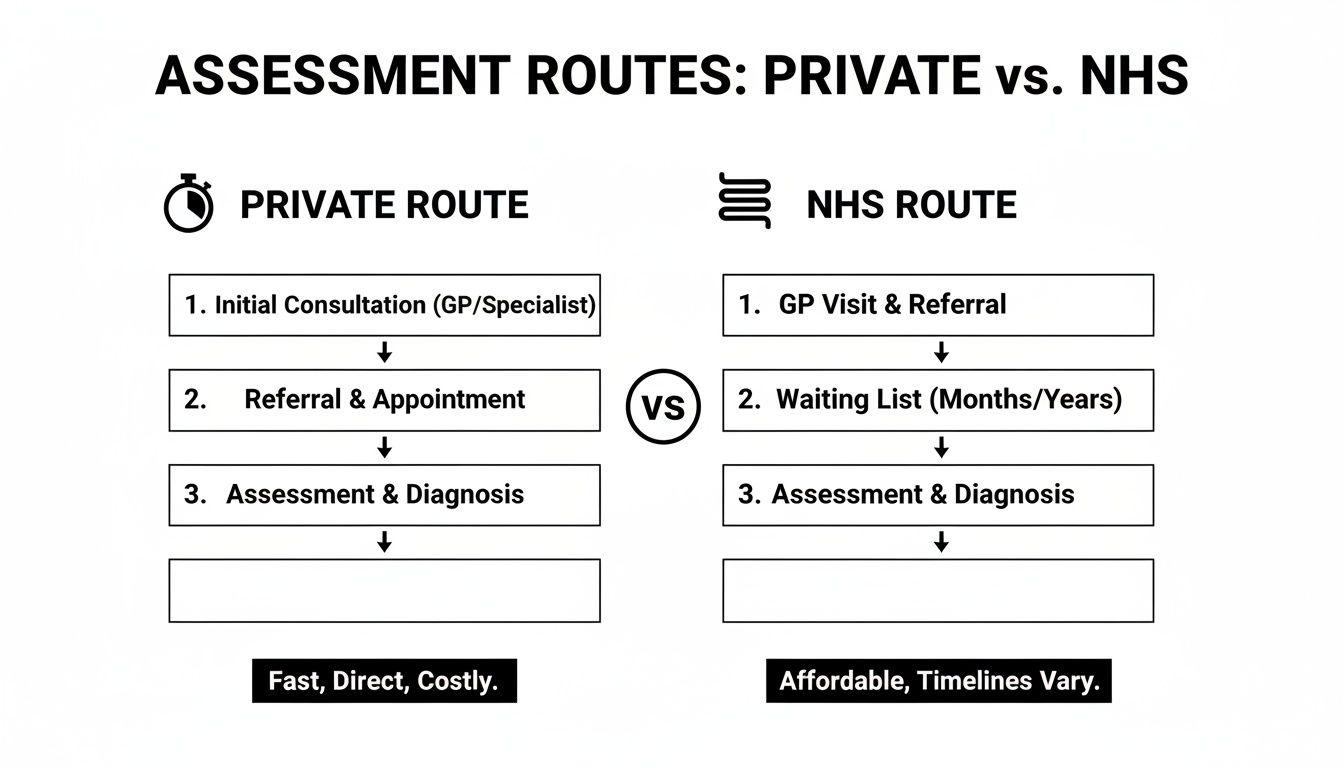
As you can see, the whole point of the private journey is to get you from that first phone call to a full, detailed report within weeks, not the months or even years you might face elsewhere.
The Initial Screening and Triage
Your journey kicks off with a screening or triage phase. This isn't the assessment itself, but a crucial first filter to make sure the service is a good match for your mental health needs. It's a bit like a preliminary check-in, where the clinical team reviews your enquiry to be certain they have the specific expertise you require for ADHD, Autism, or other concerns.
You'll usually be asked to fill out some detailed questionnaires covering your symptoms, personal history, and what you’re hoping to find out. If you're seeking an assessment for ADHD or Autism, for example, these forms will likely touch on your experiences from childhood, school, and your working life. Getting this groundwork done upfront means your first appointment with the psychiatrist can be focused and incredibly productive from the very start.
The In-depth Clinical Interview
The heart of the assessment is the in-depth clinical interview with your consultant psychiatrist. This is a dedicated, confidential conversation, typically lasting between one and two hours, where you have the space to tell your story without judgement. It's not a rigid Q&A session; it's a guided discussion designed to explore your life experiences in the context of your mental health.
Your psychiatrist will be interested in several areas of your life:
- Developmental History: They’ll gently ask about your early years, key milestones, and any difficulties you might have had as a child or teenager, which is key for assessing ADHD and Autism.
- School and Work History: How you navigated education and your career can reveal important patterns, especially when it comes to neurodevelopmental conditions.
- Mental Health History: This involves talking about your current symptoms and any previous struggles with anxiety, depression, or other conditions that may co-occur with ADHD or Autism.
- Social and Family Relationships: Understanding how your symptoms impact your daily interactions with others is a key piece of the puzzle.
Your life story is the most important piece of evidence. It allows the psychiatrist to build a complete picture, connecting past events to present challenges to see the patterns that lead to a diagnosis for ADHD, Autism, or other mental health conditions.
Using Gold-Standard Diagnostic Tools
Alongside your conversation, the assessment will use recognised diagnostic tools and rating scales. These are highly structured questionnaires and tests that provide an objective way to measure the symptoms associated with conditions like ADHD and Autism. They add a layer of scientific rigour to the mental health assessment process.
For instance, an ADHD assessment will likely use the DIVA-5 (Diagnostic Interview for ADHD in Adults), a structured interview based on official diagnostic criteria. An Autism assessment might involve tools that look closely at social communication patterns or sensory sensitivities. You can learn more about the specifics of the entire process in our guide on how to get a mental health assessment.
By weaving together your personal story from the interview with objective data from these tools, the psychiatrist can arrive at an accurate and reliable conclusion. Every step is there to make sure the final report isn't just a label, but a true reflection of you.
Making Sense of Your Diagnostic Report
Getting your report after a private psychiatric assessment is a huge moment. It's the culmination of everything you've been through to get to this point, but it's also where the next chapter begins. A proper diagnostic report isn’t just a label for ADHD or Autism; think of it as a detailed, personalised roadmap for understanding your mental health and figuring out what comes next.

The whole point is to give you clarity. It shouldn’t be a dense, clinical document filled with jargon. Instead, it should be a clear and accessible guide that empowers you with knowledge about your mental health, whether that’s ADHD, Autism, or another condition like anxiety or depression.
What to Expect in Your Report
A thorough report from a consultant-led service is carefully structured to tell your complete story. It pieces together your personal history with the clinical findings to give you a full, coherent picture of your mental health.
You'll usually find these key sections:
- Clinical Diagnosis: This is the formal diagnosis, stated clearly and based on internationally recognised criteria like the DSM-5 or ICD-11. It’s the official conclusion drawn from all the information gathered during your assessment.
- Detailed Clinical Narrative: This is the ‘why’ behind the diagnosis. Here, the psychiatrist connects the dots, explaining how your experiences and the results from any tests line up with the specific criteria for a condition like ADHD or Autism.
- Personalised Recommendations: This is arguably the most important part. It’s where you get practical, actionable advice tailored specifically to your mental health needs. This could cover everything from potential treatments and therapies to support strategies for work or home.
The value of this document goes far beyond personal insight. A recent poll found that 84% of people who received a diagnosis felt they understood themselves better, 58% improved how they managed their mental health, and 54% saw a boost in self-esteem. But with almost half of people on NHS lists waiting over a year, many turn to private options for this kind of timely care. You can read the full research on these mental health trends on institute.global.
Moving Forward with Your Diagnosis
Your report is designed to be a functional tool that guides your next steps. For many people, especially those with a new ADHD diagnosis, this often means thinking about medication. A private online service can manage this process for you safely and effectively.
ADHD Medication Titration: This is the careful process of finding the right medication and the right dose for you. It isn’t a one-size-fits-all approach. Your consultant psychiatrist will manage this through regular follow-up appointments, making sure your treatment is working well while keeping an eye out for any side effects. It's all handled remotely, which adds a layer of convenience without ever compromising on clinical safety.
Ongoing care is just as important. Once your dosage is stable, your report can be shared with your GP to set up a ‘shared care agreement’. This allows your NHS doctor to take over prescribing, integrating your private diagnosis seamlessly into your overall healthcare.
A diagnostic report is not an endpoint; it is a starting point. It provides the evidence-based foundation you need to access workplace adjustments, seek specific therapies, or simply explain your mental health needs more clearly to others. It is your key to unlocking the right support.
Ultimately, the report should leave you feeling informed, validated, and ready for what’s next. Whether you're considering an assessment for yourself or a loved one, it helps to know what to expect from the process. If you’re interested in learning more about the specifics of an autism assessment, you might find our guide on how to test for Autism helpful.
How Private Assessments Support Legal Cases
When legal matters get complicated, a private psychiatric assessment can cut through the noise and provide the objective clarity everyone needs. For solicitors, employers, and individuals caught up in complex disputes, these reports are more than just a diagnosis for a mental health condition; they are impartial, evidence-based tools that can genuinely shape the outcome of a case. They shift the conversation from subjective claims to a structured clinical opinion from a GMC-registered specialist.
Think of the psychiatrist as an expert witness. Their job isn’t to pick a side. It’s to offer an independent, professional view on a person's mental state. This can be vital for establishing a clear link between an event—like a traumatic workplace incident or a road accident—and a resulting psychological condition like PTSD, anxiety, or depression.
The Role of Medico-Legal Reports
The formal document that comes out of this process is called a medico-legal report. It's written specifically for legal professionals, designed to be easily understood by them and to withstand the pressures of a courtroom. These reports often become pivotal pieces of evidence during the process of discovery in litigation, and can have a major influence on case strategy.
The need for this kind of expert insight is on the rise. In 2024, 42% of all approved Personal Independence Payment (PIP) claims were for psychiatric disorders. That’s a staggering 190% increase since 2019, with 40% of those claims related to anxiety or depression. For solicitors and employers navigating this landscape, private psychiatric evaluations offer impartial expertise, transparent pricing, and refreshingly quick turnaround times.
These reports provide essential insights across a range of legal situations:
- Personal Injury Claims: They help to measure the psychological damage suffered after an accident, which is crucial for calculating fair compensation.
- Employment Tribunals: A report can add weight to claims of workplace stress, bullying, or discrimination by assessing the real psychological impact on an employee.
- Family Court Matters: In sensitive child residency cases, an assessment can offer an objective perspective on a parent’s mental fitness.
Why Speed and Clarity Matter in Legal Cases
Legal cases don't wait. They run on tight, unmovable deadlines. The reliable timelines you get with private services are a game-changer for legal professionals who simply can't afford the long waits often associated with public health systems. When a solicitor knows exactly when a report will land on their desk, they can build their case with confidence.
In a legal context, a psychiatric report must be more than just a diagnosis; it must be a clear, defensible, and objective analysis that connects a person's mental health to the specific legal questions at hand. This is where a specialist medico-legal assessment proves its worth.
On top of that, clear, upfront pricing removes any financial guesswork. Legal teams can budget accurately for the expert evidence they need, without any nasty surprises or hidden fees down the line. It's this powerful combination of speed, clarity, and predictability that makes a private psychiatric assessment such an indispensable tool for reaching a fair and well-informed legal outcome.
Getting Ready for Your Assessment and Understanding the Costs
Knowing what to expect practically can make the whole process of getting a private psychiatric assessment feel much less daunting. Getting a clear handle on the costs and timelines involved from the start means you can plan properly, taking financial guesswork out of the equation. It’s also just as important to know how to prepare for the assessment itself, so you can make the most of your time with the specialist.
Understanding the investment is usually the first question people have. Good private providers are always transparent about their pricing, especially for common assessments like ADHD and Autism. They should offer a clear, all-in-one package price, which is a world away from confusing hourly billing. This way, you know exactly what the total cost for your mental health assessment will be right from the beginning.
It can also be useful to see how these services are structured behind the scenes, which often relates to standardised billing codes for mental health.
What Does a Private Assessment Typically Cost?
When you opt for a private assessment for ADHD, Autism, or other mental health concerns, you're not just paying for an hour of a psychiatrist's time; you're investing in a comprehensive diagnostic service. The fee should cover absolutely everything from the initial questionnaires right through to the final, detailed report, with no hidden costs popping up later.

This table breaks down what’s typically included in different assessment packages, giving you a clearer idea of what your investment covers.
Typical Private Assessment Service Packages
| Service Type | What's Included | Typical Timeline |
|---|---|---|
| ADHD Assessment | Pre-assessment screening, diagnostic interview with a psychiatrist, standardised rating scales (e.g., DIVA-5), detailed report with diagnosis & treatment plan, and a post-assessment feedback session. | 4-6 weeks from initial enquiry to final report. |
| Autism Spectrum Condition (ASC) Assessment | Pre-assessment screening, ADOS-2 and/or ADI-R interviews, cognitive and adaptive behaviour tests, detailed report with diagnosis & support recommendations, and a post-assessment feedback session. | 6-8 weeks from initial enquiry to final report. |
| General Mental Health Assessment | Pre-assessment screening, extended clinical interview covering psychiatric history, administration of relevant psychometric tests for conditions like anxiety or depression, comprehensive report with diagnosis & personalised treatment options. | 2-4 weeks from initial enquiry to final report. |
This all-inclusive approach gives you certainty and makes it much easier to budget for your mental health care.
How to Prepare for Your Appointment
Once your assessment is booked, a little bit of prep work can make a huge difference on the day. The main goal is to give your psychiatrist a complete and accurate picture of you and the challenges you're facing, whether for ADHD, Autism, or general mental health. Think of it as gathering the evidence to tell your own story effectively.
Don't worry, this isn't about creating a mountain of paperwork. Just pulling a few things together and organising your thoughts will help you communicate everything clearly and feel more confident during the consultation.
Getting ready for your assessment is more than just being organised. It's about taking an active role in your own care, ensuring your story is heard and understood, which ultimately leads to a more accurate and helpful outcome for your mental health.
Here are a few simple but powerful steps you can take:
- Dig Out Old Documents: See if you can find any old school reports, work performance reviews, or letters from other doctors. These can offer a valuable outside perspective on your behaviour and difficulties over the years.
- Map Out Your Symptoms: Try jotting down a rough timeline of major life events and when you first noticed your symptoms. Most importantly, think about how they affect you day-to-day—at work, in your relationships, or just getting things done at home.
- Ask Someone Close to You: If you feel comfortable, have a chat with a parent, your partner, or a trusted friend. They might remember things from your childhood or notice patterns in your behaviour that you don't, adding crucial context for the psychiatrist.
- List Your Questions: Make a list of everything you want to ask the psychiatrist. This is your chance to get answers from an expert, so don’t hold back. Ask about the diagnosis, treatment options, or anything else that’s on your mind.
Taking these steps helps you walk into your appointment feeling prepared and in control, ready to have a really productive conversation about your mental health.
Your Questions Answered
Taking the first step towards a private psychiatric assessment for ADHD, Autism, or other mental health concerns is a big decision, and it’s completely normal to have a few questions before you begin. We’ve put together answers to some of the most common queries we receive, aiming to clear up any doubts you might have.
Think of this as the final piece of the puzzle, designed to give you the confidence and clarity you need to move forward.
Is a Private Diagnosis Recognised by the NHS?
This is probably the most critical question we get asked, and the answer is a clear and simple yes. When an assessment for a condition like ADHD or Autism is carried out by a consultant psychiatrist on the GMC’s Specialist Register within a CQC-regulated service, the diagnosis holds the same medical weight as one from the NHS.
Essentially, we operate under the very same professional standards. The detailed report you receive is a formal medical document, which you can then share with your GP to have it added to your official health record.
Many people also use their report to secure crucial support, like reasonable adjustments at work under the Equality Act 2010. If you're considering medication for ADHD, it's a good idea to chat with your GP about a potential 'shared care agreement'. This helps ensure a seamless transition if you start treatment privately and want the NHS to take over your prescriptions later on.
How Can You Accurately Assess ADHD or Autism Online?
It might sound a bit strange at first – diagnosing complex neurodevelopmental conditions like ADHD or Autism through a video call. However, this is now a well-established and highly effective method. Online assessments aren't a watered-down version; they follow the exact same rigorous NICE (National Institute for Health and Care Excellence) guidelines as face-to-face appointments.
The whole process happens over a secure video link. Your psychiatrist will guide you through structured clinical interviews and use gold-standard screening tools to build a complete picture of your mental health. These tools have been designed and validated to work just as effectively remotely, so there's no compromise on quality.
For many people, being in their own home actually helps. It removes the stress of a clinical setting, making it easier to relax and speak openly. This often leads to a much more authentic conversation, giving the psychiatrist a truer understanding of your experiences with ADHD or Autism.
What Happens If I Don’t Get the Diagnosis I Was Expecting?
The real goal of any mental health assessment is to find clinical clarity, whatever that may look like. It’s not unusual for someone to come to us thinking they have ADHD, for example, only for the assessment to uncover that their difficulties stem from something else entirely, like complex anxiety or trauma.
If you don't meet the clinical criteria for the condition you suspected, the report won't just leave you with a 'no'. It will provide a detailed explanation as to why.
More importantly, it will explore other possible causes for the challenges you're facing, such as anxiety, depression, or another condition. Whatever the outcome, the report will always finish with personalised, practical recommendations for treatment and support, giving you a clear path forward for your mental health.
Do I Need a GP Referral to Book a Private Assessment?
No, you don't. One of the main reasons people choose to go private is the ability to self-refer. This means you can bypass the often long waiting times for a GP referral and get direct access to a specialist for your mental health concerns when you need it most.
While you don't need a referral to book with us, we always think it's best to keep your doctor in the loop about your health.
If you give us your consent, we're more than happy to share the final report with your GP. This kind of collaboration is key to good, continuous care and ensures your private diagnosis for ADHD or Autism becomes part of your complete NHS health record.
At Insight Diagnostics Global, we’re dedicated to providing clear, expert, and timely assessments for adults who need answers about their mental health. If you feel ready to take that next step towards understanding and support, we're here to help.
Learn more about our CQC-regulated, consultant-led assessments at https://insightdiagnostics.co.uk.