
If you're an adult in the UK wondering if you have ADHD, finding the right psychiatrist for ADHD is the single most important decision you'll make. A psychiatrist is a medical doctor who specialises in mental health, which means they are the only professionals who can provide a formal diagnosis, prescribe medication, and map out a complete treatment plan that’s built around you.
Why a Specialist Psychiatrist Is Your First Step
Have you spent years feeling like your brain is just wired differently? Maybe you've wrestled with focus, felt constantly overwhelmed by everyday tasks, or struggled to stay organised. If that sounds familiar, getting a clear answer can be a huge relief. For many adults, this journey begins with a suspicion of Attention Deficit Hyperactivity Disorder (ADHD), often with overlapping traits of Autism Spectrum Disorder (ASD).
A specialist psychiatrist is the expert you need to help you make sense of it all. Unlike other mental health professionals, their medical background allows them to rule out other conditions that might be causing your symptoms, such as anxiety or depression, which frequently co-occur. Most importantly, they can manage medication if that's the right path for you. They have a deep understanding of how ADHD shows up in adults, which can look very different from the classic symptoms we associate with children.
The Overlap of ADHD and Autism
It’s incredibly common for ADHD and Autism to exist together, a combination often referred to as AuDHD. Many people feel like they don't fit perfectly into one box or the other, and there’s a good reason for that. Both are neurodevelopmental conditions that affect how the brain processes information and can profoundly impact your mental health.
- Shared Traits: Both conditions can impact executive functions, which are the mental skills we use for things like organisation and managing time. This can lead to similar struggles in daily life.
- Distinct Differences: The 'why' behind certain behaviours can be quite different. For instance, ADHD hyperfocus can be intense but often jumps from one interest to another. An autistic special interest tends to be more consistent and deeply rooted over a longer period.
A psychiatrist with experience in neurodiversity can carefully untangle these overlapping traits. Their job is to make sure you get a diagnosis that genuinely reflects your personal experience, which is the foundation for creating a support plan that actually works for your overall mental health. You can learn more about the evaluation process in our guide to getting a private psychiatric assessment in the UK.
The Urgent Need for Diagnosis in the UK
The biggest hurdle for many adults is simply getting an assessment. Right now in the UK, there's a huge gap between the number of people who likely have ADHD and those who have a diagnosis. It’s estimated that only one in nine adults with ADHD has been formally diagnosed.
Recent data shows that while around 2.5 million people in England are thought to have ADHD, fewer than 300,000 have an official diagnosis. This really highlights the strain on our mental health services. You can read more about the ADHD statistics that shape UK mental healthcare.
This gap means millions of adults are trying to manage their careers, relationships, and day-to-day lives without the understanding or support that a diagnosis provides. Seeing a psychiatrist for ADHD isn't just about getting a label—it's about finally getting the right tools and strategies to help you thrive and protect your mental wellbeing.
What an Adult ADHD Assessment Actually Involves
Taking the first step towards an adult ADHD assessment can feel a bit daunting. Let's be honest, it's a big deal. But knowing what to expect can take a lot of the mystery—and the anxiety—out of the process. Think of it less like a test and more like a collaborative investigation into how your brain works. The whole point is to build a clear, 360-degree view of your life, both now and in the past, so you can get the right answers and support.
It usually kicks off after a chat with your GP, who can point you towards a specialist. From that point, you'll go through a series of detailed conversations and use some standardised assessment tools. A psychiatrist specialising in ADHD needs to understand not just what you’re struggling with today, but also see the threads of these challenges woven through your life story.
This simple three-step process gives you a bird's-eye view of the path to getting the clarity you need.
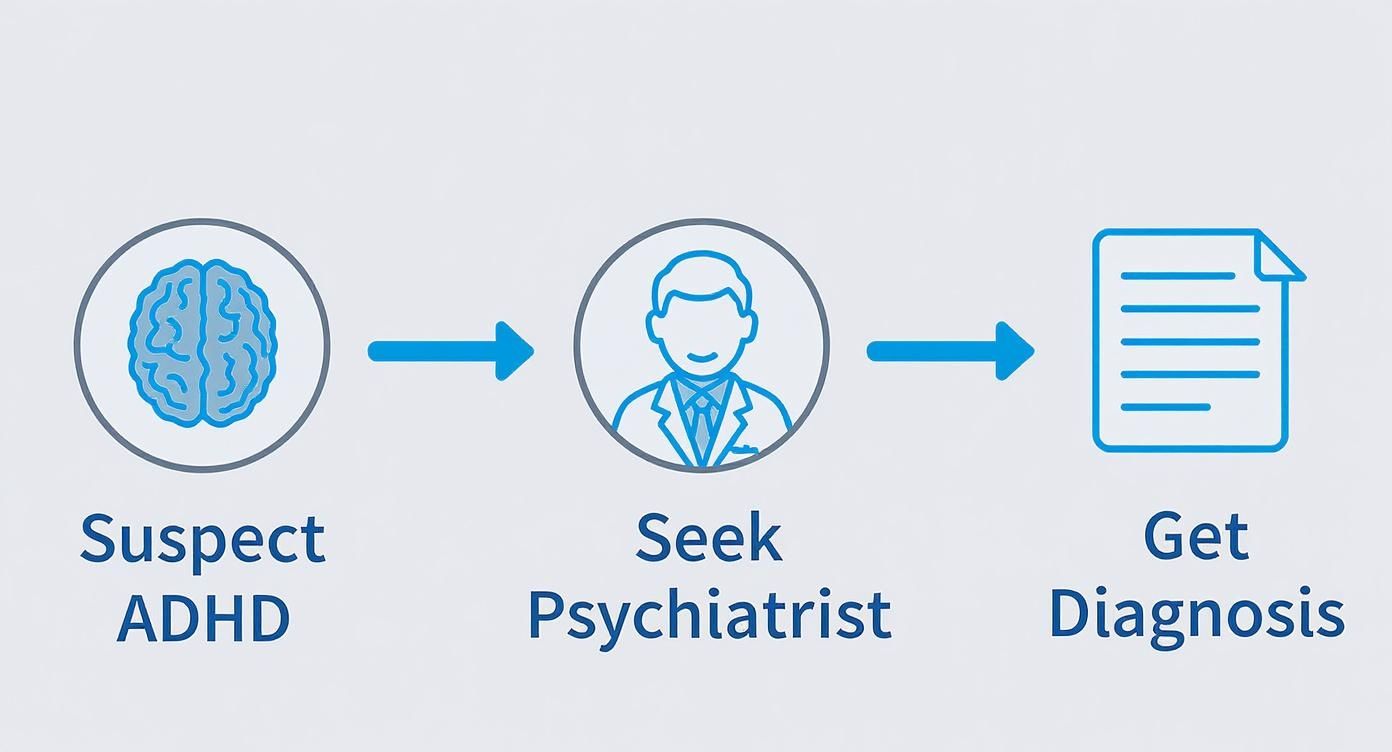
As the infographic shows, the journey starts with your own intuition, leads to professional expertise, and ends with a formal, well-understood conclusion.
Key Stages of the Assessment
The heart of the assessment is a deep-dive clinical interview with a consultant psychiatrist. This isn’t a quick chat; it’s a thorough conversation about your symptoms, your personal history, and the real-world impact all of this has on your daily life—from your career and relationships to your general sense of well-being.
To give this conversation structure, psychiatrists use specific diagnostic tools. One of the gold standards is the DIVA-5 (Diagnostic Interview for ADHD in Adults). This isn't just a questionnaire; it's a carefully designed framework that helps the psychiatrist methodically explore your symptoms and make sure nothing is missed.
It's also incredibly helpful to bring in some backup information. This could include things like:
- Old school reports: These are like a time capsule, often providing objective evidence of traits like inattention or hyperactivity from your childhood.
- Input from a parent or partner: Getting the perspective of someone who knows you inside and out can add another layer of understanding.
- Work performance reviews: These can highlight how challenges might be showing up in a professional environment.
You can get a much more detailed breakdown of what the day looks like by reading our guide to the adult ADHD assessment process.
An assessment is so much more than just ticking boxes. It's a partnership to uncover your unique story, identify any co-occurring conditions like anxiety or Autism, and ultimately build a plan that empowers you to move forward.
Online vs. In-Person Assessments: Which is Right for You?
Thankfully, you now have more flexibility in how you connect with a specialist. Both online and in-person assessments are valid and effective, but one might just feel better for you.
Online Assessments are a game-changer for convenience. You can forget about travel time and costs, and many people find it far easier to open up from the comfort of their own home. It’s a fantastic way to access top-tier psychiatric care, no matter where you live.
In-Person Assessments, on the other hand, are perfect for those who prefer a traditional, face-to-face connection. Some people simply find it easier to build rapport and communicate when they’re in the same room as their psychiatrist.
At the end of the day, the choice is yours. Both routes follow the same rigorous diagnostic standards and lead to a thorough, professional evaluation. The most important thing is that you feel comfortable, because that’s what makes for a truly open and productive assessment.
Getting to Grips with ADHD Medication and Titration
For many adults, medication is a game-changer in managing ADHD, and a psychiatrist is the specialist who’ll guide you through it. Taking that first step can feel daunting, but knowing what to expect makes the whole process feel much more straightforward. The aim isn't just to get a prescription; it's to find the precise support that helps your brain function at its best.
This careful and collaborative process is called titration. It’s a bit like tuning a guitar. You wouldn't just give the strings a random twist and hope for a perfect melody. You adjust each one slowly, listening carefully, until they all work together in harmony. Titration is exactly that—a methodical process of fine-tuning your medication and dosage to find the perfect balance for your unique brain chemistry.

What to Expect During the Titration Phase
The titration period is a very personal phase of your treatment, with your psychiatrist right there with you every step of the way. It always starts with a very low dose of a prescribed medication, which is then gently increased over several weeks.
During this time, you'll have regular check-ins to keep an eye on a few key things:
- How it's working: Are you noticing improvements in your symptoms? Is it easier to focus, or do you feel less restless?
- Any side effects: You’ll talk through anything you’re experiencing, which could be anything from a dry mouth to changes in your appetite or sleep patterns. It's really important to flag any new physical sensations.
- Your physical health: Your psychiatrist will monitor your blood pressure and heart rate to make sure your body is responding well and everything is safe.
Anxiety often goes hand-in-hand with ADHD, and it can bring its own physical symptoms. For instance, it's helpful to know how anxiety-induced heart palpitations can feel. Keeping the lines of communication wide open with your psychiatrist is crucial to tell the difference between medication side effects and other conditions. You can read more about the different types of ADHD medication for adults in the UK in our detailed guide.
Understanding Shared Care Agreements
Once you and your psychiatrist have landed on a medication plan that feels stable and effective, the next step is thinking about long-term prescriptions. In the UK, a Shared Care Agreement is a brilliant arrangement that makes your ongoing treatment much more affordable and convenient.
A Shared Care Agreement is a formal arrangement between your private psychiatrist and your NHS GP. Essentially, it allows your GP to take over writing your prescriptions. This means you can get them at the standard NHS cost rather than paying the higher private rate.
This agreement ensures your care is seamless, as your GP is kept in the loop about your entire treatment plan. It’s a really practical solution that connects private specialist care with the NHS system, making long-term ADHD management far more sustainable. This is why we often suggest letting your GP know you’re starting your assessment journey early on.
The Complex Link Between ADHD and Autism
https://www.youtube.com/embed/BgqBS9RBN64
If you're exploring an ADHD diagnosis as an adult, you might find that the label doesn't feel like a perfect fit. It's common to see yourself in the classic descriptions of ADHD but also notice traits that seem to point towards autism. This feeling of being stuck between two worlds is incredibly common because these two neurodevelopmental conditions often show up together.
This overlap isn't just a coincidence; it's a well-documented reality. A huge number of people diagnosed with Autism Spectrum Disorder (ASD) also have ADHD, and the same is true in reverse. That's why finding a psychiatrist for adhd who truly understands neurodiversity is so important—they can see the whole picture, not just one piece of the puzzle.
Instead of trying to force your experience into one box or the other, it’s much more helpful to think about how these conditions can coexist and shape each other. Many in the community now refer to this combined experience as AuDHD.
Overlapping Traits and Subtle Differences
On the surface, ADHD and autism can look surprisingly alike, which is a big reason why diagnosis can be so tricky. Both can impact things like executive function, how you interact with others, and how you process the world through your senses. But if you look a little deeper, the 'why' behind these behaviours is often completely different.
Let's break down a few common areas where things get blurry:
- Intense Focus: ADHD hyperfocus can look a lot like an autistic special interest. The key difference? Hyperfocus can be a bit of a whirlwind, jumping from one fascinating topic to the next without much warning. An autistic special interest is usually a deeper, more consistent passion that becomes a fundamental part of who you are.
- Social Challenges: Someone with ADHD might dominate conversations, interrupt, or zone out, all thanks to impulsivity and a wandering attention span. An autistic person, on the other hand, might struggle more with reading between the lines, picking up on social cues, or understanding unwritten social rules. The end result might look similar, but the root cause is distinct.
- Sensory Sensitivities: Both brains can have a complicated relationship with sensory input. An ADHD brain often craves stimulation to stay engaged (think fidgeting or loud music). In contrast, an autistic brain can easily become overwhelmed by the very same things, leading to sensory overload.
Getting to grips with the specific ADHD symptoms in adults is a great way to start untangling these threads before you even speak to a specialist.
One of the biggest hurdles in diagnosis is when one condition effectively hides the other. For instance, an autistic person's natural preference for routine and structure can mask the classic disorganisation of ADHD, making it easy to miss without a clinician who knows what to look for.
Why a Dual Diagnosis Matters
Getting a proper diagnosis of both ADHD and autism (if you have both) is more than just getting a label. It's about getting a complete, accurate user manual for your own brain. It unlocks support and strategies that are genuinely tailored to your unique way of thinking and your overall mental health.
This clarity is validating. It helps you understand that you're not just 'disorganised' or 'socially awkward'—you're navigating life with a brain that's wired differently. A full picture gives you the power to build a life that works for you, not against you, and seek mental health support that addresses the specific challenges of AuDHD, such as burnout or social anxiety.
How to Choose the Right UK Psychiatrist
Picking the right professional is a huge step. It’s not just about getting a diagnosis; it’s about finding an expert you genuinely connect with, someone who understands the nuances of ADHD in adults and how it might intertwine with other aspects of your life, especially co-occurring conditions like Autism and anxiety. It's a balance between practical things, like cost and waiting times, and something much more personal – finding a specialist whose approach just feels right for you.
To make a good choice, you need to understand what you're stepping into. The private route is often much faster than waiting for the NHS, but that speed comes at a price. You'll need to think about the cost of the initial assessment, the follow-up appointments, and the process of getting medication levels right, known as titration.
Understanding the Costs and Timelines
Getting your head around the financial side of a private diagnosis is essential. It helps you plan and means there are no nasty surprises down the line. Costs can vary quite a bit between clinics, but the table below gives you a ballpark idea of what to expect.
Estimated Private ADHD Service Costs in the UK
| Service | Estimated Cost Range (£) |
|---|---|
| Initial ADHD Assessment | £700 – £1,500 |
| Follow-Up Consultations | £150 – £400 per session |
| Medication Titration Package | £200 – £600 |
| Repeat Private Prescriptions | £30 – £80 per script |
It's clear that going private is a significant financial commitment. However, the trade-off is time. While NHS waiting lists for adult ADHD assessments can be years long, a private psychiatrist for ADHD can often see you within weeks. For many adults struggling with their mental health, at work or in their relationships, getting help that quickly can be completely life-changing.
Your Checklist for Finding the Right Specialist
Finding a good clinician isn't just about grabbing the first available slot. You need to do a bit of homework to make sure they have the right qualifications and, crucially, a deep understanding of neurodiversity in adults.
Here’s a quick checklist to help you out:
- Check Their GMC Registration: This is non-negotiable. Make sure the psychiatrist is on the General Medical Council (GMC) Specialist Register. It’s your guarantee they are a fully qualified and licensed doctor in the UK.
- Confirm Their Speciality in Adult ADHD: Psychiatry is a vast field. You need someone whose bread and butter is adult neurodevelopmental conditions. Look for a psychiatrist who makes it clear this is a core focus of their practice. This is vital for getting an accurate diagnosis, especially if you suspect overlapping conditions like autism.
- Get a Feel for Their Approach: Do they seem collaborative? Are they happy to discuss all the options, from medication to therapy and coaching? You're looking for a partner in your health, so finding someone whose treatment philosophy gels with yours is really important.
- Read Patient Reviews and Testimonials: What are other people saying? Reviews can give you a real sense of a psychiatrist’s bedside manner, how they communicate, and the quality of care they provide. It’s often the best way to get a glimpse into what the experience will actually be like.
How to Prepare for Your First Appointment
Walking into your first appointment with an ADHD psychiatrist can feel a bit daunting, but a little preparation goes a long way. Getting your thoughts and history in order beforehand doesn't just calm your nerves; it helps the psychiatrist get a crystal-clear picture of what life is really like for you.
Think of it this way: you're the expert on your own life. The psychiatrist has the clinical expertise, but you hold the story. Your job is to present that story as clearly as possible, providing the evidence they need to make an accurate assessment. This means looking back, not just at last week, but across your entire life.

Organising Your Thoughts and History
The single most helpful thing you can do is jot down your symptoms alongside real-life examples. Vague statements aren't nearly as powerful as concrete situations. Instead of just saying "I struggle with organisation," talk about the time you missed a flight because you couldn't find your passport, or how you regularly pay late fees on bills you simply forgot about.
Try structuring your notes around these key areas of your life:
- Your School Days: Have a dig around for old school reports. Teacher comments like "daydreams in class," "is easily distracted," or "fails to reach his full potential" can be incredibly telling.
- Your Career Path: Think about past performance reviews or feedback from managers. Have you consistently had trouble with deadlines, project management, or even just getting along with colleagues?
- Home and Relationships: How do your suspected ADHD traits impact your family life, friendships, or your ability to keep on top of finances and household chores? Be honest about it.
- The Emotional Toll: It’s vital to talk about how these challenges make you feel. Note down any persistent anxiety, feelings of failure, frustration, or low self-esteem that stem from these struggles. This is a crucial part of your mental health picture.
By putting together a detailed account of your experiences, you’re not just preparing for an appointment; you're building a case. This groundwork ensures your consultation is focused, efficient, and a true reflection of your reality.
Preparing Your Questions
Remember, this is a conversation, not an interrogation. It's your chance to interview them, too. Come prepared with a list of questions for the psychiatrist.
You might want to ask about their specific experience with adults who have both ADHD and autism, what treatment options they recommend beyond medication, or what the follow-up process looks like. Having your questions ready means you’ll leave the appointment feeling informed, empowered, and clear on what comes next.
Your ADHD Questions Answered
It’s completely normal to have a lot of questions when you start looking into an ADHD assessment. Let’s walk through some of the most common ones to give you a clearer picture of what to expect.
Common Questions About the Diagnostic Process
Do I Need a GP Referral to See a Private Psychiatrist for ADHD?
This is a really common question. While you can sometimes book directly with a private clinic, getting a referral from your GP is almost always the best approach. It gives the psychiatrist a complete picture of your medical history, which is vital for an accurate assessment and understanding your broader mental health.
More importantly, if you hope to have your GP take over prescribing your medication on the NHS later on (through something called a 'shared care agreement'), they need to be in the loop from the very beginning. Starting with a referral makes this process much smoother down the line.
What Happens If I Don’t Get Diagnosed with ADHD?
It can feel daunting to go through an assessment and not come out with an ADHD diagnosis, but the process is never a waste of time. A comprehensive psychiatric assessment is designed to find the root cause of your challenges.
If it isn't ADHD, the psychiatrist will use their expertise to explain what else might be going on. It could be anxiety, depression, or even Autism, for example. They'll then guide you towards the right kind of support or treatment for whatever they find. The real goal is to get you answers and a clear plan for your mental health, no matter the outcome.
A diagnosis is the key that unlocks necessary support. A formal diagnostic report from your psychiatrist validates your condition and is essential for accessing accommodations like ‘Access to Work’ grants or extra time in university exams.
How Can a Psychiatrist Help with Support at Work or University?
This is where a formal diagnosis really makes a practical difference. Once you have one, your psychiatrist will write up an official diagnostic report. This isn't just a piece of paper; it's the evidence you need to access vital support systems.
With that report, you can apply for government grants like 'Access to Work' to fund workplace adjustments. If you're studying, it's what you'll show your university's Disability Support Services to arrange for things like extra time in exams.
At Insight Diagnostics Global, our consultant-led team provides clear, robust assessments for adults exploring ADHD and Autism. If you're ready for clarity, learn more about our online services.