
Navigating daily life with neurodivergent conditions like ADHD and Autism Spectrum Disorder (ASD) presents unique challenges, particularly in environments designed for neurotypical minds. The constant demand to manage focus, organisation, and sensory input can be exhausting and often leads to significant mental health strain, including anxiety and depression. However, under the UK's Equality Act 2010, neurodivergence and mental health conditions are often recognised as disabilities, entitling individuals to legal protections against discrimination.
This means employers, educational institutions, and service providers have a legal duty to implement reasonable adjustments for ADHD and other related conditions. These are specific changes to practices, policies, or physical environments that remove barriers and ensure equal opportunity for success. Understanding your rights is the first step, but knowing what to ask for is the crucial second step.
This guide moves beyond theory to offer a definitive roundup of practical, actionable adjustments that can transform productivity and well-being. We will explore specific strategies for the workplace and educational settings, detailing not just what to ask for, but how to request it effectively. To truly unlock potential and effectively manage ADHD and co-occurring conditions, it's crucial to consider how these adjustments fit into a wider strategy, such as building a personal productivity system that actually works. From deadline flexibility to sensory accommodations, this list provides the concrete examples needed to start a constructive conversation and create an environment where you can truly thrive.
1. Structured Environment & Physical Organization
For individuals with ADHD and Autism, the external world can often feel as chaotic as their internal thought processes. A key reasonable adjustment involves creating a structured and physically organised environment. This accommodation acts as an external form of executive functioning, helping to compensate for difficulties with focus, memory, and task initiation by reducing cognitive load and minimising distractions.
A well-organised space provides clear, visual cues that guide action and reduce the mental energy spent searching for items or deciding what to do next. This is not about minimalist aesthetics but about functional design; a space where everything has a designated home and is easily accessible. This structure is one of the most effective reasonable adjustments for ADHD and ASD because it directly tackles the core challenge of managing a distracting environment.

How It Works in Practice
Implementing a structured environment can be tailored to various settings:
- In the Workplace: An employer could provide noise-cancelling headphones, a desk in a low-traffic area, or physical storage solutions like labelled filing cabinets and drawer organisers. Some tech companies design "zones" within open-plan offices for quiet work, collaboration, and breaks, allowing employees to choose the environment that best suits their current task.
- In Education: Schools can use visual timetables, colour-coded subject folders, and designated classroom areas for different activities (e.g., a quiet reading corner, a group work station). This helps students with ADHD and Autism understand expectations and transition between tasks more smoothly.
- At Home: Creating a dedicated, clutter-free home office with clear surfaces and easy-to-access supplies can significantly improve focus for remote workers. Using labelled storage boxes and a "launchpad" by the door for keys, wallets, and phones can prevent the daily frantic search for essential items.
Actionable Tips for Implementation
- Start Small: Focus on organising one specific area first, like your desk or a single kitchen counter, before tackling an entire room.
- Use Visual Labels: Combine text with icons or pictures on labels for faster recognition, a strategy particularly helpful for both ADHD and Autism.
- Establish a "Reset" Routine: Dedicate 10-15 minutes at the end of each day to return items to their designated places.
- Think Vertically: Use shelving and wall organisers to keep surfaces clear and important items within your line of sight.
Creating this external order is a powerful non-medical strategy for managing ADHD and ASD symptoms. You can explore more non-pharmacological approaches and learn more about how to manage ADHD without medication.
2. Time Management & Scheduling Tools
One of the most profound challenges for individuals with ADHD is an altered perception of time, often referred to as "time blindness." Similarly, individuals with Autism may struggle with transitions and sequencing. This makes it difficult to gauge how long tasks will take, sense the passage of time, or meet deadlines consistently. Implementing external time management and scheduling tools is a crucial reasonable adjustment that provides the external structure needed to navigate a time-driven world. These tools externalise time awareness, offloading the cognitive burden from a neurodivergent brain.
Using these systems helps translate abstract concepts like "in an hour" or "soon" into concrete, visual, or auditory cues. This practical support is one of the most effective reasonable adjustments for ADHD as it directly compensates for a core executive functioning deficit. By making time tangible, individuals can better plan, prioritise, and execute tasks, reducing the anxiety and stress that often accompany time-related challenges and broader mental health struggles.

How It Works in Practice
These tools can be adapted for any environment to create predictable routines and clear expectations:
- In the Workplace: An employer can provide licenses for task management software like Asana or Monday.com, allowing for clear project timelines and responsibilities. Simple adjustments like encouraging the use of shared digital calendars (e.g., Google Calendar) with automated reminders can prevent missed meetings and deadlines. This proactive support is a key component of effective workplace mental health strategies.
- In Education: Teachers can use a visual timer, such as a Time Timer, to show students how much time is left for an activity. Providing a digital or physical planner and dedicating class time to help students break down large assignments into smaller, manageable steps with their own deadlines is also highly effective.
- At Home: Setting multiple alarms and reminders on a smartphone for appointments, medication, or even breaks is a simple but powerful tool. Using a colour-coded calendar for family activities, work deadlines, and personal appointments can provide a clear visual overview of the week, reducing mental clutter.
Actionable Tips for Implementation
- Build in Buffers: Always schedule a 15-20 minute buffer before and after appointments to account for transitions and potential delays.
- Use Multiple Reminders: Set alarms for 24 hours before, 1 hour before, and 15 minutes before any important event or deadline.
- Embrace Time-Blocking: Use the Pomodoro Technique by working in focused 25-minute intervals with short breaks. This makes large tasks feel less overwhelming.
- Create a Daily Review: Start each day by reviewing your schedule and top three priorities to set a clear focus.
3. Extended Time & Deadline Extensions
A common misconception is that needing more time equates to a lack of ability or intelligence. For individuals with ADHD or Autism, however, time operates differently. Difficulties with executive functions like task initiation (overcoming "paralysis"), sustaining focus, and managing internal distractions mean that completing a task to a high standard can simply take longer. Extended time and deadline extensions are crucial reasonable adjustments that level the playing field, allowing for a truer reflection of an individual's skills and knowledge.
This accommodation acknowledges that a neurodivergent brain may require a longer runway to get started and more time to process information without being penalised. It shifts the focus from speed to quality, recognising that the path to a finished product might be less linear. Providing this flexibility is one of the most impactful reasonable adjustments for ADHD and other mental health conditions in both academic and professional settings, as it directly supports challenges with time perception and project management.
How It Works in Practice
Allowing for more time can be formalised in several ways, depending on the environment:
- In Education: Universities and colleges frequently grant students with a diagnosed disability extra time (e.g., 25% additional time) in examinations. This allows students to read questions carefully, organise their thoughts, and review their answers without the added pressure of a ticking clock that can exacerbate anxiety and attention difficulties.
- In the Workplace: An employer might agree to flexible deadlines for specific projects, provided the employee communicates their needs in advance. This could involve extending an internal report deadline by a few days or building buffer time into a long-term project plan to account for potential executive function hurdles.
- During Assessments: For formal qualifications or standardised tests like the SATs or professional certifications, candidates with documented ADHD or Autism can apply for accommodations. This ensures the test measures their knowledge rather than their ability to perform under rigid time constraints.
Actionable Tips for Implementation
- Formalise the Request: Always put requests for extensions in writing. This creates a clear record and helps formalise the accommodation with a manager or educational institution.
- Use Time Strategically: Use the extra time for planning, structuring, and reviewing work, not just for procrastination. Break the task into smaller parts and assign them to the extended timeframe.
- Communicate Proactively: If you anticipate needing an extension, inform your supervisor or tutor as early as possible. This demonstrates foresight and respect for their schedule.
- Negotiate Checkpoints: For larger projects, suggest intermediate deadlines or checkpoints. This helps you stay on track and keeps your manager informed of your progress, building trust.
These types of accommodations are not exclusive to ADHD and can be vital for various neurodevelopmental and mental health conditions. You can learn more about reasonable adjustments for mental health and how they apply in different contexts.
4. Noise-Canceling & Sensory Accommodations
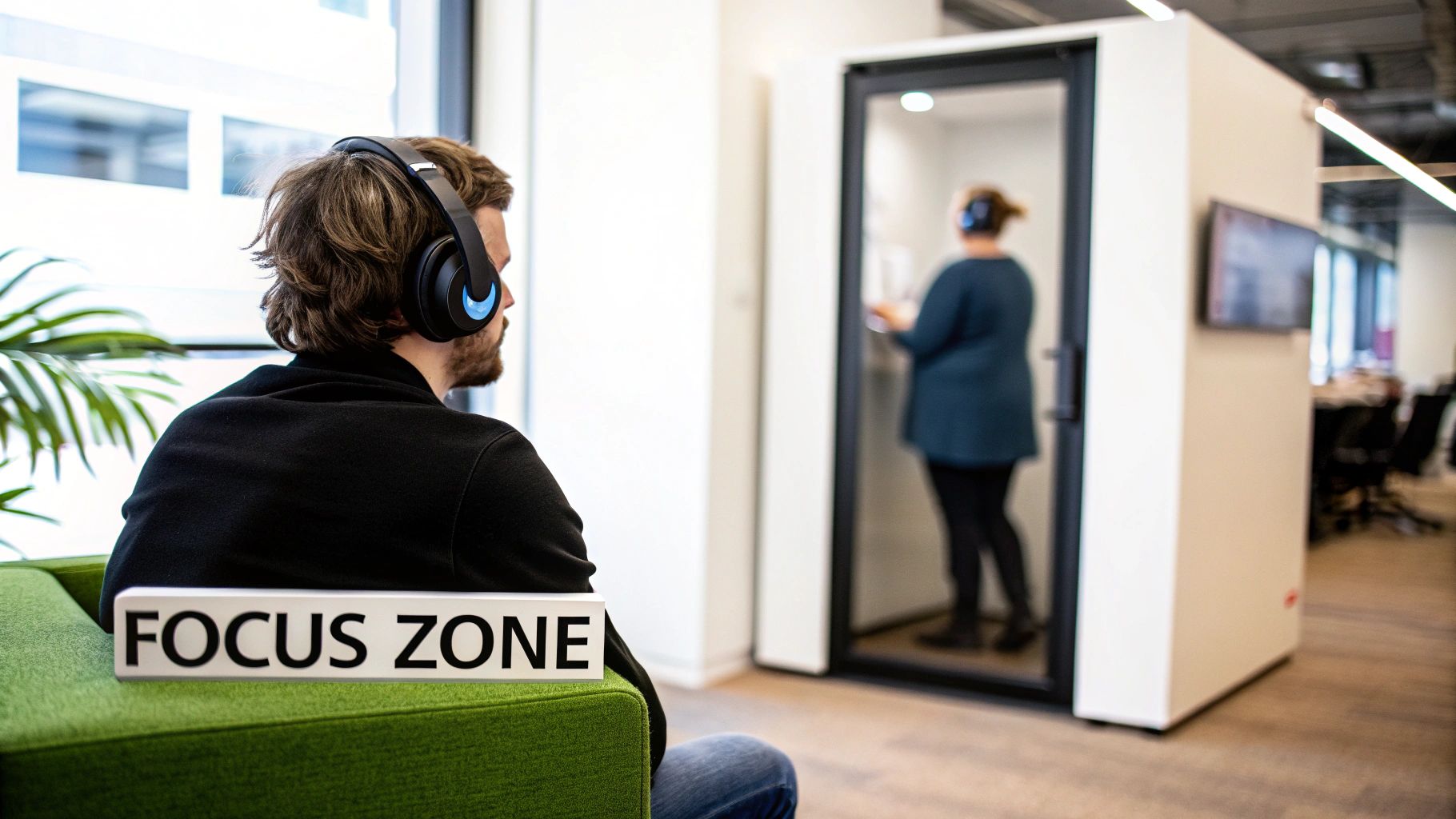
For many individuals with ADHD and Autism, the sensory world can be overwhelming. Auditory and visual stimuli that others might easily ignore can become significant distractions, hijacking focus and draining mental energy. This heightened sensory sensitivity means that controlling the immediate environment is a critical accommodation, not just a preference. Providing noise-canceling headphones, quiet spaces, and other sensory tools are powerful reasonable adjustments for ADHD and ASD because they help regulate sensory input, allowing the brain to concentrate on the task at hand.
These accommodations work by creating a 'sensory bubble', reducing the cognitive load required to filter out irrelevant background noise and movement. This allows for more sustained attention and less mental fatigue, directly addressing the core challenges of distractibility, sensory overload, and maintaining focus. By managing the external environment, individuals can better manage their internal state and mental health.
How It Works in Practice
Implementing sensory accommodations can be adapted to various contexts and needs:
- In the Workplace: Progressive companies provide quiet focus rooms or soundproof booths for deep work. An employer could also approve the use of high-quality noise-canceling headphones or offer adjustments to desk lighting to reduce glare and visual strain—accommodations beneficial for both ADHD and Autism.
- In Education: Schools can offer sensory-friendly testing spaces free from the typical noise of a classroom. They might also permit students to use fidget tools, which provide non-distracting sensory input that can paradoxically improve focus for individuals with ADHD or provide vital self-regulation for autistic students.
- At Home: For remote work, an individual can request support to create an optimal environment, such as a screen filter to reduce blue light or permission to block out time for focused, uninterrupted work. Using soundscapes like white or brown noise can also help mask distracting household sounds.
Actionable Tips for Implementation
- Experiment with Sound: Silence isn't always best. Try different background sounds like white noise, brown noise, or instrumental music to see what aids your focus most effectively.
- Combine Tools: Pair noise-canceling headphones with a fidget tool (like a stress ball or spinner ring) to engage both auditory and tactile senses for optimal concentration.
- Layer Your Sound Blocking: In very noisy environments, using simple earplugs underneath noise-canceling headphones can provide an extra layer of silence.
- Request Lighting Adjustments: Ask for your desk to be moved away from harsh fluorescent lights or windows with direct sunlight. If that isn't possible, a desk lamp with adjustable warmth and brightness can make a significant difference.
5. Written Instructions & Task Checklists
For individuals with ADHD, retaining verbal information can be a significant challenge due to difficulties with working memory. Similarly, autistic individuals often benefit from clear, literal, and unambiguous communication. Instructions given in a meeting or a quick conversation can feel like trying to catch water with a sieve. Providing clear, written documentation of expectations, procedures, and task steps is a fundamental reasonable adjustment that acts as an essential external memory aid and clarifies ambiguity. This allows the individual to reference information repeatedly, reducing anxiety and the likelihood of errors.
Written instructions and checklists break down complex, multi-step tasks into manageable components, directly addressing executive functioning deficits in planning and organisation. This accommodation transforms abstract expectations into concrete, actionable steps. Implementing this is one of the most impactful reasonable adjustments for ADHD because it provides a reliable, permanent record that supports focus and reduces cognitive load, allowing the individual to dedicate their mental energy to the task itself, not to remembering how to do it.

How It Works in Practice
This adjustment can be seamlessly integrated into various environments to support individuals with ADHD and other neurodevelopmental conditions like Autism Spectrum Disorder (ASD).
- In the Workplace: An employer can follow up verbal instructions from a meeting with a summary email outlining key decisions and action points. For recurring processes, creating a standard operating procedure (SOP) document or using project management tools like Asana or Trello with built-in checklist templates can provide invaluable structure.
- In Education: Universities provide detailed course syllabi and assignment rubrics, which are perfect examples of this adjustment. Lecturers can also provide lecture slides in advance, allowing students to familiarise themselves with the material and reducing the cognitive load of listening and note-taking simultaneously.
- For Assessments: During a psychiatric assessment or legal evaluation, providing a written outline of the session's structure and the types of questions that will be asked can help manage anxiety and allow the individual to prepare their thoughts, leading to a more accurate and less stressful experience for a wide range of mental health conditions.
Actionable Tips for Implementation
- Use Bullet Points: Present information in concise, bulleted lists or numbered steps rather than dense paragraphs.
- Incorporate Visuals: Use screenshots, diagrams, or icons to clarify steps, especially for technical or software-based tasks.
- Create Master Checklists: Develop reusable templates for recurring tasks (e.g., a monthly report checklist) to ensure consistency and prevent steps from being missed.
- Make Instructions Accessible: Store all documentation in a central, easily searchable location, such as a shared drive or a dedicated channel in a team communication app.
- Add Context: Briefly include the "why" behind a task or the expected time for each step to help with prioritisation and motivation.
6. Movement Breaks & Physical Activity Integration
For many individuals with ADHD, particularly those with hyperactive or combined presentations, the need for movement is not a distraction but a necessity for cognitive function. Similarly, for some autistic individuals, 'stimming' or repetitive movements can be a crucial self-regulation tool. Integrating movement breaks and physical activity is a powerful adjustment that channels this need constructively. Instead of restricting movement, this approach leverages it to improve focus, regulate attention, and manage restlessness.
This accommodation recognises that physical stillness can be counterproductive for a neurodivergent brain. Kinetic input helps organise thoughts and sustain concentration, making it one of the most effective reasonable adjustments for ADHD for those who find prolonged periods of sitting challenging. It shifts the perspective from viewing movement as disruptive to seeing it as an essential tool for engagement, productivity, and mental health.
How It Works in Practice
Implementing structured movement can be adapted to any environment to harness its cognitive benefits:
- In the Workplace: Progressive employers might provide standing desks, treadmill desks, or under-desk cycling machines. Encouraging "walking meetings" for discussions or allowing short, frequent breaks for a quick walk around the office can be highly effective. Some companies integrate a culture of wellness by having designated areas for stretching or short exercises.
- In Education: A teacher could permit a student with ADHD to use a resistance band on their chair, stand at the back of the classroom to work, or take short "errands" (like delivering a message to another teacher) as a brain break. Building five-minute movement sessions into longer lessons benefits the entire class while providing crucial regulation for students with ADHD and Autism.
- At Home: Remote workers can schedule walking breaks, use a timer to remind them to stand and stretch every 30 minutes, or incorporate short bursts of high-intensity exercise like star jumps between focused work blocks. Pacing while on a phone call or listening to a webinar is another simple yet effective way to integrate movement.
Actionable Tips for Implementation
- Use the Pomodoro Technique: Work in focused 25-minute intervals, using the 5-minute breaks for physical activity like stretching, walking up and down stairs, or doing a few squats.
- Keep Equipment Handy: Store resistance bands, a yoga mat, or small hand weights near your workspace for easy access during breaks.
- Schedule Movement: Add physical activity blocks directly into your calendar as non-negotiable appointments to ensure they happen.
- Exercise Before High-Focus Tasks: Engage in vigorous exercise before starting a mentally demanding project to prime the brain for better focus and attention.
Strategically allowing and planning for physical activity is a transformative adjustment that directly supports the neurobiology of ADHD and other neurodivergent conditions, turning a potential challenge into a strength for sustained performance.
7. External Accountability & Check-in Systems
Individuals with ADHD or other mental health conditions like depression often grapple with challenges in internal motivation, self-monitoring, and initiating tasks due to executive function differences. An external accountability system introduces structured interactions with another person, such as a supervisor, coach, or mentor, to provide the external framework and motivation that may be difficult to generate internally. This system shifts the impetus for action from a purely internal drive to an interpersonal commitment.
This approach acts as a powerful scaffold for executive functions. Knowing a check-in is scheduled creates a sense of urgency and a clear deadline, helping to combat procrastination and time blindness. These structured interactions are one of the most effective reasonable adjustments for ADHD because they directly address core difficulties with planning, prioritisation, and consistent follow-through, transforming abstract goals into manageable, scheduled commitments.
How It Works in Practice
External accountability can be formalised in professional, educational, and personal contexts:
- In the Workplace: An employer could implement brief, daily or weekly "stand-up" meetings where team members share their priorities and progress. A formal mentorship programme with a senior colleague, involving scheduled 15-minute check-ins twice a week to review goals and obstacles, can provide crucial structure without being burdensome.
- In Education: A university student could be paired with an academic tutor or a study buddy for weekly goal-setting sessions. These meetings would focus on breaking down large assignments into smaller steps and reviewing the previous week's progress, helping the student stay on track with their coursework.
- At Home & Personally: Engaging a professional ADHD coach provides expert, structured support tailored to individual challenges. Alternatively, forming a small accountability group with peers, either in person or online, for regular check-ins on personal or professional projects can create a supportive and motivating community.
Actionable Tips for Implementation
- Frame as Support: Emphasise that check-ins are a supportive tool for success, not a method of surveillance or micromanagement.
- Set Clear Goals: Use each check-in to establish clear, specific, and achievable goals for the next period.
- Use Visual Tools: Utilise shared documents, project management software, or a simple whiteboard to track progress visually.
- Keep it Brief: Structure check-ins to be short and focused (e.g., 15-30 minutes) to maintain engagement and respect everyone's time.
- Celebrate Small Wins: Acknowledge and celebrate progress, no matter how small, to build momentum and positive reinforcement.
By creating an external loop of feedback and encouragement, this adjustment helps build consistency and confidence, making it an invaluable strategy for managing ADHD, ASD and mental health symptoms.
8. Medication Support & Pharmaceutical Management
While many adjustments focus on external environments, addressing the internal neurochemical landscape is often a foundational step for individuals with ADHD and other mental health conditions like anxiety or depression. Pharmaceutical management involves the use of prescribed medications that help regulate key neurotransmitters. For ADHD, these are typically dopamine and norepinephrine, which directly improves executive functions like attention, impulse control, and emotional regulation.
Medication is not a cure but a tool that enables other behavioural strategies and accommodations to be more effective. By stabilising core neurological functions, it creates the cognitive space for an individual to implement organisational systems, engage in therapy, and benefit from workplace adjustments. As such, proper medical management is one of the most critical reasonable adjustments for ADHD, acting as a key that unlocks an individual's inherent capabilities.
How It Works in Practice
Pharmaceutical support is highly individualised and managed by a qualified healthcare professional, typically a psychiatrist specialising in ADHD or mental health. The goal is to find the right medication and dosage to maximise symptom management while minimising side effects.
- In the Workplace: An employee on a stable medication regimen can better maintain focus, manage complex projects, and regulate emotional responses to workplace stress. Employers can support this by allowing flexible start times to accommodate medication schedules or providing private spaces for an employee to take medication if needed.
- In Education: For a university student, medication can mean the difference between being able to follow a lecture and becoming overwhelmed by distractions. Extended-release formulas are often used to provide consistent symptom coverage throughout the academic day, from early morning classes to late-night study sessions.
- At Home: Effective medication can reduce the internal chaos that makes household management feel impossible. Tasks like planning meals, paying bills, and maintaining routines become more achievable, reducing family stress and improving overall quality of life.
Actionable Tips for Implementation
- Work with a Specialist: Engage an experienced psychiatrist for an accurate diagnosis and a carefully managed medication titration process for any mental health condition.
- Track Symptoms and Side Effects: Keep a detailed log to share with your provider. This data is invaluable for fine-tuning your dosage and finding the optimal treatment.
- Time Your Doses: Align medication timing with periods of peak cognitive demand, such as important work projects or study blocks, as advised by your doctor.
- Combine with Other Supports: Medication works best as part of a comprehensive plan that includes therapy, coaching, and environmental accommodations.
- Schedule Regular Reviews: Reassess medication effectiveness with your psychiatrist at least annually to ensure it remains the right approach for your needs.
8-Point Comparison: Reasonable Adjustments for ADHD & Autism
| Accommodation | 🔄 Implementation Complexity | ⚡ Resource Requirements | ⭐📊 Expected Outcomes | 💡 Ideal Use Cases | ⭐ Key Advantages |
|---|---|---|---|---|---|
| Structured Environment & Physical Organization | Medium — initial setup effort, low ongoing | Low–Medium — shelving, labels, time | Improves focus; reduces search time and sensory overload | Home offices, classrooms, people with visual distractibility (ADHD/ASD) | Reduces decision fatigue; supports working memory |
| Time Management & Scheduling Tools | Low–Medium — setup + habit formation | Low — apps, timers, calendar systems | Fewer missed deadlines; better punctuality and time awareness | Those with time blindness or transition difficulties (ADHD/ASD) | Externalizes time; increases reliability |
| Extended Time & Deadline Extensions | Low (policy/process) but requires documentation | Low — administrative adjustments; possible staffing impacts | Higher-quality work; reduced test/work stress | Exams, high-stakes assessments, formal workplace accommodations | Allows true capability demonstration; legally supported |
| Noise-Canceling & Sensory Accommodations | Low–Medium — procure tools and adapt space | Low–Medium — headphones, quiet rooms, lighting controls | Improved concentration; decreased sensory overwhelm | Open offices, sensory-sensitive individuals (common in ADHD/ASD) | Tailorable sensory control; relatively cost-effective |
| Written Instructions & Task Checklists | Medium — time to create and maintain docs | Low — documentation tools, time investment | Fewer errors; independent task completion; clearer expectations | Complex/multi-step tasks, onboarding, training | External memory aid; reduces miscommunication and ambiguity |
| Movement Breaks & Physical Activity Integration | Low — policy/culture change; scheduling needed | Low — space, standing desks, simple equipment | Increased attention, mood and productivity; less restlessness | Hyperactive individuals (ADHD); self-regulation (ASD) | Boosts dopamine and cognitive readiness |
| External Accountability & Check-in Systems | Medium — scheduling and relationship management | Medium — time from coaches/supervisors; tracking tools | Greater task initiation and follow-through; earlier issue detection | Low internal motivation; remote or solitary workers | Provides external motivation; improves reliability |
| Medication Support & Pharmaceutical Management | Medium–High — clinical assessment and titration | Medium–High — medical visits, monitoring, cost | Large improvements in attention and executive function (varies by individual) | Moderate-to-severe ADHD or co-occurring mental health conditions | Often enables other accommodations to be more effective; evidence-based |
From Knowledge to Action: Securing the Support You Need
Navigating the landscape of support for Attention Deficit Hyperactivity Disorder (ADHD) and co-occurring conditions like Autism Spectrum Disorder (ASD) can feel overwhelming. Throughout this guide, we have explored a comprehensive range of reasonable adjustments for ADHD, from tangible tools like noise-cancelling headphones and structured checklists to procedural changes such as flexible deadlines and regular check-in systems. We have seen how these accommodations are not about seeking an unfair advantage; they are about levelling the playing field, removing barriers, and creating an environment where neurodivergent individuals can harness their unique strengths and contribute their full potential.
The journey from understanding these adjustments to implementing them successfully is one of proactive self-advocacy. The core principle is to transform abstract challenges into concrete, actionable solutions. By mastering this process, you are not just managing a condition, you are actively architecting a life and career that aligns with how your brain works, rather than fighting against it. This is a powerful shift from a deficit-based mindset to one of strategic self-management and empowerment.
Key Takeaways and Your Next Steps
The most effective approach is a collaborative and well-documented one. Remember, under the Equality Act 2010, employers and institutions have a legal duty to make reasonable adjustments for disabilities, which can include ADHD, Autism and other mental health conditions. Your role is to clearly articulate your needs and propose solutions that are both effective for you and feasible for them to implement.
Here are your actionable next steps to move forward:
- Conduct a Personal Audit: Reflect on the specific challenges you face daily. Do you struggle with initiation, focus, memory, or sensory overload? Connect each challenge to one or more of the adjustments discussed in this article, creating a personalised list of potential solutions.
- Gather Your Evidence: While not always legally required for every minor adjustment, a formal diagnosis provides undeniable clarity and weight to your requests. It moves the conversation from "I think I need this" to "My medical assessment recommends this." This is particularly crucial when seeking substantial support or navigating more formal processes like assessments or legal settings.
- Frame Your Request: Prepare a clear, concise written request. Avoid vague statements. Instead of saying "I need help with my workload," try "To manage my focus and ensure high-quality work, I propose using noise-cancelling headphones and structuring my tasks with a digital checklist, which we could review briefly at the start of each week." This solution-focused approach presents you as a proactive partner in your own success.
- Initiate a Collaborative Dialogue: Schedule a meeting with your line manager, HR representative, or academic advisor. Present your request as a way to enhance your productivity and well-being, benefiting both you and the organisation. Be prepared to discuss, negotiate, and trial different adjustments to find what works best.
Key Insight: The power of a reasonable adjustment lies in its specificity. A well-defined accommodation, linked directly to a documented challenge and supported by professional assessment, is significantly more likely to be understood, approved, and successfully implemented.
Ultimately, securing the right reasonable adjustments for ADHD is a transformative process. It's about building a supportive scaffold that allows you to manage challenges effectively, reduce unnecessary stress, and create the mental space needed to excel. By taking these informed, strategic steps, you are not just asking for help; you are taking control of your environment and advocating for your right to thrive. This proactive stance is the most critical step in unlocking your full potential and building a sustainable, successful, and fulfilling personal and professional life.
If you are seeking to formalise your diagnosis or require a robust, court-compliant psychiatric report to support your request for reasonable adjustments, Insight Diagnostics Global provides CQC-regulated, consultant-led assessments for ADHD, Autism, and other mental health conditions. A comprehensive report from our specialists can provide the clear evidence and detailed recommendations needed to secure the support you are entitled to. Explore our services to take the definitive next step in your journey at Insight Diagnostics Global.