
Reasonable adjustments for mental health are all about making practical changes at work to remove, or at least reduce, any disadvantages you might face because of a mental health condition. It’s not about getting special treatment; it’s about making sure you have the same shot at success as everyone else. This is particularly important for neurodivergent conditions like Autism and ADHD, which often co-occur with mental health challenges and are fully protected under UK disability law.
Understanding the Purpose of Workplace Adjustments

A great way to think about a reasonable adjustment is to compare it to a pair of glasses. Someone with poor eyesight isn’t getting an unfair advantage by wearing them. The glasses are simply a tool that levels the playing field, allowing them to see clearly and do their job properly. In the same way, adjustments for mental health conditions linked to ADHD and autism are just practical tools that help dismantle barriers in the workplace.
These barriers aren't always obvious. Sometimes they’re physical, like a loud, open-plan office that can be a sensory nightmare for an autistic employee. Other times, they’re about process, such as a rigid 9-to-5 schedule that just doesn’t work for someone with ADHD whose focus fluctuates. The whole point of an adjustment is to tweak the environment or the way things are done so that these obstacles don't get in the way of you doing your job.
Removing Barriers for Neurodivergent Employees
For someone with Autism or ADHD, the typical workplace can be filled with unique challenges that often go completely unnoticed by neurotypical colleagues. Reasonable adjustments for mental health are absolutely vital for building an inclusive environment where every single person can do their best work.
The core principles are straightforward:
- It's about individual needs: What works for one person with ADHD might not work for another. The best support is always tailored to specific challenges, whether that’s help with executive function, managing sensory overload, or finding better ways to communicate.
- It’s about fairness, not favouritism: These changes are a legal duty for employers under the Equality Act 2010. The law is there to ensure that employees with conditions like Autism and ADHD aren't put at a "substantial disadvantage" compared to others.
- It's about unlocking potential: By getting rid of unnecessary hurdles, adjustments empower neurodivergent individuals to bring their full skills and talents to the table. This is a win-win – it boosts job satisfaction and improves productivity for the organisation.
Why This Matters for You
Getting your head around what reasonable adjustments really are is the first, most important step towards asking for what you need. A lot of people, especially those with ADHD or autism, might not even realise that the struggles they face at work—like burnout, anxiety, or difficulty focusing—are legitimate grounds for requesting support.
It's a common myth that asking for help is a sign of weakness or that you can't cope. The truth is, requesting an adjustment is a smart, proactive move to build a working life that’s both successful and sustainable. It’s simply about getting the right tools for the job.
This guide is here to give you that clarity and confidence. We’ll walk through your legal rights, share practical examples of adjustments that work well for ADHD and autism, and show you how to start a positive conversation with your employer. Once you understand what reasonable adjustments for mental health are—and what they aren’t—you can confidently find the support you need to truly flourish in your career.
Understanding Your Rights Under the Equality Act
Your right to get support at work isn't just a matter of good management practice; it’s enshrined in law. Here in the UK, the bedrock of these protections is the Equality Act 2010, a landmark piece of legislation designed to ensure people with disabilities are treated fairly. Crucially, this includes mental health conditions and neurodivergent profiles like Autism and ADHD.
Thinking about legal acts can feel a bit intimidating, but the core principle is actually quite straightforward. The law is there to stop discrimination and, just as importantly, it requires employers to proactively remove barriers that you might face because of your condition. It’s not about giving you an unfair advantage—it’s about levelling the playing field so that your condition doesn't leave you at a ‘substantial disadvantage’ compared to your colleagues.
To be covered by the Act, your condition doesn't necessarily need a formal diagnosis, but it does have to meet a specific legal definition. Getting your head around these terms is the first step in understanding your rights and confidently asking for the reasonable adjustments for mental health you need to do your job well.
What Does the Law Actually Say?
The Equality Act 2010 places a legal duty on employers to make accommodations for employees with a disability. In the UK, a mental health condition is considered a disability if it has a 'substantial adverse effect' on your day-to-day activities and has lasted, or is expected to last, for at least 12 months. This legal duty is the powerful mechanism that turns a workplace struggle into a right for support. The Faculty of Public Health provides a great overview of these employer duties on their official website.
This definition was deliberately written to be broad, covering a wide spectrum of experiences. It applies just as much to conditions like anxiety or depression as it does to ADHD and Autism. The real focus isn't on the name of the condition, but on the impact it has on your ability to carry out normal activities.
So, let's break down what those key legal phrases actually mean in the real world.
The 'Substantial' and 'Long-Term' Test
For your condition to be protected under the Equality Act, its impact has to be both ‘substantial’ and ‘long-term’. These aren't just vague words; they have specific legal weight.
- Substantial: This just means the effect is more than minor or trivial. For instance, if your ADHD makes it consistently hard to concentrate in a noisy, open-plan office to the point your work suffers, that's a substantial impact. It’s a real barrier.
- Long-Term: This means the condition has already lasted, or is likely to last, for 12 months or more. Many mental health conditions fit this, and since neurodivergent conditions like Autism are lifelong, they automatically clear this hurdle.
A key thing to remember is that you don't have to be completely unable to do something for the impact to be 'substantial'. It's all about whether your condition puts you at a disadvantage when you do it.
Let's look at a couple of examples focused on Autism and ADHD:
- An autistic employee finds back-to-back team meetings incredibly draining because of the sensory overload and the demands of social communication. They manage to get through them, but they’re often too exhausted afterwards to focus on their other work. This is a substantial disadvantage.
- An employee with ADHD finds the lack of structure and constant interruptions in their role a huge challenge. It takes them far longer to complete tasks than their colleagues, and the stress of trying to keep up severely affects their sleep and anxiety levels. This is also a substantial disadvantage.
In both scenarios, the employee can technically perform the task, but their condition creates a significant hurdle that others don't face. This is precisely the gap that the duty to make reasonable adjustments is meant to bridge. Sometimes, getting a professional evaluation can make all the difference. A comprehensive fitness to work assessment can help you and your employer clearly identify and articulate these specific disadvantages, paving the way for effective support.
Practical Adjustments for ADHD and Autism
Knowing your rights under the Equality Act is one thing, but turning that knowledge into real-world solutions is where the real change happens. For anyone with ADHD or Autism, a standard office environment can be a minefield of hidden challenges. This is precisely where reasonable adjustments come in—they're not about special treatment but about levelling the playing field.
These aren't about reinventing the wheel or asking for the impossible. Often, the most effective adjustments are simple, practical tweaks designed to target specific hurdles, whether that’s sensory overload, difficulties with organisation, or different communication styles. The key is to figure out what support you actually need and how to ask for it.
The guide below breaks down the key criteria from the Equality Act. It shows how the combination of a condition, its impact on your daily life, and how long it lasts are the three pillars that build the case for adjustments.
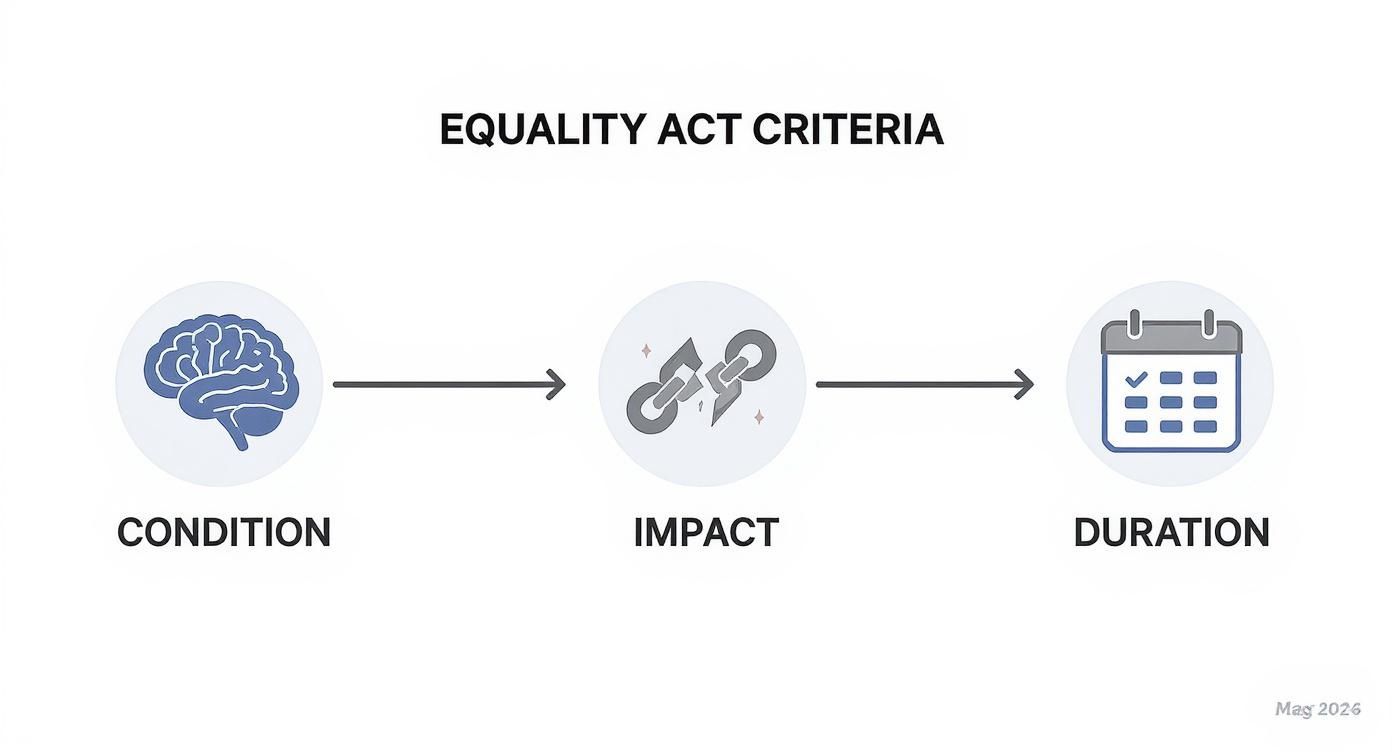
It’s this trio of factors—the condition, its substantial impact, and its long-term nature—that creates a legal duty for an employer to step in and provide support.
Tackling Sensory and Environmental Challenges
Modern open-plan offices, with their endless background chatter and visual noise, can be a real nightmare for many neurodivergent people. An environment one person finds buzzing and collaborative, another can find completely overwhelming, making it impossible to concentrate.
If you’re autistic, that constant sensory input—from harsh fluorescent lighting to the smell of microwaved fish from the kitchen—can be incredibly jarring. For someone with ADHD, the constant movement and conversation on the periphery can make focusing on a single task feel like a monumental effort.
Luckily, the solutions are often straightforward:
- Noise-cancelling headphones to create a bubble of quiet.
- The freedom to work from a quieter spot in the office or from home a couple of days a week.
- Simple lighting changes, like using a desk lamp instead of the main overheads.
- Moving your desk away from busy walkways, printers, or the kitchenette.
These are low-cost, high-impact changes that can make a world of difference to someone's well-being and productivity. Taking a broader view, implementing effective workplace stress management strategies can help create a healthier environment for everyone, not just those with a diagnosis.
Supporting Executive Function and Organisation
Executive functions are the brain's project managers—the skills we all use to plan our day, organise tasks, and maintain focus. For many with ADHD and Autism, this is an area of real difficulty, which might show up as struggling to prioritise work, missing deadlines, or finding it hard to switch gears between different tasks.
This has nothing to do with intelligence or how capable someone is. It's simply a different way of processing the world. With the right support structures in place, these challenges are entirely manageable.
Reasonable adjustments can provide that external structure. Think of it like using a sat-nav to get to a new destination—it doesn't drive the car for you, but it gives you the turn-by-turn directions you need to get there successfully.
Helpful adjustments here could include:
- Providing access to task-management software like Trello or Asana.
- Breaking down big, intimidating projects into a series of smaller, clearer steps.
- Encouraging the use of timers or focus apps to help structure the workday.
- Scheduling short, regular check-ins with a manager to help set priorities.
Enhancing Communication and Instructions
Clear, direct communication is the backbone of any successful team, but it's absolutely critical when working with neurodivergent colleagues. Many autistic people, for instance, process language very literally, so vague instructions or sarcasm can cause genuine confusion and anxiety.
Likewise, someone with ADHD might struggle to absorb a long list of verbal instructions, especially if they’re given in a noisy room. A simple change in how information is delivered can prevent mistakes and ensure everyone is on the same page. Alongside formal adjustments, learning some practical strategies to improve focus and attention at work can also be a game-changer for individuals.
Effective communication adjustments often involve:
- Following up verbal instructions with a written summary in an email.
- Using clear, direct language and avoiding idioms or vague metaphors.
- Creating a culture where it’s okay to ask for clarification.
- Sharing an agenda before meetings and sending a summary of action points afterwards.
To bring this all together, the table below offers a practical look at how these adjustments can be applied to address specific challenges faced by people with ADHD and Autism at work.
Common Workplace Challenges and Effective Adjustments for Neurodiversity
| Challenge Area | Example for ADHD | Example for Autism |
|---|---|---|
| Focus & Distraction | Providing noise-cancelling headphones and allowing flexible start/finish times to work during quieter hours. | Offering a desk in a low-traffic area of the office or a privacy screen to reduce visual distractions. |
| Organisation & Planning | Using project management software with visual timelines and allowing time in the schedule for planning tasks. | Providing clear, written checklists for multi-step tasks and breaking down large projects into smaller parts. |
| Communication | Summarising verbal instructions in a follow-up email and having regular, structured check-in meetings. | Giving direct, literal feedback and instructions; avoiding sarcasm or idioms and providing meeting agendas in advance. |
| Sensory Sensitivity | Permitting flexible work-from-home days to control the sensory environment and manage focus levels. | Adjusting desk lighting (e.g., using a lamp instead of overhead fluorescents) and allowing a relaxed dress code for sensory comfort. |
As you can see, the focus is always on finding practical, actionable solutions that empower the individual to do their best work.
How to Ask Your Employer for Support
Knowing your rights is one thing, but actually starting that conversation with your employer? That can feel like the hardest part. The thought of discussing your mental health, especially if it relates to neurodivergence like Autism or ADHD, often stirs up a lot of anxiety and uncertainty.
But it’s important to reframe this conversation in your mind. This isn't about confrontation or asking for special favours. It’s a collaborative problem-solving session. You're simply explaining what you need to do your best work. When you frame it around positive outcomes and your commitment to the job, the whole dynamic can shift.
This is your roadmap for requesting reasonable adjustments for mental health. We'll walk through how to prepare, who to talk to, and exactly what to say to make your case with confidence.
Preparing for the Conversation
A little prep work beforehand can make all the difference. If you go into the meeting without a clear plan, the conversation can easily become vague and unproductive. The aim here is to be specific, solution-focused, and calm.
First, take some time to think about the specific hurdles you face at work. Don't just settle for "I struggle to focus." Dig deeper. For an autistic person, is it that "The noise in the open-plan office makes it impossible to concentrate on detailed reports"? For someone with ADHD, is it "I miss key details in meetings because of auditory processing issues"? The more precise you are, the easier it becomes to find a practical solution.
Next, brainstorm some potential fixes. If noise is the problem, would noise-cancelling headphones do the trick? Or maybe working from a quieter area a few hours a day? Coming to the table with suggestions shows you’ve really thought this through and are being proactive.
Here’s a simple process to follow:
- Identify the Barriers: Jot down the specific tasks or workplace situations that your mental health or neurodivergence makes difficult.
- Link Barriers to Your Condition: Connect the dots. For example, "My auditory sensitivity, which is part of my Autism, makes the constant phone ringing on the sales floor overwhelming."
- Propose Adjustments: For each barrier, suggest one or two possible adjustments. Think back to the practical examples we covered earlier.
- Focus on the Benefits: Frame your request around how these changes will boost your productivity, focus, and overall contribution to the team.
Who Should You Talk To?
Figuring out who to approach is a key decision. For most people, their direct line manager is the obvious first stop. They know you and your role inside out, so they're often in the best position to understand and implement practical changes on the ground.
But what if you don't feel comfortable talking to your manager about your mental health? That’s completely fine. In that case, the Human Resources (HR) department is your next port of call. HR professionals are trained to handle these conversations, understand the Equality Act, and are bound by confidentiality. They can help facilitate the discussion and make sure the proper process is followed.
The choice is yours. It all comes down to who you trust and feel most comfortable with. Just remember, once you disclose your condition to your manager, the company is legally considered to 'know' about it, which triggers their duty to make adjustments.
Starting the Conversation and What to Say
When you're ready, ask for a private meeting at a time when neither of you will be rushed. You can kick things off with a simple, direct opener that sets a positive tone. You absolutely do not need to share your entire medical history unless you choose to.
Here are a few ways to get the ball rolling:
- "I’d like to chat about some small changes to my workspace that I think will really help me focus and improve my productivity."
- "I'm really committed to my role here, and I've been thinking about some ways to manage my work more effectively. Could we discuss some ideas?"
- "I'm writing to request some reasonable adjustments to support my work, in line with the Equality Act. I have some suggestions I'd like to talk through."
This kind of conversation is becoming much more common, particularly with younger generations entering the workforce. Recent data shows that in 2024, 35% of employees aged 18-24 needed time off for stress-related mental health issues. This group is also the most likely to have received support, with 54% reporting they had adjustments made for them. You can dive deeper into these trends in the full burnout report.
Sometimes, your employer might need more information to fully understand your request. They may ask for a doctor's note or suggest a referral to an occupational health specialist. This is where having a formal diagnosis for your Autism or ADHD can be incredibly helpful. If you're considering this step, a professional mental health assessment online can provide the clarity and official documentation needed to strengthen your case.
What You Can Expect From Your Employer
When you're ready to talk about adjustments, it helps to understand things from your employer's side of the table. This isn't just about asking for a favour; you're triggering a legal duty they have under the Equality Act 2010. Their job is to take your request seriously and find effective ways to support you.
Knowing where they stand helps you frame the conversation as a partnership. Legally, their duty is to make sure your mental health condition, whether it’s Autism, ADHD, or anxiety, doesn't put you at a ‘substantial disadvantage’ compared to your colleagues. Once they know you're struggling, they have to act.
And how do they know? You might tell them directly, they could get a note from your doctor, or it might just be obvious from your behaviour at work. Whatever the trigger, that’s the starting pistol for finding a solution together.
What Does 'Reasonable' Actually Mean?
The word ‘reasonable’ is the key here, and it's deliberately flexible. What’s reasonable for a huge corporation might not be for a small start-up. When your employer looks at your request, they'll weigh up a few practical things.
They'll likely ask themselves:
- Will it work? Is this adjustment genuinely going to remove the obstacle you’re facing?
- Can we actually do it? How practical is it to make this change in your specific role and our workplace?
- How much will it cost? Employers are expected to cover the cost, but if an adjustment is eye-wateringly expensive, it might be deemed unreasonable, especially for a smaller business.
- What resources do we have? Does the company have the money, staff, and space to implement the change without causing massive disruption?
Think of it like this: getting you specialised software to help with focus is almost always going to be a reasonable adjustment. Asking to soundproof an entire open-plan office, however, would probably be a non-starter because of the sheer cost and upheaval.
Why Smart Employers Don't See This as a Burden
The best employers don’t view reasonable adjustments as a box-ticking exercise. They see them for what they are: a smart investment. When a company properly supports employees with conditions like Autism and ADHD, the whole business gets stronger and more resilient. The payoff goes way beyond just staying on the right side of the law.
A supportive workplace keeps its people. That alone saves a fortune in recruitment and training costs. It also means you, and others like you, can actually do your best work, which is a clear win for productivity.
Ultimately, a culture where people feel safe enough to ask for help is just a healthier place to be. It chips away at stigma, opens up communication, and builds a level of trust and loyalty that you can't put a price on.
The need for this is more urgent than ever. Work-related mental health issues have been on a worrying upward trend in the UK. A 2023 government review kicked off new initiatives to rethink how workplace disability is handled, putting the focus squarely on prevention and early intervention. You can read more about the government's plans for a healthier working lifecycle on pinsentmasons.com.
The Make-or-Break Role of Your Manager
More often than not, the success of any adjustment comes down to one person: your line manager. They are the lynchpin. This is precisely why it’s so critical for companies to train their managers to handle these conversations with skill and empathy, especially when discussing neurodivergent conditions.
A properly trained manager knows how to listen without passing judgment, keep the focus on practical fixes, and respect your confidentiality. They are the vital link between your needs and company policy, making sure the support you get is both effective and handled with dignity. Seeing them as an ally, rather than an obstacle, can make all the difference.
Building a Truly Supportive Workplace Culture

Real support is about more than just ticking legal boxes. The best workplaces don't just react to requests; they actively build an inclusive environment where support is part of the company's very fabric. This means creating a culture where reasonable adjustments for mental health are simply the norm, especially for neurodivergent employees.
When this happens, it becomes much easier for everyone to do their best work, including employees with conditions like Autism or ADHD, without ever feeling like they're an exception. An atmosphere of open conversation around mental health breaks down the stigma that so often stops people from seeking help in the first place. That’s a win for the whole organisation.
From Policy to Practice
A mission statement on a website isn't enough. Building this kind of culture means taking practical steps that people can see and feel, proving the company genuinely cares about its team's wellbeing. It’s about designing a workplace for everyone, right from the outset.
So, what does this look like in action?
- Employee Resource Groups (ERGs): These groups offer a powerful sense of community and give neurodivergent employees a collective voice to advocate for what they need.
- Mental Health First Aiders: Having trained colleagues who can spot the signs of distress and offer immediate, confidential support can be a game-changer.
- Inclusive Workspace Design: Thinking about things like sensory needs when designing an office—by creating quiet zones, for example—doesn't just help autistic colleagues. It benefits anyone who needs a space to focus.
Cultivating an environment where every single person feels supported is non-negotiable for modern businesses. If you're looking for ideas, these insights on building a strong remote working culture offer fantastic principles that can apply to any team, remote or not.
The Universal Benefit of Inclusivity
Here's the thing: an inclusive culture isn't just for those with a diagnosis. When you introduce clearer communication, flexible working options, and respect for different working styles, you create a better, more productive environment for all employees. It slashes burnout, boosts retention, and sparks creativity across the entire company.
Ultimately, a workplace that proactively supports neurodiversity and mental health doesn't just accommodate differences; it celebrates them as a strength. This creates a powerful sense of psychological safety for everyone.
This whole approach is rooted in a simple truth: people do their best work when they feel seen, understood, and valued. A great starting point for managers and colleagues is to understand specific needs better. Our guide on how to support someone with autism is packed with practical advice to help you do just that.
Your Questions Answered
When you're trying to get the right support for your mental health at work, a lot of questions can come up. Let's tackle some of the most common ones, especially for conditions like Autism and ADHD, with clear, straightforward answers.
Do I Actually Need a Formal Diagnosis to Get Support?
Technically, no. The law is on your side even without a specific label. Your rights under the Equality Act 2010 hinge on how your condition affects you day-to-day, not on a formal diagnosis. If it has a "substantial" and "long-term" negative impact, your employer has a legal duty to consider making adjustments.
That said, walking into a meeting with a formal diagnosis of a condition like ADHD or Autism can make the whole process much smoother. It gives everyone a clear, recognised starting point for understanding your needs and often makes your request for support much stronger, particularly if your employer asks for medical evidence.
The key thing to remember is that the law focuses on the effect of your condition, not the name it has. A diagnosis simply provides powerful, unambiguous evidence of that effect.
Who Foots the Bill for These Adjustments?
Your employer, always. You should never be asked to pay for anything that helps you do your job. It is 100% the employer's responsibility to cover the cost of reasonable adjustments.
So, if things like noise-cancelling headphones or specialised software for ADHD or Autism support are agreed upon, the company must provide them at its own expense. It’s also worth knowing that employers can get financial help through the government’s Access to Work scheme, which often covers the costs, so there's really no financial excuse.
What Can I Do if My Request Is Turned Down?
An employer can't just say 'no' without a very good reason. If they deny your request, they have to explain exactly why the adjustment isn't 'reasonable' for the business. A flat-out refusal without justification isn't acceptable.
If you feel their decision is unfair, here’s what you can do:
- Start with a conversation: Your first step should be to try and sort it out informally. Ask for another chat to understand their objections and see if you can find a different solution that works for everyone.
- Make it formal: If talking doesn't resolve it, you can raise a formal grievance through your company's internal process.
- Seek further advice: If you're still getting nowhere, you might have a case for an employment tribunal. It's a big step, so it's always wise to get proper legal advice before heading down that road.
At Insight Diagnostics Global, we provide comprehensive, CQC-regulated online assessments for adults with ADHD, Autism, and other mental health conditions. Our expert reports can give you the clarity and evidence needed to confidently request reasonable adjustments and secure the right support. Learn more about our services.