

At their heart, the fundamental difference between ADHD and Autism lies in what drives the primary challenges. ADHD is mainly about attention regulation, impulse control, and executive functions, often linked to how the brain's dopamine system works. Autism Spectrum Disorder (ASD), however, is defined by core differences in social communication, sensory processing, and patterns of behaviour, such as deep, specific interests and a strong need for routine.
Though their outward signs can sometimes look alike, the internal experience and underlying neurology are worlds apart.
Understanding the Core Differences Between ADHD and Autism

While both ADHD and ASD are lifelong neurodevelopmental conditions, it's helpful to see them as distinct "neurotypes." You could think of it this way: ADHD is often a struggle with regulating output—managing your focus, reining in impulses, and directing your energy. Autism, in contrast, is more about processing input—making sense of social cues, managing sensory information, and finding security in predictable patterns.
Let's take a common behaviour like procrastination. An adult with ADHD might struggle to start a task because of executive dysfunction—the brain simply won’t "switch on" for it—or they get sidetracked by a dozen other things. An autistic adult, on the other hand, might avoid that same task because it messes with a carefully established routine or involves navigating unpredictable social interactions. The outcome is the same, but the reason why is completely different.
Quick Look: ADHD vs Autism at Their Core
Getting to grips with these foundational differences is the first step towards getting the right diagnosis and support. While many traits can and do overlap, the core motivation behind a behaviour is often the biggest clue. The table below breaks down the basics.
| Differentiating Factor | ADHD (Attention & Executive Function) | Autism (Social & Sensory Processing) |
|---|---|---|
| Primary Challenge | Regulating attention, controlling impulses, and managing executive tasks like planning and organisation. | Interpreting social communication, navigating sensory environments, and adapting to changes in routine. |
| Social Interaction | Often wants to connect socially but can struggle due to impulsivity (like interrupting) or inattention (missing social cues). | May find social interaction inherently confusing or exhausting; often prefers direct, literal communication and feels more comfortable in one-on-one settings. |
| Focus Style | Attention is variable and interest-driven. Struggles to sustain focus on tasks that aren't engaging, but can "hyperfocus" intensely on things they enjoy. | Deep, sustained, and often lifelong focus on specific "special interests" that provide immense comfort, joy, and expertise. |
| Routine & Structure | Often craves structure to function better but struggles to independently create and stick to routines due to executive dysfunction. | Relies on predictable routines for comfort and emotional regulation. Unexpected changes can be a major source of anxiety and distress. |
This distinction is crucial. It’s estimated that in the UK, around 1 in 100 people are on the autism spectrum, while ADHD affects an estimated 2.6 million adults. What’s more, there's a significant overlap, with research suggesting that between 30% and 80% of autistic individuals also have ADHD. This high rate of co-occurrence makes a clear, accurate diagnosis absolutely essential for effective management.
Ultimately, figuring out if a challenge comes from a difficulty with attention regulation or from social-sensory processing is the key. You can get a better sense of this by exploring the common ADHD symptoms in adults and comparing them to what you know about autistic traits.
A Detailed Comparison of Social and Communication Styles

When it comes to telling the difference between ADHD and Autism, nowhere are the distinctions clearer than in how we interact with others. While both can lead to social difficulties, the reasons why are fundamentally different. Getting to grips with these nuances helps us move past unhelpful stereotypes and see the real lived experience behind each condition.
For an adult with ADHD, the desire to connect is often strong, but putting it into practice can be a struggle. Their social challenges usually spring directly from core ADHD traits like impulsivity and inattention. It’s not that they don't understand social cues; it's that their brain makes it hard to regulate their actions and stay focused in the moment.
On the other hand, an autistic adult might find socialising confusing or completely exhausting. For them, the difficulty often lies in trying to decipher unwritten social rules, interpret body language, or manage the sheer unpredictability of a conversation. They tend to prefer direct, literal communication, which can sometimes be misunderstood by their neurotypical peers.
Social Motivation and Energy
The motivation behind socialising is a massive point of difference. An adult with ADHD might actively seek out parties and gatherings, feeling energised by the buzz. Yet, they might find themselves unintentionally dominating conversations or completely losing the thread of what someone is saying.
An autistic person, however, may need to use up a huge amount of mental energy just to 'perform' socially. They often prefer quiet, one-on-one chats over big groups, which can quickly become overwhelming due to sensory overload and the intense mental effort of social processing.
For many autistic people, social interaction is like manually translating a foreign language in real-time. For many with ADHD, it's like trying to hold a conversation while a dozen different radio stations are playing in your head. The desire to connect might be there for both, but the internal barriers are worlds apart.
Navigating a Work Meeting
Let’s put this into a real-world context: a standard work meeting. This scenario really shines a light on how different internal wiring can lead to very different behaviours.
- The Adult with ADHD: They might interrupt a colleague, not to be rude, but because an exciting idea just exploded into their mind and they had to share it. They could also appear disengaged—doodling or fidgeting—when they're actually using these tactics to help them focus. Their mind might drift, causing them to miss key instructions, which is a source of frustration for everyone involved, especially themselves.
- The Autistic Adult: They may prefer to listen intently first, processing all the information before offering a contribution. They might ask for very specific clarifications on points that seem obvious to others, simply because they want to eliminate any ambiguity. They can struggle to read between the lines of office politics or sarcasm, taking comments at face value. Their input will likely be direct, factual, and straight to the point, bypassing the usual social niceties.
This table breaks down the common communication styles and the internal experiences driving them, offering a much clearer picture of the difference between ADHD and autism in social settings.
| Social Aspect | Typical ADHD Experience | Typical Autistic Experience |
|---|---|---|
| Conversation Flow | Prone to interrupting or changing topics abruptly due to impulsivity and fast-moving thoughts. | Prefers a logical, sequential conversation. May struggle to keep up with rapid, overlapping dialogue. |
| Non-Verbal Cues | May miss facial expressions or shifts in tone due to inattention, not a lack of understanding. | Often finds interpreting non-verbal cues difficult and mentally taxing; may avoid eye contact to reduce sensory input. |
| Friendship Dynamics | Can form friendships easily but may struggle to maintain them due to forgetfulness or perceived inconsistency. | May have fewer but deeper friendships, valuing shared interests and direct, honest communication. |
| Social Burnout | Burnout often comes from the mental effort of masking inattention and controlling impulsivity. | Burnout is frequently caused by sensory overload and the cognitive load of decoding social rules. |
Ultimately, while both adults with ADHD and autism can feel like they're on the outside looking in, their internal worlds are vastly different. For one, the challenge is taming an overactive and distractible mind. For the other, it's about navigating a world that communicates in a code that doesn't come naturally.
Diving Deeper: Focus, Routines, and Special Interests
One of the most telling ways to distinguish between ADHD and autism lies in how each condition shapes a person's focus, relationship with routine, and passionate interests. On the surface, both can lead to intense concentration and a need for structure, but the 'why' behind these behaviours is worlds apart. The differences really get to the heart of the neurological wiring—executive function struggles versus sensory and social processing needs.
For someone with ADHD, focus is a bit of a moving target. It’s usually captured by whatever is new, urgent, or genuinely fascinating. This is where the famous hyperfocus comes in: they can get so lost in an engaging task that hours fly by and the outside world ceases to exist. The catch is that this powerful concentration is almost impossible to summon for the mundane but necessary stuff, like filling out forms or doing the washing up.
In contrast, an autistic person’s intense focus is channelled into what are known as special interests. These aren't just passing hobbies; they are deep, enduring passions that bring profound joy, comfort, and a sense of order to their world. The drive isn't just about stimulation—it's a fundamental part of their identity and how they connect with life on their own terms.
Hyperfocus vs. Special Interests: What’s the Difference?
At first glance, ADHD hyperfocus and autistic special interests can look quite similar. Both involve a deep dive into a topic. However, the nature of that focus and its purpose are fundamentally different. You could say hyperfocus is a state you fall into, while a special interest is a relationship you have with a subject.
-
ADHD Hyperfocus: This state is often kickstarted by something that gives the brain a big dopamine hit—a new video game, a gripping project at work, or the pressure of a looming deadline. It’s an all-or-nothing concentration that can last for hours but often fizzles out once the novelty fades. The subject of hyperfocus can be unpredictable and might not be something they care about long-term.
-
Autistic Special Interests: These are consistent, long-term fascinations. An autistic person might spend years learning everything there is to know about ancient Roman history, a specific species of bird, or the mechanics of a complex system. Engaging with a special interest is a crucial tool for self-regulation; it’s genuinely calming and helps manage anxiety.
A key way to tell them apart is how the person feels afterwards. Following a bout of hyperfocus, someone with ADHD might feel drained, guilty, or stressed, suddenly realising they’ve neglected other important tasks. For an autistic person, spending time on a special interest is typically restorative and energising. It's a vital part of their emotional well-being.
The Role of Routine and Structure
How a person approaches daily routines offers another clear point of difference. Many adults with ADHD desperately want structure because they know it helps them manage their life, but their executive dysfunction makes it incredibly difficult to build and stick to consistent habits. They might buy a fancy planner and map out their week in great detail, only to struggle to follow through, creating a frustrating cycle of ambition and self-reproach.
For autistic adults, routines are often more than just helpful—they're essential for emotional and sensory stability. A predictable schedule lowers the mental effort required to navigate a chaotic world and provides a profound sense of safety. An unexpected change to a plan isn't just a minor inconvenience; it can be deeply distressing and trigger significant anxiety.
This table breaks down these contrasting experiences:
| Trait | The ADHD Experience | The Autistic Experience |
|---|---|---|
| Focus | Driven by novelty and interest; can be intense but is often inconsistent and hard to direct ('hyperfocus'). | Deep, sustained, and consistent focus on specific topics that provide joy and comfort ('special interests'). |
| Motivation | The brain is chasing dopamine, stimulation, or reacting to urgency. | To gain deep knowledge, find comfort, and self-regulate through a genuine passion. |
| Routine | Often desired for structure but very difficult to maintain due to challenges with executive function. | Essential for predictability and emotional safety; disruptions can cause significant distress. |
| Flexibility | Can be highly spontaneous and adaptable, sometimes to the point of being disorganised. | Generally prefers predictability; can find sudden changes to plans or the environment very challenging. |
Ultimately, getting to the bottom of whether focus is driven by a fleeting, intense stimulation or a deep, comforting passion is a huge step in telling ADHD and autism apart. In the same way, looking at whether a routine is a helpful but elusive goal or a fundamental need for stability provides another crucial piece of the diagnostic puzzle.
Navigating the Diagnostic Journey in the UK
https://www.youtube.com/embed/0guTAD8nf04
If you suspect you might have ADHD or autism as an adult in the UK, getting a formal diagnosis involves a specific journey. Understanding the different pathways can make the entire process feel less intimidating.
Your first port of call is usually your GP. They can refer you to a specialist neurodevelopmental service, but it's important to be aware that NHS waiting lists for adult assessments can be incredibly long. Because of this, many people decide to look into private services to get a faster evaluation. Both routes ultimately lead to the same goal—a clear and accurate diagnosis—but the timeframes and procedures can be worlds apart.
ADHD vs Autism Assessment Focus
While both assessments are incredibly thorough, they're designed to look for different things. Each evaluation is structured to uncover the specific behavioural patterns and internal experiences linked to either ADHD or autism.
An ADHD assessment is going to zoom in on your executive functions. Clinicians are looking for a lifelong history of inattention, hyperactivity, and impulsivity. They’ll use detailed interviews, rating scales, and a look back at your developmental history to get a full picture. You can get a better sense of the process by exploring what a full ADHD assessment in the UK involves.
On the other hand, an autism assessment explores different territory. Here, the focus shifts to social communication and interaction, differences in sensory processing, and the presence of restricted or repetitive behaviours and interests. The main goal is to understand how you interpret and engage with the world.
Finding the Right Clinician
For any adult, but especially for women, finding a clinician who genuinely understands neurodiversity is crucial. In adulthood, ADHD and autism can look very different from the childhood stereotypes, often hidden by coping mechanisms built up over a lifetime. An experienced specialist knows how to look past the surface.
They're also skilled at unravelling co-occurring conditions, which is a big part of the diagnostic puzzle for many adults. It's so important to work with a professional who can distinguish between the root cause of a particular behaviour and any secondary conditions that might have cropped up along the way.
This infographic neatly sums up a key difference that often comes up during assessments: what’s driving your focus?
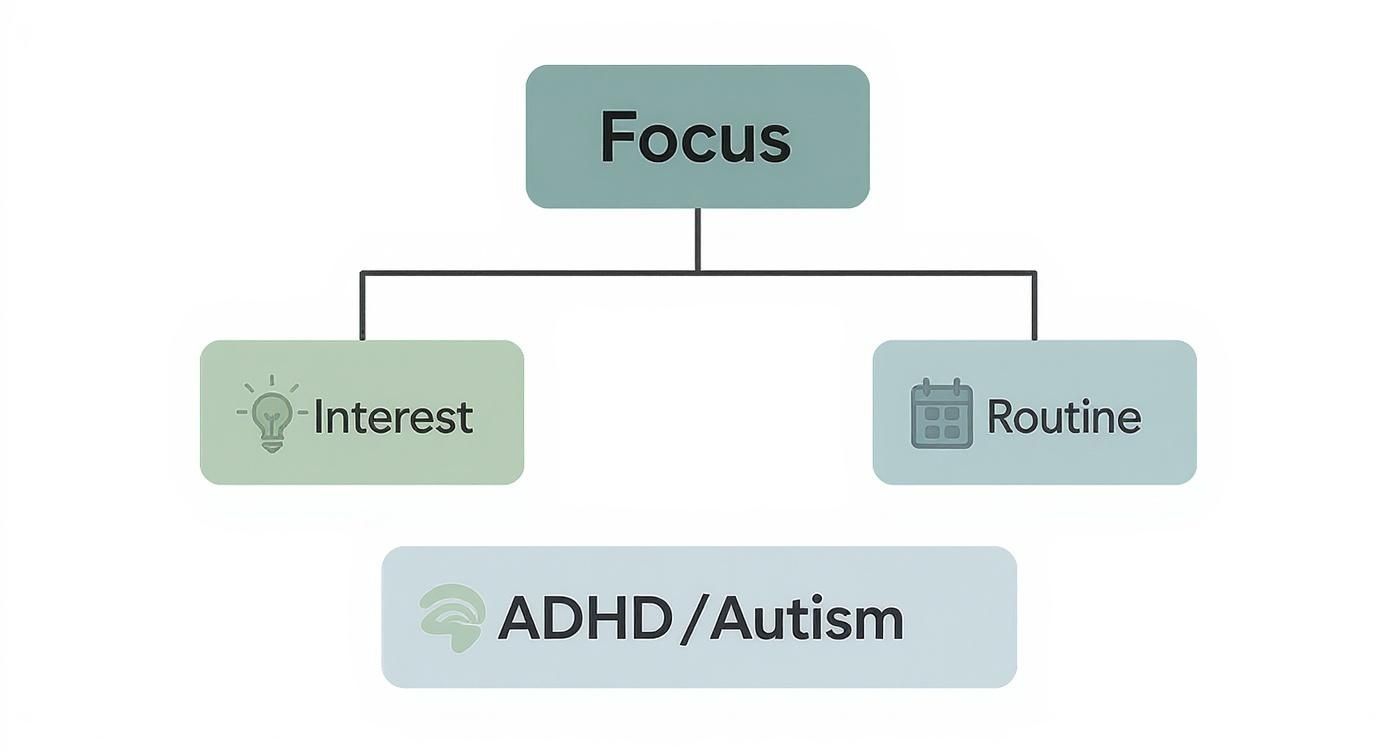
It’s a great visual reminder that while both conditions can lead to intense concentration, the motivation behind that focus is a vital clue for diagnosis.
The diagnostic landscape in the UK has its own set of challenges. ADHD and autism are often missed, particularly in girls and women who may present differently. For example, research highlights a much higher diagnostic rate for ADHD in boys versus girls (3.62% vs 0.85%), pointing to a historical diagnostic gap. This disparity underscores why getting a comprehensive, expert assessment is so critical for receiving the right support tailored to your unique neurotype.
A skilled diagnostician doesn't just look for symptoms; they seek to understand your entire lived experience. Their role is to piece together the puzzle of your life, from childhood to the present day, to provide a diagnosis that is not just a label, but a key to understanding yourself.
Comparing Support Strategies and Management Approaches
When you're trying to tell the difference between ADHD and Autism, looking at the support strategies for each is a massive clue. Because the underlying neurology is completely different, the things that help someone thrive are also worlds apart. A strategy that’s a game-changer for managing ADHD's executive function challenges might be useless, or even stressful, for an autistic person dealing with sensory and social difficulties.
Getting a clear diagnosis is the first, most critical step. From there, you can build a toolkit of strategies that are actually suited to the specific neurotype. For adults with ADHD, the main goal is usually to prop up executive functions—improving focus, getting organised, and taming impulsivity. For autistic adults, support is more often centred on navigating social communication, managing sensory sensitivities, and creating predictable environments to dial down anxiety.
Core Therapeutic and Medical Interventions
The medical and therapy routes for ADHD and autism go in very different directions, which really highlights their core differences. ADHD management often relies on a blend of medication and practical, skill-based coaching. Autism support, on the other hand, prioritises therapies that build communication and coping skills.
For ADHD:
- Stimulant Medications: These are often the first port of call. Medications like methylphenidate or amphetamine-based stimulants work by boosting dopamine and norepinephrine levels in the brain. This chemical tweak helps to sharpen focus, reduce impulsivity, and improve the ability to stick with a task.
- Executive Function Coaching: This is a very practical, goal-focused type of support. It helps adults with ADHD develop concrete systems for organisation, time management, and planning. It’s less about deep emotional work and more about building tangible life skills that make day-to-day life run more smoothly.
For Autism:
- Speech and Language Therapy: This isn't just for children. It can be incredibly helpful for autistic adults in navigating the subtle rules of social communication, like understanding how to take turns in a conversation or figuring out when someone isn't being literal.
- Occupational Therapy: An occupational therapist is brilliant at helping with sensory overwhelm. They can also help develop daily living skills and create routines that support emotional regulation. It’s important to note that there is no medication to treat core autistic traits themselves.
Creating Supportive Environments
Beyond formal therapies, tweaking your environment is a powerful way to manage both conditions, but the changes look very different. The ideal setup for someone with ADHD is rarely the same as what works for an autistic person.
For an adult with ADHD, the focus is on minimising external distractions and maximising cues for focus. This might look like:
- Using noise-cancelling headphones to silence office chatter.
- Keeping a minimalist, clutter-free workspace.
- Using visual timers and digital reminders to stay on track.
For an autistic adult, the goal is to create a sensory-friendly and predictable space. This could involve:
- Swapping harsh fluorescent bulbs for softer, adjustable lighting.
- Using soft textiles and weighted blankets for calming sensory input.
- Sticking to a highly structured daily routine to reduce uncertainty and the mental load of making decisions.
The key takeaway is this: for ADHD, you're often designing an environment to help the brain start and stay on a task. For autism, you're designing an environment that reduces sensory and social overwhelm, creating a sense of safety and calm.
Building a Personalised Management Toolkit
Ultimately, managing either condition well comes down to building a personalised toolkit. While medication is a cornerstone for many with ADHD, it isn't the whole story. Lots of people look into how to manage ADHD without medication by bringing in lifestyle changes, therapy, and environmental adjustments. The best approach is rarely just one thing; it's a mix of strategies tailored to an individual’s unique challenges.
The table below gives a quick overview of some of the most common support approaches for each neurotype, highlighting just how different they can be.
Support Approaches for ADHD and Autism
| Support Type | Primary Focus for ADHD | Primary Focus for Autism |
|---|---|---|
| Medication | Stimulants or non-stimulants to improve focus and reduce impulsivity. | No specific medication for core traits; medication may be used for co-occurring conditions like anxiety. |
| Therapy | Cognitive Behavioural Therapy (CBT) and executive function coaching to build skills. | Speech, occupational, and other therapies to support communication and sensory needs. |
| Environment | Creating distraction-free zones and using organisational tools to aid executive function. | Designing sensory-friendly spaces and establishing predictable routines for emotional regulation. |
| Lifestyle | Regular exercise, structured routines, and mindfulness to help regulate energy and attention. | Engaging in special interests, practising self-advocacy, and using sensory tools for self-soothing. |
Recognising these fundamental differences is crucial for anyone supporting a neurodivergent person. Trying to apply a one-size-fits-all approach is a recipe for frustration. Real, effective support comes from understanding the unique internal world of the person you're trying to help and giving them tools that actually align with how their brain is wired.
The Reality of Overlap and Co-occurrence

It’s becoming clear that for many adults, lived experience doesn’t fit neatly into a single diagnostic box. Rather than it being a straightforward case of ADHD or autism, a growing number of people are discovering they are both autistic and have ADHD. This co-occurrence, often called AuDHD, results in a unique neurotype with its own distinct blend of strengths and challenges.
Understanding this overlap is vital because the two conditions interact in complex ways. Sometimes, they mask each other, with one set of traits making the other less apparent. For instance, the autistic need for deep, focused interests can be constantly derailed by the ADHD brain’s relentless search for novelty. This can create a deeply frustrating cycle of starting and abandoning passions.
On the other hand, the traits can amplify one another. An individual might grapple with the intense emotional dysregulation common in ADHD alongside the sensory sensitivities of autism, making everyday life feel incredibly overwhelming. This internal push-and-pull demands a far more nuanced approach to support than either condition would in isolation.
The AuDHD Experience: An Internal Conflict
Living with AuDHD can feel like a constant internal negotiation between two opposing forces. It isn't just a simple mix of symptoms; it's an intricate dance of traits that can feel bewildering until it's properly understood.
A classic example is the clash between impulsivity and the need for predictability.
- The ADHD brain might impulsively say "yes" to a last-minute social plan, craving the excitement and stimulation.
- The autistic brain then floods with anxiety because the sudden change shatters a carefully structured routine.
This internal conflict often leads to burnout, confusion, and a persistent feeling of being at war with yourself. It also helps explain why many people with AuDHD don't fit the textbook stereotype of either condition, which can complicate the diagnostic journey.
Receiving a dual diagnosis can be genuinely life-changing. It offers a complete framework for understanding why you might simultaneously crave structure yet struggle to maintain it, or why you can be both incredibly spontaneous and deeply resistant to change. It validates the true complexity of your experience.
Why a Dual Diagnosis Matters
Recognising the potential for co-occurrence is crucial for finding support that actually works. An assessment that only screens for one condition is likely to miss the bigger picture, leading to strategies that are incomplete or ineffective. A dual diagnosis, however, allows for a support plan that acknowledges the interplay between traits and addresses the unique challenges of AuDHD.
This complexity is mirrored in the diagnostic landscape. Historically, ADHD and autism were considered separate, but modern understanding acknowledges their significant overlap. The increase in adult ADHD diagnoses has highlighted this connection, as many individuals seeking an ADHD assessment discover they also have autistic traits. It's also known that conditions like anxiety are very common in both neurotypes, with up to 72% of UK adults with ADHD also experiencing anxiety. Research from ADDitude Magazine explores these intricate links.
Frequently Asked Questions
It’s completely normal to have a lot of questions when you’re trying to make sense of neurodevelopmental conditions. We’ve put together some clear answers to the queries we hear most often from adults exploring the differences between ADHD and Autism.
Can You Be Diagnosed with Both ADHD and Autism?
Yes, absolutely. It's actually quite common for someone to be diagnosed with both ADHD and autism, a combination that many people now refer to as AuDHD. A thorough neurodevelopmental assessment is designed to look for the presence of one or both conditions. Identifying this overlap is crucial because it allows for a support plan that truly fits the individual, addressing the unique challenges that come with having both.
Is Hyperfocus in ADHD the Same as a Special Interest in Autism?
This is a great question, as they can look similar from the outside but feel very different on the inside. At their core, they are not the same thing.
ADHD hyperfocus is an intense state of concentration, usually triggered by something new, interesting, or stimulating. The catch is that it's often hard to control or direct. An autistic special interest, on the other hand, is a deep and enduring passion for a particular subject. It’s a source of great joy and comfort, and often a fundamental part of an autistic person's identity.
The internal experience is a key differentiator. Hyperfocus can leave someone with ADHD feeling drained and behind on other tasks, whereas engaging with a special interest is typically restorative and energising for an autistic person.
Do ADHD Medications Help with Autism Symptoms?
ADHD medications, like stimulants, are designed to target the core symptoms of ADHD – things like inattention, hyperactivity, and impulsivity. They don't treat the core traits of autism, such as differences in social communication, repetitive behaviours, or sensory sensitivities.
However, for someone who has both ADHD and autism, getting the ADHD symptoms under control can have a positive knock-on effect. When medication helps reduce the constant feeling of being overwhelmed and improves executive functions, it can make it easier to navigate the daily challenges that come with being autistic.
At Insight Diagnostics Global, our consultant-led team provides expert, CQC-regulated assessments for adults seeking clarity on ADHD, Autism, and co-occurring conditions. If you are ready to understand your unique neurotype and explore personalised support options, you can learn more about our comprehensive online services at https://insightdiagnostics.co.uk.