

If you’re an adult in the UK and suspect you might be autistic, finding clarity usually means going for a formal diagnosis. This journey presents a choice: do you go through the NHS or a private assessment? Both paths lead to a specialised evaluation, one that can unlock a profound new level of self-understanding and open doors to much-needed support. It's a big decision, and it’s often tied up with figuring out how co-occurring conditions like ADHD fit into the picture and affect your mental health.
Starting Your UK Adult Autism Diagnosis Journey

That lightbulb moment when you realise you might be autistic as an adult can be overwhelming. For so many people, it’s a feeling of sudden, intense clarity – like scattered puzzle pieces of your life finally snapping into place to form a complete picture. This realisation often comes after years of feeling fundamentally different without a name for it, or battling anxiety, depression, and other mental health challenges that never seemed to have a root cause.
Pursuing a diagnosis is a perfectly valid and often empowering next step. It’s not about getting a label; it’s about gaining a genuine framework to understand your own mind and how you experience the world. An official diagnosis acts as a powerful tool for self-acceptance, helping you re-evaluate past struggles with mental health and finally recognise your unique strengths.
Why a Formal Diagnosis Matters
For a lot of people, the main reason for getting an assessment is simply the need for validation. After a lifetime spent masking your true self or feeling deeply misunderstood, having a clinician confirm your experiences can be incredibly affirming. It provides a solid, tangible explanation for lifelong patterns in your thinking, social interactions, and sensory sensitivities.
But beyond that personal insight, a formal diagnosis comes with some very practical benefits here in the UK. It’s often the key that unlocks crucial support systems.
- Workplace Adjustments: Under the Equality Act 2010, a diagnosis gives you the legal right to ask for reasonable adjustments at work. This could mean anything from flexible hours to a desk in a quieter part of the office.
- Access to Specialised Support: It can open the door to neurodivergent-specific mental health services, counselling, and peer support groups who just get it.
- Clarity on Co-occurring Conditions: The assessment process frequently uncovers co-occurring conditions like ADHD, which is incredibly common in autistic people. Understanding this overlap is vital for managing your mental health effectively.
For many adults, a diagnosis is not an endpoint but a beginning. It offers a new lens through which to view their life, moving from confusion and self-criticism towards understanding and self-compassion.
This guide is designed to walk you through the entire process of diagnosing autism in adults in the UK. We’ll break down the two main routes—the NHS and private pathways—to help you figure out which one makes the most sense for you. If you’re already looking into local options, learning more about a private autism diagnosis near you can give you a better feel for what’s available. By the time you've finished reading, you'll have a clear roadmap for your journey toward self-discovery and support.
Recognizing Autistic Traits in Adulthood
For many adults in the UK, the path to considering an autism assessment rarely begins with a simple checklist. It's more often a slow-dawning realisation, born from a lifetime of feeling just a little out of sync with everyone else, or from wrestling with anxiety and depression that never quite responds to treatment.
That's because autism in adults, especially in those who have navigated life without a diagnosis, looks very different from the outdated stereotypes. It’s a far more subtle and complex internal experience, shaped by years of trying to adapt to a world not quite built for the way your brain works.
Beyond the Surface: The Internal Experience
To really understand autism in adulthood, you have to look past what’s visible on the surface. Many undiagnosed autistic adults have become masters of social camouflaging, or ‘masking’. This is the often exhausting effort of suppressing your natural instincts—like stimming (self-soothing through repetitive movements) or avoiding intense eye contact—while consciously mimicking the social behaviours you see in others.
Think of it like manually operating a system that’s automatic for most people. It’s a constant performance that can drain your energy, erode your sense of self, and place an incredible strain on your mental health. This relentless effort is one of the main drivers of autistic burnout—a profound state of physical, mental, and emotional exhaustion.
Another huge piece of the puzzle is sensory sensitivity. This is much more than simply disliking loud noises; it's a neurological reality where everyday sensations can feel completely overwhelming.
- Sounds: The low hum of a refrigerator or the overlapping chatter in a busy café can feel physically painful.
- Sights: Bright, fluorescent lights or visually cluttered rooms can cause genuine distress and confusion.
- Touch: The texture of a certain fabric or an unexpected light touch from a stranger can be deeply uncomfortable.
- Smells & Tastes: A strong perfume or a specific food texture can trigger a powerful, negative reaction.
Just getting through a normal day means constantly managing this sensory onslaught, which takes up a huge amount of mental bandwidth. For a more detailed look at these experiences, our guide on the signs of undiagnosed autism in adults goes into greater depth.
Special Interests and Executive Function
Autistic people often have incredibly deep and passionate interests, sometimes called ‘special interests’. These are far more than just hobbies; they are a source of immense joy, comfort, and a way to recharge. Diving deep into these subjects is a core part of autistic identity and can lead to incredible expertise.
On the flip side, many autistic adults grapple with executive function. These are the mental skills we all use to get things done: planning, organising, starting tasks, and managing our emotions. When these skills are a challenge, it might look like:
- Struggling to keep on top of household chores, even though you’re highly intelligent.
- Feeling completely paralysed when faced with a big project, unable to start without a clear, step-by-step plan.
- Experiencing emotional reactions that feel way out of proportion to the trigger.
For years, these difficulties can be misinterpreted as laziness or carelessness, leading to a lifetime of unfair self-criticism and confusion.
The Overlap with ADHD and Mental Health
It’s very common for autism and ADHD to exist together, and their traits often overlap in complex ways. Both can affect executive function and emotional regulation, making it crucial to get an accurate picture during an assessment to ensure you get the right support.
Many adults first explore an autism diagnosis because they’re searching for the root cause of long-term anxiety, depression, or trauma. The diagnosis often provides the missing context, finally explaining why years of traditional mental health treatments haven't quite hit the mark.
This reality is reflected in the sheer number of undiagnosed autistic adults. A 2023 study estimated that somewhere between 150,000 and 500,000 people in England aged 20 to 49 may be autistic without knowing it. The gender gap in diagnosis is also significant; a 2021 study found autism was identified in 2.8 per cent of boys but just 0.65 per cent of girls. This highlights how differently autism can present, and why so many women and girls go undiagnosed until much later in life.
Navigating NHS and Private Diagnostic Pathways
If you’re an adult in the UK thinking about a formal autism assessment, you essentially have two paths to choose from: going through the National Health Service (NHS) or opting for a private provider. Both routes should lead to the same destination—a thorough, NICE-compliant diagnosis. The journey, however, looks very different in terms of time, cost, and the steps you’ll need to take.
Deciding which path to take is a big deal, as it really sets the tone for your whole diagnostic experience. For many people, the first step is simply figuring out why they want a diagnosis and what they hope to get out of it.
Often, people start questioning if they might be autistic because of other challenges, like persistent anxiety. This isn't a coincidence.
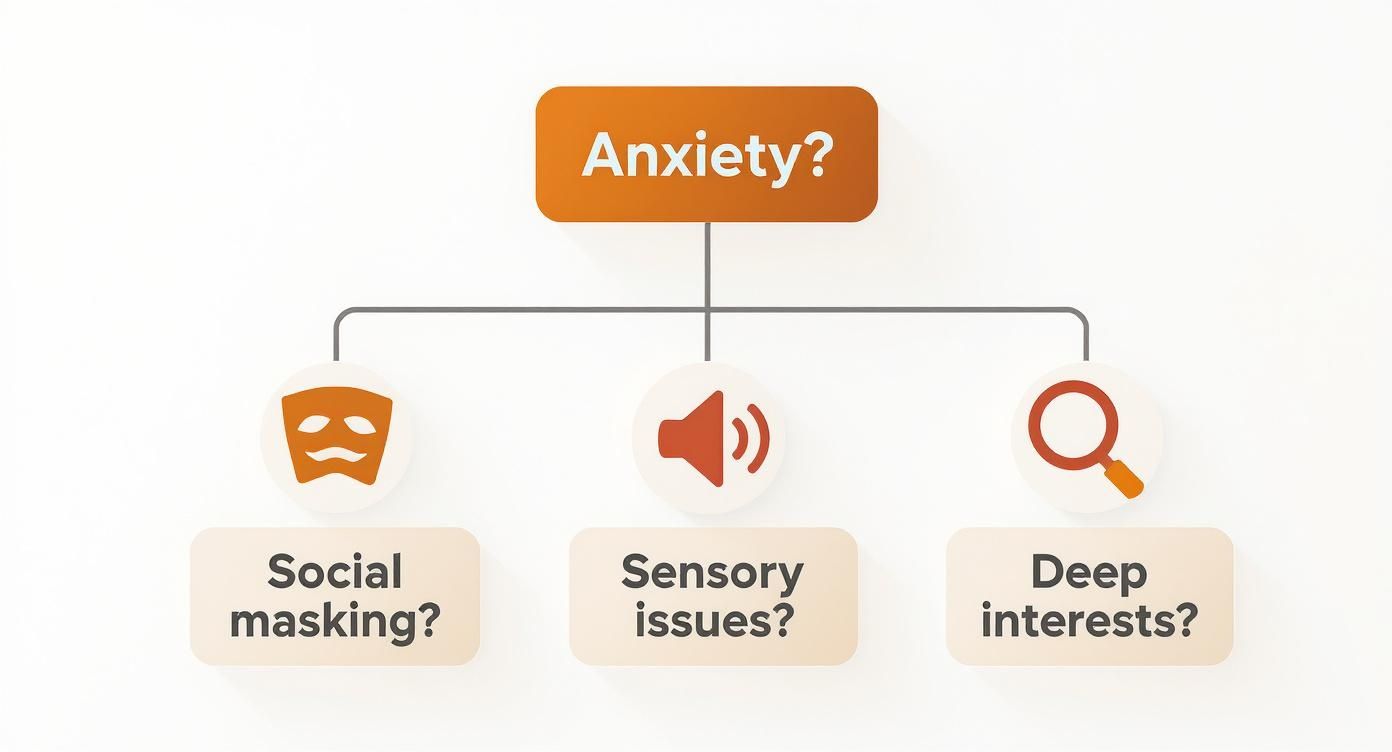
As you can see, the constant mental effort of social masking, dealing with sensory overload, or the sheer intensity of deep interests can all feed into anxiety. These are classic experiences for many autistic adults, and recognising this connection is often the first real step.
The NHS Pathway: Starting with Your GP
The journey to an NHS diagnosis almost always starts with a chat with your GP. This appointment is your gateway to getting a referral to a specialist adult autism team, so it pays to be prepared.
Think of it like building a case for yourself. Before you go, try to jot down specific examples from your life that you feel point towards autism. Focus on difficulties with social communication, sensory sensitivities, and any lifelong patterns of behaviour. It's also vital to mention any mental health struggles, like anxiety or depression, and if you suspect you may also have ADHD.
Your GP’s job isn’t to diagnose you on the spot. Their role is to listen and decide if there’s enough reason to refer you for a specialist assessment. If they agree, they’ll send a referral to your local diagnostic service. Unfortunately, this is where the biggest challenge of the NHS route often begins.
The wait for an autism assessment in England has reached crisis point. As of June this year, a staggering 236,225 people were on the waiting list. To make matters worse, nearly nine in ten (89%) have been waiting longer than the 13-week target set by NICE guidelines. The average wait is now over 17 months. You can dig deeper into the autism assessment waiting times on Autism.org.uk.
One potential way to speed things up in England is to use the ‘Right to Choose’ policy. This gives you the right to ask for a referral to a different provider that has an NHS contract, even if they’re outside your local area. It's not a magic bullet, but it can sometimes cut down the wait.
The Private Pathway: Speed and Control
For many, the NHS waiting lists are simply too long. A private assessment offers a much, much faster alternative. When you go private, you gain a lot more control—you can pick your clinician and get an assessment scheduled in a matter of weeks, not years.
Of course, this speed and control come at a price. A full private autism assessment for an adult in the UK typically costs between £1,500 and £3,000, sometimes more. It’s a significant investment, so doing your homework to find a reputable, high-quality provider is absolutely essential.
When you’re looking at private options, make sure they tick these boxes:
- Properly Qualified Clinicians: The assessment should be carried out by a team led by a qualified expert, like a clinical psychologist or psychiatrist. Check that they are registered with a professional body like the HCPC or GMC.
- NICE-Compliant Assessment: The process must follow the guidelines from the National Institute for Health and Care Excellence (NICE). This is crucial, as it ensures the diagnosis is robust and will be recognised by the NHS, employers, and universities.
- A Detailed Report: You shouldn’t just get a yes/no answer. A good assessment concludes with a comprehensive report that explains the findings and offers personalised recommendations for support going forward, especially concerning your mental health.
Choosing your route is a personal decision with big implications. If you're leaning towards the private path, it's worth getting a clear picture of what a private autism assessment for adults actually entails. It’s a more direct way to get the clarity and answers you need to better understand yourself.
What Happens During an Adult Autism Assessment?

The thought of walking into an autism assessment can feel pretty overwhelming. But a lot of that anxiety comes from the unknown. Knowing what actually happens can make all the difference.
It's crucial to remember this isn't a test you can pass or fail. It’s more like a structured conversation—a deep dive into your life experiences, designed to build a complete picture of who you are. UK clinicians follow clear NICE guidelines, combining in-depth discussion with specific assessment tools to get a real understanding of your neurotype.
The whole point is to gather information about your life, both now and in the past. Your personal experience is the most important piece of the puzzle.
Core Components of the Assessment
A proper, thorough assessment isn't just a single chat. It's made up of different sessions and uses a few key tools. The main goal is to understand how your traits show up today and, just as importantly, to find evidence that they’ve been part of you throughout your life. That’s a fundamental requirement for an autism diagnosis.
You’ll likely come across two "gold standard" tools that are widely used and respected:
- Autism Diagnostic Observation Schedule (ADOS-2): This sounds more intimidating than it is. It's basically a semi-structured session where the clinician guides you through a few activities and conversations. The idea is to create natural-feeling social scenarios to see your communication style, how you interact, and your patterns of behaviour firsthand. It might involve something like making up a story from a picture book or doing a small creative task.
- Autism Diagnostic Interview-Revised (ADI-R): This is a very detailed interview, but it focuses specifically on your developmental history. The clinician will ask a lot of questions about your early years (usually before you were five), digging into your social development, communication, and behaviour back then.
These tools give the process a solid framework, but the real heart of the assessment is the conversation and connection between you and the clinician.
The Developmental History Interview
A huge part of diagnosing autism in adults in the UK is looking for a lifelong pattern. This is often done through a developmental history interview, which ideally involves someone who knew you well as a young child—a parent, an older sibling, or a close family friend.
This part can cause a lot of stress, especially if bringing a family member in isn't an option or something you feel comfortable with. Don’t worry. Clinicians are used to this and are very flexible. If you can’t bring someone along, they’ll lean more heavily on your own memories, old school reports, childhood diaries, or even home videos to help build that picture. Your own account of your childhood is a completely valid and vital source of information.
The assessment isn't about judging you or your past. It's a process of discovery. The clinician is simply trying to piece together a lifetime of experiences to see if they fit the diagnostic criteria for autism. Your honesty and willingness to reflect are the most valuable things you can bring to the process.
Exploring Co-occurring Conditions Like ADHD and Anxiety
It's incredibly common for autistic people to have other conditions, with ADHD and anxiety being at the top of the list. Any good assessment will actively look for these. Understanding the full picture of your neurobiology and mental health is essential for getting the right support.
The clinician will ask questions to help untangle any overlapping traits. For instance, they might explore whether your struggles with focus are situational (like when you're absorbed in a special interest, which is common in autism) or if they happen across almost every area of your life (which points more towards ADHD).
They’ll also talk about your experiences with anxiety, figuring out if it's a separate condition or a direct result of navigating a world not built for you—a response to things like social masking or sensory overload. This integrated approach ensures the final report is genuinely helpful and its recommendations reflect what you actually need.
Understanding Your Diagnosis and What Comes Next
Getting your diagnostic report is a big moment. It’s often the final piece of the puzzle after a long, personal journey of questioning and searching for answers. Holding that document in your hands can unleash a whole wave of emotions.
For so many people, the first feeling is just immense relief. It’s validation. After a lifetime of feeling like you were out of step with everyone else, the report finally offers a clear, official reason why. It confirms you were never "broken" or "difficult"—you were autistic, trying to find your way in a world not built for you. That validation can be an incredibly powerful first step toward real self-acceptance.
Of course, it's not always that simple. Alongside the relief, you might feel a pang of grief for the person you could have been with earlier support. It’s also completely normal to feel a bit lost or overwhelmed as you start to process this new, fundamental part of your identity. Whatever you're feeling, it's valid. It's all part of the process.
Decoding Your Diagnostic Report
At first glance, your report might look like a dense, clinical document, but think of it as your personal roadmap. It’s structured to show exactly how the clinicians came to their conclusion, usually referencing specific diagnostic criteria from manuals like the DSM-5 or ICD-11. It will lay out the observations from your assessment and connect them to your developmental history.
While the entire report is valuable, the recommendations section is your immediate action plan. This is where the clinical jargon gets translated into practical, real-world support.
- Mental Health Support: You might see suggestions for therapies known to work well for autistic people, like neurodiversity-affirming CBT, or counselling to help with co-occurring conditions like anxiety.
- Workplace Adjustments: It will often list specific, actionable ideas for reasonable adjustments you can ask for at work.
- Support Strategies: This could cover anything from sensory regulation techniques and executive functioning aids to recommendations for joining local autistic-led support groups.
This section is designed to give you the tools to move forward. If you're still piecing together what being autistic means in day-to-day life, our guide on understanding autism spectrum disorder in adults can offer more context.
Sharing Your Diagnosis With Others
Deciding who, when, and how to tell people about your diagnosis is entirely up to you. You are in the driver's seat. There’s no rush and no right or wrong way to do it, so give yourself the time you need.
When you do start sharing, be prepared for a mixed bag of reactions. Hopefully, you’ll be met with support and understanding. But some people might react with disbelief, hitting you with comments like, "But you don't look autistic." This usually comes from a place of ignorance and tired old stereotypes, not from a personal rejection of you. Having a think about how you might handle these conversations beforehand can really help.
Your diagnostic report, whether it’s from the NHS or a trusted private practice, is a legally recognised document. It's your key to unlocking crucial support, like the government's Access to Work scheme, which can provide funding for specialist equipment, coaching, and other help at your job.
This report is proof that you have a right to reasonable adjustments under the Equality Act 2010. It gives you the standing you need to ask for support at work, in education, or in healthcare. Realising the power this document holds is a vital step toward building a life that truly works for you.
Building Your Life After an Autism Diagnosis
https://www.youtube.com/embed/7uAek9ISZzU
Getting an autism diagnosis as an adult isn't the end of the road. Far from it. Think of it as finally being handed the right map for a country you've been navigating your whole life. It offers a new, clearer way to understand your past and gives you a solid platform to build a future that genuinely works for you, particularly when it comes to your mental health and wellbeing.
Finding Your Tribe
For many newly diagnosed adults, one of the most powerful next steps is finding a community. Connecting with other autistic people, whether it’s at a local meet-up or in an online forum, can feel like coming home. Suddenly, you're in a space where you don't have to constantly explain yourself or hide parts of who you are. You're just… understood.
This kind of peer support is more than just nice to have; it’s often essential. The lack of an earlier diagnosis can leave people feeling incredibly isolated. In fact, startling research suggests that between 89 to 97 per cent of autistic adults aged 40 and over in the UK might still be undiagnosed. This diagnosis gap means countless people have missed out on vital support, putting them at higher risk of social isolation and poorer health. You can read the full findings on underdiagnosis in older adults for a deeper look.
Making Work, Work for You
A formal diagnosis isn't just a piece of paper—it's a key. It unlocks your legal rights at work under the Equality Act 2010. This law means your employer has a legal duty to make reasonable adjustments, which are practical changes to help you do your job without being at a disadvantage.
So, what does this look like in practice? It could be things like:
- Your Workspace: Moving you to a quieter spot in the office, providing noise-cancelling headphones, or changing the lighting to reduce sensory strain.
- Your Schedule: Allowing flexible start and finish times to miss the chaos of rush hour, or enabling you to work from home.
- How You Communicate: Getting instructions in writing rather than just verbally, or having more time to process information in meetings.
Knowing your rights empowers you to stop just surviving your work environment and start shaping it to fit your needs.
Looking After Your Mental Health and Avoiding Burnout
Trying to function in a world that isn't built for your brain is draining. Over time, this can lead to a state of complete exhaustion known as autistic burnout. It's not just feeling tired; it's a total shutdown caused by long-term sensory overload, the pressure of social masking, and the mental load of day-to-day tasks. Learning about autistic burnout and its management through counselling is a crucial step for many after diagnosis.
A diagnosis is permission to put your own mental and sensory needs first. It gives you the validation you need to set firm boundaries, protect your energy, and say "no" to things that you know will push you over the edge.
The first step is figuring out your personal triggers. Once you know what drains your battery, you can create a personal "sensory diet" to keep yourself regulated. This might mean scheduling quiet downtime after a hectic meeting, using stim toys to self-soothe, or diving into a special interest to recharge. It’s all about proactively managing your energy, not just reacting when you’re already running on empty.
A Few Common Questions
Getting your head around an adult autism diagnosis in the UK often throws up a lot of questions. Let's tackle some of the most frequent ones we hear, particularly around how autism overlaps with ADHD and mental health.
Can I Get Assessed for Autism and ADHD at the Same Time?
Yes, absolutely. In fact, it’s often the best way to do it. Many specialist UK clinicians are well-versed in assessing for both at once, simply because they so often go hand-in-hand.
A combined assessment gives the clinical team a complete view of your neurotype. It helps them carefully untangle traits that can look similar on the surface—like challenges with focus or managing big emotions—to figure out what’s driving them. This way, you get a really accurate picture and any support recommendations are built around the whole you.
Will the NHS Accept My Private Diagnosis?
A private diagnosis is legally valid, but the key thing to check is that it was carried out according to NICE guidelines. This is non-negotiable.
As long as a qualified private provider has followed these national standards, their diagnosis should be accepted by the NHS, your employer, and any educational institutions. One thing to be aware of, though, is that if you're seeking ADHD medication through the NHS, you might hit a roadblock trying to get them to take over a prescription started privately. The bottom line? Always, always double-check that any private service is working to NICE standards.
An autism diagnosis doesn’t change who you are. What it does is give you a new, clearer lens through which to understand your entire life. It’s a framework that can help you finally access the right support and embrace your strengths with a bit more self-compassion.
What Happens if I Don’t Get a Diagnosis?
It can feel incredibly disheartening to go through an assessment and be told you aren't autistic, especially if you’ve felt a strong connection to the experiences of other autistic people.
A good clinician won't just leave you with a simple 'no'. Their report should walk you through exactly how they reached their conclusion. They should also offer other possible explanations for what you're experiencing, which could point to things like social anxiety, complex trauma, or another form of neurodivergence. Even if it's not the answer you expected, the assessment can still be a really important step towards getting the right kind of support for your mental health.
At Insight Diagnostics Global, we offer thorough, CQC-regulated online assessments for adults looking for clarity about autism, ADHD, and their mental health. Our consultant-led team provides robust, NICE-compliant reports to help you understand yourself better and move forward with confidence. To find out how we can help, visit us at https://insightdiagnostics.co.uk.