

An adult ADHD assessment often feels like standing at a crossroads. One route leads to NHS referrals, another to private clinics and a third to online consultant-led services. Picking the right direction means matching speed, cost and depth to your priorities. It’s also vital to consider co-occurring autism spectrum traits and broader mental health needs for a truly comprehensive evaluation.
Choosing The Right ADHD Assessment Pathway
Each option offers different timelines and budgets. Think about your location, how quickly you want answers and what you can invest financially. Also check whether the service evaluates autism and screens for anxiety or depression alongside ADHD.
• NHS Referral
- Free evaluation
- Wait times up to 12 months
- Local multidisciplinary teams, some with autism specialists
• Private Clinics
- Appointments within 2–6 weeks
- Fees ranging £300–£800
- In-person specialist interviews and tailored reports, often including mental health screening
• Online Consultant-Led Services
- Digital screening followed by video triage
- Typical cost £500–£700
- Fast reports with follow-up titration packages and optional autism-quota screening
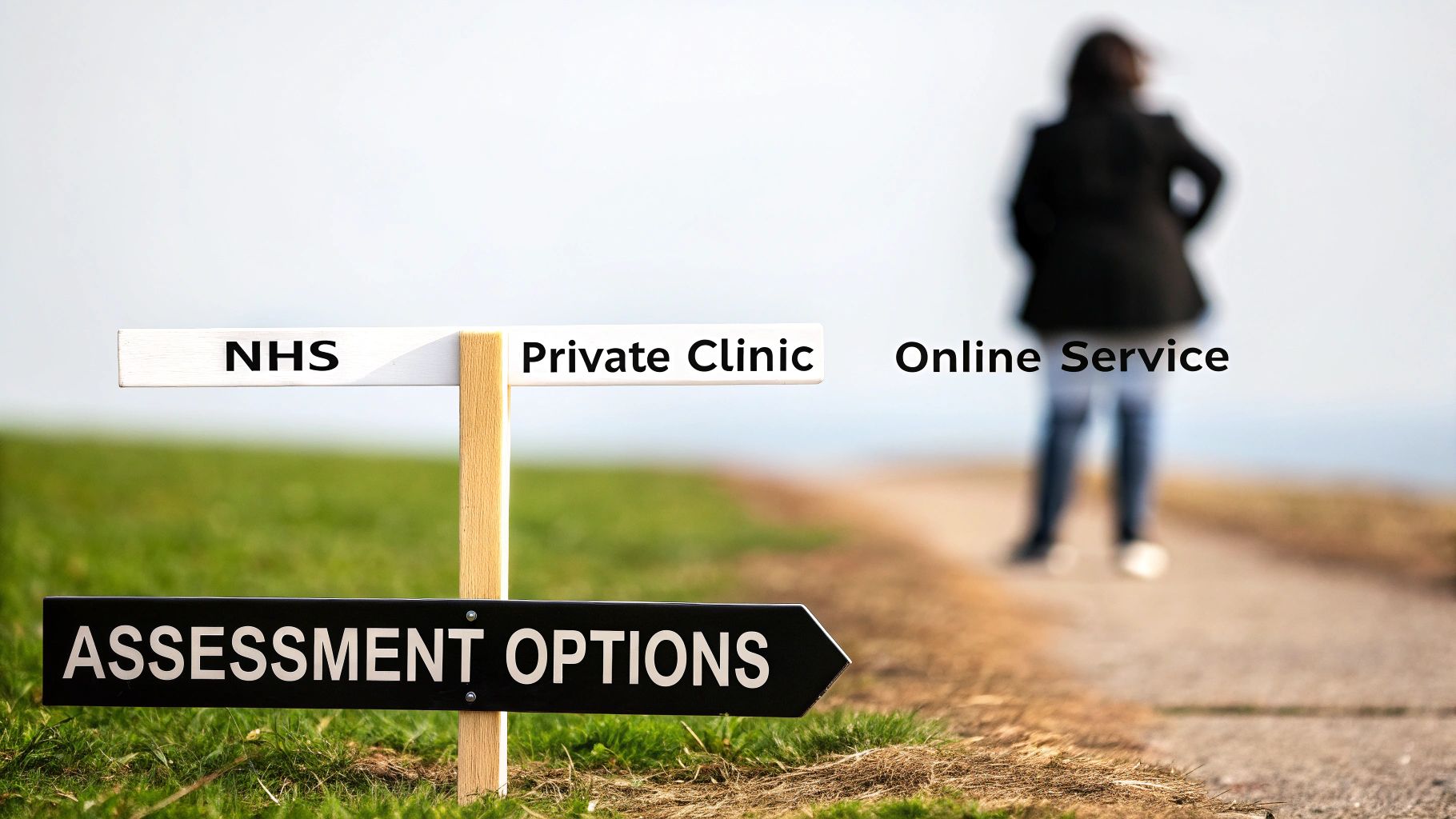
Assessment Options Summary
Before you commit, here’s a quick side-by-side glance at three main assessment pathways. It helps anchor your decision around timing, cost, provider type—and whether they cover autism screening and mental health checks.
| Assessment Pathway | Typical Wait Time | Estimated Cost | Provider Type |
|---|---|---|---|
| NHS Referral | 6–12+ months | Free | NHS psychiatric teams |
| Private Clinics | 2–6 weeks | £300–£800 | Private psychiatrists |
| Online Consultant-Led Services | 1–3 weeks | £500–£700 | GMC-registered consultants |
This snapshot makes it easier to spot which route aligns with your needs for speed, budget, thoroughness and comprehensive neurodiversity assessment.
Key Insights For First Steps
Think of the assessment as a roadmap that guides you from confusion to clarity—across ADHD, autism and mental health.
Starting off clear reduces unnecessary stress and sets realistic expectations.
• If speed is your priority, online services deliver results in 1–3 weeks.
• If cost is your main concern, NHS referral is free.
• If you want the most in-depth evaluation, private clinics often include autism screening, anxiety and depression measures.
This overview should help you zero in on the pathway that fits best.
Learn more in our detailed guide on how to get tested for ADHD in the UK.
Assessments At A Glance
In the next section, we’ll unpack screening tools, diagnostic interviews and follow-up plans step by step.
Clarity is within your reach today.
Understanding Key Concepts In ADHD Assessment
Before we jump into the practical steps, it helps to see ADHD and autism traits in everyday terms. Picture inattentiveness as an inbox swelling with unread emails, while hyperactivity feels like a sealed car full of restless passengers. Impulsivity? It’s the pop-up ad that hijacks your screen before you’ve had a chance to breathe. And sensory overload might feel like every notification ding turning into a fire alarm—common in autism.
- Inattentiveness: Losing track of routines, overlooking details and drifting off task.
- Hyperactivity: A simmering restlessness, fidgeting when you should be still.
- Impulsivity: Acting on sudden urges, cutting in on conversations or making quick decisions without second thoughts.
- Sensory Sensitivities: Heightened reactions to noise, light or textures—often pointing to autism traits.
Symptoms need to appear in more than one setting—home, work or social life—to rule out stress-related lapses.
Key Traits Defined
Moving from those vivid images, clinicians rely on established frameworks like DSM-5 and NICE. They blend conversations, rating scales and sometimes objective tools—think of QbTest—to gather a full picture.
This visual lays out the three ADHD symptom clusters alongside autism-related sensory markers. To qualify, you must have shown signs before the age of 12, even if memories blur over time. Spotting consistent patterns across different environments helps confirm ADHD or autism rather than isolated hiccups.
Guideline Frameworks
Clinicians follow the DSM-5 criteria or NICE 2024 standards to keep diagnoses consistent. Below is a quick comparison:
| Guideline | Symptom Threshold | Childhood Onset | Objective Testing |
|---|---|---|---|
| DSM-5 | 5 or more | Before age 12 | Optional |
| NICE | 5 or more | Before age 12 | Recommended |
- QbTest tracks movement and response times to quantify hyperactivity.
- Continuous performance tests measure reaction speed and errors.
- Autism screens like AQ-10 flag social communication and repetitive behaviors.
Objective assessments reduce reliance on self-report and help pinpoint neurodiverse traits.
Still, the personal narrative remains key—no chart can fully capture your daily struggles.
Assessment Backlog Crisis
Despite clear guidelines, the UK faces a crisis in adult ADHD assessment. By mid-2025, roughly 500,000 adults in England were waiting for a diagnosis, and over 125,000 had been stuck in limbo for two years or more. This delay takes a heavy toll on work performance, relationships and overall wellbeing, often worsening anxiety and depression.
Research from NHS England’s ADHD Taskforce shows around 3–4% of UK adults—some 2 million people—have ADHD, yet services can’t keep up. Prescription rates doubled to nearly 278,000 in 2023-24, but only 15.6% of adults with ADHD receive treatment.
- Regional highs hit 19.6% in NHS Frimley.
- Lows drop to 6.1% in Humber and North Yorkshire.
“Regional disparities and pandemic backlogs have left millions undiagnosed,” warns Professor Anita Thapar, chair of the Taskforce.
Calls for extra funding, GP training and integrated autism services are growing louder each month.
Distinguishing Co-Occurring Conditions
Adult ADHD and autism often overlap under the neurodiversity umbrella. Autism, anxiety and depression frequently co-occur, with shared executive function challenges and sensory or emotional regulation issues. Clinicians dig deep into your developmental history and current life stressors to separate or confirm overlapping diagnoses. If autism traits are suspected, you may complete an Autism Spectrum Quotient (AQ-10) and be referred for specialist assessments like ADOS-2 or ADI-R.
You might find our adult ADHD symptoms checklist useful for spotting subtle traits across different settings.
- Masked hyperactivity hidden through rigid routines
- Mental racing felt as internal restlessness
- Executive dysfunction leading to chronic lateness or lost items
- Forgetfulness affecting work and social life
- Impulsive choices risking finances or relationships
- Restlessness disrupting sleep and amplifying anxiety
- Sensory overload from lights, sounds or textures influencing focus
Clear communication about these overlaps keeps misdiagnosis at bay.
Real World Examples
Take Sarah, for example. She missed crucial deadlines under tight schedules—a classic inattentive pattern that only emerged during performance reviews. Then there’s James, whose impulsive spending sprees showed up every payday, revealing a habit of quick decisions without weighing consequences.
- Sarah’s review notes flagged repeated task omissions under pressure.
- James’s bank statements highlighted unplanned transactions after social gatherings.
A full evaluation weaves these personal stories into a treatment plan tailored to your unique neurodiverse profile.
Step By Step ADHD Assessment Process
Starting an adult ADHD evaluation often feels like fitting together pieces of a complex jigsaw. Each appointment reveals a bit more of your focus profile, bringing the full picture into view. Integrated autism and mental health checks ensure no angle is missed.
We begin with a referral—either through your GP or a direct online self-referral service.
- NHS GP Referral: Standardised paperwork then local triage.
- Private Online Self-Referral: Fast turnaround with appointments in days.
- Employer/Legal Referral: Medico-legal evaluations and court-compliant reports.
For instance, Sam’s first call with an online consultant highlighted how he struggles to sustain attention on routine tasks and experiences sensory overload in busy environments.
Initial Referral And Triage
Within seven working days of submitting your referral, a triage interview is usually scheduled. Alex experienced a similar process in an in-person clinic over a two-week window. Many services now include brief screens for anxiety and autism alongside ADHD questions.
You’ll receive either a screening link or an appointment letter by email. Many services outline clear timelines so you can plan your next steps.
Screening Questionnaires
Next, you complete validated forms to map out symptom patterns in inattentive, hyperactive, impulsive—and sometimes autism and mental health—domains:
- Adult ADHD Self-Report Scale (ASRS): 18 items on current symptom frequency.
- Barkley Adult ADHD Rating Scale (BAARS-IV): Tracks lifelong behaviours and executive challenges.
- Wender Utah Rating Scale: Recalls childhood patterns that shape present-day attention issues.
- Autism Spectrum Quotient (AQ-10): A quick 10-item screen for autism traits.
- GAD-7 and PHQ-9: Brief measures for anxiety and depression screening.
These scores highlight priority areas for your diagnostic interview and guide the conversation.
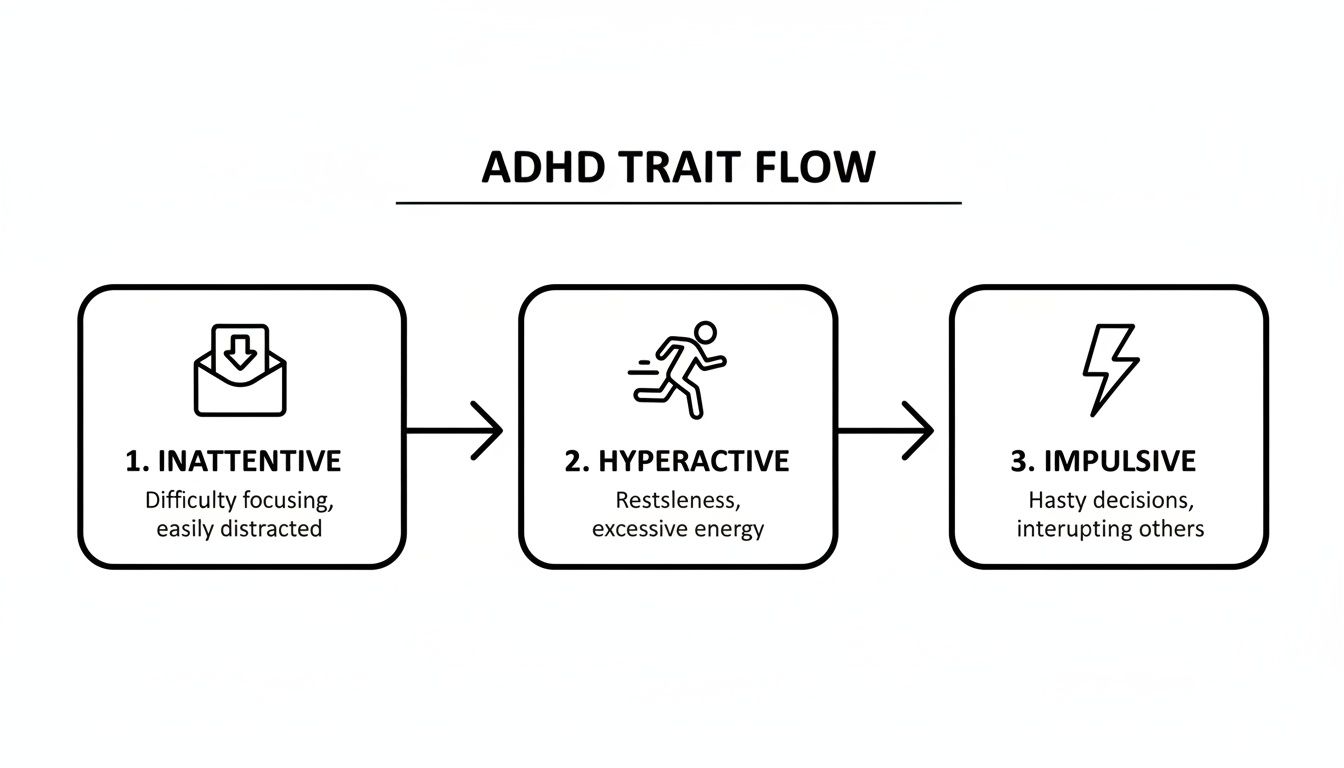
This visual lays out the three core ADHD traits—inattention, hyperactivity and impulsivity—in a simple progression.
Diagnostic Interviews
A structured interview follows, digging into personal history and daily impact. Clinicians lean on DSM-5 or NICE guidelines to ensure all angles are covered, including autism and mental health probes.
- Detailed timeline from childhood milestones through current challenges.
- Real-world examples, such as missed deadlines or impulse buys, to illustrate each symptom.
- Input from partners or co-workers offers an outside perspective on behaviour patterns.
Differential questioning screens for anxiety, depression or ASD. By the end, a clear narrative emerges so recommendations can be tailored precisely.
Objective Assessment Tools
Tools like QbTest add measurable data on movement, attention and reaction speed. While seated before a sensor array, you respond to visual prompts—fidgeting and missed targets become quantifiable. NICE recommends QbTest for adults to speed up diagnosis and boost accuracy.
Yet in the UK, waiting lists have soared: over 500,000 adults queued by June 2025, with 125,000 enduring waits beyond two years. Read the full interim report from NHS England’s ADHD Taskforce for more insights.
| Phase | Online Service | NHS In-Person Pathway |
|---|---|---|
| Referral & Triage | 1 week | 4–8 weeks |
| Screening Questionnaires | 1 week | 4–6 weeks |
| Diagnostic Interview | 1–2 weeks | 8–12 weeks |
| Objective Testing (QbTest) | 1 week | Variable (waiting list) |
| Report Delivery | 2–3 days | 4–6 weeks |
A structured timeline empowers you to plan ahead and reduce uncertainty across ADHD, autism and mental health evaluations.
Most online services compress this into a three- to four-week turnaround. NHS pathways can stretch past six months, depending on local demand.
Next Steps And Follow Up
Once your report lands, your clinician or GP will review treatment options—medication, coaching or therapy. A titration appointment for stimulants helps zero in on the right dose. If co-occurring autism is identified, referrals to autism-specific therapy or social skills groups may follow.
Routine follow-ups typically occur every four to six weeks at first, then shift to quarterly reviews. Alongside professional guidance, you can:
- Use calendars, alarms and focus apps to build consistent routines.
- Negotiate workplace adjustments, such as flexible hours or distraction-free spaces.
- Explore occupational therapy or sensory integration strategies for autism.
- Join peer support or time-management groups for practical tips.
Sam claimed a quiet corner at work and boosted his productivity by 50%. Alex’s peer-led group transformed her scheduling habits overnight.
Keeping a daily journal of symptoms spawns real examples you can share during interviews. This living record becomes a vital puzzle piece when shaping your treatment plan.
Ask your service about court-compliant reporting if you need medico-legal documentation. Insight Diagnostics Global offers clear report options and online medication titration support within five working days.
Next, we’ll guide you through gathering evidence and setting realistic timelines for your ADHD assessment. Stay proactive and empowered on your journey.
Preparing For ADHD Assessment And Timeline

Piecing together your ADHD story is like sketching a map—every detail helps trace the route. School reports often highlight early signs of inattention, while recent appraisals show how challenges play out at work. Include any previous autism assessments or mental health therapy notes for a complete picture.
Document Checklist
- Childhood school assessments with teacher comments
- Professional feedback or appraisals from employers
- Sleep and mood logs from daily routines
- Medication history and dosage records
- Symptom diaries or focus-tracking screenshots
- Previous autism evaluation or mental health assessment reports
Organise everything in chronological order, labelling each file with dates and contexts. Scan papers, photograph reports and store digital files in one shared folder for quick access.
“Completeness reduces delays and gives assessors the full picture.”
Next, jot down concise notes on daily life—short bullet points work wonders during interviews. For example, note when concentration dips or restlessness peaks over a week.
Project Timeline
- GP Referral and Initial Triage: 1–2 weeks
- Screening Questionnaires: 1–2 weeks
- Diagnostic Interview: 2–4 weeks
- Objective Testing (e.g., QbTest): 1–3 weeks
- Report Delivery and Feedback: 1–2 weeks
| Pathway | Typical Duration |
|---|---|
| Regional NHS | Up to 6+ months |
| Online Consultant-Led Services | From 4 weeks |
Real-world waits can vary across the UK. Mapping out these steps helps you anticipate each phase rather than be caught off guard.
Recent studies reveal a striking gap: just 0.32% of adults had a formal ADHD record in a 9 million GP dataset by January 2025—roughly 1 in 300 people.
Read the full King’s Fund report on adult ADHD diagnosis data.
Low diagnosis rates leave millions undiagnosed despite self-reported symptoms.
We also recommend exploring your rights early on. See our guide on Your Right to Choose ADHD Assessment for practical tips.
Before your appointment, prepare questions about medication adjustments, therapy referrals, autism-specific support and workplace accommodations.
Tip
- Pack all documents at least a week before your appointment
- Label digital and paper files with clear headings
- Share files securely via encrypted email or portal
Reducing Assessment Anxiety
A clear plan eases nerves on the day. Set reminders a day before each slot and double-check details. Use calming techniques like deep breathing or a brief walk between sessions.
- Pack snacks and water for longer meetings
- Confirm appointment times and links in advance
- Arrange childcare or work cover if needed
Key Takeaways
- Preparing your history thoroughly reduces delays
- Mapping a timeline brings structure and calm
- Every document you provide sharpens the accuracy of your assessment
Stay proactive and you’ll tackle each phase with confidence.
Comparing Service Costs And Packages
Money often tops the list when you’re exploring an adult ADHD assessment. On one hand, the NHS route is free—but wait times can stretch for 6–12+ months, depending where you live. On the other, private clinics offer tiered packages that vary in price, scope and speed. Many now bundle autism and mental health screening into premium tiers.
In a basic private package, you’ll typically have a detailed interview, standard rating scales and a concise report. Step up to premium and you’ll see extras like medication titration, therapy referrals, autism diagnostics and even court-compliant documentation.
Online consultant-led options blend digital screening tools with e-reports, plus optional phone or video follow-ups. They often promise clearer timelines, letting you pick the mode of delivery that suits you best.
- NHS assessments are free, but waits often stretch to 6–12+ months.
- Private Basic covers a clinical interview and DSM/NICE-aligned report for £300–£500.
- Private Premium adds therapy referrals, autism screens, titration and medico-legal paperwork from £700–£1,200.
- Online Standard includes digital screening and an e-report from £500–£650.
- Online Premium tiers offer autism screening, follow-up consultations and fast-track reports at £750–£900.
Service Package Tiers
Below is a quick overview of the main service levels, their core features and typical price brackets.
Service Packages Comparison
Features and pricing of common adult ADHD assessment packages
| Package Level | Assessment Components | Follow Up Support | Price Range |
|---|---|---|---|
| NHS Standard | GP referral, screening questionnaire, interview | Local team follow up on treatment plan | Free |
| Private Basic | Clinical interview and DSM/NICE-aligned report | One follow-up call or email | £300–£500 |
| Private Premium | Interview, report, autism screen, titration, therapy | Three follow-up sessions and legal doc | £700–£1,200 |
| Online Standard | Digital screening and e-report | Single video or phone review | £500–£650 |
| Online Premium | Screening, e-report, autism AQ-10, peer group | Up to four follow-up consultations | £750–£900 |
Each tier varies in clinician time and detail. Standard assessments tend to last around two to three hours, while premium sessions can stretch to four hours or more for a deep dive into your neurodiverse history.
For a detailed breakdown on costs, check out our guide on private ADHD assessment costs.
Hidden Fees And Payment Plans
Some providers charge extra for add-ons or licences. Always check for:
- Additional tests, such as QbTest or objective attention measures
- Admin fees if you need court-compliant or medico-legal documents
- Fast-track options to slash wait times, often costing £100–£200 extra
- Cancellation or rescheduling fees, sometimes £50–£75 per session
Tip: Ask for a full breakdown of costs before you book.
Many clinics—especially online ones—now offer interest-free plans over three or six months. Be sure to:
- Confirm if you can split the total into equal monthly instalments
- Check whether any deposit is required and if it’s refundable
- Note any expiry windows on promotional pricing
- Review your insurance policy for mental health coverage
Choosing The Best Value
When you weigh your options, think about both depth and speed. The NHS route avoids fees but might delay your diagnosis by over a year. Private premium packages cost more but deliver faster results, robust follow-up and reports that stand up in court. Online services strike a balance between cost and convenience, though they often lack face-to-face time.
Ultimately, your choice should reflect your budget, urgency and the level of support you need—for ADHD, autism and general mental health. Ask detailed questions about session length, clinician qualifications and report complexity, and read client reviews to ensure you’re making a confident decision.
Interpreting Assessment Results And Follow Up Options
When you open your clinician’s report, it can feel like someone handed you a roadmap. All those interviews, questionnaires and tests suddenly line up into clear findings. Each section points you towards the next practical step, whether it’s ADHD medication, autism-specific therapy or mental health support.
A key part of the report shows whether you meet DSM-5 or NICE criteria and classifies your symptom severity as mild, moderate or severe. That rating steers the recommendations for support, therapy or medication adjustments.
Reading Your Diagnostic Report
Reading your report starts by spotting the Diagnostic Criteria and the Severity Ratings.
Under Diagnostic Criteria (whether DSM-5 or NICE), you’ll see the exact symptoms you’ve met for a diagnosis. For instance, ticking off 6 or more inattentive behaviours signals significant focus issues. If AQ-10 items are flagged, autism interventions may be recommended.
Severity Ratings then outline how those traits show up in your work, relationships and daily life. A moderate label means you might need more regular interventions compared to a mild label.
- Diagnostic Criteria identifies symptom thresholds, childhood onset requirements and autism screener results.
- Severity Ratings clarify how symptoms affect daily life.
- Clinician Notes offer personalised observations and context.
Working With Your GP
After you’ve digested the report, book a meeting with your GP within two weeks. That way, prescriptions or referrals follow directly from your assessment.
If medication is on the cards, your GP will explain titration—starting low and tweaking the dose every 4–6 weeks. This process lets you find the right balance without rushing. If autism or significant anxiety/depression is noted, you may be referred to a psychologist or specialist service.
During these check-ins, you’ll note any side effects alongside gains in concentration. One patient, Anna, reported a 40% boost in focus after just two dosage adjustments.
- Schedule a GP review within two weeks of receiving your report.
- Share your full report and ask specific questions about treatment or referrals.
- Agree on a medication titration plan, therapy referral or autism support pathway.
“Titration visits turn static data into dynamic treatment,” says Dr. Patel, consultant psychiatrist.
Setting Up Support And Accommodations
Medication is often just the first step. Adding behavioural therapy, autism-informed strategies and small changes to your surroundings can build a sturdy support network around your focus.
Simple tweaks—like creating a low-distraction workspace—can cut background noise by 30% and boost productivity. These changes help you keep your attention on the task at hand.
If you’re studying, many institutions offer deadline extensions or extra breaks. Just attach a copy of your assessment when you apply.
- Peer Support Groups help you share tips and reduce isolation.
- Behavioural Therapists teach time-management and routine-building skills.
- Occupational Therapists assist with sensory-friendly environments.
- Workplace Accommodations include flexible hours and noise-cancelling tools.
| Support Type | Benefit | Next Step |
|---|---|---|
| Medication Titration | Optimal dose identified | Book GP follow-up |
| Therapy Sessions | Build coping strategies | Find a CQC-registered therapist |
| Occupational Therapy | Sensory regulation strategies | Request a referral |
| Workplace Adjustments | Reduced distractions | Discuss with HR or line manager |
| Peer Support | Community learning and care | Locate a local or online support group |
With these steps, you’ll turn test insights into action. A structured follow-up plan ensures your ADHD assessment for adults fuels real progress.
Creating Your Action Plan
The final challenge is turning all that good advice into a daily routine. Like following a map, clear action steps keep you moving forward without feeling swamped.
Pick two or three high-priority goals from your report—perhaps starting a planner habit or booking your first therapy session. Limiting your focus helps stop overwhelm before it starts.
Use simple tools—digital calendars, alarms or productivity apps—to bring these goals to life. For example, setting a Pomodoro timer splits work into manageable blocks.
- Identify Your Top Three Goals with deadlines.
- Choose Tools and Supports required such as apps or accountability partners.
- Schedule Checkpoints weekly to review progress and adjust.
- Celebrate Milestones to reinforce positive habits.
| Step | Tool Example | Benefit |
|---|---|---|
| Goal Setting | SMART template | Clarifies objectives |
| Tracking | Habit tracker app | Shows visual progress |
| Reminders | Calendar alerts | Provides timely prompts |
| Review | Weekly journal | Encourages reflection |
Visual progress is a great motivator—when you see your achievements laid out, it’s far harder to slip back into old patterns. Structured charts or grids can feel more like a launchpad than a list of chores.
Don’t forget to schedule short breaks during your focused sessions and reward yourself for small wins. Small, consistent tweaks translate into big improvements over time.
Frequently Asked Questions
How Do I Access NHS ADHD Evaluations As An Adult?
Most adults begin with a GP referral – it’s free but often involves regional wait times of 6–12+ months. Collect your recent medical history, autism or mental health evaluation reports and any childhood school documents to support your application.
What Should I Expect In An Online ADHD Assessment For Adults?
Online services usually combine:
- Digital screening questionnaires you complete in a few days (ADHD, autism, anxiety/depression)
- A video consultation to discuss your history
- A comprehensive electronic report
After filling out the initial forms, you can typically book that video interview within 1–2 weeks, leading to faster feedback and optional follow-up titration packages.
Cost Considerations For ADHD Assessments For Adults
- NHS Assessments: Free but slower to arrange
- Private Clinics: £300–£800
- Online Services: £500–£700
Always request a full fee breakdown and ask about interest-free instalment plans before you commit.
What Tips Help With Medication Follow-Up And Therapy?
- Schedule GP reviews every 4–6 weeks during titration
- Keep a simple symptom diary to track changes across ADHD, autism and mood
- Consider behavioural therapy, occupational therapy or peer support groups for extra tools and accountability
Planning ahead with clear timelines, documents and mental health checks can halve assessment delays.
Next Steps
- Review your GP’s referral letter.
- Prepare all necessary digital files.
- Bookmark our resource page for further guidance.
Book now with Insight Diagnostics Global: Insight Diagnostics Global