If you're facing a long, daunting wait for an ADHD or Autism assessment on the NHS, it's easy to feel stuck. But you have more power than you might think. Thanks to the NHS Right to Choose legislation, you have a legal right to pick a qualified provider for your assessment, even if they're outside your local area. This can dramatically cut down your wait time and put you back in control of your mental health journey.
What is Right to Choose for ADHD and Autism Assessments?

Think about it this way: if your GP said you needed to see a heart specialist, you’d probably be offered a choice of hospitals. The NHS Right to Choose for mental and neurodevelopmental health operates on the very same principle, but it’s a lesser-known right, especially when it comes to conditions like ADHD and Autism Spectrum Disorder (ASD).
This right, which applies to anyone registered with a GP in England, allows you to sidestep the often lengthy waiting lists of your local services. Instead of being automatically funnelled into the local NHS mental health system, you can ask your GP for a referral to an alternative provider that holds an NHS Standard Contract. This means you get the same NHS-funded care, just from a different, qualified service—and often, much, much faster.
This isn't just about convenience. It’s a fundamental patient right created to ensure everyone gets timely access to specialist care. For adults who may have spent years struggling with the symptoms of neurodivergence, getting that diagnosis is the crucial first step toward understanding, support, and the right treatment for their mental health.
Standard NHS Pathway vs Right to Choose at a Glance
To really get a feel for how much of a difference this can make, it helps to see the two routes laid out side-by-side. The traditional path is the one most people know, but the Right to Choose option opens up a whole new set of possibilities for your mental health care.
| Feature | Standard NHS Pathway | Right to Choose Pathway |
|---|---|---|
| Provider Choice | Limited to your local NHS trust or its commissioned services. You typically have little to no say in where you are sent. | You can choose any qualified provider in England that holds an NHS Standard Contract for the service you need. |
| Typical Wait Times | Often very long, with waits that can stretch from many months to several years depending on your location. | Significantly shorter. Many alternative providers can offer an assessment within a few weeks or months. |
| Referral Process | Your GP refers you directly to the local mental health service based on their established procedures. | You must actively request a referral to a specific, named provider of your choice during your GP appointment. |
| Cost to Patient | Free at the point of use, as it is funded entirely by the NHS. | Also free. The NHS funds the entire assessment and subsequent treatment with your chosen provider. |
As you can see, while both options are funded by the NHS, the Right to Choose pathway gives you far more agency over how and when you receive care.
Taking Control of Your Mental Health Journey
Using your Right to Choose is all about self-advocacy. It transforms you from a passive recipient of care into an active partner in your own health decisions. This shift in mindset is incredibly important, especially in mental and neurodevelopmental health, where feeling heard and in control is a massive part of the process.
By selecting a provider that aligns with your needs—perhaps one with a shorter waiting list or a specialism in adult ADHD and Autism—you are taking a proactive step towards getting the answers you deserve.
So, how do you get started? It all begins with a conversation with your GP. You’ll need to clearly state that you want to use your Right to Choose for an ADHD or Autism assessment and come prepared with the name of your chosen qualified provider. Knowing your rights gives you the confidence to have that conversation and start down the path to a formal diagnosis. To get a better idea of what to expect, you can learn more about what a comprehensive ADHD assessment in the UK actually involves.
Why the ‘Right to Choose’ Can Be a Lifeline
If you’re facing the prospect of a long wait for an ADHD or Autism assessment, you’re definitely not alone. It’s a frustrating reality that across the UK, our healthcare system is grappling with a huge demand for mental and neurodevelopmental health services. This isn't about pointing fingers at the NHS; it’s about recognising a massive challenge that leaves too many people feeling stuck.
The gap between needing support and actually getting it has become a chasm. For adults, this can mean waiting years—sometimes decades—grappling with symptoms without ever understanding what’s behind them. That kind of delay takes a heavy toll on work, relationships, and your overall mental health and wellbeing.
The Staggering Diagnosis Gap
One of the biggest reasons pathways like the right to choose adhd assessment even exist is the sheer number of people living with undiagnosed neurodivergence. We've become much more aware of conditions like ADHD and Autism, but the system's capacity to assess people hasn't caught up. It’s created a bottleneck that’s having a real impact on people’s mental health.
Let's look at the numbers. In England, studies have uncovered a massive gap between how many people are thought to have ADHD and how many have actually been diagnosed. One analysis of over 9.5 million UK primary care records found just 0.32% of people had an ADHD diagnosis. Yet, population surveys suggest the real figure is closer to 3.4%. That hints that for every person with a diagnosis, there could be nine others out there without one. If you want to dig deeper, you can explore more about these ADHD statistics.
This isn’t just a number on a page. It represents countless people trying to get through life without the validation, tools, or treatment that a proper diagnosis can unlock.
When you wait years for an assessment, you are not just waiting for a label. You are waiting for self-acceptance, for new ways to manage daily challenges, and for access to support that can fundamentally improve your mental health.
That long wait isn't a minor inconvenience; it's a long, drawn-out period of uncertainty and struggle. This is exactly why having another route to an assessment isn't just a nice-to-have, it’s a lifeline.
Demand vs. Capacity: A Growing Challenge
In many ways, the rising demand for assessments is a good thing—it shows people are recognising their struggles and are brave enough to ask for help. But when services are already stretched to breaking point, this demand just creates impossibly long waiting lists. You’ve probably heard it called a "postcode lottery," where your chances of getting timely care depend entirely on where you happen to live.
This is the very problem that Right to Choose was designed to tackle. It works like a safety valve, letting some of the pressure off local NHS mental health services by spreading the load across a wider network of qualified providers.
So, what does this actually mean for you?
- You're in control: Instead of just sitting on a list, you can actively find a provider who can see you sooner.
- Faster help: An earlier diagnosis means you can start trying out new strategies and, if it’s right for you, begin treatment much earlier.
- A better sense of self: One study found that 84% of people felt that self-understanding and acceptance were huge benefits of getting their diagnosis.
By using your right to choose adhd assessment, you are not "jumping the queue." You’re using a proper, NHS-funded pathway created to make sure everyone can get specialist care in a reasonable timeframe, no matter what the waiting lists look like in their local area. It’s a system that acknowledges your needs and gives you a clear, practical way to get the mental health support you deserve.
How to Use Your Right to Choose for an Assessment
Knowing you have the right to choose your assessment provider is one thing; actually putting it into action is another. So, let’s walk through your practical, step-by-step game plan for successfully using your Right to Choose for an ADHD assessment or Autism assessment. The goal here is to help you feel prepared and confident when you speak to your GP, armed with the right information to make the whole process as smooth as possible.
Think of it like preparing for an important meeting. You wouldn't just show up and hope for the best, would you? You’d gather your notes, anticipate questions, and have a clear objective. The exact same approach applies here, and it all starts with a bit of groundwork before you even book your GP appointment.
This flowchart shows how Right to Choose provides a lifeline, turning high patient demand and system strain into genuinely better access to care.
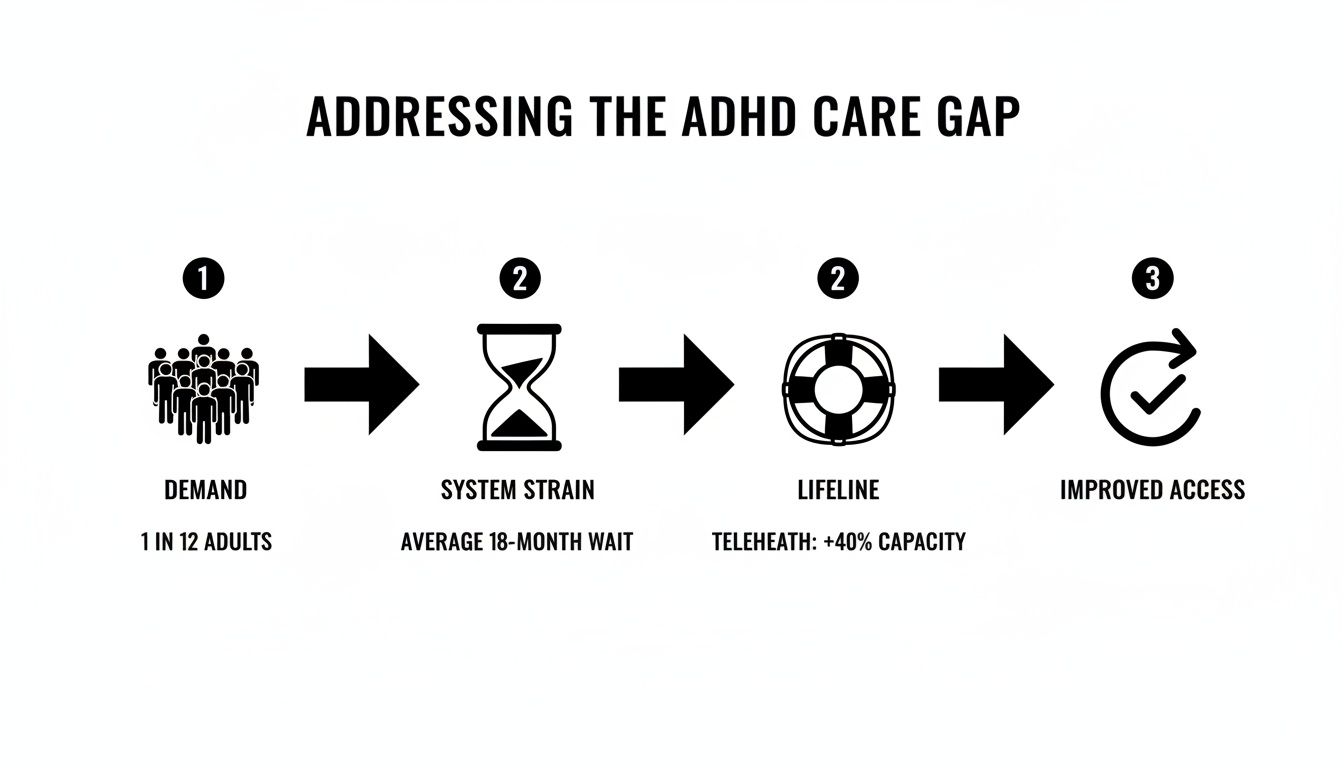
As you can see, this patient right acts as a crucial intervention, easing the bottleneck that's built up from the overwhelming demand on local NHS mental health services.
Preparing for Your GP Appointment
Your conversation with your GP is the most critical step in this entire journey. To get it right, you need to do more than just list your symptoms. You need to clearly and calmly state your intention to exercise your Right to Choose.
Here’s a simple checklist to get you ready:
-
Document Your Symptoms: Get a notebook or open a document and write down specific examples of how you think ADHD or Autism traits affect your daily life. Think about work, your relationships, home life, and your mental health. The more concrete your examples, the stronger your case.
-
Research Qualified Providers: You need to find a provider that accepts Right to Choose referrals. This is the crucial part: they must hold an NHS Standard Contract for the service you need. It’s completely non-negotiable. Reputable providers, like Insight Diagnostics Global, will state this clearly on their websites.
-
Prepare Your Letter: Don't rely on memory alone in the appointment. Having a formal letter ready is the single most effective way to communicate your request. Many providers even offer downloadable template letters on their websites that you can fill in with your details and theirs.
This groundwork shows your GP that you’ve done your homework and are making a well-informed request under official NHS legislation. If you want a deeper dive into what the assessment itself involves, you can learn more by exploring our detailed guide on how to get tested for ADHD in the UK.
Finding a Qualified Provider
It’s true that the responsibility of finding a suitable provider falls to you, the patient. This might feel like a bit of extra work, but it’s what gives you control over the process. When you're searching, you’re looking for a few key things that prove a provider is qualified to accept an NHS-funded referral.
A provider must:
- Be CQC-Regulated: The Care Quality Commission (CQC) is the independent regulator of health and social care in England. This registration ensures the service meets fundamental standards of quality and safety.
- Hold an NHS Standard Contract: This is the specific type of contract used by NHS England to pay for healthcare services from outside providers. Without it, a provider simply cannot accept a Right to Choose referral.
- Offer the Specific Service You Need: The contract must be for adult ADHD or Autism assessments, depending on what you're seeking. A contract for a different service won't work.
When navigating the complexities of your Right to Choose options, it is essential to know how to evaluate information sources to make well-informed decisions. This ensures you select a credible and appropriate service for your mental health needs.
Communicating Your Request Clearly
During your appointment, be direct but polite. Start by explaining your symptoms and why you believe an assessment is necessary for your mental health. Then, state your request clearly.
You could say something along the lines of: "Based on my symptoms, I would like a referral for an adult ADHD and/or Autism assessment. I would like to exercise my NHS Right to Choose, and I have chosen [Provider Name] as they are a qualified provider with an NHS Standard Contract."
At this point, you can hand your GP the pre-filled template letter. This formalises your request and gives your doctor all the necessary information in one go, including the provider’s contact details and confirmation that they accept these referrals. This simple step can prevent misunderstandings and helps ensure the referral gets sent to the right place, kicking off your journey to getting a timely and accurate diagnosis.
Navigating the UK's Mental Health Postcode Lottery
In an ideal world, everyone in England would have the same access to NHS mental health care. But the reality is quite different. When it comes to getting an ADHD or autism assessment, your chances of a timely diagnosis often boil down to your postcode.
This frustrating inconsistency is what’s become known as the "postcode lottery." It’s a system where your specific location can dictate the quality, speed, and availability of the care you receive.
We’re not talking about small differences here. The gap can be huge. In one part of the country, the wait for an adult ADHD assessment might be a manageable six months. Travel a couple of counties over, and you could be looking at a staggering six-year wait. This creates a deeply unfair system of haves and have-nots, leaving countless people in limbo while their mental health and lives are put on hold.
These regional gaps go beyond just waiting times, too. You’ll find significant differences in everything from diagnosis rates and access to specialist services to which medications are readily available, all varying from one Integrated Care Board (ICB) to the next.
Why Your Location Matters So Much
So, what's causing this? The problem is rooted in how local NHS trusts are funded and managed. Each trust operates with its own budget and sets its own priorities for mental health services. This means a service that’s well-funded in one area might be critically under-resourced in another.
As demand for ADHD and autism assessments has shot up in recent years, trusts with already stretched capacity simply can’t cope. It creates a massive bottleneck. You could be struggling with debilitating symptoms that severely impact your mental health, but if your local service has a two-year backlog, you’re told to wait. This is exactly where a national policy like Right to Choose becomes so incredibly important.
Right to Choose levels the playing field. It acknowledges that local capacity shouldn't be a barrier to essential mental healthcare and gives you a legitimate way to access an assessment elsewhere, funded by the NHS.
It’s a policy designed to ensure your right to care isn't defined by your address. Understanding just how bad the situation is in your local area often highlights why this alternative pathway is not just helpful, but vital.
The Stark Reality of Regional Disparities
The evidence of this lottery is everywhere. Access to a timely right to choose adhd assessment in the UK is wildly inconsistent. In its 2025 response to the ADHD Taskforce, NHS England itself confirmed that services are buckling under the pressure of rising referrals for neurodevelopmental conditions.
The Taskforce even recommended new diagnosis models specifically to shorten these waiting lists and reduce the unfairness. You can also see the disparity in regional prescribing data, which shows that medication rates for ADHD can be more than three times higher in some areas compared to others. If you want to dive into the data, you can read the complete analysis from The King's Fund.
This data simply confirms what thousands of people already know from personal experience: a system where equal access is more of an aspiration than a reality. If you're facing a ridiculously long delay, it's worth understanding the different waiting times you might encounter. For example, learning about the Psychiatry UK waiting time can give you a benchmark to compare against other providers and your local NHS service.
By exercising your Right to Choose, you aren't just looking for a shortcut. You are using an official, NHS-approved pathway designed to bypass these very systemic failings. It ensures you can get the diagnosis and support you deserve without being penalised by your postcode.
Choosing Your ADHD and Autism Assessment Pathway

Okay, so you understand your rights. Now comes the big decision: which path is actually right for you and your mental health journey? In England, you generally have three main routes to an ADHD or Autism assessment, and each comes with its own set of pros and cons.
Your final choice will probably hinge on a mix of urgency, your financial situation, and how much patience you have. The three main doors you can walk through are the standard local NHS service, an NHS-funded assessment using your Right to Choose, or paying for a fully private assessment yourself. Getting this choice right from the start is key to managing your expectations and getting the support you need.
Comparing Your Options
To help you figure out what’s best, let's lay everything out side-by-side. Seeing how each pathway stacks up on the things that matter most—like waiting times and costs—can make the decision a whole lot clearer.
The table below breaks down the pros, cons, costs, and typical timelines you can expect from each route.
Comparison of ADHD & Autism Assessment Pathways
| Factor | Standard NHS Pathway | Right to Choose Provider | Fully Private (Self-Funded) |
|---|---|---|---|
| Cost | Free at the point of use. | Free at the point of use. | Paid for entirely by you. Costs often range from £700-£2000+. |
| Wait Times | Very long. You could be waiting for months, or even several years, depending on where you live. | Significantly shorter. Usually a few weeks to several months. | The fastest option by a long shot. An assessment can often be booked within days or weeks. |
| Referral | Your GP refers you directly to your local NHS mental health trust. | You ask your GP to refer you to a specific, qualified provider that you've chosen. | Self-referral is usually an option. You often don't need to involve your GP at all. |
| Choice | No choice. You're sent to the designated service for your local area. | You can choose any qualified provider in England that holds an NHS contract. | Complete freedom to choose any private clinic or psychiatrist you like. |
| Post-Diagnosis | Medication and all your aftercare are managed within the NHS system. | Medication titration is covered. Afterwards, a Shared Care Agreement is set up with your GP for ongoing prescriptions. | You pay for medication and titration privately until (and only if) your GP agrees to a Shared Care Agreement. |
As you can see, it's a real balancing act. The standard NHS route won't cost you a penny, but it will cost you time—and potentially a lot of it. Going private gets you speed, but it comes with a hefty price tag.
Right to Choose: A Balanced Approach
This is where the Right to Choose pathway really shines. It often acts as the perfect middle ground, taking some of the best bits from the other two options. You get the speed and choice that you’d normally associate with private care, but it remains completely funded by the NHS.
This makes it an incredibly powerful option for anyone who needs a timely diagnosis but simply can’t afford to pay for it out of pocket. The only catch? You need to be your own advocate. It requires you to do the research, find a provider, and actively request the referral from your GP.
The Private Pathway: What to Consider
Opting to go fully private is, without a doubt, the quickest way to get answers. Many people take this route if they feel their mental health is in crisis or if the long NHS wait is having a serious impact on their job, studies, or family life. You can often skip the GP referral process entirely and book directly with a clinic.
But be warned: the financial commitment doesn't stop with the assessment fee. You'll also be paying privately for your medication and the titration process (finding the right dose), which can run into hundreds of pounds every month. On top of that, there's no guarantee your GP will agree to take over your care with a Shared Care Agreement afterwards, especially if they have any doubts about the quality of the private provider’s assessment. If you're considering this, it's worth exploring what a private ADHD assessment fully entails.
Ultimately, the "best" pathway is the one that fits your specific needs. If speed is the most critical factor and you have the funds, private care is a perfectly valid choice. If cost is your main concern, then the standard NHS or Right to Choose routes are the way to go.
By weighing up these factors carefully, you can choose the pathway that gives you the most effective and manageable route to getting the mental health support you deserve.
Got Questions About Right to Choose? You're Not Alone.
Trying to figure out how the healthcare system works can be a real headache, especially when you’re just trying to get the mental health support you need. It’s only natural to have a lot of questions.
To clear things up, we've tackled some of the most common queries people have when using their Right to Choose for an ADHD or Autism assessment. Think of this as your practical guide to navigating the process, from that initial chat with your GP to what happens with medication.
Can My GP Just Say No to My Referral?
This is a big one, and it causes a lot of anxiety. The good news is, the rules are on your side. Your GP can't refuse a Right to Choose referral just because they're worried about the cost or because your chosen provider isn't local. The decision has to be a clinical one.
So, when could they refuse? Only if they have a solid clinical reason to believe the service isn't right for your specific situation. But if you fit the criteria for an ADHD or Autism assessment and your chosen provider has a proper NHS contract, your GP has a duty to refer you.
If you feel like you've been unfairly turned down, don't just accept it. You can and should challenge the decision. Start by making a formal complaint to the practice manager. If that doesn't get you anywhere, the next step is to take your case to your local Integrated Care Board (ICB).
What About the Cost of Medication? Is That Covered?
Yes, absolutely. This is a crucial point. When you exercise your Right to Choose for an ADHD assessment, the NHS covers the entire package of care from that provider. It’s not just the assessment itself; it covers the whole journey, including the diagnosis and getting your treatment plan sorted.
This includes the medication titration phase – that all-important process of carefully figuring out which medication and dosage works best for you. This part is fully funded.
Once you and your specialist are happy that your treatment is stable, they’ll set up a Shared Care Agreement with your GP. It's essentially a handover document that lets your local doctor take over writing your prescriptions. From then on, you’ll just pay the standard NHS prescription charge like you would for any other medicine.
I'm Not in England – Can I Still Use Right to Choose?
Right to Choose is specifically an English NHS policy. The healthcare systems in Scotland, Wales, and Northern Ireland are run separately and have their own rules and referral routes.
While you can still get specialist care in these nations, they don't have the same legal Right to Choose framework for mental and neurodevelopmental health. If you live in Scotland, Wales, or Northern Ireland, your GP is the best person to talk to. They'll be able to explain the specific options available in your area.
Quick reminder: Right to Choose is for patients registered with a GP in England. If you're elsewhere in the UK, always check the local healthcare guidance for your nation.
How Do I Find a Provider That Qualifies?
It’s up to you to find a suitable provider, but it’s more straightforward than it sounds. A quick search for "UK adult ADHD Autism assessment Right to Choose" is a great place to start. You’re looking for clinics that have a specific page on their website explaining how they work with these referrals.
The absolute deal-breaker is this: they must clearly state that they hold an NHS Standard Contract for adult ADHD and/or Autism services. Without that, the referral can't happen.
ADHD and Autism charities and online support groups can also be brilliant resources, as people often share lists of providers they've had good experiences with. Before you take a name to your GP, do a final check on the provider's own website to confirm their credentials and make sure they are regulated by the CQC. A few minutes of research here can save you a lot of hassle later on.
Navigating your mental health journey requires a partner you can trust. Insight Diagnostics Global offers CQC-regulated, consultant-led online assessments for ADHD and Autism, ensuring you receive a robust diagnosis and clear, actionable recommendations. If you're ready to take the next step with a provider that accepts Right to Choose referrals, explore our services and start your path to clarity today. Visit us at https://insightdiagnostics.co.uk.