

When you suspect you might have ADHD or autism, the thought of an NHS waiting list stretching on for years can be completely deflating. The overlap between these conditions and other mental health challenges, like anxiety or depression, can make this waiting period even more difficult. This is where a private ADHD and autism assessment comes in—it offers a way to get answers and support in a matter of weeks, not years. For many adults, this quicker path is a vital investment in their mental and emotional well-being.
Why Choose a Private ADHD and Autism Assessment?
Living with undiagnosed neurodivergence can feel like you’re trying to read a map written in a different language. Simple things like meeting expectations at work, navigating social events, or even just keeping on top of household chores can feel like a constant uphill battle. It’s draining, and it often leads to burnout, anxiety, depression, and a persistent feeling that you just don't fit in. The impact on your overall mental health can be profound.
This is why getting a formal diagnosis is so important. It’s not about getting a label; it’s about finally understanding the root cause of your struggles and how they connect to your mental health.
A diagnosis is like being handed the user manual for your own brain. It gives you the words to explain your experiences, validates mental health struggles you may have faced your whole life, and provides a framework for working with your neurotype, not against it.
The Reality of NHS Waiting Times
Let's be honest: the main reason people go private is the sheer length of NHS queues. Public services are completely swamped by the demand for assessments, leaving thousands of people in limbo. In the UK, the numbers are stark—over 177,000 people are currently waiting for an ADHD assessment alone.
For some, that wait can be as long as eight years. In that time, careers can stall, relationships can suffer, and mental health can take a serious hit. The situation has become so critical that private assessments now account for a massive 48% of all ADHD diagnoses, while NHS diagnoses have dropped to just 35%. You can see more data on the current state of UK assessments on audhdpsychiatry.co.uk.
To put it into perspective, here’s a quick comparison of what to expect.
Private Assessment vs NHS Pathway at a Glance
| Factor | Private Assessment (e.g., Insight Diagnostics Global) | NHS Pathway |
|---|---|---|
| Wait Time | Weeks (typically 4-8) | Months to years (can be 2-8 years) |
| Cost | Self-funded (costs vary) | Free at the point of service |
| Choice of Clinician | You can choose the clinic and often the specific consultant | Allocated based on availability in your local trust |
| Process Control | More control over scheduling and communication | Less flexibility; appointments are set by the service |
| Post-Diagnosis Support | Often includes immediate access to medication titration and follow-ups | Follow-up support and medication pathways can have additional waiting lists |
Ultimately, the choice depends on your personal circumstances, but a private assessment offers a clear route for those whose mental health can't afford the long wait.
Unlocking Personalised Support and Strategies
Going private isn't just about skipping the queue; it's about moving straight into proactive, meaningful support for your neurodivergence and your mental health. The benefits go far beyond simply getting a yes or no answer.
- Validation and Self-Understanding: A diagnosis confirms that what you're experiencing is real and has a neurobiological basis. It validates the associated anxiety or depression and confirms it’s not a character flaw. For many, this is incredibly healing.
- Personalised Strategies: You'll receive a detailed diagnostic report with recommendations designed specifically for you, helping you manage challenges at work, at home, and in your relationships, which in turn improves your mental health.
- Access to Workplace Adjustments: A formal diagnosis is what you need to request reasonable adjustments at work under the Equality Act 2010, helping you get the support you need to do your job well without constant burnout.
- A Clear Path Forward: It puts an end to the guesswork. You’ll have a clear direction for therapy, coaching, or medication if you decide that's the right path for you. If you're weighing up your options, it's also worth looking into the Right to Choose ADHD assessment pathway.
In the end, choosing a private adhd and autism assessment is an investment in yourself. It’s about taking control, stop fighting against your own brain, and starting to build a life that plays to your strengths and supports your mental health where you need it most.
Navigating the Assessment Process Step by Step
The thought of any psychiatric assessment can feel pretty overwhelming, especially when you're already dealing with mental health challenges. But a good private process isn't about putting you under a microscope; it's designed to be clear, supportive, and structured from start to finish. It’s less of an interrogation and more of a collaborative investigation into your life’s unique story.
Think of the consultant psychiatrist as a specialist detective. Your life experiences, old school reports, insights from family, and your current mental health struggles are all vital clues. Their job is to put these pieces together to build a complete picture of who you are, making sure nothing important is missed.
The Initial Steps: Enquiry and Triage
Your journey starts the moment you get in touch with a clinic, usually with a simple phone call or by filling out an online form. A responsible provider won't just book you straight in for an assessment. First, they’ll carry out a clinical triage.
This is an essential screening stage, typically handled by a mental health professional. They'll review your initial information to see if a full private ADHD and autism assessment is genuinely the right path for you, or if your symptoms might be better explained by another mental health condition. It’s a crucial first check to make sure you’re getting the right kind of help from the very beginning.
This flowchart gives you a side-by-side look at the typical private process compared to the often much longer NHS journey.
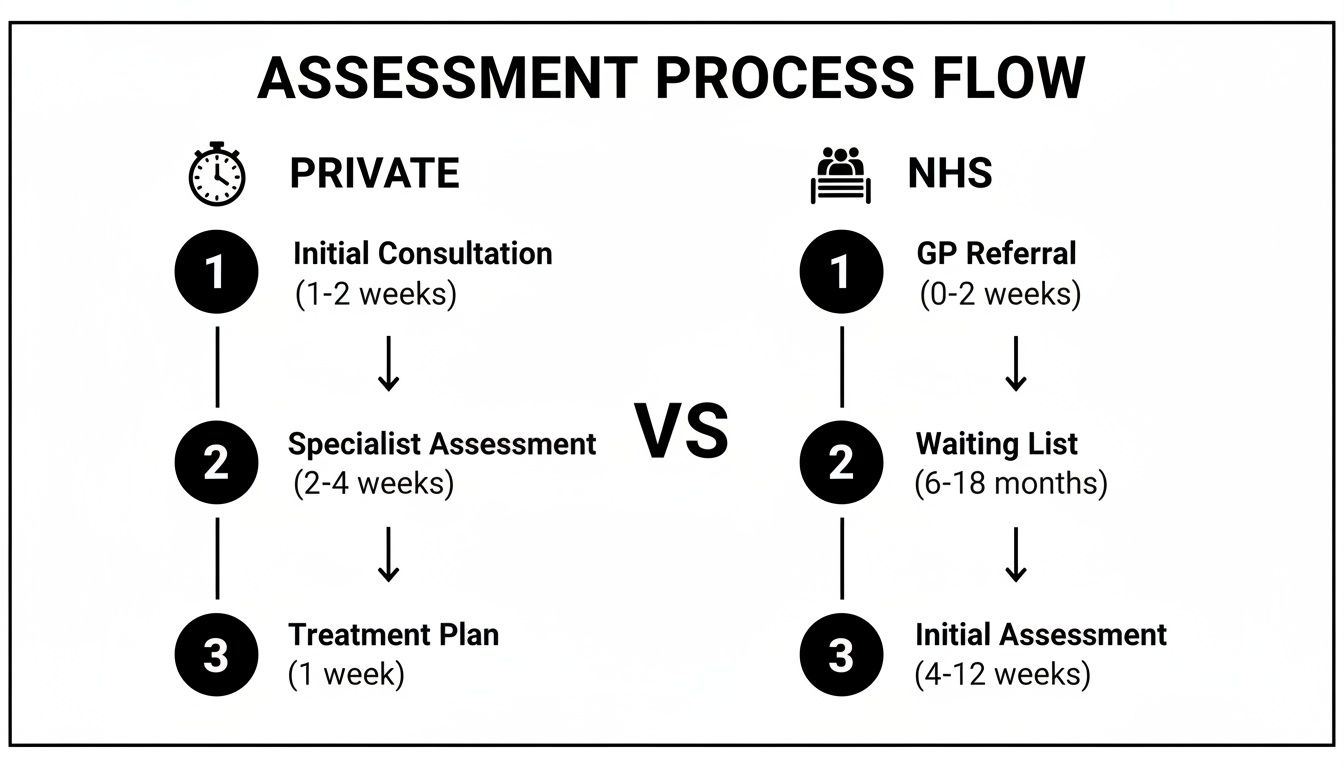
The difference is stark. The private route offers a much clearer, more direct timeline for people who need answers without a long, detrimental wait for their mental health.
Gathering the Evidence: Pre-Assessment Questionnaires
After you’ve passed triage, you’ll receive a set of detailed pre-assessment forms. They might look like a lot of paperwork, but filling them out thoroughly is one of the most critical parts of the whole process.
These questionnaires are designed to gather a huge amount of information from different parts of your life:
- Developmental History: This covers your early childhood, when you hit certain milestones, and what your time at primary and secondary school was like.
- Current Symptoms and Challenges: Here, you’ll describe the specific difficulties you’re facing every day—at work, at home, or in your relationships.
- Medical and Mental Health History: This gives the consultant important context about any other mental health conditions, like anxiety or depression, or treatments you've had.
It's also very common for clinics to request input from someone who knows you well, like a parent, sibling, or long-term partner. Hearing from another person adds an invaluable layer of perspective to your assessment. If you'd like to understand more about what these evaluations involve, you can learn more by checking out our guide on how to get a mental health assessment.
The Core of the Process: The Clinical Interview
The clinical interview is the heart of the assessment. It's an in-depth, one-to-one conversation with a consultant psychiatrist, which usually lasts anywhere from 90 minutes to three hours. The aim is to dig deeper into the information you provided on your forms.
The psychiatrist will gently guide you through your life story, asking specific questions that relate to the diagnostic criteria for both ADHD and Autism Spectrum Disorder (ASD). This isn't a test with right or wrong answers. It’s a collaborative discussion focused on understanding your personal patterns of thinking, behaviour, and social interaction, and how these relate to your overall mental health.
This structured conversation allows the specialist to observe how you communicate and process information in real-time. It is this combination of historical data from your forms and direct clinical observation that leads to a reliable and accurate diagnostic conclusion.
By breaking the journey down into these clear, manageable stages, the private ADHD and autism assessment process feels far less intimidating. Each step builds logically on the last, ensuring that by the end, your psychiatrist has everything they need to give you the clarity you’re looking for.
How to Find a Reputable and Regulated Provider

Choosing the right provider for your private ADHD and autism assessment is, without a doubt, the most important decision you'll make. The private market has exploded in recent years, but it's not all regulated equally, which means the quality of care can be wildly inconsistent.
Your job is to find a clinic that delivers a service that is medically robust, ethically sound, and genuinely helpful for your mental health. This means becoming a savvy consumer who can tell the difference between a high-quality clinical service and a provider that cuts corners. Getting this right protects your time and money, and it ensures you walk away with a diagnosis you can actually trust.
The Non-Negotiable Role of CQC Regulation
The first thing to look for, and it's an absolute deal-breaker, is regulation by the Care Quality Commission (CQC). The CQC is the independent regulator for all health and social care in England. Their job is to make sure providers meet fundamental standards of quality and safety.
A CQC-regulated clinic is held accountable. It undergoes inspections and has to prove that its care is safe, effective, and responsive. This is your number one safeguard against poor or unsafe practice.
A provider that isn't CQC regulated is essentially operating outside the established framework for patient safety in the UK. For something as critical as a mental health diagnosis for ADHD or autism, this oversight isn't just a "nice to have"—it's essential.
This accountability is particularly crucial now. While private clinics are filling a huge gap left by NHS waiting lists, this rapid growth has attracted scrutiny. Some providers have been criticised for inconsistent CQC inspections, and professional bodies like the GMC often rely on patient complaints to step in. This creates a grey area where some clinics might not use gold-standard assessment tools or follow comprehensive diagnostic methods. To get a better sense of the landscape, this overview of ADHD statistics and services is a good starting point.
Why a GMC Specialist Psychiatrist Matters
Just as important is who is leading the assessment. A legitimate, trustworthy diagnostic process has to be led by a Consultant Psychiatrist who is on the General Medical Council (GMC) Specialist Register. This is the highest level of psychiatric qualification in the UK.
A psychiatrist on the GMC Specialist Register has gone through years of rigorous training focused on diagnosing and treating complex mental health conditions, including adult ADHD and autism. Their expertise guarantees a few key things:
- Diagnostic Accuracy: They have the clinical skill to tell the difference between ADHD, autism, and other co-occurring mental health conditions that can look similar, like anxiety, bipolar disorder, or personality disorders.
- Adherence to Guidelines: They are professionally bound to follow the NICE (National Institute for Health and Care Excellence) guidelines, which are the benchmark for best practice.
- Report Credibility: The diagnostic reports they produce carry real weight with GPs, employers, universities, and even in medico-legal contexts.
A report signed by a properly qualified psychiatrist is a powerful document. Without it, you might find your diagnosis isn't accepted for workplace adjustments or for setting up a shared care agreement with your GP. Reputable clinics will often let you find a psychiatrist with the right credentials directly on their website.
Your Checklist for Choosing a Provider
To help you cut through the noise, here is a simple checklist of questions to ask any provider before you commit. Their answers will tell you almost everything you need to know about their legitimacy and quality.
- Are you regulated by the CQC? If they hesitate or say no, that's a red flag. Move on.
- Who will be conducting my assessment? Make sure you hear the words "Consultant Psychiatrist on the GMC Specialist Register."
- Do you follow NICE guidelines for adult ADHD and autism assessments? This should be a straightforward "yes."
- What does your post-diagnostic support pathway look like? A good clinic won't just hand you a report and disappear. They'll have clear next steps for your mental health, like medication titration, therapy referrals, or coaching.
- Will my diagnostic report be accepted by my GP for a shared care agreement? A credible provider will write a report specifically for this, though the final decision always rests with the GP.
Asking these direct questions helps ensure you're choosing a private ADHD and autism assessment service that is safe, professional, and capable of giving you the life-changing clarity you're looking for.
What Happens After Your Diagnosis

Getting a diagnosis from a private ADHD and autism assessment isn’t the finish line. It's actually the starting block for a new, more informed chapter of your life. Think of the diagnosis as a key; what comes next is all about learning how to use it to unlock the right support, build self-understanding, and find effective strategies that improve both your daily functioning and your overall mental health.
This new journey begins with your diagnostic report. This is so much more than a simple "yes" or "no" answer. A good report is a detailed roadmap, one that validates your past experiences while giving you a clear direction for the future.
Deconstructing Your Diagnostic Report
A solid diagnostic report from a reputable, consultant-led service will be a detailed and highly personal document. It weaves together all the information gathered during your assessment into a clear story, explaining exactly why the clinician reached their conclusion.
First and foremost, it will clearly state the diagnosis based on established clinical criteria like the DSM-5 or ICD-11. This formalises everything, making the report a legitimate document you can use to get the support you need.
But the real gold is often in the personalised recommendations. These are tailored ideas for support and interventions designed to help you manage challenges and play to your strengths. They might include things like:
- Workplace Adjustments: Practical suggestions for reasonable adjustments under the Equality Act 2010, such as asking for flexible working hours or a desk in a quieter part of the office to reduce stress and sensory overload.
- Therapeutic Support: Recommendations for specific therapies that have proven helpful for ADHD, autism, and any co-occurring mental health conditions, like Cognitive Behavioural Therapy (CBT) or psychoeducation sessions.
- Medication Options: If you receive an ADHD diagnosis, the report will explore whether medication could be a good fit and outline the next steps.
- Practical Strategies: Real-world tips for handling things like executive dysfunction, sensory sensitivities, or difficulties with social communication.
This comprehensive document becomes your primary tool for advocating for yourself, whether you're talking to your GP, your boss, or your family.
Exploring Post-Diagnostic Support Options
With your report in hand, you can start exploring what support looks like for you. For so many people, the diagnosis itself provides the validation they’ve been missing, giving them the confidence to seek help without feeling like an imposter. It’s powerful confirmation that your mental health struggles are real and rooted in neurobiology—not a character flaw or lack of trying.
This newfound self-understanding is often the first, and most important, form of support. It allows you to look back at your life with a new perspective and, hopefully, be a lot kinder to yourself. From there, you can move on to more structured pathways. If you’re looking for practical tips for day-to-day life, our guide on how to cope with ADHD has some excellent advice for building effective routines.
A diagnosis isn't just about identifying challenges; it's about discovering a new lens through which to view your life and your mental health. It empowers you to seek out environments and strategies that align with your neurotype, rather than forcing yourself to fit into a neurotypical mould.
Understanding ADHD Medication Titration
For those diagnosed with ADHD, medication can be a genuinely life-changing tool. But it’s not as simple as just getting a prescription. The process is called titration, and it’s a careful, collaborative journey to find exactly the right medication and dosage for you.
Think of it like tuning an old radio. You’re slowly turning the dial to find that perfect frequency where the signal is crystal clear and the static fades into the background. Here’s how it works:
- Starting on a Low Dose: Your psychiatrist will start you on a very small dose of a stimulant or non-stimulant medication.
- Gradual Increases: Over several weeks, and under your clinician's close supervision, the dose is slowly increased.
- Regular Monitoring: You’ll have frequent check-ins to discuss how you're feeling, the medication's effectiveness, and any side effects. Physical and mental health checks, like blood pressure, heart rate, and mood, are also part of this.
- Finding the Optimal Level: This continues until you and your psychiatrist find the dose that gives you the most benefit with the fewest possible side effects. This becomes your stable, ongoing dose.
The titration process ensures your treatment is both safe and effective, tailored precisely to your brain and body. This careful management is a hallmark of a high-quality private ADHD and autism assessment service, showing that their commitment to your care extends far beyond the diagnosis itself.
Understanding the Costs and Timelines
When you're looking into a private ADHD and autism assessment, knowing what to expect in terms of cost and time is absolutely essential. For most people, the choice to go private boils down to a single, critical trade-off: investing your money to save an enormous amount of time and prevent further decline in your mental health. Let's break down exactly what that investment looks like.
The number one reason people choose the private route is speed. Simple as that. While an NHS assessment is free, the waiting lists are notoriously long, often stretching from many months into several years. A private clinic, on the other hand, can usually get you in for an initial consultation within weeks.
This isn't just about getting things done faster. For someone whose mental health, relationships, or career is on the line, waiting years for clarity can be incredibly damaging. Getting a timely diagnosis and the right support can genuinely turn things around, preventing burnout and giving you the tools you need right when you need them most.
Breaking Down the Fees
Getting to grips with a clinic’s fee structure is vital if you want to avoid any nasty surprises down the line. Any reputable provider will give you a clear, itemised breakdown of what their assessment package covers. Make sure you read the fine print, because what's included can differ from one clinic to the next.
Your main assessment fee will almost always cover the core diagnostic process itself. But it’s the other critical services that might be billed separately. For instance, if you're diagnosed with ADHD and want to explore medication, the 'titration' process—where a clinician works with you to find the right medication and dose—is often a separate, additional cost because it requires several follow-up appointments.
To give you a clearer picture, here’s a typical example of how services are often bundled.
Typical Private Assessment Service Breakdown
This table shows what's commonly included in a standard assessment package versus what might carry an extra charge.
| Service Component | Description | Typical Inclusion in Package |
|---|---|---|
| Initial Clinical Triage | A preliminary check of your situation and mental health to make sure the assessment is right for you. | Usually included. |
| Pre-Assessment Questionnaires | The detailed forms filled out by you and often a family member or partner before the main appointment. | Always included. |
| Clinical Interview | The in-depth consultation with a GMC-registered consultant psychiatrist. | Always included. |
| Diagnostic Report | The comprehensive document explaining the diagnosis and providing personalised recommendations for mental health and well-being. | Always included. |
| Medication Titration | The process of carefully finding the optimal ADHD medication and dosage under supervision. | Often a separate package or fee. |
| Follow-Up Consultations | Extra appointments to go over your report, discuss therapy, or check on your progress and mental health. | Usually an additional cost per session. |
It's always a good idea to ask for a full fee schedule upfront so you have a complete understanding of the total potential cost from assessment to post-diagnostic support.
The Value of a Timely Diagnosis
Just looking at the price tag of a private assessment doesn't tell the whole story. Think of it as an investment in your well-being, your career, and your future. You also have to consider the hidden costs of not getting a diagnosis.
An undiagnosed condition can lead to lost job opportunities, strained personal relationships, and a persistent, damaging impact on your self-esteem and mental health. The cost of a private assessment is often small when weighed against the long-term emotional and financial toll of struggling without answers.
For example, an adult with undiagnosed ADHD might constantly fight to meet deadlines, leading to chronic stress, anxiety, and poor performance reviews. A diagnosis can open the door to reasonable adjustments at work—like noise-cancelling headphones or flexible hours—that allow them to finally play to their strengths. In the same way, an autistic adult who learns why they find certain social situations so draining can develop new strategies to protect their mental energy and build healthier, more authentic relationships.
Ultimately, the speed and clarity of a private ADHD and autism assessment give you a clear path forward. It empowers you to stop just surviving and start building a life that truly works for you.
Using Your Diagnosis for Workplace and Legal Support
Getting a diagnostic report from a private ADHD and autism assessment isn't just about gaining personal insight. It’s a powerful, official document that can unlock vital support and legal protections. Think of it as your key to advocating for yourself, enabling you to get the adjustments you’re entitled to in your career, education, and sometimes even in legal situations.
This is especially true at work. In the UK, both ADHD and autism can be considered disabilities under the Equality Act 2010. This isn’t just a label; it means employers have a legal duty to make 'reasonable adjustments' for you, especially if your condition has a long-term impact on your mental health and day-to-day activities. A solid report from a GMC-registered consultant psychiatrist provides the formal evidence you need to get that conversation started.
Securing Reasonable Adjustments at Work
Reasonable adjustments aren't about asking for special treatment. They're practical changes designed to remove the barriers you might face because of your neurodivergence, levelling the playing field so you can do your job to the best of your ability. A good diagnostic report will often suggest specific, personalised adjustments that would help you.
A few common examples include:
- Flexible Working Hours to help you work when you're most focused and productive, reducing burnout.
- Noise-Cancelling Headphones or a desk in a quieter part of the office to cut down on sensory overload and anxiety.
- Written Instructions and checklists to support working memory and keep tasks on track.
- Software and Assistive Technology, like text-to-speech tools or mind-mapping apps.
These small changes can make a massive difference, reducing stress and helping you showcase your true talents.
Your Report in Medico-Legal Contexts
Beyond the workplace, a detailed psychiatric evaluation carries real weight in various medico-legal scenarios. Because a report from a consultant-led service is so thorough and evidence-based, it stands up as a credible and impartial piece of evidence.
In legal proceedings—anything from an employment tribunal to a family court matter—an expert psychiatric report offers an objective, clinical view on how your condition and associated mental health challenges affect your day-to-day life. It helps ensure that any decisions are made with a full and fair understanding of your circumstances.
It's also really important to understand your rights to workplace support for mental health and neurodevelopmental conditions following a diagnosis. While the specifics can vary, having this knowledge empowers you to ask for what you need.
Ultimately, a high-quality diagnostic report is your official tool for self-advocacy. It turns your lived experience into documented proof, making sure you can get the support and fair treatment you are legally entitled to. It’s the bridge between knowing yourself and ensuring the world makes space for you to thrive.
Your Questions Answered
Thinking about a private ADHD or autism assessment can feel like stepping into a whole new world, and it's natural to have a lot of questions. Let's walk through some of the most common ones to give you a clearer picture of the road ahead.
Will My GP Actually Accept a Private Diagnosis?
This is probably the biggest question people have, and it’s a fair one. Whether your GP agrees to take over your prescriptions under a 'shared care agreement' is ultimately their decision.
However, you can massively increase the chances of a "yes". The key is to give them a high-quality diagnostic report from a CQC-regulated service, written by a GMC-registered consultant psychiatrist. This isn't just a piece of paper; it’s a professional clinical document that meets strict NICE guidelines.
My best advice? Have a chat with your GP before you book the assessment. Letting them know your plans from the start makes for a much smoother handover later on.
Think of a top-tier diagnostic report as a professional handover. It gives your GP the clinical evidence and confidence they need to take over your care, making a shared care agreement a much more straightforward decision.
What Happens if I Don't Get a Diagnosis?
It’s a common worry – what if I go through all this and they say it’s not ADHD or autism? A good assessment provides clarity, no matter the outcome. If you don't meet the specific diagnostic criteria, the consultant psychiatrist won't just leave you in the dark.
They’ll explain exactly why, and this is where the real value comes in. Your report will often point towards other things that could be causing your difficulties, like anxiety, trauma, or specific mood disorders. A comprehensive assessment is a holistic mental health evaluation. Most importantly, you'll still get clear, personalised recommendations for the right kind of support and treatment for whatever is going on.
Do I Need a Referral from My GP to Go Private?
You don't always need a GP referral to book a private assessment, but I strongly recommend getting one. A referral means the assessing psychiatrist gets your full medical history, which is absolutely crucial for an accurate, well-rounded mental health evaluation.
It also keeps your GP in the loop, which helps everything feel more joined-up. Any reputable clinic will be happy to explain their process and why they might ask for one.
At Insight Diagnostics Global, our goal is to provide clear, consultant-led assessments that give you the answers you've been looking for. As a CQC-regulated online service, we ensure your diagnosis is robust, respected, and helps you move forward with confidence in your mental health journey. Begin your journey to clarity today.