
If you’ve ever wondered whether your lifelong struggles with focus, social situations, or mental health might be signs of something more, you’re in the right place. An ADHD and autism assessment is a comprehensive clinical evaluation, led by a specialist like a psychiatrist, to see if an adult’s experiences align with the criteria for Attention Deficit Hyperactivity Disorder (ADHD), Autism Spectrum Disorder (ASD), or both.
This isn't about ticking boxes on a generic quiz. It’s a deep dive that can lead to a formal diagnosis, offering profound clarity about your mental health and unlocking the right kind of support for your specific neurotype.
Understanding the Path to an ADHD and Autism Diagnosis

For many adults in the UK, the idea that certain challenges with mental health aren't personal failings but a matter of neurotype is a life-changing realisation. If you've spent years feeling out of sync with the world and battling anxiety or low mood, seeking an assessment is a powerful step toward understanding the root cause.
Instead of seeing these as ‘disorders,’ it helps to think of ADHD and autism as your brain being wired differently. This unique wiring has a fundamental impact on your mental and emotional wellbeing, influencing everything from how you process information to the way you experience stress and social interactions.
The Core Traits of ADHD and Autism
Although they are distinct conditions, ADHD and autism share some common ground, which can make things confusing and often creates a complex impact on mental health. Let's break down the core characteristics.
ADHD (Attention Deficit Hyperactivity Disorder): This primarily impacts the brain's executive functions—the management system that controls focus, organisation, and impulse control. For an adult, this might look like struggling to finish projects, constantly misplacing your keys, or feeling a persistent internal restlessness that fuels anxiety.
Autism Spectrum Disorder (ASD): This shapes how you experience social communication, social interaction, and sensory input. An autistic adult might find social cues baffling, leading to social anxiety, or feel overwhelmed by certain sounds and lights, causing significant stress. You can explore this further in our guide on getting an autism diagnosis.
Why the Overlap Matters for Your Mental Health
The connection between neurodivergence and mental health is profound. A significant amount of research shows that many people diagnosed with one condition also meet the criteria for the other. In fact, one recent meta-analysis revealed that a staggering 39% of people with autism also have co-occurring ADHD.
This overlap, often called AuDHD, can create a confusing and conflicting internal world. For instance, the ADHD part of your brain might crave novelty and stimulation, while the autistic part needs routine and predictability to feel safe. This constant internal tug-of-war is exhausting and is a common pathway to chronic anxiety, depression, and burnout if it goes unrecognised.
A formal ADHD and autism assessment is not just about getting labels. It's about receiving a personalised roadmap that explains your unique neurotype, validates your lived experiences, and gives you clear, practical strategies to improve your mental wellbeing.
Getting to grips with the components of a neurodevelopmental assessment, which can include things like cognitive assessments, helps take the mystery out of it all. A good evaluation will look at the complex interplay between ADHD, autism, and your mental health, ensuring that any support plan addresses you as a whole person. This integrated approach is often the key to finally making sense of it all and building a life that works with your brain, not against it.
Why Is It So Hard to Get an Assessment?
If you’ve started looking into an official ADHD and autism assessment, you’ve probably run into the same frustrating wall so many others have: the wait. The simple truth is that across the UK, public health services are completely swamped by a massive surge in people seeking neurodevelopmental evaluations, often because of the severe impact on their mental health.
This isn't just a hunch that things are busy; the numbers are staggering. As more and more adults begin to recognise neurodivergent traits in themselves, referral lists have exploded, creating a bottleneck that leaves thousands in limbo, just waiting for answers and relief.
Soaring Demand, Stretched Services
The scale of the problem is difficult to overstate. In December 2023, official data showed that 172,022 people in the UK were on an open referral list for suspected autism alone—the highest figure ever recorded. To put that in perspective, it’s a shocking five-fold increase in just four years, which paints a very clear picture of a system under enormous strain. If you're interested in the details, you can explore the data in a government review of mental health, autism and ADHD services.
While official guidelines suggest people should be seen within three months of a referral, the reality on the ground is starkly different. It’s common to wait ten months or more, and in some parts of the country, the wait can stretch up to an unbelievable five years. This isn’t just a delay; it's a life-altering period of uncertainty that can worsen existing mental health conditions.
The Mental Health Toll of Being on a Waiting List
Living in this diagnostic limbo takes a heavy toll. Without a formal diagnosis, you're left trying to navigate a world that often isn't built for your way of thinking, which can lead to a painful cycle of misunderstanding, self-blame, and deteriorating mental health.
This prolonged struggle often triggers or exacerbates serious mental health challenges, including:
- Chronic Anxiety: The constant effort to manage unexplained difficulties at work, in relationships, or in social situations can create a permanent state of high-level anxiety.
- Persistent Depression: Feeling like you’re failing at things others find easy can eat away at your self-worth, often spiralling into depression.
- Burnout: The sheer mental and emotional energy it takes to "mask" your traits or force your brain to function in a neurotypical way is exhausting and can lead to complete burnout.
Waiting indefinitely for an assessment is more than just having your name on a list. It means enduring years of preventable distress, missing out on support, and carrying the heavy burden of poor mental health without understanding why.
Why Private Assessments Have Become a Lifeline
It’s completely understandable to feel frustrated by the prospect of an indefinite wait. It's exactly why so many people now see private, consultant-led services not as a luxury, but as a necessary alternative to protect their mental health. Choosing this route isn't about "skipping the queue"—it's about taking back control of your wellbeing when the public system simply can't offer the timely support you need.
A private assessment provides a clear, structured, and much faster path to getting answers. Instead of waiting years, you can get a thorough evaluation from a specialist psychiatrist within weeks. This lets you move past the agonising uncertainty and start the journey toward understanding, validation, and finding the right support to help you thrive. For many, it's the only realistic way to finally address their mental health and begin building a better future.
Your Step-By-Step Guide to the Online Assessment Process
The idea of an ADHD and autism assessment can feel pretty daunting, but I want to assure you that a good quality online process is structured, transparent, and built to understand you as a whole person, including your mental health. It’s not just a quick chat or a single test; it's a careful, methodical journey where we piece together information from different parts of your life to build an accurate picture.
Knowing what happens at each stage helps to demystify the whole thing, making you feel more prepared and in control. The entire point is to move from a place of uncertainty to one of clarity, with an expert guiding you at every turn.
This kind of thorough, guideline-compliant care is now much more accessible thanks to the rise of remote psychiatry services. This modern approach means specialists can connect with you without the usual geographical barriers or the frustratingly long waits you often find with traditional clinics.
Stage 1: The Initial Screening and Triage
Your journey with us kicks off with an initial screening. This usually involves you filling out a set of detailed online forms and questionnaires that cover your life history, current challenges, and your mental health.
Think of this as laying the groundwork for your full assessment. The details you share help our clinical team figure out if a full evaluation is the right next step for you. It also ensures we match you with the specialist best suited to your specific needs. This triage step is absolutely vital for making the process efficient and effective.
This isn't just admin, by the way. It’s the very first layer of evidence, giving your consultant psychiatrist a preliminary map of your experiences and flagging the key areas, including any co-occurring mental health concerns, that we’ll need to explore.
To give you a clearer idea of how we structure our process, here’s a quick overview of what to expect from start to finish.
The ADHD and Autism Assessment Process at a Glance
This table summarises the key stages in our online, consultant-led assessment process, outlining the purpose and what to expect from each step.
| Assessment Stage | Purpose | What to Expect |
|---|---|---|
| Initial Screening & Triage | To gather foundational information and determine the right clinical pathway for you. | Completing secure online forms and detailed questionnaires about your history, mental health, and current challenges. |
| Standardised Rating Scales | To collect objective, quantifiable data on neurodivergent traits using clinically validated tools. | Filling out specific, evidence-based questionnaires designed to measure traits related to ADHD and autism. |
| Collateral History | To gain a 360-degree view by gathering insights from someone who knows you well. | With your permission, we'll speak to a parent, partner, or sibling about your childhood and development. |
| In-Depth Clinical Interview | The core diagnostic conversation where all evidence is synthesised by a consultant psychiatrist. | A comprehensive, two-hour video consultation to discuss your life experiences and mental health history. |
This structured approach ensures that by the time you speak with the consultant, a comprehensive picture of your life has already started to form.
Stage 2: Standardised Rating Scales
Once the initial screening is done, we'll ask you to complete several standardised rating scales. These are scientifically validated tools used across the field to measure the presence and severity of both ADHD and autistic traits.
These scales give us objective, measurable data that sits alongside the personal stories and experiences you share. They're a crucial part of a robust assessment because they allow us to compare your responses against established clinical benchmarks, adding another layer of rigour to the process.
You'll likely come across tools such as:
- For ADHD: The Adult ADHD Self-Report Scale (ASRS) or the Conners' Adult ADHD Rating Scales (CAARS). These ask specific questions about things like focus, restlessness, and impulsivity in different areas of your life.
- For Autism: The Autism Spectrum Quotient (AQ) or the Ritvo Autism Asperger Diagnostic Scale (RAADS-R). These tend to explore social interaction, communication preferences, sensory sensitivities, and deep patterns of interest.
Sadly, high demand for these assessments can lead to significant delays, which has a real impact on people's mental wellbeing, as this flowchart illustrates.
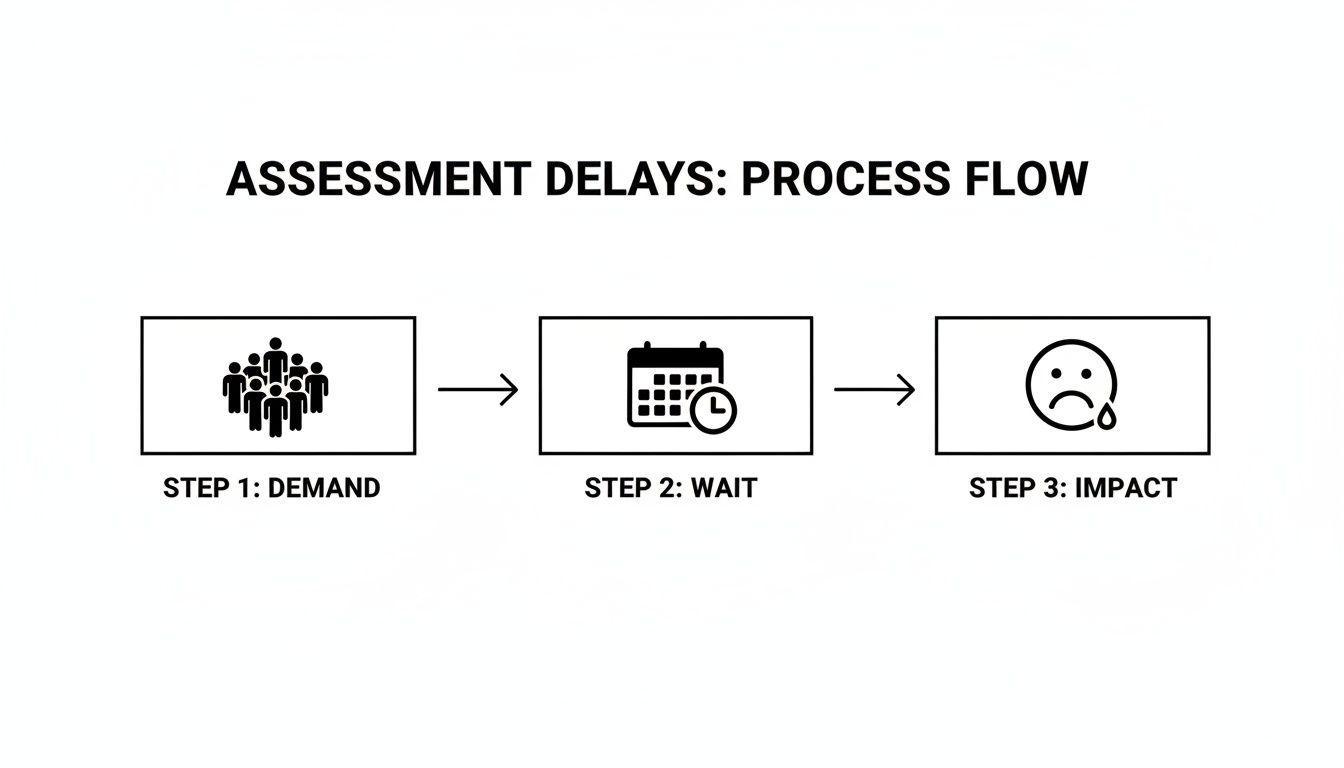
As you can see, the connection between overwhelming demand, long waiting lists, and a direct negative effect on mental health is clear.
Stage 3: Collateral History
Neurodevelopmental conditions like ADHD and autism have been with you your whole life, right from childhood. That’s why getting an outside perspective on your early years is so incredibly valuable. We call this process gathering collateral history.
We’ll ask for your permission to speak with someone who knows you really well and has known you for a long time—perhaps a parent, an older sibling, or a long-term partner. They can share insights into your early development, your behaviour as a child, and how your traits have shown up over the years.
Collateral history isn't about "checking up" on you. It's about enriching the clinical picture with memories and observations you might not recall yourself, providing a 360-degree view of your life story.
This step is particularly important because, as adults, we often develop very sophisticated coping mechanisms or "masking" strategies that can hide our core traits. Hearing from someone else helps your psychiatrist see beyond the mask to the authentic experiences underneath.
Stage 4: The In-Depth Clinical Interview
This is the final, and most important, part of the process: the clinical interview with a specialist consultant psychiatrist. Lasting around two hours, this is a structured, deep-dive conversation where the clinician brings together every piece of information we've gathered so far. You can get a sense of how this fits into a wider diagnostic framework by reading about a general online mental health assessment.
During this interview, the psychiatrist will carefully ask you about:
- Your developmental history, from childhood right up to today.
- Your experiences at school, at work, and in your relationships.
- Your mental health history, including any previous diagnoses like anxiety or depression.
- The specific challenges and, just as importantly, the strengths you see in your daily life.
This is a collaborative discussion, not an interrogation. It’s your space to share your story, feel truly heard, and ask any questions you have. The psychiatrist will use their expertise to gently explore your experiences, making sure they have a complete, nuanced understanding of your neurotype and its impact on your mental health before reaching a conclusion.
Making Sense of Your Diagnostic Report and Next Steps

After all the interviews and questionnaires, the final piece of the puzzle is your diagnostic report. This isn’t just a brief summary; it’s a comprehensive story that weaves together every shred of information from your ADHD and autism assessment. For many people, receiving this document is a huge moment—a point of clarity that can completely reframe how you see yourself, your past struggles, and your mental health.
Think of it as a personalised user manual for your brain. It takes all the raw data from rating scales, your personal history, and the clinical interviews and translates it into a clear, coherent narrative. Its main job is to give you a definitive, evidence-based answer and explain how your neurotype connects to your mental wellbeing.
This report is designed to empower you. It validates your experiences and gives you a solid foundation to start building a future that truly works for you.
What Is Inside Your Diagnostic Report
Your report is a formal medical document, but it's carefully written to be as clear and useful as possible. It’s all about connecting the dots between your real-life experiences and the established clinical criteria, creating a conclusion that is both robust and easy to understand. While every report is unique, they generally follow a familiar structure.
Here’s what you can expect to find inside:
- A Summary of Your History: This section will recap the key details of your developmental, school, social, and mental health background that you discussed with the clinician.
- Clinical Observations: These are the psychiatrist’s professional notes from your interview, touching on things like your communication style, how you presented, and your thought processes.
- Assessment Tool Results: This part breaks down the scores from any standardised scales you completed and explains what they mean in a clinical context.
- Formal Diagnostic Conclusion: The bottom line. This is a clear statement confirming whether you meet the diagnostic criteria for ADHD, ASD, or another condition, and how these may relate to your mental health.
This structure makes the findings transparent, so you can see exactly how the clinician arrived at their conclusion and what it means moving forward.
A diagnostic report is not an endpoint; it is a starting point. It's the map you need to navigate the next chapter, armed with self-awareness and a clear direction for seeking the right kind of mental health support.
Personalised Recommendations and a Plan for the Future
The recommendations section is arguably the most powerful part of the entire report. A diagnosis is just a label, after all. Its real value lies in what you do with it. This is where the clinical findings are translated into practical, real-world advice to support your mental health and wellbeing. Our guide on how to test for autism touches on some of the pathways a diagnosis can open up.
Your personalised plan might include suggestions like:
- Therapeutic Support: Recommendations for specific therapies, such as Cognitive Behavioural Therapy (CBT) adapted for neurodivergent minds to manage anxiety, or specialist coaching to build executive function skills.
- Workplace or Educational Adjustments: A list of formal reasonable adjustments you can request to reduce stress and improve performance.
- Medication Options: If you receive an ADHD diagnosis, the report will discuss whether medication might be a helpful part of your treatment plan to improve focus and reduce impulsivity.
- Further Resources: Helpful links to support groups, charities, and books that can help you continue learning about your neurotype and how to manage your mental health.
The Follow-Up Consultation: A Space for Your Questions
Receiving and reading a report like this can stir up a lot of thoughts and feelings. It’s completely normal to have questions, which is why a follow-up consultation with your psychiatrist is a standard part of our process. This is your dedicated time to go through the findings, ask anything that’s on your mind, and really process what it all means for your mental health.
This conversation is vital. It ensures you don’t just walk away with a document, but that you fully understand what’s in it and feel ready for what’s next. It’s a chance to work with your consultant to shape a proactive plan, turning the insights from your assessment into positive, lasting change.
Navigating Medication and Ongoing ADHD Support
For many people, getting an ADHD diagnosis through an ADHD and autism assessment is the first step towards considering medication. It’s a big decision, and rightly so, but it can be a genuinely helpful tool for managing the core challenges of ADHD, like inattention and impulsivity, which often have a direct impact on mental health.
Starting on medication isn't just a case of picking up a prescription. The journey begins with a very careful, collaborative process called titration. This is where you and your specialist psychiatrist work closely together to find not just the right medication, but the exact dose that works for your unique brain chemistry.
Think of it like tuning an instrument. The aim is to find that perfect note – a dose strong enough to make a real difference to your ADHD symptoms while supporting your overall mental wellbeing and minimising side effects.
The ADHD Titration Process Explained
Titration is a closely supervised journey, managed safely and effectively through online appointments. You'll start on a very low dose of medication, which is then gradually increased over several weeks. All the while, you'll have regular check-ins with your clinician.
During these catch-ups, you’ll be asked to share feedback on:
- Symptom Improvement: Are you starting to notice positive shifts in your focus, organisation, or impulse control?
- Side Effects: Have you experienced anything unwanted, like changes to your appetite or sleep patterns?
- Overall Wellbeing: How are you feeling in general? We'll also keep an eye on physical health markers, like your blood pressure and heart rate, to ensure your treatment is safe.
This ongoing conversation allows your psychiatrist to make small, precise adjustments, making sure your treatment is both effective and supportive of your overall health.
Finding the Right Medication for You
It's really important to know there's no single "best" medication for ADHD. Everyone responds differently. The two main types are methylphenidate-based (like Concerta) and lisdexamfetamine-based (like Elvanse), though sometimes non-stimulant options are a better fit.
The titration process is a journey of discovery. It’s about methodically finding the medication and dose that helps quiet the noise, which can in turn alleviate related anxiety and improve your mental capacity.
Your psychiatrist will use their clinical expertise to suggest a starting point, but your feedback is what truly guides the journey. This meticulous process ensures medication becomes a supportive tool, not a blunt instrument. If you want to dive deeper into the specifics, have a look at our detailed guide on ADHD medication for adults in the UK.
Ongoing Support and Monitoring for Long-Term Success
Once you’ve found a dose that feels stable and effective, the support doesn't end there. Lasting success comes from consistent monitoring and staying in touch with your clinical team. This usually means having regular reviews to make sure the medication is still working well for you and to manage any long-term health factors.
Ultimately, the goal is often to set up a 'shared care' agreement with your GP. This means that after your specialist has handled the diagnosis and titration, your GP can take over issuing routine prescriptions, all under the guidance of your psychiatrist. It’s a collaborative approach designed to give you seamless, continuous care for your long-term mental health.
Frequently Asked Questions About Neurodiversity Assessments
Thinking about getting an ADHD or autism assessment as an adult usually brings up a lot of questions. It's completely normal to wonder about the practical side of things – the costs, the process, and what it all means for your mental health in the end. Getting straight answers is the first step to making a decision that feels right for you.
We've put together some of the most common questions we hear from people just starting this journey. Our goal is to give you clear, honest information so you can move forward with confidence.
How Much Will It Cost and How Long Will It Take?
We're completely upfront about our costs, with clear pricing for our different assessment packages. No hidden surprises. One of the biggest differences you'll notice compared to public health routes is the timeline. We can typically get your assessment scheduled within seven working days of you getting in touch, and you'll have your final report in your hands within five working days after your clinical interview. We do this to shorten that difficult waiting period and get you the clarity you're looking for as quickly as possible.
Do I Need to Get a Referral From My GP?
No, you don't. We accept self-referrals, which means you can contact us directly without having to go through your GP first. This removes a significant hurdle for many people and puts you in control of your own health journey. That said, keeping your GP in the loop can be really helpful down the line, especially if you receive an ADHD diagnosis and want to set up a shared care agreement for medication. We are always happy to work with NHS services to make sure your care is seamless.
What Happens If I Don't Receive a Diagnosis?
This is a really common and understandable worry. The important thing to remember is that a thorough assessment is incredibly valuable, no matter the outcome. If it turns out you don't meet the clinical criteria for ADHD or autism, the process is far from a waste of time.
The real goal of an assessment is clarity for your mental health. Even without a specific ADHD or autism diagnosis, the evaluation can highlight other things that might be going on, like anxiety, trauma, or a mood disorder, and point you towards the right kind of support.
Ultimately, you’ll leave with answers and a clear sense of what to do next to improve your wellbeing, which is a huge step forward in itself.
Is an Online Assessment as Good as a Face-to-Face One?
Absolutely. Our online assessments are every bit as valid and clinically robust as traditional in-person services. They are carried out by consultant psychiatrists on the GMC Specialist Register and follow the exact same strict NICE (National Institute for Health and Care Excellence) guidelines. We use the same 'gold-standard' diagnostic tools you'd find in any top clinic, so the quality of the clinical evaluation is identical.
The main difference is convenience and comfort. Being able to go through the process in a familiar, private space can reduce anxiety and make a world of difference. And as a CQC-regulated clinic, you can be confident you're receiving the highest standard of professional care.
At Insight Diagnostics Global, we provide clear, expert-led pathways to understanding your mental health. If you are ready to get the answers you deserve, learn more about our comprehensive online assessments.