An ADHD assessment for adults in the UK isn't just a simple test; it's a comprehensive clinical evaluation carried out by a specialist, usually a psychiatrist. Think of it as putting together a puzzle. The process involves in-depth conversations, detailed questionnaires, and a careful look back at your life story, from childhood right up to the present day, to see if your experiences match the diagnostic criteria for Attention Deficit Hyperactivity Disorder.
The First Step: Understanding Adult ADHD in the UK

That initial moment when you start to wonder, "Could I have ADHD?" can be a real mix of relief and confusion. For decades, ADHD was seen as something that only affected hyperactive kids, which meant countless adults were left feeling like their struggles weren't real or valid. But adult ADHD is far more subtle and complex. It’s often less about bouncing off the walls and more about a constant, invisible battle inside your own head.
This internal struggle often boils down to challenges with executive dysfunction—your brain's 'air traffic control' system that manages planning, organising, and staying focused. It’s why a seemingly small task can feel like climbing a mountain, why you might live in constant fear of deadlines, or why keeping on top of bills and household chores feels like an impossible task. Then there's emotional dysregulation, which can turn up the volume on everything, making it tough to manage frustration, sensitivity, and sudden mood swings. This can naturally take a toll on your relationships and how you see yourself.
Moving Beyond Stereotypes
When you start to see these patterns in yourself, it’s a game-changer. You begin to realise you're not "lazy" or "disorganised"—you're just working with a brain that's wired differently. The knock-on effect of these challenges can be huge, impacting everything from your career and personal life to your overall mental health.
Realising your daily struggles might be symptoms of ADHD is often the start of a profound journey. It's about moving from self-blame to self-understanding, providing a new framework to make sense of your entire life's experiences.
The path to understanding yourself isn't always a straight line, though. Many adults discover they have co-occurring conditions, which can make things feel a bit more complicated. A common overlap is between ADHD and Autism Spectrum Disorder (ASD), which can significantly impact mental health.
- Shared Traits: People with ADHD and autism can both find social communication, sensory overload, and executive functioning tricky.
- Distinct Differences: The 'why' behind these traits is often different. For example, someone with ADHD might lose focus in a chat because their mind has jumped to something else, whereas an autistic person might find maintaining eye contact or reading social cues more demanding.
- Mental Health Impact: Trying to navigate the world with undiagnosed ADHD or autism can be incredibly draining. The constant effort to "fit in" or keep up is a common reason why anxiety and depression can develop.
You Are Not Alone in Seeking Answers
If you feel the emotional weight of considering an adhd assessment for adults uk, know that your feelings are completely valid. It's a huge step towards getting clarity after what might have been years of uncertainty. And you're definitely not on your own. It's thought that around 3-4% of adults have ADHD, which could mean over 2 million people in the UK are living without the support that a diagnosis can bring. The scale of this is a significant public health issue, as highlighted in reports from organisations like The King's Fund.
Getting to grips with these complexities is the first real step. Whether you're exploring if you have ADHD, autism, or both, a formal assessment is more than just getting a label. It's about finding validation, learning effective strategies, and taking a crucial step towards better mental wellbeing. To help you map out your own experiences, a great place to start is by looking through our adult ADHD symptoms checklist.
Choosing Your Path: NHS vs Private ADHD Assessments
So, you’ve decided to look into an ADHD assessment for adults in the UK. That's a huge step. The next big question is, how do you actually get one? In the UK, you’re looking at two main routes: going through the NHS or opting for a private provider like us.
Each path has its own map, its own speed limits, and its own costs. There’s no single "best" way – it's all about what works for you, your timeline, and your budget. Let's break down what each journey actually looks like.
The NHS Assessment Pathway
For most people, the NHS route starts with a trip to the local GP. You'll need to book a chat to run through your symptoms and explain why you think ADHD might be the reason for your struggles. If your GP agrees an assessment is the right next step, they’ll refer you to the local adult ADHD service.
This is where patience becomes absolutely essential. NHS services are stretched thin, and the waiting lists for an adult ADHD assessment can be staggering. We’re not talking weeks; it’s common to wait many months, and in some parts of the country, it can even be a few years. For someone who is already finding life a challenge, that long wait can feel pretty overwhelming.
The Private Assessment Pathway
This is where the private route really differs. Instead of waiting for a GP referral, you can usually contact a private clinic directly and refer yourself. It cuts out a significant bit of admin and gets the ball rolling much, much faster.
With a private provider, you're generally looking at a wait of weeks, not years. This speed is the number one reason people choose to go private. It means getting a potential diagnosis sooner, which opens the door to treatment, support, and practical help like workplace adjustments when you need them most. Of course, that speed and convenience comes with a price tag, which is the main thing to weigh up.
At its core, the decision often boils down to time versus money. The NHS route is free, but you pay with your time. The private route costs money, but it gives you back your time.
To really see the difference, it helps to put them side-by-side.
Comparing NHS and Private ADHD Assessment Pathways
Here's a straightforward comparison to help you see how the two routes stack up against each other.
| Feature | NHS Pathway | Private Pathway |
|---|---|---|
| Referral Process | A GP referral is almost always needed, adding an extra step and potential delay. | You can usually self-refer, which gives you direct and immediate access. |
| Wait Times | Often very long, stretching from many months to, in some cases, several years. | Typically much shorter, with assessments often available within a few weeks. |
| Cost | The assessment and any resulting NHS treatment are free at the point of care. | You pay for the assessment, the report, and any follow-up care or medication. |
| Choice of Specialist | You'll be seen by the next available specialist in your local trust, with little choice. | You often have more choice over the specific psychiatrist or specialist you see. |
| Report and Follow-Up | A diagnostic report is provided, but getting follow-up care or starting medication can involve another long wait. | A comprehensive report is standard, with a clear path to immediate follow-up and treatment. |
Ultimately, there’s no right or wrong choice here. It’s a completely personal decision based on your circumstances – how urgently you need answers, what you can afford, and what level of control you want over the process.
Whichever route you're considering, it's vital to know exactly who can diagnose ADHD and what qualifications they need. A credible, properly conducted assessment is the foundation for everything that comes next.
What to Expect During Your ADHD Assessment
Thinking about an ADHD assessment for adults in the UK can feel a bit overwhelming. It’s natural to be nervous, but knowing what’s involved can really help settle those nerves. The most important thing to remember is that this isn't a test you can pass or fail. It’s a collaborative process—a deep dive into your life experiences with a specialist who is there to understand your unique story.
The goal is simply to build a complete and accurate picture of you. The clinician wants to see how your experiences, from your school days right up to today, line up with the formal criteria for ADHD. They'll also carefully consider whether other things, like anxiety or autism, might be part of the picture too.
This flowchart gives you a bird's-eye view of the main stages, comparing the journey you'd take through the NHS versus a private provider.
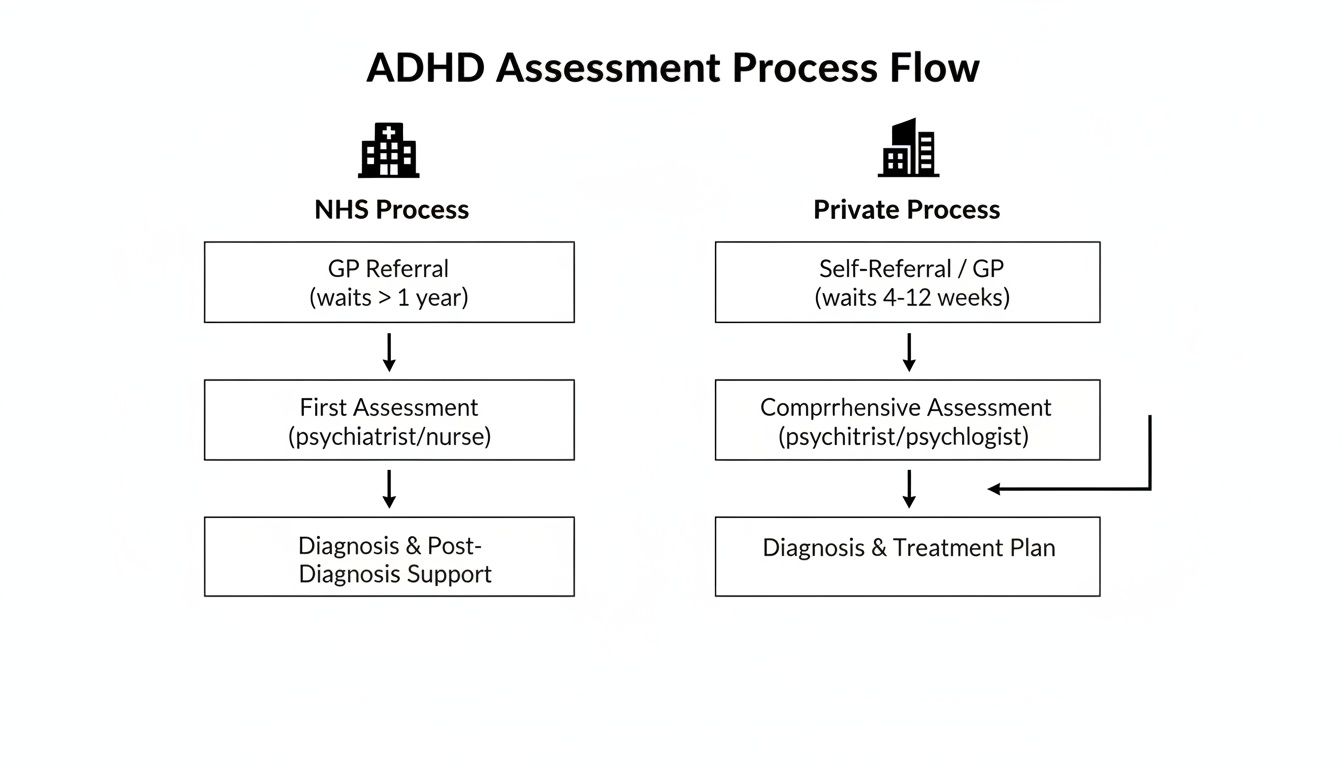
As you can see, while the core clinical steps are pretty similar, the big differences lie in how you get access and how long you'll be waiting.
The Initial Steps: Pre-Assessment Information Gathering
Your journey will actually start long before you have your main appointment. The first thing you'll be asked to do is fill out some detailed questionnaires and screening forms. These aren't just box-ticking exercises; they're the first and most crucial step in gathering the objective information the specialist needs.
These forms will typically ask about:
- Your current struggles: You’ll be asked to describe difficulties with things like focus, getting organised, acting on impulse, and managing your emotions at work, at home, and in your relationships.
- Your history: The questions will go back to your childhood, looking for signs of ADHD traits before the age of 12, which is a key part of the diagnostic criteria.
- Your overall mental health: This helps the clinician see the bigger picture and understand any past or present experiences with anxiety, depression, or other conditions.
Think of this paperwork as laying the groundwork. It gives your specialist a solid foundation of evidence and a preliminary understanding of your situation before you even meet.
The Core Clinical Interview: A Deep Dive
The heart of any ADHD assessment is the clinical interview. This is a detailed, semi-structured conversation with a psychiatrist or another qualified clinician, usually lasting anywhere from 90 minutes to three hours. It's much more than a simple Q&A; it's a guided conversation where the expert carefully pieces together your life story.
During this chat, they'll explore how possible ADHD symptoms have shown up and affected you at different stages of your life. It’s your chance to give real-world examples, share personal stories, and explain the genuine impact these challenges have had on you.
A really skilled specialist will also be carrying out a differential diagnosis. This is a clinical term for the process of carefully considering whether your symptoms could be better explained by something else.
An experienced clinician understands that neurodiversity is complex. They'll meticulously untangle the overlaps between ADHD, autism, and common mental health conditions like anxiety to make sure the final diagnosis is accurate and, most importantly, helpful for you.
For example, they'll work to tell the difference between the physical restlessness of ADHD and the internal churn of anxiety. They'll also explore whether difficulties in social settings come from ADHD-related inattentiveness or from differences in social communication often seen in autism. This is an absolutely critical part of the process. To get a better feel for how these structured evaluations work, you can read our guide on what is a psychiatric assessment.
The Role of Informant Input
To get a full 360-degree view, your clinician will often ask for input from someone who knows you well—maybe a partner, a parent, or a lifelong friend. This is called informant input. It's not about them 'checking up' on you; it's about adding another valuable perspective to the picture.
A parent might remember comments from old school reports you’ve completely forgotten, providing vital evidence from your childhood. A partner might be able to describe how your traits play out in your daily home life in ways you no longer even notice. This external insight helps to confirm your own experiences and builds a much more robust and reliable diagnostic picture.
By combining what you tell them, what they observe in the interview, and this third-party feedback, the specialist can confidently piece everything together to determine if you meet the criteria for an ADHD diagnosis.
Navigating Life After Your Diagnosis

Getting your diagnostic report can be a huge moment. For many, it’s not just a piece of paper; it’s the instruction manual for your own brain you’ve been missing. It brings a sense of validation after what might have been years, or even decades, of feeling different and not knowing why. This report is the key that unlocks what comes next.
A properly detailed report, following a comprehensive ADHD assessment for adults in the UK, won't just give you a label. It will lay out a formal diagnosis based on established clinical frameworks like the DSM-5, clearly explaining how your personal history and experiences fit the criteria. Think of it as a crucial piece of medical evidence.
But it’s the next part that really matters. The report should also give you a set of personalised, practical recommendations. This is where the true value lies, as it turns clinical findings into a real-world roadmap for improving your day-to-day life.
Understanding Your Treatment Options
With a diagnosis in hand, the conversation naturally shifts to support. Your options will generally fall into two categories: medical and non-medical support. Both are designed to help you manage your ADHD traits more effectively and give your overall well-being a boost.
For many people, medication can be a game-changer. The process of getting the prescription right is called titration.
- What is Titration? Titration is a careful, consultant-led process that can take several weeks or even a few months. You’ll start on a very low dose of an ADHD medication, and your psychiatrist will gradually adjust it until you hit that sweet spot – the optimal dose that helps your symptoms with the fewest possible side effects.
- Ongoing Monitoring: Throughout this period, you’ll have regular check-ins to monitor your physical health (things like blood pressure and heart rate) and discuss how you’re feeling.
Of course, medication isn't the only tool in the box, and it isn't the right path for everyone. Non-medical support is just as vital. This could be anything from ADHD coaching to develop new organisational strategies, to therapy like CBT to work through the anxiety or low self-esteem that often comes from a lifetime of feeling out of sync with everyone else.
Your Diagnosis as a Tool for Self-Advocacy
Your diagnostic report is a powerful document. It’s the official evidence you need to ask for and receive formal support. In the UK, ADHD can be covered by the Equality Act 2010, which means you are legally entitled to "reasonable adjustments" at work and in education.
A formal diagnosis empowers you to stop trying to force yourself into systems that weren't built for your brain. Instead, you can start adapting those systems to work for you. It’s the foundation for getting the support you deserve.
This can make a massive difference in several key areas of your life:
- At Work: Your report is your ticket to applying for the government's Access to Work scheme. This can provide funding for things like noise-cancelling headphones, specialised software, or even an ADHD coach to help you thrive in your role.
- At University: Students can use their diagnosis to apply for Disabled Students' Allowance (DSA). This can fund specialist equipment, one-on-one study support, and other vital resources to level the academic playing field.
- In Your Relationships: The clarity that comes with a diagnosis can be transformative for personal relationships. It gives you and your loved ones a shared language to understand behaviours – like forgetfulness or emotional intensity – that might have caused friction in the past.
Arranging Ongoing Care with a Shared Care Agreement
Once your medication is stable after titration, the final piece of the puzzle is often arranging a Shared Care Agreement with your GP. This is simply a formal agreement where your specialist psychiatrist hands over the responsibility for writing your repeat prescriptions to your local NHS GP.
This ensures your care continues smoothly, making it much easier and more affordable to get your medication. Your specialist will typically still check in for an annual review, but your GP will handle the day-to-day prescribing, neatly integrating your ADHD treatment into your regular healthcare.
Getting a Handle on Private ADHD Assessment Costs and Timelines
When you're looking into a private ADHD assessment for adults in the UK, the two biggest questions are usually "How much?" and "How long?". It’s completely understandable. The decision to go private often comes from a need for answers sooner rather than later, and knowing the full financial picture upfront means you can move forward without any nasty surprises.
A good provider will be clear from the start: the fee for the assessment itself is just the first step. Think of it like buying a car – the sticker price gets you the car, but it doesn't include the insurance, tax, or fuel you'll need to actually drive it.
That initial assessment fee covers the expert diagnostic work: the deep-dive clinical interviews, sifting through all the questionnaire data, and creating your in-depth diagnostic report. But you absolutely need to ask what happens after you get a diagnosis, because that's where other costs come into play. These follow-on services are what transform a diagnosis on paper into real-world support.
For instance, the journey to find the right medication and dosage is a separate, specialist process called titration. Any follow-up appointments to check in on your progress or chat about non-medical coping strategies will also be billed separately. And finally, you’ll need to cover the cost of private prescriptions until you can hopefully set up a Shared Care Agreement with your GP.
What Does the Assessment Fee Actually Cover?
When you pay for a private ADHD assessment, you're paying for a specialist's dedicated time and clinical expertise. The fee covers all the essential diagnostic work needed to give you a solid, evidence-backed answer about whether you have ADHD.
Here’s what’s typically bundled into that initial cost:
- Pre-Assessment Review: Before you even speak, the clinician spends time poring over your questionnaires and any other information you’ve sent in.
- The Main Clinical Interview: This is the core of the assessment – a structured, in-depth conversation with the psychiatrist that can last anywhere from 90 minutes to three hours.
- A Comprehensive Diagnostic Report: You’ll receive a formal, detailed document that explains the diagnostic outcome, the evidence behind it, and tailored recommendations for your next steps.
It's always smart to confirm exactly what's included before you commit. To get a really clear idea of how these costs add up, it’s worth looking at a detailed breakdown of the cost of an ADHD assessment in the UK.
Realistic Timelines from First Call to First Prescription
One of the biggest draws of going private is, without a doubt, the speed. NHS waiting lists can stretch on for years, which is an incredibly long time to be left in limbo. The private route is a world away from that, getting you the clarity and support you need without that agonising wait.
The private assessment timeline is measured in weeks, not years. From your first contact to receiving a diagnosis, the entire process can often be wrapped up in under a month, offering a clear and efficient path forward.
A typical private journey looks something like this:
- Initial Enquiry: Once you make contact, you can usually be offered an assessment date within just one to two weeks.
- Assessment and Diagnosis: After your main appointment, the specialist needs time to finalise their thoughts and write up your report. This usually takes another five to seven working days.
- Starting Titration: If medication is the right path for you, this can begin almost straight after your diagnosis. This is a carefully managed process to find the right medication and dose, and it typically takes about six to twelve weeks.
ADHD, Autism, and Your Mental Health
Living with an undiagnosed neurodevelopmental condition can feel like you’re constantly trying to solve a puzzle with half the pieces missing. It’s a frustrating and often isolating experience, and the daily struggles can take a real toll on your mental wellbeing.
This is particularly true when you consider the significant overlap between ADHD and Autism Spectrum Disorder (ASD). Both are lifelong neurotypes—ways your brain is wired—not mental illnesses. Because they can exist together and share some similar traits on the surface, figuring out what’s going on can be a complex journey.
Trying to manage life without the right understanding or support is exhausting. The sheer effort it takes to stay organised, follow conversations, or just get through the day can easily lead to secondary mental health issues like chronic anxiety and depression. That’s precisely why a thorough ADHD assessment for adults in the UK that looks at the whole picture is so vital.
The Overlap Between ADHD and Autism
At a glance, some of the characteristics of ADHD and autism can seem quite similar. Both can impact your executive functioning (your brain's 'management system') and how you navigate the world. But the reasons behind these behaviours are often worlds apart.
Take a busy social gathering, for example. Both someone with ADHD and an autistic person might find it a real struggle.
- The ADHD Experience: A person with ADHD might feel completely overwhelmed by all the different conversations happening at once. Their focus gets pulled in a dozen directions, making it impossible to stick with one person, which can lead to them feeling restless and fidgety.
- The Autistic Experience: An autistic person might find the sensory input—the bright lights, loud music, and mixed smells—physically painful or overwhelming. They might also struggle to interpret unspoken social cues, leading to complete exhaustion and the need to find a quiet space.
Difficulties with planning and organisation are another common thread. A specialist assessment is crucial to get to the bottom of these experiences and give you an accurate diagnosis, which is the first step towards getting the right kind of help.
Understanding the 'why' behind your challenges is the key. A diagnosis isn't about fitting you into a box; it's about providing a framework that validates your experiences and illuminates the most effective path forward for your unique neurotype.
The Toll on Your Mental Health
The diagnosis gap for adult ADHD in the UK is staggering. Recent research shows that only around 1 in 9 people with the condition ever receive a formal diagnosis. With some figures suggesting over 80% of adults with ADHD are undiagnosed, millions are left to figure things out on their own. You can discover more about these ADHD statistics and the diagnosis gap on our blog.
This lack of recognition can have a devastating impact on your mental health. When you constantly feel like you're underachieving or failing to meet expectations without knowing why, it can create a vicious cycle of shame, anxiety, and plummeting self-esteem.
Over the years, these feelings can snowball into more serious conditions like Generalised Anxiety Disorder or clinical depression. This is why a holistic diagnostic process is so important. It isn't just about spotting ADHD or autism; it's also about identifying any secondary mental health conditions that have cropped up along the way. Seeing the full picture ensures you get support that addresses not just the symptoms, but the root cause and its effect on your life.
Your Questions Answered: Adult ADHD Assessments
Thinking about getting an ADHD assessment can bring up a lot of questions. It's completely normal to want to understand how it all works. Let's clear up some of the most common queries.
Do I Need My GP to Refer Me for a Private Assessment?
In short, no. One of the main reasons people choose the private route is that you can refer yourself directly to a clinic like ours. This lets you bypass the often lengthy NHS waiting lists that start with getting a GP appointment.
That said, it’s still a good idea to keep your GP in the loop. A good clinic will encourage this. It helps ensure your medical records are complete and can make things much smoother down the line, especially if you decide to arrange a Shared Care Agreement for your medication with the NHS.
What if the Assessment Shows I Don’t Have ADHD?
This is a common worry, but a thorough assessment is valuable no matter the outcome. If you don't meet the clinical criteria for ADHD, the specialist's report won't just say 'no'. It will clearly explain why and, crucially, offer other potential explanations for the challenges you're facing.
The report might suggest exploring other possibilities like anxiety, depression, or even autism. Think of it less as a dead end and more as a signpost pointing you in the right direction for getting the right support.
An assessment is about gaining clarity, not just getting a label. Whether the result is an ADHD diagnosis or something else, you walk away with a much clearer understanding of yourself and what to do next.
Can I Use a Private Diagnosis to Get Support at Work?
Yes, absolutely. A diagnostic report from a GMC-registered psychiatrist is a legally recognised medical document.
Under the Equality Act 2010, this report is powerful evidence you can use to request ‘reasonable adjustments’ from your employer. Your report will usually include tailored recommendations, giving you and your manager practical ideas for support that could make a real difference to your working life.
At Insight Diagnostics Global, we’re here to provide the clarity you need with our expert-led assessments. If you’re ready to finally get some answers, take a look at our CQC-regulated adult ADHD assessment services.