So, you're exploring an ADHD assessment and trying to figure out who can actually give you a formal diagnosis here in the UK. It’s a common point of confusion, but getting it clear is your first big step, especially when considering other mental health factors or conditions like autism.
In the UK, the final word on an ADHD diagnosis must come from a specialist mental health professional. This is almost always a psychiatrist. Your GP is your crucial first port of call, but they act more like a gatekeeper—they listen to your concerns and can refer you on, but they aren't the one to make the diagnosis itself.
Your First Step on the UK ADHD Diagnosis Pathway

Starting this journey can feel pretty overwhelming. Knowing who to talk to and who holds the keys to a proper diagnosis helps cut through the noise and puts you back in control.
Think of it this way: your GP is the one who hands you the map and points you towards the right trail. The specialist, on the other hand, is the expert guide who walks that trail with you. They know the terrain inside out and can confirm you've reached the right destination. This specialist-led process is vital for an accurate assessment, particularly when other conditions like autism, anxiety, or depression might be in the mix, as they often share overlapping symptoms with ADHD.
Why a Specialist is Essential
Diagnosing ADHD properly isn't about ticking off a quick checklist. It’s a deep dive into your life story, from your school days right up to the challenges you're facing today. A specialist has the training to see the subtle differences between ADHD and other mental health conditions with overlapping symptoms, making sure you get to the root of what's really going on.
This isn't just best practice; it's a requirement. The UK's National Institute for Health and Care Excellence (NICE) guidelines are very clear that only specialists should be diagnosing ADHD. This is all about maintaining a high standard of care and diagnostic accuracy.
Despite this, ADHD is massively underdiagnosed in the UK. A sobering analysis of 9 million GP records found that only 0.32% of people had a recorded diagnosis. Experts believe this is just a fraction of the reality—perhaps only one in nine people who actually have the condition.
To help you get a clearer picture of the professionals involved, here's a quick rundown of who does what.
Who's Who in Your UK ADHD Diagnosis Journey
This table breaks down the different healthcare professionals you might meet and clarifies their specific roles in the assessment process.
| Professional | Their Role in Your Diagnosis | Can They Formally Diagnose ADHD? |
|---|---|---|
| GP (General Practitioner) | Your first point of contact. They'll discuss your symptoms and, if appropriate, make a referral to a specialist service. | No. They are the gateway to assessment. |
| Psychiatrist | A medical doctor specialising in mental health. They conduct the diagnostic assessment, can prescribe medication, and create a treatment plan. | Yes. This is the most common route. |
| Specialist Nurse | A nurse with advanced training in a specific area like ADHD. They can often diagnose and, if they are a qualified prescriber, manage medication. | Yes, if they have the appropriate specialist qualifications. |
| Psychologist | A professional trained in psychology. Clinical or counselling psychologists may conduct parts of the assessment, but they cannot prescribe medication. | Sometimes. They can contribute to or lead a diagnosis, often as part of a multi-disciplinary team. |
Understanding these roles can make the process feel much less intimidating as you know who to expect and what they're there to do.
A formal diagnosis isn't just about getting a label; it's about finally understanding the unique wiring of your brain. It gives you a new lens for self-compassion and unlocks the door to strategies, support, and treatments that can genuinely change your life.
For many, just getting onto the pathway is the hardest bit. It can be really helpful to understand what the whole process looks like from start to finish. You can learn more about this in our guide on how to get tested for ADHD in the UK. While our guide covers the general process, those looking for more in-depth information might find resources offering specific guidance on adult ADHD diagnosis useful as well.
The Specialists Qualified to Diagnose ADHD
If you're starting the journey towards an ADHD diagnosis, the first big question is: who can actually give you one? In the UK, a formal diagnosis has to come from a healthcare professional with very specific training in neurodevelopmental conditions. It's not something every mental health clinician can do, so knowing who to turn to is the first crucial step.
The main specialists you’ll encounter are Consultant Psychiatrists. You can think of a psychiatrist as a medical doctor who has spent years specialising in mental health. They're trained to spot the signs of conditions like ADHD and, importantly, they're the ones who can prescribe and manage medication. This makes them a central figure in the whole process, from that first assessment right through to your ongoing treatment.
Beyond Psychiatrists: Other Key Professionals
While psychiatrists are often the go-to, they aren't the only ones qualified. A few other highly trained specialists can assess and diagnose ADHD, often working together as part of a wider team.
- Clinical Psychologists who have specialised in neurodevelopmental disorders are also able to carry out very detailed assessments. They're like diagnostic experts, using in-depth testing and behavioural analysis to build a complete picture of how your brain works. The key difference is that they can't prescribe medication.
- Specialist Nurses can also diagnose ADHD and manage medication, provided they've completed advanced training and are qualified prescribers. They often play a fantastic role in bridging the gap between clinical assessment and practical, day-to-day patient support.
Getting your head around these different roles is really helpful. If you want to understand more about their specific contributions, especially when medication might be part of the picture, learning about the role of a psychiatrist for ADHD is a great place to start.
The Importance of Specialist Expertise for Complex Cases
This need for a specialist isn't just red tape; it's essential for getting an accurate diagnosis. ADHD rarely travels alone. It often shows up alongside other conditions like anxiety, depression, or even other neurodevelopmental conditions like Autism Spectrum Disorder (ASD).
Trying to untangle all of that requires a truly skilled professional. A specialist can tell the difference between the overlapping traits of ADHD and autism, for instance. They can also figure out if your anxiety is a separate condition or a direct result of the daily struggles of living with undiagnosed ADHD.
A specialist assessment does more than just tick a box for ADHD. It creates a complete picture of your mental health, ensuring that any treatment plan addresses your unique combination of strengths and challenges, rather than just applying a one-size-fits-all label.
This thorough, nuanced approach means your diagnosis is solid and genuinely reflects your experience. It gives you a reliable foundation to build on as you start to move forward with the right support.
Comparing NHS vs Private ADHD Assessments
If you're looking for an ADHD assessment in the UK, you’ve got two main roads you can take: the NHS or the private route. This isn't just a simple choice; it’s a decision that pits speed against cost and has long-term implications for your care. Think of it as a marathon versus a sprint – understanding what each involves is the first step.
The NHS route is often considered the gold standard. It’s a specialist-led assessment that’s free at the point of use, and any diagnosis you receive is automatically recognised and integrated into the wider healthcare system. This can make life much simpler when it comes to ongoing treatment and support.
But there’s a huge, unavoidable catch: the waiting times. And "waiting" is putting it mildly. Analysis from The King's Fund has shown that with no official targets for ADHD waiting times, people are often left hanging for years, not months. These huge delays are precisely why so many people are now looking for private options; for many, waiting that long simply isn't an option.
The Trade-Offs of Going Private
Going private is the fast track. Instead of waiting years, you can often get an appointment within a matter of weeks. For someone who is struggling, this speed can be a genuine lifeline, giving them the clarity they need to start therapy or medication much sooner. You also get a much wider choice of specialists and clinics.
Of course, this speed and choice come at a price. A private assessment can set you back hundreds, sometimes thousands, of pounds. And the costs don't stop once you have the diagnosis. You'll also need to budget for follow-up appointments and the full cost of private prescriptions until your treatment is stable.
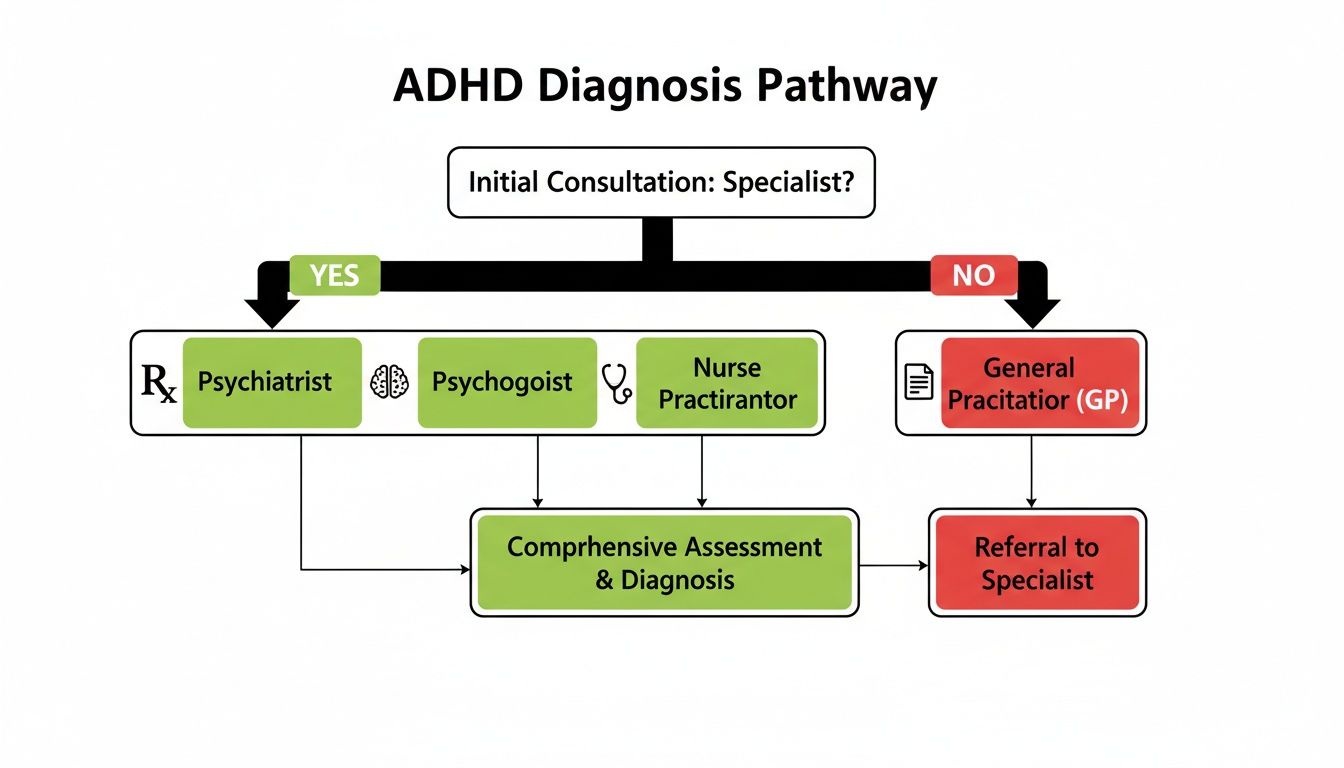
As this flowchart shows, a proper diagnosis has to come from a specialist—like a psychiatrist or specialist nurse—whether you go through the NHS or pay for it yourself.
It all boils down to a pretty tough question: Can you afford to pay for a quick diagnosis, or can you afford to wait for a free one? You're essentially weighing up your financial health against your mental health needs.
NHS vs Private ADHD Diagnosis: A Side-by-Side Comparison
To help you weigh your options, here’s a straightforward comparison of the two pathways. This table breaks down the key differences you’ll want to consider before making a decision.
| Feature | NHS Pathway | Private Pathway |
|---|---|---|
| Cost | Free at the point of use. Prescriptions are at the standard NHS rate. | Assessments can cost £700 – £2,000+. You pay for follow-ups and the full cost of private prescriptions. |
| Waiting Times | Extremely long. It’s common to wait 1-5 years for an initial assessment, depending on your location. | Very short. You can often be seen within a few weeks to a couple of months. |
| Choice of Clinician | Limited. You are referred to your local NHS mental health service and assigned a specialist. | High. You can research and choose from a wide range of clinics and individual specialists across the UK. |
| Process | Starts with a GP referral. Follows a structured, but often slow, pathway through the local NHS trust. | You can self-refer directly to a clinic. The process is much faster and more streamlined. |
| Ongoing Care | Fully integrated. Your GP manages prescriptions and care seamlessly after diagnosis and titration. | Relies on a Shared Care Agreement (SCA) with your GP. If refused, you must continue to pay privately. |
Ultimately, the right path depends on your personal circumstances—your finances, your urgency, and what level of certainty you need for long-term care.
Navigating Shared Care Agreements
One of the trickiest parts of going private is getting your ongoing care moved back into the NHS. The end goal for most people is to get a Shared Care Agreement (SCA). This is a formal arrangement where your private specialist hands over the prescribing of your medication to your NHS GP once you’re on a stable dose.
An SCA is a game-changer because it means you switch from paying for expensive private prescriptions to the standard NHS charge. But here’s the crucial part: your GP does not have to agree to it. Some refuse due to local policies, a lack of confidence in the private provider, or simply not wanting to take on the responsibility.
Before you even think about booking a private assessment, have a conversation with your GP. Ask them directly if they are generally willing to enter into a shared care agreement with a private ADHD clinic. This one chat could save you a world of stress and unexpected costs, making sure your journey to a full ADHD diagnosis in the UK is as smooth as it can be.
What a Comprehensive ADHD Assessment Involves

A proper ADHD assessment isn't just a quick chat or a simple questionnaire. It’s more like putting together a detailed jigsaw puzzle of your life. You and the clinician work together, collecting pieces of evidence from your past and present to build a complete and accurate picture of how your brain works. The whole process is designed to be thorough for a very good reason—to make sure any diagnosis is reliable and genuinely reflects your lived experience.
The heart of the assessment is the clinical interview. This is a deep dive, starting with your childhood. The clinician will want to know about your school reports, what you were like as a kid, your friendships, and any early signs of inattention or hyperactivity. They’ll then draw a line from those early days to your life now, exploring how symptoms might be affecting your career, relationships, and general wellbeing.
Gathering Evidence from Multiple Angles
To get the full picture, clinicians need to understand how your traits show up in different parts of your life. That’s why the assessment nearly always involves standardised rating scales or questionnaires. You'll fill these out, but often they'll also ask a partner, a parent, or a close friend who has known you for a long time to complete one as well.
This gives the clinician a vital outside perspective. It’s a bit like a film director using different camera angles to see the whole scene. It helps the specialist see beyond your own self-perception and understand how your symptoms look to others. It also helps confirm that the traits have been there throughout your life, which is a key part of an official ADHD diagnosis.
Ruling Out or Identifying Other Conditions
One of the most crucial tasks for the person assessing you is to carefully untangle what’s going on. ADHD rarely travels alone. It often exists alongside other conditions, and its symptoms can sometimes look a lot like something else entirely.
A good assessor will skillfully investigate whether your challenges might be explained by, or are happening in addition to, other conditions such as:
- Autism Spectrum Disorder (ASD): There can be a significant overlap in areas like social difficulties or executive function challenges. A specialist with expertise in both knows how to differentiate these conditions or diagnose them as co-occurring.
- Anxiety and Depression: It’s no surprise that living with undiagnosed ADHD can lead to anxiety or low mood. The assessor's job is to figure out if these are separate conditions or a direct result of the struggles caused by ADHD.
- Mood Disorders: Emotional dysregulation is a massive part of ADHD for many people, but it needs to be distinguished from conditions like bipolar disorder.
An expert assessment doesn't just look for ADHD; it looks at you as a whole person. The goal is to understand the complete picture of your mental health to create a support plan that addresses all your needs, not just one part of them.
This meticulous approach is exactly why diagnosis must be handled by specialists. As a recent report from NHS England's independent ADHD Taskforce pointed out, qualified healthcare professionals are critical for getting an accurate diagnosis in the UK. The report even recommends more standardised processes to improve quality and access for everyone. You can read the full report from the ADHD Taskforce to see how the push for better specialist services is shaping up nationally. Ultimately, this methodical process ensures you walk away with real clarity, not just a label.
Navigating Medication and Treatment After Diagnosis

Getting an ADHD diagnosis isn’t the finish line; it’s the starting block. It’s the point where you finally get the instruction manual for your brain, opening up a world of strategies to help you manage your symptoms. For many, medication is a significant—and often life-changing—part of that new approach.
It's a common misconception, though, that any clinician who diagnoses ADHD can also prescribe medication. In the UK, that's not the case. The authority to prescribe and manage ADHD medication rests solely with medical professionals, specifically psychiatrists or specialist nurse prescribers. This is a crucial safeguard, ensuring the person managing your treatment has a deep understanding of your overall medical profile, including any other mental health conditions you might have.
The Titration Process Explained
If you and your specialist agree that medication is the right path, you’ll start a process called titration. This isn't a simple case of "take this pill and call me in a month." It’s a careful, collaborative journey.
I often tell my clients to think of it like tuning an old-school radio. You start with static, and you slowly, carefully turn the dial. The goal is to find that perfect frequency where the music is crystal clear (maximum symptom relief) without any of the crackle and hiss (minimal side effects). This period involves regular check-ins with your prescriber to see how you're feeling and make small adjustments until you land on the dose that works best for you.
The titration phase is absolutely vital. It’s a partnership between you and your clinician to fine-tune your treatment, ensuring the medication supports you effectively and safely. Rushing this stage can lead to poor outcomes, so patience is key.
Bridging Private and NHS Care with Shared Agreements
If you’ve gone the private route for your diagnosis and started medication, you're probably wondering about the long-term costs. The goal for most is to eventually transfer the prescription over to the NHS. This is where a Shared Care Agreement (SCA) comes in.
An SCA is essentially a formal handover document that allows your GP to take over the repeat prescriptions from your specialist once your medication and dose are stable. But here’s the critical part: a GP isn’t obligated to accept it. That's why I always advise people to have a chat with their GP before they even begin private treatment. A quick, proactive conversation can save a lot of headaches later and pave the way for a smooth transition. To get a better handle on what's involved, you can learn more about ADHD medication for adults in the UK.
And remember, medication is rarely the whole story. It's an incredibly powerful tool, but it's just one tool in the box. True success often comes from a combination of medication, therapy, coaching, and practical strategies like using ADHD productivity tools. This holistic approach is what helps people truly thrive.
Your Questions About ADHD Diagnosis, Answered
Working out how to get an ADHD diagnosis in the UK can feel like navigating a maze. It’s completely normal to have a lot of questions. Here, I'll answer some of the most common ones I hear, giving you clear, practical advice to help you find your way.
What if My GP Won't Refer Me for an Assessment?
This is a scenario that can feel really disheartening. The short answer is yes, a GP can refuse a referral if they don't see enough evidence pointing towards ADHD as the root cause of your struggles. If they do, however, they really ought to explain their clinical thinking behind that decision.
If you find yourself in this situation and disagree with their conclusion, you have every right to ask for a second opinion. You can see another GP at your practice or register with a new one.
To give yourself the best chance, go prepared. Don’t just list symptoms; bring real-world examples. Talk about how these challenges show up at work, in your relationships, and in your day-to-day life. The more specific you are, the clearer the picture becomes.
Is an Online ADHD Diagnosis Actually Legitimate?
An online diagnosis can be just as valid as an in-person one, but you have to be incredibly careful about who you choose. For any diagnosis to be taken seriously by the NHS, it must come from a UK-based clinician who is properly registered – for instance, a psychiatrist on the GMC Specialist Register.
Crucially, the assessment itself has to follow the national NICE guidelines. This isn't just about filling out a quick online form. It means a proper, in-depth clinical interview and a deep dive into your personal history. A thorough private diagnosis like this should be acceptable to your GP, but it’s always a smart move to chat with them about 'shared care' before you commit to anything.
What Happens if I Have Both Autism and ADHD?
It’s actually very common for autism and ADHD to show up together. Research points to a significant overlap between the two, which is why a really skilled, expert assessment is non-negotiable here.
A specialist with experience in both conditions will know how to tease apart the different traits. They’ll understand how the characteristics can overlap, interact, or even mask each other. This is crucial because treatment and support strategies may need to be adapted for someone who is autistic and has ADHD.
A good diagnostician doesn’t view ADHD in a vacuum. They carry out a holistic assessment to see the full picture of your mental health, making sure your final report and support plan are true to your unique neurotype.
If both conditions are present, the final report should make that clear. This clarity is what leads to a truly effective support plan that is genuinely tailored to the specific strengths and challenges that come with being both autistic and having ADHD.
Will My NHS GP Recognise a Private Diagnosis?
This is probably one of the most important questions if you're thinking of going private. In theory, yes. The system is designed for an NHS GP to accept a private diagnosis through something called a Shared Care Agreement (SCA).
Here’s how it works: after a private specialist diagnoses you and gets you settled on the right medication and dose (a process called titration), they can ask your GP to take over writing the prescriptions. The catch is that GPs aren't required to say yes.
Some might refuse because of local health board policies, a lack of confidence in the private clinic, or concerns about the workload and costs involved. That's why it is absolutely vital to talk to your GP before you book a private assessment. Understanding their stance on shared care from the outset can save you a world of stress and complications down the line.
At Insight Diagnostics Global, our consultant-led team provides CQC-regulated, NICE-compliant online assessments for adults, ensuring you receive a thorough and respected diagnosis. To learn more about our process and take the next step with confidence, explore our services.