
An adult autism assessment is a detailed clinical process for figuring out if someone’s lifelong experiences line up with the diagnostic criteria for Autism Spectrum Disorder (ASD). It’s a deep dive with specialists, using structured interviews and evaluations to bring clarity to adults who’ve always felt a bit different but never knew precisely why.
Why More Adults Are Seeking an Autism Assessment
Have you ever felt like you're trying to play a social game but you missed the day they handed out the rulebook? That’s a feeling many adults share, and it’s often what nudges them towards seeking an autism assessment later in life. This journey doesn’t usually start with one big moment, but rather a lifetime of quiet questions and feeling just a little out of step with everyone else.
The workplace is often where these differences really start to stand out. The unspoken rules of office chit-chat, the sensory hell of a noisy open-plan office, or the struggle to decode vague feedback can create a constant hum of stress. It’s never been about a lack of skill; it's about having a brain that's wired to process the world in a fundamentally different way.
The Overlap with ADHD and Mental Health
For many, the road to an autism assessment is a winding one, often with a few other stops along the way. It’s really common for adults to have been diagnosed with anxiety or depression first. While these mental health conditions are absolutely real, they can sometimes be a direct result of the exhaustion that comes from constantly trying to fit into a neurotypical world without the right tools or self-awareness. An autism diagnosis can completely reframe these challenges, showing them as a natural reaction to a lifelong mismatch between a person's needs and their surroundings.
Then there’s the significant overlap with Attention Deficit Hyperactivity Disorder (ADHD). A huge number of autistic people also have ADHD, a combination known as AuDHD, which can make for a confusing picture. The interplay between autism, ADHD, and mental health is complex.
- Executive Function: Struggling with planning and staying organised? That’s a classic trait of both ADHD and autism. In ADHD it might stem from difficulties with focus, while in autism it could be due to a need for predictable routines.
- Social Challenges: Difficulty making or keeping friends could be down to ADHD-related impulsivity or emotional dysregulation, or it could be due to autistic differences in communication and social processing.
- Sensory Issues: While we often link sensory sensitivity to autism, ADHD also involves sensory-seeking or sensory-avoidant behaviours. Untangling whether sensory overload is causing anxiety, or if anxiety is heightening sensory sensitivity, is a key part of a good assessment.
This complex mix means that what looks like one thing on the surface could easily be explained by the other—or a combination of both, often impacting overall mental wellbeing.
An adult autism assessment isn't about getting a label. It's about finally getting the user manual for your own brain, one that explains the unique patterns of thought, feeling, and behaviour you've lived with for decades.
A Search for Clarity and Self-Acceptance
Ultimately, choosing to get an adult autism assessment is about one thing: clarity. It’s driven by that deep need to finally understand lifelong patterns, from your intensely focused passions to why you feel utterly drained after a simple chat. It's about swapping years of self-criticism, which can fuel anxiety and depression, for a bit of self-compassion.
A formal diagnosis provides a name and a framework for all those experiences. It validates that feeling of being different and offers a new way to look at past struggles and future opportunities. This shift in perspective is often the first, and most important, step toward better mental health, learning to advocate for yourself, and finally building a life that works with your brain, not against it.
Your Guide to the Online Adult Autism Assessment Process
Taking the first step towards an adult autism assessment can feel like a huge, uncertain leap. But knowing what’s involved can make all the difference, turning that feeling of anxiety into a sense of control. A modern, consultant-led online assessment isn't just a single, daunting test. It's a carefully structured journey, made up of several key stages designed to build an accurate, holistic picture of who you are.
It’s a collaborative path, one that helps you move from a place of uncertainty to one of genuine clarity and, ultimately, self-acceptance.
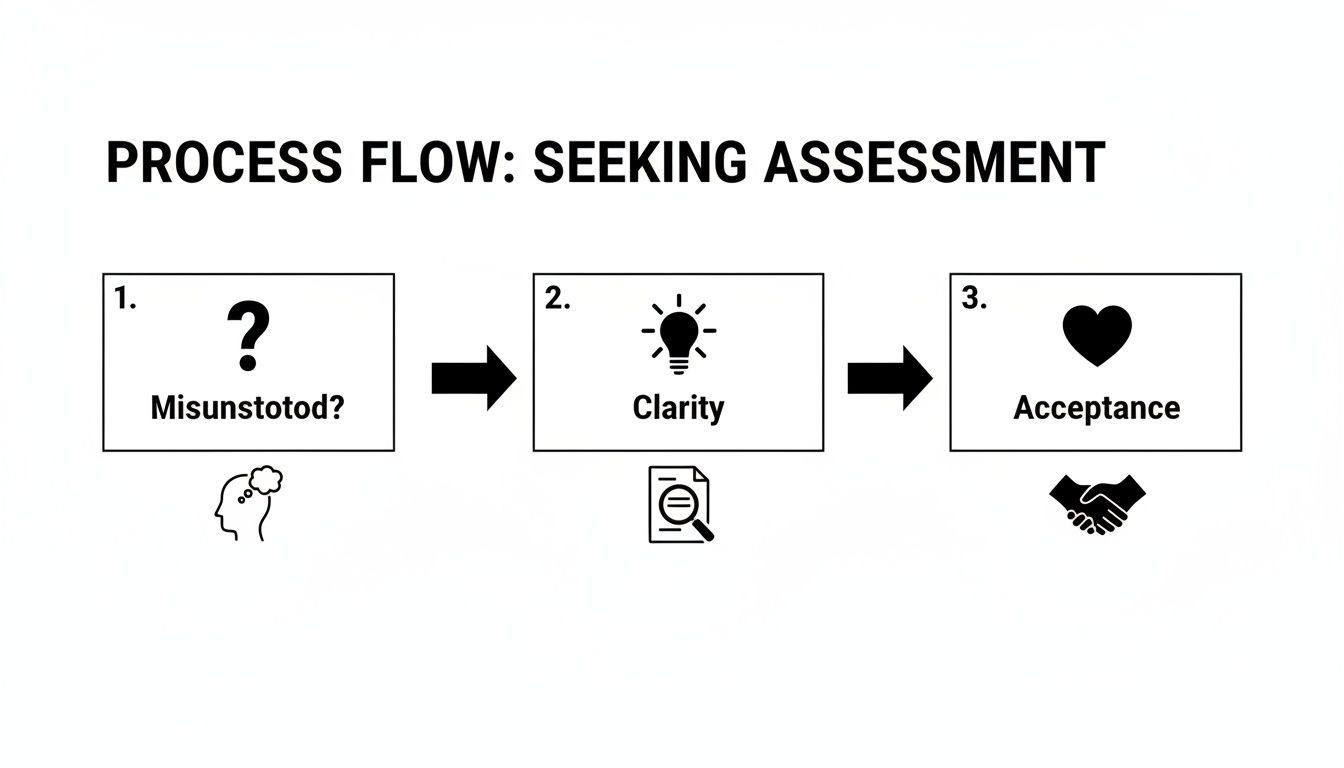
This diagram neatly captures the emotional journey many people take—starting out feeling misunderstood and finally reaching the clarity and peace that a diagnosis can provide.
The Initial Screening and Triage
Your journey begins with a triage or screening stage. This isn’t part of the diagnosis itself, but it’s an essential first checkpoint to make sure a full autism assessment is genuinely the right path for you. Think of it as a preliminary conversation to get our bearings.
You’ll usually be asked to fill out some detailed questionnaires covering your developmental history, the challenges you're facing now, and why you’re considering an assessment. This gives the clinical team a good initial understanding of your situation and helps confirm that your experiences point towards autism, so you don't waste time and money on an unsuitable process.
This early step is also great for spotting any potential co-occurring conditions, like ADHD or anxiety, which is vital for a truly thorough evaluation. To get a feel for what this involves, you can see how it fits into a broader online mental health assessment.
The In-Depth Clinical Interview
Once you’re through the screening, you move to the core of the assessment: the clinical interview. This is a detailed, guided conversation with a specialist psychiatrist or clinical psychologist—it’s absolutely not an interrogation. The real aim is for the clinician to understand your life story, through your own eyes.
You'll chat through different parts of your life, including:
- Early Development: What you remember from your childhood and school days.
- Social Communication: How you find navigating friendships, relationships, and the workplace.
- Repetitive Behaviours and Interests: Your passions, routines, and how you cope with unexpected changes.
- Sensory Experiences: Your sensitivities to things like sounds, bright lights, certain textures, or smells.
- Mental Health History: Discussing any past diagnoses like anxiety or depression and exploring how they connect with your core experiences.
This conversation is the heart of the diagnostic process. It allows the specialist to map your personal experiences directly onto the official DSM-5 criteria.
Using Gold-Standard Diagnostic Tools
To add structure and objectivity, clinicians use what are known as "gold-standard" psychometric tools. These aren’t tests you can pass or fail; they’re much more like frameworks for a deeper conversation. Tools such as the RAADS-R (Ritvo Autism Asperger Diagnostic Scale-Revised) or elements of the ADOS (Autism Diagnostic Observation Schedule) adapted for online use provide a set of standardised questions that help explore autistic traits in a really detailed way.
These instruments ensure the assessment is both comprehensive and consistent. They add another layer of evidence, helping the clinician investigate specific areas, including overlaps with ADHD and how your traits impact your mental health, which all adds up to a more reliable and well-rounded evaluation.
Think of these tools less like a formal exam and more like a structured interview. They are prompts designed to help you find the words for experiences you may have never known how to describe, ensuring no stone is left unturned.
The Role of Collateral History
The final piece of the puzzle is what’s called collateral history. This simply means gathering some insights from someone who knows you well—maybe a partner, parent, or a close friend. It's not about "checking up on you" at all; it’s about building a richer, more complete picture of your life.
Because autism is a lifelong neurodevelopmental condition, getting another person's perspective on your childhood behaviours or current social patterns can be incredibly helpful. Their observations can provide context for things you might not remember or even recognise in yourself, which ultimately strengthens the accuracy of the final diagnostic conclusion. When all these components come together, they create a reliable, empathetic, and definitive assessment.
Why a Timely and Accessible Diagnosis Matters
Living with the suspicion that you might be autistic, but having no official answer, can be an incredibly draining experience. It’s a period of limbo that, for many adults, stretches on for years, taking a heavy toll on mental health. This isn't just about patience; the long wait for an adult autism assessment often allows anxiety, depression, and self-doubt to take root and grow.
Think of it like trying to assemble a complicated piece of furniture with the wrong instructions. You can see the parts, but nothing quite fits together, and the whole process is frustrating and exhausting. A timely diagnosis provides the correct manual for you, offering the clarity you need to finally make sense of things.
It’s this need for clarity that really highlights the differences between the NHS and private assessment routes. While the goal is the same, the path to getting there can be worlds apart.
NHS vs Private Online Assessment Timeline
The stark contrast in waiting times is often the deciding factor for adults seeking an assessment. A long delay doesn't just postpone an answer; it puts a hold on getting vital support, asking for workplace accommodations, and, most importantly, achieving self-understanding. For many, this delay is a direct barrier to improving their quality of life and mental health.
The table below gives you a realistic look at the timelines you can expect from each pathway. It shows just how much a private online assessment can shrink that period of uncertainty.
| Assessment Stage | Typical NHS Pathway | Private Online Pathway |
|---|---|---|
| Initial Referral | A GP referral is required, which can take weeks or even months to get an appointment for. | Self-referral is almost always an option, letting you kickstart the process right away. |
| Waiting List | This is the biggest hurdle, often lasting 2 to 5 years, with some areas having even longer lists. | You can typically schedule an assessment within 1 to 2 weeks of your first enquiry. |
| Assessment Process | Often involves several appointments that can be spread out over a period of many months. | The entire assessment is usually completed in just a few weeks, from the main interview to feedback. |
| Report Delivery | It can take several more months after the final appointment to receive your diagnostic report. | A comprehensive report is typically ready and delivered within 5 to 10 working days of the final session. |
As you can see, we’re not just talking about a difference of a few months—it’s often years. For a deeper dive into what shapes these timelines, you can read our guide on how long an autism diagnosis typically takes.
The Power of a Prompt Diagnosis
Getting a diagnosis isn’t a race, but getting one sooner rather than later is incredibly empowering. It provides a solid framework for understanding why you’ve struggled in the past and gives you the tools to build a better future. Suddenly, a lifetime of feeling 'different' or 'out of sync' is reframed into a clear, valid neurotype.
This new understanding has practical, real-world benefits that directly improve mental wellbeing:
-
Workplace Accommodations: A formal diagnosis is your key to unlocking reasonable adjustments at work, like getting a quieter desk or more flexible hours. It can turn a job you’re barely coping with into a career where you can thrive.
-
Better Relationships: When you understand your own social and communication style, you can explain it to partners, friends, and family. This leads to healthier, more authentic connections built on mutual understanding, not guesswork.
-
Less Anxiety and Burnout: A diagnosis can finally silence that inner critic that blames you for finding certain situations difficult. Knowing why something is challenging helps you develop effective coping strategies, practice self-compassion, and reduce the exhausting mental effort of "masking." A diagnosis of co-occurring ADHD can also open doors to medication that significantly improves focus and emotional regulation.
Ultimately, an accessible and timely adult autism assessment is a form of preventative care. It stops the cycle of confusion and burnout before it causes lasting harm, giving you the validation and knowledge you need to start building a life that truly fits.
Understanding Your Diagnostic Report and Next Steps
Getting your diagnostic report after an adult autism assessment is a really significant moment. It often marks the end of a long, sometimes confusing, journey and the start of a new chapter—one of self-understanding. But when you're holding a detailed clinical document, it’s completely natural to wonder, "Okay, so what does this all actually mean for me?"
This report is so much more than a label. The best way to think of it is as a personalised user manual for your brain. It’s a practical roadmap that helps explain your unique wiring, highlights your strengths, and makes sense of your challenges. It's the key that can turn a lifetime of questions into clarity, helping you move forward with real confidence.
Decoding the Structure of Your Report
A thorough report from a private adult autism assessment will always have several key parts. Each section is designed to build on the last, creating a complete and evidence-based picture of who you are, grounded in both clinical evidence and your own lived experience.
Generally, you can expect to find these sections:
- Clinical and Developmental History: This part summarises all the information you shared during your interviews. It covers your early life, social experiences, school or work history, and any mental health challenges you've faced.
- Summary of Findings: This is where the clinician connects the dots. They'll link your personal experiences to the formal diagnostic criteria for Autism Spectrum Disorder (ASD), often referencing frameworks like the DSM-5.
- Formal Diagnosis: The definitive conclusion of the assessment. It will clearly state whether or not you meet the criteria for ASD. If any co-occurring conditions like ADHD or anxiety were spotted, they’ll be noted here, too.
- Personalised Recommendations: This is arguably the most important part of the whole document. It offers practical, actionable advice and suggestions for support that are tailored specifically to your profile, including strategies for managing both autism and ADHD traits.
If you want to get to grips with some of the clinical language, a guide to ICD-10 codes for neurodevelopmental conditions can be a helpful resource for understanding how diagnoses are formally classified.
From Clinical Document to Practical Roadmap
The real power of your report is unlocked in the recommendations section. This isn't just generic, one-size-fits-all advice; it’s a set of personalised strategies designed to improve your life and wellbeing by translating the clinical findings into real-world actions.
For instance, if sensory sensitivities were a key finding, the report might suggest specific workplace adjustments like using noise-cancelling headphones or asking for a desk away from a busy walkway. If co-occurring ADHD was identified, recommendations might include medication options, coaching for executive functions, or specific apps for organisation. These recommendations are the bridge between your diagnosis and a more supported, comfortable future.
An adult autism assessment report should empower you, not overwhelm you. Its primary purpose is to provide a clear explanation for your lifelong experiences and equip you with the tools to advocate for your needs effectively.
What Are the Immediate Next Steps?
Once you've had a bit of time to sit with the information, you can start thinking about what comes next. There’s absolutely no rush, and you are in complete control of who you share this with.
Here are a few common first steps people take:
- Share with Your GP: You might choose to give a copy of your report to your GP so the diagnosis can be added to your medical records. This is often helpful for ensuring continuity of care down the line, particularly if you wish to explore medication for co-occurring ADHD.
- Explore Post-Diagnostic Support: Many clinics offer follow-up sessions. These can be invaluable for talking through the report with the clinician, asking any lingering questions, and processing the emotional side of a diagnosis in a supportive space.
- Consider Therapy or Coaching: You could look for therapists or coaches who specialise in working with autistic and/or ADHD adults. They can help you explore your identity, learn to manage autistic burnout, or develop new coping strategies.
A diagnosis isn’t an endpoint. It’s really the beginning of a new relationship with yourself—one built on a foundation of understanding, self-compassion, and the knowledge you need to build a life that truly fits you.
How an Autism Diagnosis Can Reshape Your Life
Getting an adult autism assessment is rarely about just getting a label. For many, it's about finally finding the right lens to see their life through. Suddenly, a lifetime of confusing, disconnected experiences—from social struggles to deep, all-consuming interests—can click into place, forming a coherent picture. It’s not an end point; it’s the beginning of a profound journey of self-discovery.
This new clarity often brings an incredible sense of relief and validation. That constant feeling of being 'different', the sheer exhaustion after social events, or the struggle to just fit in—these are no longer personal failings. Instead, they are finally understood as fundamental parts of a different way of being, a distinct neurotype. This single shift can reframe decades of self-doubt into genuine self-acceptance.

From Self-Doubt to Self-Advocacy
One of the most powerful changes a diagnosis brings is the move from self-criticism to self-advocacy. For years, you might have been pushing through overwhelming sensory overload or forcing yourself into social situations that left you completely drained, telling yourself you just needed to ‘try harder’. A diagnosis gives you the permission to stop trying to force a square peg into a round hole.
Armed with this understanding, you can begin to advocate for what you actually need. It gives you the power to recognise your limits, honour your sensory profile, and start building a life that works with your brain's natural wiring instead of constantly fighting against it. This is absolutely crucial for preventing autistic burnout and protecting your mental health long-term.
Transforming Relationships Through Clarity
A diagnosis can also be a game-changer for your personal relationships. Without the right words to explain your inner world, partners, friends, and family might misinterpret your actions as being aloof, disinterested, or stubborn. When you have a clear framework, communication can become more open, honest, and effective.
You can start explaining your needs in a way that makes sense to others:
- “I’m not being antisocial, but my social battery is completely empty after that meeting. I just need some quiet time to recharge.”
- “Sudden changes to our plans are really hard for me to handle. Could we try to stick to the original idea, or at least talk through alternatives beforehand?”
- “I might struggle with saying ‘I love you’ all the time, but I show I care through my actions and by wanting to share my interests with you.”
This newfound clarity allows your loved ones to see your behaviour through a new lens, fostering empathy and building healthier, more authentic connections based on mutual respect, not misunderstanding.
A diagnosis is like being handed the user manual for your own mind. It doesn't change who you are at your core, but it gives you the language to explain your operating system—both to yourself and to others.
Unlocking Your Potential at Work
In your professional life, an adult autism assessment can be a vital tool for thriving, not just surviving. A formal diagnosis is a protected characteristic under the Equality Act 2010, which means you are legally entitled to reasonable adjustments at work. This isn't about getting special treatment; it’s about levelling the playing field so you can do your job to the best of your ability.
Often, these adjustments are surprisingly simple but can make a huge difference:
- Environmental Changes: Requesting a desk in a quieter corner of the office or being allowed to use noise-cancelling headphones to manage sensory input.
- Communication Adjustments: Asking for instructions to be put in a clear, direct email rather than given in a vague, verbal chat.
- Flexible Working: Arranging different hours or some remote workdays to help manage energy levels and avoid the sensory drain of a daily commute.
These small changes can transform a job from a source of constant stress into a sustainable and fulfilling career. If you also have ADHD, many of these supports overlap, and exploring reasonable adjustments for ADHD can provide even more ideas. Ultimately, a diagnosis gives you the official backing and personal confidence to build a professional life that truly works for you.
The Costs and Practicalities of a Private Assessment
Deciding to pursue a private adult autism assessment is a big step, and understanding the practical side of things is crucial. It’s natural to focus on the cost, but it helps to think of it less as a simple fee and more as an investment in your own wellbeing and future. The price tag is a reflection of a deeply specialised and thorough clinical process.
A standard assessment package isn’t just a single appointment. It covers the considerable time of a consultant psychiatrist, the use of gold-standard diagnostic tools, and the painstaking creation of a detailed, multi-page report. This final document is often the key to unlocking support, accommodations, and a much deeper sense of self-understanding. For a full breakdown of what goes into the pricing, you can find more details on our private autism assessment costs page.
Preparing for Your Online Assessment
A little bit of preparation can make a huge difference to your online assessment experience. The main goal is to get rid of any potential stress on the day so you can focus completely on the conversation with your clinician. When you feel calm and ready, it's much easier to share your experiences openly and honestly.
Here are a few practical tips to help you get set up:
- Create a Comfortable Space: Find a quiet, private room where you won’t be disturbed. Settle into a comfy chair, have a glass of water handy, and check that the lighting feels right for you.
- Gather Your Thoughts: You don't need a perfectly polished script. However, spending a little time beforehand jotting down key memories, recurring difficulties, or specific examples from your life can be incredibly helpful. Think about how autism, ADHD, and mental health symptoms have shown up for you.
- Collect Supporting Information: If you happen to have them, things like old school reports, work performance reviews, or even letters from family that mention your social differences or intense hobbies can add valuable context for the clinician.
Preparing for your assessment isn't about passing a test; it's about making it easier for you to share your story. The more comfortable you are, the clearer the picture the clinician can build.
Having Your Questions Ready
Finally, remember this assessment is a conversation, not an interrogation. This is your chance to get clarity and ask an expert all the things you want to know. Before your appointment, take a moment to think about what’s on your mind.
You might want to jot down questions like:
- What happens if the outcome isn't clear-cut?
- How do you tell the difference between autism and ADHD traits in my case?
- What sort of support do you usually recommend for someone with my profile of autism, ADHD, and anxiety?
Bringing your own questions helps make the whole process feel more collaborative. It ensures you walk away feeling heard, understood, and genuinely informed about your next steps.
Your Questions Answered
It's completely normal to have questions as you consider an adult autism assessment. In fact, it’s a big step. This final section is here to clear up some of the most common queries we hear, giving you the confidence to move forward.
Can an Online Autism Assessment Really Be Accurate?
Absolutely. A properly structured online assessment is every bit as reliable and clinically sound as meeting a specialist in person. When it’s led by an experienced psychiatrist using trusted, gold-standard tools like the RAADS-R, the process follows the exact same clinical guidelines and diagnostic criteria (from the DSM-5).
The heart of the assessment isn't the room you're in; it's the deep, detailed conversation about your life experiences. That's what ensures an accurate and meaningful outcome.
What if the Assessment Shows I’m Not Autistic?
An assessment is never a waste of time, no matter the result. If the final report concludes that you don't meet the criteria for autism, that doesn't mean your struggles aren't real. Far from it.
Instead, you'll have a rich, detailed document that helps make sense of your unique strengths and challenges. It effectively rules out one possibility, giving you the clarity to explore others. A good assessment will still provide valuable insights; for example, the findings might strongly point towards ADHD, anxiety disorders, or even Complex PTSD, providing a new, more accurate direction for getting the right support and improving your mental health.
How Is This Different From an ADHD Assessment?
It's a great question, especially since so many traits can look similar on the surface. The key difference is the core focus of the investigation.
An adult autism assessment specifically looks for lifelong patterns in:
- Social communication and how you interact with others
- Restricted interests and repetitive behaviours
- Your unique sensory experiences
An ADHD assessment, on the other hand, zeroes in on persistent patterns of inattention, hyperactivity, and impulsivity. A good clinician will always keep an eye out for both, as it’s very common to be autistic and have ADHD. The skill lies in getting to the why behind your behaviours—the underlying cognitive and emotional reasons—not just observing the behaviours themselves.
An assessment is a process of discovery. Whether it leads to an autism diagnosis or clarifies another path, the ultimate goal is to provide you with the answers and understanding you deserve.
At Insight Diagnostics Global, we provide consultant-led, CQC-regulated online assessments to give you the clarity you need. If you're ready to take the next step, you can learn more about our autism assessment services.