
An adult autism assessment in the UK is a professional evaluation to see if your lifelong experiences and traits align with the diagnostic criteria for Autism Spectrum Disorder (ASD). You can go through the NHS or a private provider, and many people choose the private route for a faster path to getting the clarity they need, especially when dealing with co-occurring conditions like ADHD or mental health challenges.
This journey often begins after years, sometimes decades, of feeling like you're somehow different, without ever really knowing why.
Why More Adults Than Ever Are Seeking an Autism Diagnosis

If you're looking into an adult autism assessment, you are definitely not on your own. There's a growing wave of adults finally seeking answers to questions they've had their whole lives about social situations, sensory sensitivities, and their own mental health. It’s a search for understanding after a lifetime of trying to navigate a world that never quite felt built for you.
Many belong to what's often called a 'lost generation'. They grew up before autism was well understood, especially in people without co-occurring learning disabilities. You might have been called shy, difficult, or just 'too sensitive', all while struggling with challenges at work, with friends, and in your personal life.
For these adults, a diagnosis isn't just about getting a label. It’s about gaining a new lens through which to see yourself and your past. It provides a reason—not an excuse—for why some things are so exhausting or why conversations can feel like a game where you never learned the rules.
The Link Between Autism, ADHD, and Mental Health
It's incredibly common for autism to walk hand-in-hand with other conditions, which can make things feel complicated and confusing. The overlap between autism and ADHD is especially strong, and many adults who suspect one find they have traits of both. This combination of neurotypes can create a unique profile of strengths and challenges.
This complexity often has a significant impact on mental wellbeing. Autistic people, especially those who also have ADHD, can experience intense anxiety or depression. This can stem from the constant energy it takes to 'mask' in social situations, cope with sensory overload, or manage executive function difficulties. This is why a thorough, expert assessment that considers the whole picture is so important.
An accurate diagnosis can feel like finding the missing piece of a puzzle. It validates what you've always felt and helps untangle autistic traits from ADHD symptoms or related mental health conditions, paving the way for the right kind of support.
The Scale of Undiagnosed Autism in the UK
The need for clear and accessible diagnostic services is huge. Research keeps pointing to a massive diagnostic gap, especially for adults who have spent their lives without answers.
A 2023 study from UCL estimated there could be over 750,000 undiagnosed autistic adults aged 20 and over in England alone. The analysis suggests that for older adults, the figure could be as high as nine in ten being undiagnosed and living with unrecognised needs.
This reality highlights just how crucial it is to have clear pathways to a diagnosis. Whether you choose the NHS or a private service, an adult autism assessment UK is a massive step towards self-acceptance, validation, and building a life where you can truly thrive. Learning about the signs of undiagnosed autism in adults is often the first step on that path.
Choosing Your Path: NHS vs. Private Assessments
Deciding where to get an adult autism assessment is one of the biggest steps you'll take. In the UK, you essentially have two routes: through the NHS or by going private. Each has its own rhythm, timeline, and things to think about, so getting to grips with the differences is the best way to make a choice that feels right for you.
For most people, the NHS is the natural starting point. The journey usually kicks off with a chat with your GP, where you'll talk through what you've been experiencing. If it sounds like an assessment is needed, they'll refer you to a local specialist team. The massive plus here is that it’s free. The major drawback? The wait.
The simple truth is that demand has completely outstripped capacity. NHS data shows a huge backlog for autism referrals in England, with the vast majority of people waiting much longer than the recommended 13-week target. This isn't just a small delay; waiting lists have been growing year on year. Priory Group has some eye-opening statistics on this if you want to dig deeper.
The NHS Pathway Explained
If you go down the NHS route, the process is thorough but often painfully slow. Once your GP referral is accepted, you’ll be put on a waiting list. Eventually, you'll have an initial screening, and if that indicates autism, you’ll join another queue for the full diagnostic assessment. The clinical standards are high, but the waits can easily stretch from many months into several years, depending on where you live.
This long period of uncertainty can be incredibly tough. Many people seeking a diagnosis are also navigating related challenges like anxiety, depression, or suspected ADHD, and being left in limbo often makes things worse. After a lifetime of feeling like you don't quite fit in, being told to just wait can feel pretty demoralising.
Exploring the Private Assessment Route
This is where the private pathway comes in as a much faster alternative. For many adults—especially if their mental health is taking a hit or they need clarity for work or university—getting answers quickly is worth the investment. With a private adult autism assessment UK, you can often be seen within a few weeks, not years.
Speed isn't the only advantage. Going private gives you more control. You can do your own research, pick a clinic, or even choose a specific consultant psychiatrist who specialises in adult autism or co-occurring conditions like ADHD. The assessments are typically very thorough, and you’ll receive a detailed diagnostic report that can be used to request workplace adjustments or access other kinds of support. The big hurdle, of course, is the cost, which is a significant financial commitment.
Choosing a private assessment is often a pragmatic decision, driven by an urgent need for answers and a detailed, practical report. It’s about cutting through the waiting lists to get to a place of understanding, support, and self-acceptance.
To make things clearer, let's put the two options side-by-side.
NHS vs Private Adult Autism Assessment: A Side-by-Side Comparison
This table breaks down the key differences to help you weigh things up.
| Feature | NHS Pathway | Private Pathway |
|---|---|---|
| Cost | Free at the point of use. | Requires self-funding, often costing between £1,500 and £3,000. |
| Waiting Time | Very long; typically months and often extending to several years. | Very short; assessments are usually available within a few weeks. |
| Referral Process | A GP referral is mandatory to get onto the waiting list. | Self-referral is usually possible, offering direct access. |
| Choice of Clinician | You are assigned to the local NHS service with little to no choice of specialist. | You can choose your provider and clinician based on their expertise. |
| Report Detail | Reports are clinically sound but can sometimes be less detailed. | Reports are typically very detailed and tailored for workplace or educational needs. |
Ultimately, there’s no single "right" answer. The best path for you comes down to your personal circumstances—your budget, how urgently you need answers, and the impact the waiting is having on your mental health. Learning more about what an autism diagnosis in adults in the UK involves can give you the clarity needed to make your next move.
What to Expect During the Assessment Process
Thinking about getting an adult autism assessment can feel daunting, but knowing what’s involved often makes the whole process feel much more manageable. The goal of a good assessment isn’t to "test" you or catch you out; it’s a collaborative effort to build a detailed, authentic picture of who you are.
Think of it as a guided conversation about your life, past and present. You bring the expertise on your own experiences, and the clinician provides the professional framework to understand them. The process is broken down into clear stages, each designed to piece together your unique profile.
This flowchart gives you a bird's-eye view of the typical journey, comparing the NHS route with a private one. You can see straight away where the key differences in timing and access lie.
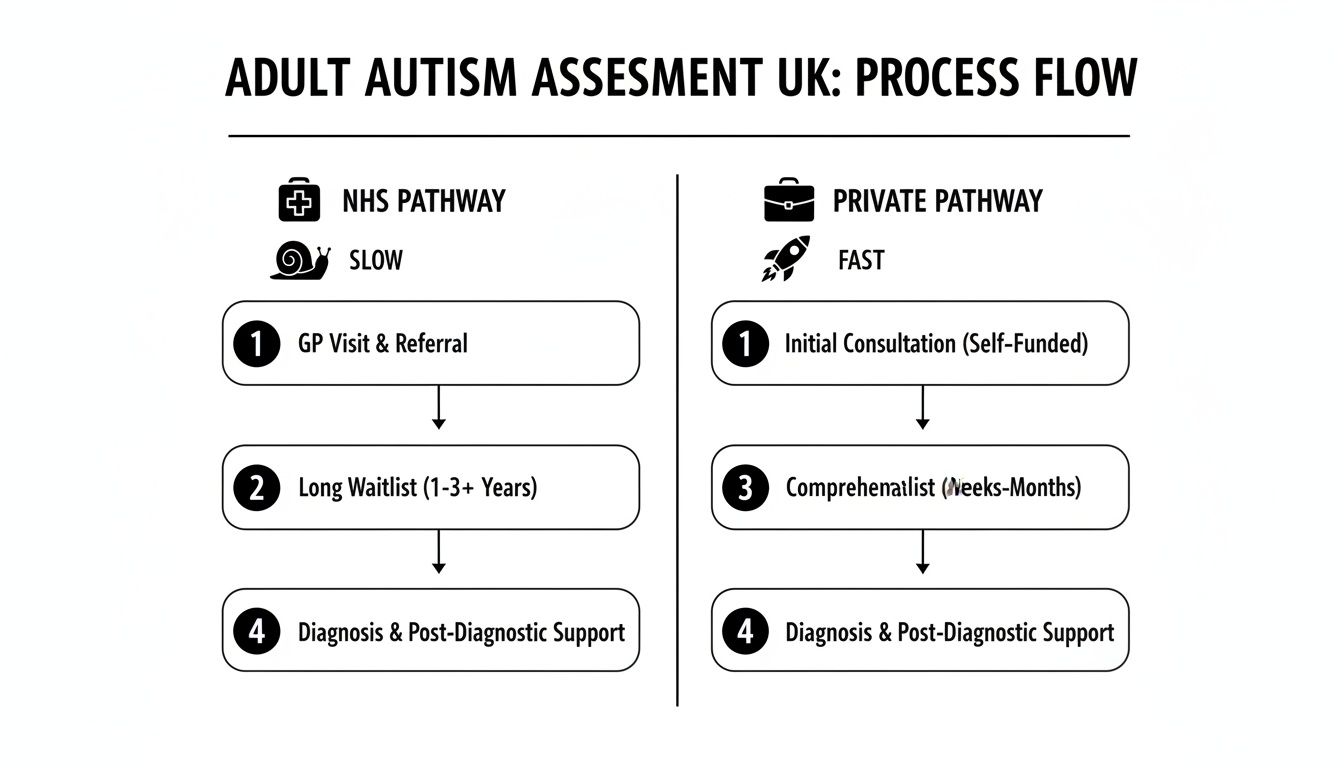
As the diagram shows, while both pathways are designed to be thorough, the private option generally offers a much quicker and more direct path from your first enquiry to receiving a final report.
Stage 1: The Initial Screening And Questionnaires
Your journey will almost always start with a set of detailed questionnaires. This isn't just admin; filling these out beforehand allows your main interview to be far more focused and productive. It gives the clinician a solid foundation of information to work from.
You’ll be asked about all sorts of things: your early development, your social and communication style, sensory experiences, and any patterns of behaviour or deep-seated interests. It's also common for providers to ask a close family member or partner to fill out a form, as their perspective can add invaluable context, especially from your childhood. This stage is also crucial for screening for other conditions like ADHD or anxiety, which often go hand-in-hand with autism and are vital for an accurate diagnosis.
To get a sense of how comprehensive these evaluations are, looking at a template for review of systems can provide a good insight into the structured way clinicians gather this kind of detailed information.
Stage 2: The Main Diagnostic Interview
This is the heart of your adult autism assessment UK. It's an in-depth conversation with a specialist psychiatrist or psychologist about your life and experiences. Far from a rigid Q&A, it’s a dynamic exploration led by what you have to say.
The clinician will guide the conversation to cover key areas, such as:
- Your social world: How you find making and keeping friends, navigating work relationships, or understanding social rules.
- Communication styles: How you interpret body language or sarcasm, and how you prefer to express yourself.
- Sensory sensitivities: Your reactions to specific sounds, lights, textures, or even smells.
- Routines and passions: The importance of structure in your life and the intensity of your hobbies and interests.
- Mental Health History: A discussion of any past or present challenges with anxiety, depression, or symptoms of other conditions like ADHD.
During this interview, the clinician also uses their professional expertise to observe how you communicate and interact in the moment. In a quality online assessment, this is done via a secure video call, which is just as effective for clinical observation as a face-to-face meeting.
The diagnostic interview is all about connecting the dots. The clinician is looking for a consistent pattern of traits that have been part of your life story, not just how you present on the day of the assessment itself.
Stage 3: Standardised Assessment Tools
To back up their clinical judgement, specialists often use standardised assessment tools. These aren't tests you can pass or fail. Instead, they are structured methods for gathering very specific information in a consistent, evidence-based way.
Two of the most respected and widely used tools are:
- ADOS-2 (Autism Diagnostic Observation Schedule): A series of activities and conversations that allow the clinician to observe social communication and interaction in a semi-structured setting.
- ADI-R (Autism Diagnostic Interview-Revised): A highly detailed interview, usually conducted with a parent or caregiver, that focuses on your developmental history right from early childhood.
While not every assessment will use every tool, they add an extra layer of clinical rigour. By combining your personal story, insights from others, and data from these standardised measures, the clinician can build a robust, confident conclusion on whether you meet the criteria for an autism diagnosis. If you’d like to understand more about the wider context of these evaluations, you might find our guide on what a psychiatric assessment is helpful.
Your Comprehensive Diagnostic Report: What It Is and How to Use It
Once your assessment is complete, you’ll receive your diagnostic report. This isn't just a piece of paper with a 'yes' or 'no' on it; think of it more like a personalised user guide for your own brain. A good report can be life-changing, offering a new lens through which to understand yourself, your past experiences, and your unique way of seeing the world.
This document brings everything together—the hours of conversation, the questionnaires, the clinical observations—and translates it into a structured, meaningful guide. It's a powerful tool, built to help you, and the people around you, finally understand your specific profile of strengths and challenges.
What to Expect in a High-Quality Report
A thorough diagnostic report from a reputable adult autism assessment UK provider will be detailed, clear, and easy to understand. It’s more than just a summary; it's the official record of your diagnosis and the evidence you'll need to get support.
So, what should you look for? A proper report will always include these key elements:
- A Clear Diagnostic Conclusion: This will state plainly whether you meet the clinical criteria for Autism Spectrum Disorder, usually referencing the DSM-5 or ICD-11 manuals.
- Summary of Evidence: This is the 'why'. The clinician will connect the dots, explaining how your personal history and experiences map onto the specific diagnostic criteria.
- Co-occurring Conditions: It’s common for autism to exist alongside other conditions. The report should note any signs of things like ADHD, anxiety, or depression, as this is crucial for your overall picture of health.
- A Personalised Profile: For many, this is the most useful part. It moves beyond diagnosis to outline your individual strengths and the areas where you genuinely struggle.
A robust diagnostic report doesn't just give you a label. It provides a narrative that makes sense of your life, validating your struggles while also highlighting your unique abilities and talents.
Using Your Report to Advocate for Your Needs
This document is designed for action. Its main purpose is to empower you to get the right support, whether that’s at work, in education, or elsewhere. It’s the key that unlocks accommodations and understanding from people and systems that might have previously dismissed your needs.
For instance, your report is essential for securing reasonable adjustments at work. Under the Equality Act 2010, employers have a legal duty to make accommodations for autistic employees.
These adjustments aren't huge favours; they're small changes that make a big difference. They could include things like:
- Providing instructions in writing rather than just verbally.
- Allowing noise-cancelling headphones in a busy, open-plan office.
- Offering flexible working hours to help you manage sensory overload or energy levels.
- Modifying the interview process for new roles to better suit your communication style.
Mental Health and Further Support
Your report also acts as a vital bridge to better mental health support. The clarity it gives on how your autistic traits intersect with conditions like anxiety or ADHD is invaluable for therapists. It helps ensure that any support you receive is neuro-affirmative and actually suited to you.
For example, knowing that your social anxiety is rooted in autistic social processing leads to completely different (and far more effective) support strategies than those used for non-autistic people. The report gives your GP, therapist, or psychiatrist a detailed, expert-led foundation to build on, making sure any future care is both effective and empathetic. It really is the start of a new chapter—one built on informed self-awareness and the right kind of support.
How to Prepare for Your Assessment
Getting ready for an adult autism assessment is one of the most empowering things you can do for yourself. This isn't about passing a test. It’s about collecting the threads of your own life story so the clinician can see the whole, authentic you. Taking the time to prepare properly helps make the process as accurate and smooth as possible, giving you the clarity you're looking for.
Think of yourself as a detective building a case file on your own life. The aim is to gather evidence from your past and present that paints a full picture of your experiences. This isn't just about the struggles, but also your unique strengths, deep interests, and the particular way you see the world. A well-prepared approach helps your assessor understand who you really are, far beyond what they can see in a single conversation.
Gathering Your Personal History
To get a complete picture, clinicians need to understand how your traits have shown up throughout your entire life. Digging into your past can unearth some really valuable evidence and jog your memory about things you might have forgotten.
Try to track down any of these documents if you can:
- Old School Reports: These are often a goldmine. Look for comments from teachers about your social skills, concentration, or any particular challenges or talents they noticed.
- Childhood Medical Records: Notes from old developmental check-ups or referrals can sometimes offer useful clues.
- Journals or Diaries: Your own words can provide incredibly raw and honest insights into how you were thinking and feeling at different points in your life.
- Feedback from Past Jobs: Old performance reviews might highlight recurring themes about your communication style, teamwork, or how you approached certain tasks.
Structuring Your Reflections
Alongside digging up old documents, it's a massive help to think through your life experiences in a structured way before the assessment. This will help you communicate everything clearly and make sure you don't forget crucial details when you're feeling the pressure.
Try making notes on these key areas:
- Social Life: Think about friendships, relationships, and being in groups, right from childhood up to today. What felt natural? What has always been a struggle?
- Sensory Experiences: Make a list of any sensitivities you have to things like bright lights, loud noises, specific textures, or even tastes. How do they impact your day-to-day life?
- Routines and Interests: Describe how important routines are to you. Go into detail about your hobbies and special interests—what are they, and how deeply do you get into them?
- Mental Health: Make a note of any history of anxiety, depression, or traits that might point to ADHD. There's a lot of overlap, and giving this context is vital for an accurate adult autism assessment UK.
Choosing the right provider is just as crucial as gathering your personal information. A credible, empathetic service ensures your investment of time, money, and emotional energy leads to a trustworthy and useful outcome.
Choosing a Reputable Provider
The surge in people seeking assessments has, unfortunately, opened the door for some unqualified practitioners. The Adult Psychiatric Morbidity Survey (APMS) found that around one in 100 adults are autistic, but most of those identified in the survey weren’t known to services. This highlights a 'lost generation' in desperate need of reliable support. To find the right help, it’s vital to check out any potential provider carefully. You can learn more about the research into this diagnostic gap and understand why quality services are so important.
Use this checklist to make sure you're choosing a credible clinic:
- CQC Regulation: Are they regulated by the Care Quality Commission? This is a non-negotiable seal of approval for quality and safety in the UK.
- Clinician Qualifications: Are the assessments led by GMC-registered consultant psychiatrists or HCPC-registered clinical psychologists who actually specialise in adult autism?
- NICE Guidelines: Does the provider state clearly that they follow the National Institute for Health and Care Excellence (NICE) guidelines? This is the official clinical standard in the UK.
- Transparent Pricing: Is the cost breakdown completely clear, with no nasty surprises or hidden fees for reports or follow-up appointments?
- Clear Process: Do they explain exactly what the assessment involves, from the first step to the last?
By taking these steps to prepare, you put yourself in the best possible position to get real value from your assessment. If you're wondering whether you need to test for autism, you can take a look at our helpful guide to see what a self-screener might cover.
Life After Diagnosis: Navigating Your Next Steps

Getting an autism diagnosis as an adult is a huge moment, and it can stir up a whole mix of emotions. For many, it's a profound sense of relief. Suddenly, a lifetime of feeling different, of experiences you couldn't quite explain, clicks into place. But for others, it can feel a bit daunting, opening up a new set of questions. There’s no right or wrong way to feel.
The most important thing is to give yourself time to let it all sink in. Your diagnosis doesn't change who you fundamentally are; it just gives you a new lens through which to understand yourself. Think of it less as an endpoint and more as the start of a new chapter—one where you finally have the instruction manual for your own brain.
This newfound self-awareness is the bedrock for everything that comes next. It can help you navigate relationships, work, and your own mental wellbeing with a clarity you may not have had before. The journey from here is often about learning to unmask, advocating for your needs, and finding your tribe.
Managing Co-occurring Conditions Like ADHD and Anxiety
For lots of autistic adults, the diagnosis is just one piece of the puzzle. It’s incredibly common for autism to exist alongside other conditions, especially ADHD, anxiety, and depression. In fact, research consistently shows that over 70% of autistic people have at least one co-occurring mental health condition.
This is why a thorough adult autism assessment in the UK that considers these potential overlaps is so important. A clear, comprehensive diagnosis helps you and your support network figure out what is an autistic trait versus what might be a symptom of anxiety or the executive dysfunction that comes with ADHD. Getting this distinction right is crucial for accessing the right support.
For instance, standard therapies for generalised anxiety might not hit the mark if the root cause is actually sensory overwhelm or the burnout that comes from constantly masking autistic traits. A diagnosis allows for a much more targeted approach, focusing on strategies that tackle the specific cause of distress, not just the surface-level symptoms. It empowers you to find neuro-affirming support that honours your autistic identity.
"Understanding the interplay between autism, ADHD, and your mental health is transformative. It allows you to stop fighting against your own brain and start working with it, using strategies that are designed for your unique neurotype."
Finding Community and Seeking Support
You absolutely do not have to figure this all out on your own. Connecting with the wider autistic community can be one of the most validating and empowering things you do. Hearing from people who just get it can dissolve feelings of isolation and offer real-world advice for living in a neurotypical world.
Here are a few practical next steps you might consider:
- Explore Peer Support Groups: Online forums and local groups can be brilliant, safe spaces to share what you're going through and learn from others.
- Seek Workplace Adjustments: Under the Equality Act 2010, you have a right to reasonable adjustments at work. This could mean anything from flexible working hours and a quieter desk space to clearer, written communication from managers.
- Inform Loved Ones (When You're Ready): Deciding who to tell, and when, is a deeply personal choice. When the time feels right, sharing your diagnosis with trusted family and friends can help them understand you better and offer more meaningful support.
Organisations like the National Autistic Society are a treasure trove of information, offering everything from post-diagnosis guides to directories of local services. Your diagnosis is the key—it unlocks a new level of self-understanding and helps you find the support you've always deserved.
Frequently Asked Questions
Thinking about getting an adult autism assessment can feel overwhelming, and it's natural to have questions. Here are some straightforward answers to the things people most often ask about the process in the UK.
How Much Does a Private Adult Autism Assessment Cost in the UK?
You can expect to pay anywhere from £1,500 to over £3,000 for a private adult autism assessment in the UK. The final figure really depends on who you go with – their reputation, the expertise of their clinicians, and just how in-depth the assessment is.
A good clinic will always be upfront about their pricing. They should be following the official NICE guidelines, which is your guarantee that the diagnosis will be thorough and properly recognised.
Is a Private Diagnosis Recognised by the NHS?
Yes, generally speaking. If you get a diagnosis from a reputable private clinic that sticks to the national NICE guidelines, the NHS should recognise it. The key is to pick a provider that's regulated by the CQC and uses specialists like GMC-registered consultant psychiatrists.
While the NHS isn't required to pay for any treatments suggested by a private clinician, the diagnosis itself can be added to your NHS record. This is really important for getting access to local support services and making sure your care is consistent.
Can I Get a Reliable Autism Diagnosis Online?
Absolutely. A proper online assessment from a credible UK provider is a perfectly valid way to get a diagnosis. The best clinics use secure video calls to carry out the exact same detailed, NICE-compliant assessments you'd get in person, including all the necessary clinical interviews and observations.
This way of doing things makes assessments accessible to so many more people. It gets rid of travel stress and lets you do the assessment from a place where you feel comfortable, which is a huge plus if you're also dealing with things like anxiety.
An online assessment led by a qualified consultant psychiatrist offers the same clinical rigour as a face-to-face appointment. The key is choosing a CQC-regulated provider that adheres strictly to national standards for both autism and mental health diagnostics.
What Should I Do If My GP Won’t Refer Me?
It can be really frustrating if your GP is reluctant to refer you. The best thing you can do is go in prepared. Make a clear list of the traits and difficulties you've experienced that make you think you might be autistic, and be ready to explain how they've affected you since you were young. Bringing along the results of a self-screening tool, like the AQ-10, can also help make your case.
If they still say no, you are well within your rights to ask for a second opinion from another GP at the same practice. If that doesn't work out, going private is your most direct route. It means you can skip the GP referral hurdle altogether and move forward with getting the clarity you're looking for.
At Insight Diagnostics Global, we provide fully online, consultant-led assessments for adults seeking clarity on autism, ADHD, and related mental health conditions. Our CQC-regulated service is delivered by GMC-registered psychiatrists, ensuring your diagnosis is robust, respected, and delivered with compassionate care. To learn more or to book an initial triage call, please visit us online.