
For many adults in the UK, the path to an autism diagnosis is a long one. It’s not just about a clinical assessment; it’s a deeply personal journey towards self-understanding, often starting years before a professional is ever involved.
This journey usually begins with a quiet, persistent feeling of being different, a gradual realisation that lifelong traits and struggles might finally have an explanation.
The Growing Quest for an Adult Autism Diagnosis UK
The question, "Am I autistic?" rarely comes out of the blue. More often, it’s a slow-dawning conclusion after years of feeling out of step with the world, struggling with social cues that seem obvious to others, or feeling utterly drained from simply trying to fit in.
Seeking a diagnosis isn't about getting a label. It’s about finding a framework that makes sense of a lifetime of experiences. It’s the moment when all the seemingly disconnected pieces of your life finally click into place.
This rise in adults seeking answers is thanks, in large part, to a much better public understanding of neurodiversity. As we move away from outdated stereotypes, more people are seeing their own stories reflected in the real experiences of autistic individuals.
Understanding the Overlap with ADHD and Mental Health
The road to an autism diagnosis is rarely a straight one. The reality for many neurodivergent adults is a complex interplay between autism, Attention Deficit Hyperactivity Disorder (ADHD), and their mental health. It's incredibly common for autistic people to also have ADHD, creating a unique and often challenging internal landscape.
Living in a world that isn't built for you, without knowing why, also takes a huge toll on mental health. Many people first seek help for persistent difficulties in social situations and are initially diagnosed with social anxiety disorder, only to later discover that autism is the root cause.
Some of the most common overlapping challenges include:
- Anxiety and Depression: These often stem from social exhaustion, sensory overload, and the stress of "masking"—the conscious or subconscious effort to hide autistic traits.
- Burnout: This isn't just feeling tired; it's a state of profound mental and emotional exhaustion from the constant work of navigating a neurotypical world.
- ADHD: When both conditions are present, a person might find themselves juggling competing needs, like the autistic desire for predictable routines clashing with the ADHD brain's craving for novelty and stimulation. This internal conflict can be a significant source of stress.
"A diagnosis can provide a clearer explanation for your feelings, behaviours, and experiences. For some, the diagnosis confirms what they have long suspected. It can provide clarity and understanding."
Untangling this web of experiences is a deeply personal process. Unfortunately, getting answers is a huge public health challenge in the UK. Research shows that a staggering majority of middle-aged and older autistic adults are living without a diagnosis. One major review found that between 89 to 97 per cent of autistic adults aged 40 and above remain undiagnosed. You can read more about these findings from King's College London.
This guide is designed to be a clear, compassionate roadmap for anyone starting this journey.
Choosing Your Path: NHS vs Private Assessments
So, you've decided to explore an adult autism diagnosis in the UK. One of the first, and biggest, decisions you'll face is whether to go through the NHS or seek a private assessment. There's no single "right" answer here. The best path for you will come down to a very personal calculation of time, money, and what you need from the entire process.
Think of it as two different roads leading to the same destination. Both can get you the clarity you're looking for, but the journey, the speed, and the cost are worlds apart. It's a crucial first step, so understanding what each route involves is key.
This decision tree gives you a good visual of those initial steps, right from that first inkling that you might be autistic through to actually seeking a formal opinion.
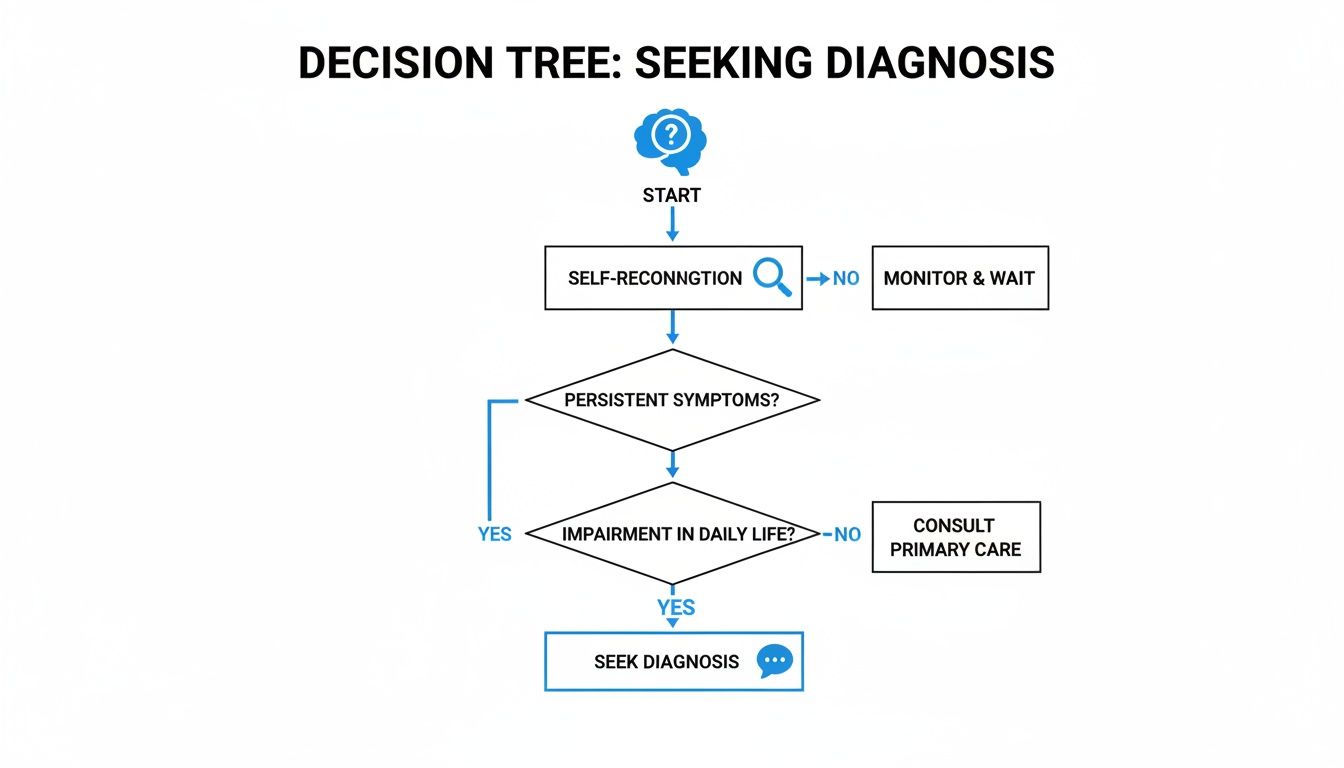
As you can see, the journey often starts long before you ever sit down with a doctor. It begins with your own research and self-reflection.
The NHS Pathway Explained
For most people in the UK, the NHS is the natural starting point. The process kicks off with a visit to your GP, who essentially acts as the gatekeeper for specialist services. You'll need to go in prepared to explain why you think you might be autistic, sharing real-life examples of how certain traits have affected you throughout your life.
If your GP agrees an assessment is the right next step, they'll refer you to the local NHS autism assessment service. And this is where you hit the biggest hurdle on the NHS route: the waiting times.
Right now, England is dealing with a monumental backlog. The latest figures show that over 204,000 people are on the waiting list for an autism assessment. What’s more, a shocking 89% of them have been waiting for longer than the recommended 13 weeks. This isn't just a small delay; it's a system under immense strain from a massive surge in demand.
While the NHS provides an essential service that's free at the point of care, the reality for many adults is a wait that can stretch from many months into several years. Living in that limbo, waiting for answers while you're already struggling with your mental health and potential ADHD, can take a heavy toll.
The Private Pathway Alternative
If the thought of waiting years is simply unbearable, the private sector offers a much faster route. With a private adult autism diagnosis, you can usually refer yourself directly, cutting out the need for a GP referral altogether. This puts you much more in control of the process. You can choose a specific clinic or even a specialist known for their expertise in adult autism, especially if you suspect co-occurring conditions like ADHD.
The main draws of going private are speed and efficiency. You can often be seen and assessed within a few weeks, not years. The catch, of course, is the cost. It's a significant financial commitment and a barrier for many people. A full, high-quality private assessment can run into thousands of pounds. If you're considering this option, it’s a good idea to look into what a private psychiatric assessment involves to get a clear picture of the process and costs.
Making Your Decision: A Side-by-Side Comparison
Weighing up the NHS versus a private assessment means balancing some really important factors. To help make things clearer, let's break down the key differences in a simple table.
Comparing NHS and Private Autism Diagnosis Pathways
| Factor | NHS Pathway | Private Pathway |
|---|---|---|
| Cost | Free at the point of use. | A significant financial investment, often costing £1,500 – £3,000+. |
| Waiting Times | Extremely long; often 1-5 years, sometimes longer. | Much shorter; typically a matter of weeks to a few months. |
| Referral Process | Requires a GP referral, which can sometimes be difficult to secure. | Most clinics allow for self-referral, giving you direct access. |
| Choice of Provider | You are referred to your local NHS service; there is no choice of clinician. | You have full choice over the clinic and specialist you see. |
| Recognition | The diagnosis is universally accepted by the NHS, employers, and education. | A good-quality, NICE-compliant report is widely accepted, but some NHS services may not accept it for follow-up care. |
Ultimately, both routes are designed to provide a thorough, professional evaluation that follows the national NICE (National Institute for Health and Care Excellence) guidelines. The fundamental trade-off really boils down to time versus money. You have to decide which of those resources you can afford to part with.
What to Expect During Your Autism Assessment
Walking into an autism assessment can feel hugely intimidating. For many, it’s the culmination of years, sometimes decades, of questioning and searching for answers. It’s natural to feel nervous, but it helps to know that a good assessment isn’t a cold, clinical test. It's more of a structured, deep conversation designed to build a complete picture of who you are and how you experience the world.
The whole point is to look back over your life, with an expert guide, to see if the consistent patterns and traits that define autism are there, and to understand how they may interact with ADHD or affect your mental health.
The process usually starts before you even speak to a clinician, with a set of screening forms. These questionnaires will ask about your current struggles, how you handle social situations, any sensory sensitivities, and the deep, passionate interests you might have. Think of these forms as the first chapter of your story – they give the clinical team the essential context they need before you dive in together.
The Developmental History Interview
After the initial paperwork, you get to the heart of the assessment: the developmental history interview. This is a really in-depth conversation that traces the thread of your life, from your earliest memories right up to today. Your clinician will ask about things like your first friendships, how you played as a child, your time at school, and your experiences in the workplace.
This journey back in time is absolutely crucial. Autism is a lifelong neurodevelopmental condition, which means the traits have been part of you since you were very young, even if nobody recognised them at the time. Talking through your childhood helps the specialist separate autistic traits from things that might have come along later, like anxiety, depression, or the exhaustion of burnout.
For instance, struggling to make eye contact since you were a toddler tells a very different story from developing social anxiety in your twenties after a bad experience at work. The developmental history connects all those dots.
A key goal of the assessment is to understand your unique internal experience. It’s not just about what you do, but why you do it. For instance, do you prefer routine because it's comforting and predictable (an autistic trait), or because you fear something bad will happen if you deviate (often related to anxiety)? This helps differentiate between autism, ADHD, and mental health conditions.
Clinical Observation and Standardised Tools
While your own account of your life is the most important piece of the puzzle, clinicians also use standardised tools to structure their evaluation. One of the most common you’ll hear about is the Autism Diagnostic Observation Schedule, Second Edition (ADOS-2). This is a semi-structured assessment where the clinician guides you through different activities and topics of conversation.
It’s designed to create natural opportunities for social interaction, but it’s absolutely not a pass-or-fail test. It’s simply a way for the specialist to observe your communication style, your use of non-verbal cues, and your thought processes in a supportive, real-time setting. This gives them objective evidence to sit alongside the life history you’ve shared. The whole process, including the specific tools used, forms part of a robust psychiatric assessment. To get a better sense of the thoroughness involved, you can learn more about what a full psychiatric assessment covers.
The Role of an Informant
To get the most complete picture possible, it’s often really helpful to involve someone who knows you well. This could be a partner, parent, sibling, or a close friend who has known you for a long time. This person, sometimes called an "informant," can offer an outside perspective on your traits and history.
Their input can be invaluable for a few reasons:
- Childhood Memories: They might remember details from your early years that you’ve forgotten.
- Objective Observation: They can describe behaviours or habits that you might not even realise you do.
- Corroboration: Hearing their experiences can help confirm that certain traits have been present throughout your life.
For many adults, especially those who have spent a lifetime "masking" or trying to fit in, having someone else share their observations can shine a light on challenges that aren't always visible from the outside.
Modern Online Assessments
In the last few years, high-quality online assessments have become a trusted and much more accessible route for adult autism diagnosis in the UK. These aren't just simple online quizzes; they are full clinical evaluations carried out by specialist psychiatrists and psychologists over secure video calls.
A properly conducted online assessment follows the exact same NICE guidelines as an in-person one. It will still include the deep dive into your developmental history, clinical observation, and the use of standardised tools. The diagnosis is just as rigorous and valid. For many, this approach is a game-changer, removing the stress and sensory overload that can come with travelling to an unfamiliar clinic.
How to Prepare for Your Assessment Session
Walking into an adult autism assessment can feel daunting, but a bit of preparation can make all the difference. It shifts the experience from something that feels stressful into an opportunity for you to be truly heard. The idea isn't to "pass a test," but to give the clinician an honest and clear window into your world, including how autism, ADHD, and your mental health intersect.
By organising your thoughts beforehand, you make sure that the key details of your life don't get lost in the moment. Many adults worry that a lifetime of 'masking' will hide their real challenges, or that the anxiety of the day will make their minds go blank. Getting your evidence in order provides a solid foundation for the conversation, helping the clinician see the real you.

Gathering Your Experiences
The most valuable thing you can bring to an assessment is your own story. Clinicians are looking for patterns of experience that stretch all the way back to childhood. A great way to start is by jotting down notes, focusing on the themes that have shown up again and again in your life, not just one-off incidents.
It can be helpful to map out a rough timeline, noting big life events and how you felt or coped at the time. Try to think about a few different areas:
- Social and Communication: How has making or keeping friends been for you? Is small talk a complete minefield? Do you prefer deep conversations with one person over big groups?
- Sensory Sensitivities: Are you overwhelmed by bright supermarket lights, loud cafés, or the feel of certain fabrics? Do you find comfort in specific sensory inputs, like a weighted blanket or repetitive movements (stimming)?
- Intense Interests: Think about the hobbies and topics that have completely absorbed you over the years. What’s important is their intensity and the focus they give you.
- Need for Routine: How do you feel when plans change at the last minute? Do you rely on having a predictable structure to your day to keep anxiety at bay?
Remember, this isn’t just about listing difficulties. It’s about building a complete picture of who you are. Note how ADHD traits (like impulsivity or trouble focusing) might interact with your autistic need for structure, and how this combination has impacted your mental health.
Collecting Supporting Documents
On top of your own reflections, having some paperwork from your past can be incredibly powerful. These documents can offer a more objective look at what you were like as a child, often before you became skilled at masking your traits.
See if you can dig out things like:
- Old School Reports: Teacher comments can be a goldmine. Look for phrases like "a daydreamer," "very quiet," "in a world of their own," or notes about you struggling with group activities even if you were academically bright.
- Childhood Journals or Diaries: Your own words from the past can be a direct line to your younger self's thoughts, worries, and social experiences.
- Medical or Mental Health Records: If you've ever been assessed for anxiety, depression, or ADHD, those reports provide crucial context for the clinician.
- Emails or Letters: Old correspondence might hold clues about communication differences or social misunderstandings you’ve experienced.
Pulling this information together helps build a really solid history. As you learn more about how to get tested for autism, you’ll get a clearer sense of what information is most useful. The more you can provide, the easier it is for the clinician to see the full picture, leading to a thorough and accurate assessment.
Life After Diagnosis: Understanding Your Report and What Comes Next
Getting your diagnostic report is a huge moment. It's more than just a piece of paper; it’s a new way of understanding a lifetime of experiences. Think of it as the starting point for building a life that genuinely works for you. The formal diagnosis itself, usually based on criteria from the DSM-5 or ICD-11, provides the clinical foundation, but the real value is in what comes next.
A good report won't just be a wall of clinical text. It will tell a story—your story—summarising your personal history, your unique strengths, and the challenges you've faced. Crucially, it should offer a set of personalised recommendations. This is the part that translates everything from theory into practice. It’s the bridge from asking, "Am I autistic?" to confidently saying, "I am autistic, and now I know how to find the right support."
Navigating Mental Health and Co-occurring Conditions
For many autistic adults, the journey to diagnosis is paved with struggles around mental health. It's very common to already have diagnoses like ADHD, anxiety, or depression. A thorough diagnostic report will acknowledge these overlaps and, importantly, explain how being autistic might influence your mental health.
For instance, what was previously just called 'generalised anxiety' might now be reframed as a completely understandable reaction to constant sensory overload or the exhaustion of masking. This shift in perspective is incredibly powerful. It moves the focus from just treating a symptom (the anxiety) to addressing the root cause (unmet autistic or ADHD needs). The goal isn't to change your neurotype, but to create strategies and environments that lessen the mental health burden.
This desire for clarity is a big reason why the number of people seeking an adult autism diagnosis in the UK has skyrocketed. The long-term trend is staggering. Between 1998 and 2018, autism diagnoses in the UK shot up by an explosive 787 per cent. That’s a near eight-fold increase, largely driven by adults who are finally getting the answers they've been searching for.
Finding the Right Support for You
The recommendations in your report are your personalised toolkit. Not every suggestion will be a perfect fit, and that’s okay—take your time exploring what feels right for you. The most important thing is that you now have a formal basis to access support that might have been out of reach before.
A diagnosis does not change who you are; it illuminates who you have always been. It empowers you to stop trying to fit into a world not designed for you and start advocating for the adjustments that allow you to thrive.
After getting your diagnosis, you might want to look into the various support options available, such as therapy for autism in the UK. There are many different avenues to explore:
- Peer Support Groups: Connecting with other autistic adults can be incredibly validating. There's nothing quite like sharing experiences in a safe, understanding space to reduce feelings of isolation and get practical, real-world advice.
- Specialist Coaching or Therapy: You could work with a therapist who truly understands neurodiversity. They can help you develop strategies for managing things like executive function (a common challenge in both autism and ADHD), sensory sensitivities, or navigating social communication.
- Self-Advocacy: Learning how to clearly and confidently communicate your needs is a vital skill. This could be anything from explaining your sensory needs to family to discussing workplace adjustments with your manager.
Practical Steps in the Workplace
One of the most immediate and tangible benefits of your diagnosis is in the workplace. Autism is recognised as a disability under the Equality Act 2010, which means you have a legal right to request "reasonable adjustments."
Your diagnostic report is the official document you need to start that conversation with your employer. Remember, these adjustments aren't about getting special treatment. They're about levelling the playing field so you can do your job to the best of your ability.
Common workplace adjustments include things like:
- Sensory Environment Changes: Getting permission to use noise-cancelling headphones, moving your desk to a quieter part of the office, or having harsh overhead lighting adjusted.
- Communication Preferences: Requesting instructions in writing instead of just verbally, or asking for agendas to be sent out before meetings so you can prepare.
- Flexible Working: Adjusting your start and finish times to avoid a chaotic commute, or having the option to work from home on certain days.
Your diagnosis is the key that unlocks these conversations, empowering you to build a working life that supports your well-being instead of draining it.
When You Need a Formal Report for Legal and Employment Matters
Your diagnostic report is a deeply personal and affirming document. But sometimes, you need something more formal – something that can stand up in a legal or professional setting. This is where a medico-legal report comes in. Think of it as a specialist psychiatric assessment, specifically designed to provide impartial, evidence-based documentation for situations involving solicitors, employers, or tribunals.
An adult autism diagnosis in the UK is rarely the whole story. Many of us are also navigating co-occurring conditions like ADHD or other mental health challenges. A good medico-legal report captures this complete picture, carefully explaining how these intersecting conditions affect your day-to-day life, your capacity to work, and your overall well-being.
What Makes a Report Court Compliant?
A standard diagnostic letter is great for confirming a diagnosis, but a court-compliant report is a different beast entirely. It’s built to be understood by people who aren't clinicians – think judges, HR managers, and solicitors. It swaps clinical jargon for clear, objective analysis.
This kind of report will usually:
- Provide a Detailed History: It lays out your entire developmental, personal, and psychiatric history to show a clear, lifelong pattern of autistic and/or ADHD traits.
- Offer an Expert Opinion: The psychiatrist gives a clear, professional opinion on your diagnosis and, crucially, how it affects you in the context of the legal or employment issue at hand.
- Establish Causation and Impact: It draws a direct line between your neurotype and specific difficulties you've faced, whether that’s discrimination at work or the psychological toll of an accident.
- Be Impartial and Evidence-Based: The report is a neutral, factual document. It’s based on a rigorous assessment and is designed to withstand scrutiny in a formal setting.
When a Medico-Legal Report is Necessary
These reports are vital when you need official, heavyweight documentation to secure fair treatment or the right accommodations. They provide the critical evidence needed to back up your case.
A medico-legal report translates your lived experience of autism, ADHD, or other mental health conditions into a formal language that legal and employment systems can understand and act upon. It provides the objective evidence needed to validate your needs and secure your rights.
You’ll likely need one for situations like:
- Employment Tribunals: To support a claim of disability discrimination or to formally request reasonable adjustments your employer has been hesitant to provide.
- Personal Injury Claims: To document the psychological fallout from an accident and explain how your neurodivergence has complicated or intensified the impact.
- Family Court Matters: To offer important context on how autism or ADHD might affect parenting styles or relationship dynamics.
- Court of Protection Proceedings: To provide an expert opinion on an individual's mental capacity in a way that respects their neurotype.
Getting through these complex situations requires specialist expertise. To understand more about how these reports are put together and what they can achieve, you can explore the details of a medico-legal consultancy service. This ensures the document you rely on is credible, robust, and fit for purpose.
Your Questions Answered: Navigating an Adult Autism Diagnosis
Working out the right path to an adult autism diagnosis in the UK can feel a bit like a maze. It’s natural to have a lot of questions, especially when trying to understand how autism fits in with other conditions like ADHD or anxiety.
Let's clear up some of the most common queries to help you move forward with more confidence.
Can I Be Autistic if I Already Have an ADHD or Anxiety Diagnosis?
Yes, absolutely. In fact, it's incredibly common for autism to exist alongside ADHD, anxiety, depression, and other mental health conditions. A good clinician knows this and will carry out a detailed assessment to see the whole picture, not just one part of it.
The aim isn't to swap one diagnosis for another. It's about understanding how all the different threads of your experience weave together. This is the only way to build a support plan that genuinely works for you, addressing your autistic traits and any other challenges you face.
A proper adult autism assessment should help you make sense of it all. It can explain how conditions like ADHD or anxiety interact with your autistic mind, giving you a clearer map for managing your overall wellbeing.
Is an Online Autism Assessment as Good as a Face-to-Face One?
When it’s done right, yes. A high-quality online assessment from a reputable, CQC-regulated service with experienced, GMC-registered psychiatrists is just as rigorous as an in-person one. They follow the same official NICE guidelines and use the same in-depth diagnostic tools and interview methods, all conducted over a secure video link.
The big advantage is accessibility. This modern approach opens up specialist services to people who might otherwise struggle, removing the stress and sensory overwhelm of travelling to an unfamiliar clinic. It means you can get top-quality diagnostic care, no matter where you live.
What if My GP Won't Refer Me for an NHS Assessment?
This is a really common and frustrating roadblock. The best way to tackle it is to go to your appointment fully prepared. Write down a clear list of your traits, and for each one, think of specific examples of how they've affected you throughout your life. It can also help to mention the official NICE guidelines for autism diagnosis in adults.
If your GP still says no, you are entitled to ask for a second opinion from another doctor at the same practice. Faced with long waits and these kinds of hurdles, this is often the point where many people decide to look into a private adult autism diagnosis in the UK to take back control and avoid more delays.
Will a Private Diagnosis be Recognised by My Employer or the NHS?
A diagnosis from a reputable private clinic that strictly follows NICE guidelines is a valid medical document and is generally well-respected. Under the Equality Act 2010, employers are legally required to consider making reasonable adjustments for any employee with a valid diagnosis, whether it’s from the NHS or a private provider.
While some specific NHS services might want to do their own assessment before providing certain types of follow-up care, a comprehensive private report gives you the official evidence needed for almost all forms of support and self-advocacy. It formally confirms your neurotype.
At Insight Diagnostics Global, we provide expert, CQC-regulated online assessments for adults seeking clarity about autism, ADHD, and their mental health. Our consultant-led team offers a thorough and compassionate process, delivering clear reports and personalised guidance to help you find your way forward. To find out more or to book an assessment, please visit us at https://insightdiagnostics.co.uk.