The journey to an adult neurodevelopmental assessment often begins quietly, with a question you can't quite shake: 'Could I be autistic?' or 'Could I have ADHD?' If you're a UK adult asking this, you're not alone. Perhaps your child was recently diagnosed, and their experience felt uncannily familiar. Or maybe you stumbled across a video online that described your entire life with startling accuracy.
For many, this isn't about finding a label. It's about finding a framework—a way to finally make sense of a lifetime of feeling just a little out of sync with the world around you.
Why More Adults Are Asking "Am I Autistic or Do I Have ADHD?"
The path to an autism or ADHD diagnosis as an adult is rarely a straight line. It usually comes after years of trying to navigate a world that doesn't always feel built for you, without really knowing why. This quiet internal questioning is happening more and more, largely because we finally have the language and public awareness to talk about neurodiversity openly.
What often triggers this realisation? It can be anything. A common one is when a child goes through an assessment for autism or ADHD, and the parent sees themselves reflected in the diagnostic criteria. For others, it’s that lightbulb moment of seeing content from other neurodivergent adults and thinking, "that's me."
Lifting the Lid on a Lifetime of Masking
So, why does this realisation so often come later in life? For autism in particular, a huge part of the answer is masking. It’s also known as camouflaging, and it's the often subconscious process of hiding your natural autistic traits to fit in. This might mean forcing eye contact even when it feels uncomfortable, suppressing the urge to stim, or carefully rehearsing scripts for social situations.
Think of masking like being a fluent speaker of a second language. You can get by perfectly well, but you're constantly translating in your head. It’s draining, and it means the real you – and your real needs – stay hidden.
This level of effort is utterly exhausting. It’s also incredibly effective at hiding autistic traits from parents, teachers, and even doctors, which is why so many slip through the net as children. Getting a diagnosis in adulthood is often the first time those hidden struggles are truly seen and validated.
The Strong Connection Between Autism and ADHD
It's impossible to talk about adult autism diagnosis without mentioning ADHD. The two neurodevelopmental conditions are closely linked, with a huge number of people having traits of both. This significant overlap, known as co-occurrence, can make trying to figure things out on your own feel confusing.
Because of this, many specialist clinics now assess for both conditions at the same time. This integrated approach gives you a complete picture of your neurotype and ensures that any support you get is right for all of you. The fact is, a staggering number of adults are still without a diagnosis. A review by King's College London estimated that between 89% and 97% of autistic adults over 40 in the UK could be undiagnosed, simply because the signs weren't recognised years ago. You can read more about the research into undiagnosed autistic adults.
Navigating Your Diagnostic Options: NHS vs. Private
Deciding to get an autism or ADHD diagnosis as an adult is a huge step. Your next big decision is how to go about it. In the UK, you’ve got two main paths: the National Health Service (NHS) or going private. Getting to grips with the pros and cons of each is vital for figuring out what’s right for you, your budget, and how quickly you need answers.
Many people start this journey after a lightbulb moment – maybe their child gets diagnosed, or they stumble across a video that feels a bit too relatable. This is often the spark that leads them to explore their options more formally.
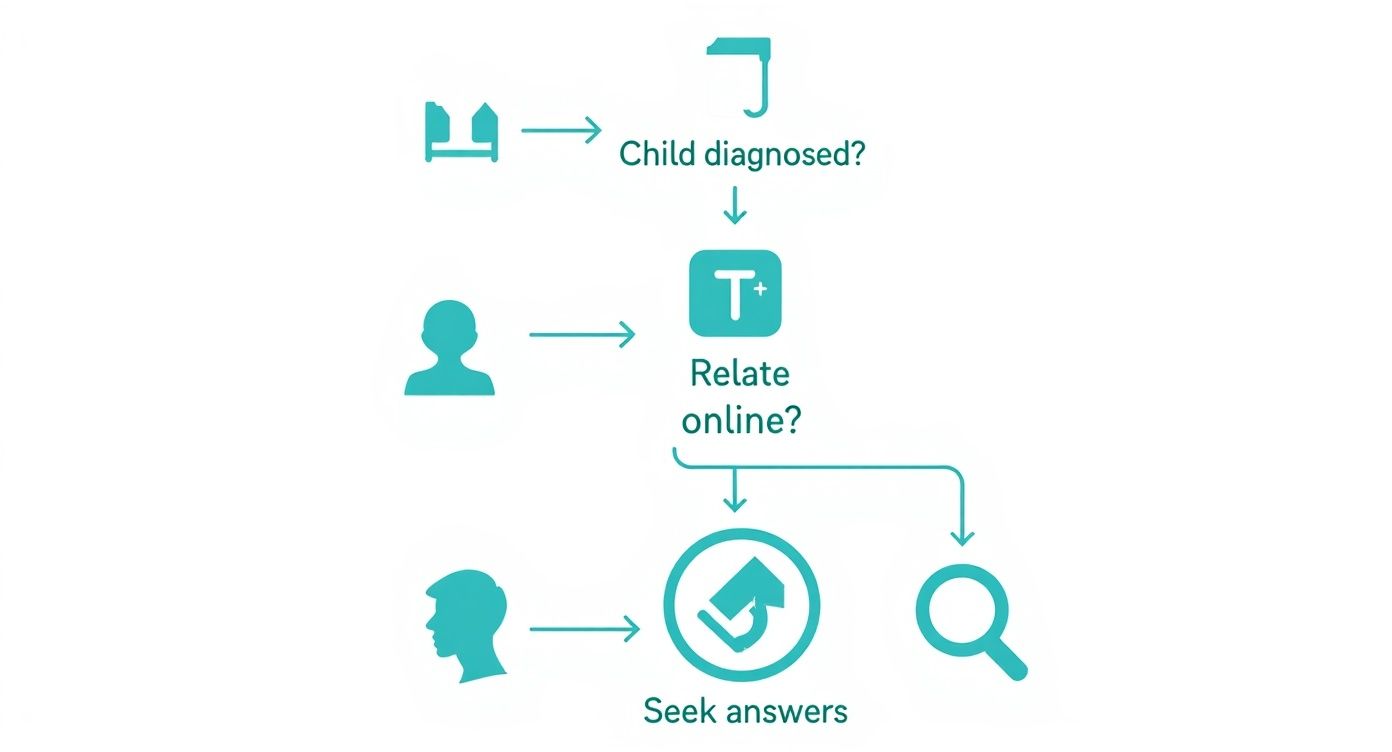
As the infographic shows, the path to a diagnosis isn't always linear. It often starts with a personal realisation, pushing you towards the more structured routes of either the NHS or a private assessment.
Let's break down what each of those journeys actually looks like.
The NHS Pathway Explained
For most, the NHS is the natural first port of call. On paper, the process is simple, but in reality, it's often a test of endurance.
It all starts with your GP. You'll need to book an appointment to talk through why you think you might be autistic or have ADHD. Your doctor will probably ask you to fill out a short screening tool, like the AQ-10 for autism or the ASRS for ADHD, to get a better sense of your traits.
If your GP agrees an assessment seems like the right next step, they’ll refer you to the local specialist neurodevelopmental team. And this is where the long wait usually begins.
NHS waiting lists for adult autism and ADHD assessments are notoriously long. While official targets are in place, it’s not unusual for people to wait two years or even longer from that initial GP referral to their first proper assessment. The uncertainty during this time can be incredibly challenging.
Once your name finally gets to the top of the list, you’ll be invited for a full, comprehensive assessment – all completely free of charge. The NHS route is rigorous and follows national standards, but it requires a huge amount of patience.
The Private Assessment Route
If waiting years just isn't an option, going private offers a much faster path. Here, you're in the driver's seat. You research and select a clinic or specialist yourself, get in touch directly, and schedule your assessment. The wait is often just a few weeks.
Of course, that speed comes with a hefty price tag. A private assessment for autism or a combined autism and ADHD assessment typically costs anywhere from £1,500 to over £3,000. The price often varies depending on the provider and whether you're being assessed for one or both conditions. It's a good idea to research the typical private ADHD assessment cost to get a realistic idea of the financial side.
A word of caution: if you go private, do your homework. Make absolutely sure the provider is reputable and their assessments follow the official NICE (National Institute for Health and Care Excellence) guidelines. A properly conducted diagnosis should be recognised by employers, universities, and sometimes even the NHS for post-diagnostic support.
A Hybrid Option: Right to Choose in England
For those in England, there’s a fantastic third option that many people don't know about: Right to Choose. This NHS legislation gives you the right to choose where you receive your assessment for conditions like ADHD and autism. This includes certain private providers that hold NHS contracts.
Essentially, if you qualify for an NHS referral, you can ask your GP to send it to one of these qualified providers instead of your local NHS service.
This route can dramatically cut your waiting time, giving you the speed of a private assessment but without the personal cost, as it’s funded by the NHS. It’s a brilliant bridge between the two traditional pathways, but it’s crucial to remember this is only available in England, and you'll need to find a provider that participates in the scheme.
NHS vs Private Adult Autism & ADHD Diagnosis: A UK Comparison
To make things clearer, it helps to see the key differences side-by-side. While both routes aim for the same outcome—a thorough and accurate assessment—the journey to get there is worlds apart. Think of it as choosing between a reliable, free bus service that has a long and unpredictable route, versus a private taxi that gets you there directly but at a significant cost.
Here's a breakdown of what to expect from each pathway:
| Factor | NHS Pathway | Private Pathway |
|---|---|---|
| Cost | Free at the point of use. | £1,500 – £3,000+. Often paid upfront. |
| Waiting Time | Extremely long, often 2+ years from GP referral. | Much shorter, typically a few weeks to a few months. |
| Referral Process | Requires a referral from your GP to a local NHS service. | Self-referral. You contact the clinic directly. |
| Choice of Provider | Limited. You are referred to your local commissioned service. | Full choice. You can research and select any provider. |
| Post-Diagnosis | Access to NHS-funded support services (though also with long waits). | Support is often an optional, paid-for extra. |
| Recognition | Universally recognised by all UK institutions. | Generally well-recognised if NICE-compliant, but can be variable. |
Ultimately, there is no single 'best' choice; there is only the best choice for you. Your decision will hinge on your personal circumstances, your finances, and how urgently you feel you need clarity and support.
What to Expect During Your Autism and ADHD Assessment
Walking into an assessment for autism and ADHD can feel a bit like preparing for an exam when you haven't been told the subject. It’s completely normal to feel a little anxious, but knowing what's involved can make a world of difference. The whole point isn't to test you or catch you out; it’s to build a detailed, authentic picture of who you are, right back to your earliest years.

A proper adult autism and ADHD assessment in the UK today is a deep and collaborative process. It weaves together structured conversations, in-depth questionnaires, and a good look at your personal history to really get to grips with your unique way of thinking and being. It's designed this way to make sure any final conclusion is both solid and genuinely helpful.
The Core Components of the Assessment
Think of the assessment less as a single appointment and more like putting together a complex jigsaw puzzle. Clinicians use a range of specialised tools and approaches to gather all the necessary pieces. These aren’t pass-fail tests; they're simply structured ways to explore your life experiences.
Generally, you can expect the process to involve a few key parts:
- Clinical and Developmental Interview: This is really the heart of the whole thing. It’s a comprehensive chat with a specialist about your life, from childhood memories right through to the challenges and strengths you experience day-to-day.
- Structured Observational Tools: For autism, clinicians often use formal assessment tools to observe social communication styles and other behaviours in a standardised way.
- Self-Report Questionnaires: You'll be asked to fill out forms about your own traits, experiences, and difficulties from your perspective.
- Informant Input: Someone who knows you well—like a partner, close friend, or parent—might be asked to complete a questionnaire or even join part of an interview to offer their perspective.
Unpacking the Diagnostic Tools
To make sure an assessment is up to scratch, clinicians use "gold standard" tools that are recognised by NICE guidelines. For autism, this often involves the Autism Diagnostic Observation Schedule, Second Edition (ADOS-2). This is a semi-structured assessment where you’ll do various activities and have conversations, which lets the clinician see your social communication and interaction styles in a consistent setting.
Another crucial tool is the Autism Diagnostic Interview-Revised (ADI-R). This is a very detailed, structured interview, usually with a parent or someone who knew you well as a young child (ideally before you were five). Its purpose is to build a thorough developmental history, which is essential for a diagnosis.
Think of these tools as different camera lenses. The ADOS-2 is like a high-resolution snapshot of how you interact in the moment. The ADI-R, on the other hand, is like digging into a historical photo album, giving the clinician a rich, detailed view of your entire developmental journey.
For ADHD, the process uses similar in-depth interviews and questionnaires. A widely used tool is the Diagnostic Interview for ADHD in Adults (DIVA). It’s a structured interview that methodically works through ADHD symptoms, checking for their presence in both your childhood and your adult life. This is key to establishing the persistent pattern that an ADHD diagnosis requires.
Differentiating Between Autism and ADHD
One of the trickiest parts of a combined assessment is carefully unpicking the traits of autism and ADHD, as they can often overlap. Things like executive function struggles, social burnout, and sensory sensitivities can be features of both. A good clinician will spend time exploring the 'why' behind your experiences.
For instance, are social difficulties down to missing non-verbal cues (often linked to autism), or is it more about being too distracted and impulsive to keep up with a conversation (more typical of ADHD)? The clinician's job is to spot these distinct underlying patterns. They’ll look for the core characteristics of each condition to determine if you meet the criteria for autism, ADHD, or both, ensuring your final report is an accurate reflection of you.
How to Prepare for Your Assessment
Getting an adult autism and ADHD diagnosis isn't like sitting an exam you can pass or fail. It’s a collaborative process. Think of it more like you and the clinician are building a detailed case file about your life. The more information and evidence you can bring to the table, the clearer the picture becomes for them.
Putting in some effort beforehand helps make sure your experiences are heard and understood properly, which ultimately leads to a more accurate and helpful outcome.

This prep work is all about piecing together a comprehensive developmental history. It allows the specialist to see the consistent patterns of traits and challenges that have been there throughout your life – a core part of the diagnostic criteria for both conditions. Walking into your assessment feeling organised and ready to share your story can make all the difference.
Document Your Lifelong Traits and Experiences
Your lived experience is the most powerful tool you have. The trouble is, when you're put on the spot in an assessment, it can be incredibly hard to recall specific examples from years ago. The trick is to start jotting everything down before your appointment.
Start a document and begin listing your experiences, maybe grouping them by diagnostic criteria for autism and ADHD. For every point you make, try to think of a concrete, real-world example from both your adult life and your childhood.
- Social and Communication (Autism): Do you mentally rehearse conversations? Is small talk just baffling or completely draining? Think back to the playground – did you always feel a bit out of sync with the other kids?
- Sensory Experiences (Autism/ADHD): Are you really sensitive to certain sounds, lights, or the texture of food? Do you find yourself seeking out specific sensory feelings, like the comfort of a heavy blanket? Did you cut the labels out of all your clothes as a kid?
- Repetitive Behaviours and Routines (Autism): Do you rely on specific routines to feel okay? Do you have incredibly deep interests you can talk about for hours (often called ‘special interests’)? As a child, did you have intense hobbies or a very particular way your toys had to be arranged?
- Executive Functioning (ADHD/Autism): Do you find it hard to organise tasks, manage time, or just get started on things? Do you struggle with inattention or hyperactivity? At school, were you labelled a "daydreamer," "disruptive," or told you were disorganised?
Gather Evidence from Your Past
Your own memories are vital, but having some objective evidence from your past can really strengthen your case. This helps the clinician build an unbiased picture of your early development, especially as our childhood memories can be a bit fuzzy.
Think of yourself as a historian of your own life. Old school reports are like historical artefacts; a single comment from a teacher like "struggles to work in groups" or "very knowledgeable on one topic but drifts off in others" can provide powerful, independent evidence of lifelong traits.
Don't panic if you don’t have much. Not everyone’s parents were hoarders! But it’s always worth asking if they kept anything. Old diaries, childhood medical notes, or even home videos can also be surprisingly helpful.
Involve Someone Who Knows You Well
Another crucial piece of the puzzle is getting the perspective of someone who has known you for a long time. In the assessment world, this person is sometimes called an 'informant', and their input provides a valuable outside view on your experiences.
This person could be:
- A Parent or Older Relative: They can offer priceless insights into your early years – developmental milestones, how you played as a toddler, and behaviours you might not even remember.
- A Long-Term Partner or Spouse: They see your day-to-day adult life up close, offering current examples of how your traits show up in relationships and at home.
- A Lifelong Friend: Someone who has been around since childhood can connect the dots, speaking to how you were then and how you are now.
Ask them to write down their own memories and observations before the assessment. This kind of preparation makes the whole process smoother and more thorough, ensuring everything is built on a solid foundation of evidence.
What to Do After Your Diagnosis: A Practical Guide
Getting your diagnostic report is a huge moment. For many people, it’s the first time a lifetime of confusing or difficult experiences finally clicks into place. This document is far more than a label—it's a personalised manual for your brain, offering validation for past struggles and a clear path forward.
That first read can stir up a lot of different feelings. It's completely normal to feel a wave of relief and validation. At the same time, you might also feel a sense of grief for the person you were, who had to get by without this crucial piece of self-knowledge. Be kind to yourself and allow space for all of it. There's no right or wrong way to react.
How to Make Sense of Your Diagnostic Report
Your report is a detailed clinical document, usually put together by the psychiatrist or psychologist who assessed you. While the layout might vary, they all tend to follow a similar structure. Essentially, it summarises all the evidence and explains how it lines up with the diagnostic criteria for Autism Spectrum Disorder (ASD) and/or ADHD, referencing frameworks like the DSM-5 or ICD-11.
You can expect to find a few key sections:
- Background Information: A brief overview of your developmental, family, and medical history.
- Assessment Process: This part outlines which tools were used, like clinical interviews, observational assessments (such as the ADOS-2), and any questionnaires you completed.
- Diagnostic Formulation: This is the heart of the report. Here, the clinician connects the dots, explaining how your personal experiences and their observations meet the specific criteria for autism and/or ADHD.
- Recommendations: This is your action plan. It will suggest practical next steps, from workplace adjustments and therapy options to medication for ADHD and other support services.
Getting Support at Work and in Education
A formal diagnosis is your key to unlocking legal protections and practical support, whether you're working or studying. In the UK, autism and ADHD are recognised as disabilities under the Equality Act 2010. This puts a legal duty on employers and educational institutions to make reasonable adjustments for you.
To get this support, you'll need to disclose your diagnosis. Sharing your report, or even just a summary letter from your clinician, is the proof they need to start putting things in place.
Reasonable adjustments aren’t about getting an unfair advantage; they’re about creating a level playing field so you can thrive. This could be as simple as getting noise-cancelling headphones for a noisy office, receiving instructions in writing, or being offered flexible hours to help manage your energy.
This support is absolutely vital. We know that more than 1 in 100 people in the UK are autistic—that’s over 700,000 individuals. Yet, staggeringly, only about 30% of autistic adults are in any form of paid work, one of the lowest employment rates for any disability group.
The Emotional Journey and Finding Your People
The time after a diagnosis is often a period of rediscovery. It’s a chance to look back on your life with a new understanding, finally making sense of why some things have always felt so hard while also recognising strengths you might have previously dismissed.
One of the most powerful things you can do is connect with other neurodivergent people. Finding your community, whether in a local group or an online forum, means finding a space where you don't have to constantly explain yourself. You can share stories and get real-world advice from people who just get it.
Your report might also recommend specific therapies. Cognitive Behavioural Therapy (CBT) can be adapted to help with anxiety, and specialist coaching can provide brilliant strategies for tackling executive function challenges. For those with a dual diagnosis, ADHD medication might be an option. If that’s on the cards for you, it’s worth looking into the cost of ADHD medications to help you plan.
Ultimately, your diagnosis is the starting point. It empowers you to begin building a life that genuinely works for you, not against you.
Common Questions About Adult Autism & ADHD Diagnosis in the UK
Taking the first steps toward an adult neurodevelopmental diagnosis can bring up a lot of questions. As you get closer to the process, it’s completely normal for practical worries and specific concerns to surface. Here, we'll tackle some of the most common queries we hear from adults who are thinking about, or already navigating, an assessment.
Our aim is to give you clear, straightforward answers to help you feel more prepared and confident about what comes next.
Can I Get a Diagnosis Without Childhood Evidence?
Yes, you absolutely can. While old school reports or home videos can be helpful, they are definitely not a requirement for an autism diagnosis in adults UK or an ADHD diagnosis. Skilled clinicians know how to build a rich picture of your developmental history through in-depth interviews with you.
Your own memories and experiences, sometimes backed up by conversations with a close family member or a friend who has known you for a long time, are often more than enough. A good diagnostician understands that not everyone has a box of old documents in the attic and can make an accurate assessment based on your life as you've lived it.
Will a Private Diagnosis Be Recognised by My GP and Employer?
In short, a diagnosis from a reputable private clinic that adheres strictly to NICE (National Institute for Health and Care Excellence) guidelines should be recognised. Legally, the Equality Act 2010 obliges employers to consider making reasonable adjustments for you based on any formal, professionally conducted diagnosis.
When it comes to local NHS services, acceptance for things like post-diagnostic support or shared care agreements for ADHD medication can sometimes vary from one trust to another. The best way to avoid any hitches is to check that your chosen private provider conducts fully NICE-compliant assessments before you commit.
The key is credibility. A robust, well-documented report from a qualified specialist is difficult for any official body to ignore. It provides the necessary evidence of your needs and legal entitlements.
How Is a Combined Autism and ADHD Assessment Different?
A combined assessment is a specialist process designed to carefully untangle the often overlapping traits of autism and ADHD. It’s not uncommon for people to have both. A clinician experienced in neurodiversity will use targeted diagnostic tools and very specific questions to determine if you meet the full criteria for Autism Spectrum Disorder, ADHD, or both.
They’ll be looking for distinct patterns relating to:
- For Autism: Core challenges with social communication and interaction, alongside restricted interests or repetitive behaviours.
- For ADHD: A persistent pattern of inattention and/or hyperactivity-impulsivity that gets in the way of daily life.
This detailed approach ensures the final picture is clear and accurately reflects your unique neurotype. Getting this clarity is vital, especially when you start thinking about support strategies. While some approaches overlap, you might want to learn more about how to manage ADHD without medication as part of a plan that’s built just for you.
Is a Diagnosis Still Worth It if I Am Managing Well?
This is a really personal question, and there’s no single right answer. For many adults who feel they are ‘managing’ on the surface, a diagnosis brings a profound, often life-changing sense of self-understanding. It’s not about fixing something that’s broken; think of it as finally getting the right user manual for your brain.
This new perspective can reframe a lifetime of challenges, help you let go of self-blame, and connect you with a supportive community. It gives you the power to build a life that truly accommodates your needs, which can massively improve your wellbeing, even if you don't feel like you're in crisis.
At Insight Diagnostics Global, we provide CQC-regulated, NICE-compliant online assessments for adults seeking clarity. Our consultant-led team of GMC-registered psychiatrists offers comprehensive evaluations for both Autism and ADHD, delivering clear reports and actionable next steps. If you're ready to find answers, explore our services at https://insightdiagnostics.co.uk.