
The key to telling autism and social anxiety apart really comes down to the why behind the social difficulties. At its heart, autism is a lifelong neurodevelopmental difference. It shapes how a person communicates, experiences the world through their senses, and interacts socially from day one. Social anxiety, on the other hand, is a mental health condition driven by a persistent fear of negative judgment from other people. Getting this core distinction right is absolutely vital for a correct diagnosis and, more importantly, for finding the right kind of support.
Untangling the Overlap Between Autism, ADHD, and Mental Health
Trying to navigate social situations can feel utterly exhausting, but figuring out the root cause of the struggle is the first crucial step. For many adults here in the UK, the lines between Autism Spectrum Disorder (ASD), Attention-Deficit/Hyperactivity Disorder (ADHD), and Social Anxiety Disorder (SAD) can feel incredibly blurry, often leading to a great deal of confusion and, unfortunately, misdiagnosis.
On the surface, these conditions can look quite similar. Someone with any of them might avoid social gatherings or find interactions completely draining. The internal experience, however, is a world apart. An autistic person might skip a party because the loud music and flashing lights are a sensory nightmare. Someone with social anxiety avoids that same party because they're terrified of being judged. And a person with ADHD might avoid it because the effort of focusing on multiple conversations feels overwhelming, or they fear impulsively saying the wrong thing.
Key Foundational Differences
It's so important to distinguish between a unique neurodevelopmental profile and a fear-based mental health condition. Things get even more complex because it's not uncommon for autistic and ADHD individuals to develop social anxiety as a secondary condition, often after a lifetime of social misunderstandings and negative experiences. If you'd like a more thorough grounding in the core characteristics of autism, you can learn more about what Autism Spectrum Disorder is in adults in our detailed guide.
The core question isn't if someone struggles socially, but why. Is the difficulty rooted in a different way of processing the world (autism/ADHD), or an intense fear of how the world perceives them (social anxiety)?
In this guide, we'll dive deep into the nuances separating autism, ADHD, and social anxiety. We’ll look at everything from the core symptoms and diagnostic criteria to how co-occurring conditions can change the picture. This table offers a quick snapshot of the primary distinctions we'll explore.
| Characteristic | Autism Spectrum Disorder (ASD) | Social Anxiety Disorder (SAD) |
|---|---|---|
| Primary Nature | A lifelong neurodevelopmental condition affecting communication, sensory processing, and behaviour. | A mental health condition defined by an intense fear of social scrutiny and judgment. |
| Origin of Social Avoidance | Typically stems from sensory overload, difficulty reading social cues, or sheer cognitive exhaustion. | Driven by a fear of embarrassment, rejection, or being negatively evaluated by others. |
| Onset | Traits are present from early childhood, though they might not be recognised until adulthood. | Can develop at any time but often emerges during the teenage years. |
| Core Motivation | Social motivation can vary; the challenge is often in the "how" of social interaction, not the "want." | A strong desire for connection is usually there, but it's blocked by overwhelming fear. |
Defining Autism and Social Anxiety Disorder
Before we can untangle the threads of autism and social anxiety, we need to get to grips with what they actually are. On the surface, they can look similar, but their roots are in completely different places. This is crucial because neurodevelopmental conditions like autism and ADHD require different support strategies than mental health conditions like anxiety.
Autism Spectrum Disorder (ASD) is a lifelong neurodevelopmental condition. This simply means it’s a difference in brain development that starts early in life, shaping how a person experiences and interacts with the world around them. It’s not a mental illness you can cure; it’s a fundamental part of who someone is.
On the other hand, Social Anxiety Disorder (SAD)—sometimes called social phobia—is an anxiety disorder. It’s a mental health condition driven by an intense, persistent fear of being watched, judged, or publicly humiliated. This fear can be so powerful that it makes people avoid social situations altogether.
What is Autism Spectrum Disorder?
At its heart, autism involves a different way of experiencing the world, which typically shows up in two main areas. The first is social communication and interaction. For autistic people, this isn't about not wanting to connect with others; it's more about the immense effort required to decipher and navigate social rules that don't come naturally.
The second core feature is the presence of restricted or repetitive patterns of behaviour, interests, or activities. This can look like a few different things:
- Stimming: Repetitive movements or sounds, like rocking or humming, that help a person manage their senses or emotions.
- Intense Interests: A deep, passionate focus on specific topics, which can bring a lot of joy and lead to incredible expertise.
- Sensory Sensitivities: Being over- or under-sensitive to things like bright lights, loud noises, certain textures, or smells.
- A Need for Routine: A strong reliance on predictability. Unexpected changes can be genuinely distressing because they disrupt a sense of safety and order.
For an autism diagnosis, these characteristics must have been present since early childhood, even if they weren’t properly understood or identified until much later in life.
What is Social Anxiety Disorder?
Social Anxiety Disorder is all about a crippling fear of social situations where you feel you might do something embarrassing or be judged negatively. It's the fear that you’ll act in a way—or show signs of anxiety—that will lead to humiliation. This is far more than just being a bit shy; it’s a deep-seated mental health struggle that can get in the way of work, school, and forming relationships.
The anxiety felt is usually completely out of proportion to the actual risk in the situation. To be diagnosed, this fear and avoidance has to be persistent, typically lasting for six months or more, and cause real problems in a person's daily life. And unlike autism, social anxiety can start at any time, though it very often first appears in the teenage years.
A great way to think about the difference is to ask: where is the exhaustion coming from? For an autistic person, it's the mental effort of translating social cues. For someone with ADHD, it's regulating attention and impulses. For someone with social anxiety, it's the relentless fear of judgment.
To lay it out clearly, let's look at the core definitions side-by-side.
Core Definitions: Autism vs Social Anxiety
| Characteristic | Autism Spectrum Disorder (ASD) | Social Anxiety Disorder (SAD) |
|---|---|---|
| Classification | Neurodevelopmental Condition | Anxiety Disorder (Mental Health Condition) |
| Core Nature | A difference in brain development affecting lifelong social processing and behaviour. | An intense, fear-based response to potential social scrutiny and negative evaluation. |
| Primary Focus | Challenges with social communication mechanics, sensory processing, and repetitive behaviours. | Overwhelming fear of humiliation, embarrassment, or rejection in social settings. |
| Typical Onset | Present from early childhood, though may be identified later in life. | Often emerges in adolescence but can develop at any age. |
This table shows that while both can make socialising hard, their underlying structures are completely different. Autism is a developmental difference in a person's neurological "wiring," whereas social anxiety is a fear-based mental health response.
Comparing Overlapping and Distinct Symptoms
To really tell the difference between autism, ADHD, and social anxiety, you have to look beyond the surface behaviours and ask a simple question: why? The internal reason behind an action is what truly separates them. So many traits can look identical on the outside, but their roots are completely different, and this distinction is vital for finding support that actually works.
Take avoiding eye contact—a classic example. For someone with social anxiety, this is almost always a reaction to the fear of being judged. But for an autistic person, it’s often about sensory management; direct gaze can feel overwhelming. For a person with ADHD, they might struggle with eye contact because their attention is constantly shifting, not out of fear or sensory distress.
The Nuances of Social Motivation
One of the biggest areas of confusion is social motivation. It's a myth that autistic people don't want friends. Many absolutely do, but they find the 'how' of social interaction baffling or exhausting. They might struggle to navigate the unwritten rules, feeling like everyone else got a social rulebook they never received.
On the other hand, an adult with social anxiety disorder usually understands social norms perfectly well. The desire for connection is there, but it's completely hijacked by a powerful fear of the interaction itself. People with ADHD also desire connection, but may struggle due to impulsivity or difficulty following conversational threads, which can lead to social rejection and, eventually, anxiety.
Key Differentiator: In autism, the social challenge is a 'how-to' problem. In ADHD, it's often an 'executive function' problem (attention, impulsivity). For social anxiety, it’s a paralysing 'what-if' fear about the outcome.
This core difference creates a ripple effect. An autistic person might talk at length about a special interest, not picking up on cues that the other person is bored. Someone with ADHD might interrupt or change topics abruptly. A person with social anxiety is far more likely to stay quiet, constantly second-guessing everything they say for fear of boring or offending someone.
Communication Styles and Cognitive Processing
The way someone processes and communicates information is another huge clue. Autistic people often have a very literal and direct communication style. Sarcasm and hints can go straight over their heads. This is a fundamental difference in cognitive processing, not an unwillingness to engage.
In contrast, a person with social anxiety is often hyper-aware of social nuance. They might spend hours agonising over conversations—both before and after they happen—replaying every word. Their communication difficulty isn't about misunderstanding social rules; it's about being crippled by the fear of breaking them.
This diagram helps to visually lay out some of the core differences and similarities.
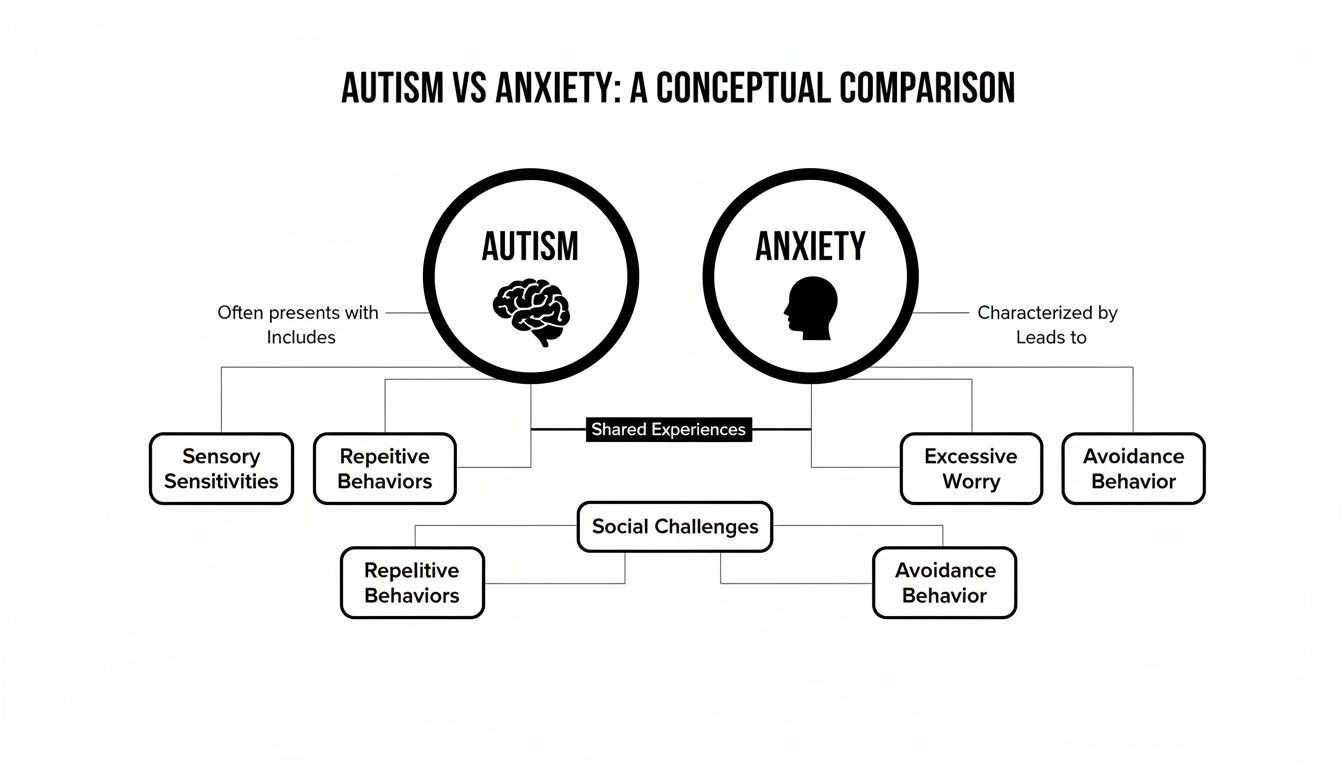
As the visual shows, while both conditions can make social situations difficult, autism stems from neurodevelopmental differences, whereas social anxiety is driven by patterns of fear and worry.
The Role of Special Interests and Routine
Routines and interests also serve very different functions. For autistic adults, special interests are a deep well of joy, comfort, and expertise. Diving into these topics is regulating and restorative. Likewise, routines create a predictable and safe structure. These aren't just preferences; they're an essential part of the autistic experience.
For someone with only social anxiety, this kind of intense, all-consuming interest isn't a core feature. And while they might stick to routines, it’s often a form of avoidance—like only going to the same quiet pub to avoid unpredictable social run-ins—rather than an innate need for structure. Individuals with ADHD can also have intense interests (hyperfocus), but they may shift topics more frequently than is typical in autism.
It’s shocking how often these symptoms are misinterpreted. The underdiagnosis of autism in middle-aged and older adults in the UK is a huge problem. A landmark review from King's College London found that 89% of 40-59-year-olds and a staggering 97% of those aged 60+ who are autistic remain undiagnosed. Many are mislabelled with mental health conditions like social anxiety, meaning they never get the right kind of support. You can read more about these autism diagnosis findings to understand the full scale of the issue.
Getting these distinctions right isn’t just a clinical exercise. It’s absolutely essential for self-understanding and for finding the right diagnostic path for your mental health.
How Clinicians Tell Autism and Social Anxiety Apart
Telling the difference between autism, ADHD, and social anxiety isn't as simple as running through a symptom checklist. It calls for a much deeper, more specialised look into a person's entire life story. A skilled clinician pieces together clues stretching all the way from early childhood right up to the present day.
The absolute cornerstone of this process is the developmental history. For an autism or ADHD diagnosis to be considered, clinicians need to see clear evidence that traits have been there since the very beginning. This lifelong pattern is what separates a neurotype from a mental health condition developed later.
Social anxiety, on the other hand, often crops up during the teenage years or later. It’s not something you’re born with. It’s a fear-based condition that typically develops over time. This difference in origin is one of the most fundamental distinctions a diagnostician makes.
The Assessment Toolkit
To get this right, clinicians use a whole range of tools and methods. There's no single test that gives a definitive answer; it's all about building a comprehensive, three-dimensional picture of the individual.
- Structured Clinical Interviews: These are in-depth conversations covering everything from early development and school experiences to current struggles. The questions are specifically designed to get to the why behind any social difficulties.
- Psychometric Tools and Questionnaires: Standardised tools like the Autism Diagnostic Observation Schedule (ADOS) for autism or the DIVA-5 for ADHD give clinicians a structured framework to observe and gather detailed historical information.
- Observational Data: Throughout the entire assessment, the clinician is carefully observing non-verbal communication, how language is used, and the way the person interacts within the assessment environment itself.
By combining these methods, an expert can start to untangle innate, neurological differences from learned, fear-based behaviours. If you want a more detailed look at how this all comes together, our guide on what to expect from a psychiatric assessment breaks it down further.
Co-occurrence and Getting the Right Diagnosis
Here’s where it gets particularly tricky: you can have both. It’s incredibly common for autistic people and those with ADHD to develop social anxiety. After years of social missteps, being misunderstood, or facing bullying, it’s almost a natural consequence to become anxious about social situations. This high rate of co-occurrence with mental health conditions is a key reason why a comprehensive assessment is so important.
A truly thorough assessment doesn't just hunt for one condition. The goal is to identify all co-occurring conditions, because an effective support plan for an autistic person who also has social anxiety looks vastly different from a plan for someone with social anxiety alone.
Trying to treat the social anxiety without recognising the underlying neurodivergence can be a waste of time, or even counterproductive. Pushing an autistic person into standard exposure therapy could be deeply distressing if the root cause of their discomfort is sensory overload, not a fear of being judged.
Unfortunately, getting this kind of specialist assessment is a massive hurdle. In the UK, the waiting lists for an autism and ADHD diagnosis have spiralled out of control, with over 204,000 people in England currently waiting for an autism assessment alone. This backlog means adults can be left in limbo for years, deepening their mental health struggles. Specialist services like Insight Diagnostics Global provide a vital alternative, offering consultant-led evaluations within seven working days.
Finding the Right Support and Management Strategies

Getting an accurate diagnosis is the critical first step towards finding support that actually works. When you're looking at autism versus social anxiety, the approaches to management are fundamentally different because they address completely separate root causes. One aims to manage a mental health condition rooted in fear, while the other focuses on adapting to a lifelong neurotype.
For social anxiety, the main goal is to dial down the intense fear of being judged. Evidence-based therapies like Cognitive Behavioural Therapy (CBT) work wonders here, helping people challenge anxious thoughts.
Support for an autistic or ADHD person, on the other hand, is never about a 'cure'. It’s all about developing skills and creating accommodations that help them navigate a world largely built for neurotypical people. It’s an approach centred on empowerment and adaptation, not on changing who a person is.
Tailoring Therapeutic Approaches
A misdiagnosis can lead to interventions that aren't just unhelpful but can be genuinely harmful. For instance, pushing an autistic individual into standard exposure therapy might completely miss the fact that their distress comes from sensory overload. This can lead to burnout and deeper mental health issues.
This is exactly why a person-centred plan is non-negotiable. For someone with social anxiety, effective therapy often involves:
- Gradual Exposure: Carefully facing feared social situations to lessen the anxiety response over time.
- Cognitive Restructuring: Learning to reframe distorted, negative thoughts about social judgement.
- Mindfulness Techniques: Building skills to manage the physical sensations of anxiety.
There are many great resources out there, including those for overcoming anxiety, which can be an essential part of the journey.
In contrast, support for an autistic or ADHD adult is much broader and often includes:
- Occupational Therapy: To develop practical strategies for managing sensory sensitivities (autism) or executive functions (ADHD).
- Communication Support: Helping individuals understand different communication styles and find effective ways to express their needs.
- Environmental Accommodations: Making real-world changes at work or home, like using noise-cancelling headphones or establishing a predictable daily routine.
The crucial difference is this: social anxiety support aims to change the fearful response, whereas autism/ADHD support aims to change the environment and provide tools to better navigate it.
Practical Support in Daily Life
The right support extends far beyond the therapy room. For an autistic person, managing co-occurring mental health conditions like anxiety is often a major focus, but it’s done with the crucial understanding that the anxiety is frequently a direct result of living with unaccommodated autistic traits. If you'd like to explore this further, you can learn about practical ways for how to support someone with autism in our detailed guide.
The following table really brings home how different the goals and methods are, highlighting why a correct diagnosis is so vital for effective long-term mental health.
Support Strategies for Autism vs Social Anxiety
| Support Area | Primary Approach for Autism | Primary Approach for Social Anxiety |
|---|---|---|
| Main Goal | To accommodate neurodivergent traits and reduce environmental stressors, enabling the person to thrive as they are. | To reduce the fear of negative social evaluation and decrease avoidance behaviours. |
| Therapeutic Focus | Skill-building for self-advocacy, emotional regulation, and managing sensory needs. Therapy is neuroaffirming. | Challenging anxious thought patterns and gradually building confidence in feared social settings through CBT and exposure. |
| Environmental Changes | Crucial. Focuses on modifying surroundings (e.g., dim lighting, quiet spaces) and creating predictable routines. | Secondary. May involve choosing less crowded venues at first, but the long-term goal is to function in varied environments. |
| Medication | No medication for core autistic traits. May be used for co-occurring conditions like anxiety, depression, or ADHD. | Antidepressants (SSRIs) or anti-anxiety medications are often effective in managing symptoms alongside therapy. |
Ultimately, getting clarity on whether someone's social challenges come from a deep-seated fear of judgement or from fundamental differences in how their brain processes the world is the key that unlocks the right kind of mental health support.
Getting Clarity: Your Next Steps
Trying to untangle the threads of social difficulties can be confusing and draining. If you’ve seen yourself in this discussion of autism, ADHD, and social anxiety, taking the next step towards getting a clear picture is a massive step forward for your mental health. A formal diagnosis can seem intimidating, but it empowers you to find the right specialist.
A proper diagnosis isn't just about getting a label. It’s about gaining a practical, working understanding of your own brain. This knowledge is the key to unlocking the right support, getting accommodations at work, and finally making sense of lifelong patterns. It’s a chance to stop trying to force yourself into a mould that doesn't fit and start building a life that works with who you are.
Red Flags: When to Consider an Autism Assessment
While social anxiety can be incredibly tough, certain lifelong patterns often hint at an underlying neurodevelopmental difference like autism or ADHD. If you're wondering if there’s more to your social challenges than anxiety alone, see if these experiences resonate with you.
It might be worth exploring a formal autism assessment if you have:
- A Lifelong History of Social Challenges: A feeling of being ‘different’ or struggling to connect that goes right back to childhood.
- Intense, Passionate Interests: You have deep, all-consuming interests that bring you a huge amount of joy and comfort.
- Significant Sensory Sensitivities: You're highly sensitive to noise, bright lights, certain textures, or smells.
- A Persistent Feeling of 'Masking': You've learned to consciously copy others' social behaviour to blend in, which leaves you feeling exhausted.
- Difficulty with Unspoken Social Rules: You often miss subtle social cues, take things very literally, or struggle to grasp sarcasm.
- A Strong Need for Routine and Predictability: Unexpected changes to your plans or daily rhythm cause a great deal of distress.
If this list feels strikingly familiar, it could be the right time to look into a diagnostic pathway. You can learn more about what this involves in our guide on how to get tested for autism.
Finding Specialist Diagnostic Services
The hard truth for many adults in the UK is that NHS waiting lists for autism and ADHD assessments can be incredibly long—often years. Living in this state of limbo can take a serious toll on your mental health, especially when you're not getting the right support for co-occurring conditions. This is where private, specialist services can provide a vital alternative.
An expert diagnostic process shouldn't feel like an interrogation. It should be a collaborative, empathetic journey led by a specialist who understands the nuanced presentation of autism and ADHD in adults, including in women and those who have become masters of masking.
When looking for a private assessment, it’s crucial to choose a reputable and regulated provider. A CQC-regulated service ensures the clinic meets national standards for quality and safety. Opting for a consultant-led online service also means you can access experienced psychiatrists from anywhere in the country.
The end result of a high-quality assessment is a comprehensive and detailed diagnostic report. This document is so much more than a diagnosis; think of it as a personalised user manual for your brain. It offers invaluable insights for self-understanding, serves as the evidence you need to access workplace accommodations under the Equality Act 2010, and points you towards mental health strategies that actually work.
At Insight Diagnostics Global, we provide a fully online, consultant-led mental health service for adults. Our CQC-regulated clinic, staffed by GMC-registered psychiatrists, delivers timely, empathetic, and thorough assessments for Autism, ADHD, and other mental health conditions, helping you find the clarity you deserve. https://insightdiagnostics.co.uk