
Starting the search for a specialist can feel overwhelming, especially when you need to find a psychiatrist for something as specific as an ADHD or Autism assessment. The journey through mental health support can seem complex, often forcing a choice between the NHS and private routes, each with its own timelines and hurdles. My goal here is to give you a clear, practical roadmap to navigate this process with confidence.
Why Finding a Psychiatrist Is So Challenging Right Now

If you’ve found accessing mental health support in the UK a real struggle, you’re certainly not alone. The demand for services, particularly for neurodevelopmental conditions like Autism and ADHD, has shot up, putting incredible pressure on an already stretched system. The unfortunate result is often long, frustrating waits for the specialised mental health assessments you need.
Getting a Grip on the Current Situation
The simple truth is that finding a psychiatrist in the UK has become harder because of a serious shortage in the mental health workforce. Since 2016, there's been a 21% increase in people reaching out for mental health support. The problem? With vacancy rates for doctors in NHS mental health services hovering at 10.5%, the supply of specialists just hasn't kept up.
This gap is precisely why NHS waiting lists can stretch for months, and in some cases, even years for conditions like autism spectrum disorder (ASD) and ADHD. If you want to dig deeper into these workforce issues, this evidence brief from the NHS lays out the data.
This reality forces many people to think hard about their options. The NHS provides a vital service, but the long waits simply aren't practical for everyone whose mental health is suffering now.
For many adults looking for a timely diagnosis for ADHD or Autism, private online clinics have become an essential alternative. They offer a way around the long waiting lists, providing a comprehensive assessment from a specialist much, much sooner.
NHS, Private Care, and Your Right to Choose
So, what are your options for mental health support? Your main routes to seeing a psychiatrist are through the NHS or by going private. The NHS is free, but private services give you faster access for a fee.
But there's also a third option that blends the two. It's worth looking into the Right to Choose pathway for an ADHD assessment. This can allow you to pick a CQC-regulated private provider for your assessment, with the cost covered by the NHS.
Getting to know all three of these routes is the very first step. It's how you'll make an informed decision that truly fits your personal circumstances and your mental health needs, particularly for an Autism or ADHD assessment.
So, you’ve decided to find a psychiatrist. Knowing where to start can feel like the biggest hurdle, but there are a few well-trodden paths that can lead you straight to a qualified professional, especially if you're looking for help with Adult ADHD or Autism.
Your GP is the traditional first port of call in the UK's healthcare system. A chat with them allows you to voice your mental health concerns, get an initial take on things, and secure a referral into the NHS mental health system. This route is a cornerstone of our healthcare, but it’s also where you can run into those long waiting lists for ADHD and Autism assessments.
If you want to take a more hands-on approach, you can go directly to the source: official professional registers. Think of these as the definitive directories for finding and vetting specialists on your own terms.
Tapping into Professional Directories
The General Medical Council (GMC) Specialist Register is your go-to. It's the official, comprehensive list of every doctor who is legally allowed to practise as a consultant in the UK. A quick search lets you instantly verify a psychiatrist's qualifications and confirm their specific area of expertise, such as adult ADHD. The Royal College of Psychiatrists also has a public directory, which is another fantastic tool for finding members near you.
It's also worth getting a feel for different treatment approaches, as some professionals specialise in certain areas. For instance, exploring topics like understanding when to consider Ketamine therapy for depression can give you a broader perspective on mental health treatments, especially for more complex situations. This kind of research helps you find someone whose methods feel right for you.
Using these registers puts you in the driver's seat. You can filter your search to find professionals who explicitly list adult ADHD and Autism as their specialisms, ensuring you’re connecting with someone who really gets the nuances of neurodiversity. If you want to dig a bit deeper into who can give a formal diagnosis, our guide on who diagnoses ADHD breaks it down further.
Exploring Private Clinics and Online Platforms
Looking beyond the official registers, you'll find a growing number of trusted private clinics and specialised online platforms focusing on mental health. These services are often the fastest way to get an appointment for an ADHD or Autism assessment, as they provide direct access to consultant-led teams, cutting out the need for a GP referral and slashing the waiting time.
When you start looking at these options, keep an eye out for a few key things:
- Consultant-led: This is non-negotiable. It means your assessment and treatment plan will be overseen by a senior psychiatrist who is on the GMC Specialist Register.
- Specialised in Neurodiversity: You want a clinic that lives and breathes adult ADHD and Autism. They’ll have assessment processes specifically designed for these conditions.
- Transparent: Their website should be crystal clear about their process, their fees, and the qualifications of every person on their clinical team. No smoke and mirrors.
Choosing a service that specialises in neurodevelopmental conditions is absolutely crucial. A general psychiatrist might have a textbook understanding, but a specialist will appreciate the subtle and complex ways ADHD or Autism can show up in adulthood. That deep, focused expertise makes all the difference in getting an accurate, empathetic assessment and the right mental health support.
How to Verify Credentials and Ensure Quality Care
So, you've got a shortlist of potential psychiatrists. What now? This next part is arguably the most important step for your own safety and peace of mind: doing a little bit of homework to confirm their credentials.
It’s not just about finding any psychiatrist; it's about finding a properly qualified and regulated professional you can trust with your mental health, especially for an Autism or ADHD diagnosis. Thankfully, this isn't as daunting as it sounds, and doing these quick checks will empower you to move forward with real confidence.
The Gold Standard: The GMC Specialist Register
The single most important check you can make is with the General Medical Council (GMC). Every single doctor practising in the UK has to be registered with them.
But for a consultant psychiatrist, there's an extra layer. They must also appear on the GMC's Specialist Register. This is your proof that they have completed years of rigorous, advanced training specifically in psychiatry and are legally recognised as a specialist.
It's really easy to check. Just head over to the GMC website and search for the doctor by name or their GMC number.
Here's what the search tool looks like on their site.
The results will confirm their status and, crucially, show you their entry on the Specialist Register, often listing their specific field, like 'General Psychiatry'. It’s a simple click that tells you everything you need to know about their core qualifications.
Why is this so vital? Well, the NHS mental health workforce grew by 23% between 2010 and 2023, but the number of consultant psychiatrists only rose by 22%. In that same period, the number of therapists and support staff jumped by 45%. While these professionals play a crucial role, only a doctor on the Specialist Register can provide a medical diagnosis for ADHD or Autism. You can explore these workforce statistics further here.
Checking Clinics: Look for CQC Regulation
If you're looking at a clinic or an online service rather than a solo practitioner, there's another key regulator to know: the Care Quality Commission (CQC).
Think of the CQC as the independent watchdog for all health and social care services in England.
When a clinic is CQC-regulated, it means they are inspected regularly to ensure they're meeting national standards for quality and safety. It's a sign that they take their responsibilities to patient mental health seriously. This includes:
- Safety: Are their practices set up to prevent avoidable harm?
- Effectiveness: Is the care they provide based on solid evidence?
- Responsiveness: Do they listen and adapt to the needs of their patients?
A clinic's CQC registration is a non-negotiable quality marker. It tells you they are held to a high standard for everything from their clinical procedures to how they handle your personal data, giving you a powerful layer of protection for your mental health journey.
By taking these two simple steps—checking the GMC Specialist Register for the individual psychiatrist and ensuring any clinic is CQC regulated—you can feel secure in your choice. This diligence is the foundation for a trustworthy and effective private psychiatric assessment, whether it's for ADHD, Autism, or any other mental health concern.
Comparing Online and In-Person Consultations
One of the biggest decisions you'll make is how you want to meet your psychiatrist. With telehealth becoming more common, you’re no longer limited to traditional face-to-face appointments. This is a huge shift, especially if you're looking for an ADHD or Autism assessment, and each option has its own clear pros and cons for your mental health journey.
Ultimately, the best choice really boils down to what suits your life and makes you feel most comfortable. For some, the formal structure of a clinic provides a sense of security. For others, the privacy and sheer convenience of an online meeting is a total game-changer.
The Case for Online Assessments
Online consultations have thrown the doors wide open for specialist mental health care. The biggest win? Convenience. When you don't have to worry about travel time or costs, it's so much easier to squeeze an appointment into a packed schedule. This is a lifesaver for busy professionals or parents juggling a million things at once.
There's another, more personal, advantage. If you deal with social anxiety or sensory sensitivities—which often go hand-in-hand with ADHD and Autism—the idea of a clinic can be incredibly stressful. Being in your own home, a space where you feel safe and in control, can significantly lower your anxiety. This often leads to a more open and productive conversation with your psychiatrist.
The comfort of your own home can't be overstated. It removes the stress of navigating a new environment, allowing you to focus entirely on the conversation with your specialist, which can lead to a more effective mental health assessment.
The Value of In-Person Meetings
Even with all the benefits of going online, there’s still a strong case for meeting in person. There's a different kind of connection you can build when you're in the same room. It gives the psychiatrist a chance to pick up on subtle, non-verbal cues that just don't translate as clearly over a video call, which can be important in an Autism assessment.
Some people also just function better with a clear boundary between home life and clinical appointments. The physical act of travelling to an office can help you mentally switch gears, creating a dedicated time and space to focus completely on your health without any distractions from work or family.
Regardless of which path you choose, the fundamentals of verifying a specialist's credentials remain the same.
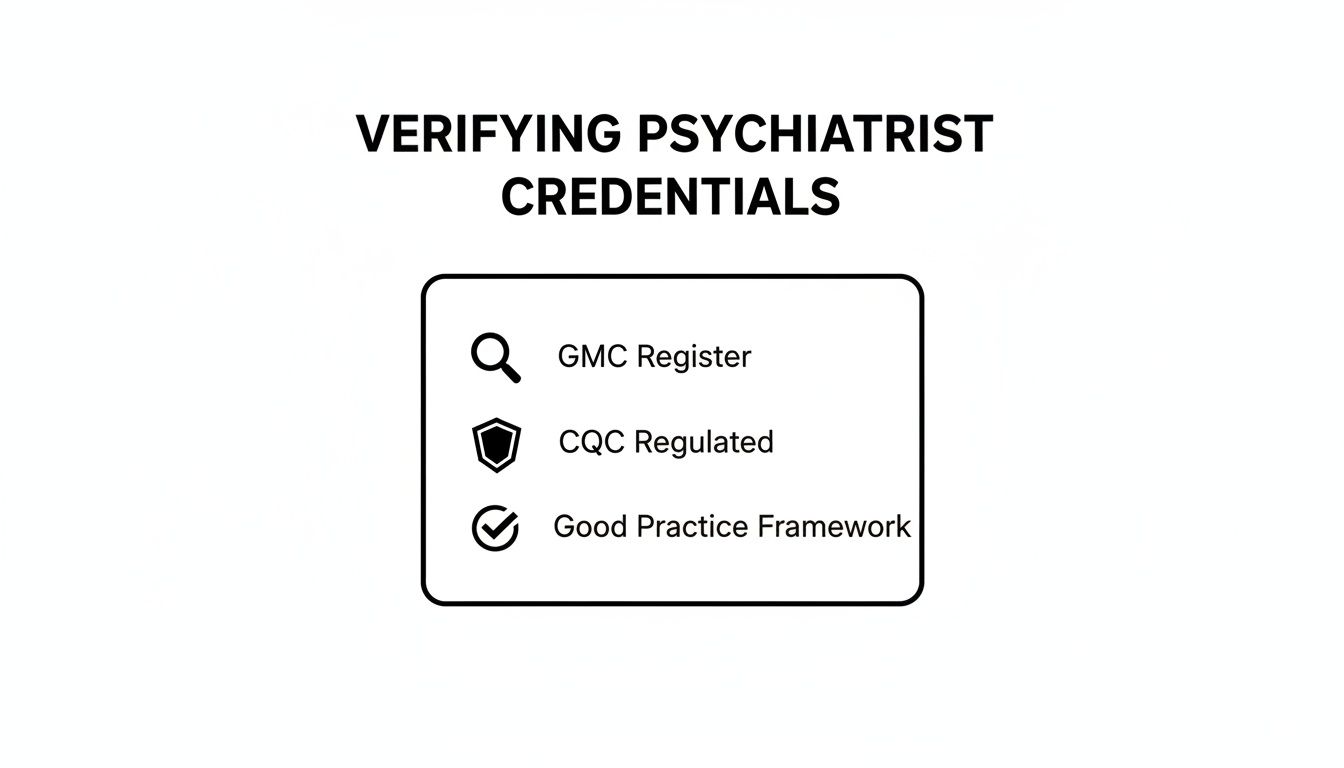
As this guide shows, checking for GMC registration and CQC regulation is non-negotiable. It's your baseline for ensuring you're in safe, professional hands, whether you meet online or off.
Making the Right Choice for You
Let's break down the practical differences to help you decide which route feels right.
| Feature | Online Consultation | In-Person Consultation |
|---|---|---|
| Convenience | No travel needed; attend from anywhere. | Requires travel to and from the clinic. |
| Accessibility | Ideal for those in remote areas or with mobility issues. | Limited by geographical location and physical access. |
| Comfort | Familiar, low-stress environment (your home). | Can feel more formal; some find this reassuring. |
| Scheduling | More flexible, easier to fit into a busy day. | Less flexible; requires a larger time block for travel. |
| Rapport | Effective, but can miss some non-verbal cues. | Allows for direct observation of body language. |
| Speed | Often has shorter waiting times for an appointment. | Can involve longer waiting lists for local specialists. |
There really is no "best" option here—only what's best for you and your mental health needs. Think about your own circumstances.
- Accessibility: Do you live miles from the nearest specialist clinic or have mobility challenges?
- Comfort: Do you feel more at ease at home, or do you prefer the focus of a clinical setting?
- Schedule: Can you realistically block out half a day for travel and an appointment?
- Urgency: How quickly do you need answers about your ADHD or Autism? Online services can often get you in sooner.
With projections suggesting over 50% of UK workers may struggle with their mental health by 2025, the demand for timely support is critical. The associated costs to employers are already estimated at £53-£56 billion annually. Fast-track services like ours, which can schedule an assessment within seven working days, provide a vital solution for people who simply can't afford to wait. You can explore how these figures impact the UK workforce on Statista.
If the flexibility of a remote consultation sounds like it might be a good fit, it’s worth exploring the details of an online mental health assessment to see if the process aligns with what you’re looking for.
Preparing for Your First Appointment
The best consultations start long before you step into the clinic or join a video call. Getting organised beforehand isn't just about efficiency; it's about taking an active role in your own mental health journey. This is particularly vital when you're seeking an assessment for conditions like Autism or ADHD, where the nuances of your life experience are absolutely key.
Putting in a little time upfront to gather your thoughts can massively cut down on appointment-day anxiety. It means you won't forget crucial points and can focus on the conversation itself, rather than trying to recall important details on the spot.
What to Bring to Your Appointment
Think of this as pulling together a brief personal file. Having all the relevant information to hand helps the psychiatrist get a full, clear picture of your mental health and the specific challenges you're dealing with. It’s a simple step that saves time and lets them focus on what truly matters for your ADHD or Autism assessment.
Here’s a quick checklist of what you should aim to have with you:
- Your GP Referral Letter: If you have one, it gives the psychiatrist valuable background and context.
- Previous Assessments: School reports (especially teacher comments), or reports from educational psychologists, therapists, or other specialists are all helpful, even if they're from your school days.
- Current Medications: A simple list of everything you're currently taking, including dosages and the reason for each one.
- Family History: A few notes on any known mental health or neurodevelopmental conditions in your immediate family, especially things like ADHD or Autism.
Beyond the paperwork, it’s incredibly useful to jot down your own observations. For instance, if you think you might have ADHD, write down specific examples of how you lose focus at work or struggle to manage everyday chores. For suspected Autism, note down experiences with social situations or sensory sensitivities. These real-life scenarios are gold dust for a diagnostician.
Your job isn't to diagnose yourself, but to give the specialist the raw information they need to do their job. Your lived experience is the most important piece of the puzzle, so sharing concrete examples gives them the clearest possible view of what you're going through.
Key Questions to Ask Your Psychiatrist
Your first appointment is a two-way conversation. You're interviewing them just as much as they're assessing you. Asking the right questions helps you gauge their approach and confirm they’re the right person for you, especially when you need to find a psychiatrist with a deep understanding of neurodiversity and mental health.
Think about having a few of these questions ready to go:
- Experience with Adults: "Could you tell me about your specific experience diagnosing ADHD and/or Autism in adults, especially when symptoms might not be 'textbook'?"
- The Assessment Process: "Can you walk me through what your assessment process looks like for ADHD or Autism? What kind of tools or methods do you use?"
- Involving Others: "Do you usually involve a partner or family member to get another perspective during the assessment?"
- Follow-Up Care: "If I am diagnosed, what happens next? How do you handle treatment plans, including both medication and therapy options?"
- The Report: "What sort of report will I get at the end of this? Will it include practical recommendations I can use at work or home?"
Coming prepared with questions like these shows you're engaged in the process and helps you build a strong, collaborative relationship with your mental health professional right from the start.
What to Expect: Costs, Timelines, and What Comes Next
Before you commit, it’s worth getting a clear picture of what going private for psychiatric support actually involves. Understanding the costs and how long things might take can save a lot of stress, especially when you’re already navigating the mental health challenges of a condition like ADHD or Autism.
The costs aren't just one lump sum. Think of it in stages. First, there's the initial comprehensive assessment, where the psychiatrist really gets to know you, your history, and your current struggles. From there, they'll produce a detailed diagnostic report. This document is crucial—not just for your own mental health journey, but for things like getting support at work.
Breaking Down the Fees and Timescales
When you're dealing with something like ADHD, the journey doesn't stop at the diagnosis. You'll likely need ongoing support, which means follow-up appointments and potentially medication titration. That’s just the clinical term for the process of carefully finding the right medication and dosage that works for you, and it requires regular check-ins with your specialist.
So, when you're budgeting, you’ll typically be looking at:
- Initial Assessment Fee: A one-off charge for that first in-depth consultation for Autism or ADHD.
- Report Fee: Sometimes this is bundled, but often it’s a separate cost for writing up the detailed medical report.
- Follow-Up Appointments: These are charged per session for managing your treatment plan.
- Prescription Fees: The actual cost of any medication prescribed, which you'll pay at the pharmacy.
One of the biggest draws of the private sector is speed. We all know NHS waiting lists for mental health services can be incredibly long. With a private service, it’s not unusual to get an initial assessment booked within just a few working days. After that, you could have a full diagnostic report in your hands within another week.
Frankly, the speed and clarity are game-changers. Getting a diagnosis and a solid report in a matter of weeks, instead of waiting months or even years, means you can start getting the right mental health support and moving forward with your life almost immediately.
Life After a Diagnosis
Getting a diagnosis for ADHD or Autism is a huge moment, but it’s really just the beginning of a new chapter in your mental health journey. That diagnostic report is more than a label; it’s a powerful, practical tool. It forms the basis of your personalised treatment plan, which could involve anything from therapy and coaching to medication.
It's also the official document you’ll need to ask for reasonable adjustments at work or university. These are small changes that can make a massive difference, like getting flexible working hours or being provided with specific software. Walking into a meeting with your manager or tutor with a professional medical report makes that conversation far more straightforward and effective.
Common Questions Answered
Do I really need a GP referral to see a private psychiatrist?
That's a common question, and the short answer is no, you often don't. One of the biggest advantages of going private for mental health support is the ability to self-refer. You can bypass the long NHS queues and directly contact a specialist clinic for an ADHD or Autism assessment.
While you don't need a referral, it’s still a good idea to keep your GP in the loop. It just helps ensure everyone involved in your healthcare is on the same page, which is always best for your long-term care. But for getting that initial assessment, going direct is usually a much quicker path to getting seen.
What's the real difference between a psychiatrist and a psychologist?
It’s easy to get these two mixed up, but their roles in mental health are quite distinct. Think of it this way: a psychiatrist is a medical doctor who has gone on to specialise in mental health. Because they're doctors, they can diagnose conditions like ADHD and Autism, prescribe medication if it's needed, and also recommend different types of therapy.
A psychologist, on the other hand, focuses on psychological therapies and assessments – think talking therapies like CBT. They are experts in understanding human behaviour but aren't medical doctors, so they can't prescribe medication.
Key Takeaway: If you're seeking a formal medical diagnosis for conditions like ADHD or Autism and want to explore medication as a treatment option, you absolutely need to see a psychiatrist.
For more general queries about patient services, you might also find answers on their general Frequently Asked Questions page.
At Insight Diagnostics Global, our consultant-led team provides clear, CQC-regulated assessments for adults with ADHD and Autism. Book a consultation and get the expert mental health support you need by visiting https://insightdiagnostics.co.uk.