Pursuing an autism diagnosis as an adult is a significant step, and it usually means choosing between the NHS or a private provider. The journey often begins with a growing realisation that certain traits and challenges you've faced might be more than just anxiety or ADHD, sparking a search for answers and official confirmation.
Understanding the Adult Autism Diagnosis Journey
If you've been wondering whether you might be autistic, the road to getting a formal diagnosis can seem overwhelming. Many adults arrive at this point after a lifetime of feeling 'different,' sometimes after receiving other diagnoses like anxiety, depression, or even ADHD. It's not uncommon for these to exist alongside autism, and the constant stress of navigating a world not built for your brain can significantly impact your mental health. Recognising this possibility is often the first real step forward.
Deciding to get an assessment is a profoundly personal choice. For most, it’s not about getting a label; it's about self-understanding. It’s about finally having a name for experiences you've lived with your whole life, which helps you understand your own needs, protect your mental health, and find the right kind of support.

The Reality of NHS Wait Times
Unfortunately, going through the NHS for an assessment can be a real test of patience. The system is struggling with immense demand. As of June 2025, the waiting list in England had ballooned to 236,225 people.
Even more concerning, official figures reveal that almost nine out of ten people (89%) on that list have been waiting longer than the 13-week standard recommended in the NICE guidelines. The average wait now stretches to over 17 months. These long delays, highlighted by organisations like the National Autistic Society, can be detrimental to mental health and push many people to consider their alternatives.
This is the central dilemma: the free, comprehensive service of the NHS versus the speed and directness of private care. This guide is designed to help you navigate that decision. To see what the alternative looks like, you can review the details of our private adult autism assessment process.
For so many adults, finally seeking an autism diagnosis is a moment of profound self-discovery. It’s about validating lifelong feelings that might have been brushed off as just social awkwardness, anxiety, or traits of ADHD.
This process is more than clinical—it's an emotional journey. It can be filled with uncertainty and hope, but it ultimately leads to clarity. Getting to grips with how both the NHS and private routes work is the best way to make a choice that feels right for you, your timeline, and your mental well-being.
NHS vs Private Autism Assessment At a Glance
To simplify the decision, here’s a quick comparison of the two main pathways for getting an adult autism diagnosis in the UK.
| Feature | NHS Pathway | Private Pathway |
|---|---|---|
| Cost | Free at the point of service. | Self-funded. Costs typically range from £1,500 to £3,000+. |
| Waiting Time | Extremely long. Often 1-3+ years from GP referral to assessment. | Much shorter. Typically a few weeks to a few months for an appointment. |
| Referral | Requires a GP referral to a local NHS mental health trust or specialist autism service. | Usually allows for self-referral, though a GP summary can be helpful. |
| Choice | Limited choice. You are referred to your local commissioned service, regardless of their specialisms. | Full choice of provider, allowing you to select a clinic or clinician based on expertise in autism, ADHD, and mental health. |
| Acceptance | Universally recognised by all UK public services (e.g., DWP for benefits, local authorities for support). | A good quality, NICE-compliant report is widely accepted, but some NHS services may be reluctant to act on it. |
Ultimately, the best path depends entirely on your personal circumstances. If cost is the primary barrier and you're able to wait, the NHS provides a thorough and recognised assessment. However, if you need answers sooner to support your mental health, access accommodations, or simply for your own peace of mind, the private route offers a much faster, more direct alternative.
Recognising the Signs in Your Own Life
The first step towards an autism diagnosis doesn't usually start in a doctor's office. It starts with you. It often begins with a quiet, nagging feeling that you're somehow different, that you've been playing life on a harder difficulty setting than everyone else.
This isn't about ticking boxes on some online quiz. It's about looking back over your life and seeing a pattern emerge from experiences you might have previously dismissed as just "quirks" or personal failings. Many adults come to this point after years of feeling misunderstood, often collecting other diagnoses like anxiety, depression, or even ADHD along the way. While these can certainly co-exist with autism, sometimes they’re the direct result of the mental strain of constantly trying to function in a world not designed for your brain.
Social and Sensory Overload
Think about how you feel after socialising. Is it just a bit tiring, or is it a bone-deep exhaustion that leaves you feeling completely depleted for days? This is often called 'autistic burnout', and it’s a core experience for many. That need to retreat into solitude after a team meeting or a family party isn't anti-social; it's a vital recovery process for your mental health.
This deep-seated exhaustion is often fuelled by a constant battle with your senses. Your daily environment can feel like an assault course:
- Does the buzz of fluorescent lights and the mishmash of office chatter make it impossible to focus?
- In a busy café, do you struggle to follow one conversation because your brain is trying to process the clatter of plates, the coffee machine, and three other conversations all at once?
- Are you particular about fabrics, cutting tags out of clothes, or avoiding certain textures that feel physically uncomfortable or even painful against your skin?
These aren't just preferences. They're real, tangible examples of sensory processing differences. Dealing with this kind of sensory onslaught day in and day out is incredibly draining and a common source of anxiety.
The Mask and a History of Misdiagnosis
For many of us, especially women, these autistic traits have been buried under a lifetime of practice. We learn to perform "normal." This is masking, or camouflaging—a conscious or unconscious effort to mimic the social behaviour of non-autistic people to blend in. It's forcing eye contact when it feels painful, rehearsing conversations in your head, and manually arranging your face into what you hope is the "right" expression.
Masking is like being an actor in a play where you're the only one who doesn't have the script. You can get through the scene, but it's utterly exhausting. The long-term cost is often a shaky sense of identity, chronic burnout, and poor mental health, which is frequently misread by doctors as just anxiety or depression.
This is a huge reason why so many girls and women fly under the radar. In the UK, boys and men are still 2.5 times more likely to receive an autism diagnosis. The diagnostic criteria were built around observations of young boys, meaning a whole different presentation of autism has been missed for decades. As a result, countless women reach middle age or beyond before they finally get the answers they need. A Northern Ireland Health report on autism prevalence highlights this ongoing disparity.
The Deep Dive of Special Interests
Finally, consider your passions. Do you have hobbies, or do you have worlds you dive into completely? For autistic people, these are often special interests—deep, focused, and intensely joyful pursuits.
We're not talking about a casual pastime. This is the kind of engagement where you can lose hours researching every detail of ancient Roman history, perfecting a skill in a video game, or cataloguing every type of moss in your local woods. This isn't a deficit; it's a superpower. This ability to hyperfocus, which is also a trait in ADHD, brings immense pleasure, structure, and a welcome escape from a world that can often feel chaotic and overwhelming.
If any of this sounds familiar, you're not alone. Our article on the signs of undiagnosed autism in adults goes into more detail. Trusting that feeling—that inkling that there’s more to your story—is the most important first step you can take.
Choosing Your Assessment Pathway
So, you've been doing some research and think you might be autistic. What’s next? The big decision you face in the UK is which route to take for a formal assessment: the NHS or a private provider. This isn't a small choice—it really comes down to your personal situation, how urgently you need answers for your mental health, and what your finances look like.
For many, the first port of call is their GP. This is how you start the process on the NHS, and the major benefit is that it’s free. The downside, however, is the waiting time. It’s no secret that the system is completely overwhelmed.
As more people learn about autism and conditions like ADHD, the demand for assessments has skyrocketed. The numbers paint a pretty stark picture. Between 1998 and 2018, autism diagnosis rates in the UK shot up by a reported 787%. As of September 2024, there were over 204,000 people in England with an open referral for suspected autism, and a massive 89% of them were waiting longer than the 13-week guideline set by NICE.
Navigating the NHS Route
If you decide to go through the NHS, your first step is booking an appointment with your GP. My advice? Go prepared. This isn’t the time for vague feelings; you need to clearly explain why you believe you are autistic.
Jot down a list of specific traits and real-life examples before you go. Think about things like:
- Difficulties you've had in social situations.
- Any sensory sensitivities (to light, sound, touch, or smell).
- How much you rely on routine and predictability.
- Your deep, focused special interests.
If you also suspect you might have ADHD, bring that up too. The symptoms often overlap, and a thorough assessment should really consider both. A good GP will refer you to a service that can assess for co-occurring conditions.
Assuming your GP agrees an assessment is the right next step, they'll refer you to a local specialist autism service or mental health trust. And then, you wait. In many parts of the country, that waiting list can be several years long, so you have to be prepared for that.
Exploring the Private Pathway
The main reason people choose to go private is simple: speed. Instead of being on a waiting list for years, you can often get an assessment within a few weeks or months. For anyone whose mental health is suffering because of the uncertainty, or for those who need a diagnosis to get support at work, this can be a game-changer.
Going private also puts you in the driver's seat. You get to research and choose a clinic or a particular clinician. Maybe you want someone who specialises in adult autism, has experience with co-occurring conditions like ADHD, or understands how autism and mental health intersect. You can find a service that feels right for you.
Of course, the elephant in the room is the cost. A private assessment is a significant financial commitment, and it’s important to be clear about what you’re paying for.
A private assessment isn't just about paying to skip the queue. It's an investment in timely clarity, specialist expertise, and a process that you have more control over, which can be invaluable for your mental health and well-being.
This flowchart is a great tool for thinking through some of the experiences that often lead people to seek a diagnosis in the first place, like burnout from masking your autistic traits.
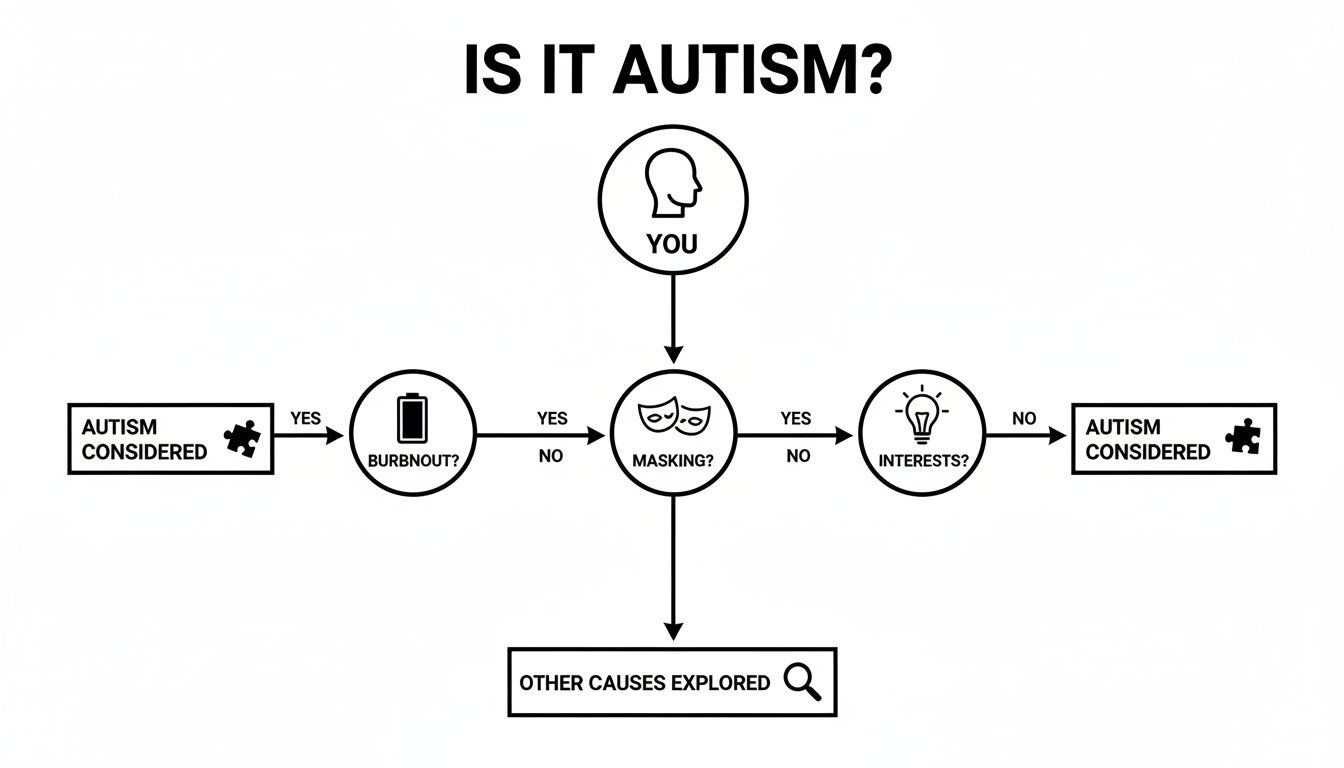
It really helps to see how these common autistic experiences, which are so often misunderstood, are actually key parts of the journey toward self-understanding.
The Rise of Online Assessments
The world of mental health support has changed a lot recently, and many reputable providers now offer full autism and ADHD assessments online. This is often done via telepsychiatry, and it’s a brilliant option for accessibility—no need to travel, and you can do it all from home.
But you have to be careful. A diagnosis is only as good as the clinician who gives it. To make sure you’re using a credible service, here’s what to look for:
- CQC Regulation: Check that the provider is regulated by the Care Quality Commission (CQC). This is the official body that ensures health services in England are safe and effective.
- GMC-Registered Specialists: The people doing the assessment must be psychiatrists or clinical psychologists listed on the General Medical Council (GMC) Specialist Register. This is your guarantee of their qualifications.
- NICE Compliance: The entire assessment process should follow the guidelines from the National Institute for Health and Care Excellence (NICE). This ensures it's thorough and meets national standards.
A diagnosis from a properly regulated online clinic is every bit as valid as one from an in-person assessment. Our guide on how to get tested for autism breaks down what a good, compliant assessment should involve. Weighing up the pros and cons of the NHS and private routes is the first real step on the path to getting the clarity you deserve.
Getting Ready for Your Autism Assessment
The thought of an assessment can be daunting, but a bit of preparation can make a world of difference. It’s less about passing a test and more about helping you organise your thoughts so you can give the clinician a clear, honest picture of your life.
Honestly, this process of self-reflection can be incredibly validating. You might start connecting dots from your past in ways you never have before, which can bring a real sense of clarity and control over the situation.
It's completely normal to feel anxious about this. As you prepare, looking into ways of how to calm anxiety naturally can be a great help in keeping things manageable.
Putting Your Personal History Together
Your first job is to start building a picture of your life through the lens of potential autistic traits. Don't stress if your childhood memories are a bit hazy—that's totally normal. Just start with what you know now and work your way back, jotting down specific examples as they pop into your head.
Try to think about these key areas:
- Social Communication: Can you recall times when small talk felt like a foreign language? Or when you took sarcasm literally and missed the joke everyone else got?
- Sensory Experiences: Make a list of your sensory sensitivities. Do you have to cut the tags out of all your clothes? Do certain background noises feel physically painful, or do you find bright lights overwhelming?
- Routines and Repetitive Behaviours: How important is your daily routine? What happens to your mood if it gets thrown off? Think about any repetitive movements you do, like fidgeting or rocking, especially when you're stressed or excited (this is often called stimming).
- Special Interests: What are you deeply passionate about? Write down what those interests are, how much time you pour into them, and the joy or calm they bring you.
- ADHD Overlap: Consider any challenges with focus, organisation, impulsivity, or restlessness. These are common in both autism and ADHD, so noting them down is important for a full picture.
This isn’t about listing your "flaws." It's about creating a rich tapestry of your lived experience, full of concrete examples.
The Importance of Collateral Information
Your own account is crucial, but an outside perspective adds another vital layer. Clinicians call this 'collateral information'—input from someone who knows you well and has seen you in different contexts. It’s a standard part of any robust assessment because it helps paint a fuller picture, especially of your early years.
Often, this person is a parent or an older sibling who can recall your childhood. But it could just as easily be a partner, spouse, or a close friend who has known you for years. They can fill in gaps you simply can't remember, like your developmental milestones or how you navigated school friendships.
Asking for this kind of help can feel exposing. It’s a good idea to frame it as part of your journey to understand yourself better. Let them know their honest memories are incredibly valuable for getting an accurate result.
Choose someone you trust completely—someone who will be supportive but also objective. Their input provides powerful evidence that strengthens the entire assessment process.
Understanding the Assessment Tools
Knowing what to expect on the day can take a huge amount of anxiety out of the equation. While every assessment is unique to the person, most clinicians use a combination of structured interviews and standardised diagnostic tools. You’ll almost certainly come across the ADOS-2 and the ADI-R.
- The ADOS-2 (Autism Diagnostic Observation Schedule, 2nd Edition): This is a series of activities and conversations designed to observe how you communicate and interact. For adults, it might involve looking at a picture book, creating a story, and chatting. It’s not a test you pass or fail; it’s just a way for the clinician to see your social and communication style in action.
- The ADI-R (Autism Diagnostic Interview-Revised): This is a very long, detailed interview about your early development. It's usually done with a parent or someone who knew you well before the age of five. The questions cover everything from your first words and early play habits to friendships and behaviour.
A good assessment for an adult will also screen for other conditions like ADHD and common mental health challenges, ensuring the final picture is complete and accurate.
Life After Your Diagnosis
Getting the results of your assessment is a huge moment. For so many people I've worked with, the diagnostic report isn't the end of the road; it's the beginning of a new way of understanding themselves and living with more intention. Think of this document as less of a label and more of a personalised user manual for your own brain. It can finally offer some clarity on past struggles and give you a practical path forward.
That moment can unleash a real mix of emotions. A huge sense of relief is incredibly common – that official validation that you weren't "broken" or "difficult" all these years, just autistic. But right alongside that, you might feel a pang of grief for the person you were, the one who had to navigate the world without this vital piece of self-knowledge. It’s important to give yourself the space to feel all of it. Every emotion is a valid part of the process.
What a Good Diagnostic Report Contains
First things first, your report should be a comprehensive, multi-page document. A flimsy, one-page summary just won't cut it. A high-quality report that meets NICE guidelines will give you a detailed breakdown of the entire assessment process. It’s your evidence and your toolkit, all in one.
It needs to clearly lay out a few key things:
- The Formal Diagnosis: A clear statement confirming whether you meet the diagnostic criteria for Autism Spectrum Disorder (ASD), usually referencing the DSM-5 or ICD-11. It should also address co-occurring conditions like ADHD if they were assessed.
- A Summary of Findings: This part should detail the evidence that led to the diagnosis, pulling from the clinical interview, your ADOS-2 observations, and information from your developmental history (ADI-R).
- Personalised Recommendations: This is, without a doubt, the most crucial part. It takes all the clinical information and translates it into practical, real-world advice that is tailored specifically to you and your mental health needs.
These recommendations are what will help you unlock real support. They give you the professional language and validation you need to start advocating for yourself effectively.
Turning Recommendations into Real-World Support
The real power of a diagnosis comes from using that information to build a life that actually fits you. The recommendations in your report become the solid foundation for seeking practical support and adjustments.
This is especially true at work. Under the Equality Act 2010, autism is considered a disability, which means you are legally entitled to reasonable adjustments. Your report is the evidence you need to back up these requests, which can make a world of difference to your well-being and job performance.
Let's say you struggle with sensory overload from a noisy, open-plan office. Your report can support a request to:
- Work from home a few days a week.
- Use noise-cancelling headphones without question.
- Be moved to a desk in a quieter corner of the office.
This isn't just about your job, either. The recommendations can guide you in managing other things you might be dealing with, like anxiety or ADHD. It's very common for autistic people to also have ADHD, and understanding how the two interact is key. Many of the strategies are helpful for both, and you can learn more in our guide to reasonable adjustments for ADHD.
Your diagnosis is not a definition of what you can't do. It is a powerful explanation for why some things are harder, giving you permission to find new, better ways of doing them.
The report might also point you towards specific therapies. For example, it could suggest Cognitive Behavioural Therapy (CBT) that has been adapted for autistic minds to help with anxiety, or sessions with an occupational therapist to build strategies for managing sensory input and executive dysfunction.
Building Your Life Post-Diagnosis
Armed with this new understanding, you can start making deliberate choices to create environments that support you instead of draining you. This might mean being more intentional with your social battery, scheduling proper downtime after big events, or finally letting yourself dive into your special interests without apology. It's about releasing that lifelong pressure to "fit in" and focusing on what you actually need to thrive.
Figuring out the next steps can feel like a big project. Taking some time to understand the available care services can be a really helpful part of mapping out your life post-diagnosis, connecting you with community and professional support systems.
Ultimately, getting an autism diagnosis as an adult is a profound act of self-advocacy. It’s about finally giving yourself the grace, the understanding, and the tools you’ve likely needed your whole life. It’s the official beginning of living more authentically, now that you have the knowledge to build a future that truly works for you.
Your Questions, Answered
Going through the process of an autism assessment as an adult brings up a lot of questions. It's completely normal to feel a bit uncertain. Here, I'll answer some of the most common things people ask, drawing on years of experience guiding adults through this very journey.
Can I Have Both Autism And ADHD?
Yes, you absolutely can. In fact, it's incredibly common for autism and ADHD to show up together. We see this all the time in our clinical work, and the research backs it up.
The tricky part is that some of the traits can look very similar on the surface. Things like challenges with executive function (planning, organising, starting tasks) or navigating social situations can be a big part of both autism and ADHD. That’s why it’s so important to have an assessment with a clinician who is deeply experienced in both. They'll be able to carefully untangle what's what and give you a clear picture of how these neurotypes present for you.
Is Self-Diagnosis Valid?
Self-identification is a powerful and, for many, a completely valid starting point. It often comes after months, or even years, of deep research, connecting with the stories of other autistic people, and finally seeing your own life experiences reflected back at you.
This process of self-discovery is incredibly valuable. It's the first step towards understanding yourself better and making changes to your life that genuinely support you and your mental health, with or without a piece of paper confirming it.
For many, that moment of self-realisation is everything. It's a way of validating your own history and can be hugely liberating, especially when you're stuck on a long waiting list or can't afford a private assessment.
It's worth remembering, though, that a formal diagnosis is the key to unlocking certain legal rights, like getting reasonable adjustments at work under the Equality Act 2010, and accessing specific support services.
What If I Don’t Get a Diagnosis?
It can be a real blow to be told you don't meet the criteria for autism, especially if you feel a strong connection to the autistic experience. It's okay to feel confused, disappointed, or even a bit lost if that happens.
A good clinician won't just say "no" and leave it at that. They should give you a comprehensive explanation of their reasoning. Often, the assessment process itself shines a light on other things that might be explaining your experiences. It might be that another neurotype or mental health condition is a better fit, such as:
- ADHD might turn out to be the primary driver of your challenges.
- Complex Post-Traumatic Stress Disorder (C-PTSD), which has a surprising amount of overlap with autistic traits.
- Social Anxiety Disorder, which can make socialising feel impossible.
- Other mental health conditions like depression or anxiety disorders can sometimes present in similar ways.
No matter the outcome, the diagnostic report should provide you with personalised insights and recommendations based on your unique profile. This is still incredibly valuable information that can point you towards the right support for you. And if you have serious doubts about the conclusion, you always have the right to seek a second opinion from a different specialist.
Will a Diagnosis Affect My Mental Health?
For most adults, getting an autism diagnosis is a profoundly positive turning point for their mental health. The overwhelming feeling is usually one of relief. It's the "aha!" moment that finally makes sense of a lifetime of feeling out of step with the world. This new understanding can lift a huge weight, helping to reduce anxiety and depression as you reframe past struggles not as personal failures, but simply as a neurodivergent person trying to navigate a neurotypical world.
That said, the time just after a diagnosis can be complex. Some people go through a kind of grieving process for the past and the support they wish they'd had sooner. It's an adjustment period, but ultimately, it empowers you to advocate for yourself, drop the exhausting mask, and build a more authentic life. In the long run, that almost always leads to a greater sense of well-being.
At Insight Diagnostics Global, we're here to provide clear, comprehensive, and compassionate online assessments for adults seeking answers. Our CQC-regulated service is run by GMC-registered specialists who truly understand the nuances of adult autism, ADHD, and co-occurring mental health conditions. If you're ready to take the next step towards self-understanding, we're here to support you.
Find out more about our services at https://insightdiagnostics.co.uk.